Trisomy 21, Down’s Syndrome, is a chromosomal abnormality caused by extra chromosome 21 material. This can be due to non-dysjunction (95%), mosaicism (3%), or translocation (2%).Reference Leshin1 The incidence of trisomy 21 is 1 in 800 live births.Reference Benke, Carver and Donahue2 It is the most common pattern of malformation in man.Reference Jones3 Advanced maternal age is a well-known risk factor (usually the non-dysjunction type). The risk increases from 1/1600 at the age of 20 to 1/370 at the age of 35, and to 1/50 above the age of 45 years.Reference Benke, Carver and Donahue2–Reference Huret and Sinet4
Up to 50% of patients with trisomy 21 may have cardiac malformations compared with 0.8% of the general population.Reference Park5, 6 This contributes to increased morbidity and a decreased life expectancy for these children. In a study by Hayes et al, congenital cardiac defects reduced survival rate to 72% and complete atrioventricular septal defect (the lesion with the worst prognosis) reduced survival rate to 58% at 10 years of age.Reference Hayes, Johnson and Thornton7
The most common cardiac lesions in trisomy 21 include; atrioventricular septal defects (43%) in the United States of America, ventricular septal defects (43.6%) in China, isolated ventricular septal defects (28.6%) in Malta and patent arterial duct (28.6%) in Guatemala.Reference Park, Matthews, Zuberbuhler, Rowe, Neches and Lennox8–Reference Vida, Barnoya, Larrazabal, de Maria Garcia and Castaneda11 Complications from the presence of these cardiac lesions especially those causing left to right shunts include congestive cardiac failure, recurrent bronchopneumonia and pulmonary hypertension.Reference Park5 It is therefore recommended that surgical intervention should occur between 3 and 8 months of age before pulmonary vascular disease becomes apparent.Reference Park5
In a study by Matthew et al (1991), 47 patients with trisomy 21 who had a definitive cardiac diagnosis were followed between 1951 and 1989. Of the 18 patients who survived, 13 (72%) had surgery. On the other hand, of the 20 non-survivors, only 4 (20%) had surgery. Those who died in the non-surgical group died from congestive cardiac failure, pneumonia, and pulmonary vascular disease at a mean age of 8.4 years.Reference Matthew, Moodie, Sterba, Murphy, Rosenkranz and Homa12
In a country such as Jamaica where resources are severalfold more limited than in developed countries and where the majority of paediatric cardiac surgery is performed by visiting cardiothoracic surgeons once or twice per year, it can be assumed that children with trisomy 21 are not afforded as many opportunities at corrective surgery as they should. This study of the epidemiology of cardiac lesions in children with trisomy 21 is the first step towards examination of outcome of these children and the rates of access to corrective surgery for these children.
Methods
This was a retrospective descriptive study of all children with trisomy 21 presenting to the Bustamante Hospital for Children for cardiac evaluation who were born between January, 1995 and December, 2004.
Setting
The Bustamante Hospital for Children is a 253-bed paediatric multidisciplinary specialist hospital located in Kingston, Jamaica. It is the only stand-alone acute care paediatric hospital in the English speaking Caribbean. Patients are seen from birth to 12 years of age and are accepted on a 24-hour basis. Approximately 65,000 children are seen per year (68,000 in 2004), more than any other hospital in the island with about 1000 patients seen in the Cardiology clinic per year (1017 in 2004).13 Of this number 20% are new patients. In each clinic, held weekly, there are about 7 new patients and 25 follow-up patients seen. Echocardiograms are also done weekly and on an emergency basis; approximately 30 are done per week. Corrective cardiac surgery is primarily arranged through the Bustamante Hospital for Children in association with visiting cardiothoracic surgeons.
Study population
Patients were identified from the cardiac clinic register. All patients with a referral diagnosis of trisomy 21 and those who after referral for cardiac evaluation were found to have trisomy 21, using four or more features from Smith’s Recognisable Pattern of Human MalformationReference Jones3 were included, all children who after evaluation at the cardiac clinic were found not to have trisomy 21 were excluded. A total of 76 patients were identified and of this number 71 charts were located. For the five patients for whom hospital records were not located, supplemental information was obtained from the cardiac clinic registry and for one patient the preoperative summary was also utilised. Data were extracted from the patient records using a data extraction sheet. The Ministry of Health Jamaica Ethics Committee granted approval for this study to be conducted.
Data analysis
Continuous variables were expressed as means and compared by the independent student’s t-test. Categorical variables were analysed using the χ2 test with α significance taken at 5%. Data were analysed using the SPSS version 12.0 for Windows software.
Results
A total of 76 patients were enrolled in the study, 30 (40%) males and 46 (60%) females; among these 110 cardiac lesions were detected. A total of 20 (26%) patients died, 48 (63%) survived, and for 8 (11%) the status was unknown. Maternal age ranged from 18 to 46 years with a median age of 35.5 years; the modal maternal age however was 42 years.
Of the 76 patients 26 (42%) were diagnosed clinically with trisomy 21 at birth, 31 (51%) were diagnosed by 1 month of age, 38 (62%) by 2 months and 53 (87%) by 6 months of age. At 1 month of age, 18 (27%) patients had been diagnosed with cardiac disease, but only 6 (9%) had been seen by the cardiologist; at 2 months cardiac disease had been detected clinically in 29 (43%) patients, but only 12 (17%) of the patients had been evaluated by the cardiologist. At 6 months 46 (69%) patients had been diagnosed with cardiac disease, but only 37 (52%) had made contact with the cardiologist; after 1 year of age as many as 16 (23%) patients were seen by the cardiologist for the first time.
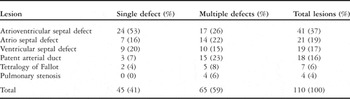
At presentation, 33 (46%) patients had cardiac complications; of these 30 (91%) had congestive cardiac failure, 10 (30%) had pneumonia, and 5 (15%) clinically had evidence of systemic pulmonary arterial pressures as demonstrated by a loud pulmonary component (P2) of the second heart sound. From echocardiography, 45 (59%) patients had single cardiac lesions, 28 (37%) had 2 lesions, and 3 (4%) patients had 3 lesions. Of the cardiovascular malformations, the most common lesion was the atrioventricular septal defect that accounted for 41 (37%) of all the lesions and occurred as a single defect in 24 (53%) of the patients, see Table 1.
Distribution of the cardiac lesions seen in children with trisomy 21 at the Bustamante Hospital for Children 1995–2004.

Pulmonary stenosis was present in four (5%) patients and it never occurred as a single defect. The most commonly occurring multiple defects were the atrioventricular septal defect together with secundum atrial septal defect, which was seen in six (8%) patients. This was followed by the atrioventricular septal defect and the patent arterial duct along with the ventricular septal defect and the patent arterial duct combination, which occurred in five (7%) patients each.
Cardiac catheterisation was recommended for 40 (53%) patients but only 9 (23%) of them had the procedure done. The age of catheterisation ranged from 5 months to 4 years with a mean (standard deviation) age of 2 (1.1) years. Surgery was recommended for 60 (83%) patients. In those for whom surgery was not recommended 50% clinically had evidence of systemic pulmonary arterial pressures as demonstrated by a loud pulmonary component (P2) of the second heart sound, lessening of their signs of cardiac failure and decreased vascular markings in the periphery of the lung fields on Chest X-ray. These patients also had decreased oxygen saturations in room air. Of the 60 patients that were recommended for surgery, six (10%) had procedures done. Of the six patients who were operated on, four (67%) of them had surgery done by local surgeons and two (33%) had surgery done overseas. The predominant lesion repaired locally was the patent arterial duct; all four patients had a patent arterial duct, two of whom had it in combination with a ventricular septal defect. The two patients who had surgery overseas had correction of their atrioventricular septal defects. No patient in this study had surgery performed by any of the visiting cardiothoracic teams. The mean (standard deviation) age of surgery was 2.4 (1.1) years. One patient developed a pneumothorax postoperatively and no patient had a reoperation.
At the time of the study, 26 (35%) patients clinically had evidence of systemic pulmonary arterial pressures as demonstrated by a loud pulmonary component (P2) of the second heart sound, lessening of their signs of cardiac failure and decreased vascular markings in the periphery of the lung fields on Chest X-ray. A total of 21 (28%) patients developed this while awaiting an opportunity for surgery, mean (standard deviation) length of time 48.5 (28.5) months. Also 41 (57%) patients had congestive cardiac failure compared with 30 (42%) at presentation and 16 (21%) patients had evidence of recurrent pneumonias.
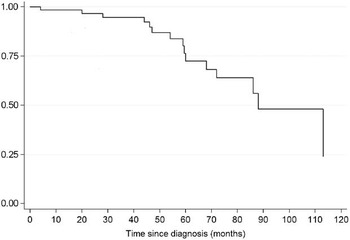
A total of 7 (9%) patients had a period of default, returning to the clinic more than 1 year after their last scheduled appointment, while 29 (38%) patients were lost to follow-up. A total of 20 (26%) patients died, 5 (25%) males and 15 (75%) females; of these 6 (30%) were in congestive cardiac failure at the time of demise, 1 (5%) each had infective endocarditis and purulent peritonitis and for 12 (60%) patients, the cause of death was unknown. Figure 1 shows the Kaplan–Meier survival curve for the study patients, the median survival time was 88 months (7.3 years). The age of presentation was not found to significantly affect outcome. Analyses using the two sample log rank test to compare survival experiences showed no statistically significant difference in survival between patients with the atrioventricular septal defect and those without this defect, patients who had systemic pulmonary arterial pressures and those who did not and patients who presented with congestive cardiac failure and those who did not.
Survival analysis of children with trisomy 21, who have congenital cardiac lesions seen at the Bustamante Hospital for Children.

Discussion
The atrioventricular septal defect was clearly demonstrated as the defect that was most prevalent accounting for 53% of single defects and 37% of all defects seen in the population investigated. This is in keeping with results reported in Caucasian and Indian populations.Reference Park5, Reference Parvathy, Balakrishnan, Ranjith, Saldanha, Sai and Vakamudi14 The atrial septal defect was seen in 19% of the patients occurring as the second most prevalent defect. This differs from previous series where the atrial septal defect was reported as the third most prevalent lesion.Reference Park5, Reference Lo, Leung, Lau and Yeung9, Reference Parvathy, Balakrishnan, Ranjith, Saldanha, Sai and Vakamudi14 However, the distribution of cardiac defects found in this study closely mimics that reported by Jaiyesimi et al for Omani Arab children.Reference Jaiyesimi and Baichoo15
From the data given in this study, only a small number of patients received surgical repair. Only 10% of the patients recommended for surgery had corrective procedures, one third of these went overseas. The defects that are routinely repaired locally are the atrial septal defect, the ventricular septal defect, and the patent arterial duct. These defects occurred in one third of the patients, alone or in combination. Five of these patients were not recommended for surgery because they had small defects. If surgery was routinely offered to children with trisomy 21 that had these defects one would expect closer to 33% of the patients to have received surgery locally compared with the 6% of patients that did have surgery.
There was a high percentage of patients who developed cardiac failure (15%), who had evidence of systemic pulmonary arterial pressures (26%) and who died (26%). This morbidity and mortality seen can be directly attributed to the fact that minimal surgical intervention was offered and medical management was the mainstay of treatment. For those who received surgery, this intervention was usually in the third year of life, which is extremely late for these patients.
The age of presentation was clearly documented as not having any effect on the outcome of the patients. A total of 69% of the children were clinically diagnosed with cardiac lesions by 6 months of age, but this did not result in an improved survival advantage over those who presented at a later age. Possibly the single most important factor that was responsible for this was the lack of surgical intervention. If children with trisomy 21, who have cardiac lesions, are not offered corrective surgery in a timely manner, it makes no difference what age they present at since the outcome, congestive cardiac failure, pulmonary vascular disease or death, will ultimately be the same. In addition, although the clinical diagnoses of trisomy 21 and cardiac disease were made in more than half the patients before 6 months, the numbers presenting to the cardiologist were not commensurate with the rate of detection. At 1 year, a high percentage of patients were still presenting to the cardiologist for the first time.
Several factors affect the accessibility of cardiac evaluation and surgical intervention in children with trisomy 21 in Jamaica. The sole practising paediatric cardiologist in the public health service operates out of the Bustamante Hospital for Children in the capital Kingston, thus a large percentage of the children with cardiac lesions from across Jamaica are primarily referred to the Bustamante Hospital for Children for evaluation. As the cardiology service is operated by one cardiologist this can result in delays in patients being evaluated. Some children with cardiac lesions are also evaluated at the University Hospital of the West Indies, which is located in Kingston. Therefore, for children living in rural areas there can be limitations to accessing appropriate cardiology services due to financial and geographical constraints.
The paediatric service in Jamaica on a whole receives invaluable assistance from visiting paediatric cardiothoracic teams from the United Kingdom and the United States of America. However, there is always a large pool of patients with no chromosomal abnormalities that require intervention, making it extremely difficult for children with trisomy 21 to receive corrective surgery. During the study period no child with trisomy 21 received surgery from the visiting teams. In addition, there was no paediatric cardiothoracic surgeon assigned specifically to the Bustamante Hospital for Children and there was the absence of a functional paediatric cardiothoracic operating theatre dedicated to cardiothoracic surgery. As such, though surgeries can be done locally there is a significant backlog of patients due to the marked inaccessibility of this critical service to the paediatric population and difficulties in accessing important investigations such as cardiac catheterisations.
Another cause for concern highlighted in this study is the fact that more than one third of the patients were lost to follow-up. This is important because whether or not surgical intervention is offered to children with trisomy 21, who have cardiac defects they require long-term follow-up cardiac care. The fact that at the time of demise 30% of the patients were in congestive cardiac failure, highlights the fact that these children were receiving suboptimal medical management. Several factors could be contributing to this; availability and accessibility of the required medications and medical expertise as well as patient compliance with follow-up visits and accessing appropriate medical care.
This study has also highlighted the fact that the diagnosis of trisomy 21 for these children was made solely on a clinical basis; chromosomal testing was not performed in any of the children or their parents. At the time of the study these tests were not available locally and it was relatively costly for most Jamaicans to access these tests overseas. However, genetic testing is prudent as parents need genetic counselling, especially as it relates to recurrence risk, which only chromosomal analysis could definitively determine.
The modal maternal age was 42 years, 50% of the mothers were 35 years and older, these women ideally should receive prenatal counselling, screening tests, and chromosomal analysis if the screening tests are positive. This would allow for prenatal identification of infants with trisomy 21, and institution of protocols for the care of these infants from birth. This should include a cardiac evaluation, whether or not evidence of a cardiac lesion is clinically apparent. This will eliminate the lag time between diagnosis of trisomy 21, an underlying congenital cardiac lesion and presentation to the cardiologist shown in this study.
In addition, there is a need for increased medical expertise in the management of children with trisomy 21, who have cardiac lesions as well as increased availability and accessibility to the required medications. Parental education to improve knowledge about the disease and compliance with medical management and the provision of a parent support system are key issues that will also have to be addressed to improve the quality of life for children with trisomy 21 in Jamaica.
This study was limited by the fact that for 11% of the patients outcome was unknown, this in effect may affect the validity of the percentage survival as it relates to the entire population of these children with cardiac disease.
This study showed that in Jamaica the majority of children with trisomy 21 who had cardiac lesions were not offered surgical intervention and subsequently had a high morbidity and mortality. These findings have major implications for the prognosis of children with trisomy 21 in Jamaica as the most common cardiac defect found in this study, the atrioventricular septal defect, has been shown to decrease survival in these children.Reference Hayes, Johnson and Thornton7 Care of patients with trisomy 21 should aim to offer more operative intervention as well as a structured support network, which would greatly improve the outcome of these patients.