Introduction
In animals, prenatal energy deprivation leads to both growth retardation and adult disease,Reference Cottrell and Ozanne 1 but so does gestational energy overload.Reference Elahi, Cagampang and Mukhtar 2 Recently, low birthweight has been associated with non-alcoholic hepatic steatosis (fatty liver disease; FLD) in adulthood in human males.Reference Sandboge, Perala and Salonen 3 FLD (non-alcoholic) is an indicator of hepatic insulin resistance and the metabolic syndrome. Several liver enzymes indicate FLD; γ-glutamyl transferase (GGT) and alanine aminotransferase (ALT), specific markers of liver damage or function, have been most studied.Reference Fraser, Ebrahim, Davey Smith and Lawlor 4 These enzymes have been independently associated with several cardiovascular risk factors and outcomes, even when levels fall within the reference/normal range.Reference Xia, Yan and Lin 5 Other enzymes, such as aspartate transaminase (AST), are also elevated, though not exclusively, in FLD, and have been less studied.Reference Fraser, Ebrahim, Davey Smith and Lawlor 4
However, human studies of early life influences on liver enzymes are rare. Some studies have been conducted in children, generally finding reduced fetal growth associated increased risk.Reference Nobili, Marcellini and Marchesini 6 , Reference Anderson, Howe and Fraser 7 In adults, one study found a negative association between GGT and birthweight (not statistically significant).Reference Robertson and Benzeval 8 In addition, differences by sex have been reported, with at least one study suggesting an inverse association between birthweight and adult GGT/ALT in women, but potentially a direct association in men.Reference Fraser, Ebrahim, Ben-Shlomo, Davey Smith and Lawlor 9 , Reference Fraser, Ebrahim, Smith and Lawlor 10 Two studies have considered preterm birth (PTB): in the preterm birth and early life programming of adult health and disease (ESTER) study, Finnish adults who were born preterm had higher risk of fatty liver index [FLI; an index combining information on triglycerides, body mass index (BMI), GGT, and waist circumferenceReference Bedogni, Bellentani and Miglioli 11 ] >30, and to have higher overall ALT and AST levels, but no difference in GGT,Reference Sipola-Leppanen, Vaarasmaki and Tikanmaki 12 while a small Dutch study found that accelerated weight gain in infancy was associated with FLI, whereas birthweight and gestational age were not.Reference Breij, Kerkhof and Hokken-Koelega 13
The question of the relationship between birthweight and liver enzymes thus remains an open question, suggesting that further research is needed. Two opposing hypotheses could be put forth on the relationship between birthweight and adult FLD. The first is that those with a genetic or other consistent, lifetime propensity for increased adiposity would be larger at birth and have worse health as adults. The ‘thrifty phenotype’ hypothesis, on the other hand, indicates that prenatal undernutrition, normally indicated by lower birthweight, is associated with adult cardiovascular disease, possibly due to lasting alterations in energy metabolism.Reference Luo, Xiao and Nuyt 14 – Reference Hales and Barker 16 We hypothesized that indicators of reduced fetal growth will be associated with higher levels of liver enzymes and increased indicators of fatty liver in adulthood. In this paper, we examine whether the association between indicators of prenatal growth and health (birthweight and gestational age) predicts adult raised liver enzyme levels, both at a clinical level and within the normal range, and whether this relationship varies by sex. We consider these questions in two long-running studies of child and adult cardiovascular health: the Bogalusa Heart Study (BHS) and the Cardiovascular Risk in Young Finns (YF).
Methods
Study populations
The BHS is a long-running, community-based series of cross-sectional studies conducted in Bogalusa, LA. Data from this analysis were taken from three follow-up studies conducted between 1985 and 2002. Standardized protocols were used at each visit, with subjects instructed to fast. For subjects with multiple visits, data at the latest available measurement were used. Among 2598 participants aged 18 and older, 1950 had at least one liver enzyme measurement and one birth outcome measure; there were no differences in sex, race or BMI between those included and excluded, but the included participants tended to be younger (mean age 31.8 v. 33.6, P<0.01). After exclusions for pregnant women (n=21), multiple births (n=68), and those lacking fasting blood samples (n=62; some overlap among groups), 1803 observations were left for analysis. Participants were born between 1938 and 1987 (median year=1966).
The Cardiovascular Risk in YF study was officially started in 1980 to examine heart disease risk factors in children and adolescents.Reference Raitakari, Juonala and Ronnemaa 17 At baseline, participants were 3–18 years old (i.e. birth years between 1962 and 1977); follow-ups have been regularly conducted every 3–5 years since then, with the most recent in 2011. In total, 3571 participants had data on at least one birth outcome and one liver enzyme. Overall, loss to follow-up has been greater among men, older participants, and smokers.Reference Raitakari, Juonala and Ronnemaa 17 Liver enzymes were measured after 2001; among those who participated in at least one of those exams, whether a participant had liver enzymes measurements did not vary by sex or BMI, but did vary by age (mean age 31.3 v. 34.7, P<0.01).
Exposure measurement
For BHS, data had previously been linked with birth certificates to determine participants’ birthweight and gestational age.Reference Mzayek, Hassig and Sherwin 18 For YF, participants and their parents reported birthweight and gestational age at an early visit. Such reports, particularly by the mother, have been found to correlate well with clinical records.Reference Sou, Chen, Hsieh and Jeng 19 – Reference Hakim, Tielsch and See 22 Both absolute and relative measures of birthweight were examined. Low birthweight (LBW) was defined as birthweight <2500 g and macrosomia as birthweight >4000 g. Small-for-gestational-age (SGA) was defined as weight <10th percentile and large-for-gestational-age (LGA) as weight >90th percentile for gestation by sex with the study population used to define percentiles. For BHS, the included sample had only 7.9% SGA compared with the original sample used to construct the percentiles, implying that it may be somewhat lower-risk group. PTB was defined as birth <37 weeks’ gestation.
Outcome measurement
BHS
GGT and ALT levels were measured as part of a multiple chemistry profile (SMA20) by enzymatic procedures with the multichannel Olympus Au-5000 analyzer (Olympus, Lake Success, NY, USA). FLI was calculated by the method of Bedogni et al.,Reference Bedogni, Bellentani and Miglioli 11 incorporating GGT, BMI, triglycerides and waist circumference.
YF
Venous blood samples were drawn after an overnight fast and serum was separated, aliquoted, and stored at −70°C until analysis. From the samples taken in study year 2011, GGT, ALT and AST concentrations were measured by enzymatic methods (GGT, ALT, AST, Glucose, Cholesterol and Triglycerides System Reagent, Beckman Coulter Biomedical, O’Callaghan’s Mills, Ireland) on an automatic analyzer (AU400, Olympus, Tokyo, Japan) at the laboratory of the Department of Chronic Disease Prevention, National Institute for Health and Welfare, Turku, Finland. From the samples taken in study year 2001, the GGT, ALT and AST concentrations were measured at the Department of Laboratory Medicine, Konventhospital Barmherzige Brueder Linz, Austria, on an ARCHITECT automated analyzer (Abbott Diagnostics, Abbott Parks, IL, USA). In addition, in the YF study, ultrasound imaging of the liver was performed in 2011 for 2546 study participants using a validated protocolReference Edens, van Ooijen and Post 23 and Sequoia 512 ultrasound mainframes (Acuson, Mountain View, CA, USA) with 4.0 MHz adult abdominal transducers. Evaluation of hepatic steatosis was performed according to liver-to-kidney contrast, parenchymal brightness, deep beam attenuation and bright vessel walls,Reference Saverymuttu, Joseph and Maxwell 24 and the presence of hepatic steatosis was assessed visually by a trained ultrasonographer. The participants were classified into probable fatty liver and normal liver groups.Reference Suomela, Oikonen and Virtanen 25 FLI was calculated as for BHS.
Covariate definitions
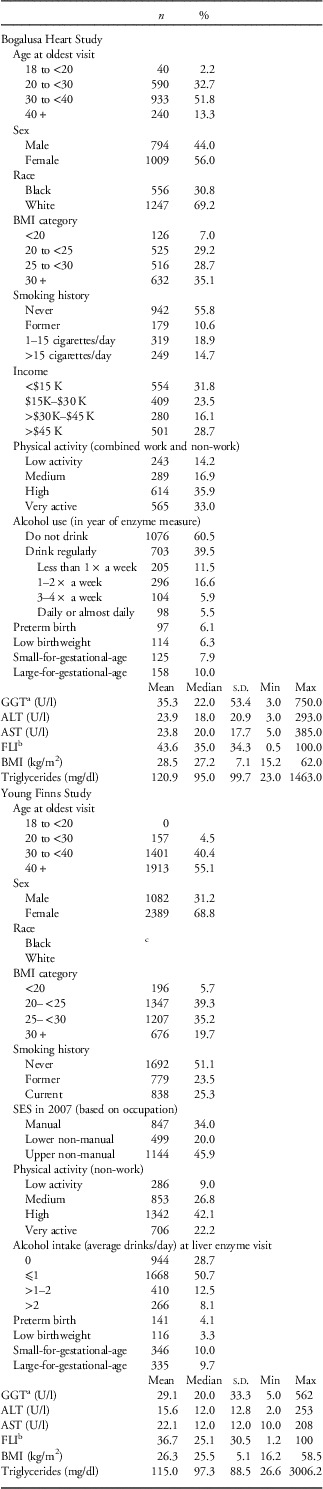
All covariates were measured at the time of the liver enzyme measurement and defined as listed in Table 1, unless otherwise specified.
Participants in the Bogalusa Heart Study, 1995–2002 (n=1803) and Cardiovascular Risk in Young Finns Study (2001–2011, n=3571)

BMI, body mass index; SES, socioeconomic status; GGT, γ-glutamyl transferase; ALT, alanine transaminase; AST, aspartase transaminase; FLI, fatty liver index.
a At oldest visit.
b FLI=(e0.953×ln(triglycerides)+0.139×BMI+0.718×ln(ggt)+0.053×waist circumference−15.745)/(1+e0.953×ln (triglycerides)0.139×BMI+0.718×loge (ggt)+0.053×waist circumference−15.745)×100.
c Race/ethnicity information was not collected as such in the Young Finns Study; however, the vast majority is White.
For BHS, physical activity was based on two questions, ranking physical activity at work and outside of work on a five-point scale. For YF, non-work physical activity was based on combined information on frequency, intensity and duration of physical exercise.Reference Raitakari, Porkka and Taimela 26
Modeling strategy
The study designs were thought to differ sufficiently that combining the data for analysis would not be appropriate; therefore, results are presented separately by study.
First, a dichotomous outcome with levels indicating possible clinical concern based on the literature (for men, GGT>68 U/l, ALT>59 U/l; for women, GGT>40 U/l, ALT>41 U/l;Reference Ceriotti, Henny and Queralto 27 for all, AST>34 U/l, FLI>=60Reference Bedogni, Bellentani and Miglioli 11 ) were examined using logistic regression; in addition, ultrasound fatty liver was examined for YF participants. Next, outcomes within the reference range (in order to examine higher risk individuals without clinical disease and to exclude those with clinically increased liver enzymes due to non-metabolic causesReference Patel, Srinivasan, Xu, Chen and Berenson 28 ) were examined (liver enzymes levels were log-transformed) using linear models. Generally, three sets of models were examined. The first was unadjusted. The second included covariates identified based on a directed acyclic graph (DAG) using the DAGitty program.Reference Textor, Hardt and Knuppel 29 The same covariates were included in each model: age, sex, race, smoking, alcohol use, education, income and physical activity. Depending on one’s causal model, adult BMI could be a confounder (if higher genetic propensity to be large leads to higher birthweight and higher adult BMI) or an intermediate (if intrauterine undernutrition leads to later adiposity)Reference Ong and Dunger 30 . In the first case, adjustment would be appropriate; in the second, it could in fact create a spurious association.Reference Tu, West, Ellison and Gilthorpe 31 The final set of models includes the BMI adjustment. Because of substantial missing data for some of the covariates, particularly income (3% for BHS), SES (30% in YF) and physical activity (5% for BHS, 10% for YF), multiple imputation was used (using SAS’s proc mi and proc mianalyze). Finally, interactions with sex was assessed by examining stratified analyses and the product term in multivariable models. For ease of presentation, SGA, LGA and PTB are presented in the tables; information on LBW and macrosomia is provided in the supplementary material.
As alcohol consumption is a common cause of FLD, a sensitivity analysis excluded heavy drinkers, defined in BHS as daily drinking or drinking five or more drinks at one time more than 1×/week in the past month reported at any exam (n=197, 11.0%) and in YF as reporting consuming six or more drinks at one time two or more times/month (n=736, 23.9%), at any visit. Results were very similar to those shown.
All participants gave informed consent and the BHS study was approved by the Institutional Review Board of Tulane University. The original YF study was approved by the local ethics committees.
Results
Participants in both studies were young adults; however, the YF sample was older at the time of measurement, leaner and had more favorable cardiovascular indicators than the BHS sample (Table 1). All liver enzyme measures were strongly correlated with each other, with BMI, and with lipid measures in both samples (Table S1). In all, 391 (15.4%) of the YF sample had indications of fatty liver on ultrasound.
BHS
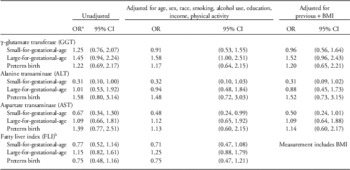
For the dichotomous outcomes (Table 2), birth measures were not strongly associated with high levels of liver enzymes, although there was a tendency for LGA to be associated with higher GGT (adjusted odds ratio (aOR) 1.58, 95% confidence interval (CI) 1.00–2.51; after adjustment for BMI, aOR 1.52, 0.96–2.43) and for SGA to be less likely to have high ALT (fully aOR 0.31, 95% CI 0.09–1.02). LBW was also associated with a reduced likelihood of being in the high FLI group (aOR 0.53, 0.33–0.85; Table S2).
Birth outcomes as predictors of clinically high levels of liver enzymes, the Bogalusa Heart Study (n=1803)

BMI, body mass index, OR, odds ratio, CI, confidence interval.
a Reference category for all models is all participants not categorized as ‘case’. Cut-offs for clinical concern: for men, GGT>68 U/l, ALT>59 U/l; for women, GGT>40 U/l, ALT>41 U/l;Reference Ceriotti, Henny and Queralto 27 for all, AST>34 U/l, FLI⩾60.Reference Bedogni, Bellentani and Miglioli 11
b FLI=(e0.953×ln(triglycerides)+0.139×BMI+0.718×ln(ggt)+0.053×waist circumference−15.745)/(1+e0.953×ln (triglycerides)+0.139×BMI+0.718×loge (ggt)+0.053×waist circumference−15.745)×100.
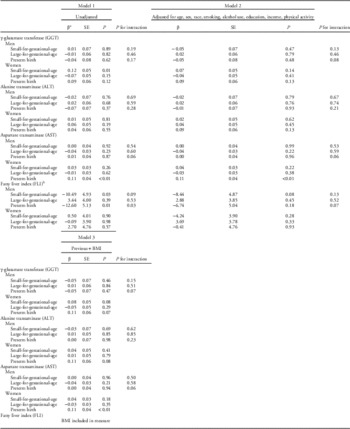
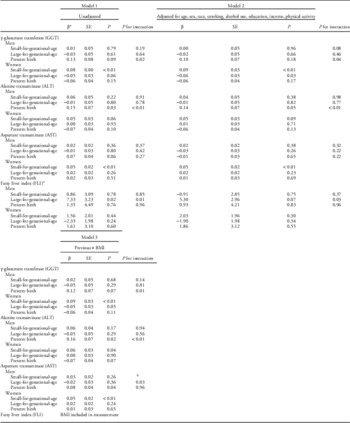
When liver enzymes were considered as a continuous outcome, some interactions were found between sex and the continuous outcome measures (Tables 3 and S3), so stratified results are provided. When BMI was adjusted for, LBW and PTB were associated with higher AST (among women only) and lower FLI (men only). Macrosomia was associated with lower GGT (women only) in some models.
Birth outcomes as predictors of continuous liver enzymes (log-transformed, within the normal range), with adjustment for confounders, the Bogalusa Heart Study

BMI, body mass index.
a Increase in outcome in those with and without the listed birth outcome.
b Not log-transformed.
Cardiovascular Risk in YF
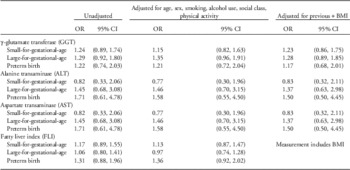
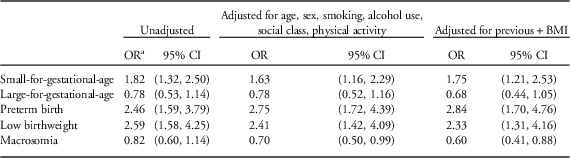
For dichotomous outcomes (Table 4), the strongest association was with LBW, associated with high GGT (aOR 1.68, 95% CI 1.02–2.76; adjusted for BMI, 1.65, 0.98–2.77) and FLI (1.98, 1.33–2.95) (Tables 4 and S4). For continuous markers (Table 5), at least one marker (LBW, PTB or SGA) was associated with higher GGT (SGA, women only), ALT (men and women), AST (stronger in women; Table 5) and higher FLI (women only; Table S5). At least one marker of increased growth was associated with lower GGT (stronger in women) and lower ALT (stronger in men). SGA, LBW and PTB were also associated with increased likelihood of probable fatty liver on ultrasound (Table 6).
Birth outcomes as predictors of clinically high levelsFootnote a of liver enzymes, Cardiovascular Risk in Young Finns Study (n=3571)

OR, odds ratio; CI, confidence interval.
a Reference category for all models is all participants not categorized as ‘case’. Cut-offs for clinical concern: for men, GGT>68, ALT>59; for women, GGT>40, ALT>41;Reference Ceriotti, Henny and Queralto 27 for all, AST>34, FLI⩾60.Reference Bedogni, Bellentani and Miglioli 11
Birth outcomes as predictors of continuous liver enzymes (log-transformed, within the normal range), Cardiovascular Risk in Young Finns Study

a Not log-transformed.
b Interaction model failed to converge.
Birth outcomes as predictors of probable fatty liver on ultrasound, the Cardiovascular Risk in Young Finns Study (n=2546)

OR, odds ratio; CI, confidence interval.
a Reference category for all models is all participants not categorized as ‘case’.
Discussion
The BHS data more strongly supported the idea that some individuals have higher relative weight and metabolic risk throughout their lifetimes: LGA was associated with high GGT, whereas SGA/LBW was associated with lower ALT and FLI in some analyses. High ALT in early-mid pregnancy was associated with LGA in one study.Reference Yarrington, Cantonwine, Seely, McElrath and Zera 32 The YF sample showed results more consistent with the thrifty phenotype hypothesis, with LBW/SGA associated with higher GGT, ALT and FLI, as well as probable fatty liver on ultrasound. Previous studies have found inverse associations between birthweight and the enzymes studied here, although the exact associations have varied by study.Reference Anderson, Howe and Fraser 7 , Reference Robertson and Benzeval 8 , Reference Fraser, Ebrahim, Smith and Lawlor 10 , Reference Cai, Cole, Haack, Butte and Comuzzie 33 Inverse associations (lower birthweight/higher liver enzymes) have been more commonly found in women,Reference Sandboge, Perala and Salonen 3 , Reference Fraser, Ebrahim, Ben-Shlomo, Davey Smith and Lawlor 9 , Reference Fraser, Ebrahim, Smith and Lawlor 10 which is mostly consistent with our data for GGT. The extent to which there are sex differences in developmental programming is unclear, with conflicting results in the relatively few studies available.Reference Dasinger and Alexander 34 Several studies have found the association between LBW and type 2 diabetes to be stronger in women,Reference Alexander, Henry Dasinger and Intapad 35 but the association between LBW and hypertension has sometimes been found to be stronger in men.Reference Dasinger and Alexander 34 However, birthweight could interact with sex-specific hormone systems; gene expression; diet, alcohol use or smoking; or growth patterns for differential effects, and animal studies of fetal programming have often found variation by sex.Reference Dasinger and Alexander 34 , Reference Gilbert and Nijland 36
We are not aware of another study that has examined PTB as a predictor of later ultrasound fatty liver, although women who enter pregnancy with fatty liver have been found to have a higher risk of PTB.Reference Hagstrom, Hoijer and Ludvigsson 37 Late PTB was associated with higher ALT, AST and FLI (though not GGT) values in another study;Reference Sipola-Leppanen, Vaarasmaki and Tikanmaki 12 the majority of the PTB in our study were late, but the mean differences in both of our cohorts are much smaller than found in this previous study. Another study found that accelerated weight gain in infancy was associated with FLI but LBW and gestational age were not, but this study was limited to a young adults born preterm.Reference Breij, Kerkhof and Hokken-Koelega 13
Support for the hypotheses that both low birthweight and high birthweight are associated with liver fat can be found in the animal literature. Higher-fat diets have been associated with both increased and decreased weight and corresponding adverse effects on the liver.Reference Elahi, Cagampang and Mukhtar 2 , Reference Aagaard-Tillery, Grove and Bishop 38 – Reference Dudley, Sloboda, Connor, Beltrand and Vickers 40 Some modelsReference McCurdy, Bishop and Williams 39 , Reference Knight, Pennell, Shah and Lye 41 indicate differential effects of prenatal diets on fetal outcomes in different strains, which suggests there may be variation by population or genetics. The study populations in this analysis were different in some ways, including race/ethnicity, but no clear risk factor (age, BMI, race) emerged as a cause for the difference. The analyses were repeated within the white portion of the BHS cohort, and results are more similar to black BHS participants than to the YF (data not shown). However, most of the associations had overlapping confidence intervals; the one exception is the opposite-direction associations between LBW/PTB and FLI in the two cohorts. Possible explanations for the difference include measurement error, or genetic, cultural, or life course differences between the populations. If, as has been suggested in some studies,Reference Breij, Kerkhof and Hokken-Koelega 13 , Reference Morrison, Duffield, Muhlhausler, Gentili and McMillen 42 catch-up growth is a stronger predictor of adult metabolic health than birthweight per se, it is possible that the postnatal growth patterns differ between the two cohorts.
Strengths of the study include the fairly large sample size and the ability to assess the study question in two different cohorts. This analysis incorporates large studies of young adults and includes a diverse, U.S.-based population, unlike previous research.Reference Sandboge, Perala and Salonen 3 , Reference Fraser, Ebrahim, Davey Smith and Lawlor 4 , Reference Fraser, Ebrahim, Ben-Shlomo, Davey Smith and Lawlor 9 , Reference Fraser, Ebrahim, Smith and Lawlor 10 Limitations include the lack of a direct assessment of some relevant covariates, such as liver fat concentrations, body fat mass and distribution, diet, and substance use, and the lack of standardization of the timing of the measures. A single outcome measure was used; liver enzymes have substantial variability and are raised in a number of clinical conditions.Reference Friedman 43 We cannot take into account hepatosteatosis due to hepatotoxic medication, and only a limited adjustment can be made for alcohol use (based on self-report), although a sensitivity analysis showed excluding heavy drinkers had little effect on the results (data not shown). Ultrasound is not a direct measurement of liver fat, although the echogenicity of the liver is an indicator of probable fatty deposition, and is used by most general medicine doctors. A large number of comparisons were made, so type 1 error is a possibility, particularly for interaction analyses. As in any study of birth outcomes and adult cardiovascular parameters, no mechanism can be directly demonstrated, and the possibility of unmeasured confounders is always a possibility. We do not have information on the specific causes of growth restriction or preterm birth, and so cannot distinguish between possible causes such as placental dysfunction and infection.Reference Goldenberg, Culhane, Iams and Romero 44 Pre-eclampsia is a cause of many medically indicated preterm births, and has been associated with many later metabolic changes.Reference Adams, Yeh, Bennett-Kunzier and Kinzler 45 Although adult adiposity can directly cause FLD, birthweight would not be a direct cause, and so the relationship would reflect an underlying nutritional, genetic or growth link between the two.
These results contribute to the literature on the relationship between birthweight and adult FLD, suggesting a physiological link between these characteristics. This analysis adds to the growing body of research suggesting intrauterine influences on adult cardiovascular health. It also, however, encourages consideration of population and genetic variation in these relationships.
Acknowledgements
The Bogalusa Heart Study is supported by NIH grants R01HL02942, HL15103, HD069587, HD32194, AG16592.
Financial Support
The YF Study has been financially supported by the Academy of Finland (grants 126925, 121584, 124282, 129378 (Salve), 117787 (Gendi), and 41071 (Skidi)); the Social Insurance Institution of Finland; Kuopio, Tampere and Turku University Hospital Medical Funds; Juho Vainio Foundation; Paavo Nurmi Foundation; Finnish Foundation of Cardiovascular Research; Finnish Cultural Foundation; and Yrjö Jahnsson Foundation.
Conflicts of Interest
None.
Ethical Standards
The authors assert that all procedures contributing to this work comply with the ethical standards of the United States and Finland and with the Helsinki Declaration of 1975, as revised in 2008. All participants gave informed consent and the BHS study was approved by the Institutional Review Board of Tulane University. The original YF study was approved by the local ethics committees.
Supplementary Material
To view supplementary material for this article, please visit https://doi.org/10.1017/S2040174416000635