


War can cause enormous strain on government finances. Over the course of World War II, for example, spending by the American government rose from 20% of gross domestic product to 53%. Not surprisingly, a rich literature has emphasized the crucial importance of states’ ability to pay for their wars (Bordo and White Reference Bordo and White1991; Brewer Reference Brewer1991; Kennedy Reference Kennedy1989; Rasler and Thompson Reference Rasler and Thompson1989). Remarkably, less attention has been paid to the question of how states choose one method of war finance over another. Adam Smith ([1776] Reference Smith and Edwin1904) argued that states would go to great lengths to avoid war taxes, assuming that borrowing would be the technique of first resort. Joseph Schumpeter ([1918] Reference Joseph1954, 7), in contrast, anticipated exactly the opposite.Footnote 1 In practice, we see remarkable variation in states’ war finance choices, suggesting that we can rely on neither intuition. Why, for example, did the United States levy a war tax to finance the Spanish-American War but not the Mexican-American War, which was a costlier conflict? Why has it chosen not to levy a war tax to finance wars in Afghanistan and Iraq? In short, what are the determinants of American war taxes?
In this article, we argue that key decisions about financing wars—in particular, whether to resort to war taxes—are the product of politics. The distributional consequences of war taxes are extraordinary, often enduring beyond the war itself. War finance is therefore a high-stakes political opportunity to advance the fiscal interests of core constituencies. This means that Republicans—and their predecessors, the Whigs and Federalists—were more likely to favor taxes early in the country's history, when the prevailing modes of taxation took the form of ad valorem tariffs and excise taxes that favored manufacturing interests, the Republican base. In contrast, Democrats tended to eschew taxes, because their support came from the South, an exporting region adversely affected by tariffs and excise taxes. After the Sixteenth Amendment made income taxes constitutional in 1913, taxation tended to mean income taxes: Then Democrats favored a progressive income tax because of the prominent place of labor in their political base, whereas Republicans, supported by businesses that opposed higher income taxes, tended to favor less expansive fiscal policies, including on war taxation. In short, because taxes redistribute income, partisanship helps determine whether leaders generate revenues through war taxes or alternatives.
The argument about partisanship and war finance fills a gap in three literatures: war finance, domestic politics and conflict, and tax policy. First, the literature related to war finance either assumes that leaders turn to taxation to meet the revenue needs of war (Levi Reference Levi1988; Reiter and Stam Reference Reiter and Stam2002; (Schumpeter [1918] Reference Schumpeter1954); Tilly Reference Tilly1990), or given the likely unpopularity and administrative difficulty of taxation (Slantchev Reference Slantchev2012; Smith [1776] Reference Smith and Edwin1904), they are more inclined to borrow; democratic regimes for which access to credit should make loans more forthcoming especially use the latter means of war finance (Schultz and Weingast Reference Schultz and Weingast2003). In addition to being unable to explain variation, this literature on war finance has also remained largely silent on how partisan preferences—and the redistributive interests behind them—may affect war finance strategies.Footnote 2
Second, to the extent that research on domestic politics and conflict has examined the role of partisanship, the focus has been on the recourse to force or to partisan rhetoric during crises abroad. Whereas Gowa (Reference Gowa1998, 307) finds that wars create “tacit partisan truces,” in which political elites refrain from using wars to fight partisan battles at home, Schultz (Reference Schultz1998) and Ramsay (Reference Ramsay2004) suggest that electoral opportunism gives opposition parties incentives to challenge the incumbent's foreign policy decisions. Thus, the literature presents diverging views about the effect of partisanship on foreign policy decisions and war onset. More importantly, questions about how partisanship affects other aspects of war, such as how states generate revenues for war, have gone unanswered.
Lastly, the literature on tax policy either disagrees about the role of partisanship or does not address wartime dynamics. Although a number of scholars refer to the division between Republicans and Democrats on free trade and protection (Bailey, Goldstein, and Weingast Reference Bailey, Goldstein and Weingast1997; Frieden Reference Frieden1997; Gourevitch Reference Gourevitch1977; Hansen Reference Hansen1990), others (Dryzek Reference Dryzek1996; Murray Reference Murray1978; Williams and Collins Reference Williams and Collins1997) argue that tax policy is not driven by politics but by structural constraints, such as macroeconomic business cycles. More importantly for this analysis, these studies do not consider wartime dynamics. Given the sheer magnitude of fiscal resources required and the evidence that politics may stop at the water's edge in other conflict-related issues such as war onset, partisan dynamics during wartime merits analysis.
Having outlined the argument and its contributions, the rest of this article proceeds as follows. First, it discusses the main ways in which states finance wars, laying out the theoretical tradeoffs between taxation and other ways of financing the costs of war and highlighting the way war taxation imposes a burden on the populace that is more direct and therefore potentially more politically costly than alternatives such as borrowing or increasing the money supply. Second, it develops an argument about why wars become opportunities for leaders to advance constituency interests and how the distributional consequences of taxation have informed partisan preferences on war taxes over time. Third, it presents three main sources of evidence to support the argument about partisan fiscal differences during wartime: a new dataset of American war taxes levied between 1789 and 2010, which we use to assess the role of presidential partisanship in war finance; an analysis of roll-call votes to test legislative partisanship; and a short case study of the Civil War to illustrate how partisan differences shaped the two sides’ approaches to war finance. It concludes with implications for the causes and consequences of war taxes.
WARS AND THE NEED FOR REVENUE
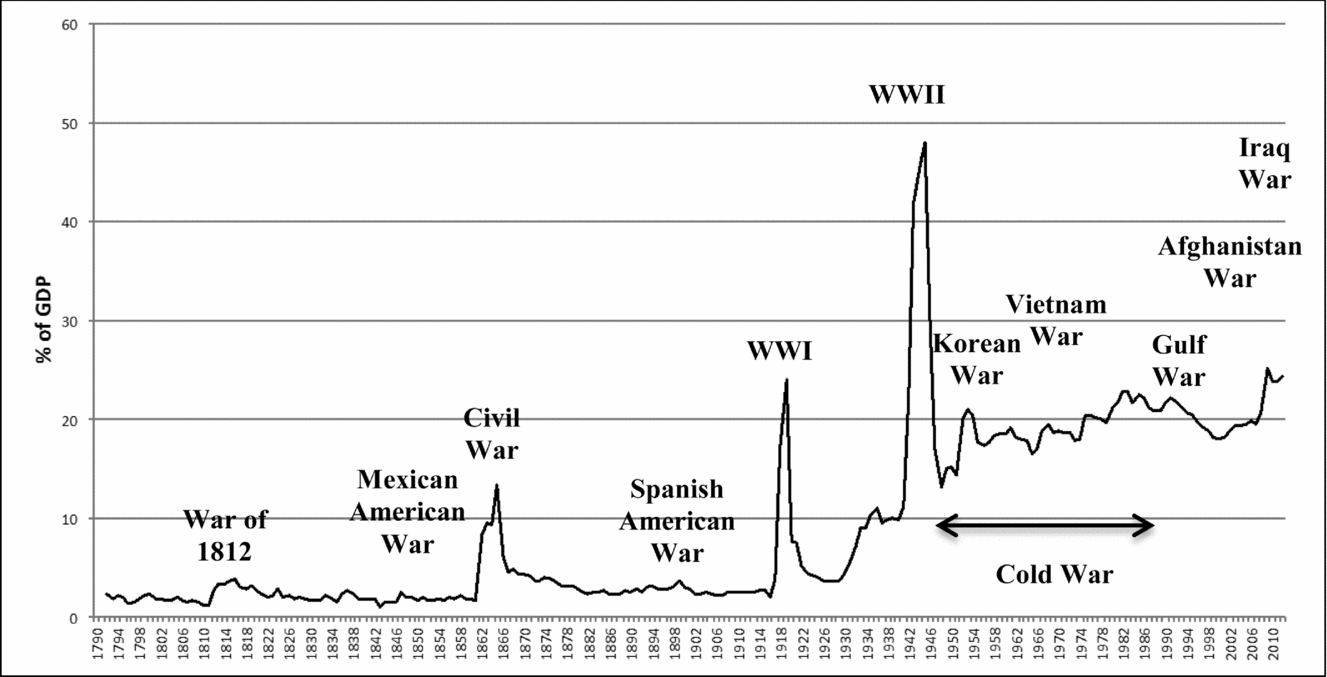
Analyses of government spending shocks invariably point to the impact of wars (Barro Reference Barro1981; Burnside, Eichenbaum, and Fisher Reference Burnside, Eichenbaum and Fisher2003; Ramey Reference Ramey2011). The reason is that wars tend to be characterized by large, urgent revenue needs compared to the smoother expenditures experienced during peacetime (Brownlee Reference Brownlee1996). Figure 1 makes this point graphically, mapping periods of war onto U.S. government expenditures since 1789 and showing the often massive increases in spending that accompany war. Scholars have made two conflicting claims about how states will tend to meet these revenue needs. Schumpeter ([1918] Reference Schumpeter1954) and later Tilly (Reference Tilly1990), Levi (Reference Levi1997), and Reiter and Stam (Reference Reiter and Stam2002) suggest that, because of the magnitude of a war's revenue needs, states inevitably rely on taxation to generate the resources needed to fight the war. This view is at odds with Smith, who argues that leaders would be deterred from raising taxes “for fear of offending the people who, by so great and so sudden an increase of taxes, would soon be disgusted with the war. . .the facility of borrowing delivers them from the embarrassment which this fear and inability would otherwise occasion” ([1776] 1904, 37). Borrowing is a way to avoid the potential political and indeed administrative costs associated with war taxation, explaining why it is a staple in states’ war finance portfolios (Slantchev Reference Slantchev2012).
U.S. Government Expenditures, 1789–2010
Source: Historical Statistics of the United States, Table Ea636–643: -Federal government expenditure, by major function: 1789–1970; Budget of the United States Government, Office of Management and Budget, 1962–2010.

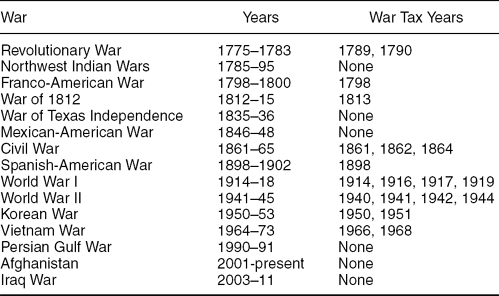
The history of war finance in the United States paints a complex picture that incorporates elements of both perspectives. Although in many cases the country has financed wars through increased extraction, Table 1 shows that the United States has sometimes relied exclusively on a combination of borrowing and increasing the money supply (Cappella 2012; Goldin 1980). As we argue in the next sections, Smith's assertion is consistent with the general way in which different forms of war finance confront the populace with the costs of war, but it does not capture the specific distributional consequences of taxes that explain why some leaders resort to war taxes while others pursue alternative forms of war finance.
U.S. Wars and War Taxes, 1789–2010
Sources: See Online Appendix.
Direct versus Indirect Methods of War Finance
States have generally financed the cost of wars in ways that affect the populace either directly—through taxes—or indirectly through borrowing or increasing the money supply (Rockoff Reference Rockoff and Harrison1998).Footnote 3 Whether the costs of war have direct or indirect effects on the public affects the potential political costs leaders face and thus their incentives for how to finance wars.
Tilly (Reference Tilly, Martin, Mehrotra and Prasad2009, xiii) has argued that taxation “constitutes the largest intervention of governments in their subjects’ private life, so much so that the history of state expansion becomes a history of violent struggles over taxes.” Taxes become a matter of struggle and coercion (Brennan and Buchanan Reference Brennan and Buchanan2006) because they represent “a permanent transfer of purchasing power by the taxpayer to the government” (Gilbert Reference Gilbert1970, 4).
Longitudinal studies of American public opinion point to the unpopularity of taxation. Between 1947 and 2010, the percentage of Americans who believed that their taxes were too high averaged 57.5%, compared to 37% who believed their taxes were about right and 2% who indicated that the levels were too low.Footnote 4 These findings suggest a general tendency for the overwhelming majority of Americans to favor either the status quo or reductions in the tax burden. Consistent with these trends, it is not surprising that a number of empirical studies have linked a leader's tax policy with punitive electoral consequences (Geys and Vermeir Reference Geys and Vermeir2008, 301–17; Rose Reference Rose1985). All things equal, an instrumental politician with a short time horizon might seek to avoid taxes.Footnote 5
The political costs associated with taxes are potentially even more relevant for leaders during wartime than peacetime. Not only might war taxes have adverse impacts on a leader's longevity but they can also affect support for the war itself. Suggesting this possibility, the Washington Post (“Big Tax Bill Passed” 1919) editorialized that World War I taxes “will bring daily, almost hourly, reminders to the people of the United States of the burden that is entailed in the prosecutions of a just and victorious war. The average citizen feels the effect of the war tax when he arises in the morning. . .he is reminded of it the last thing at night when he puts on his tax-assessed pajamas.” Daily reminders of the direct burden might taint the war itself; insofar as the “unfavorable public opinion environment ultimately constrains the range of politically acceptable policies for successfully concluding a military operation” (Larson and Savych Reference Larson and Savych2005, xvii), leaders might be justifiably cautious about drawing increased scrutiny and in turn unwanted constraints on the war effort. As one editorial summarized pithily at the beginning of World War I, “increased taxes are never a good political expedient” (Washington Post, 1914). All things being equal, leaders have incentives to finance the cost of war through measures that expose the populace less directly to the cost of conflict, such as borrowing or increasing the money supply.
Borrowing is politically expedient for two reasons. First, because borrowing reduces the need to impose higher tax rates, it can minimize the potential electoral consequences. Instead, it transfers the cost to a future cohort that does not affect the current leader's prospects of reelection. Second, wars are but one contribution to the debt, which means that, to the extent that the public is concerned with debt issues, the war will be a more diffuse target, because it sits alongside numerous other debt sources.
Debt repayment of American war expenses illustrates both points. For most wars, repayment is a decades-long process accompanied by many other changes that muddle the role of war finance policies. For example, the United States began to repay its World War I debt during the 1920s, a period of deflation that increased the real value of the debt. The 1930s further complicated the debt picture, as the gap between expenditures and revenues grew because of the Depression (Brown Reference Brown, Dornbusch and Draghi1990, 244). Rancorous political debates about how to pay down the peacetime debt made no specific reference to World War I or President Wilson—by then just two contributions among many to the debt problem (Rockoff Reference Rockoff2012, 167–68).
To be sure, borrowing may increase the level of debt such that it requires legislation to raise the debt ceiling, which can introduce a contentious set of debates. In practice, however, two factors minimize any political costs associated with these debates. One is that despite the fanfare, Congress invariably passes legislation to increase the debt ceiling. As a former director of the Congressional Budget Office testified, “most analysts view the statutory limit of federal debt as archaic. . .voting separately on the debt is hardly effective as a means of controlling deficits. . .by the time the debt ceiling comes up for a vote, it is too late to balk at paying the government's bills” (Blum Reference Blum1990). Indeed, the legislation often becomes “must pass” legislation and a vehicle for passing other measures (Sellers Reference Sellers2011). A more important reason that the political costs of this legislation are relatively low is that the issue often reaches a level of complexity such that the public is uncertain whom to blame. During the 2011 debt ceiling debates, only 18% of Americans claimed to understand the issue. Among those who did claim to understand it, political costs did not have a clear directionality: Almost as many people were concerned about not raising the debt limit (42%) as raising it (47%) (Pew 2011a). Moreover, for about two-thirds of people, the negotiations had no effect or even increased their support for the president and Speaker of the House (Pew 2011b), political figures at the center of the debate.
In short, wartime borrowing is politically advantageous relative to war taxation: Although it adds to the overall debt, it is only one of many sources, and the ultimate repayment takes place long after the leader who initiated the war has stepped down and the war has ended, reducing the political costs for the current leader and the war. For example, in the run-up to the Spanish-American War, the Chicago Daily Tribune (“War Taxes Will Not Last Long” 1898) anticipated that such political expediency would drive decisions about war finance. The editors noted derisively, “Legislative demagogues always favor the borrowing method. They think high taxes will be unpopular with their constituents.”
The other major alternative to war taxation is to expand the money supply, which is also likely to introduce fewer direct political costs. Financing wars by increasing the money supply contributes to inflation, with more money chasing the same goods (Pigou Reference Pigou1940). As with debt that comes from borrowing to finance a war, however, the sources of inflation from increasing the money supply are many (DeLong Reference DeLong1996), which can make it difficult to separate the role of the war from other factors. In addition, the government has mechanisms to curb war-induced inflation and reduce its burden on the population, thereby minimizing its political costs. During World War II, for example, the Roosevelt administration responded to inflationary pressures with price controls (Friedman and Schwartz Reference Friedman and Schwartz1971), and “to the extent that controls were effective in suppressing inflation,Footnote 6 they served to further conceal the costs of the war” (Rockoff Reference Rockoff2012, 319) and therefore the negative political scrutiny of the leader and the war.
Although the process of expanding the money supply has changed over time, its availability and appeal as a form of war finance have not. In the United States’ earlier history, issuing notes was fairly straightforward. As Hurst (Reference Hurst1973, 86) suggests, the framers “left the Constitution silent on the new Congress's authority to issue currency, and their discussion indicates that they did so in order that the federal government might command all the money resources it might need to deal with unusual circumstances” such as war. Indeed, as war with Britain approached in 1812, former president Thomas Jefferson urged that the United States fund the war by increasing the monetary supply. “[S]uspension of specie payments and the issue of the notes of the government to serve as money is held to be the natural and proper policy for the financial management of a war” (Mitchell Reference Mitchell1897, 117–18).
After the Federal Reserve was established in 1913, the United States did not literally print money, but relied on bond sales on the open market essentially for the same purposes of increasing the money supply. The Federal Reserve became independent in 1951, which prevents unilateral expansion of the money supply, but “independence” does not mean “apolitical.” Elected officials in Congress have oversight of the Federal Reserve, providing a “tool of communication between the central bank and the elected representation” (Blinder Reference Blinder2001, 25). Moreover, in addition to having the mandates of price stability and employment, the Federal Reserve has a third and equal mandate—to maintain moderate long-term interest rates—which it often interprets as maintaining stability in financial markets (Federal Reserve 2012). Such a mandate would justify the Federal Reserve's purchase of government debt if wartime bond sales were depressing bond prices.
Whether the approach to increasing the money supply is printing money or relying on buying government debt, both have the political virtue of concealing the costs of war. John Maynard Keynes’ observation about the concealed costs is apt: Financing wars in this manner “engages all the hidden forces of economic law on the side of destruction, and does it in a manner which one man in a million is able to diagnose” (quoted in Rockoff Reference Rockoff2012, 22). As such, the connection with the war is less direct than taxation, and therefore the potential political costs are lower.
THE PARTISAN TURN TO WAR TAXES
As the previous section suggests, leaders can finance wars through taxes, which directly expose individuals to the costs of war and introduce political risk in terms of weakening public support for both the leader and the war. Alternatively, they can pursue finance options that impose costs indirectly, whether through borrowing or increasing the money supply. Although in general the directness of taxation is likely to be unpopular, tax policies have enormous distributional consequences, benefiting particular political constituencies and offsetting the political disincentives that Adam Smith attributed to war taxes. To the extent that political parties reflect the material preferences of their supporters (Alt Reference Alt1986; Hibbs Reference Hibbs1997), parties’ platforms will diverge based on the effects of different fiscal policies on their constituencies. Parties whose core constituencies benefit from the distributional impact of a particular tax arrangement tend to favor taxes, whereas those whose constituencies are adversely affected pursue revenue sources other than taxes (Dixit and Londregan Reference Dixit and Londregan1995; Ray Reference Ray1987). We suggest that this dynamic, in which partisan preferences on taxation emerge because they draw on different bases of support, drives decisions about whether to levy war taxes, with parties whose specific constituencies benefit from taxes favoring war taxes over other forms of war finance.
Although some scholars of the literature on domestic institutions and international conflict minimize the role of partisanship in crisis settings (Gowa Reference Gowa1998) or argue that outside threats unify domestic political elites (Coser Reference Coser1956; Kupchan and Trubowitz),Footnote 7 there are several reasons why politics-as-usual prevails when it comes to the question of war finance. One is that the meaning of bipartisan unity in the context of war finance is indeterminate, because neither taxation nor its alternatives are unambiguously more patriotic than the other. Second, wars involve enormous revenue needs, such that the impact of war finance policies is far greater than would be involved during peacetime (Brownlee Reference Brownlee1996; Hurst Reference Hurst1973). For example, the 1918 Revenue Act was designed to collect $6 billion in taxes (Blakey and Blakey Reference Blakey and Blakey1919), the equivalent of 8% of GDP, with a top tax rate of 77% and a lowest rate of 6%. The distributional consequences of wartime fiscal policies are considerable, and so, therefore, are the political stakes of debates about whether to issue a war tax.
A related reason why partisanship remains salient in terms of war finance is that, because of the magnitude of the fiscal needs, revenue policies implemented during wars can have durable consequences that outlast the wars and carry over well into peacetime (Mayhew Reference Mayhew2005). Civil War taxes established the terms of political discourse about the income tax that were eventually made constitutional (Ratner Reference Ratner1942, 134–35); the Spanish-American War telephone tax endured 108 years, ending in 2006 (Davidson Reference Davidson2006); and for World Wars I and II, “emergency-driven tax policies acquired a legitimacy and cultural force that helped keep them in place well after the emergency war was over” (Brownlee Reference Brownlee1996, 39).
Taken together, wars create high stakes in terms of the degree and longevity of their potential impacts. “Wars seem to be capable of generating whole new political universes,” (Mayhew Reference Mayhew2005), opening policy windows for durable change that might be closed during peacetime. Wars become opportunities to shift, sometimes permanently, the allocation of a large volume of resources. Recognizing this opportunity, Keynes (Reference Keynes1940, iii) urged the Labour government to finance World War II through progressive taxation, stating, “I have endeavoured to snatch from the exigency of war positive social improvements.” Henry Morgenthau, the U.S. secretary of the treasury, expressed a similar preference for American war finance: “The function of wartime taxation is to distribute the inevitable burden more equitably” (quoted in Sparrow Reference Sparrow1996, 109–10). War may have created the revenue needs behind progressive taxes (Scheve and Stasavage Reference Scheve and Stasavage2010), but the resort to taxation as the form of finance is as much about redistributive politics, in which partisan differences loom large, as about economics.
The specific effect of partisanship on war taxes has shifted over time as the prevailing type of taxation and its distributional consequences have changed. Before passage of the Sixteenth Amendment in 1913, taxes tended to mean ad valorem taxes and, in particular, protective tariffs. The tariff issue was a highly contentious source of division between the two major parties. As Bensel (Reference Bensel2000, 468–69) notes, “the tariff so starkly redistributed wealth between the sections and the socio-economic bases of the two parties almost exactly divided the electorate into winners and losers.” In the case of tariffs, the winners were the manufacturing sectors because protective tariffs made the products of domestic industries more attractive. The losers of protective tariffs were the export-producing agricultural sectors, with “the tax on imports in actuality working as a tax on exports” (James Reference James1978, 231). Republicans, drawing their support from the manufacturing sectors of the Northeast and Great Lakes regions, favored protective tariffs with an eye toward privileging their core constituencies. Democrats, supported by agrarian interests in the South and West, tended to oppose tariffs (Witte Reference Witte1985, 68). Sponsorship of and votes on tariff legislation during the nineteenth century were consistent with these partisan differences. Almost without exception, Republicans imposed taxation, whereas Democrats favored free trade (Bensel Reference Bensel2000, 468–72).
These preferences on taxation began to reverse after the economic depression of 1893 (Joseph Reference Joseph2004). Democrats, led by the Populists and Progressives, turned to a reformist agenda in the form of a progressive tax that would appeal to farmers and augment their support among constituents in the West and South (Baack and Ray Reference Baack and John Ray1985; Saldin Reference Saldin2010). Advancing the populist reform position as a member of the House Ways and Means Committee, William Jennings Bryan advocated the income tax as a more progressive and equitable form of revenue generation than taxes on trade (Reference Bryan1909, 163): “[W]hy should not those sections pay most which enjoy most?” he asked. In 1894, Congress passed an income tax of 2%, but the Supreme Court ruled it unconstitutional in 1895 (Barclay Reference Barclay1987; Dunbar Reference Dunbar1894). Progressives continued to advocate for the income tax on the basis of a “burden-redistributing argument” (King Reference King1983, 10), culminating in the Sixteenth Amendment, which authorized the income tax in 1913.
Before passage of that amendment, the U.S. government had collected almost none of its tax revenues from income. Throughout the nineteenth century, tariffs comprised more than 90% of federal revenue.Footnote 8 After 1913, taxation increasingly meant income tax. The contribution of ad valorem taxes dropped to less than 10% over the course of the twentieth century, with income taxes—individual, corporate, and payrollFootnote 9—coming to contribute close to 90% of federal tax revenues compared to 2% at the beginning of the twentieth century (Blakey and Blakey Reference Blakey and Blakey1940, 3; Witte Reference Witte1985, 80).
As income taxes replaced ad valorem taxes as the primary source of revenues, Republicans, supported by business interests with a preference for low taxes, generally became a party that opposed taxes (Quinn and Shapiro Reference Quinn and Shapiro1991; Ray Reference Ray1987). Over time Democrats became more likely to support higher taxes, because taxes came to mean income taxes, a progressive measure that their supporters backed (Cox and McCubbins Reference Cox, McCubbins and Cox1991; Snyder and Groseclose Reference Snyder and Groseclose2000).Footnote 10
In sum, general voter antipathy regarding taxation tends to mask the distributional effects of varying tax structures. Leaders from parties whose core constituencies benefit from changes to the tax structure tend to incorporate these preferences into their decisions about whether to generate revenues through taxes, which explains partisan fiscal differences. Because of the high stakes generated by the magnitude and durability of war's fiscal policies, we expect these partisan differences to carry over into wartime and play a key role in whether leaders seek to generate war revenues through taxes rather than alternative measures. In the following sections, we test the role of partisanship as a determinant of war taxation in three ways: a statistical analysis of presidential partisanship, a roll-call analysis of legislative partisanship, and a historical case study of the Civil War.
ASSESSING THE EFFECT OF PRESIDENTIAL PARTISANSHIP ON AMERICAN WAR TAXATION
As the first part of our empirical strategy, we created a new dataset of war taxes adopted in the United States between 1789 and 2010. Controlling for a number of political and economic factors that could affect the propensity to levy a war tax, we analyzed the independent influence of the president's party on the likelihood of adopting a war tax. Because the dependent variable—whether a war tax is levied in a particular year (discussed in detail later)—is dichotomous, we used logistic regression to estimate the effect of leaders’ partisan differences and to account probabilistically for the influence of other factors that could affect war finance.
Although the number of actual instances of war taxes (20) is not large, we were interested in the conditions that produced a war tax and therefore needed to consider instances in which leaders might have had an opportunity to levy a war tax but did not (Geddes Reference Geddes1990; Poast Reference Poast2012). U.S. history suggests that the opportunities that are “at risk” for a war tax arise not just during wartime but also in the years before, after, and altogether outside major wars. The United States has levied war taxes before its involvement in a war, such as in World War I and II; to mobilize for conflicts that never reach technical thresholds of war, such as the 1798 Quasi-War; and after the end of a war to pay retroactively for wars, such as the Revolutionary War and World War I. If we included only years in which the United States was engaged in a full-fledged war, we would fail to capture these war taxes. However, we also needed to guard against treating all years the same. Doing so would equate the decision not to adopt a war tax surrounding a conflict with the decision not to adopt a war tax when there is no conflict.
With these considerations in mind, we followed three approaches in structuring our analysis. The first approach restricted the number of observations to those years that were most proximate to major conflict and therefore most plausibly at risk for the adoption of a war tax. Accordingly, in Models 1 and 2 we restricted observations to years in which the United States was involved in a warFootnote 11 plus five years after the war to take into account retroactive taxation, as seen after the Revolutionary War to pay off wartime debts, for example. We also included years in which the United States levied taxes in anticipation of a war, such as in 1914 in preparation for World War I or in 1940 for World War II.
A second approach was more inclusive and considered the Cold War years as at risk for a war tax. Before the Korean War, President Truman proposed a war tax that the chairman of the House Ways and Means Committee described as being able to help “build a better A-bomb than the one Joe Stalin's cooking up for us” (Paul Reference Paul1954, 599). Throughout the Cold War period, defense spending as a percentage of GDP remained high; for example, “over half of the current US debt was incurred in the 1980s for an unprecedented peacetime buildup of more than 50 percent in real terms” (Markusen Reference Markusen1993, 391). Given these high “peacetime” expenditures and the real possibility of a Cold War tax, Models 3 and 4 followed the restrictions in Models 1 and 2 but included the Cold War period as at risk for war taxation.
The third approach was the most inclusive and considered all years in which the United States engaged in the deployment of military force between 1789 and 2010. This approach has the virtue of hewing most closely to the historical record of war taxes, because the United States has been involved in some sort of war, occupation, or militarized dispute in nearly every year of its history (Grimmett Reference Grimmett2002).Footnote 12 In models 5 and 6, we included all years in which hostilities reached mobilizational levels, measured as those reaching a hostility level higher than 3 in the Militarized Interstate Dispute database 3.10 (Ghosn, Palmer, and Bremer Reference Ghosn, Palmer and Bremer2004). Other ways to restrict the sample, including restricting it to a hostility level of 3 or higher and not excluding any observations, did not affect our findings.
The Outcome of Interest: Adoption of a War Tax
We coded war taxes, taxes imposed to support the mobilization for or conduct of a war, as an indicator variable taking the value of 1 when a war tax is levied and 0 otherwise. We distinguished between war taxes and taxes that happen to increase during war, because even during wartime the government has a multitude of programs to fund and may need to resort to higher taxes.Footnote 13 Both types of taxes are likely to generate political debate, but the cause and consequences of war taxes are qualitatively different from those of general taxes, and therefore they are the specific subject of our analysis.Footnote 14
Because we were interested in the conditions that prompted the adoption of the tax, we only coded for the year in which a new tax was levied. Whenever a war-related tax increase was authorized by Congress, the indicator variable was coded as 1 for that year even if war taxes were adopted in previous years to pay for the same conflict, because every new tax is a discrete decision requiring additional political capital. For example, we coded both the Emergency Revenue Act of 1914 and the Revenue Act of 1916 as war tax years.
Measuring Presidential Partisanship
We included the variable party to evaluate whether partisanship played a role in determining whether a war tax is levied. We considered the Federalist, Whig, and Republican parties before 1913 and the Democratic party from 1913 to the present to be more favorable toward taxes. Therefore, this variable took on a value of 1 whenever the president belonged to the party with a pro-tax inclination and a 0 otherwise. Although we also controlled for the role of Congress and ran a separate analysis that focused on congressional roll-call voting, our main variable for this part of the analysis was the president's party, drawing on the claim that “it is the nature of war to increase the executive at the expense of the legislative authority” (Federalist 8, quoted in Howell Reference Howell2011, 90). In the Online Appendix we also operationalized the partisanship dynamic as an interaction term between party (coded as Republican versus Democrat) and a dummy variable (type) for the prevailing tax (ad valorem vs. income).
Control Variables
We controlled for a number of factors that could affect whether leaders resorted to war taxes to finance conflict. We grouped the factors that affect the likelihood of taxation under two main headings: economic and political.Footnote 15
Economic Controls
Although leaders may not find taxation politically appealing, taxation might be a matter of economic necessity. As Brownlee (Reference Brownlee1996, 3) notes, “the need of the federal government for vast new revenues to meet national emergencies invariably forced its leadership to reexamine thoroughly the nation's financial options.” We included the variable cost to reflect the revenue push associated with a conflict; in other words, the fiscal demands introduced as the country prepares for or engages in war. The measure of interest is related to the annual change in military expenditures because it reflects the additional burden that is brought about by conflict. For example, discussions about World War I taxes focused on compensating for budgetary gaps rather than overall levels of defense spending, which the normal budget process could accommodate (“Cost of War to United States” 1914). In addition to the revenue push associated with a conflict, it is important to consider this measure not in absolute terms but with regard to the economy's ability to bear it. We therefore operationalized this variable as the lag of the yearly change in military expenditures as a share of GDP, which takes into account the potential changes in the cost of war due to technological advances (Arena et al. Reference Arena, Blickstein, Younossi and Grammich2006; “Defence Spending in a Time of Austerity” 2010). Other ways to operationalize the cost variable, such as change without a lag or three- and five-year moving averages, as well as measured in levels rather than change, did not affect our findings.
Another factor that could create incentives for a war tax would be high levels of inflation. For example, President Johnson's secretary of the treasury, Henry Fowler, suggested that a Vietnam War tax was necessary as “an anti-inflationary measure designed to relieve the pressures. . .which are producing. . .the highest interest rates in 40 years, and a perceptible trend toward a general condition of economic instability” (quoted in Warden Reference Warden1966). A war tax was seen as tamping down inflationary pressures in the economy. We operationalized the variable inflation as the yearly change in the U.S. Consumer Price Index.
A third factor is whether alternatives, especially loans, were not available. In their study of the United Kingdom and France during the Napoleonic Wars, Bordo and White (Reference Bordo and White1991) find that the UK borrowed heavily, whereas France financed the war primarily through taxation because it had no access to loans in international markets. France's use of price controls, money creation, and hyperinflation created concern in international markets about its ability to meet its financial commitments. Although Tomz (Reference Tomz2007, 75) uses Fitch credit ratings as a way of assessing the likelihood of repaying debts, this measure only begins in the twentieth century. Instead, we follow Alesina et al. (1992) in suggesting that debt levels as a function of output offer a measure of credibility. We included the variable debt/GDP to reflect the country's ability to finance the conflict by borrowing money, using data on total U.S. Public Debt Outstanding/GDP.
Another factor that could affect war taxation is economic performance, which may be affected by normal business cycles or by whether the devastation of war takes place at home or abroad. As Lane asserts (Reference Lane2003), “the conventional wisdom is that fiscal policy should be countercyclical,” in which governments lower taxes during recessions and raise taxes during prosperous economic times. Loath to stifle performance in recessions, governments exercising countercyclical fiscal policies would be less inclined to tax when growth is negative. For instance, responding to proposals for an Afghanistan war tax, a number of legislators such as Senator Kent Conrad (D-ND) linked their opposition to the economic recession: “It's not a good idea to raise taxes in the middle of an economic downturn” (Rushing 2009). We included the variable growthrate to control for whether the economy is expanding or contracting, operationalized as the lag in the yearly change in total GDP.
Finally, we accounted for potential effects related to the type of tax practically available to policy makers before and after 1913. Because there may be certain features of ad valorem and income taxes that make them more or less appealing to politicians, we included the dummy variable type, adopting a value of 1 after 1913 when taxation became primarily income taxes.
Political Control Variables
We also controlled for political factors that could have an impact on whether leaders sought to levy a war tax. First, we controlled for divided government—whether there is political unity or division between the executive and legislative branches (Alesina and Rosenthal Reference Alesina and Rosenthal1995, 2; Cox and McCubbins Reference Cox, McCubbins and Cox1991). As Bensel (Reference Bensel2000, 469) notes with respect to nineteenth-century tax legislation, “because the tariff was so deeply embedded in major party competition, significant changes in the law were possible only when one of the two parties controlled both chambers of Congress and the presidency.” To control for interbranch constraints, we included the variable divided—an indicator variable adopting the value of 1 whenever the president faced an opposition-controlled Congress, and 0 otherwise. Additionally, to account for the possibility that the effect of divided government may differ depending on the party in office—in other words, because an anti-tax president can veto a tax passed by Congress, but a pro-tax president may not be able to force Congress to act—we included an interaction between party and divided in the Online Appendix.
Second, electoral cycles might constrain leaders’ interest in taxation, with leaders expecting that higher taxes would be unpopular among constituents (Ashworth and Heyndels Reference Ashworth and Heyndels2002). We included the dummy variable election, which took the value of 1 in the year of a presidential election.
Third, we accounted for the onset of and rationale for war, which could affect the public's support for a war tax. Although taxes may generally be unpopular, a war in response to an attack might elicit a stronger patriotic impulse among the populace—and consequently a greater sense of fiscal sacrifice—than one that the United States initiates. James Sparrow's (Reference Sparrow2008) study of World War II shows the sense of fiscal sacrifice that followed from Pearl Harbor. According to this logic, retaliatory wars would lower the opposition to a war tax compared to preventive ones. Based on the Militarized Interstate Disputes database, the variable retaliation took the value of 1 whenever the United States responded to an attack.Footnote 16
Fourth, we controlled for the severity of militarized conflict to account for differences in the extent to which years are at risk for adopting a tax. We constructed this variable based on the degree of hostility in which the United States was involved in a given year as a proxy for the imminence of war in that year. We included the variable severity, based on the Militarized Interstate Dispute database variable hostility level.
Lastly, because the likelihood of the adoption of a war tax at time t may be related to the adoption of a war tax earlier in time (Mehrotra Reference Mehrotra2010), we followed Beck, Katz, and Tucker (Reference Beck, Katz and Tucker1998) in addressing potential temporal dependence. We included the variable numberyears, which counts the number of years since the last war tax was levied, along with three cubic splines.Footnote 17
Results
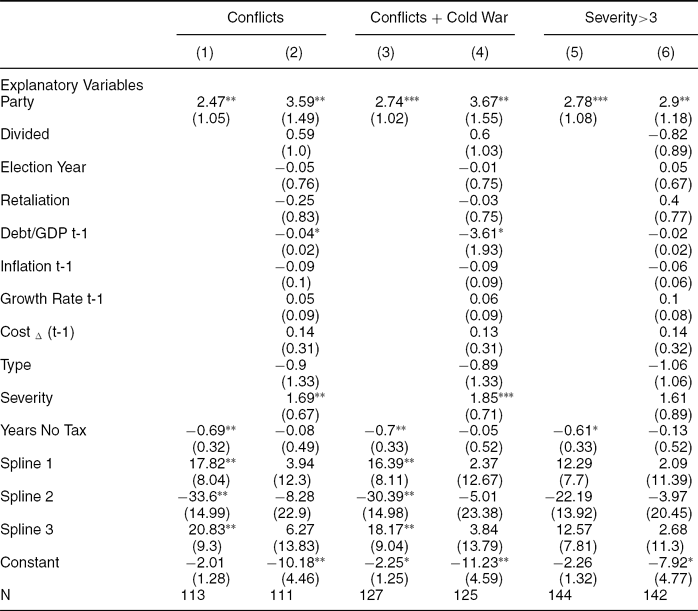
Table 2 shows the results from our analysis of the effect of presidential partisanship on war taxation.Footnote 18 Models 1, 3, and 5 represent baselines without control variables, whereas Models 2, 4, and 6 include controls. Across all models, there is strong support for the effect of partisanship. The severity of the conflict is also significant across models with controls, suggesting that a war tax becomes more likely as the level of hostility increases. Other controls find support in only some models or do not seem to play a significant role on average.
Logit Estimation of the Effect of Presidential Partisanship on War Taxes, 1789–2010
Note: Robust standard errors reported in parenthesis. * p < 0.10; ** p < 0.05; *** p < 0.01.
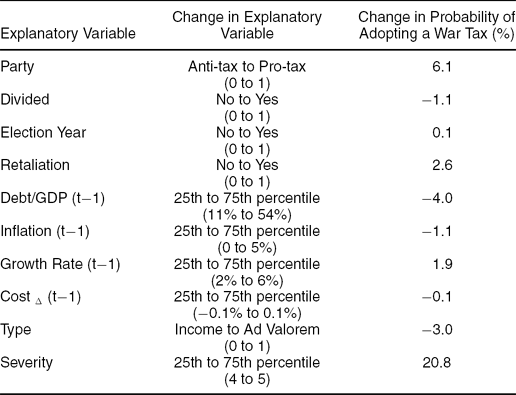
To interpret the substantive effect of these results, we used Clarify (King, Tomz, and Wittenberg Reference King, Tomz and Wittenberg2003) to estimate change in predicted probabilities of interest. Based on the model with controls that shows the most conservative results (Model 6) and setting all other variables to their means (and medians for dummy variables), the marginal effect of partisanship on the probability of adopting a war tax is 6.1 percentage points.
Marginal Effects on the Probability of a War Tax
Note: The marginal effects are estimated by setting all other variables to their medians and means. Dummy variables (i.e., Retaliate, Election Year, Divided, Type, and Party) are set to their medians, whereas the remaining variables are set to their means.
To test the sensitivity of these results, we carried out a number of robustness checks. In addition to following an alternative coding for our main independent variable—as an interaction term, as discussed earlier—we operationalized several control variables differently. We operationalized the cost variable in levels rather than change, with and without a lag and three- and five-year moving averages. We considered alternative measures of cost, such as military personnel as a percentage of total population, as well as a dummy for where the war was fought. Moreover, in case the adoption of war taxes was affected by the existence of a central bank or its independence of the executive branch, we included two additional controls: a dummy taking the value of 1 for the years when a central bank has existed in the Unites States (1791–1811, 1816–36, 1913–onward) and a dummy taking the value of 1 for the period of central bank independence (1951–onward). We also estimated the models including only those years in which severity of the conflict was greater than 2, and in an unrestricted sample including all years. None of these changes affected our findings.
We also probed whether political party influences war taxation or whether it is endogenous to war onset and whether war taxes are likely to follow once wars begin. At first glance, it seems plausible that the pro-tax party is more warlike and that with more wars come more opportunity for war taxes. Republicans were associated with many wars of the nineteenth century—the Civil War and Spanish-American Wars—when they were also the party more likely to tax. Democrats were associated with many wars of the twentieth century—both world wars, Korea, and Vietnam—at a time in which they were the party more sympathetic to taxation. To test for this possibility, we reestimated the models using war onset as the dependent variable instead of war taxes, along with standard control variables for war onset.Footnote 19 A leader's political party did not affect whether the United States became involved in a war (p value of 0.56), suggesting that the propensity to levy a war tax does not only reflect the fact that particular parties are more inclined to become involved in wars.
CONGRESSIONAL ROLL-CALL VOTES ON WAR TAX LEGISLATION
As a second component of our empirical strategy, we tested whether the partisanship argument applies to members of Congress by analyzing legislative roll-call votes. The dataset includes all legislative votes (6,814 votes) for every war tax bill voted in the House of Representatives since 1789.Footnote 20 In addition to testing legislative partisanship, this approach has the advantage of not being contingent on identifying the years “at risk” for a war tax, because it focuses on war tax votes only.
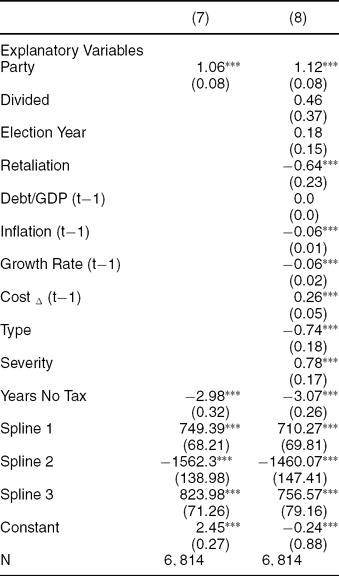
As with the previous analysis, the dependent variable is dichotomous, with each legislator's vote coded as 1 when a legislator voted in favor of a proposed war tax and 0 otherwise—an alternative coding excluding abstentions and no shows is presented in the Online Appendix. The independent variable of interest, party, took on a value of 1 whenever the legislator belonged to the party with a pro-tax inclination and a 0 otherwise.Footnote 21 As with the analysis of the president's party, we addressed potential time dependence by including the variable numberyears along with three cubic splines (Beck, Katz, and Tucker Reference Beck, Katz and Tucker1998). Model 7 shows the effect of party without controls, and Model 8 includes controls.Footnote 22
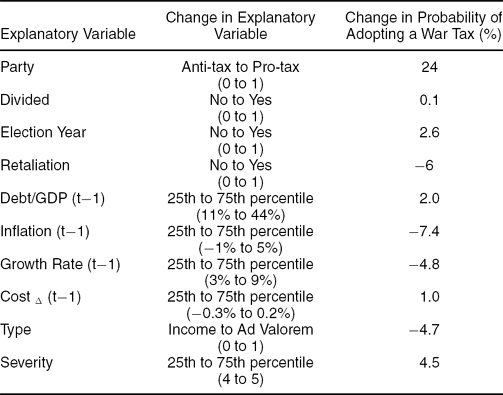
As shown in Table 4, our analysis finds that partisanship is a significant determinant of legislators’ wartime fiscal policy preferences, increasing our confidence in the findings of the previous section. As Table 5 illustrates, the marginal effect of changes in partisanship on legislators’ probability of voting for a war tax is 24 percentage points—which is larger than changes in every other factor.Footnote 23
Logit Estimation of the Effect of Partisanship on Congressional War Tax Votes, 1789–2010
Note: Dependent variable is a dummy that takes the value of 1 whenever a legislator voted in favor of a war tax. Robust standard errors reported in parenthesis. * p < 0.10; ** p < 0.05; *** p < 0.01.
Marginal Effects on the Probability of Voting for a War Tax
Note: The marginal effects are estimated by setting all other variables to their medians and means. Dummy variables (i.e., Retaliate, Election Year, Divided, Type, and Party) are set to their medians, whereas the remaining variables are set to their means. The cubic splines are dropped because their high correlation (0.99) prevents the matrix from inverting when estimating the marginal effects.
The congressional debate and subsequent vote on legislation to finance the Spanish-American War illustrate this dynamic in which, rather than legislators setting aside partisan rancor during wartime, partisanship drives congressional behavior. Although legislators were supportive of the war and for the need to raise revenue, both parties used the “crisis of war” (Ratner Reference Ratner1942, 234) to try to shift resources toward their constituents. Republicans favored tariffs and excise taxes supported by their industry supporters. Democrats, who “indicted Republicans as agents of capitalists. . .saddling costs on the common people,” opposed the war tax proposal because of the view that such taxes favored industry at the expense of lower socioeconomic groups (Ratner Reference Ratner1942, 232). The San Francisco Star summarized the stakes of the war finance debate as follows: “The war against privilege is more important than the war against Spain, of which the privileged are taking advantage to increase their own emoluments and other people's burdens” (quoted in Ratner Reference Ratner1942, 238). Amidst this acrimonious debate, Republicans prepared the war tax legislation without the consultation of Democrats, who did not see the legislation until it was presented to the full committee. The Chicago Daily Tribune (“May Defeat the War Tax Bill” 1898), whose coverage of the conflict tended to support Republicans, concluded that Democrats “are inclined to think that they have been most unfairly treated” by these procedural slights. Ultimately, only 5 Democrats voted in favor and 81 were opposed, compared to 148 Republicans in favor and only 5 opposed, suggesting that political elites used the crisis as a vehicle for advancing partisan fiscal interests.
TRACING PARTISAN FISCAL DIFFERENCES: THE CASE OF THE CIVIL WAR
Our third test of partisan differences on war taxes is a case study of the American Civil War. As Schwab notes (1892, 38), “in many ways the North and the South were similarly situated: their organic laws closely resembled each other; their commercial and financial traditions were the same; their financiers had been trained in the same school in Washington; and the demand for revenue was equally pressing.”Footnote 24 And yet the two sides generated revenues quite differently, with the North financing 20% of the war through war taxes, compared to the South's approach in which war taxes provided just 4% of the conflict's revenue needs (Ball Reference Ball1991; Schwab Reference Schwab1892). As such, the case of the Civil War helps illustrate our claims that the distributive interests behind partisanship influence war finance decisions.
With the secession of the South, the Confederate Congress became a one-party system comprised of individuals who had been Democrats. The Confederate constitution codified the Democrats’ abhorrence toward tariffs, stating that “no bounties shall be granted from the Treasury; nor shall any duties of taxes on importations from foreign nations be laid to promote or foster any branch of industry” (Davis [1881] Reference Davis1990, 565). In short, the constitution prevented the Confederacy from raising protective tariffs. This prohibition was motivated by the understanding that taxes in the antebellum period protected Northern manufacturing interests but were disadvantageous to the South for several reasons. Export duties were thought to “penalize the products of slave labor,” such as cotton, which constituted one-third of the South's exports (Ball Reference Ball1991, 42). Import duties were unpopular because, except for agricultural commodities, the South imported all its goods (Holcombe Reference Holcombe1992, 766). In short, the South “resented high tariffs as a tool of Northern interests” and sought methods other than taxation to finance the war (Weisman 2002, 60).
The result of the Confederate's aversion to taxation meant an initial reliance on loans and treasury notes to finance the war. Although the Confederacy did pass a war tax in the first two years of the conflict, it was a nominal tax; “the Government's policy was to make the burden of the war fall as lightly as possible upon the people” (Todd Reference Todd1954, 136). As the war continued, the South suffered a number of military setbacks, was unable to pay soldiers, was hurt by credibility losses in the bond market, and experienced skyrocketing levels of inflation (Ball Reference Ball1991 41, 119). Even reluctant Democratic congressmen came to the conclusion that the South had to generate additional sources of revenue and finally resorted to a more systematic approach to taxation. In 1863, the Confederacy passed an “act to lay taxes for the Common Defense and Carry on the Government of the Confederate States,” a set of taxes that reflected the interests of the Confederacy by exempting real estate, property, slaves, and religious institutions (Todd Reference Todd1954, 140); however, this set of taxes proved inadequate because of the large numbers of exemptions. Because “the necessities of war no longer permitted a strict adherence to the letter of the [Confederate] Constitution” (Todd Reference Todd1954, 148) the Confederacy had to seek more draconian tax measures in 1864; the most aggressive tax measure came only in 1865, but the Civil War ended before the Confederacy could collect the new revenues.
In contrast to the South's reluctance to raise taxes, the North more readily resorted to taxation as a way to finance the war's costs. One of the main reasons has to do with the composition of the Union Congress, which was more than three-quarters Republican. In the North, manufacturing sectors favored higher tariffs and formed the core constituency of Northeast Republicans, who in turn incorporated high tariffs into their fiscal platform (Bensel Reference Bensel2000; Stanwood Reference Stanwood1903). One of the first measures the Union Congress took after secession was to pass the Morrill Tariff of March 1861, which reintroduced protective tariffs that had been lowered through Democrat-sponsored tariff legislation of the 1840s and 1850s (Taussig Reference Taussig1910, 72).
Because the Republican-dominated Congress strongly favored tariffs, these taxes became an obvious way to finance the Civil War. During the summer of 1861, Congress passed emergency customs duties, followed by additional duties in December 1861; in almost every month between then and 1865 Congress increased the rate of almost every form of ad valorem tax (Mitchell Reference Mitchell1903, 120; Taussig Reference Taussig1910). The North did ultimately levy an income tax; Senator John Sherman (R-OH) attributed its willingness to do so only to the fact that “we are in the midst of a great war, which tasks the industry and wealth of this country. . .we are about to inaugurate a system of taxation that is unknown in this country” (Congressional Globe 1861–62). That the Republican-dominated Congress was uncomfortable with the income tax was apparent from its aggressive efforts to repeal it, which ultimately came about in 1872.
The case of the Civil War, in which we might expect to see similar fiscal policies in the North and South because of similar fiscal demands, among other reasons, lends further support to the partisan differences thesis. The Union, dominated by Republicans who drew their support from manufacturing sectors that favored protective taxes, readily resorted to taxation and financed a larger proportion of the war through war taxes. In contrast, the Confederacy, effectively a one-party system of Democrats supported by export-dependent agricultural sectors that favored free-trade policies, only belatedly raised taxes to finance a small share of the war's cost. Our emphasis on partisan differences between the North and South does not mean other factors did not play a role. For example, the South's trade relationship with cotton-dependent European countries led to the belief that the South could secure loans in Europe with the cotton as collateral, whereas the North did not expect such assistance. Nonetheless, taken together with the other two forms of evidence, the case study further strengthens our argument about partisan influences on war finance policies.
CONCLUSION
The preceding analysis helps mediate unresolved theoretical debates and empirical puzzles about war finance, domestic politics and conflict, and tax policy. It shows that the propensity for war taxes compared to alternatives such as borrowing or increasing the money supply is largely a function of partisan preferences. The reason is that the amount of revenue required makes wars high-stakes fiscal opportunities that have major redistributive consequences. If elites can raise revenues in different ways, they tend to choose the way that favors their core constituencies, given the immense and long-lasting impact. To the extent that taxation meant ad valorem taxes before 1913, Republicans tended to favor war taxes as a form of war finance, because their core constituencies favored protective tariffs; in contrast, after 1913, when taxes generally meant income taxes, Democrats were more inclined to resort to taxation as a form of war finance.
The findings have important implications for democratic accountability and the conduct of war. Immanuel Kant ([1795] Reference Kant2003) famously observed, “If the consent of the citizens is required in order to decide that war should be declared. . .nothing is more natural than that they would be very cautious . . . decreeing for themselves all the calamities of war. Among the latter would be: having to fight, having to pay the costs of war from their own resources.” Similarly, Reiter and Stam (Reference Reiter and Stam2002) conclude in their study of democratic war fighting that because “the people ultimately pay the price of war in higher taxes and bloodshed,” their support is conditional on the war being justified and fought at a reasonable cost. We show that a democracy such as the United States does not always expose its populace to the direct costs of war in the form of war taxes. Thus, much as leaders can design conscription institutions to reduce constraints on their decision making (Gowa Reference Gowa2000)—which affects the distribution of casualties across income classes—they can also reduce their constraints by affecting the way the populace experiences the costs of war in treasure. Insofar as taxation imposes the most direct form of costs and most fully exposes the actual costs of the war of any alternative, then war taxes will be associated with the most significant institutional constraints on leaders’ use of force, whereas alternatives will slacken these constraints. In contrast, financing through borrowing or increasing the money supply will tend to reduce institutional constraints on how leaders use force (Flores-Macías and Kreps Reference Flores-Macías and Kreps2013).
A related implication is that the way leaders finance wars may affect war duration. War taxes “make the cost of war painfully obvious to the general public and undermine support for it” (Rockoff Reference Rockoff2012, 317) or at least create incentives for leaders to keep wars short and low cost, just as body bags returning home from war can create political blowback because of the apparent cost in blood. Financing wars other than through direct taxation, such as in Iraq and Afghanistan, may reduce the apparent cost and affect leaders’ political incentives to bring wars to an efficient conclusion. Shrouding the cost of war may give leaders institutional slack but also extend the length of the conflict. It may be no coincidence that the two longest wars in U.S. history have not been financed by war taxes; without apparent costs, the polity has few incentives to bring the war to a more expedient close.
Supplementary materials
To view supplementary material for this article, please visit http://dx.doi.org/10.1017/S0003055413000476




Comments
No Comments have been published for this article.