Implications
A major challenge in organic pork production is to fulfil amino acid requirements using locally grown and 100% organic protein sources. Currently, a large part of organic protein is imported and typically growing pigs are housed indoors with access to outdoor concrete yards, which is not in accordance with principles in the European organic regulation focusing on nutrient recirculation and use of local renewable resources. Direct foraging in growing pigs may be a feasible strategy for farmers to reduce nitrogen input into the system and reduce costs for supplementary feed making the production more environmentally sustainable while maintaining a competitive production.
Introduction
In Northern Europe, the current practise is to feed organic growing pigs high amounts of supplementary feed containing oilseed products as well as cereals (Edwards, Reference Edwards2003; Kongsted et al., Reference Kongsted, Horsted and Hermansen2013). The majority of the protein part of the feed for example organic soya bean is imported from China where the transport in terms of carbon footprint is higher compared with the carbon footprint for cultivation and processing (Mogensen et al., Reference Mogensen, Kristensen, Nguyen and Knudsen2011). Furthermore, organic growers are typically housed indoors with access to outdoor concrete yards (Hermansen et al., Reference Hermansen, Eriksen and Oksbjerg2005). One important factor underlying this practise is environmental concern, which is related to a high nutrient input from supplemental feed, in particular nitrogen, contributing to increased risk of nutrient losses (Eriksen and Kristensen, Reference Eriksen and Kristensen2001; Sommer et al., Reference Sommer, Søgaard, Møller and Morsing2001).
One of the major challenges related to feeding organic pigs is to fulfil amino acid requirements using home-grown and locally grown 100% organic protein sources (Sundrum et al., Reference Sundrum, Schneider and Richter2005). While the use of synthetic amino acids is normal practice in conventional pig production, this is not allowed in organic livestock production (Council Regulation No. 889/2008). Currently, the EC organic regulation allows a maximum of 5% non-organic protein feed on a dry matter (DM) basis per 12 months (Council Regulation No. 889/2008). However, from 31 December 2017 monogastric animals must be fed with 100% organic protein feed (Council Regulation No. 836/2014). This reinforces the need for alternative feeding strategies that supply sufficient levels of essential amino acids of organic and local origin.
Bearing in mind that pigs have evolved as opportunistic omnivores with a unique capacity to forage above as well as below ground (Andresen, Reference Andresen2000), it seems obvious to try to increase the forage uptake from the areas they occupy. This would reduce the need for imported supplemental feed and increase recirculation of nutrients within the free-range system. Grazed legume pastures may represent an important contribution to the amino supply in growing pigs with lysine contents of up to 7 g/kg DM in grass and 18 g/kg DM in lucerne (Medicago sativa) (Edwards, Reference Edwards2003; Kyntäjä et al., Reference Kyntäjä, Partanen, Siljander-Rasi and Jalava2014) and with yields of up to 10 000 kg DM lucerne/ha (Weltin et al., Reference Weltin, Alarcon, Salomé, Berger and Bellof2014).
One major influence regarding contribution to amino acid supply is the level of herbage intake. The literature on intake of forage in growing pigs on pasture is sparse. In terms of supplementary feed being fed ad libitum, intake from direct foraging is rather low with 4% of daily organic matter intake as reported by Mowat et al. (Reference Mowat, Watson, Mayes, Kelly, Browning and Edwards2001). A higher forage intake is found when supplementary feed is restricted, with intake amounting up to 15% of total DM intake/day (Riart, Reference Riart2002; Rodríguez-Estévez et al., Reference Rodríguez-Estévez, García, Peña and Gómez2009). In accordance, foraging activity have been found to increase in feed restricted pigs compared with non-restricted pigs (Stern and Andresen, Reference Stern and Andresen2003; Kongsted et al., Reference Kongsted, Horsted and Hermansen2013). Regarding CP and lysine contribution from pasture intake, the literature is even more limited. Riart (Reference Riart2002) reported a CP contribution from forage with up to 18% of requirements in finishers and Hodgkinson et al. (Reference Hodgkinson, López and Navarrete2009) found a daily intake of CP and lysine amounting up to 115 and 6.4 g/pig respectively in European wild boar.
Experiments have shown that pigs are able to select a diet balanced in protein when given a choice (Kyriazakis and Emmans Reference Kyriazakis and Emmans1991). There are indications that when limiting protein or amino acid content of an otherwise balanced ration, pigs respond by increasing foraging behaviour (Jensen et al., Reference Jensen, Kyriazakis and Lawrence1993) and food intake (Kyriazakis, Reference Kyriazakis1994) in order to compensate. Hence, it may be possible to stimulate forage intake in pigs by restricting CP supplementary feed allowance.
Apart from supplemental feed, forage crop preference (Rachuonyo et al., Reference Rachuonyo, Allen and McGlone2005) is also an important factor in terms of increasing forage uptake. According to a preference trial with gilts, grazing lucerne and white clover were clearly preferred compared with tall fescue or buffalo-grass. This was ascribed to the palatability and ease of grazing legumes compared with grasses, which are more fibrous and difficult for pigs to graze (Rachuonyo et al., Reference Rachuonyo, Allen and McGlone2005). Importantly, lucerne has a favourable nutritional composition in terms of protein and lysine content (Kyntäjä et al., Reference Kyntäjä, Partanen, Siljander-Rasi and Jalava2014) and also produces high yields (Weltin et al., Reference Weltin, Alarcon, Salomé, Berger and Bellof2014). This is of major relevance when mitigating the challenge of fulfilling amino acid requirements using home-grown feed. On the other hand, grass is interesting in organic cropping systems as a relatively low-cost and effective catch crop (Hansen et al., Reference Hansen, Djurhuus and Kristensen2000).
The objective of the present study was to investigate the effect of feeding strategy (protein allowance) and cropping system (lucerne or grass) on foraging behaviour, forage intake as well as growth and feed conversion in organic growing pigs.
It is hypothesized that pigs restricted in CP will exhibit an increased foraging behaviour compared with pigs receiving CP according to Danish organic standards. In addition, CP restricted pigs are expected to have a higher intake from direct foraging in the range area and by that to some extent compensate as reflected in growth and feed conversion compared with pigs fed 100% CP level. Furthermore, it is hypothesized that pigs foraging on lucerne will have a higher forage intake and a performance which is less affected by protein restriction compared with pigs foraging on grass.
Material and methods
Animals, experimental design and treatments
The experiment was carried out at Aarhus University, Denmark from September 4 to October 14 2013. A total of 36 growing pigs consisting of 19 females and 17 castrated males (Landrace, Yorkshire and Duroc crossbreds) were included in the 40-days experimental period with a mean live weight of 58 kg (SD=5.1 kg) at the beginning of the experiment and a mean live weight of 90 kg (SD=7.6 kg) at the end of the experiment. The pigs were recruited from a conventional farm with free-range sows where they were reared on pasture and fed ad libitum with a commercial conventional diet for weaners and growers. The diet was optimized in terms of energy and protein according to Danish recommendations. The pigs were not snout-ringed.
The overall experimental design was a 2×2 factorial arrangement of treatments in a complete block design in three replicates where each of the blocks (replicates) consisted of four paddocks with one paddock per block receiving each of the four treatments. The first factor evaluated the effect of feed CP (HP: high protein, LP: low protein) and the second factor evaluated the effect of forage crop (lucerne, grass). Pigs were grouped according to weight and gender into the three blocks and within blocks pigs were allocated by gender to the four treatment combinations (stratified randomization) with three pigs in every treatment combination (paddock).
Forage crop was randomized to paddocks within blocks. One forage crop treatment was well-established lucerne (Medicago sativa) and the other newly established rye grass (Lolium perenne). Regarding concentrate feed treatments, pigs were fed a mean of 2.2 kg feed/pig per day or 28.1 MJ and 26.8 MJ ME for HP and LP treated pigs, respectively. This corresponds to ~80% of energy requirements according to Danish indoor recommendations for growing pigs (Anonymous, 2008). The HP feed consisted of 205 g CP and 10.6 g lysine/kg DM feed and the LP treatment of 107 g CP and 4.4 g lysine/kg DM feed.
Feeding
Treatment HP consisted of an organic standard concentrate pelleted (3.5 mm) mixture for organic growing-finishing pigs and treatment LP a mixture of coarsely grinded and granulated organic wheat (42%), barley (30%) and oats (25%). Both feeds were optimized in terms of vitamins and minerals. The same day the pigs were recruited from the conventional free-range production, they were inserted into the experimental paddocks. The pigs then went through an 8 days adaptation period. The first 5 days all pigs received the same mixture of feed HP and LP with an energy and CP content of 18.3 MJ ME and 0.28 kg CP/pig per day. On day 6 and 7 all pigs received a feed mixture of HP and LP with an energy and CP content of 24.4 MJ ME and 0.35 kg CP/pig per day. On day 8 HP pigs were fed entirely with the HP feed and LP pigs were fed a mixture of feed HP and LP containing an energy and CP content of 24.4 MJ ME and 0.32 kg CP/pig per day. On day 9 the pigs were fed entirely with the experimental feed treatments. The increase in feed energy during the experimental period corresponds with Danish recommendations for growing pigs within the actual weight class.
The pigs were fed once a day at 0730 h. In each paddock was placed two open feed troughs, which were heavy enough to avoid the pigs from turning them over and thereby prevent spillage of feed. The amount of concentrate feed allocated to pigs in each paddock was recorded on a daily basis. Any feed residues in the troughs were registered.
Experimental paddocks
The 12 paddocks were situated right next to each other and separated by a two strand electrified wire fence. The lucerne paddocks had been under-sown with barley/pea as a cover crop in 2010, which was harvested as whole crop ultimo July 2010. The lucerne paddocks were cut 3 months before the beginning of the experiment. The grass paddocks had been under-sown with barley as a cover crop in spring 2013. The field had not received any pesticides or artificial fertilizer since autumn 2009. The soil was characterized as fine loamy sand (Greve, Reference Greve2013).
Pigs in each paddock had access to an insulated hut with a floor area of 4 m2. The hut was placed directly on the pasture and supplied with straw. Water was offered from a water tub, beside which a wallowing area was available. In addition, each group of pigs had access to two feed troughs, which provided sufficient space for all pigs to eat simultaneously. Huts, feed troughs and water tubs were stationary throughout the experiment. Initially, the paddock size was 12.5×10 m. However, twice a week pigs in each paddock got access to 37.5 m2 of new pasture.
Recordings
Crop sampling
Within each paddock, two pre-grazed crop samples (0.50 m2 each) were collected every week, amounting to a total of four times (eight pre-grazed samples). In paddocks with lucerne, samples were manually divided into lucerne and dandelion (Taraxacum officinale) since they contained large amounts of dandelion. To be able to estimate lucerne nutrient intake, two post-grazed crop samples (0.50 m2 each) were collected three times in each paddock during the experimental period 1 week after the pigs got access to that particular area (six post-grazed samples). Pre- and post-grazed crop samples were collected one meter from the rear fence and from either the left or right side of the paddock (measured from the electric fence) according to a predetermined pattern. This was done in order to avoid pre-grazed and post-grazed samplings to be performed in the same spots and in order to provide a representative picture of forage crop availability. All pre- and post-grazed crops samples were harvested at a height of 6 cm and weighed immediately after sampling. It was not possible to estimate grass intake according to this method due to the pigs rooting behaviour quickly turning over the sward leaving these paddocks in a three-dimensional shape, a situation also described by Stern and Andresen (Reference Stern and Andresen2003).
Chemical analysis
One random sample of each concentrate feed was collected and sent for energy and nutrient content analysis (Eurofins Steins, 2013). DM was determined according to the method described in EU Regulation 152 (EU Regulation (EC), 2009). Metabolizable energy was analysed by in vitro enzymatic digestion as described by Tybirk (Reference Tybirk2012). CP (total nitrogen×6.25) was analysed by the Dumas method (combustion at 800°C to 1000°C) (Hansen, Reference Hansen1989) and essential amino acids according to the method described under section F in EU Regulation 152 (EU Regulation (EC), 2009).
DM content in crop samples was determined by drying in the oven at 60°C for 72 h. Metabolizable energy, CP (total nitrogen×6.25) and essential amino acids in crop samples were determined according to the methods described above for feed samples
Behavioural observations
Behavioural observations were performed to investigate effect of forage crops and concentrate feed treatments on pig behaviour. During the experimental period behavioural observations were conducted 3 days every week on Tuesdays, Wednesdays and Thursdays (day 13, 14, 15, 20, 21, 22, 27, 28, 29, 34, 35, 36). At each observation day pigs were observed from 0830 to 1000, 1030 to 1200, 1330 to 1500, 1530 to 1700 and 1730 to 1900 h.
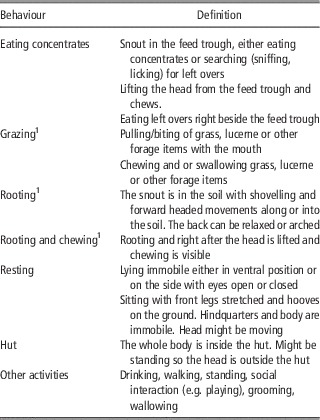
Behavioural elements were recorded as scan sampling at 2 min intervals (Martin and Bateson, Reference Martin and Bateson2007). Definitions of the recorded behaviours are given in Table 1.
Definitions of pig behaviour recorded during observations

Studnitz (Reference Studnitz2001), Stern and Andresen (Reference Stern and Andresen2003), Horsted et al. (Reference Horsted, Kongsted, Jørgensen and Sørensen2012).
1 If grazing, rooting or rooting and chewing were performed while performing other behaviours, grazing, rooting or rooting and chewing were recorded.
Observation order of paddocks was randomized between blocks and within block. Two neighbouring paddocks or the behaviour of six pigs were observed for 15 min (seven scan samplings per pig five times during a day). Thus, in total each pig was scan sampled 420 times from day 13 to day 36. The behavioural elements were recorded by the same two observers throughout the entire experimental period. The observer was placed outside the paddocks ~7 m from the fence in a vehicle and did not intervene with the pigs. Three minutes were available to move to the subsequent paddocks and accustom the pigs to the arrival and presence of the vehicle.
Climatic conditions
When the behavioural observations were carried out, climatic conditions including air temperature, wind (no wind, light wind, medium wind and strong wind) and weather type (1=sunny, 2=light clouds, 3=heavy clouds, 4=light rain, 5=heavy rain) were recorded every 15 min (n=360) according to description by Kongsted et al. (Reference Kongsted, Horsted and Hermansen2013).
Live weight, concentrate feed use, back fat and body condition
In order to measure pig performance (daily weight gain and feed conversion ratio) pigs were weighed before insertion into the paddocks and at the end of the experiment (day 40). Additionally, on day 37 of the experimental period a trained person scored body condition for each pig according to a five level scale where ‘1’ was very lean and ‘5’ was very fat as described by Bonde et al., (Reference Bonde, Rousing, Badsberg and Sørensen2004). Concentrate feed intake was measured per group of pigs. Back fat was measured on an individual basis (right above the last rib and seven cm from the backbone) with an ultrasound scanner (USM 32 Krautkramer®, Altest NDT Equipment Aps., Karlslunde, Denmark) (Madsen et al., Reference Madsen, Mcevoy, Nielsen and Svalastoga2008).
Statistical analysis
Behaviour
Effect of concentrate feed and forage crop treatments on occurrence of behavioural elements was investigated by the following model (1) using the Proc Mixed procedure (Littell et al., Reference Little, Milliken, Stroup and Wolfinger1996) in SAS (SAS Institute, 1990) where Y ijlmno is the daily sum of the behaviour in question per paddock in percentage of the total daily sum of behaviour per paddock (n=144, 12 paddocks and 12 observation days).
 $$\eqalignno{ Y_{{ijlmno}} = & \mu {\plus}\alpha _{i} {\plus}\beta _{j} {\plus}\delta _{l} {\plus}D_{{n(m)}} {\plus}W_{n} {\plus}P_{o} _{{\asterisk}} \theta {\plus}(\alpha \beta )_{{ij}} \cr & {\plus}(\alpha D)_{{im}} {\plus}(\beta D)_{{jm}} {\plus}(\alpha W)_{{in}} {\plus}(\beta W)_{{jn}} \cr &{\plus}(DW)_{{mn}} {\plus}(\alpha P)_{{io}} {\plus}(\beta P)_{{jo}} {\plus}(\alpha \beta D)_{{ijm}} \cr &{\plus}(\alpha \beta W)_{{ijn}} {\plus}(\alpha \beta P)_{{ijo}} {\plus}A_{{ijl}} {\plus}_{{{\varepsilon}ijlmno}} $$
Rooting and rooting and chewing were summed and named rooting due to the latter activity constituting only a minor part of total rooting activity. Rooting, foraging, eating concentrates, grazing and other activities were square root transformed to obtain an approximately normal distribution. For each paddock, observations right next to each other in time (observation day) were assumed to be highly correlated – an effect which is reduced as observations get further apart. Thus, the observations have an autoregressive structure, which in SAS is specified by Type=AR (1) using the Repeat function (co-variance structure) (SAS Institute, 1990).
μ is the general level of each behaviour in percentage of daily group sums; ɑ i the fixed effect of concentrate feed (i=HP, LP); β j the fixed effect of forage crop (j=lucerne, grass); δ l the fixed effect of block (l=1, 2, 3); D n(m) the effect of day nested within week (m=1, 2, 3 in each week); W n the effect of week (n=1, 2, 3, 4) and P o the effect of weather type (o=1.0 to 5.0) and θ the corresponding regression parameter. Furthermore, the following two-way and three-way interactions were included in the model: feed and forage crop (ɑβ ij ), concentrate feed and day (ɑD im ), forage crop and day (βD jm ), concentrate feed and week (ɑW in ), forage crop and week (βW jn ), day and week (DW mn ), concentrate feed and weather (ɑP io ), forage crop and weather (βP jo ), concentrate feed, forage crop and day (ɑβD ijm ), concentrate feed, forage crop and week (ɑβW ijn ) and concentrate feed, forage crop and weather (ɑβP ijo ). A ijl is the normally distributed random effect of group (paddock) (i=HP, LP; j=lucerne, grass; l=1 to 3); ε ijlmno is experimental error. It was not possible to include weather, temperature and wind in the same model due to high inter-variable correlations. Weather was prioritized as this variable was assumed to be the most important regarding impact on behaviour. Temperature was not included as it was relatively constant throughout the 12 observation days. To investigate any effects of wind on behaviour it was included in the final model if no significant effect of weather was found.
Lucerne intake
The effect of concentrate feed treatments on estimated intake of lucerne (group level, n=6) was investigated by a linear mixed model (2) using the Proc Mixed procedure (Littell et al., Reference Little, Milliken, Stroup and Wolfinger1996) in SAS (SAS Institute, 1990).
 $$Y_{{il}} =\mu {\plus}\alpha _{i} {\plus}\delta _{l} {\plus}{\varepsilon}_{{il}} $$
where Y il is the response variable for each group of pigs (intake g/pig per day); μ the general level of intake of energy and nutrients (intercept) The notation for ɑ i and δ l is similar to equation (1) and ε il is experimental error. ε il was assumed to have a normal distribution where observations from different paddocks were assumed to be uncorrelated, while observations for the same paddock were assumed to have a Compound Symmetry (CS) correlation structure.
Daily weight gain and back fat
The effect of concentrate feed and forage crop treatments on daily weight gain and back fat (animal level, n=36) was investigated by the following linear mixed model (3) using the Proc Mixed procedure (Littell et al., Reference Little, Milliken, Stroup and Wolfinger1996) in SAS (SAS Institute, 1990).
 $$\eqalignno{ Y_{{ijkl}} = & \mu {\plus}\alpha _{i} {\plus}\beta _{j} {\plus}\gamma _{k} {\plus}\delta _{l} {\plus}(\alpha \beta )_{{ij}} {\plus}(\alpha \gamma )_{{ik}} {\plus}\beta \gamma _{{jk}} \cr & {\plus}W_{{ijkl{\asterisk}}} \delta {\plus}A_{{ijl}} {\plus}{\varepsilon}_{{ijkl}} $$
where Y ijkl is the response variable for the individual pig (daily weight gain or back fat). The notation for, ɑ i , β j and δ l , is similar to Equation (1). μ the general level for daily weight gain and back fat respectively; ɣ k the fixed effect of gender (k=female, castrated male); (ɑβ) ij the two-way interaction between concentrate feed and forage crop; (ɑɣ) ik the two-way interaction between concentrate feed and gender; βɣ jk the two-way interaction between forage crop and gender. W ijkl a covariate with W representing the start weight of the pigs and δ the corresponding regression parameter (i=HP, LP; j=lucerne, grass; k=female, castrated male; l=block: 1, 2, 3); A ijl the random effect of group (i=HP, LP; j=lucerne, grass; l=block: 1, 2, 3). ε ijkl is experimental error and was assumed to have a normal distribution where observations from different paddocks were assumed to be uncorrelated, while observations for the same paddock were assumed to have a Compound Symmetry (CS) correlation structure. One pig (no. 123, female) suffered from a chronic joint infection and was therefore excluded from the statistical analysis.
Feed conversion
Effect of concentrate feed and forage crop treatments on feed conversion ratio was analysed at paddock level (n=12).
 $$\eqalignno{ Y_{{ijkl}} = & \mu {\plus}\alpha _{i} {\plus}\beta _{j} {\plus}\gamma _{k} {\plus}\delta _{l} {\plus}(\alpha \beta )_{{ij}} {\plus}(\alpha \gamma )_{{ik}} {\plus}\beta \gamma _{{jk}} \cr & {\plus}\delta W_{{ijkl}} {\plus}{\varepsilon}_{{ijkl}} $$
where Y ijkl is the response variable for each group of pigs (weight gain/MJ ME); μ the general level for weight gain per MJ ME. The notation is the same as in Equation (3) but with W representing mean start weight of each group of pigs.
Results
Yields and nutrient availability of forage
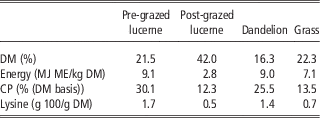
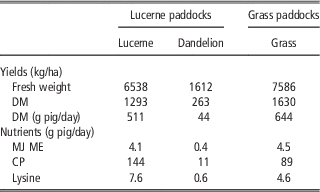
Nutrient content and estimated yields of lucerne, dandelion and grass are presented in Table 2 and Table 3, respectively. Based on DM, only a 5% higher yield was seen in grass paddocks compared with lucerne paddocks (dandelion included). The differences in yields between paddocks were higher for grass (min. 1388; max. 1793 kg/ha) and dandelion (min. 174; max. 445 kg/ha) compared with lucerne (min. 1212; max. 1374 kg/ha). Table 3 also shows estimated nutrient availability of forage crops in lucerne paddocks and grass paddocks. Regarding DM availability, pigs in lucerne paddocks had 555 and pigs in grass paddocks 644 g/pig per day corresponding to 2.9 and 3 kg fresh weight/pig per day, respectively. Minimum and maximum values were 507 and 617 g DM/pig per day in lucerne paddocks and 592 and 709 g/pig per day in grass paddocks. Thus, a 14% higher DM availability was found in grass paddocks compared with lucerne paddocks. Energy content (MJ ME/pig per day) was similar for grass paddocks and lucerne paddocks, whereas CP availability was 42% higher in lucerne paddocks compared with grass paddocks. Furthermore, lysine availability was 44% higher in lucerne paddocks compared with grass paddocks.
Dry matter (DM), energy and nutrient content of pre- and post-grazed lucerne, dandelion and grass

Mean yield and mean nutrient availability (dry matter basis=DM) of lucerne, dandelion and grass in paddocks during the 40-days experimental period

Estimates are based on pre-grazed forage crop samples.
Animal behaviour
Regarding feed and crop interactions, a significant effect was found for rooting behaviour (Table 4) but not for grazing behaviour. For both crops, LP pigs rooted significantly more than HP pigs but the effect of feed was more profound in grass (44% v. 19% of total observations) compared with lucerne (28% v. 16% of total observations). In terms of main effects, grazing was not observed significantly more in pigs receiving LP treatment compared with HP treated pigs. However, it turned out to be significantly affected by forage crop treatment. Pigs in lucerne paddocks grazed significantly more compared with pigs in grass paddocks (LS-means: lucerne=10.3, grass=4.2). Week significantly affected grazing behaviour with slightly increasing levels throughout weeks (LS-means: week 1=4.7%, week 2=6.3%, week 3=6.7%, week 4=10.5%, P<0.0001) but no such effect was found for rooting behaviour (week 1=25.3%, week 2=25.4%, week 3=23.5%, week 4=28.7%, P=0.27). In terms of interactions between feed and weather as well as forage crop and weather no significant effects were found on rooting nor grazing behaviour. Also, wind had no significant effects on rooting or grazing. For total resting behaviour (pigs resting and pigs in hut) there was a tendency (P=0.05) to an effect of feed and forage crop interactions. Pigs receiving LP treatment in grass paddocks were observed resting less compared with the other feed and forage crop interactions. Regarding main effects, total resting behaviour was significantly affected by concentrate feed treatment, with resting behaviour for LP pigs constituting 67% of resting behaviour recorded in HP treated pigs. Total resting behaviour was not affected by forage crop treatment. In addition, week did not have a significant effect on total resting behaviour (LS-means: week 1=48.2%, week 2=47.7%, week 3=53.3%, week 4=45.1%, P=0.12). The same was true for effect of weather and wind.
Effect of treatment (HP=high protein v. LP=low protein; lucerne v. grass and feed crop interactions) on daily frequencies of behaviour in percentage of all observations

Least square-means (back transformed for rooting and grazing), standard errors (SE) and P-values. Total resting behaviour includes resting and in hut.
a,b,cValues with different superscripts differ significantly at P<0.05.
Lucerne intake
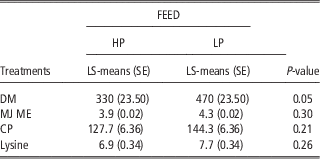
Results regarding the effect of concentrate feed treatment on estimated lucerne intake are presented in Table 5. The analysis showed no significant effect of feed treatments on DM intake, although there was a tendency to a higher intake in pigs receiving LP feed compared with pigs on HP feed treatment. No significant difference was found between LP treated pigs compared with HP treated pigs in terms of average daily intake of energy (min. 3.5; max. 4.5 MJ ME/pig), CP (min. 118; max. 144 g/pig) and lysine (min. 6.5; max. 8.2 g/pig). On average, estimated DM intake amounted to 400 g/pig per day with a minimum of 311 and a maximum of 508 g/pig per day corresponding to 2.3 and 2.6 kg fresh weight/pig per day.
Effect of treatments (HP=high protein, LP=low protein) on estimated nutrient intake from grazing lucerne (g/pig per day) (dry matter basis=DM)

Least square-means, standard errors (SE) and P-values. Estimates are based on pre- and post-grazed lucerne crop samples.
Growth performance, feed conversion, back fat and body condition
Effects of concentrate feed, forage crop and feed×crop interactions on daily weight gain, feed conversion ratio and back fat are presented in Table 6. Significant interactions between feed and forage crop were observed on daily weight gain and feed conversion ratio. Pigs receiving LP treatment in lucerne paddocks had a significantly higher daily weight gain as well as a significantly improved feed conversion ratio compared with LP treated pigs in grass paddocks. Weight difference between HP and LP treated pigs was only 18% in lucerne paddocks whereas it was 33% in grass paddocks. Regarding main effects of feed and forage crop, they significantly affected daily weight gain as well as feed conversion ratio. In terms of gender as well as interactions between gender and feed or forage, no significant effects on daily weight gain or feed conversion ratio were found. For back fat, no significant effect of feed and crop interactions or main effect of feed was observed. However, back fat tended to be higher in pigs in lucerne paddocks compared with pigs in grass paddocks. As expected in terms of gender, castrated male pigs tended to have higher back fat depth compared with female pigs (LS-means: 7.4 v. 7 mm, P=0.05). The vast majority of pigs (32) received body condition score 3. Only three pigs received score 2.5, which was the lowest score appointed (two pigs in grass paddocks receiving LP treatment and one pig in a grass paddock receiving HP treatment). Thus, LP treated pigs had scores comparable with HP treated pigs, indicating that no pigs suffered ill effects due to the reduced protein treatment.
Effect of treatments (HP=high protein v. LP=low protein; lucerne v. grass and feed×crop interactions) on pig performance

Least square-means, standard errors (SE) and P-values.
a,b,cValues with different superscripts differ significantly at P<0.05.
Discussion
Increasing forage intake in organic growing pigs has the potential to mitigate the challenges of fulfilling amino-acid requirements, while at the same time increasing nutrient circulation within the farming system. Therefore, the objective of the present study was to investigate the effect of concentrate protein allowance and cropping system on foraging behaviour and forage intake as well as growth and feed conversion.
Animal behaviour
In the present experiment, protein restricted pigs received 48% less CP compared with pigs fed according to Danish organic standards, which resulted in a significantly higher rooting activity (36% of total observations) compared with non-restricted pigs (17%). Hence, the hypothesis that protein restricted pigs were expected to exhibit an increased foraging behaviour in the range area compared with non-restricted pigs was supported in terms of rooting behaviour. In particular, this effect was pronounced for pigs in grass paddocks (HP: 19%; LP: 44%).
In comparison, a 20% reduction in feed allowance increased the frequency of rooting behaviour with 46% in growing pigs on pasture in the study by Stern & Andresen (Reference Stern and Andresen2003). Also, Kongsted and Jakobsen (unpublished results) found that rooting was increased in energy and protein restricted growing pigs foraging on grass and herbs compared with pigs fed according to recommendations. Likewise, in an indoor experiment, Jensen et al. (Reference Jensen, Kyriazakis and Lawrence1993) observed a significantly higher rooting activity in straw in protein restricted pigs compared with non-restricted pigs.
Kyriazakis (Reference Kyriazakis1994) reported an increased feed intake as a response to a reduced protein allowance, which is suggested to be ascribed to the ability of pigs to select a diet balanced in protein when given a choice (Kyriazakis and Emmans, Reference Kyriazakis and Emmans1991). On the contrary, Andresen and Redbo (Reference Andresen and Redbo1999) and Høøk Presto et al. (Reference Høøk Presto, Andersson, Folestam and Lindberg2008) did not find any effect of amino acid restriction (85% and 50% of lysine recommendations) and (93% and 86% of amino acid recommendations) on rooting behaviour in growing pigs. In the latter study, this was explained by the pigs being fed ad libitum whereby the pigs were able to increase feed intake in order to compensate.
In terms of grazing however, the hypothesis that protein restricted pigs were expected to exhibit an increased foraging behaviour in the range area, compared with non-restricted pigs, could not be supported. Similar results were found in the study by Andresen and Redbo (Reference Andresen and Redbo1999) and Stern and Andresen (Reference Stern and Andresen2003). However, grazing in the present study was considerably lower compared with the levels found in Andresen and Redbo (Reference Andresen and Redbo1999) and Stern and Andresen (Reference Stern and Andresen2003). The difference in grazing and rooting frequencies between studies is suggested partly to be due to an effect of season. The experiments by Andresen and Redbo (Reference Andresen and Redbo1999) and Stern and Andresen (Reference Stern and Andresen2003) were performed during summer where the soil is hard thereby suppressing rooting at the expense of grazing.
The question remains as to why a reduced CP level in the supplementary feed increased rooting but not grazing. One possible contributing explanation was related to the amount of accessible forage crop. Twice a week, pigs in every paddock got access to 37.5 m2 of new pasture in the morning. Independently of each other, the two observers described how the newly accessed forage areas with lucerne were depleted already at midday. This may have favoured rooting activity at the expense of grazing during the remains of the day. Thus, if the pigs had had unlimited access to good quality pasture, it is possible that grazing activity would have increased in the protein restricted pigs.
Regarding forage crop, this significantly affected rooting as well as grazing activity, which is suggested to be ascribed partly to an effect of the pigs’ possibilities to access the soil and partly an effect of forage preference. The well-established lucerne had developed deep main roots, which possibly hampered deep rooting. On the contrary, grass paddocks were newly established and thereby considerably easier to uproot. Further, since the grass paddocks only contained rye grass, it is suggested that the energy expenditure of getting sufficient nutrients by grazing may have been too high compared with the energy consumption associated with nutrients gained by foraging below the soil surface from for example earthworms. This is in line with Andresen and Redbo (Reference Andresen and Redbo1999) who suggested that the CP amount from pasture was too low to meet the pigs’ nutrient requirements, and too low to reinforce grazing behaviour. As described above, pigs are selective grazers and prefer easily digestible protein-rich crops such as legumes (Carlson et al., Reference Carlson, Lærke, Poulsen and Jørgensen1999; Gustafson and Stern, Reference Gustafson and Stern2003; Rachuonyo et al., Reference Rachuonyo, Allen and McGlone2005). Also, Rachuonyo et al. (Reference Rachuonyo, Allen and McGlone2005) observed a significantly higher grazing activity for pigs on newly established lucerne compared with newly established grass, which they ascribed to the higher palatability of lucerne and ease of grazing compared with grasses.
Lucerne intake according to crop samples
Lucerne intake based on crop samples turned out not to be significantly affected by protein feed treatment although, there was a tendency towards a significantly higher lucerne DM intake in LP pigs compared with HP pigs.
Estimated mean lucerne DM intake amounted to 330 and 470 g/pig per day for HP and LP pigs respectively, corresponding to 15% and 20% of total DM intake (DM in lucerne plus DM in supplemental feed intake).
Intake was higher compared with previous studies of feed restricted growing pigs in pasture systems with Kikuyo grass (Kanga et al., Reference Kanga, Kanengoni, Makgothi and Baloyi2012) and lucerne, fescue, Cebadilla Criolla (Riart, Reference Riart2002) and also higher compared with a study involving growing European wild boar foraging on grass-clover (Rivero et al., Reference Rivero, López and Hodgkinson2013). Compared to the present study, similar results of grass intake were recorded in Iberian finishers (Rodrígues-Estévez et al., Reference Rodríguez-Estévez, García, Peña and Gómez2009), modern hybrid finishers foraging on lucerne, fescue and Cebadilla Criolla (Riart, Reference Riart2002) and European wild boar foraging on rye grass and ribwort plantain (Hodgkinson et al., Reference Hodgkinson, López and Navarrete2009).
In terms of mean daily energy intake from lucerne based on crop samples, estimated values were 3.9 and 4.3 MJ ME/pig for HP and LP pigs respectively, corresponding to 13 and 14% of total energy intake (energy in forage plus energy in supplemental feed). Regarding CP and lysine, intake was estimated to supply HP pigs with a mean of 128 g CP and 7.0 g lysine/pig per day corresponding to 24% and 25% of total CP and lysine intake, respectively. For LP pigs estimated values were 144 g CP and 7.7 g lysine, corresponding to 41% and 48% of total daily CP and lysine intake, respectively (nutrients in lucerne plus nutrients in supplemental feed). It is likely that even higher intakes are obtainable at lower stocking densities. As mentioned earlier, new strips of forage areas with lucerne were already depleted a few hours after access. The results of the current study therefore emphasize that direct foraging on lucerne can make a substantial contribution to the amino acid supply of growing pigs. In commercial practice it may be difficult to implement direct foraging in large scale due to the large areas required. However, if combined with production of silage it is suggested to be a suitable crop, also in commercial organic pig production due to the high yields under most growing conditions. Recent studies indicate intakes of up to 50% DM intake in the finishing period (Weltin et al., Reference Weltin, Alarcon, Salomé, Berger and Bellof2014)
Performance
Feed and crop interactions were found to have a significant effect on daily weight gain and feed conversion ratio. For LP pigs in lucerne paddocks a 48% reduction in CP decreased daily weight gain with 18%, resulting in 14% poorer feed conversion ratio. However, in grass paddocks the effect of protein restriction was more pronounced with a 33% decrease in daily weight gain and 31% poorer feed conversion ratio for LP pigs compared with HP pigs. Thus, even though LP pigs were not able to fully compensate by foraging in the range area, the results suggest that in particular LP pigs in lucerne paddocks benefitted considerably from the supply of nutrients in the range area. Hence, the hypothesis that pigs restricted in protein were expected to have a higher intake from the range area and by that to some extent compensate as reflected in performance compared with non-restricted pigs was supported, in particular for LP pigs in lucerne paddocks. In addition, the hypothesis that protein restricted pigs in lucerne paddocks were expected to have a higher forage intake from the range area resulting in less affected performance compared with protein restricted pigs in grass paddocks was supported.
Daily weight gain of pigs in lucerne paddocks and HP pigs in grass paddocks was higher compared with the values observed in the study by Riart (Reference Riart2002), Stern and Andresen (Reference Stern and Andresen2003) and Strudsholm and Hermansen (Reference Strudsholm and Hermansen2005). Except for LP pigs in grass paddocks, feed conversion ratio were improved compared with the levels found in Stern and Andresen with 38 and 40 MJ ME/kg weight gain for 80% v. 100% of recommended feed allowance and in Strudsholm and Hermansen (Reference Strudsholm and Hermansen2005) with 36 and 42 MJ ME/kg weight gain for 80% v. 100% of recommended feed allowance.
In the present study LP pigs foraging on lucerne used 169 g less concentrate feed CP per kg weight gain compared with HP pigs (LP: 274; HP: 443 g CP/kg weight gain) indicating the nitrogen efficiency of the system. This is highly relevant from a resource perspective as described in the introduction. In addition, for the individual farmer, it is relevant from an economic point of view. It increases the possibility for the farmer to be self-sufficient with feed and thereby less dependent on organic soya bean prizes on the world marked. This is of major importance in particular in organic pig farming where feed costs are high. Even though estimated lucerne intake based on forage crop sampling turned out not to be significantly affected by protein feed treatment, the improved and in general high performance by LP pigs foraging on lucerne suggests that foraging in the range area contributed considerably to the nutritional supply of the pigs. The herbage cutting technique may have limited application when pigs are not ringed and are able to perform rooting behaviour. The fact that LP pigs showed a significantly higher rooting activity compared with HP pigs suggests that they were able to retrieve nutrients through rooting below the soil surface. This may explain the improved performance in LP pigs in lucerne paddocks, compared with LP pigs in grass paddocks, even though estimated forage intake was not significantly different from HP pigs. When pigs perform rooting behaviour they may find earthworms, beetles, insect larvae and other soil living organisms. CP content in earthworms has been reported to constitute 21 and 14 g/m2 in fields with lucerne and grass, respectively (Jakobsen, Reference Jakobsen2014) and up to 30 g/m2 in agroforestry systems (Smith and Bauer, Reference Smith and Bauer2014) stating the possible contribution to pigs’ nutrient requirements. Furthermore, Rose and William (Reference Rose and Williams1983) recorded an intake of 414 to 1224 earthworms per day in village pigs and Hanson and Karstad (Reference Hanson and Karstad1959) found 300 earthworms in a single pig when investigating stomach content. In the study of wild boar and feral pigs, the method of investigating stomach content has been used frequently to identify diets and feed preferences (Schley and Roper, Reference Schley and Roper2003). However, the method is time-consuming and an important drawback is that the animal must be slaughtered. Hence, there is a need to develop and identify methods and or technologies in order to perform more precise estimates of pigs’ forage intake from above as well as below the soil surface.
Conclusions
This study shows that direct foraging of lucerne in the range area has potential in terms of fulfilling protein and lysine requirements of organic growing pigs fed a concentrate pelleted diet with reduced protein content. A 48% reduction in CP allowance of the concentrate feed increased the frequency of rooting significantly but had no significant effect on grazing frequency. Daily gain and feed conversion ratio were only impaired with 18% and 11%, respectively. Consequently, protein restricted pigs foraging on lucerne used 169 g less concentrate CP per kg live weight gain compared with pigs fed according to Danish organic feeding standards. The results from pigs foraging on lucerne indicate the possibilities of reducing the input of supplementary feed into the system and as a consequence increase the eco-efficiency of organic pasture-based systems. There are challenges related to estimation of nutrient intake from pasture and especially from foraging below soil surface. In addition, more studies are needed in order to find the most appropriate paddock management and feeding strategies, taking into account the effect of season, to increase nutrient intakes from direct foraging.
Acknowledgements
The authors wish to appreciate the assistance of technician Orla Nielsen for carrying out the data collection. Also, the authors would like to express their gratitude to senior scientist Kristian Kristensen for valuable contributions to the statistical analysis. This experiment is part of a larger project (ICOPP) (Improved Contribution of local feed to support 100% Organic feed supply to Pigs and Poultry). ICOPP is a CORE Organic II research project which ran from 2011 to 2014. It was funded through the European CORE Organic II ERA-net programme to support organic research, and led by ICROFS (International Centre for Research in Organic Food Systems), Aarhus University, Denmark with 15 partners across 10 EU countries.