Introduction
The Blakesley fenestrated ethmoid forceps, eponymously named after the American rhinologist Theodore Seward Blakesley (1878–1943), belongs today in every set of endonasal surgical instruments and is mentioned in the main books of nasal surgery. This cutting instrument is usually available straight, upturned 45 degrees and 90 degrees, and possibly left or right curved.Reference Spiggle and Theis 1 Sometimes, it is also named Weil–Blakesley (all forms), 2 or Blakesley (straight), Blakesley–Weil (upturned 45 degrees) and Blakesley–Wilde (upturned 90 degrees). 3
This profusion of names for various forms is not rare. In another trade catalogue, Blakesley–Wilde is associated with upturned 45-degree and 90-degree angulation forceps, and Blakesley alone is associated with the straight forceps. 4 The 1993 Stedman's ENT Words mentions Blakesley forceps, Blakesley–Weil upturned ethmoid forceps and Blakesley–Wilde forceps.Reference Stedman 5 The 2006 Stedman's Plastic Surgery, ENT and Dentistry Words, fourth edition, lists Blakesley ethmoid forceps, Blakesley septal bone forceps, Blakesley septal compression forceps, Blakesley–Weil upturned ethmoid forceps, Blakesley–Wilde nasal forceps and Weil–Blakesley conchotome.Reference Stedman 6 Blakesley–Wilde ear forceps are also mentioned.Reference Tessier 7
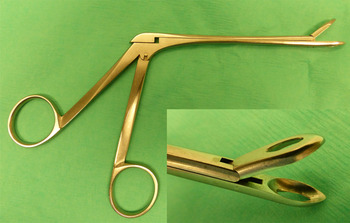
This leads to the supposition that at least two other people are also associated with these fenestrated ethmoid forceps: the Austrian laryngorhinologist Moriz Weil (1860–1938) and the Irish otologist William Wilde (1815–1876). In addition, the precise original form of Blakesley forceps is not always clear, such as its recent description as a nasal punch-like instrument.Reference Golub and Schmitt 8 To clarify, Blakesley ethmoid forceps are pistol grip handle forceps with an eccentric pivot, a thin shaft, mostly between 10 and 12 cm working length, terminated by an olive-shaped fenestrated double cutting jaw, which meets in a linear fashion edge-to-edge (Figure 1).Reference Kirkup 9
Blakesley's ethmoid forceps of today (author's collection).

This study aimed to go back to the original description of the instrument by Blakesley, and to follow its introduction, variations and acceptation by rhinosurgeons.
An extensive review of the medical literature written by and about Blakesley was conducted with the Medical Subject Heading term ‘Blakesley’ as author, using ‘Blakesley’ and ‘forceps’ as key words. The review involved searches of the PubMed archive and Google Books index (1910–1945), and the following journals (1910–1945): The Laryngoscope; The Annals of Otology, Rhinology & Laryngology; The Journal of Laryngology & Otology; The Archives of Otolaryngology; Transactions of the American Academy of Ophthalmology and Otolaryngology; The Journal of the American Medical Association; Archiv für Ohren-, Nasen-, Kehlkopftheilkunde: Zeitschrift für Ohrenheilkunde und für die Krankheiten der Luftwege / Zeitschrift für Hals-, Nasen- und Ohrenheilkunde; Monatsschrift für Ohrenheilkunde und Laryngo-Rhinologie; Annales des maladies de l'oreille, du larynx, du nez et du pharynx; Revue de laryngologie, otologie, rhinologie; and Archivio italiano di otologia, rinologia e laringologia.
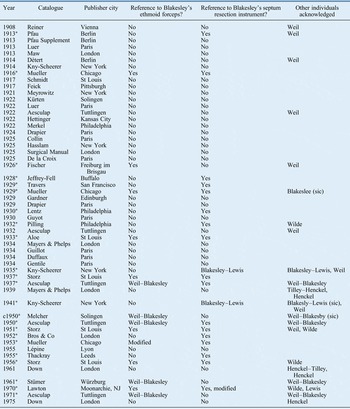
The review involved the compilation of more than 50 surgical instrument trade catalogues, including those published around the time of the first description of Blakesley's instrument until the mid-second part of the twentieth century (listed in Table I).
List of studied trade catalogues of surgical instruments

*Indicates reference to Blakesley's instrument(s).
Limitations of this study are mainly related to the impossibility of accessing all the trade catalogues published during this period, and the possibility of not having found all the literature written by and about Blakesley.
Following a biography of Blakesley, the first description of the ethmoid cutting forceps is presented. The paper then documents developments and the progression that led to the instrument becoming the standard instrument found in every ethmoidal armamentarium today.
Blakesley's biography
Very few documents exist regarding Blakesley's life. Furthermore, a review of the usual referenced otorhinolaryngological journals resulted in the discovery of only three papers written by Blakesley. These were published between 1915 and 1916, in the Transactions of the American Academy of Ophthalmology and Otolaryngology. All three papers concerned new medical instruments: a submucous septum resection instrument and an ethmoid instrument,Reference Blakesley 10 a new laryngeal snare,Reference Blakesley 11 and a new palate elevator.Reference Blakesley 12
Son of Alpheus Miles Blakesley (1835–1916), Theodore Seward Blakesley studied medicine at Rush Medical College in Chicago. He probably finished his studies in 1902 and later made a trip to Europe (dates are unknown). In Europe, he visited at least two rhinologists, including Gustav Killian (1860–1921) in Freiburg, who called him,Reference Killian 13 and Henri Paul Luc (1855–1925) in Paris.Reference Blakesley 10 Most of his career was spent in Kansas City.
Blakesley became a member of the American Academy of Ophthalmology and Otolaryngology during the First World War (the exact date is not known). At the same time, he acted as military surgeon in the medical reserve officers in Missouri, as mentioned in 1917. 14 He received an honours roll from the American Academy of Ophthalmology and Otolaryngology in 1919. 15 In 1922, he was repertorised as a member of the American College of Surgeons. 16
Blakesley was particularly interested in rhinology and dacryocystorhinostomy. In 1921, he ‘lectured on some of the causes and treatment of some of the painful diseases involving the sinuses of the face, placing special stress, and condemning the operation of pulling teeth in order to drain certain cavities of the face’ at a meeting of the Vernon County Medical Society. 17
In 1920Reference Wiener and Sauer 18 and 1923Reference Sauer 19 the rhinolaryngologist William Emil Sauer (1875–1955) of St Louis mentioned the technique of dacryocystorhinostomy used by Blakesley. In 1920, Sauer wrote:
‘Blakesley, after cocainizing the sac and corresponding mucous membrane of the nose, injects cocaine into the skin and makes a vertical incision one-quarter inch in length over the sac at its mesial margin, entering into the sac at its nasal attachment. Through this opening a specially constructed trephine, with a diameter of from 2 to 3 mm, is introduced into the sac, held in a dental right angle, and operated by a small motor with foot control. This is directed down and in, toward the torus. The ceasing of resistance indicates its passage into the nose. It is then withdrawn and the process repeated until the whole nasal floor of the sac is removed. The operation requires only a few minutes time’.Reference Wiener and Sauer 18
Sauer added, in 1923:
‘The same principle is carried out by Blakesley of Kansas City, who makes a small incision and then introduces a trephine to make his entrance into the nose. So far as I know, he pays no attention to the interior of the nose, doing it simply by the sense of touch’.Reference Sauer 19
Blakesley presented ‘an operation for chronic dacryocystitis’ in 1930, during the Colorado Congress of Ophthalmology and Otolaryngology.Reference Blakesley 20
Blakesley died at the age of 65 years in Kansas City, following a coronary artery occlusion. His grave is located in Rock Island County (Chippiannock Cemetery), Illinois.
Blakesley was also known as an amateur magician:
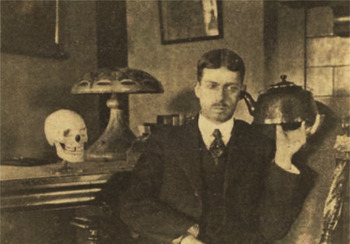
‘Dr. Blakesley is not a magic bug or a magic fan, but a man of science, who sees in magic much more than a mere form of amusement and has applied the natural sciences to produce magical effects and adapted the laws of physics, especially electricity, light and acoustics, to produce results which are magical in the impressions created in the minds of those who view them. The doctor stands high in the medical profession and devotes himself to his work six and a half days a week, the other half day he gives up to recreation and between times snatches an hour here and there for the development of his ideas in magical creations … In telepathic and spiritualistic phenomenon the doctor is especially skilful and, with the assistance of his talented wife, produces some very weird and seeming supernatural effects. The doctor's beautiful home is a mecca for every magician who comes to Kansas City’ (Figure 2). 21
Portrait of Blakesley, from The Sphinx, 1916. 21

Blakesley was a friend of the magician David Phelps Abbott (1863–1934).
First description of two nasal instruments by Blakesley
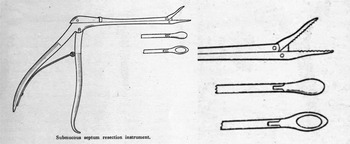
In 1915, Blakesley in fact described two nasal instruments: a submucous septum resection instrument and an ethmoid instrument.Reference Blakesley 10 Concerning the septal instrument, no longer used today, he wrote:
‘I have here an instrument that I use in submucous resection, and I have found that it is possible to rapidly fracture the perpendicular plate of the ethmoid and those vomers which are not too heavy, and at the same time it can be used as a dissector when the blades are closed. It has great power and it shortens the time of operation. Most instruments that grasp at the tip are thickest at the end in the direction they open, this is thin in this direction. This enables one to introduce the instrument, open it wide and grasp’.Reference Blakesley 10
Blakesley's drawing of this instrument (Figure 3) is not clear enough to show all the fine details of the double jaws.Reference Blakesley 10
Blakesley's original 1915 drawing of the ethmoid forceps, with detail.Reference Blakesley 10

In the fourth edition of Pfau's ENT trade catalogue, probably edited before or in 1913, Blakesley's septal instrument is already presented.Reference Pfau 22 It is shown with a grasping, non-fenestrated, serrated area, available with two different handles, including the notable pistol grip handle. This fourth edition of Pfau's trade catalogue is unfortunately not dated, but a supplement of it was published in 1913.Reference Pfau 23 The supplement states: ‘Since the edition of my catalog (fourth edition) many practical, most interesting novelties have been constructed, which are published in this list’. Blakesley is not referenced in this supplement.
The second instrument described by Blakesley in 1915 was the ethmoid instrument, the actual Blakesley nasal forceps:
‘This is a new instrument in ethmoid surgery. It is fenestrated, has great power, is thin when introduced and opens up so as to have a large grasping area. I got the idea of the duck bill when studying with Dr Luc of Paris. I have seen an operator fail in the Mosher operation to remove the ethmoid because he could not open the grasping instrument he was using wide enough to grasp after introduction after passing the anterior spine of the maxillary bone. It can be used also in removing soft polypi, etc’.Reference Blakesley 10
Blakesley did not give a clear description of this second instrument, except to say that the cutting jaws were fenestrated.
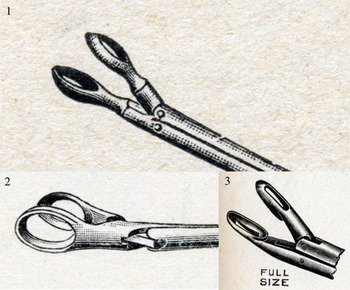
The use of a pistol grip handle in nasal instrumentation was reported in the first decade of the twentieth century. In the last decade of the nineteenth century, this pistol grip handle began to be incorporated into aural alligator forceps, which were used notably for the removal of polyps. The idea of fenestrated double cutting jaws which meet in a linear fashion edge-to-edge was also not new. In 1908, in the Reiner's trade catalogue, a ‘conchotome after Weil, with sharp pointed spoons’ is mentioned.Reference Reiner 24 Two other such kinds of devices are also depicted, in the 1913 Luer's trade catalogue under the appellation of ‘Lermoyez's lateral cutting forceps for resection of the ethmoidal bulla’, 25 and in the 1914 Kny-Scheerer trade catalogue under the name of ‘Farnham's [nasal forceps] cutting edge, fenestrated blades’ (Figure 4).Reference Kny-Scheerer 26 One of Blakesley's main ideas was to thin the distal part of the jaws to allow for an easier nasal introduction.
Predecessors of Blakesley's ethmoid forceps, by: Weil (‘1’), Lermoyez (‘2’) and Farnham (‘3’).

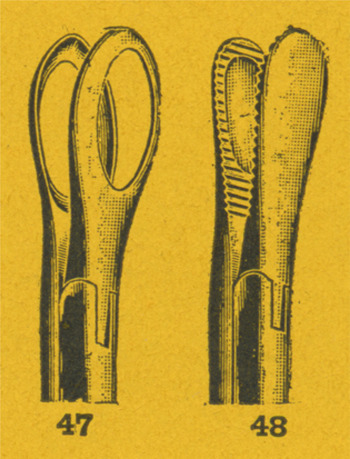
In Mueller's Surgeons’ Instruments, Office and Hospital Equipment, published in 1916 in Chicago, Blakesley's ‘ethmoid exenteration forceps’ and Blakesley's ‘septal plate forceps’ are presented (Figure 5).Reference Mueller 27 The Blakesley ethmoid forceps show fenestrated double cutting jaws, today's form, and the Blakesley septal forceps are drawn with non-fenestrated, incomplete serrated jaws.
Blakesley's ethmoid forceps (‘47’) and septal forceps (‘48’), as shown in Mueller's 1916 catalogue.Reference Mueller 27

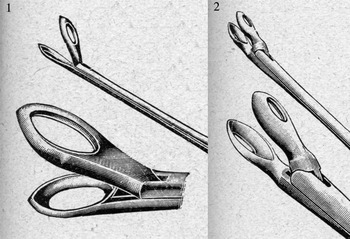
In 1922, in Aesculap's trade catalogue, the Weil's ethmoid forceps are mentioned but not the Blakesley forceps.Reference Aesculap 28 In Fischer's surgical instruments catalogue, edited in 1926, Blakesley's ethmoid cutting forceps are described (Figure 6).Reference Fischer 29 These are also presented in Mueller's 1916 catalogue, as are the ethmoid cutting forceps attributed to Weil (exactly the same drawing as in Aesculap).Reference Mueller 27 The difference between the Weil and the Blakesley ethmoid forceps lies essentially in the base of the cutting jaws, which are narrower in Weil's instrument. Blakesley's septal forceps are not presented.
Blakesley's ethmoid forceps (‘1’) and Weil's ethmoid forceps (‘2’), as shown in Fischer's 1926 trade catalogue.Reference Fischer 29

Blakesley's septal forceps showed a slight modification of the serrated jaws, complete in 1928;Reference Jeffrey-Fell 30 this modification was present in some of the usual surgical instruments catalogues until the 1960s. The septal forceps were mentioned more often than the ethmoid forceps, and then very rarely (Table I). Sometimes the forceps also appeared under the name of Blakesley–LewisReference Kny-Scheerer 31 or simply Lewis’ nasal forceps.Reference Melcher 32 On the contrary, the ethmoid forceps progressively found their definitive place in the second half of the twentieth century.
Definitive adoption of Blakesley's ethmoid forceps
After Blakesley's original description in 1915, and after the first mention found of the Weil ethmoid forceps in 1908, another very similar instrument, the ‘nasal punch forceps’, was attributed to Wilde, notably in Pilling's ENT instruments catalogue of 1932.Reference Pilling 33 It presents exactly the same characteristics as the Weil forceps. The attribution of such an instrument to Wilde is a little confused, because during his lifetime the pistol grip handle with an eccentric pivot did not exist. In addition, Wilde was mainly an otologist who effectively described some forceps notably to take away polyps from the external auditory canal. It is possible that ‘Wilde’ referred to another person, but no documentation was found to sustain this theory. Another possibility could be simply a confusion of the names Weil and Wilde, Weil being less well known than Wilde.
In 1937, in Storz Eye, Ear, Nose and Throat Instruments, Equipment and Supplies, Blakesley's ‘ethmoid curetting forceps’, Weil's nasal forceps ‘with round, flat, spoon-shaped jaws’ but not fenestrated, and Wilde's nasal forceps ‘with oval, pointed, cup-shaped, fenestrated jaws, bent upward’ are presented together.Reference Storz 34
In the 1953 Storz trade catalogue, Weil's and Wilde's forceps are available straight or upturned.Reference Storz 35 This led some instrument making companies, such as Aesculap, since 1937,Reference Aesculap. 36 to name the instrument more often the Weil–Blakesley, or, less often, the Blakesley–WeilReference Bhat and Manjunath 37 or Blakesley–Wilde.Reference Naumann and Helms 38
An unclear modification of Blakesley's septum bone forceps, described as ‘useful for removal of ethmoid cells’, is found in Mueller's 1953 ENT instruments catalogue.Reference Mueller 39 The jaws are round, fenestrated and surrounded by three cutting zones.
It is interesting to note that Blakesley's name was given different spellings, such as ‘Blakeslee’,Reference Mueller 40 ‘Blakesly’Reference Kny-Scheerer 31 or ‘Blakesby’,Reference Melcher 32 in some of these various instruments catalogues.
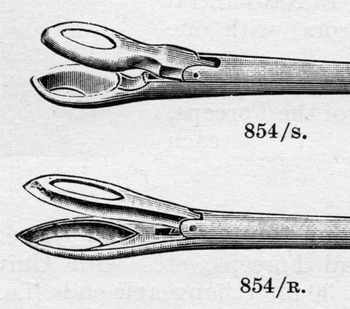
In the Mayer and Phelps 1939 catalogue, two very similar instruments resembling the Blakesley ethmoid forceps are described,Reference Mayer and Phelps 41 probably for the first time (these were not in the Mayer and Phelps 1934 catalogueReference Mayer and Phelps 42 ). The first instrument is eponymously associated with Henckel, and the second instrument, which is graduated on the shaft, is eponymously named Tilley–Henckel. Herbert Tilley (1866–1941) was an otorhinolaryngologist in London. The name ‘Henckel’ is sometimes written without the ‘c’ (i.e. ‘Henkel’).Reference Stephenson 43 No documents were found relating to Henckel. These two ‘punch forceps’ are mentioned in the 1975 Down Surgical trade catalogue.Reference Down 44 In the intervening 1952 trade catalogue, it is a little confusing because Henckel is mentioned associated with two different instruments, one like Blakesley's ethmoid forceps (‘854/R’) and one like Weil's ethmoid forceps (‘854/S’) (Figure 7).Reference Down, Mayer and Phelps. 45 Tilley is also associated with the model resembling Blakesley's original ethmoid forceps: ‘Henckel's … with bow handles, as used by Tilley’ and have measurement graduation (same drawing as in the 1939 catalogueReference Mayer and Phelps 41 ). They are still available today under the names ‘Henckel forceps’ and ‘Tilley Henckel nasal forceps’.
Images from Down Bros. and Mayer and Phelps 1952 catalogue showing two Henckel's ethmoid forceps, one like Blakesley's (‘854/R’) and one like Weil's (‘854/S’).Reference Down, Mayer and Phelps. 45

Conclusion
This study demonstrates that Blakesley first officially described his ethmoid forceps in 1915. Nevertheless, Weil preceded him because his instrument was already mentioned in 1908. Wilde's eponymous similar instruments appeared a few years later in the usual surgical instruments catalogues. The association between Blakesley and Weil is historically understandable, but not the association between Blakesley and Wilde. The ethmoid cutting forceps were also surprisingly attributed to Henckel and Tilley more than 20 years after Blakesley's original description, first only in Great Britain.
Blakesley can be considered as the inventor of these pistol grip handle forceps, which have an eccentric pivot and a thin shaft terminated by an olive-shaped fenestrated double cutting jaw that meet in a linear fashion edge-to-edge, of which the jaws are without a narrower base. Weil also played an important role, but his instrument showed a narrower base of the cutting jaws. The eponymous association with Weil is acceptable if we consider only the distal form and the major function of this instrument.
The association with other eponyms brings nothing other than confusion. Nevertheless, it would be good to avoid using the other eponyms when referring to the original Blakesley instrument, and to use Weil's eponym only for the instrument with the narrower base of the cutting jaws.