Introduction
Attention-deficit hyperactivity disorder (ADHD) is a concept covering several sub-groups of disorders with varying genetic backgrounds, patterns of co-morbidity and cognitive prerequisites (Spencer, Reference Spencer2006; Drtilkova et al. Reference Drtilkova, Sery, Theiner, Uhrova, Zackova, Balastikova and Znojil2008). Environmental circumstances may also constitute risk factors (Banerjee et al. Reference Banerjee, Middleton and Faraone2007). Parental psychopathology may be influential both as a genetic marker and as an aspect of the psychological environment. It may also be expressed in toxic influences, as in alcohol consumption during pregnancy and determine the socio-economic living conditions.
Both alcohol and drug abuse seem to be more frequent in parents of children with ADHD (Roizen et al. Reference Roizen, Blondis, Irwin, Rubinoff, Kieffer and Stein1996; Wilens et al. Reference Wilens, Hahesy, Biederman, Bredin, Tanguay, Kwon and Faraone2005). Adversity – often linked to parental substance abuse (Famularo et al. Reference Famularo, Kinscherff and Fenton1992a) – may also increase the risk of ADHD (Famularo et al. Reference Famularo, Kinscherff and Fenton1992b). Findings concerning offspring ADHD in relation to parental psychopathology are not conclusive, ranging from no increased risk (Lahey et al. Reference Lahey, Piacentini, McBurnett, Stone, Hartdagen and Hynd1988) to increased occurrence of parental ADHD, but not other types of psychopathology (Chronis et al. Reference Chronis, Lahey, Pelham, Kipp, Baumann and Lee2003) to increased rates also of parental affective disorders (Biederman et al. Reference Biederman, Faraone, Keenan and Tsuang1991) or even of other psychiatric disorder (Ghanizadeh et al. Reference Ghanizadeh, Mohammadi and Moini2008). Some studies have focused on the risk of offspring ADHD in relation to parental psychopathology and gender. In the first study, involving 114 children with ADHD, Stawicki & Nigg (Reference Stawicki and Nigg2003) reported excess parental psychopathology in parents (especially fathers) of boys with ADHD. These effects were carried by antisocial personality disorder and alcohol use disorder in fathers and by general anxiety disorder in mothers. The only finding related to girls with ADHD was higher rates of drug use disorder in the mother. Ghanizadeh et al. (Reference Ghanizadeh, Mohammadi and Moini2008) reported that fathers of 80 children with a clinical diagnosis of ADHD more often than mothers had a diagnosis of ADHD themselves, which was the only statistically significant difference between maternal and paternal psychopathology. In a study based on claims on insurance company concerning any indication of ADHD in 431 children ≤5 years of age (Figueroa, Reference Figueroa2010), both maternal and paternal ADHD were more common than in comparisons. Some disorders were more common in mothers only: mental retardation, bipolar disorder, psychosis and depression. In summary, only few studies have approached the role of gender in the intergenerational transmission of ADHD and the study groups have been fairly small with the exception of one study based on insurance claims in very young children. The contradictory results from these studies – almost no gender differences v. marked gender differences – call for further studies on this issue. Such studies may bring forward hypotheses about the interplay between genetic and environmental risk factors for the development of ADHD. This may – in turn – be of importance for the formation of future prevention and treatment strategies.
Swedish national registers offer a potential for overcoming some methodological problems in this area like retrospective reporting or biased sampling due to local traditions of identification and diagnostic procedures. Whole age cohorts can be identified and all hospital care can be scrutinized in relation to specific research questions. Parental and offspring generations are easily identified. Since July 2005 these registers also contain information on individually linked prescriptions of drugs, opening up for identifying study groups who are usually not admitted to in-patient care, but who can be identified by prescriptions of specific drugs (Wettermark et al. Reference Wettermark, Hammar, Fored, Leimanis, Otterblad Olausson, Bergman, Persson, Sundström, Westerholm and Rosén2007). Pharmacological treatment of ADHD is based on a few drugs, used almost exclusively for this indication. Thus, this study aimed at analyzing if/how gender influences the association between parental psychiatric/addictive disorders and ADHD medication in the offspring.
Methods
Design
Prescribed and dispensed ADHD medication (outcome variable) were identified in a national cohort of young, 6–19 years of age, individuals (study population). Information about maternal and paternal hospital care and/or death related to psychiatric disorder, suicide attempt/death or substance abuse was used for creation of independent variables. Data concerning maternal education, lone parenthood and social welfare were used for creating potentially confounding variables.
Study population and data
Study population
All Swedish residents are assigned a unique ten digit ID number at birth or immigration. This ID was used to link information from different national registers.
The study population was created from the birth cohorts of individuals born during 1987–2000, who were alive and residents in Sweden as on December 31, 2005 according to the Register of the Total Population. To avoid uncontrollable bias due to migration-related factors, all foreign-born individuals and individuals with a record of at least one adoptive parent and/or at least one foreign-born parent (according to the Multi-Generation Register) were excluded, leaving a study population of 1 162 524 individuals.
Independent variables
Data on parental psychiatric and addictive disorders were obtained through individual record linkage to the National Patient Register (NPR) from 1973 to 2005 and the National Cause of Death Register (NCDR) from 1986 to 2005 with the aid of the 9th and 10th revisions of the WHO International Classification of Diagnosis (ICD). The NPR contains information about all in-patient care in Sweden since 1987. Before that year – since the 1960s – it also contains information about in-patient psychiatric care at public hospitals.
Five aggregated diagnostic groups, large enough for statistical analyses, were categorized as follows:
• Suicide death or attempt (included even in the absence of a psychiatric diagnosis) – underlying cause of death in the NCDR or a hospital discharge with an external cause diagnosis of E950–E959 or E980–E989 (ICD-9) during 1973–1996 and X60–X84 or Y10–Y34 (ICD-10) during 1997–2005.
• Psychotic disorders – at least one discharge or cause of death diagnosis of schizophrenia, schizotypal and delusional (F20–F29 in ICD 10).
• Affective disorders – at least one hospital discharge or underlying cause of death diagnosis representing the F30–F39 sequence in ICD 10.
• Alcohol abuse – at least one discharge or cause of death diagnosis indicating a psychiatric or somatic disorder associated with alcohol addiction or excessive alcohol consumption.
• Illicit drug abuse – at least one discharge or cause of death diagnosis indicating a psychiatric or somatic disorder associated with illicit drug abuse.
Outcome variable
The purchase of at least one prescription of a drug with an Anatomical Therapeutic Chemical code of N06BA01–N06BA04 (amphetamine, dexamphetamine, metamphetamine and methylphenidate) or N06BA09 (atomoxetine), during 2006, according to The Swedish Prescribed Drug Register13, were used to create the outcome variable of the study: ADHD medication. Since there are regional differences in the consumption of ADHD medication in Sweden – most probably mirroring varying prescription patterns in different counties – we created a variable, ‘county of residence’, to adjust the analyses for such confounding (Lindblad et al. Reference Lindblad, Ringbäck Weitoft and Hjern2010). The counties were classified into four categories according to the proportion of children having purchased ADHD medication during 2006: high prescription rates (>0.8%), high-average prescription rates (0.7–0.8%), low-average prescription rates (0.5–0.6%) and low prescription rates (<0.5%).
Potentially confounding variables
Maternal education, lone parenthood and social welfare have previously been reported to influence offspring risk of receiving ADHD medication (Hjern et al, Reference Hjern, Ringbäck Weitoft and Lindblad2010).
• Information on maternal education in 2005 was obtained through linkage to the Swedish National Education Register and classified into four categories: having 9 years or less of schooling, representing primary school only; 10–12 years, equivalent to secondary school; 13–14 years, i.e. short post-secondary education; 15+ representing a university education.
• Lone parenthood refers to the status of the head of the household according to the Total Enumeration Income Survey of 2005. Thus, ‘single parent’ may indicate either a father or a mother.
• Data on income from social welfare in 2005 were obtained through linkage to the Total Enumeration Income Survey of 2005. Social welfare in Sweden is a form of cash income allowance from local social authorities, after a thorough means investigation, with the purpose to guarantee the applicant a minimum standard of living.
Statistics
Logistic regression was used to calculate odds ratios (OR) with 95% confidence interval (CI) as estimates of effects of parental psychiatric and addictive disorders, with consumption of ADHD medication, defined above, as the outcome variable. Interaction analyses of gender differences in effects of parental morbidity variables were made in a logistic regression model with adjustment for age and county only with any addictive and any psychiatric problem for mothers and fathers separately as the exposures. The statistical analyses were performed using SPSS version 18.0 for Windows.
Ethical considerations
This study was made with secondary data where the person's ID had been replaced with an anonymous code and informed consent was thus not possible to achieve. It was performed within the framework of the governmental mission to the National Board of Health and Welfare to follow and analyze public health including prescriptions of drugs, which means that an ethical approval was not called for.
Results
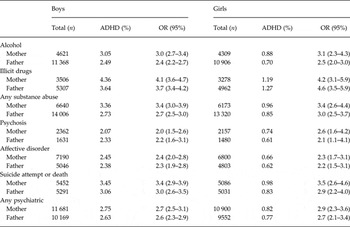
During 2006, prescribed and dispensed ADHD medications were registered in 7960 individuals (6–19 years of age), 1.06% of all boys and 0.29% of all girls. Methylphenidate was the most common drug (87.8%), followed by atomoxetine (9.2%) and amphetamine (3%). In Table 1, the crude rates of ADHD medication and OR adjusted for age are presented in relation to exposure to parental psychiatric/addictive disorders. Children of parents who are non-exposed to psychiatric/addictive disorders serve as the reference group. Parental diagnosis related to illicit drugs was associated with the highest ratios (OR: ~3.5–4), followed by suicide attempt/death (OR: ~ 3–3.5), alcohol (OR: ~2.5–3), affective disorder (OR: ~ 2.5) and psychosis (OR: ~ 2–2.5) (Table 1).
Crude rates and OR (adjusted for age only) of ADHD medication by indicators of parental addictive and psychiatric disorders

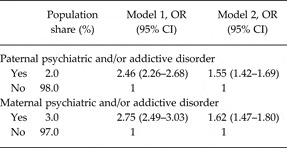
The ORs were quite similar for maternal and paternal psychiatric hospitalizations as well as for boys and girls (Table 1). This is further demonstrated in Table 2, where logistic regression of medication in relation to aggregated diagnostic constructs of all in-patient care related to psychiatric/addictive diagnoses is presented. Adjusting for social characteristics (maternal education, lone parenthood and social welfare) decreased the OR substantially and in the same way for fathers and mothers. The interaction analysis of gender showed very similar effects (interaction effects OR: 0.91–0.94; p-values 0.6–0.9) in boys and girls for the parental morbidity variables.
Logistic regression of ADHD medication at least once in 2006

Model 1 is adjusted for year of birth, sex and county of residence.
Model 2 is adjusted for year of birth, sex, county of residence, maternal education, lone parenthood and social welfare recipient.
For 566 children in the whole birth cohorts, both parents had been hospitalized at least once due to psychiatric disorder (psychosis, affective disorder and suicide attempt/death), but had no indications of substance abuse. The ORs (adjusted for age only) in this group were 3.4 (2.2–5.4) for boys and 3.0 (1.3–7.4) for girls.
Discussion
This study, involving more than 1.1 million native Swedish children and adolescents (6–19 years of age), showed increased risks of ADHD medication when parents had a history of hospitalization from addictive or psychiatric disorders. These risks were of similar magnitudes for maternal and paternal psychopathology as well as for girls and boys.
Our results contrast the findings of Stawicki & Nigg (Reference Stawicki and Nigg2003), who reported different disorders in mothers compared to fathers of children with ADHD and also a much stronger link between parental psychopathology and ADHD in boys than in girls. The study was based on a community sample and used questionnaires and structured parental interviews as diagnostic procedures. Possibly, their approach may have conveyed inclusion also of less severe cases of both offspring and parental disorders. Our findings related to parental gender support previous findings from one study involving children, 5–15 years of age – diagnosed with ADHD in child and adolescent psychiatry (Ghanizadeh et al. Reference Ghanizadeh, Mohammadi and Moini2008). Possibly, the divergent findings in the study of Figueroa (Reference Figueroa2010) may be explained by the unusual diagnostic procedure – data based on claims – and/or the much younger (≤5 years of age) study group.
Fetal exposure to environmental agents such as alcohol, nicotine and other drugs has been suggested to increase the risk for ADHD. In a previous study, we have shown that genetic confounding might explain most or even all of the increased risk previously linked to maternal tobacco use during pregnancy (Lindblad & Hjern, Reference Lindblad and Hjern2010). The slight tendency for a higher risk increase for boys for maternal compared with paternal drug and alcohol abuse in this study could be congruent with such an effect of fetal exposure, but in general the similarities between paternal and maternal abuse seem to point more in the direction of genetic mechanisms.
Daughters seem to be better able to cope with the emotional challenge of parental chronic somatic disease (Steck et al. Reference Steck, Amsler, Kappos and Bürgin2001). Similar gender differences would hypothetically have been expressed also in our study and seem to be more congruent with the findings of Stawicki & Nigg (Reference Stawicki and Nigg2003). However, the equal impact of parental psychiatric disorder for girls and boys is quite similar to the lack of interaction with gender of the offspring reported in a study focusing on maternal depression, paternal antisocial behaviour and psychiatric disorders (major depression and conduct disorder) in their child (Marmorstein et al. Reference Marmorstein, Malone and Iacono2004). Possibly genetic mechanisms are particularly prominent in samples with severe parental psychopathology.
Limitations
The parental in-patient care data serve as a marker of parental psychiatric problems and does not reflect a specific time or type of offspring exposure to these problems. Furthermore, such data are most probably not representative of cases where the diagnosis has been verified in out-patient care only or cases not reaching medical care at all. Data on out-patient care were not available which means that we could not investigate whether the risk of ADHD medication changes with the severity of parental disorder. Most probably our selection means a focus on the more severe cases, but probably to a varying degree in different sub-groups. For instance, many parents with alcohol problems have probably been treated in out-patient care only, whereas psychotic diagnoses probably more often have lead to hospitalizations. Such selection mechanisms may have brought forward too high ORs for substance abuse and more adequate ORs for psychosis.
The quality of the diagnostic procedure constitutes another potential bias but, for instance, the validity of a diagnosis of schizophrenia in the registers in focus seems to be satisfactory (Dalman et al. Reference Dalman, Broms, Cullberg and Allebeck2002). It is also reasonable to believe that the validity for aggregated diagnostic groups, as in this study, is even higher. Due to statistical power issues, it was only possible to include such aggregated groups in the analysis. Future register studies need to include more individuals/study years in order to study specific diagnostic groups.
Prescription of central stimulants is regulated by national guidelines recommending medication only when supportive interventions are not enough. The right to prescribe is restricted to selected specialists. The Swedish health care system provides free medical care for all children. Thus, for various reasons, medication is most likely a useful indicator of severe cases of ADHD in Sweden. However, ‘overprescription’ – medication of children not fulfilling ADHD-diagnostic criteria – may have occurred due to strong expectations about medication and suboptimal diagnostic routines. Along the same line, school professionals are often involved in identifying ADHD symptoms, illustrating that differences between schools and communities may influence the detection rate and thus also the medication rate. In order to minimize such effects, we made adjustments for ‘county of residence’, which means that we adjusted the analyses for different prescription patterns between counties. It is also problematic that parental psychiatric disorders may influence the detection rate of children with ADHD in several ways. The parental disorder may imply difficulties to perceive and understand the symptoms of the child. Contrarily, children of psychiatric patients may receive more and earlier child psychiatric attention than others due to the parental psychiatric contacts. Psychiatric diagnoses may also indicate less than average familial resources to adjust the family environment to the needs of the child. The gradually increasing proportion of girls among children who are prescribed ADHD medication (Janols et al. Reference Janols, Liliemark, Klintberg and von Knorring2009) highlights that gender differences in the offspring should be interpreted with care.
It should be acknowledged that there are other indications for the medications we use as a proxy of ADHD, e.g. narcolepsy. These indications are rare but we were not able to measure the extent of this potential bias. It should also be noted that the parental diagnoses refer to the ICD categories, whereas we have used the label of the Diagnostic and Statistical Manual of Mental Disorders (DSM), ‘ADHD’, for the children. The reason is that this concept is more often referred to than the ICD-labeled hyperkinetic syndrome.
Conclusion
A variety of parental psychopathologies, when in severe form, appear to be associated with offspring ADHD. However, neither parental nor offspring gender seems to influence the link between the psychiatric/addictive disorders looked for and offspring ADHD. Future studies need to address the link between offspring ADHD and more sharply defined parental diagnostic groups in nationally representative samples. Characteristics of offspring exposure to manifestations of the parental disorder also need to be scrutinized further with the aim of clarifying the type and intensity of the environmental challenge.
Acknowledgements
The research position of Frank Lindblad was financed by the Swedish Council for Working Life and Social Research. The study was also partly funded by the Swedish National Board of Health and Welfare.
Declaration of Interest
Potential conflicts of interest: none.