Brazilian Veneto is a Romance language spoken by approximately 500,000 people, most of whom live in the southern Brazilian states of Rio Grande do Sul, Santa Catarina and Paraná (Margotti Reference Margotti2004, Pereira Reference Pereira2017). It is also spoken in the southeastern Brazilian states of São Paulo and Espírito Santo (see e.g. Loriato Reference Loriato2019). The language is often referred to by its speakers as Talian (/taˈljaŋ/), meaning ‘Italian’, given the geographical origin of the speakers who developed it, even though it is not a variety of Standard Italian. In this Illustration, I will refer to the language under examination as Talian, following many speakers’ naming preference.
Talian is registered in Ethnologue as belonging to Veneto (Indo-European, Italic, Romance, Italo-Western; ISO 639-3 (vec), Eberhard, Simmons & Fenning Reference Eberhard, Simmons and Fennig2019). Even though Talian is listed as an immigrant language in Brazil’s National Institute of Historic and Artistic Heritage (in Portuguese: Instituto do Patrimônio Histórico e Artístico Nacional, IPHAN), it is assumed to have developed in Brazil with Italian immigrants and their descendants (Frosi & Mioranza Reference Frosi and Mioranza1983, Reference Frosi and Mioranza2009).
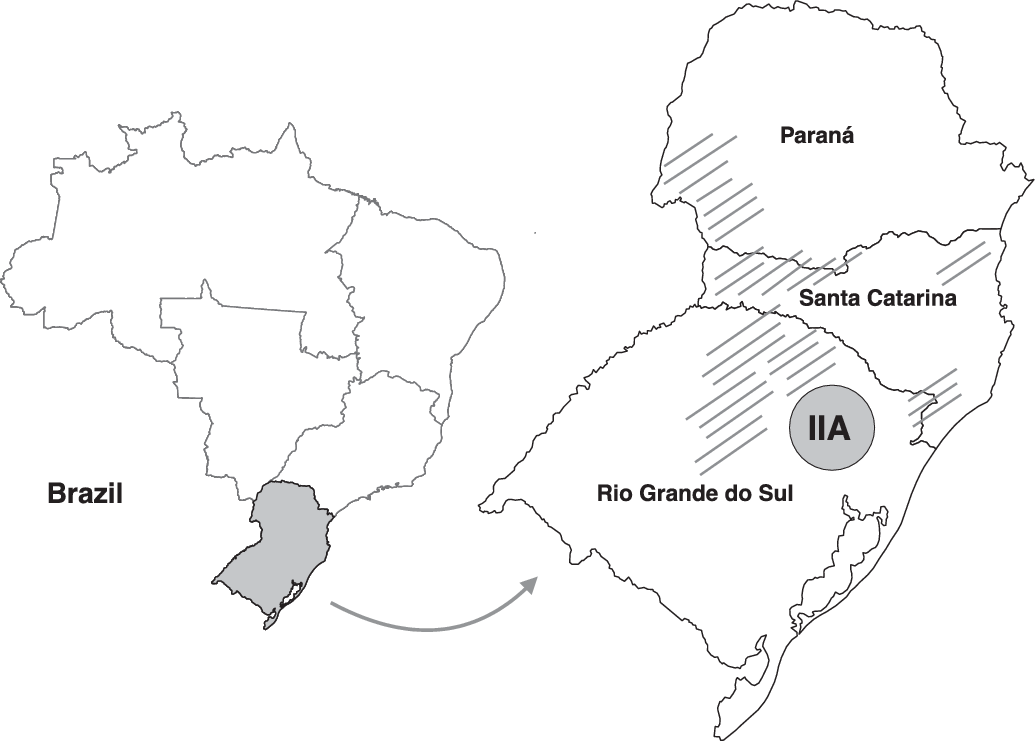
Italian immigration to Brazil started in the second half of the 19th century. In the southern state of Rio Grande do Sul, Italian immigration started in 1875, with immigrants first settling in a region known as the Italian Immigration Area (IIA; Frosi & Mioranza Reference Frosi and Mioranza1983; in Portuguese: Região de Colonização Italiana). Some immigrants and their descendants then settled in other areas of Rio Grande do Sul and other southern states (Santa Catarina and Paraná), especially after 1900 (Confortin Reference Confortin1998, Margotti Reference Margotti2004, Pertile Reference Pertile2009). Figure 1 shows the location of the IIA in Rio Grande do Sul and the other areas where Italian immigrants and their descendants settled in southern Brazil.
The Italian Immigration Area (IIA) in the state of Rio Grande do Sul. The diagonal lines correspond to other areas where Italian immigrants and their descendants settled in southern Brazil, and where Talian is also spoken.

Most Italians who immigrated to southern Brazil were from the Northeastern region of Veneto (∼54
 $\%$
) and spoke a Veneto dialect (∼60
 $\%$
); other immigrants were mostly from Lombardy (∼33
 $\%$
), Trentino-Alto Adige (∼7
 $\%$
), and Friuli-Venezia Giulia (∼4.5
 $\%$
) (Frosi & Mioranza Reference Frosi and Mioranza2009). As land assignment followed the order in which immigrants arrived in Brazil, most IIA communities ended up with settlers from different regions in Northeastern Italy who spoke different languages. Very few communities had a single immigrant language or dialect; in most cases, communities either had a majority of Veneto speakers (of different dialects) or a combination of speakers of many immigrant languages (Frosi & Mioranza Reference Frosi and Mioranza1983; see Bonatti Reference Bonatti1974 for an example of linguistic island in a Brazilian community of Italian immigrants).
The contact between the various languages spoken by Italian immigrants, the predominance of Veneto dialects among such languages, and the scarce contact with Portuguese arguably favoured the development of a Veneto-based koine (Frosi & Mioranza Reference Frosi and Mioranza1983, Reference Frosi and Mioranza2009). Over time, as the immigrants and their descendants became more familiar with Portuguese, such koine incorporated elements (such as loanwords) from Portuguese. The terms Brazilian Veneto and Talian thus refer to this Veneto-based language that was developed upon Italian immigration to Brazil. Relative to the Veneto varieties spoken in Italy today, Talian seems to be close to Central Veneto (spoken, for example, in the regions of Vicenza, Padova and Verona; see e.g. Frasson Reference Frasson2021). Today, virtually all speakers of Talian also speak Brazilian Portuguese (Confortin Reference Confortin1998, Margotti Reference Margotti2004, Pertile Reference Pertile2009).
This Illustration is based on IIA Talian, but it also applies to Talian as spoken in other regions of Brazil. Four female speakers aged between 30 and 60 years old were consulted and recorded. These speakers were all born and raised in the IIA, had lived in an IIA town for most of their lives (Antônio Prado, population 13,000), and have Italian ancestors, most of whom came from the Veneto region. They learned Talian as children in their households: three of them spoke mostly Talian during their childhood, while the other one spoke Talian and Portuguese at fairly similar rates. Today, they claim to generally use Portuguese for social and work purposes, and Talian for interactions with family members and close friends. This sort of division in language use has been reported in both the IIA and other areas where Talian is spoken (e.g. Pertile Reference Pertile2009).
Most of the sound files attached to this paper were recorded by the speaker aged 30 years old. This speaker was recorded at the studio of Rádio Solaris, the radio station in the IIA town of Antônio Prado, using a Yamaha MG16 analog mixer and an AKG D 880 S microphone, through the software Sound Forge. To obtain the acoustic measurements and additional examples discussed below, this same speaker and the other three speakers were recorded in extra individual sessions. These sessions were conducted in a silent room, using a Logitech H390 wired headset microphone connected to a MacBook. The productions from the individual sessions were recorded using Audacity at a sampling frequency of 44,100 Hz.
The examples provided here, as well as the items used in the acoustic analyses, were extracted from word lists that were read by the speakers. The target words were presented in isolation, and the speakers were instructed to produce them in a natural way, and to include pauses between their productions. As will be seen below, several phenomena observed in Talian are assumed to be variable (see e.g. Frosi & Mioranza Reference Frosi and Mioranza1983, as well as sociolinguistic studies that explore the effects of contact with Talian on Portuguese, such as Battisti & Bovo Reference Battisti and Bovo2004, and Guzzo Reference Guzzo2010). Samples of these variable phenomena were obtained in two ways: (i) from spontaneous productions based on the word list, and (ii) by asking speakers whether they were familiar with any alternative ways to produce certain items. Most transcriptions provided in this Illustration are broad (except for those that highlight variable or surface phenomena, which are provided in brackets).
Talian has no established spelling system. The orthographic transcriptions provided in this Illustration are based on a Talian–Portuguese dictionary (Luzzatto Reference Luzzatto2000) and a descriptive grammar (Stawinski Reference Stawinski1982). The speakers recorded for this Illustration are familiar with written Talian. However, most Talian speakers either do not have the habit of reading in Talian or are not able read the language whatsoever (Confortin Reference Confortin1998, Ribeiro Reference Ribeiro2005).
Consonants

Initial and medial position (syllable-initial)

Final position

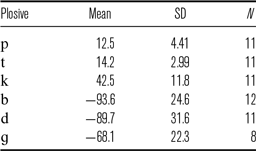
Voiced plosives have negative voice onset time (VOT), with continuous voicing throughout the closure, while voiceless plosives have short positive VOT. Table 1 shows the mean VOT (and standard deviations) for all the plosives in Talian (/p t k b d ɡ/) in word-initial (stressed) position. These measurements were obtained from two to three productions of each of the plosives by each of the four speakers.
Voice Onset Time (in milliseconds) of the plosives.

Similar to other Veneto varieties (but unlike Standard Italian, for example), Talian has no geminates. Regarding place of articulation, impressionistic observations have suggested that /t, d, s, n/ may also be dental or denti-alveolar (Frosi & Mioranza Reference Frosi and Mioranza1983).
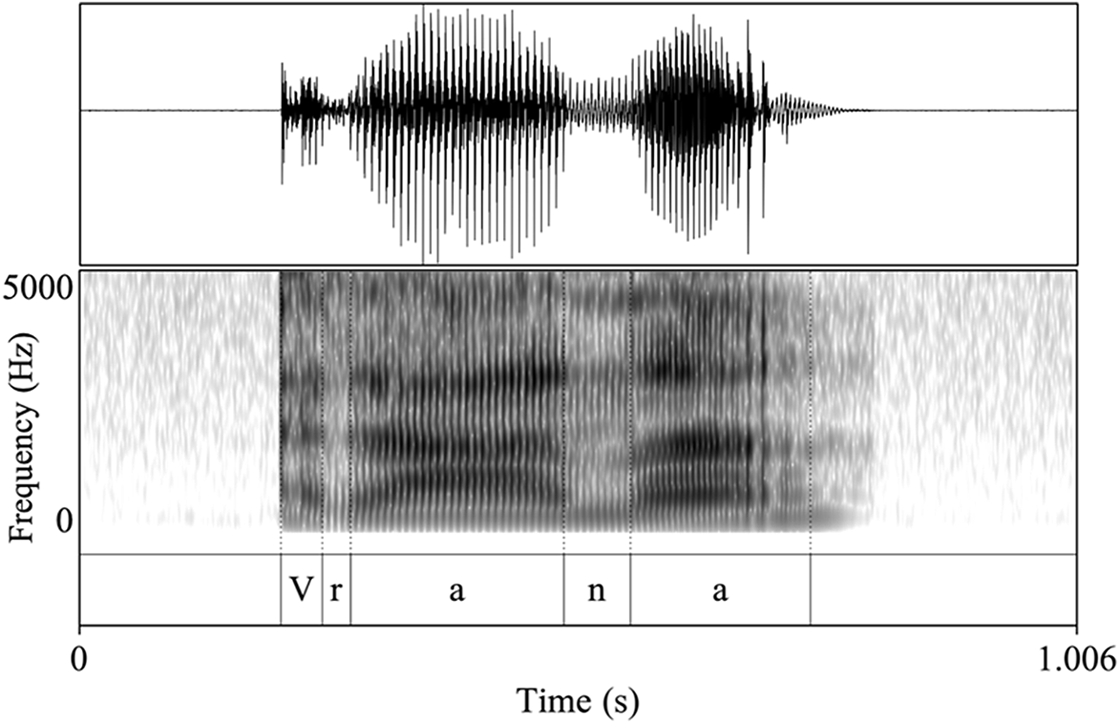
In Talian, [ɾ] alternates with [r] (e.g. [ˈɾana] ∼ [ˈrana] rana ‘frog’). The rhotic may also be produced as a fricativized trill or tap (as in the production of rana in the consonant list, which exhibits a fricativized trill; Guzzo forthcoming). Rhotic fricativization may also be found in coda position, as in the production of bicier ‘glass’ above. In complex onsets where a rhotic follows a plosive or fricative, [ɾ] is typically observed (as in /ˈkwatɾo/ quatro ‘four’ above; Guzzo forthcoming). Figures 2, 3 and 4 illustrate rhotic variation in the word rana. Figure 2 shows a tap, Figure 3 shows a trill, and Figure 4 exhibits a fricativized rhotic. Note that word-initial rhotics in Talian may be preceded by an excrescent vowel (close to [ə]), a phenomenon that has been observed in other languages that have taps/trills, such as Greek and Italian (see e.g. Baltazani & Nicolaidis Reference Baltazani, Nicolaidis, Spreafico and Vietti2013, Nodari & Meluzzi Reference Nodari and Meluzzi2020). Excrescent vowels preceding rhotics in Talian are exemplified in Figures 2 and 4.
Talian does not have post-alveolar fricatives (/ʃ ʒ/), which are also absent in other Veneto varieties (Zamboni Reference Zamboni1974, Canepari Reference Canepari1976), but exist in Brazilian Portuguese. In loanwords from Brazilian Portuguese, /ʃ ʒ/ are typically adapted as /s z/: [soˈɾasko] (for [ʃuˈxaskʊ] churrasco ‘barbecue’), [siˈnɛla] (for [ʃiˈnɛlɐ] chinela ‘sandal’), [zakaˈɾɛ] (for [ʒakaˈɾɛ] jacaré ‘cayman’), [ˈze͡ito] (for [ˈʒe͡itʊ] jeito ‘manner’). However, Talian speakers who are dominant in Portuguese or use Portuguese on a regular basis employ target /ʃ ʒ/ in such loanwords (Margotti Reference Margotti2004).
It has been noted that some Talian speakers have the fricatives [ɸ β θ ð] in their inventories, and use them primarily in place of intervocalic /f v t d/ (although these fricatives appear to be phonemic in certain lexical items; Frosi & Mioranza Reference Frosi and Mioranza1983). This has been attributed to the influence of Lombard dialects and certain Veneto dialects (such as Padovano-Vicentino-Polesano, Trevigiano-Feltrino-Bellunese, and the dialect of Venice), which contain some or all of these segments in their inventories (Frosi & Mioranza Reference Frosi and Mioranza1983; see also Zamboni Reference Zamboni1974, Canepari Reference Canepari1976). The speakers recorded for this Illustration do not use such fricatives.
It is open to discussion whether /j w/ are phonemes in Talian. /j/ + vowel strings can be produced in hiatus where /j/ is realized as [i], similar to Brazilian Portuguese (for rising diphthongs in Brazilian Portuguese, see Collischonn Reference Collischonn and Leda2010). There is no contrast between productions with hiatus and productions with [j]. Items where /j/ is preceded and followed by a vowel are possible exceptions to this alternation, since they seemingly cannot be produced with hiatus (i.e. /j/ cannot be realized as [i]): /ˈmɛjo/ meio ‘better’, /ˈpaja/ paia ‘straw’, and /ˈbujo/ buio ‘noise’.
/j w/ can be followed by all the vowels in Talian’s inventory, except for /i/ (in the case of /j/) and /u/ (in the case of /w/): /ˈpjena/ piena ‘full’, /ˈkjɛto/ chieto ‘quiet’, /ˈfjola/ fiola ‘daughter’, /ˈfjɔso/ fiosso ‘godson’, /ˈspjuma/ spiuma ‘foam’, /ˈkwindeze/ quìndese ‘fifteen’, /ˈkwesto/ questo ‘this’, /ˈkwɛɾta/ querta ‘blanket’, /ˈkwoɾ/ cuor ‘heart’, /ˈkwɔta/ quota ‘quote’. In many lexical items, as in all the examples above, /w/ follows /k/ or /ɡ/; in this case, hiatus is blocked, similarly to what is observed for the strings [kw] and [ɡw] in Brazilian Portuguese, which have been analyzed as complex segments (Collischonn Reference Collischonn and Leda2010).
As shown in the examples above, the only nasal consonant to appear word-finally is [ŋ]. However, in derived words where the nasal is followed by a vowel, [ŋ] is not used. Instead, either [ɲ] or [n] are employed: [kaŋ] → [kaˈɲeto] cagneto ‘dog.dim’, [boˈtoŋ] ‘button’ → [botoˈneto] botoneto ‘button.dim’. This suggests that word-final nasal consonants are neutralized to [ŋ] on the surface, but preserved in derived environments. Word-medially, nasal codas assimilate to the place of articulation of the following consonant: [ˈɲampo] gnampo ‘silly’; see also the examples in (2a) and (2h) below ([ˈstaŋɡa] stanga ‘pole’ and [ˈsd͡ʒoɱfo] sgionfo ‘full’, respectively), and the word [ˈvento] vento ‘wind’ in the transcribed passage.
Word-initial rhotic in the word rana ‘frog’ realized as a tap. The rhotic is preceded by an excrescent vowel.

Word-initial rhotic in the word rana ‘frog’ realized as a trill.

Word-initial fricativized rhotic in the word rana ‘frog’. The rhotic is preceded by an excrescent vowel.

Due to the influence of Lombard dialects and the Feltrino-Bellunese dialect of Veneto, word-final unstressed /o/ may be variably deleted, resulting in productions with word-final consonants other than those listed above: [ˈsaso] ∼ [sas] sasso ‘stone’, [ˈst͡ʃɔpo] ∼ [ˈst͡ʃɔp] s-ciopo ‘shotgun’ (Frosi & Mioranza Reference Frosi and Mioranza1983; see also Benincà, Parry & Pescarini Reference Benincà, Parry, Pescarini, Ledgeway and Maiden2016). Regarding obstruent codas word-medially, only [s] and [z] are observed, and their voicing is determined by the following segment: [ˈpɛste] peste ‘pest’, [dezˈmenteɡo] desméntego ‘forgetfulness’.
Vowels

The vowel inventory of Talian is similar to those of other Veneto varieties (Zamboni Reference Zamboni1974, Canepari Reference Canepari1976). In primary stressed syllables, Talian displays a seven-vowel inventory; in unstressed pretonic position, this inventory is reduced to five. In unstressed final position, only /a e i o/ are found. Unstressed final /i/ usually corresponds to the masculine plural morpheme (in nominals) or the second person singular inflection. Talian does not have contrastive vowel length.
Stressed vowels

Pretonic vowels

Unstressed final vowels

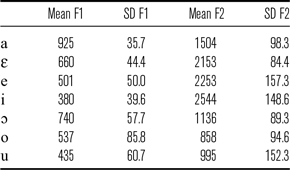
Table 2 shows the mean F1 and F2 (and standard deviations) for the seven vowels found in stressed position. The measurements displayed in Table 2 were extracted from words on the lists read by the four speakers, and obtained using Praat (Boersma & Weenink Reference Boersma and Weenink2022). Each speaker produced between two and six instances of the same vowel. All stressed vowels (n = 124) were in penultimate position in two-syllable words ending in /a/ (e.g. ruga ‘caterpillar’, bissa ‘snake’). All vowels were in open syllables with a singleton onset (CV).
F1 and F2 (in Hertz) of vowels in primary stressed position.

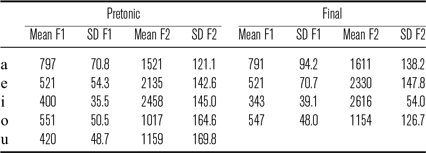
F1 and F2 (in Hz) of vowels in pretonic position and unstressed final position.

Table 3 displays the mean F1 and F2 (and standard deviations) for the five vowels found in unstressed pretonic position (/a e i o u/) and the four vowels found in unstressed word-final position (/a e i o/) in Talian. All pretonic vowels (n = 96) and all final vowels (n = 67) were in open CV syllables in two-syllable words. The pretonic vowels were extracted from words ending in a heavy (CVC) syllable (e.g. capel ‘hat’, feral ‘kerosene lamp’). As with the stressed vowels, all speakers produced between two and six tokens of each pretonic vowel. Final /a e o/ were measured from four or five items produced by each speaker; final /i/ was obtained from productions by two of the speakers (five items each). The measurements for pretonic and final vowels were also obtained with Praat (Boersma & Weenink Reference Boersma and Weenink2022).
A comparison of the data in Tables 2 and 3 suggests that vowels (especially /a/) are reduced in pretonic and word-final unstressed position. Vowel reduction in final position may be a consequence of contact with Brazilian Portuguese, where unstressed final /a/ raises to [ɐ] (Kenstowicz & Sandalo Reference Kenstowicz and Sandalo2016). It should be noted that final /e o/ may also be variably produced with a reduced vowel in Talian, similar to what is observed in Brazilian Portuguese, where [ɪ ʊ] are found in unstressed final syllables (e.g. Massini-Cagliari Reference Massini-Cagliari1992), but unlike what is observed in other Veneto varieties, where final /e o/ are preserved (e.g. Zamboni Reference Zamboni1974). Productions for words such as ragno ‘spider’ (/ˈɾaɲo/) and rame ‘copper’ (/ˈɾame/) exemplify word-final reduction of /e o/.
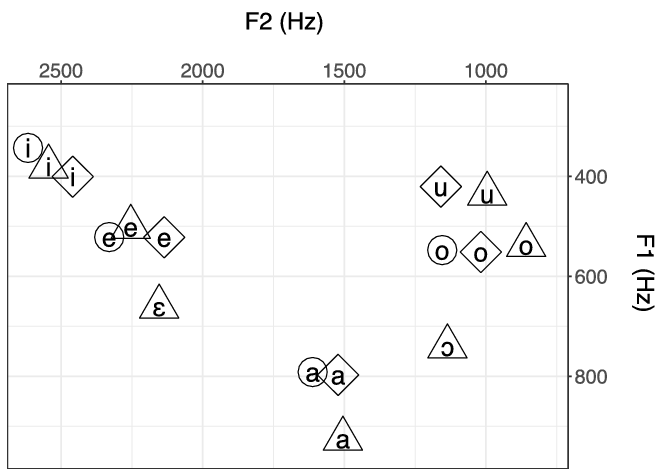
Formant measurements for stressed, pretonic, and unstressed final vowels are shown in Figure 5.
As mentioned above, the pairs /ɛ e/ and /ɔ o/ are contrastive only in stressed position. The following minimal pairs illustrate this contrast.
Formant measurements for Talian. Triangles indicate vowels in stressed position, diamonds correspond to vowels in pretonic position, and circles correspond to vowels in unstressed final position.


Talian exhibits metaphony, which is also observed in Central Veneto (Zamboni Reference Zamboni1974, Walker Reference Walker2005). Stressed upper mid vowels /e o/ raise to /i u/ when there is an unstressed final /i/. This is illustrated in example (1a). Metaphony can also spread to pretonic syllables, but it cannot apply in pretonic position if the stressed syllable is not targeted as well (see (1b)). Metaphony also targets post-tonic non-final upper mid vowels (see (1c), which also illustrates the blocking of metaphony with lower mid vowels). Regarding metaphony in words with antepenultimate stress, it appears that the process may target the stressed syllable and skip the post-tonic non-final syllable, since this sort of production has been found in written texts in Talian (e.g. the forms zúveni/dúveni instead of zúvini/dúvini as metaphonic alternatives to zóveni/dóveni ‘young.pl’; Garcia & Guzzo forthcoming). Further research is needed to confirm whether this possibility is also observed in native speakers’ speech. As indicated in the examples in (1), metaphony is variable.

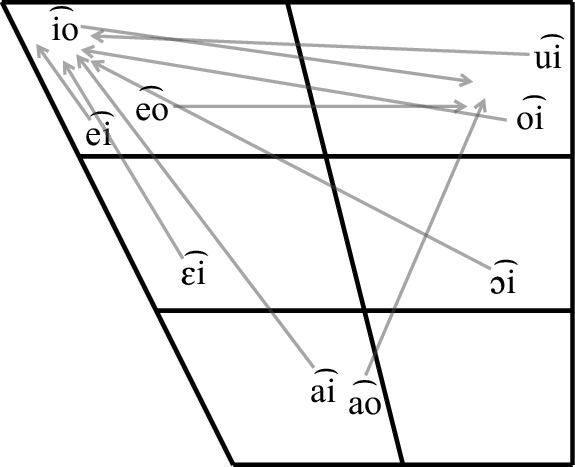
Surface falling diphthongs in Talian.

Figure 6 shows Talian’s surface falling diphthongs.Footnote 3 Two observations suggest that these diphthongs are VV sequences where the second vowel is diphthongized. First, these diphthongs can be variably produced as hiatuses. Second, surface diphthongs resulting from the pluralization of stems ending in /l/ exhibit metaphony, which suggests that the stressed vowel and the final vowel are originally in separate syllables: /faˈzol/ fasol ‘bean.sg’→ [faˈzo͡i] ∼ [faˈzu͡i] fasoi ‘bean.pl’. Talian also seems to have the diphthong /a͡u/; however, many words with such a diphthong derive from words with hiatus: /paˈuɾa/ paura ‘fear’, /spa͡uˈɾa/ spaurà ‘frightened’.
Word-internally, upper mid vowels that are followed by a heterosyllabic vowel may variably raise to high. This is the case of the alternation [maɾoˈɛle] ∼ [maɾuˈɛle] maroele ‘hemorroids’. When raising occurs, the high vowel may be realized as a tautosyllabic glide (i.e. [maˈɾwɛle]).
Surface falling diphthongs

Talian exhibits phrasal juncture phenomena targeting vowels. The following variable processes are observed across word boundaries in Talian, and are similar to the juncture phenomena observed in Brazilian Portuguese (see e.g. Abaurre Reference Abaurre1996): (i) fusion of identical vowels (e.g. [senɾoˈlea] se enrolea ‘wrapped himself’, in the transcribed passage below), (ii) deletion of the first vowel in a V]Wd/clitic V sequence, particularly if such vowel is /a/ (e.g. [ˈloɾel] lora el ‘then he’, in the passage below), and (iii) diphthongization (e.g. the second diphthong in [ˈsu͡ito͡el] suito el ‘suddenly he’, in the passage below).
Syllable structure and stress
Talian’s minimal syllable is V (see example /ˈo.vo/ ‘egg’ in (1) above). The maximal syllable template appears to be CCVC: /ˈbɾɛs.pa/ brespa ‘wasp’. Talian has a few CV lexical words (e.g. /di/ ‘day’, /tɾɛ/ ‘three’).
Regarding onset clusters, Talian allows plosive + /l ɾ/ (e.g. /ˈplasido/ plàssido ‘placid’, /ˈbɾuta/ bruta ‘ugly’, /ˈladɾo/ ladro ‘thief’, /ˈkwatɾo/ quatro ‘four’), although some gaps seemingly exist (*/tl/, */dl/). Onset clusters /fɾ/ and /fl/ are also allowed (/ˈfɾegola/ frégola ‘crumb’, /ɾiˈflɛso/ riflesso ‘reflex’). A few lexical items in Talian start with clusters /nt/ or /nd/ (e.g. the preposition /nte/ nte ‘in’ and corresponding masculine and feminine inflected forms /ntel/ and /ˈntela/, and the verb /ndaɾ/ ndar ‘to walk’ and derived forms). Such items alternate with forms where the cluster is preceded by a vowel (e.g. [anˈdaɾ]; see also the production of ntela in the transcribed passage below).
Talian also allows word-initial sC clusters, similar to other Veneto varieties. The maximal syllable template may be violated with sC clusters, as three consonants may be found before the vowel in this case. The examples in (2) illustrate some of the possible sC clusters in Talian; the examples that violate the maximal syllable template are found from (2i) to (2l). Talian sC clusters variably display voice assimilation, whose application has also been noted for sC clusters in other dialects of Veneto as well as in Standard Italian (Canepari Reference Canepari1976, Krämer Reference Krämer2009). Voice assimilation is exemplified in items (2g), (2k), and (2l), in which /s/ is voiced before a voiced consonant – but note that in other examples where /s/ is also followed by a voiced consonant (such as (2d), (2e), and (2h)), assimilation does not take place. Unlike Standard Italian, Talian allows sC clusters when the consonant following [s z] is palatal (/ɲ/) or an affricate (/t͡ʃ d͡ʒ/); similar to Standard Italian and other Veneto dialects, /sɾ/ clusters are not observed in Talian. All sC clusters can be variably produced with initial epenthesis (usually of [i] or [e]). This is likely due to influence from Brazilian Portuguese, where sC clusters are illicit (Collischonn & Wetzels Reference Collischonn, Wetzels, Wetzels, Costa and Menuzzi2016). Epenthesis in sC clusters can be observed, for example, in (2d).

Stress assignment falls within a trisyllabic window from right to left, as typically observed in Romance languages (Roca Reference Roca and van der Hulst1999). In other words, stress may fall on the final (/puˈpa/ pupa ‘daddy’), penultimate (/ˈvaka/ vaca ‘cow’) or antepenultimate syllable (/ˈpjegoɾa/ piegora ‘sheep’). The most frequent stress position is penultimate. Word-final heavy syllables (i.e. word-final syllables that end in a coda) seem to attract stress (e.g. /foˈɡoŋ/ fogon ‘stove’, /suˈdoɾ/ sudor ‘sweat’, and /kaˈpɛl/ capel ‘hat’). Stress is contrastive in Talian, as illustrated by the triad in (3).

As suggested in Figure 5 above, vowel quality is a cue to stress, as unstressed vowels are more centralized than their stressed counterparts. To examine which additional acoustic cues might correlate with stress in Talian, duration, f0 and intensity were measured for the vowels /a e i o u/ in primary stressed and pretonic position (/ɛ ɔ/ were not measured as they can only appear in stressed syllables). These measurements were extracted using Praat scripts (Boersma & Weenink Reference Boersma and Weenink2022) and are shown in Table 4 along with their standard deviations and number of tokens per category. The data suggest that stress in Talian is cued with duration (i.e. vowels in stressed syllables are longer than vowels in unstressed syllables), but not with f0 nor intensity. Figure 7 exemplifies the relatively flat pitch and intensity patterns in words that differ only in stress position (méscola ‘wooden spoon’, mescola ‘(s/he) stirs’, mescolà ‘stirred’).
Mean duration (in ms), mean f0 (in Hz), and mean intensity (in dB) of vowels in primary stressed and unstressed (pretonic) position. Standard deviations are shown in parentheses.

Intensity (solid lines) and f0 (dotted lines) in words that contrast in stress position.

It should be noted that the vowels that were measured in Table 4 were produced in words in isolation. Further research examining other contexts of production is needed to determine whether f0 and intensity play any role in cueing stress in Talian, as well as which acoustic cues are used for edge-marking in the language.
Transcription of recorded passage
Orthographic transcription
El Vento del Norte e el Sol
El Vento del Norte e el Sol i zera drio discùter qual zera el pi forte, quando un viaiante el ze rivà vestìo con na capa grossa. I ga dessidìo che’l primo que podesse far el viaiante tirar zo la capa dovea esser considerà el pi forte de luri due. Lora el Vento del Norte el ga sufià el màssimo che’l podea, ma de pi che’l sufiea deFootnote 4 pi el viaiante se enrolea ntela so capa; e par fin, el Vento del Norte el ga desistìo. Lora el Sol el ga slusà ben caldo, e el viaiante suito el ga tirà zo la so capa. E così el Vento del Norte el ga tocà acetar che’l Sol el zera el pi forte de luri due.
Broad transcription
el ˈvento del ˈnɔɾte e el sol
el ˈvento del ˈnɔɾte e el sol | i ˈzɛɾa dɾi͡o disˈkuteɾ | kwal ˈzɛɾa el pi ˈfɔɾte || ˈkwando uŋ vjaˈjante el ze ɾiˈva vesˈti͡o koŋ na ˈkapa ˈɡɾɔsa || i ɡa desiˈdi͡o | kel ˈpɾimo ke poˈdese faɾ el vjaˈjante tiˈɾaɾ zo la ˈkapa | doˈvea ˈɛseɾ konsideˈɾa el pi ˈfɔɾte de ˈluɾi ˈdue || ˈloɾel ˈvento del ˈnɔɾte | el ɡa sufiˈa el ˈmasimo kel poˈdea || ma de pi kel sufiˈea | di pi el vjaˈjante senɾoˈlea inˈtela so ˈkapa || e paɾ fiŋ | el ˈvento del ˈnɔɾte el ɡa dezisˈti͡o || ˈloɾel sol | el ɡa zluˈza beŋ ˈkaldo || e͡el vjaˈjante ˈsu͡ito͡el ɡa tiˈɾa zo la so ˈkapa || e koˈzi | el ˈvento del ˈnɔɾte | el ɡa toˈka at͡ʃeˈtaɾ | kel sol | el ˈzɛɾa el pi ˈfɔɾte de ˈluɾi ˈdue
Acknowledgements
I owe many thanks to the following people: Lenise Baldin Cavazzola, for being available to record the sound files during the Covid-19 pandemic; Maria Inês Bernardi Chilanti, for her help checking the word lists, translating the fable and recording the audio files; Elisângela de Fátima Zulian and Flavia Viapiana, for their help recording the audio files; the staff of Rádio Solaris (Leandro Schiavon, Alexandre Lucena, Fernando Silva), the radio station in Antônio Prado (RS, Brazil), for allowing me to use their studio and for their support in recording the sound files; Émie Levesque and Hannah Markert, for their research assistantship; Guilherme D. Garcia, for his insight on several aspects of this study; Valdemir Guzzo and Dirce Guzzo, for their assistance on the logistic aspects of this research; the Editor, Marija Tabain, the Associate Editor, Matthew Gordon, as well as two anonymous reviewers, for their helpful comments; and André Radtke, JIPA’s Audio Manager, for invaluable help preparing the sound files in this Illustration.
Supplementary material
To view supplementary material for this article, please visit https://doi.org/10.1017/S002510032200010X.