Between 3,600 and 3,200 years ago in northeast Louisiana, hunter-gatherers terraformed 765,000 m3 of earth into six concentric ridges over 1 km in diameter, two massive effigy mounds, and various other earthworks at the World Heritage Site of Poverty Point (Gibson Reference Gibson2000; Kidder Reference Kidder, Sassaman and Holly2011; Ortmann Reference Ortman2010). During the era of terraforming, Poverty Point was also the recipient of a vast inventory of diverse materials and objects from across much of eastern North America. Numerous among the more distant items were cooking vessels carved from soapstone, whose closest geological sources were more than 600 km to the east. Hundreds, if not thousands, of soapstone vessels were imported, used, and deposited at Poverty Point. They were used directly over fire—presumably for cooking food—and were deposited throughout the site, but especially on the north and south aspects of the ridges, along with baked-clay objects, pottery, and other culinary media (Webb Reference Webb, Broyles and Webb1975).
One extraordinary context for soapstone vessels at Poverty Point cannot be attributed to subsistence pursuits alone. Placed in a pit about 300 m west of the mound complex were nearly 3,000 sherds from hundreds of broken vessels (Webb Reference Webb1944). Little is known about this cache beyond what Clarence Webb published in this journal 73 years ago. Although we may safely assume that soapstone vessels had a long history of importation and use at Poverty Point, this event of caching, like the construction of the largest mound (Ortmann and Kidder Reference Ortmann and Kidder2013), probably occurred near or at the end of the site's occupation (Sassaman Reference Sassaman2010:130). Absolute age estimates to substantiate this claim are lacking.
Another cache of soapstone vessels from a Gulf Coast site in Mississippi (Figure 1) offers an opportunity for absolute age estimates. Bruseth (Reference Bruseth and Byrd1991) characterized Claiborne, long recognized as a cognate of Poverty Point (Gagliano and Webb Reference Gagliano, Webb and Broyles1970), as a waypoint or gateway in the westerly movement of nonlocal materials and objects from geological sources to the east, particularly soapstone vessels. In addition to the sherds distributed throughout its midden, Claiborne housed at least one cache of whole soapstone vessels. When industrial development impacted the site in the late 1960s, a spate of opportunistic investigations ensued. A group of avocational archaeologists recovered an assemblage of 12 soapstone vessels and associated artifacts in clean sand deposited in a pit, possibly a mortuary facility (Gagliano and Webb Reference Gagliano, Webb and Broyles1970:69). Upon recovery, the vessels were removed to Ohio, where they were held privately until 2016, when they were repatriated to Mississippi and made available for analysis.
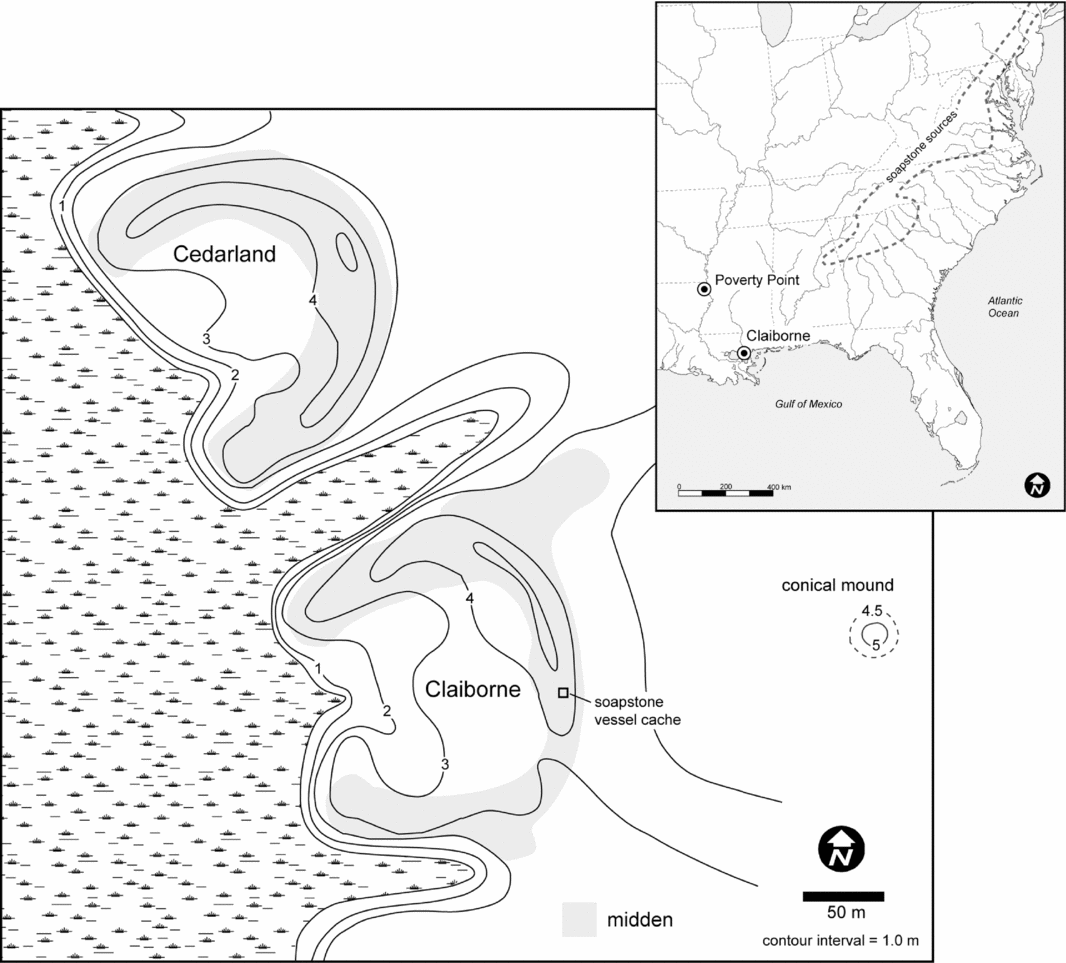
Topographic map of the Claiborne and Cedarland sites at the mouth of the Pearl River in Mississippi and inset map showing location of Poverty Point and geological sources of soapstone.

Here we provide the results of AMS assays on 11 samples of soot from 7 of the 12 Claiborne vessels. Three paired samples—one each from soot on interior and exterior surfaces—enable inferences about vessel use-life that help clarify the significance of vessel caching to the abandonment of Poverty Point. In addition, we report metric and morphological data on the vessels, most of which have been reconstructed to whole or nearly whole condition, a rarity among soapstone vessels of this region. Finally, we offer some preliminary observations on the relationship of vessel caching to broader environmental and cultural changes about 3200 cal BP, a time of upheaval throughout the American Southeast (Kidder Reference Kidder2006; Thomas and Sanger Reference Thomas and Sanger2010). First, we present some additional background on Claiborne and its investigations.
Claiborne
The Claiborne site (22HA501) is one of two arcuate middens at the mouth of the Pearl River in Mississippi (Figure 1). Just to the north of Claiborne, across a slough, is Cedarland, which is similar in scale and form to Claiborne, but different in composition and evidently slightly older than Claiborne. Gagliano and Webb (Reference Gagliano, Webb and Broyles1970:69) considered these sites to be sequential occupations by the same core population, the shift to Claiborne coincident with the advent of Poverty Point culture. Bruseth (Reference Bruseth and Byrd1991) views the shift as a consequence of colonization by people who were integral to the rise of Poverty Point. The chronology of these sites is ambiguous, but only Claiborne has the full suite of Poverty Point material culture (Bruseth Reference Bruseth and Byrd1991:18), while Cedarland has only limited affinity and instead features a preponderance of pre-Pottery Point material culture. The other major difference is that marine shell at Cedarland is mostly oyster, and at Claiborne, the brackish clam Rangia. We comment later in this report on the environmental implications of this shift.
Gagliano and his students conducted the first systematic testing at Claiborne in 1967, after the site was discovered and mapped that same year (Gagliano and Webb Reference Gagliano, Webb and Broyles1970). Students under the supervision of Richard Marshall (Reference Marshall1970) excavated at the northern end of the site in 1969 and 1970. Two years later, another group of students under the supervision of Richard Shenkel excavated test units at the south end of the site (see Boudreaux [Reference Boudreaux, Peacock and Brookes1999] for a summary). Bruseth (Reference Bruseth1980) analyzed private collections in an effort to reconstruct the site's spatial structure, and later synthesized all previous work in what is the most thorough published account of Claiborne available (Bruseth Reference Bruseth and Byrd1991); there is no comprehensive technical report of field investigations.
Before land clearing for a port facility impacted the site, Claiborne was a semicircular, elevated midden about 200 m in outside diameter and under 2 m in height. The semicircle was open to the west. Bruseth (Reference Bruseth and Byrd1991:14) notes that the midden varied from 30 m wide at the southeast section to 65 m in the northeast, where it was attenuated along the slough that separates Claiborne from Cedarland. The northern and southern ends of the semicircle, which fronted tidal marsh, consisted of organically enriched sand with abundant artifacts and vertebrate fauna, as well as with the shells of invertebrates, mostly Rangia. Features included hearths, pits, clusters of baked-clay objects, and caches of nonlocal flaked and ground stone tools. Exposed in a bulldozer cut at the south end of the semicircle was a 25 m long, 3–5 m wide deposit of burned Rangia shells, baked-clay objects, and animal bone (Bruseth Reference Bruseth and Byrd1991:17). Another large feature on the southeast section consisted of a buried stratum of perforated baked-clay objects with abundant charcoal, a sample of which returned a conventional 14C age of 3385 ± 140 BP (Bruseth Reference Bruseth and Byrd1991:18; two-sigma calibrated range of 3990–3340 BP). This ~20 m2 feature was covered by a 50 cm thick stratum of basket-loaded sand, overlain by a meter-thick midden that was bulldozed away. The emplacement of sand suggests that portions of Claiborne were constructed to form the semicircle, as opposed to merely forming through the gradual accumulation of midden (Bruseth Reference Bruseth and Byrd1991:18). Areas both inside and outside the midden ring consisted of largely sterile yellow sand.
About 170 m to the west of the semicircle was a small conical mound of sand. Bruseth (Reference Bruseth and Byrd1991:15) reports that it was 23 m in diameter and 1.5 m tall before a bulldozer leveled it. Limited testing of the mound remnant revealed no artifacts or midden (Bruseth Reference Bruseth and Byrd1991; Gagliano and Webb Reference Gagliano, Webb and Broyles1970:49). Rather, the mound consisted of sterile, tan-colored sand overlying what appeared to be the original ground surface. A line connecting this mound to the center of the semicircle comes close to intercepting the cache of 12 soapstone vessels that avocational archaeologists salvaged as Claiborne was being leveled. Road grading evidently uncovered a second cache less than 20 m northwest of the conical mound. Bruseth (Reference Bruseth1980:298; Reference Bruseth and Byrd1991:17–18) salvaged 89 soapstone sherds from the location in 1972 and surmised that they came from several vessels, “some apparently quite large,” with interior and exterior surfaces bearing soot.
Soapstone Vessel Cache
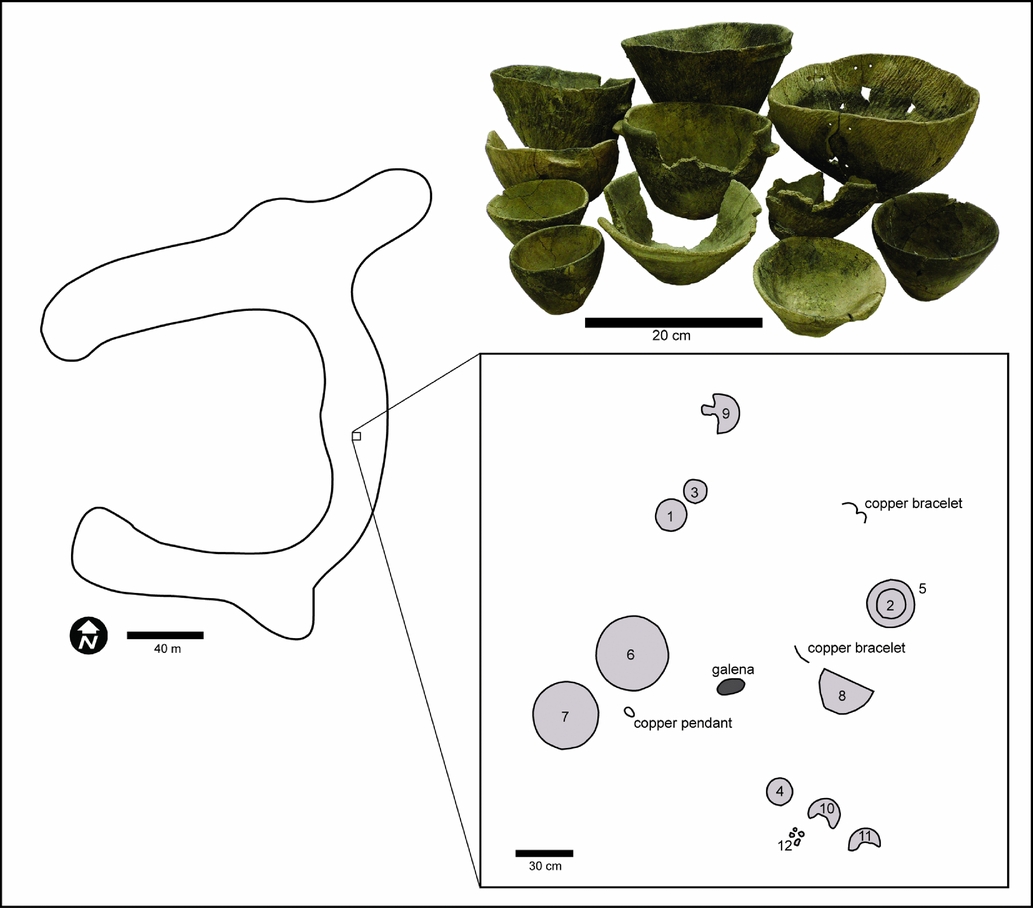
After an episode of bulldozing in 1968, Norvell Roberts, then of Picayune, Mississippi, recovered an assemblage of 12 soapstone vessels in a sterile sand stratum at the apex of the semicircle (Figure 2). Most of the vessels were fragmented, but Roberts was able to restore many of them to whole or near-whole condition. Associated with the vessels were objects of copper, a chuck of galena, and a jasper bead. Gagliano and Webb (Reference Gagliano, Webb and Broyles1970:69) surmised that the vessels and other objects were emplaced in a mortuary context in which the bone had dissolved and leached away.
Sketch map of the Claiborne ring, showing plan distribution of soapstone vessels and associated artifacts in cache (after Bruseth 1991:18) and photograph of the vessel assemblage by senior author.

Roberts reconstructed the relative position of the cached objects for Bruseth (Reference Bruseth1980:299, Reference Bruseth and Byrd1991:18). He noted that all but two of the vessels were at the same elevation, and all but two were inverted. Evidently, the cache and presumed burial(s) were emplaced in a pit dug into the apex of the ring and then backfilled with clean sand. According to Bruseth (Reference Bruseth1980:297), a bulldozer removed midden overlying the sand shortly before he discovered the cache. Given the age estimates that we report below for the cache, it is possible this overlying midden was not autochthonous but instead redeposited, perhaps from the excavation of the cache pit.
Limited information on these vessels and some photographs have been published (Roberts et al. Reference Roberts, Satchfield and Lowry1968; Gagliano and Webb Reference Gagliano, Webb and Broyles1970:58–59), but missing are reliable age estimates, morphological data, and observations on use life and condition. Bruseth (Reference Bruseth and Byrd1991:17) noted that soot was present on both the interior and exterior surfaces of the vessels. An ongoing program of soapstone vessel dating has enjoyed reasonable success in assaying soot for age estimates of the last use over fire (Sassaman Reference Sassaman2006). When the Claiborne vessels were returned to Mississippi from Roberts's current residence in Ohio, we took the opportunity to analyze the vessels for these missing data and to collect samples of soot for AMS dating. We first review the morphology and condition of the vessels and then report the results of 11 age estimates.
Vessel Morphology
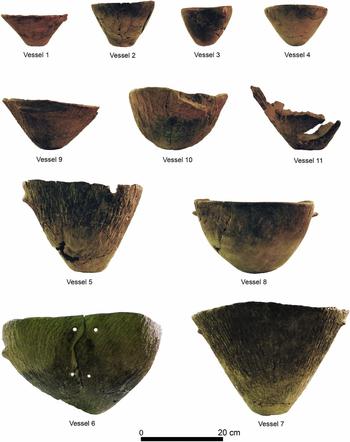
Profile photos of 11 of the 12 Claiborne vessels appear in Figure 3. Numbers assigned to vessels in this figure are arbitrary and do not conform to a numerical sequence given by Roberts, although in Figure 2, we have done our best to match our numbers to those in the plan published by Bruseth (Reference Bruseth and Byrd1991:18) using Roberts's unpublished notes and measurements curated in the state site files. Vessel 12 was too fragmentary and incomplete to represent its size or shape.
Profile photographs of 11 of 12 soapstone vessels in the Claiborne cache. Photo by senior author.

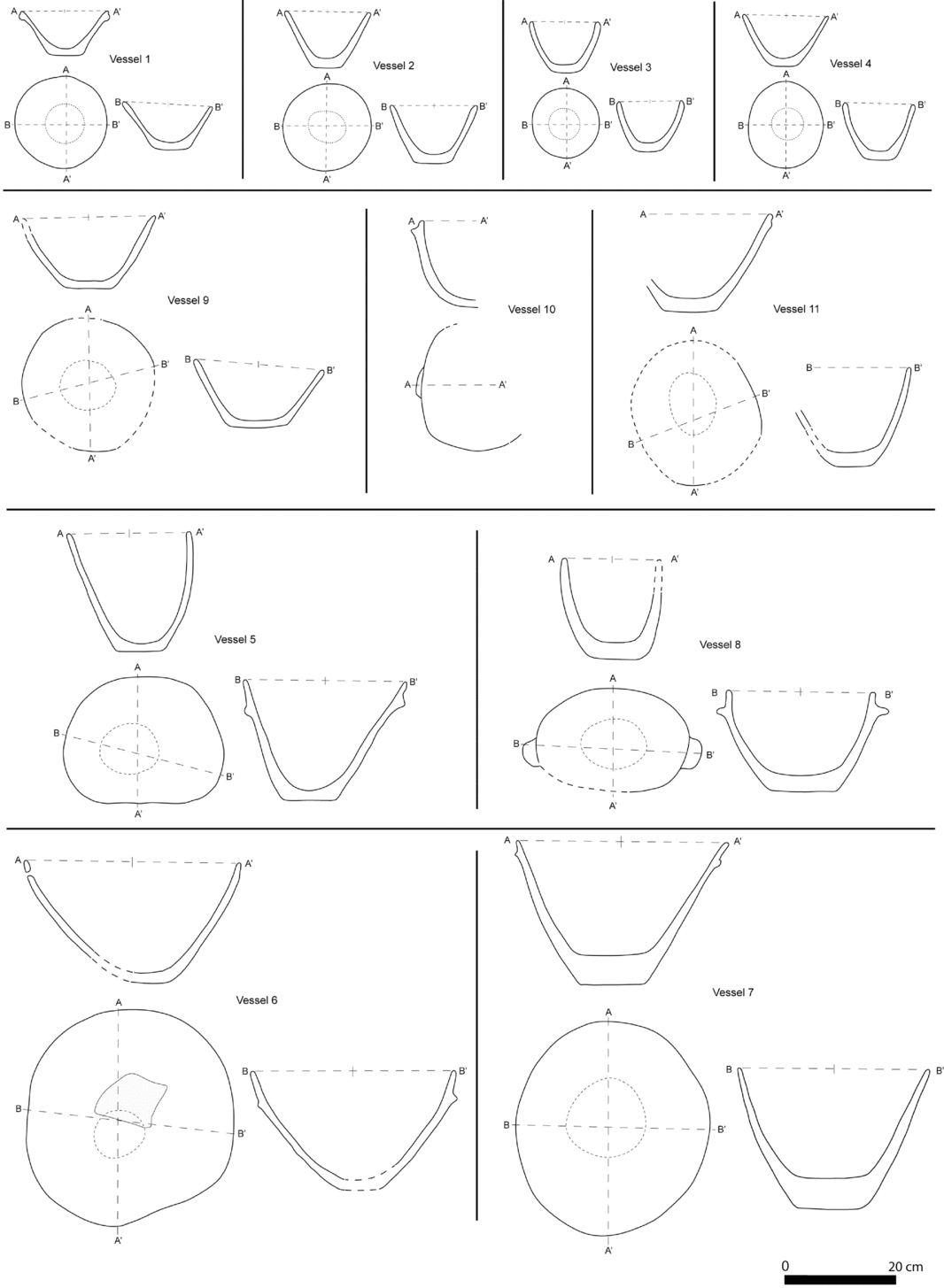
The profiles of all whole or nearly whole vessels were drawn using a form gauge and calipers. Because most of the vessels are asymmetrical, profiles were drawn along roughly orthogonal axes, generally corresponding to maximum and minimum orifice diameters. These appear in Figure 4, along with plan views of orifices showing the axes of profiles and outlines of bases, which, in all cases, were flat.
Drawings of profiles and plans of 11 of 12 soapstone vessels in the Claiborne cache.

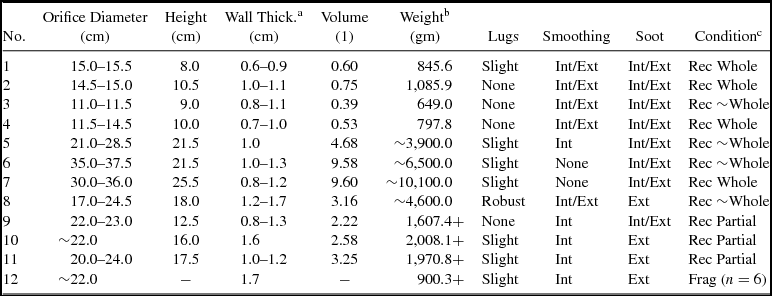
Metric and nominal data on all 12 vessels appear in Table 1. Using volumetric estimates, we group the 11 complete or nearly complete vessels into three size classes: small (0.39–0.75 L), medium (2.22–4.68 L), and large (9.58–9.60 L). The four small vessels are the most symmetrical in both plan and profile, but one (Vessel 1) is notably uneven in profile and another (Vessel 4) is oblong in plan. Vessels of this group range in height from 8.0 to 10.5 cm and have orifice diameters ranging from 11.0 to 15.5 cm. All have flat bases and outflaring walls. They all also have surfaces that were smoothed both inside and out, which is rare for soapstone vessels in the Southeast in general. Both interior and exterior surfaces bear traces of soot or some sort of carbon deposit. Only one vessel (Vessel 1) has lugs, which are slight.
Metric Data and Related Observations on the Morphology and Condition of Claiborne Soapstone Vessels.

a Measured 3 cm below the lip.
b Weights for vessels greater than 3 kg were calculated on a digital scale with resolution of only 100 g. Weights for vessel that were only partially reconstructed (Vessels 9–11) or fragmentary (Vessel 12) are minimal weights.
c Rec = reconstructed
The six vessels classified as “medium” exhibit a marked degree of morphological variation, even as they share a number of attributesFootnote 1 . They range in height from 16.0 to 21.5 cm and have orifices ranging from 17.0 to 28.5 cm in diameter. All are asymmetrical in both plan and profile. Vessel 8 is exceptional for its bilateral symmetry, but its plan is distinctively oblong, with robust lugs at either end of its long dimension. Vessel 5, in contrast, is exceptional for its marked asymmetry. One side of this vessel has a vertical profile where the orifice is flattened and an outflaring wall on its opposite side. With its flat base oriented to the straight-wall side, the vessel appears to have been designed for tilting to decant liquids. This is actually a common feature of medium-sized vessels, with the exception of Vessel 8, the oblong specimen with robust lugs. With one other exception, the remaining members of this group have slight lugs; the exception (Vessel 9) lacks lugs altogether. Among members of this group, Vessel 8 is also distinctive in having smoothed interior and exterior surfaces, like the small vessels. All others have interior smoothing but exterior surfaces showing the chisel grooves of their manufacture. Vessels 10 and 11 are smoothed on the interior but retain some of the chiseling on the upper portion of the rim. Two of the vessels bear carbon deposits on both interior and exterior surfaces, while three have definitive soot on only exterior surfaces.
Two vessels qualify as “large.” Although they have nearly identical volumes, these specimens differ in shape and degree of asymmetry. Vessel 7 is the taller of the two, with an orifice diameter that varies a full 6 cm owing to one outflaring wall, much like the medium-sized vessels. Of particular note is the extreme thickness of the offset base, which, at 5.5 cm thick, is nearly twice as thick as the next thickest base (Vessel 8 at 3.0 cm thick). Vessel 6 is more symmetrical in plan but not because it lacks an outflaring wall or offset base. In fact, Vessel 6 has one of the more extreme offset bases, again opposite the outflaring wall and thus conducive to tilting and pouring. Both vessels have slight lugs and soot on both the interior and exterior surfaces of walls. They also both lack the smoothing of interior surfaces observed on most of the other vessels. Chisel marks are evident across interior, as well as exterior, surfaces.
In sum, Claiborne soapstone vessels vary in size across a range of open bowls and jars with outflaring walls and flat, offset bases. Despite the size differences, the vessels share a basic morphology; the major exception is the oblong Vessel 8, with lugs unlike all others. Nonetheless, it too has a flat, offset base and one profile with at least slightly outflaring walls. On balance, the assemblage reflects more consistency in form than might be expected from size differences alone. With the exception of the four small vessels, all Claiborne vessels could have well-served the needs for direct-heat cooking of liquid-based foods that were decanted by tilting vessels toward the most outflaring wall, operating essentially as spouts. Observations on vessel condition support this inference and provide additional insight on the life histories of individual vessels.
Vessel Condition
Our review of vessel condition is organized by observations on manufacture, use alteration, and repair. We start, however, by first considering the condition in which these vessels were interred as a cache.
Vessel Condition at Time of Caching. Despite their fragmentary condition, most, if not all, of the Claiborne vessels likely were emplaced in the cache as whole vessels. Bulldozing accounts for much of the breakage. Mr. Roberts was able to reconstruct eight of the vessels to either whole or nearly whole form, and another three to at least half their original form. Only Vessel 12 remains largely incomplete. In his description of the cache, Bruseth (Reference Bruseth1980:298) notes that a fracture plane on one of the vessels (Vessel 11) shows the wear of an old break. If so, at least this one vessel went into the cache in pieces, if not as only a portion.
Whole vessels are scarce in the inventory of soapstone vessels in the greater Southeast. Even the cache of 200–300 vessels at Poverty Point consisted of only vessel fragments, although it is possible that some of the vessels were deliberately broken in the course of caching them (and at least five whole vessels exist for the greater site). Other known caches in Florida likewise consist of broken vessels (Sassaman Reference Sassaman, Roddick and Stahl2016).
Attributes of Manufacture. As noted above, five of the Claiborne vessels have smoothed exterior as well as interior surfaces. Smoothing obliterated the chisel marks of manufacture. Whereas interior smoothing is very common among vessels in the greater Southeast, exterior smoothing is exceedingly rare in the region. Only the soapstone vessels of the Orient phase of southern New England (Dincauze Reference Dincauze1968) are routinely smoothed both inside and out.
Five of the Claiborne vessels retain the chisel marks of manufacture on exterior surfaces. These are all medium-sized vessels, two of which also have traces of chiseling on the upper interior rim surfaces, as noted earlier. Surfaces of the final two vessels, the two largest, were not smoothed at all, which is also rare among soapstone vessels in the Southeast.
Starting with the work of William Henry Holmes (Reference Holmes1890), investigations of soapstone quarries in the East provide good perspective on manufacturing sequences, as well as the tools of quarrying, shaping, and smoothing vessels. Blanks were roughed out of either exposed outcrops or float, but there is no reason to assume that vessel size and shape was constrained by the morphology of raw material at the biggest quarries, such as Soapstone Ridge near Atlanta (Dickens and Carnes Reference Dickens and Carnes1983; Elliott Reference Elliott1986), or the Pacolet sources near Spartanburg, South Carolina (Ferguson Reference Ferguson1976). The production of multiple vessel forms is evident in the preforms and blanks abandoned at these locations. At least three forms were present at Soapstone Ridge: an elongated bowl with rounded or squared ends and usually with lugs; a hemispherical bowl with round bottom; and a conical form with a flat or pointed base (Dickens and Carnes Reference Dickens and Carnes1983:86). The flat-based variety of this latter form comes closest to the Claiborne vessels. Efforts to geochemically source archaeological soapstone to quarries have produced ambiguous results due to the extreme variation within local sources (e.g., Truncer et al. Reference Truncer, Glascock and Neff1998). The only published effort to source soapstone from Claiborne employed neutron activation analysis to infer a provenance in western North Carolina (Smith Reference Smith and Byrd1991). While we are in no position to comment on the veracity of this finding, we can confirm that vessels of the Claiborne cache appear to have been made from the same variety of soapstone, a talc-rich schist with no obvious phenocrysts or large pores. Given their overall morphological conformity, the Claiborne vessels likely trace to a single manufacturing tradition and perhaps to the same geological source.
Use Alteration and Repair. All 12 vessels in the Claiborne cache have traces of carbon on exterior surfaces, and at least eight have carbon deposits on interior surfaces. Carbon on exterior surfaces is common on soapstone vessels throughout the Southeast and is usually concentrated on the upper rim portion. This is the expected outcome for vessels used directly over an open fire. All of the Claiborne vessels meet the criteria of soot formation outlined by Hally (Reference Hally1986) and Skibo (Reference Skibo1992), and many have excellent examples of the lustrous soot that forms on the upper rim from a combination of airborne carbon and oxidized wood resins. These deposits can be quite thick in places, particularly when deposited in the grooves of chiseled surfaces. Conversely, the carbon residues of smoothed exterior surfaces (again, all of the small vessels and one medium-sized one), are thin and patchy, often varnish-like.
The high frequency of interior carbon deposits among the Claiborne vessels is unusual. Deposits of carbonized food occur occasionally on basal sherds of soapstone vessels from the Southeast, but deposits on the upper interior rim, like exterior soot, are rare. Skibo (Reference Skibo1992:148–157) observed both types of interior carbon on cooking pots of the Kalinga, attributing the upper deposits to charred rice left to simmer near a hot fire. But this resulted in patchy deposits, not the continuous band of carbon observed on Vessel 6 from Claiborne. We suspect in this case and perhaps others that interior carbon resulted from fires burning inside of vessels, which sooted upper rims much as they did exterior walls. We return to this point in our discussion below.
Another unusual form of alteration is a distinctive green staining on the flat bases of seven of the vessels and on the exterior walls of two of them. We do not know the source of this staining but suspect it may be copper carbonates. Distributed among the vessels were three copper objects, although Roberts did not report any to be in direct contact with them. Other sources cannot be ruled out, but given the presence of copper in the cache it seems likely the stains are indeed the outcome of oxidized copper that was at one time in direct contact with vessels.
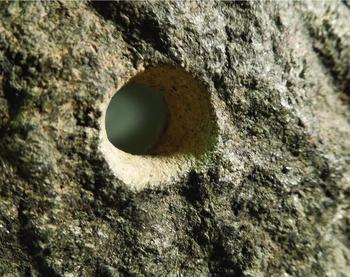
Finally, one of the large vessels (Vessel 6) has seven pairs of drilled holes to repair fractures. This practice shows up occasionally on soapstone vessels, especially far from sources of raw material, and it was a widespread means of repairing pottery vessels throughout the Southeast. In this case, the holes were drilled through sooted surfaces that were thereafter not subjected to fire (Figure 5). In other words, the holes were drilled and the vessel laced without further thermal uses and presumably just prior to it being deposited in the cache.
Close-up photo of one of 14 drilled repair holes in the wall of Vessel 6 from the Claiborne cache. Note the lack of soot in the margins of the drilled hole. Photo by senior author.

Results of AMS Assays on Carbon Deposits
Although all 12 of the Claiborne vessels bear traces of carbon deposits, three (Vessels 2, 9, and 10) did not have enough carbon to warrant sampling for AMS dating. Two of the remaining nine vessels presented only thin, varnish-like deposits, which were sampled and submitted for dating but proved to be insufficient in one case (Vessel 4) and unreliable in the second (Vessel 3; see below). The other seven vessels were sampled at least once; in three cases, both interior and exterior residues were sampled, and for one of these (Vessel 6), a second interior sample was collected. Overall, patches of carbon residue were sampled whenever feasible without exhausting the deposit. After pretreatment, samples of datable carbon need only be a few milligrams in size to provide reliable AMS assays. Ultimately, our effort produced 13 samples of carbon from nine of the vessels, of which 12 were submitted to Beta Analytic for dating. Eliminating the sample that proved to be insufficient in size, our inventory consists of 11 assays from eight vessels.
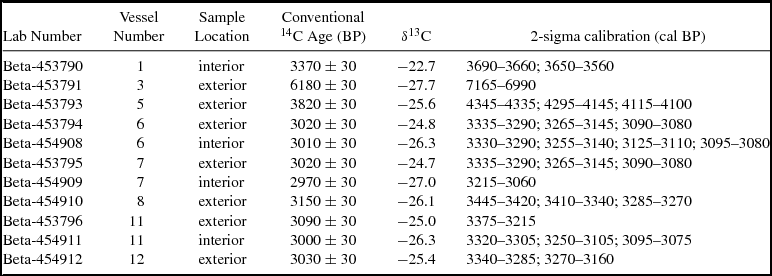
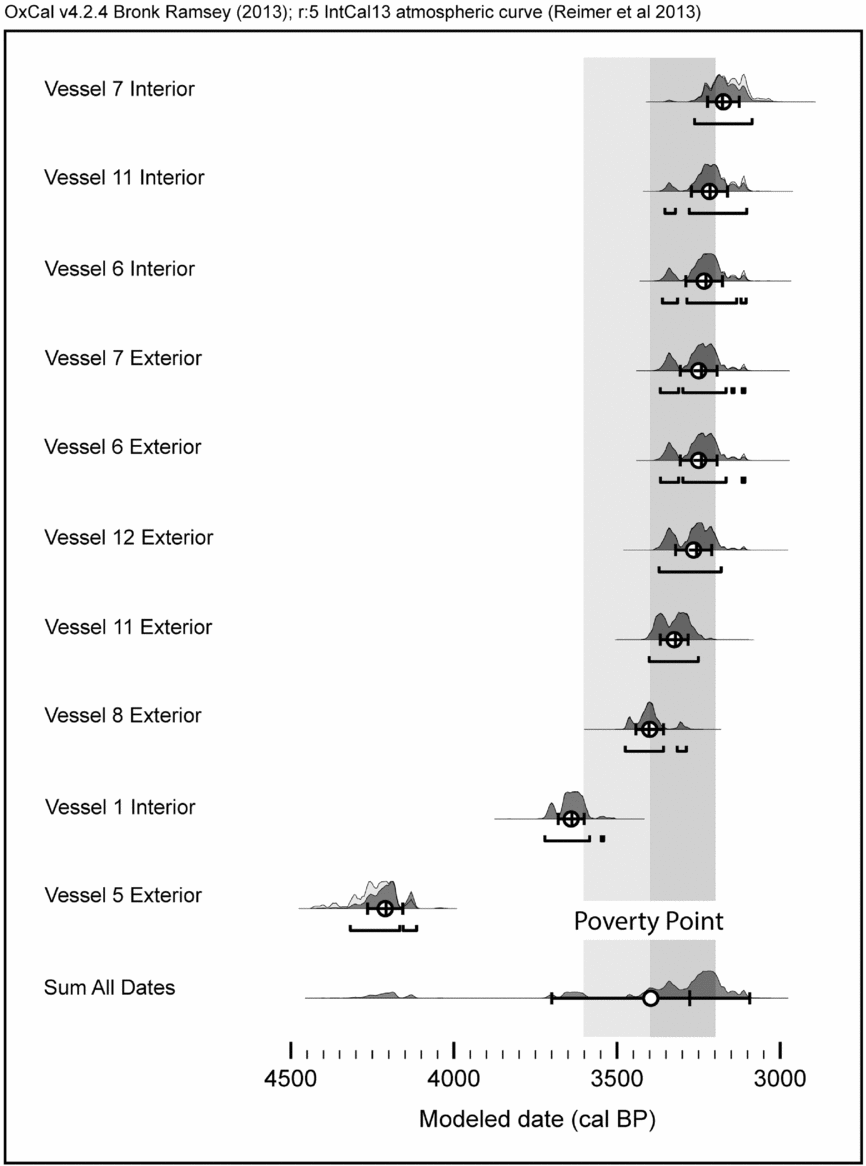
Data on the 11 AMS assays appear in Table 2 and the probability distributions of 10 of the assays appear in Figure 6, using OxCal v4.2.4 (Bronk Ramsey Reference Bronk Ramsey2013), which also provided a summed probability distribution of all assays, given at the bottom of Figure 6. Omitted from this figure is the anomalous age estimate from an interior residue of Vessel 3. At over 6,000 radiocarbon years BP, the Vessel 3 assay is out of stride with all the others from Claiborne and, indeed, with the chronology of soapstone vessels from throughout North America, save for a single assay on soot from a vessel sherd from a site in panhandle Florida (Sassaman Reference Sassaman2006)Footnote 2 .
Data on AMS Assays of Soot from Claiborne Soapstone Vessels.

Note: Calibrations based on Reimer et al. Reference Reimer, Bard, Bayliss, Warren Beck, Blackwell, Bronk Ramsey, Buck, Cheng, Lawrence Edwards, Friedrich, Grootes, Guilderson, Haflidason, Hajdas, Hatté, Heaton, Hoffmann, Hogg, Hughen, Kaiser, Kromer, Manning, Niu, Reimer, Richards, Marian Scott, Southon, Staff, Turney and van derPlicht2013.
Individual and summed probability distributions of 10 AMS assays on soot taken from seven of the soapstone vessels cached at Claiborne. Shown in this figure is an idealized chronology for Poverty Point, with the first two centuries (3600–3400 cal BP) a period of intense settlement and importation of nonlocal goods, and the second two centuries (3400–3200 cal BP) a period of intense terraforming.

With eight of 11 age estimates falling in the two-sigma range of 3445–3060 cal BP, the summed probability distribution for these assays is strongly modal at ~3225 cal BP. This, we suggest, is the maximum age for the act of caching vessels. Comparison of the assays run on carbon from interior and exterior surfaces suggests a slightly more recent age for caching. The three youngest age estimates are from interior carbon samples with matching exterior carbon samples of greater age. If, as we surmised earlier, interior residues resulted from fires inside of vessels, this timing implies a use-life history for at least these three vessels of first being used directly over fire, then adapted for use as portable hearths.
In sum, AMS age estimates of soot from soapstone vessels at Claiborne indicate that the act of caching took place no earlier than 3,225 years ago, and perhaps slightly later if the latest age estimate (2970 ± 30 BP or 3215–3060 cal BP) is accepted as the terminus post quem for the event. Either way, the cache was emplaced near or at the end of Poverty Point's time as a locus of habitation, mounding, and importation. In closing this report, we discuss briefly the implications of the Claiborne cache for the history of Poverty Point in particular and developments in the region more generally.
Discussion
Recent reviews of the radiometric chronology of Poverty Point help clarify the site's complex sequence of occupation and mound building (Kidder et al. Reference Kidder, Arco, Ortmann, Schilling, Boeke, Bielitz, Heet and Adelsberger2009:182–197; Ortmann Reference Ortman2007, Reference Ortman2010), although many details remain ambiguous. Indeed, Ortmann (Reference Ortman2010:672) admits that the suite of 69 radiometric assays—amassed over six decades by multiple researchers using eight different labs—“provides a confusing picture of the development of the cultural landscape.” However, the sequence of mound construction is more precise, due in large measure to the recent work of Kidder and colleagues, including investigations into the penultimate construction, Mound A (Kidder et al. Reference Kidder, Arco, Ortmann, Schilling, Boeke, Bielitz, Heet and Adelsberger2009; Ortmann and Kidder Reference Ortmann and Kidder2013). Notable in the sequence of mound construction is the flurry of activity that ensued after 3400 cal BP (Kidder Reference Kidder, Sassaman and Holly2011). The prior two or three centuries marked an era of intense site use, which resulted in a dense and unusually diverse assemblage, but only limited mound construction, specifically the construction of Mound B shortly after 3500 cal BP. A century later, Mound B was capped, most of the ridge system was built, and Mound C was erected. Mound A came next, after about 3264 cal BP (Kidder et al. Reference Kidder, Arco, Ortmann, Schilling, Boeke, Bielitz, Heet and Adelsberger2009). The very last construction was the newly documented Mound F, north of the main compound, which was erected before 3100 cal BP and possibly before 3200 cal BP (Greenlee Reference Greenlee2013, Reference Greenlee2015). At about this same time, large posts were emplaced in circular arrangements in the open area (plaza) enclosed by the ridges. Four AMS assays on charcoal from posthole fill suggest these features slightly predate 3200 cal BP (Greenlee Reference Greenlee2009, Reference Greenlee2010).
Kidder (Reference Kidder, Sassaman and Holly2011:115) regards the post-3400 cal BP period at Poverty Point as a time of radical transformation, one that redefined the community with “a new, unified, and common cosmology, mythic character, and history.” It is, as Kidder (Reference Kidder, Sassaman and Holly2011:117) suggests, a reverse history, with some of the largest public-works projects occurring toward the end of the sequence. However, the occupational history of Poverty Point remains ambiguous even though the timing of its public-works projects is now relatively well established. Archaeologists do not agree on the size and permanence of Poverty Point's resident population, when it peaked, and when the site was abandoned as a place of residence. Kidder (Reference Kidder, Sassaman and Holly2011) estimates that it took 2,000 laborers and a support staff of another 1,000 persons to construct Mound A, which, he calculates, took less than three months. It is likely that some, perhaps most, of the persons involved in this project traveled from other places to participate. They, along with residents, shared in this experience, but then they left, perhaps to return repeatedly. These sorts of events or pilgrimages (Spivey et al. Reference Spivey, Kidder, Ortmann, Arco, Gilmore and O'Donoughue2015) could well have continued after most or all of a resident population abandoned Poverty Point. When its resident population left is uncertain, but current data suggest no later than around 3100 cal BP.
Like the construction of Mound A, the caching of sherds from hundreds of soapstone vessels at Poverty Point most likely took place at or near the end of the site's occupation span. It is noteworthy that some of the sherds from the cache cross-mend with sherds from the ridges, more than a kilometer away, leading Gibson (Reference Gibson and Isaac1998:304) to surmise that the cache was a “collection of fragments picked up across the site.” If correct, this would corroborate a late date for the cache inasmuch as the sherds needed time to accumulate from the use and breakage of vessels. It also suggests an act of closure or termination, but we will need absolute age estimates for both the caching event and the abandonment of Poverty Point to substantiate this inference. For now, we can only speculate that the Poverty Point cache is the same age as the Claiborne cache. Accepting that speculation, how do these two caches compare in terms of context, content, and condition?
Compared to the cache at Claiborne, the Poverty Point example is markedly different in at least two ways: (1) it consists of only broken vessels, and (2) its inventory of vessels is at least 25 times greater in frequency. These differences aside, the caches have much in common. First, they were both emplaced in pits roughly 5 m2 in plan. The depth of the Claiborne pit is uncertain, but Webb (Reference Webb1944:388) reports the Poverty Point pit to be about 60 cm deep, cut into yellow clay with vertical walls. Second, the vessels themselves are similar in size and shape, albeit we do not have much detail on vessel form from Poverty Point. With the exception of some especially thick-walled vessels in the Poverty Point cache, the range of morphological variation described by Webb (Reference Webb1944) would fit comfortably in the range of Claiborne vessels. Both assemblages consist of open bowls and jars with asymmetrical plans, outflaring walls, and circular, flat bases. They both have typically chiseled exteriors and smoothed or partially smoothed interiors, with some smoothed on both surfacesFootnote 3 . Lugs are common to vessels in both assemblages, and they vary from long and slight to short and pronounced. Finally, both caches contained vessels made from soapstone with limited mineralogical variation (Webb Reference Webb1944:388), although characterization of both caches could benefit from petrographic analyses.Footnote 4
Further comparisons must await analysis of the Poverty Point cache, which is in the offing. For now, we are confident that these two incidences of caching took place toward the end of the respective occupation sequence of the sites, with Claiborne possibly abandoned well before the caching event. Given this timing, the caches evoke a sense of closure, perhaps an effort to redirect the course of history. As noted earlier, the 200–300 vessels in the Poverty Point cache were evidently gathered from around the site (Gibson Reference Gibson and Isaac1998:304; Webb Reference Webb1944:394). Those that were whole were deliberately broken before being emplaced in the pit. Webb (Reference Webb1944:388) observed four burned patches 30–60 cm in diameter at the bottom of the pit, one with a bed of ash 10 cm thick. At Claiborne, the vessels were emplaced upside down, with two exceptions, and the one with seven pairs of holes was laced together and not used again before being cached. The fill of the pit consisted of pure sand, possibly with excavated midden emplaced on top.
The immediate source of vessels cached at Claiborne is uncertain. In the case of Poverty Point, vessels and sherds that were cached could have been readily drawn from the ambient inventory of soapstone vessel and sherds site-wide. Ultimately, of course, they came from sources hundreds of kilometers to the east. Those cached at Claiborne may have likewise been locally gathered, but they were whole, and it is possible they were delivered not from sources to the east but from Poverty Point itself. This may seem counterintuitive—that vessels would travel so far to the west, from sources to the east, only to return to an easterly location for caching. Yet if Claiborne was abandoned before Poverty Point, it was not a resident community that cached the vessels. As we reviewed earlier, archaeologists typically regard Claiborne as an early site in the history of Poverty Point, and its counterpart to the north, Cedarland, as its predecessor. If so, it is reasonable to propose that descendants of Cedarland—among them the people of Claiborne—were among the persons who took up residence at Poverty Point to begin the large-scale public works projects of 3400–3200 cal BP. Alternatively, residents of Claiborne, among many others, may have regularly traveled to Poverty Point to participate in public gatherings (Spivey et al. Reference Spivey, Kidder, Ortmann, Arco, Gilmore and O'Donoughue2015)Footnote 5 . Either way, the vessels cached at Claiborne could have been transported down the Mississippi or Pearl rivers by canoe, perhaps with fires burning inside them, leaving interior soot just before they were cached. The implication of this scenario for the sequence of paired soot dates (i.e., interior estimates younger than exterior) tends to be substantiated by our limited samples.
That all but two of the Claiborne vessels were inverted in the cache adds to our suspicion that caching was about closure or commemoration. In other places in the interior Southeast after 3,200 years ago, soapstone vessels continued to be used for culinary purposes (Wells et al. Reference Wells, Sherwood and Hollenbach2016), but in a few cryptic cases in the middle Tennessee River valley, soapstone vessels were emplaced over the heads of the deceased (Beasley and Ryba Reference Beasley and Ryba2004; Hill and Johnson Reference Hill and Johnson2004). We cannot be confident that the Claiborne cache was a mortuary cache, but if it portended what was to follow, it makes sense that inverted pots were virtual persons. Soapstone caches in mortuary contexts are known for a site on the northern Gulf Coast of Florida and one at the mouth of the St. Johns River in Florida. The latter is firmly dated to ~3400 cal BP (Sassaman Reference Sassaman2017), coeval with intensified terraforming at Poverty Point. The former has only one assay of about ~4000 cal BP (Yates Reference Yates2000), but this early an age is not unusual for Gulf coastal assemblages (Sassaman Reference Sassaman2006) and lends a deeper timeframe to a regional tradition. What the Claiborne cache and others suggests is that, after a long history of utilitarian use, soapstone vessels were parlayed into objects of historical practice, emplaced at locations of cultural value during episodes of abandonment, or even long after they were abandoned.
We refrain from further speculation, but make brief mention of the connection between caching and climate change. One perspective traces the long history of caching to an even longer history of sea-level rise in the Gulf of Mexico and the multigenerational rhythms of settlement abandonment and relocations (Sassaman Reference Sassaman, Roddick and Stahl2016). The Claiborne cache invites us to ponder the conditions under which this history was disrupted. Climate changes at this time were not favorable for sustained land use in places subject to flooding (Kidder Reference Kidder2006), along major rivers, and even those high above the floodplain, like Poverty Point on Maçon Ridge, were vulnerable to evulsions of river channels after massive floods. Simultaneously, places along the coast were evidently subject to a regressive sea, witnessed in the retreat of saltwater and the advance of freshwater plumes seaward. The regional gap of coastal settlement from about 3200–2500 BP may well be a consequence of regression and seaward relocation of settlements (Anderson and Sassaman Reference Anderson and Sassaman2012:107–111)Footnote 6 . At a local scale, Cedarland and Claiborne reflect a seaward-shifting marine biome. Without knowledge of rates of marsh aggradation and subsidence, we cannot attribute the shift from oysters to Rangia to lowered seas alone, and, of course, we cannot assume that shellfish were collected only locally. Still, the shift in shellfish taxa seems to point in that direction, and similar trends in Rangia have been documented elsewhere along the northern Gulf Coast (e.g., Thomas and Campbell Reference Thomas, Campbell and Byrd1991: 113–115).
Conclusion
Archaeologists have hypothesized that Claiborne was integral to the rise of Poverty Point as a major civic-ceremonial center (Bruseth Reference Bruseth and Byrd1991:14, 22–23; Gagliano and Webb Reference Gagliano, Webb and Broyles1970:57, 72; Sassaman Reference Sassaman2005, Reference Sassaman2010:63–66). However, the soapstone vessel cache at Claiborne was emplaced towards the end of Poverty Point's occupational sequence and possibly well after Claiborne was abandoned. Environmental instability during the late third millennium BP in the greater Southeast was likely a factor in detachment from these and other places of vulnerability. Widespread displacement disrupted interaction networks that had formed over prior centuries, further challenging any effort to maintain tradition in the context of marked environmental and social change. We suggest that soapstone vessel caching at Claiborne, Poverty Point, and other sites in the network was among the interventions that people made to deal with change (Sassaman Reference Sassaman, Roddick and Stahl2016).
Like all soapstone vessels in the Poverty Point sphere of exchange, those cached at Claiborne traveled far from quarry sources to the east. In this particular case, the vessels perhaps took a second major journey—from Poverty Point to the mouth of the Pearl River—before being cached. A few decades ago, the vessels took a third journey to Ohio, where they awaited return to Mississippi this past year. Dating of these vessels contributes to the timeline of events leading to the abandonment of Poverty Point and much of the coastal Southeast. Subtle but meaningful differences in the age of soot from exterior and interior surfaces of the Claiborne vessels take us even further into the microhistory of displacement and abandonment. We have more work to do to explain connections between climate, settlement abandonment, and ritual caching, but dating the Claiborne assemblage is a positive step in the right direction. We are grateful to Mr. Norvell Roberts for enabling the Claiborne vessels to take one final journey to a place where they are now properly curated and available for additional study.
Acknowledgments
As we were finalizing this manuscript, we learned of the passing of Mr. Norvell Roberts. The process of repatriating the Claiborne soapstone vessels to Mississippi began in September 2015 when the second author wrote to Mr. Roberts to see if he would be willing to donate the assemblage to the Mississippi Department of Archives and History (MDAH). A year and a half later, staff of MDAH traveled to Ohio to fulfill Mr. Roberts's wishes that the assemblage be made available for study and that it be put on display at the Museum of Mississippi History, which is under development. We are thrilled to be able to honor Mr. Roberts's selflessness and foresight with this report and only wish he had the chance to see the results of our analysis. For making possible the senior author's stay in Jackson to analyze the assemblage and for background information on Claiborne, we are grateful to MDAH staff Pamela Edwards Lieb, Patty Miller-Beech, and David Abbott. Jim Bruseth and Jon Gibson provided helpful information in piecing together the story of Claiborne. Comments on an earlier draft of this paper by T. R. Kidder, Jon Gibson, and an anonymous reviewer prevented the lead author from making unfounded leaps of inference. Our thanks to Editor Robert Kelly for effective editing of our prose. Miriam E. Domínguez graciously provided the Spanish translation of the abstract. Funding for this project was provided by the Hyatt and Cici Brown Endowment for Florida Archaeology.
Data Availability Statement
The Claiborne soapstone vessels from the cache reported here, as well as documentation provided by Mr. Norvell Roberts, are curated at the Mississippi Department of Archives and History in Jackson, Mississippi.