


Introduction
Clientelism, or the exchange of benefits for political support,Footnote 1 entails organizational challenges. Classic accounts on parties’ literature have assumed that the organizational capacity stems from political parties, which provide the infrastructure, brokerage networks, and resources to reduce the contingency problem of clientelism (Kitschelt and Wilkinson Reference Kitschelt and Wilkinson.2007; Stokes Reference Stokes2005; Hicken Reference Hicken2011). Abundant scholarship has explained the logic and persistence of party machines Footnote 2 in dissimilar contexts, such as Argentina (Auyero Reference Auyero2001; Szwarcberg Reference Szwarcberg2015; Levitsky Reference Levitsky2003), India (Auerbach and Thachil Reference Auerbach and Thachil.2023), and Taiwan (Wang and Kurzman Reference Wang, Kurzman. and Schaffer.2007).
Where party machines are not available, however, politicians can still rely on clientelism by using organizational substitutes (Hale Reference Hale2010). In weakly organized political contexts, office-seekers may use local operators instead of parties (Levitsky and Zavaleta Reference Levitsky, Zavaleta., Levitsky, Loxton, Van Dyck and Domínguez2016) or even the networks of bureaucrats with civil society groups, as reported in Peru (Cornell and Grimes Reference Cornell and Grimes.2023), or in the Philippines and Indonesia, where politicians use local machines or ad hoc teams as vehicles to sustain clientelistic exchanges (Aspinall et al. Reference Aspinall, Weiss, Hicken and Hutchcroft2022). More recently, scholars have shown that even policy-oriented parties may turn to local groups for organizational support to incorporate clientelism in their electoral mobilization toolkit. Although programmatic parties primarily compete through policy-based offers (Kitschelt et al. Reference Kitschelt, Hawkins, Luna, Rosas and Zechmeister2010), they may still rely on civil society groups as organizational substitutes for clientelistic mobilization (Holland and Palmer-Rubin Reference Holland and Palmer-Rubin.2015; Contreras Reference Contreras2025), thereby diversifying their electoral strategies along socioeconomic conditions of voters (Magaloni et al. Reference Magaloni, Diaz-Cayeros, Estévez., Kitschelt and Wilkinson.2007; Luna Reference Luna2014).
However, while party machines have been extensively studied, much less is known about how incumbent mayors come to rely on organizational substitutes for clientelistic mobilization.Footnote 3 Existing research has identified a wide range of local organizations that can serve as mobilization vehicles—from peasant organizations and unions to neighborhood associations (Gay Reference Gay1994; Auerbach Reference Auerbach2016; Garay et al. Reference Garay, Palmer-Rubin and Poertner.2020; Scott Reference Scott1972; Schmidt et al. Reference Schmidt, Scott, Landi and Guasti1977)—and highlights the role of civil society leaders as organizational brokers (Holland and Palmer-Rubin Reference Holland and Palmer-Rubin.2015) or claim-making intermediaries (Kruks-Wisner Reference Kruks-Wisner2018). Related work further suggests that variation in interest groups’ organizational capacity shapes whether organizations become dependent on politicians and fall into a patronage trap (Palmer-Rubin Reference Palmer-Rubin2022) or retain greater autonomy (Cooperman Reference Cooperman2024; Contreras Reference Contreras2025). What remains unclear is why some local associations—among the many present in municipal life—become recurrent partners in clientelistic mobilization, while others do not.
In local environments where multiple citizens’ associations coexist, why do incumbent mayors choose certain community-based groups over others as organizational substitutes for clientelism? Drawing on multiyear interview-based research, field notes from participant observation, and descriptive statistics from Chile—a setting where local party organizations lack the dense, communal-level brokerage networks associated with machine politics (Arriagada Reference Arriagada2013; Rosenblatt Reference Rosenblatt2018; Luna Reference Luna2024), yet clientelism persists in municipal settings—I show that incumbent mayors transfer the organizational costs of clientelism onto territorially rooted groups whose primary activity is claim-making: the practice of individuals or groups approaching the state to have their demands addressed (Gallagher et al. Reference Gallagher, Kruks-Wisner and Taylor.2024). These groups provide organizational capacity in the form of vertically integrated structuresFootnote 4 originally developed for demand collection, which mayors can repurpose to mobilize voters, display political advertisements in the territory, and secure campaign support in exchange for targeted distribution that addresses members’ resource demands. Because these organizations offer ready-to-use structures for coordination and mobilization, they are more likely than non-claim-making groups to engage in relational clientelism.
The article makes several contributions to the literature on clientelism, claim-making, and local political organization. First, it shifts the explanatory focus from whether organizational substitutes exist to which local organizations become recurrent intermediaries and why. Rather than treating all civil society groups as potential vehicles for clientelism, I show that claim-making associations—whose vertically integrated structures and territorial embeddedness emerge from everyday problem-solving routines, not electoral strategy—are systematically more attractive partners for mayors operating without machine-like party structures. Whereas existing accounts emphasize the organizational capacity of mass-membership interest groups (Palmer-Rubin Reference Palmer-Rubin2022), I show that territorial rootedness and claim-making function are distinct and consequential attributes at the municipal level, and that the organizational features politicians can repurpose for mobilization—delegate networks, demand-aggregation routines, and routinized access to municipal offices—are structural by-products of claim-making pressures rather than markers of general organizational strength or deliberate electoral investment. Non-claim-making organizations of comparable size operating in the same municipalities lack these specific features not because they are weak, but because their activities do not require them to build systems for aggregating and relaying demands across bounded territory. Second, the article contributes to emerging research that highlights interest organizations, citizens’ claim-making, and demand-side triggers as key to understanding how contemporary clientelism operates (Holland and Palmer-Rubin Reference Holland and Palmer-Rubin.2015; Palmer-Rubin Reference Palmer-Rubin2022; Cooperman Reference Cooperman2024; Nichter Reference Nichter2018). I advance this line of work by showing how community-based groups developed for claim-making are more likely to act as intermediaries for local candidates who lack the organizational backing of party machines, and by specifying the municipal conditions under which this mechanism operates.
The article proceeds as follows. The second section reviews existing explanations and develops the argument, outlining its observable implications. The third section provides the contextual background, case selection, and research strategy. The fourth and fifth sections present the empirical evidence and evaluate alternative explanations. The conclusion summarizes the main contributions.
Organizational Substitutes and Clientelistic Mobilization
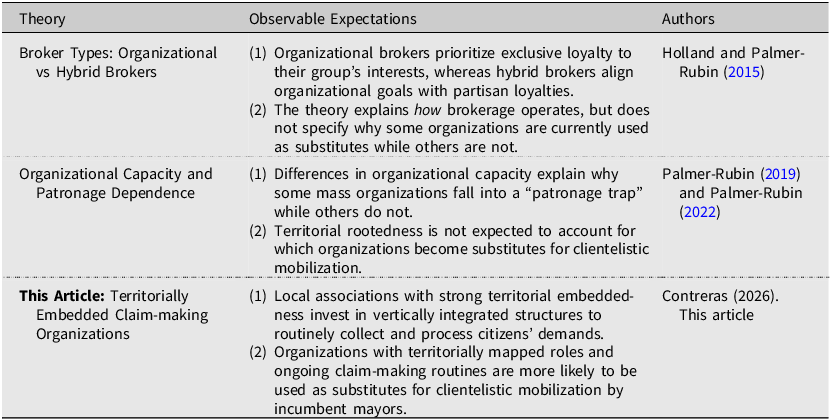
Scholarship on clientelism has largely centered on party machines, while studies of organizational substitutes have documented a range of potential partners. Yet these accounts offer limited leverage for explaining why some local groups become recurrent substitutes for clientelistic mobilization while others do not. In what follows, I draw on research on claim-making and grassroots politics, which has identified the features and practices that make some groups more attractive intermediaries than others, to derive alternative expectations (see Table 1).
Why Office-Seekers Use Some Organizations as Substitutes While Others Cannot? Alternative Explanations

Table 1. Long description
A table with three columns and four rows, comparing theories, observable expectations, and authors. The columns are labeled Theory, Observable Expectations, and Authors. The rows are labeled with different theories and their corresponding observable expectations and authors. Row 1: Theory: Broker Types: Organizational vs Hybrid Brokers, Observable Expectations: (1) Organizational brokers prioritize exclusive loyalty to their group’s interests, whereas hybrid brokers align organizational goals with partisan loyalties. (2) The theory explains how brokerage operates, but does not specify why some organizations are currently used as substitutes while others are not., Authors: Holland and Palmer-Rubin (2015). Row 2: Theory: Organizational Capacity and Patronage Dependence, Observable Expectations: (1) Differences in organizational capacity explain why some mass organizations fall into a “patronage trap” while others do not. (2) Territorial rootedness is not expected to account for which organizations become substitutes for clientelistic mobilization., Authors: Palmer-Rubin (2019) and Palmer-Rubin (2022). Row 3: Theory: This Article: Territorially Embedded Claim-making Organizations, Observable Expectations: (1) Local associations with strong territorial embeddedness invest in vertically integrated structures to routinely collect and process citizens’ demands. (2) Organizations with territorially mapped roles and ongoing claim-making routines are more likely to be used as substitutes for clientelistic mobilization by incumbent mayors., Authors: Contreras (2026). This article.
Source: Author’s elaboration.
Claim-making—the everyday activities through which individuals or organized groups approach the state to secure rights, services, or other benefits (Gallagher et al. Reference Gallagher, Kruks-Wisner and Taylor.2024)—has long been linked to the organizational practices and leadership strategies that help grassroots communities obtain state responsiveness and access to public resources (Kruks-Wisner Reference Kruks-Wisner2018; Cooperman Reference Cooperman2024; Auyero Reference Auyero2001). In some settings, these claim-making dynamics also intersect with forms of relational clientelism (Nichter Reference Nichter2018). This is a recurring theme in accounts of squatter settlements and neighborhood organization in Latin America, including Peru (Collier Reference Collier1976; Stokes Reference Stokes1995), Chile (Oxhorn Reference Oxhorn1995), and Brazil (Gay Reference Gay1994). Similar dynamics appear in Asia, where local communities press for redistribution and channel the interests of vulnerable groups, as documented in India (Auerbach Reference Auerbach2016; Kruks-Wisner Reference Kruks-Wisner2018) and in rural Pakistan (Khan Mohmand Reference Khan Mohmand2019).Footnote 5 These insights are useful here because they point to the organizational features through which some groups can credibly aggregate demands and maintain regular contact with residents—capacities that politicians may later repurpose for mobilization.
A first explanation draws on Holland and Palmer-Rubin (Reference Holland and Palmer-Rubin.2015)’s typology of organizational and hybrid brokers. Based on evidence from associations in Mexico and Colombia, they show how civil society leaders connect organized groups to politicians: some brokers remain primarily loyal to their organizations’ interests, whereas others also hold partisan commitments. This framework usefully foregrounds how leaders’ loyalties shape brokerage relationships. It does not, however, directly address the question at the center of this article. In municipal settings where multiple organizations coexist, it remains unclear why mayors repeatedly rely on some groups as substitutes for clientelistic mobilization while bypassing others.
A second explanation follows Palmer-Rubin (Reference Palmer-Rubin2022)’s analysis of how organizational capacity shapes interest groups’ ties to parties. Palmer-Rubin focuses on explaining why leaders of some community groups are willing to provide electoral services to politicians: his answer is compensatory: groups with weak internal capacity turn to patronage because they cannot sustain recruitment, retention, and mobilization with their own resources, and thus exchange electoral effort for targeted benefits. This framework is developed primarily with mass-membership organizations whose willingness to engage stems from resource deficits rather than from the content of their activities.
My argument addresses a complementary question: why do incumbent mayors prefer some organizations over others as partners for clientelistic mobilization? The decisive factor in municipal arenas is not whether groups lack internal capacity, but whether they are territorially embedded claim-making organizations that continuously channel neighbors’ demands to municipal authorities. By mapping roles and routines onto the barrio, these organizations generate dense local ties and recurrent contact beyond electoral periods, making mobilization commitments more credible. Yet my argument also speaks directly to the question of why leaders of claim-making groups would be willing to act as substitutes—a question whose answer differs from Palmer-Rubin’s compensatory logic. Leaders of claim-making organizations are willing not because they are organizationally weak, but because their primary mandate— addressing members’ demands—creates a standing need for access to the municipal resources that incumbents control. Providing electoral support in exchange for targeted assistance is, for claim-making leaders, a rational strategy for maintaining the channel through which members’ demands are addressed, not a concession made out of organizational necessity. The two accounts are therefore complementary: Palmer-Rubin explains when leaders of community groups provide services because they are weak; this article explains which groups politicians prefer and why the leaders of those groups have their own independent reasons to engage.
Argument and Observable Implications
Scholarship on contentious politics shows that political actors often appropriate pre-existing organizations as mobilization infrastructures, drawing on their communication channels and social networks (Tarrow Reference Tarrow2012; McAdam Reference McAdam1982). Similar dynamics have been documented in party building, where parties leverage established organizations to extend territorial reach and secure grassroots support (Levitsky et al. Reference Levitsky, Zavaleta., Levitsky, Loxton, Van Dyck and Domínguez2016; LeBas Reference LeBas2011; Van Dyck Reference Van Dyck, Levitsky, Van Dyck and Domínguez2016).
Building on this insight, I argue that, much as social movements appropriate pre-existing organizations for recruitment and parties leverage them to cultivate grassroots support, incumbent mayors may rely on civil society organizations as organizational substitutes for clientelistic voter mobilization.Footnote 6 When they lack the organizational capacity of machine-like parties, incumbent mayors can instead draw on civil society groups that are deeply embedded in local territories and equipped with vertically integrated structures originally developed for claim-making, thereby externalizing the organizational costs of clientelism.Footnote 7
The argument is explicitly bounded to the municipal arena, where three conditions converge to make organizational substitution most tractable. First, the claim-making organizations at the center of this argument—neighborhood associations and similar groups—are territorially defined at the neighborhood scale, which maps directly onto the administrative unit of the municipality. Mayors control precisely the discretionary resources that fuel claim-making interactions: social assistance, municipal public works, and basic services. This alignment between the scale of the organization and the level of government that controls the relevant resources creates the structural preconditions for sustained exchange. Second, relational clientelism requires repeated interaction over time. In municipal arenas, mayors and neighborhood associations are co-present in the same bounded territory across electoral cycles, generating the recurrent encounters that allow credible commitments to form (Nichter Reference Nichter2018; Cooperman Reference Cooperman2024). Third, this article focuses specifically on settings where municipal party organization is thin even for nationally active parties—precisely the condition under which incumbent mayors face pressure to find substitutes. At regional or national levels, claim-making interactions shift to different institutional interlocutors (central government agencies, national social programs, parliamentary offices), and the organizations that broker these interactions differ correspondingly in scale, internal structure, and degree of territorial embeddedness. The mechanism proposed here may operate at other territorial levels where analogous conditions hold, but the municipal arena is where its component parts—neighborhood-scale organizations, mayoral discretion over local resources, and thin local party organization—most consistently converge.
Within this municipal arena, the argument turns on two questions. Why do some community-based organizations develop vertically integrated structures in the first place? And under what conditions do leaders make these organizational resources available to incumbent mayors?
I argue that some local associations build organizational capacity in order to act more effectively as claim-makers for their members’ demands. Existing research shows that civil society organizations (CSOs)—including neighborhood associations (Auerbach Reference Auerbach2016; Dosh Reference Dosh2010; Chriswell and Huberts Reference Chriswell and Huberts.2023), peasant organizations (Schmidt et al. Reference Schmidt, Scott, Landi and Guasti1977), small business groups (Holland and Palmer-Rubin Reference Holland and Palmer-Rubin.2015), organizations in squatter settlements (Gay Reference Gay1994; Dosh Reference Dosh2010; Oxhorn Reference Oxhorn1995), and unions (Larreguy et al. Reference Larreguy, Montiel and Querubin.2017)—frequently press the state for redistribution and targeted benefits. Leaders in these organizations confront a steady flow of member demands. To manage this pressure, they often assemble vertically integrated structures—such as block-level delegates and differentiated internal roles—that reduce the informational costs of identifying, prioritizing, and aggregating requests. This organizational infrastructure allows leaders to approach local authorities more systematically and to claim resources to address members’ needs. These structures are built to solve a claim-making problem, not to create an electoral vehicle. The specific form of capacity that makes substitution tractable—territorially mapped delegate systems, demand-aggregation routines, embedded contacts within municipal offices—is generated by claim-making function and is absent in organizations of comparable size whose activities impose no comparable need for systematic, territory-wide demand relay.
Step 1 (Claim-making → vertical organization). Claim-making pressures induce leaders to build vertically integrated structures to collect, prioritize, and transmit demands.
Observable implication 1 (OI1). In claim-making organizations, we should observe vertically integrated arrangements that make demand collection more efficient, such as (a) role differentiation mapped onto local territory (e.g., street-or sector-level delegates or coordinators who relay requests to leaders), (b) routine practices for collecting and prioritizing demands (e.g., regular meetings), and (c) the operation of these roles and routines beyond electoral periods. The plausibility of this step would be reduced if claim-making organizations lack stable roles and routines for aggregating demands, or if comparable vertical structures appear only during campaigns rather than as part of everyday problem-solving.
Because claim-making leaders routinely approach municipal offices for targeted assistance, they engage in repeated interactions with incumbent mayors (Kruks-Wisner Reference Kruks-Wisner2018; Nichter Reference Nichter2018; Auerbach and Thachil Reference Auerbach and Thachil.2023; Cooperman Reference Cooperman2024). These encounters can generate mutual incentives for cooperation (Nichter Reference Nichter2018; Oliveros Reference Oliveros2021). Leaders seek goods, favors, services, and other resources to address members’ needs and to demonstrate responsiveness. Politicians, in turn, control municipal resources that can help resolve local problems. Crucially, leaders of claim-making groups have their own reasons to sustain this exchange: because their mandate requires continuous access to municipal resources, maintaining a cooperative relationship with incumbents is not merely an electoral concession but a condition for fulfilling their organizational role. This gives the exchange a bilateral character—politicians channel targeted resources through recognized leaders and draw on their territorial structures for mobilization; leaders accept and sustain this arrangement because it secures the municipal access their mandate requires. Figure 1 provides a stylized depiction of the process linking claim-making to relational clientelism.
Positive and Negative Cases of the Use of Mobilizing Structures for Clientelism: A Controlled Comparison
Source: Author’s elaboration.

Step 2 (Claim-making interactions → bilateral exchange and substitution). Routine claim-making interactions create conditions for sustained bilateral exchange: politicians channel targeted municipal resources through recognized leaders in return for electoral mobilization; leaders accept this arrangement because their mandate requires continuous access to those same resources. Politicians thereby gain an organizational substitute; leaders gain a reliable channel through which to address members’ demands.
Claim-making organizations are attractive partners because they supply scarce organizational inputs that candidates operating without machine-like party structures often lack. Through regular contact with residents, leaders hold privileged information about local needs and networks. They also have territorial organizational architectures—such as street-or sector-level intermediaries—that facilitate the collection and updating of information across the neighborhood. Finally, these organizations maintain communication channels that allow leaders to circulate information quickly and coordinate collective action. Taken together, claim-making groups provide politicians with (1) privileged information about residents; (2) a territorial structure for aggregating and monitoring mobilization; and (3) ready-to-use communication channels for activating members.
Observable implication 2 (OI2). Politicians rely on community-based groups as organizational substitutes. In doing so, they activate relational clientelism: municipal resources are channeled through recognized leaders with an expectation of electoral mobilization in return. We should observe leaders using organizational channels (e.g., delegate networks and messaging apps) to disseminate campaign information, coordinate attendance at rallies, facilitate canvassing, or organize the placement of political advertisements. The plausibility of this step would be reduced if municipal support is provided primarily through individual, unmediated channels, or if leaders report receiving assistance without any corresponding requests for electoral mobilization.
Yet not all community-based organizations invest in organizational capacity. Many are not oriented towards addressing members’ everyday problems and therefore have little reason to develop vertically integrated structures across bounded territories. Unlike claim-making associations, their leaders face no steady flow of individual requests, and thus have weaker incentives to appoint street-level intermediaries or to maintain routine channels for aggregating demands (for example, delegate systems or demand collection WhatsApp groups).
The absence of a continuous bottom-up flow of demands has two implications. First, without recurring grassroots requests, leaders have weaker incentives to build hierarchical channels for collecting and prioritizing demands. As a result, the infrastructures politicians might repurpose for mobilization—delegate networks, communication chains, and routines for coordination—are less likely to exist. Second, where such infrastructures are thin or absent, leaders’ mobilization promises are less credible, making reciprocal exchange harder to sustain. Where demand flows are continuous, by contrast, repeated interaction between claim-making leaders and local politicians can mitigate credibility problems by anchoring exchange in expectations of future dealings (Nichter Reference Nichter2018; Cooperman Reference Cooperman2024). When demand flows are weak, this stabilizing dynamic is less likely to emerge, reducing the likelihood that politicians rely on non-claim-making organizations as substitutes.
Observable implication 3 (OI3). In non-claim-making organizations, we should observe weaker—or absent—clientelistic ties with local politicians. Specifically, if the absence of a continuous bottom-up flow of demands limits organizational investment and weakens the credibility of mobilization promises, then (a) these groups should lack vertically integrated arrangements for aggregating members’ requests, and (b) their interactions with municipal authorities should center on one-off or occasional assistance rather than sustained exchanges that activate organizational channels for electoral mobilization. The plausibility of this step would be reduced if non–claim-making organizations routinely develop comparable demand-aggregation structures, or if politicians regularly channel targeted resources through them while expecting and receiving mobilization in return.
Case Selection, Methods and Limitations
I leverage data collected from Chile, where party competition and party organizations at the national level are widely characterized as programmatic and structured primarily around policy-based offers (see Appendix 1).Footnote 8 Nevertheless, this national programmatic orientation does not preclude local politicians from deploying non-programmatic strategies in municipal politics. In practice, local politicians routinely rely on patronage, pork-barrel practices, and clientelism, despite the absence of dense, communal-level brokerage networks in local party organizationsFootnote 9 (Baronet Reference Barozet2003; Belmar et al. Reference Belmar, Contreras, Morales and Troncoso2024; Luna Reference Luna2014; Arriagada Reference Arriagada2013; Mimica and Navia Reference Mimica and Navia.2019). These dynamics have been documented across parties and historical periods, from classic accounts of political brokerage in the pre-authoritarian era (Valenzuela Reference Valenzuela1977) to more recent analyses of how fragmented local intermediaries mediate access to resources and political support in post-transition Chile (Luna and Mardones Reference Luna and Mardones.2017). Quantitative evidence further confirms the persistence of these practices: panel data across Chile’s 345 municipalities reveals a political budget cycle in temporary hiring during election years, with mayors from traditional parties spending significantly more than their independent counterparts (Lavert et al. Reference Livert, Avila and Carrasco.2023).
Chile is an appropriate setting for this study for three reasons. First, its parties compete predominantly on programmatic grounds at the national level, meaning conventional accounts premised on machine organization would not predict non-programmatic mobilization in municipal politics—making it a useful context for identifying how clientelism is organized where machines are absent. Second, Santiago’s Metropolitan Region combines socioeconomic variation across municipalities with mayors from parties of different ideological orientations, allowing me to assess whether the mechanism is conditioned by poverty or partisan affiliation. Third, neighborhood associations and other local groups are legally registered and institutionally identifiable, enabling systematic comparison of organizations with contrasting features within the same municipal territory. Appendix 1 provides full details, including a comparative overview of party linkage classifications worldwide.
I conducted fieldwork in three municipalities in Santiago, Chile. I begin with Recoleta (low-middle income), governed by a mayor from the Chilean Communist Party (PC). Conventional theories of party machines (Stokes et al. Reference Stokes, Dunning, Nazareno and Brusco2013; Auerbach and Thachil Reference Auerbach and Thachil.2023) expect clientelism to operate through pyramidal party structures that monitor voters and enforce reciprocity. Where such structures are absent, as in the PC’s local organization, these theories would predict limited clientelistic mobilization. Recoleta thus provides a useful setting to examine whether politicians substitute civil society groups for party machines when local party organization is thin. I then follow a diverse-case strategy (Gerring Reference Gerring2016) by selecting two additional municipalities that vary in socioeconomic profile and partisan control: La Pintana (the poorest municipality in Santiago), governed by the Christian Democratic Party (PDC), and La Florida (upper-middle income), governed by the right-wing Democratic Independent Union (UDI). This variation allows me to test whether the mechanism operates across different socioeconomic and partisan contexts, or whether it is conditional on poverty or ideology. Appendix 1 in the Supplementary Material provides full details on case selection.
The PC, PDC, and UDI differ sharply in how they are organized nationally and at the communal level. Nationally, these are institutionalized parties with parliamentary representation and, in the case of the PC and PDC, histories spanning Chile’s democratic and authoritarian periods (Rosenblatt Reference Rosenblatt2018). At the communal level, however, none operates the pyramidal ward-broker networks through which machine parties monitor voters and enforce reciprocity (Stokes et al. Reference Stokes, Dunning, Nazareno and Brusco2013; Auerbach and Thachil Reference Auerbach and Thachil.2023). National strength and local organizational thinness coexist—a pattern documented across Chilean parties of both left and right for more than a decade (Arriagada Reference Arriagada2013; Rosenblatt Reference Rosenblatt2018; Luna Reference Luna2024). Arriagada (Reference Arriagada2013, p. 19), conducting fieldwork in Santiago’s municipalities, found that communal party units “have very low penetration into social bases” and “cannot by themselves articulate the different levels of intermediation between authorities and citizens”—a scenario “radically different” from the brokerage-dense local structure described by Valenzuela (Reference Valenzuela1977) (author’s translation). Subsequent scholarship confirms that local organizational decay cuts across the ideological spectrum, affecting the PS, DC, PPD, and RN alike (Rosenblatt Reference Rosenblatt2018), and producing “strong local caudillos, who could reproduce electoral adherence in local and congressional elections while challenging their parties in Congress and other institutional arenas” (Luna Reference Luna2024, p. 85).
Interview evidence from the present study corroborates this picture at the commune level. A former president of the Partido Socialista described municipal politics as “a completely different world [es outro mundo]”: “every mayor makes their own decisions … I have no control over the strategies mayors and councilors use to mobilize voters. I know some of them have created their maquinaria [machine], but it is difficult to know precisely how they compete in elections.”Footnote 10 Interviews with Partido Demócrata Cristiano party officials and key municipal directors in Recoleta and La Pintana corroborated this pattern across parties and time periods.Footnote 11 These testimonies—from unrelated informants, different parties, and different moments—consistently describe local party organizations as lacking the ward-level brokerage capacity that machine politics theory presupposes. In the case of La Florida, the UDI presents a historical nuance: studies from the early 2000s documented that UDI elites used their authoritarian organizational inheritance to deploy denser local networks in poor urban districts (Barozet Reference Barozet2003; Luna Reference Luna2014; Loxton Reference Loxton2021); by the time of fieldwork (2018–23), however, the La Florida administration operated without comparable machine-like local structures—a temporal shift that makes La Florida a useful case for assessing the mechanism in a municipality once governed by a party with comparatively stronger local organizational capacity.
The unit of analysis is organizations within municipalities. The three municipalities constitute the comparative frame within which I observe variation in organizations’ functional type—claim-making versus non-claim-making—and assess whether variation in functional type accounts for observed differences in clientelistic ties with local politicians. This nested design allows the argument to be evaluated both across municipalities (does the mechanism operate under different socioeconomic and partisan conditions?) and within them (do claim-making organizations systematically differ from non-claim-making ones in the same setting?).
Analytically, I examine interview and observational materials using process tracing (Beach and Pedersen Reference Beach and Pedersen.2019; Waldner Reference Waldner2016) to assess the observable implications of my argument and to adjudicate between alternative explanations. Following Gerson and Damaske (Reference Gerson and Damaske.2020), Small and Cook (Reference Small and Cook.2023), and Lareau (Reference Lareau2021), I triangulate multiple data collection strategies to address common inferential challenges in qualitative research, including social desirability bias, respondent reliability, and measurement error. Drawing on 97 interviews, participant observation, and shadowing conducted over five years of fieldwork (2018–23), I trace the processes through which incumbent mayors overcome organizational shortcomings and sustain clientelistic exchanges via organizational substitutes. Interviews cover local politicians, senior municipal officials, party elites, and leaders of diverse community organizations—including neighborhood associations, sports clubs, cooperatives, and senior centers—that vary in purpose and organizational structure.Footnote 12 Appendix 2 (Supplementary Material) provides full details of the interview plan, fieldwork decisions, and how I addressed inferential challenges such as respondent reliability and deception.
Importantly, as in most qualitative projects, the evidence does not aim for representativeness; instead, it is designed to uncover causes, patterns, and mechanisms that can be assessed in other contexts to evaluate scope conditions (Beach and Pedersen Reference Beach and Pedersen.2019). Building on these qualitative findings, I present a simple formal model in Appendix 4 (Supplementary Material) that derives testable implications, which future research could examine using surveys, experimental designs, or qualitative studies in other cases.
Evaluating Observable Implications
I evaluate the argument through three observable implications. First, I assess whether claim-making organizations develop vertically integrated structures that facilitate the collection and processing of demands beyond electoral periods (OI1). Second, I examine whether politicians repurpose these organizations as organizational substitutes by channeling targeted municipal resources through recognized leaders and activating their internal channels for electoral mobilization (OI2). Third, I assess the contrast case (OI3): where continuous bottom-up demand flows are absent, local associations should exhibit thinner organizational infrastructures and, accordingly, weaker—or absent—relational clientelistic ties. The excerpts below are drawn from interviews and field observations conducted across the three municipalities over five years of fieldwork, and reflect patterns that recur consistently across the full corpus of interview and observational material. I then evaluate three alternative explanations.
Building Vertical Structures to Process Demands (OI1)
In municipal settings, some community-based organizations develop hierarchical structures as leaders gather residents’ demands and approach public officials to address them.Footnote 13 In Chile, neighborhood associations (juntas de vecinos) are legally constituted bodies under Law 19.418, which defines their functions and attributions. These associations are routinely sustained by residents’ demands. As leaders often note, addressing people’s needs is their raison d’être. Meeting such demands therefore constitutes a central responsibility of neighborhood association leaders. The consistent response to questions about the organization’s role was: “To address people’s demands and urgencies.”Footnote 14 Noelia, a local leader, expressed it succinctly:
We represent the necessities and concerns of our communities. We advocate for local demands in front of authorities. We visit the municipal building to demand solutions for our neighbors’ needs.Footnote 15
The volume of demands that leaders collect and transmit to authorities cannot be managed by only one or two individuals. Neighborhood territories typically cover large areas with hundreds of households. In the three municipalities studied, even the smallest neighborhood association (in La Pintana) comprised 50 households.Footnote 16 To handle demand collection, neighborhood associations appoint delegates as a second tier in the organizational hierarchy. Delegates gather neighbors’ concerns and transmit them in a bottom-up fashion to leaders, who then press municipal staff or directly petition key officials, such as the mayor or councilors, for solutions. Camila, a neighborhood leader in La Pintana, described how the organization is structured:
We represent our community. We have 1,640 neighbors, and we have “todo mapeado” [a detailed map], with all the necessities and people’s demands. [The strategy is] one delegate per block, who transmits all the information to us.Footnote 17
Demands move from neighbors to block delegates, who in turn pass them on to leaders. Petitions advance step by step through this chain of actors, reflecting the vertical organization that facilitates systematic demand aggregation. Neighborhood leaders themselves describe how this hierarchy operates. Viviana, from La Pintana, recounted:
The role we play here [as leaders] is to assist our community and protect our village [referring to security problems]. We use chat groups so the people may call or text us. This is also the channel through which we deliver the handouts provided by the municipality. They [the municipality] help us a lot.Footnote 18
In La Florida, I found a similar pattern. Yasna, a neighborhood association leader, explained:
I intermediate the help municipality brings to our neighbors. We have delegates in every block of the neighborhood, also we have a WhatsApp chat to keep informed about what people need.Footnote 19
Eliana, who leads an association covering roughly 1,300 households,Footnote 20 similarly noted:
Our structure consists of 22 delegates. I inform them of all the things related to the community. We have a chat group where I communicate with each of them. They, in turn, have their own chat groups with the neighbors in their block.Footnote 21
In Recoleta, neighborhood association leaders describe the same logic of demand collection, strengthening the argument that vertical structures are built to manage claim-making rather than at politicians’ behest. Tatiana, a neighborhood leader, explained:
We have delegates all across our territory. We need it because otherwise there is no way that we can manage neighbors’ demands. We use the delegates and create a WhatsApp group as a way to collect petitions more easily.Footnote 22
Reinforcing this account, Claudia similarly noted that “We all use WhatsApp groups and some neighbors in the blocks inform us about what people need. It is obvious, one person cannot do all the work.”Footnote 23 The convergence of these patterns across all three municipalities—which differ in socioeconomic profile, partisan control, and income level—reduces the plausibility that observations reflect the particular characteristics of a single case (Gerson and Damaske Reference Gerson and Damaske.2020; Lareau Reference Lareau2021).
When these structures function properly, the routine collection of individual demands provides leaders with a clear picture of residents’ needs across the neighborhood. As Yasna from La Florida put it: “I do everything. Las juntas [neighborhood associations] deal with all kinds of matters, lo que sea que nuestra gente necesite [whatever the requirement may be]. We are a muni chica (small municipality), receiving both neighbors’ complaints and demands.”
These vertically integrated arrangements do not end with demand collection; they also structure how leaders transmit demands to municipal authorities and pursue solutions. After collecting demands, leaders take on the task of securing responses from municipal authorities. They report routinely visiting municipal offices, calling directors and senior staff, and mobilizing contacts within the municipal apparatus to address residents’ requests. Rosa, from La Pintana, summarized this reality neatly:
I must know my people’s requirements. I also must have contacts in the municipality to solve their problems. I have a close relationship with some directors [she names some directors] in the municipal building, even when I don’t support the mayor’s administration. But, you know, if you do not have contacts, you cannot help your people. It is absolutely necessary.Footnote 24
In a similar vein, Camila, a neighborhood association leader in a different sector of La Pintana, explained:
This neighborhood association represents roughly a thousand households. We take people’s demands to the municipal offices. We need resources for street lights or to solve particular problems such as rushing a medical appointment. Having contacts in the municipality is key, especially with directors.Footnote 25
Leaders emphasized maintaining regular contact with municipal workers who can provide assistance. For needs such as food, medication, and building materials, they seek ties with directors in the Department of Municipal Development or in social assistance offices. They also cultivate relationships with staff in the health or sanitation departments when demands concern those areas.
Rosa illustrated this point when she needed to obtain a medical appointment for a neighbor:
I have a very close relationship with the workers at the consultorio [local medical center]. When one of my neighbors needs an urgent appointment or a home visit by a doctor, I call them. It is the fastest way to get a response.Footnote 26
The evidence above provides a hoop test for the argument. OI1 posits that if claim-making organizations are to function as organizational substitutes, they must first develop vertically integrated structures that routinely collect, process, and transmit residents’ demands beyond electoral periods. The presence of territorially mapped delegates, hierarchical communication channels, and regular interactions with municipal offices in the three municipalities satisfies this necessary condition. However, OI1 is not sufficient to establish organizational substitution, as vertical organization alone does not imply clientelistic exchange or mobilization on behalf of incumbents.
At the same time, the evidence reduces the plausibility of alternative explanations that attribute organizational capacity primarily to electoral mobilization or campaign-period investment. Leaders consistently describe these structures as oriented toward everyday problem-solving rather than electoral activity. The next subsection therefore examines whether, and under what conditions, politicians repurpose these claim-making structures as organizational substitutes for mobilization (OI2).
How Politicians Use Community-based Groups as Organizational Substitutes for Electoral Support (OI2)
Interview evidence across the three municipalities shows a consistent pattern: neighborhood leaders activate their organizations’ internal structures to provide electoral support in exchange for municipal assistance.Footnote 27 The excerpts below show how communication channels, delegate networks, and territorial coverage are repurposed to disseminate campaign materials, conduct street-level canvassing for incumbents, and mobilize voters during electoral periods.
Francisca, a neighborhood leader in La Pintana, explained how her association supports the mayoral campaign using her organization infrastructure:
I tell my neighbors to support and vote for him [mayor] during elections. I am in permanent contact with neighbors and relay all the info that municipal directives want me to inform them of. I obviously highlight the good things the municipality has done in the comuna and our neighborhood.Footnote 28
Leaders in La Florida reported similar patterns. Lia, a neighborhood leader, explained:
We use WhatsApp to share information from the municipality for the mayor’s campaign. We also speak directly with our neighbors about supporting the mayor and put up palomas [campaign posters] on the blocks [social-housing apartments].Footnote 29
As these accounts suggest, neighborhood organizations’ communication infrastructures are used to relay information originating in the municipality, including assessments of incumbents’ performance and campaign messages.
Crucially, beyond information dissemination, leaders described reciprocating municipal assistance by actively mobilizing electoral support. Josefina, a neighborhood leader from La Pintana, detailed how organizational channels are activated in exchange for municipal resources:
“My role is to know people’s necessities. We are coordinated with the municipality, with directors and municipal workers. In our junta [neighborhood association] we use WhatsApp […] and have 14 delegates, one for each block, who are crucial to inform what people need to municipal offices.”
“Do you support the mayor in return for the help she gives to you?” I asked.
“I do support the mayor … yes. I mobilize neighbors, distribute political ads, and coordinate attendance at municipal events. I deliver the information they send us. We campaign with neighbors in the ‘puerta a puerta’ (door-knocking campaign) […]. We help them, because they help us.”Footnote 30
Leaders described providing electoral support in several forms: mobilizing voters, coordinating participation in campaign activities, and facilitating the distribution of political advertisements throughout the neighborhood. As one leader noted, “hanging a paloma [political ad] in front of houses signals to the neighbors who they should support.”Footnote 31 Juana elaborated:
[…] They [municipal officers] help me with favors because I mobilize people. I do not force people to vote for anyone, but I advertise my vote with the paloma … and they [the neighbors] believe me. If the municipality does a good job, people trust me.
Leaders also reported monitoring cooperation within their communities. Francisca described keeping records of neighbors who assisted with campaign activities:
I put palomas in the front of my house and tell neighbors to hang palomas as well. I registered the names of all neighbors that help us. Last [municipal] election [2016] I listed all the people who lend the front of their houses [for political ads]. They must support the mayor because they help us. How can you demand stuff later? If people do not support the mayor, you cannot come here to demand things.Footnote 32
In Recoleta, Tatiana captured the exchange logic with equal directness:
The logic with the mayor is you give me, I will help you back. It is as simple as that. If the mayor helps us with cleaning and repairing the streets, cutting the trees to avoid the mix with light cables, then we as a neighborhood association will help him in the elections. He knows that.Footnote 33
These accounts indicate that leaders use delegates and communication channels not only to disseminate information, but also to coordinate and signal electoral support within the territory. Crucially, accounts from municipal officials corroborate leaders’ descriptions. Jaime, a senior director in La Pintana, stated:
Local leaders demand the resources they need for their members [neighbors] and offer political support. Neighborhood groups have a pattern; they depend 99% on municipal resources to solve neighbors’ requirements.Footnote 34
Adolfo, another senior director, described a similar relationship:
You can say we have some sort of clients in the territory. We give municipal help to those groups that support us during elections. You know … everyone knows … this is politics …and neighborhood associations are important because they know people’s needs. They know their people and the territory very well.Footnote 35
Taken together, the accounts of neighborhood leaders and municipal directors substantially increase the plausibility of the argument that politicians repurpose community-based organizations as organizational substitutes. Directors’ acknowledgments are particularly probative, as they face few incentives to openly recognize quid-pro-quo exchanges. While this evidence does not conclusively rule out all alternative explanations, it substantially weakens accounts that portray these interactions as non-electoral or purely administrative favor provision, thereby lending support to OI2.
Making Clientelism Work without Party Machines
This subsection consolidates the mechanism uncovered in OI1 and OI2. Neighborhood association leaders describe their core mandate as mediating residents’ claim-making and securing responses from municipal authorities.Footnote 36 Doing so requires (i) an internal infrastructure that enables leaders to collect and process demands, and (ii) routine access to municipal offices, directors, and frontline staff who can help address those demands.
Figure 2 summarizes how this claim-making infrastructure becomes usable for electoral mobilization. Leaders aggregate demands through a vertically integrated chain (neighbors → delegates → leaders) and maintain communication channels (e.g., chat groups) that operate beyond campaigns. These routines structure leaders’ interactions with municipal offices and facilitate the upward flow of information and requests. This pattern recurred across the neighborhood associations observed in all three municipalities, reducing the plausibility of a purely socioeconomic explanation. It is consistent with an account in which organizational routines and territorial embeddedness play at least a partial explanatory role.Footnote 37
Claim-making infrastructures as organizational substitutes for clientelistic mobilization.
Source: Author’s elaboration.

Crucially, the same organizational channels that make claim-making workable also provide a ready-made mobilization apparatus. When municipal authorities channel targeted assistance through recognized leaders, leaders can activate delegates and communication networks to disseminate campaign information, coordinate participation in electoral activities, and facilitate the placement of political advertisements. In this sense, political support flows downward through the very structures built to move demands upward, enabling relational clientelism even where parties lack machine-like capacity (Nichter Reference Nichter2018). Taken together, leaders’ and municipal officials’ accounts of this organizational repurposing increase the plausibility of the organizational substitution argument and weaken interpretations that frame municipal support as routine service provision rather than electorally conditioned exchange.
The next subsection evaluates the contrast case (OI3): organizations that do not face sustained bottom-up demand flows are less likely to develop comparable infrastructures and therefore provide a weaker basis for sustained clientelistic exchange.
Local Associations without Vertically Integrated Structures (OI3)
OI3 expects that where continuous bottom-up demand flows are absent, local associations will display thinner organizational infrastructures and correspondingly weaker—or absent—relational clientelistic ties. Evidence from non-claim-making organizations supports this expectation.
Leaders of senior clubs and sports organizations emphasized that members do not approach them with individual requests to be channeled to municipal offices. Veronica, president of a senior club in Recoleta, explained:
“I do not receive particular demands, actually. That is not the purpose of our group. We get together to chat, to have ‘once’ [Chilean dinner], or to play board games.”
“Then, do you take any requests to municipal offices?”, I asked.
“We are a constituted group. We of course know the people in the municipality. Sometimes we apply to public funds or to municipal-sponsored trips to the beach. But we have no constant demands to be addressed.”Footnote 38
Carla, from one of the largest local football clubs in La Pintana, described a similar pattern:
Neighbors do not seek assistance from us. Our role is to organize football matches for children and young residents, not to solve people’s problems. Occasionally, we require assistance from the municipality for transportation, a service they provide at times.Footnote 39
Consistent with the absence of routine demand aggregation, leaders described organizational arrangements that are comparatively flat and oriented towards coordinating specific activities rather than collecting and prioritizing members’ requests. When asked about her club’s structure, Carla replied:
We do not have a proper structure. I concentrate all the information. I contact children’s parents to inform them about the games.
Researcher: “How do you communicate with them? For instance, neighbors’ associations have delegates in every street to collect information from neighbors’? How do you inform about groups’ activities?”
“Well, I have a chat group to inform about the matches on weekends. But we are not like las juntas [neighborhood associations]. We do not need delegates because there is no information to collect.”Footnote 40
Magdalena, who leads an environmental group in La Pintana, likewise contrasted her organization with neighborhood associations that negotiate with the municipality and mobilize electorally:
“We organize meetings using social media. Our focus is on promoting environmental initiatives within the commune. We stand out as being quite distinct from the neighborhood associations, in a sense. Our purpose is very specific.”
“What makes you different from the neighborhood associations? Could you elaborate on that?”, I asked back.
“Well, particularly in this población [slum], ‘La Mónica’ [the President of her neighborhood association] mobilizes people in support of the mayor. Everyone knows that. She negotiates with the muni [municipal authorities]. We are different from neighborhood associations in that respect.”Footnote 41
Corroborating these accounts, municipal officials reported that neighborhood association leaders are the primary actors who routinely bring requests to municipal offices. Luis, in La Pintana, noted:
“You can run into neighborhood leaders in the municipal office all the time. They come directly to our offices to make requirements or call me directly. They are very insistent.”
Researcher: “What about other local associations?”
“Other groups do not approach us with requirements as frequently; we mostly receive requirements from neighborhood leaders.”Footnote 42
Finally, leaders of non-claim-making groups reported that municipal assistance, when provided, rarely comes with explicit expectations of electoral mobilization. Karina, president of a cooperative in Recoleta, recounted:
Our cooperative has never been asked for any kind of political favors. We have just attended either to present our projects at some public events or during certain mayors’ public speeches. But they have not asked us for votes or mobilized people. It may also be because we are a small cooperative […]Footnote 43
Veronica similarly noted:
They [municipal authorities] do not request us to campaign during elections. Maybe a photo for the newspaper when they provide transportation, but nothing else.Footnote 44
Rather than exchanging assistance for mobilization, these organizations described interactions with municipalities that center on applying for programs, grants, or project support, occasionally accompanied by symbolic credit-claiming. As Gaspar, president of a cooperative in Recoleta, put it:
The support they give us is because they [municipality] believe in the individual development of people and give us support. It is because they are communists and believe in communitarian development, it is an ideological position. They only advise us; they do not ask us for more than a picture with the mayor.Footnote 45
Taken together, these excerpts are consistent with OI3: where organizations do not face sustained claim-making pressures, they are less likely to develop vertically integrated infrastructures that politicians can readily repurpose as substitutes, and their ties with municipal authorities revolve more around program access and symbolic visibility than electorally conditioned exchange.
The Recoleta cooperatives provide additional confirmation of this pattern. Despite receiving municipal support and maintaining contact with local authorities, neither cooperative was asked to mobilize voters, coordinate campaign participation, or activate members for electoral activity. Attending a public event or appearing in a photograph with the mayor is consistent with the municipality claiming credit for its programs—a standard form of political communication that requires no organizational mobilization in return. The key distinction is not whether an organization maintains contact with the municipality, but whether that contact is conditioned on electoral mobilization. Neither cooperative described such conditioning, and neither possesses the delegate networks or demand-aggregation routines that would make systematic mobilization feasible. This is precisely what OI3 predicts: non-claim-making organizations may receive occasional municipal support and provide symbolic visibility, but without the bilateral exchange structure activated through vertical organizational channels that characterize relational clientelism.
Alternative Explanations
In theory-testing process tracing, evidence should increase the plausibility of the theorized mechanism while reducing the plausibility of rival accounts by assessing whether their observable implications appear in the case (Beach and Pedersen Reference Beach and Pedersen.2019; Bennett and Checkel Reference Bennett and Checkel2014). I therefore evaluate three alternative explanations.
Alternative 1: Clientelism as Compensation for Weak Organizational Capacity
Palmer-Rubin’s framework yields a clear expectation: organizations should rely on patronage because they cannot generate organizational capacity internally (recruitment, retention, mobilization). My evidence from Chile does not match this expectation. Neighborhood associations engage local politicians despite already having functioning vertical structures and routinized demand aggregation; the exchanges are oriented to resolving neighbors’ claims, not to remedying weak membership capacity. This pattern reduces the plausibility of a “patronage trap” logic as the primary driver.
In addition, Palmer-Rubin’s comparison focuses on mass-membership organizations that are not anchored in bounded territories. In Chile, territorial embeddedness is central: neighborhood associations act as recurrent intermediaries because their vertical structures are mapped onto the barrio, allowing them to credibly mobilize and to credibly signal local needs. This increases the plausibility of the theorized mechanism, in which clientelism hinges on the combination of claim-making routines and territorial rootedness in the municipal arena.
Alternative 2: Organizational Brokers
Holland and Palmer-Rubin’s broker typology usefully classifies intermediaries, but it offers limited leverage on my key outcome: which organizations become recurrent substitutes. A necessary implication for this alternative is that organizational leaders should be similarly able to broker across the main types of local groups. Yet within the same municipalities, many organizations (e.g., sports clubs, senior groups) do not enter clientelistic exchanges. These negative cases reduce the plausibility of a generic “organizational broker” account unless it specifies why some organizations broker and others do not.
My framework provides those discriminators: organizations with routinized claim-making infrastructures and territorially embedded vertical structures are systematically better positioned to operate as substitutes under different socioeconomic contexts. The broker account is also often linked to party-system volatility: brokerage should matter most where partisan linkages are unstable (Holland and Palmer-Rubin Reference Holland and Palmer-Rubin.2015, 1204). Yet organizational substitution is also observed in a context like Chile, a comparatively institutionalized setting in which even policy-oriented parties engage local intermediaries. This lowers the plausibility that volatility is a necessary precondition, and instead supports a municipal-level mechanism driven by local incentives and territorially embedded claim-making organizations. I expand these tests and discussion of alternative explanations in Appendix 3 of the Supplementary Material.
Alternative 3: Local Operators Recruited by Politicians
A third alternative holds that the neighborhood leaders in this study are not autonomous claim-makers subsequently co-opted by politicians, but political operators installed by the mayor from the outset to build and manage a territorial mobilization apparatus. Under this account, the claim-making structures observed in OI1 are products of electoral organization rather than its precondition.
If leaders are recruited as political operators, their organizational capacity should be absent in those who do not support the incumbent, and leadership itself should be subject to mayoral appointment rather than independent election. Neither expectation is borne out. Neighborhood associations are legally constituted bodies under Law 19.418, with elected leadership and functions defined independently of any mayoral administration; mayors inherit these organizations rather than create them.Footnote 46 Rosa’s account, for instance, is directly probative: she reports maintaining contacts in municipal offices even when not supporting the mayor’s administration, demonstrating that organizational capacity for demand processing and claim-making exists independent of electoral alignment. This pattern was reinforced by other neighborhood association leaders. In Recoleta, Tatiana described working across successive administrations:
I do not care if the mayor is Communist or UDI [right-wing party], I need to sort out our neighbors’ problems. The previous mayor was UDI, and I had to work with him. Now [he] is Communist and I do the same. It is not about the mayor’s party. What matters is that they address our demands. I have worked here as the leader for almost 20 years.Footnote 47
In La Florida, Lia noted a similar logic:
We are like social workers. I am not right-wing, but I still have to go to the muni to bring solutions for our barrio.Footnote 48
Taken together, these accounts are inconsistent with a systematic recruitment account: organizational capacity persists across changes in political alignment, and leadership is defined by law independently of any mayoral administration. Their indifference to the mayor’s partisan identity—Tatiana working similarly with Communist and UDI administrations across two decades, Lia supporting a right-wing mayor despite her own different sympathies—reinforces rather than complicates this picture. The exchange is transactional: leaders provide electoral support because it secures the municipal access their claim-making mandate requires, not because of partisan alignment. What drives the exchange is not partisan identity but control over the resources that leaders need to fulfill their mandate.
Conclusion
This article advances research on local political organization by explaining how politicians sustain clientelistic linkages without machine-like infrastructures. Conventional accounts anticipate organizational substitution, but offer limited leverage for explaining why some local groups become recurrent intermediaries while others do not. I show that in Chile, incumbent mayors compensate for thin party organization by partnering repeatedly with territorially rooted claim-making organizations as substitutes. The key insight is that substitution is patterned: mayors are more likely to rely on groups whose claim-making routines generate vertically integrated structures that can be repurposed for mobilization, rather than on other community organizations that lack these features.
The article contributes to research on party-voters linkages and clientelism in several ways. First, it shifts attention from whether substitutes exist to when particular organizations become recurrent intermediaries. Second, it shows that clientelistic tactics can operate without fully developed party machines: incumbent mayors draw on local groups whose routine claim-making infrastructures can be repurposed for mobilization in exchange for municipal support. Third, at a time of party disaffection and strained representation, the findings clarify one way local politicians sustain links with citizens who might otherwise remain disengaged.
Finally, the article complements scholarship linking associational life to clientelistic relationships (Holland and Palmer-Rubin Reference Holland and Palmer-Rubin.2015; Auerbach and Thachil Reference Auerbach and Thachil.2023). Organizational routines, coordination capacity, and local networks help explain why some groups enter clientelistic exchanges while others do not (Garay et al. Reference Garay, Palmer-Rubin and Poertner.2020; Gottlieb and Larreguy Reference Gottlieb and Larreguy.2020; Cruz Reference Cruz2019). My evidence suggests that politicians’ relationships with community groups are patterned: they are more likely to work repeatedly with organizations that can credibly mobilize and campaign through existing, territorially embedded structures.
The study prioritizes internal validity by tracing the mechanism through in-depth evidence from three municipalities that vary in socioeconomic profile and partisan control. As is common in process-tracing research, this design limits external validity (Bennett and Checkel Reference Bennett and Checkel2014; Beach and Pedersen Reference Beach and Pedersen.2019). The three attributes at the center of the argument—claim-making function, vertically integrated structure, and territorial embeddedness—co-occur among neighborhood associations and are jointly absent among the contrast organizations; the design assesses the bundle rather than isolating each attribute’s independent contribution. Within-type variation offers partial leverage: Rosa’s account of maintaining municipal contacts while withholding mayoral support suggests that claim-making function generates vertical structures independently of electoral alignment, but fully disentangling the three attributes would require cases possessing some but not all of the bundle. The design is bounded in a related respect: the negative cases—sports clubs, senior groups, and cooperatives—are organization types within the three municipalities, not separate municipalities; the design has more leverage over within-commune functional variation than over cross-municipal differences in scope conditions.
Even so, the mechanism yields portable expectations that can be assessed through complementary research designs.Footnote 49 It should be most observable where parties lack dense municipal broker networks yet control discretionary resources, and where autonomous civil society organizations with territorially bounded constituencies routinely intermediate claim-making; it should be less likely where party machines already provide mobilization infrastructures, where civil society organizations lack autonomy, or where claim-making is primarily individualized rather than organized. As party organizations weaken across Latin America and beyond, identifying which civic groups become recurrent substitutes is a question with direct implications for how democratic representation and resource distribution intersect at the local level.
Supplementary material
To view supplementary material for this article, please visit https://doi.org/10.1017/lap.2026.10066
Funding declaration
This research was funded by the National Agency for Research and Development (ANID)/Scholarship Program/BECASCHILE/2019 - 72200354, and supported by the Millennium Nucleus Center for the Study of Politics, Public Opinion and Media in Chile (MEPOP, NCS2024_007), Worcester and St. Hugh’s Colleges grants (University of Oxford), and APSA’s Comparative Politics, Political Organizations and Parties sections and APSA Committee on the Status of Graduate Students in the Profession.
Competing interests
The author declared no potential conflicts of interest with respect to the research, authorship, and/or publication of this article.


 Open access

