Introduction
While later life is generally characterized by happiness and emotional well-being (Charles and Carstensen, Reference Charles and Carstensen2010), late life depression (LLD) affects a significant proportion of older people. Population-based studies have demonstrated that over 8% of community-dwelling older people aged 50 years and over have clinically relevant depressive symptoms (O Regan et al., Reference Regan, Kearney, Savva, Cronin and Kenny2013), rising to 11% in a cohort aged over 70 years (Steffens et al., Reference Steffens, Fisher, Langa, Potter and Plassman2009). LLD independently confers an increased risk of several adverse outcomes, including functional decline (Lenze et al., Reference Lenze2005), dementia, cardiovascular events, and all-cause mortality (Baldwin et al., Reference Baldwin, Gallagley, Gourlay, Jackson and Burns2006). Depression in later life is also an important risk factor for death by suicide (Crumpacker, Reference Crumpacker2008).
Globally, suicide accounts for almost 800,000 deaths per year (Varnik, Reference Varnik2012). Despite the reported decline in suicide in later life, suicide rates among older people remain high (Shah et al., 2016). Compared to younger people, older people have higher rates of death ideation (Fiske et al., Reference Fiske, Wetherell and Gatz2009), such as a passive wish to die, which may be a clinical marker for future suicidal behavior (Baca-Garcia et al., Reference Baca-Garcia2011). Suicide in later life is more closely associated with depression and suicide attempts are more likely to be fatal in older adults (Van Orden and Conwell, Reference Van Orden and Conwell2011).
Medical treatment for LLD is effective, however (Rajji et al., Reference Rajji, Mulsant, Lotrich, Lokker and Reynolds2008), and antidepressants have been shown to reduce the risk of suicidal behavior in older people (Stone et al., Reference Stone2009). Furthermore, improvement in depressive symptoms with appropriate therapy is also associated with an improvement in functional ability (Oslin et al., Reference Oslin, Streim, Katz, Edell and TenHave2000).
Undetected depression has a poor prognosis (Licht-Strunk et al., Reference Licht-Strunk, Beekman, de Haan and van Marwijk2009). A shorter duration of untreated depression is associated with better remission rates at 12 weeks (Ghio et al., Reference Ghio2015), while longer duration of untreated LLD is associated with hippocampal volume loss (Sheline et al., Reference Sheline, Gado and Kraemer2003). Despite this, it is well recognized that LLD often goes undetected or untreated (Rothschild, Reference Rothschild1996; Birrer and Vemuri, Reference Birrer and Vemuri2004). Several possible reasons have been suggested for this, including the reluctance of older people to report mood-related symptoms to healthcare professionals (Chew-Graham et al., Reference Chew-Graham2012). However, little research has quantified the burden of untreated LLD at a population level to date.
Our hypothesis was that a significant proportion of cases of depression in later life are undetected or untreated. The aim of this study, therefore, is to clarify the prevalence of and characteristics of community-dwelling people aged 50 years or more with untreated depression. We will also determine if untreated depression is more prevalent in an older age group aged 75 years or more. Furthermore, we will ascertain the prevalence of older people experiencing passive death ideation, in order to clarify how many of these participants are also untreated.
Methods
Study design
This is a cross-sectional study of The Irish Longitudinal Study on Ageing (TILDA) cohort of older people, examining the prevalence and characteristics of participants with untreated depression and passive death ideation.
TILDA is a study of a nationally representative sample of community-dwelling older adults aged 50 years and over. The TILDA study design has been outlined previously (Whelan and Savva, 2013). Briefly, an initial multi-stage sample of addresses was chosen by means of the RANSAM sampling procedure based on the Irish Geodirectory, a comprehensive and up-to-date listing and mapping of residential addresses in Ireland compiled by the Ordinance Survey Office. This was designed to ensure that the sample would be representative of the Irish population with each address in the country having an equal probability of selection from the sample list of addresses.
We analyzed data from the second wave of TILDA collected between 2010 and 2012. Data were analyzed from Wave 2 rather than Wave 1 as the Composite International Diagnostic Interview (CIDI) was not available for analysis at Wave 1.
All assessments were carried out by trained research nurses. The study was approved by the Faculty of Health Sciences Research Ethics Committee at Trinity College Dublin, and all participants gave informed written consent. All experimental procedures adhered to the Declaration of Helsinki.
Participants were included if they were aged 50 years or more, and underwent assessment of both mood and cognition at Wave 2.
Depression
The 20-item Centre for Epidemiological Studies Depression scale (CES-D) was used to measure depressive symptoms, with a cut-off score of 16 indicating clinically significant depressive symptoms (Villagut et al., Reference Villagut, Forero, Barbaglia and Alonso2016). It focuses on depressive symptoms within the last two weeks, i.e. current depression, and has been well validated against clinical diagnosis of depression in later life (Lewinsohn et al., Reference Lewinsohn, Seeley, Roberts and Allen1997). Specific CES-D questions on mood, worthlessness, and appetite were also analyzed separately.
The CIDI, a structured diagnostic interview, was used to assess for a major depressive episode within the last 12 months (Kessler and Ustün, Reference Kessler and Ustün2004).
Depression was defined as a CES-D score ≥ 16 (Villagut et al., Reference Villagut, Forero, Barbaglia and Alonso2016) and/or a CIDI indicative of major depressive episode within the last year. Untreated depression was defined as depression in participants not prescribed antidepressants or antipsychotics.
At the same time as depression assessments, medication lists were examined for each participant and medication was coded using the Anatomical Therapeutic Chemical (ATC) Classification System. Antidepressants were coded as N06AA (non-selective monoamine reuptake inhibitors), N06AB (selective serotonin reuptake inhibitors), N06AF (monoamine oxidase inhibitors, non-selective), N06AG (monoamine oxidase A inhibitors), and N06AX (other antidepressants). Antipsychotics were coded as N05AA (phenothiazines with aliphatic side-chain), N05AB (phenothiazines with piperazine structure), N05AC (phenothiazines with piperidine structure), N05AD (butyrophenone derivatives), N05AE (indole derivatives), N05AF (thioxanthene derivatives), N05AG (diphenylbutylpiperidine derivatives), N05AH (diazepines, oxazepines, thiazepines, oxepines), N05AL (benzamides), N05AN (lithium), and N05AX (other antipsychotics).
Death ideation
Participants were asked “In the last month, have you felt like you would rather be dead?” and those that answered yes were said to have death ideation.
Other measures
Data were collected on social variables, including educational attainment and marital status. Living in a rural setting was defined as living outside a city or town. Loneliness was defined as answering as a “moderate amount of time” or “all of the time” when the participant was asked how often they felt lonely. Participants were questioned directly regarding instrumental activities of daily living (IADL), specifically their ability to dress, including putting on shoes and socks; walk across a room; bath or shower; eat, including cutting up food; get in and out of bed and use the toilet, and functional impairment was defined as having one or more impairments in any of these tasks. Cognitive impairment was defined as a score of 24 or less on the Mini-Mental State Examination (MMSE). Grip strength was measured using a dynamometer and expressed in kilograms. Participants were also asked if they had visited their general practitioner (GP) within the last 12 months. Cardiovascular disease was defined as self-report of myocardial infarction, angina, cardiac arrhythmia, or cardiac failure.
Statistical analysis
Data were analyzed using Stata version 12.1 (Stata®, College Station, TX). Categorical variables were compared using the χ 2 test. Normally distributed continuous variables were described as means and standard deviations and analyzed using Student's t-test.
Binary logistic regression models, reporting odds ratios, were used to examine the associations between variables of interest and death ideation in later life. The variables of interest added to the model were chosen based on their likelihood of association with death ideation (Kim et al., Reference Kim, Bogner, Brown and Gallo2006; Hirsch et al., Reference Hirsch, Duberstein, Chapman and Lyness2007; Ayalon and Litwin, Reference Ayalon and Litwin2009; Kiosses et al., Reference Kiosses, Szanto and Alexopoulos2014). A p value ≤ 0.05 was considered statistically significant.
Results
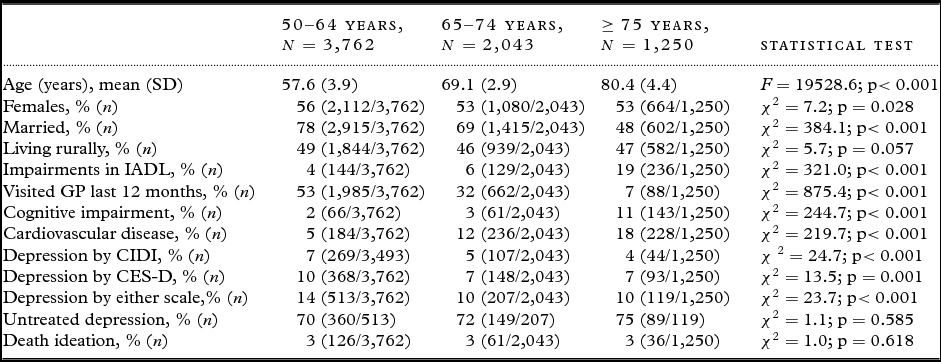
A total of 7,282 participants aged 50 years or more were included in the TILDA study at Wave 2. Of these, 227 were excluded as mood or cognitive assessments were incomplete, yielding a final study sample of 7,055 participants. Just over half of participants were aged 50–64 years, one-third were aged 65–74 years, and the remaining sixth were aged 75 years or more. See Table 1 for baseline characteristics of the study sample.
Baseline characteristics of study sample by age group

Notes: Continuous variables were analyzed with ANOVA; Categorical variables were analyzed with χ 2 test.
SD = standard deviation; IADL = instrumental activities of daily living; GP = general practitioner; CES-D = Centre for Epidemiological Studies Depression scale.
Cognitive impairment was defined as MMSE ≤ 24.Cardiovascular disease was defined as self-report of angina, congestive cardiac failure, arrhythmia, or myocardial infarction. Death ideation was defined as answering “yes” when asked “In the last month, have you ever felt that you would rather be dead?”
Untreated depression
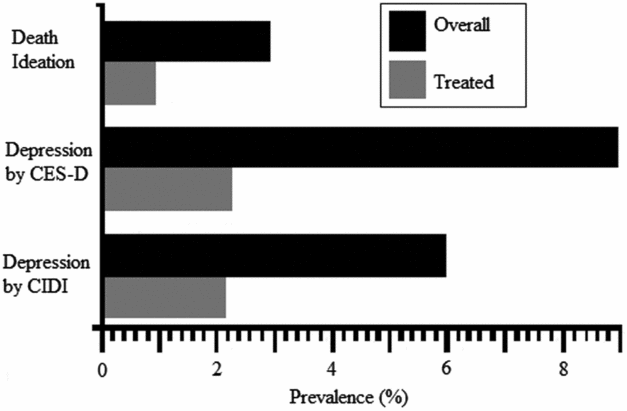
In total, 6% (420/7,055) of study participants met criteria for a major depressive episode within the last 12 months by the CIDI, while 9% (609/7,055) had a score ≥16 on the CES-D, suggestive of current clinically relevant depressive symptoms. Prevalence of depression was highest in the 50–64 year olds (see Table 1).
In total, 12% (839/7,055) of participants met criteria for depression by either scale, with one-third (241/839) of these were on medical therapy for depression. When stratified by age, there were no statistically significant differences in treatment rates between groups (see Table 1). Overall the proportion receiving treatment was higher for those who were screened positive by the CIDI compared to the CESD (see Figure 1).
Prevalence of overall and untreated depression and death ideation. CES-D = Centre for Epidemiological Studies Depression scale; CIDI = Composite International Diagnostic Interview.

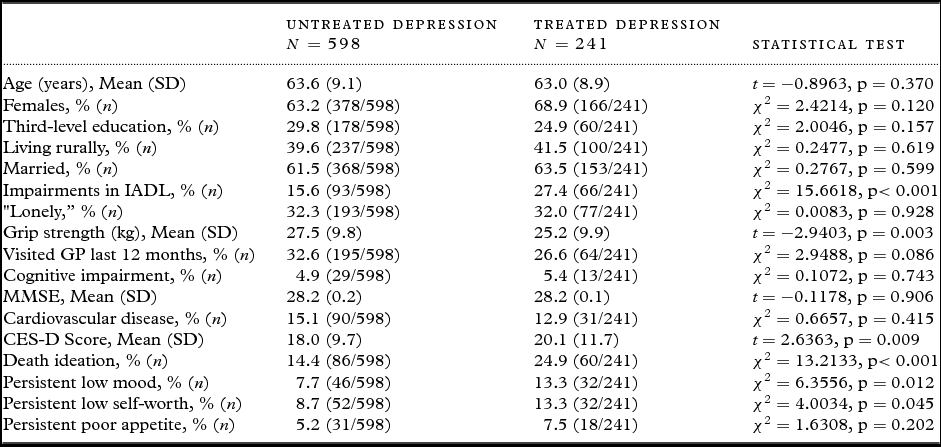
Baseline differences between participants with treated and untreated depression are shown in Table 2. Older people with untreated depression were less likely to have functional impairment and had marginally better grip strength compared to those with treated depression. There was no significant difference in age or GP visits within the last year between the two groups. There was also no difference between the groups with respect to factors associated with social connectedness, including marital status, rural living, and feelings of loneliness.
Baseline characteristics of treated and untreated depression groups

Notes: Continuous variables were analyzed with Student's t-test; Categorical variables were analyzed with χ 2 test. SD = standard deviation; IADL = instrumental activities of daily living; kg = kilograms; GP = general practitioner; MMSE = Mini-Mental State Examination; CES-D = Centre for Epidemiological Studies Depression scale. “Lonely” was defined as answering “moderate amount of time” or “all of the time” when asked “How often are you lonely?” Cognitive impairment was defined as MMSE ≤ 24. Cardiovascular disease was defined as self-report of angina, congestive cardiac failure, arrhythmia, or myocardial infarction. Death ideation was defined as answering “yes” when asked “In the last month, have you ever felt that you would rather be dead?” Persistent low mood was defined as answering “All of the time”when asked to give a response to “I felt depressed.” Persistent low self-worth was defined as answering “Never” when asked to give a response to “I felt just as good as other people. ” Persistent poor appetite was defined as answering “All of the time” when asked for a response to “I did not feel like eating; my appetite was poor.”
Participants with untreated depression had a lower burden of depressive symptoms by CES-D compared to those on treatment and were also less likely to endorse symptoms of persistent low mood or worthlessness (see Table 1).
Death ideation
When asked, “In last month, have you felt like you would rather be dead?” over 3% (223/7,055) of participants said yes (see Table 1). Less than one-third (68/223) of this group had visited their GP within the last 12 months. Two-thirds of people with death ideation met criteria for depression by either CES-D or CIDI (146/223) and one-third were on medical treatment for depression (68/223).
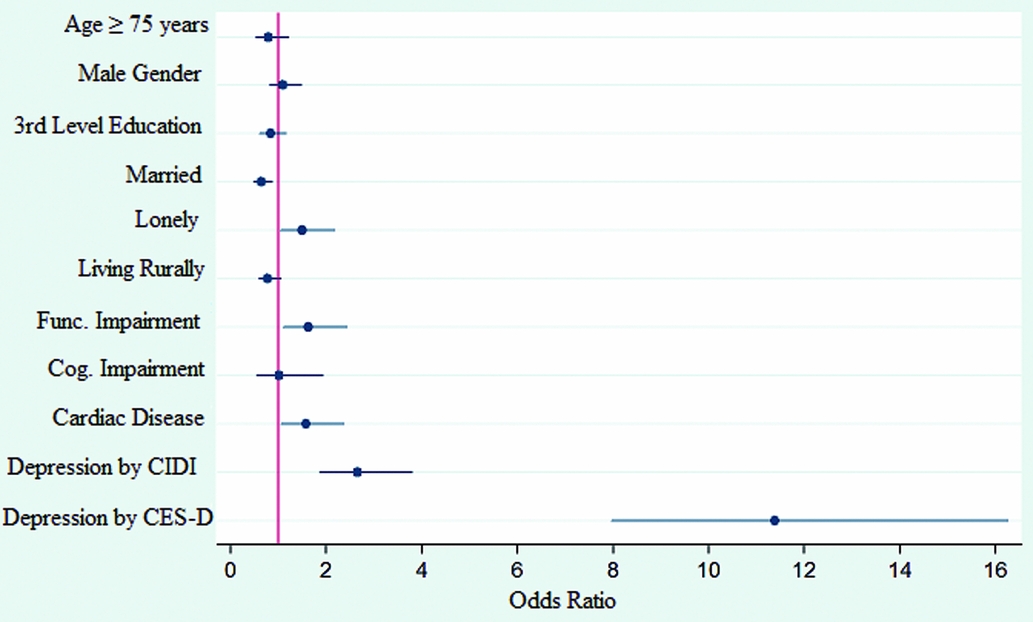
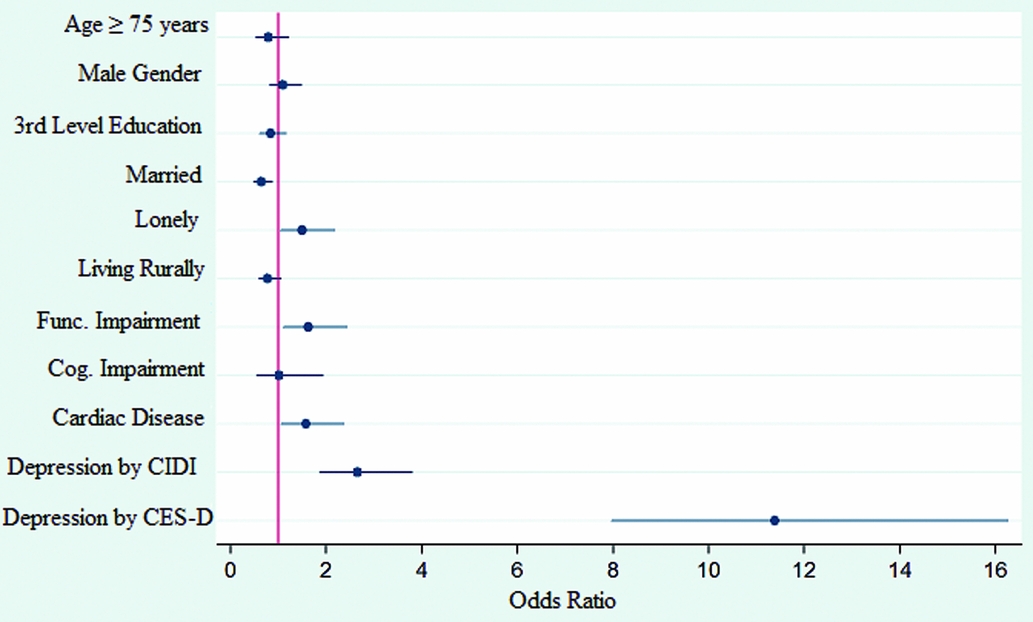
Logistic regression demonstrated that, when controlling for other relevant variables, depression is significantly associated with death ideation with odds ratios of 11.4 (8.0–16.3) and 2.7 (1.9–3.8) for current depression by CES-D and 12-month major depression by CIDI, respectively. Other factors significantly associated with death ideation include cardiovascular disease, functional impairment, and loneliness, while being married is associated with a lower likelihood of death ideation (see Figure 2).
Binary logistic regression demonstrating odds ratios for association of variables of interest with death ideation. Death ideation was defined as answering “yes” when asked “In the last month, have you ever felt that you would rather be dead?” CIDI = Composite International Diagnostic Interview; CES-D = Centre for Epidemiological Studies Depression scale. “Lonely” was defined as answering “moderate amount of time” or “all of the time” when asked “How often are you lonely?”. Func. Impairment = functional impairment. Functional impairment was defined as having one or more impairment in instrumental activities of daily living (IADL), including cleaning and maintaining the house, managing money, moving within the community, and preparing meals. Cog. Impairment = cognitive impairment. Cognitive impairment was defined as MMSE ≤ 24. Cardiac disease was defined as self-report of angina, congestive cardiac failure, arrhythmia, or myocardial infarction.
Discussion
This study demonstrates that one in eight older people meet clinical criteria for either a major depressive episode within the last year, or have current clinically significant depressive symptoms. Only one-third of these participants were prescribed medical treatment for depression. Treatment rates for depression remain constant when stratified by age, with similar findings in those aged 75 years or more compared to those aged between 50 and 64 years.
Additionally, we found that 3% of older people have experienced thoughts that they would rather be dead in the last month, with less than one-third of this group visiting their GP within the last year. Significantly, we also show that current depressive symptoms are strongly associated with death ideation, further highlighting the importance of appropriate assessment and treatment of LLD where required.
There has been relatively little research quantifying untreated or undetected LLD to date. Similar to our findings, a study of homebound older people found that one-third of those with depression were prescribed appropriate antidepressant medication (Sirey et al., Reference Sirey2008), while studies in specific patient-populations, such as diabetics (Li et al., Reference Li, Ford, Zhao, Ahluwalia, Pearson and Mokdad2009) and patients attending general practice (Lotfi et al., Reference Lotfi, Flyckt, Krakau, Mårtensson and Nilsson2010), have also shown high rates of untreated depression. A study by Olfson et al. (2016) found that two-thirds of American adults screening positive for depression were untreated. To our knowledge, this is the first study to examine untreated depression at a population level specifically in older people, however.
There have been several potential reasons suggested for this disparity. It is well recognized that older people are less likely to report symptoms of low mood to their doctors (Murray et al., Reference Murray, Banerjee, Byng, Tylee, Bhugra and Macdonald2006), and may not recognize depressive symptoms as a legitimate reason to present to their GP (Chew-Graham et al., Reference Chew-Graham2012), in the same way as chest pain or shortness of breath, for example. Depression in later life remains a stigmatized illness and this may negatively influence attitudes of older people in seeking medical attention for LLD or even suicidal thoughts (Connor et al., Reference Conner2010). There was no significant difference in GP visits within the last year between the untreated and treated depression groups in our study, however, although those with treated depression were more likely to have functional impairment, perhaps reflecting increased contact with other healthcare professionals.
There are further barriers to treatment once the older person presents to an appropriate healthcare setting. Depression can be difficult to diagnose. Diagnosis is clinical and there is no specific diagnostic test. In the primary care setting, a meta-analysis of participants with depression found that, while there was reliable accuracy when ruling out depression, confirming a diagnosis of depression was more difficult, with less than half of cases correctly identified (Mitchell et al., Reference Mitchell, Vaze and Rao2009). Furthermore, diagnostic accuracy in LLD specifically is lower than in earlier-onset depression (Mitchell et al., Reference Mitchell, Rao and Vaze2010).This is not surprising as assessment of mood in later life can be complicated by co-existing medical illness and cognitive impairment (Nuyen et al., Reference Nuyen, Volkers, Verhaak, Schellevis, Groenewegen and Van den Bos2005), making reliable ascertainment of symptoms more difficult. We did not find any differences in scores on cognitive scales between treated and untreated groups, however.
LLD also presents differently to earlier-onset depression, with less pure mood symptoms, and our study shows that participants with untreated depression were less likely to report persistent low mood or worthlessness than those with treated depression.
Even when a diagnosis of depression is made, it may not be acted upon. LLD may be incorrectly viewed, by both doctors and patients, as an inevitable consequence of ageing rather than an objective clinical diagnosis (Volkers et al., Reference Volkers, Nuyen, Verhaak and Schellevis2004; Burroughs et al., Reference Burroughs, Lovell, Morley, Baldwin, Burns and Chew-Graham2006) and antidepressants are often prescribed at subtherapeutic doses in older people (Fitch et al., Reference Fitch, Molnar, Power, Wilkins and Man-Son-Hing2005). It is also possible, however, that a significant proportion of those not prescribed pharmacological therapy are instead linked with psychology input; however, it is difficult to see how this may have been accessed in the first place given the low rates of GP attendance we have demonstrated.
Interventions aimed at improving detection and treatment of depression and suicidal behavior in later life need to be targeted at several different levels. Public awareness campaigns have been successful in reducing the stigma around mental health conditions in younger people and efforts are required to focus on similar issues in later life. It is important that older people are aware that it is not normal to be depressed, even in the context of some of the challenges of later life, and that rates of depression in later life are actually lower than in earlier life (Gelenberg, Reference Gelenberg2010). They should therefore be encouraged to seek help from a healthcare professional when they are experiencing symptoms of depression or suicidal thoughts.
Equally, it is important that healthcare professionals have a low threshold for asking older people about symptoms of depression and suicidal thoughts. The complexity of LLD is unsuited to short appointment times in primary or secondary care and flexibility regarding assessment is vital. Interval reassessment of older people with suspected depression may improve diagnostic accuracy (Mitchell et al., Reference Mitchell, Vaze and Rao2009). Once depression is appropriately diagnosed, older people should not be deprived of effective therapy for fear of potential side effects and older people should specifically be asked about death or suicidal ideation. This is particularly important when we consider that depression is closely associated with death ideation in our study.
There are some limitations to our study that must be noted. Diagnosis of depression was based on validated screening tools rather than gold standard clinical diagnosis. Both CES-D and CIDI have been validated against clinical diagnoses, however. It must also be noted that the two depression assessments used relate to different time periods, with the CES-D focusing on a current depressive symptoms within the last 2 weeks and the CIDI relating to major depression within the last year. Prevalence of untreated depression based on these two scales is broadly similar, however, and we felt that including results from both scales increased the reliability of our results. Additionally, when asked about death ideation, participants were specifically asked about symptoms within the last month rather than over a 2-week or 12-month period and this discrepancy may impact on our findings.
Untreated depression was based on the absence of medical treatment for depression alone and may therefore include some participants who were referred for psychological therapy only and unfortunately we do not have any data on psychotherapy input. Furthermore, not everybody meeting criteria for depression requires or wants treatment with antidepressants; however, current treatment guidelines for depression in later life clearly favor a dual approach of both medical and psychological therapies in the first instance (Alexopoulos, Reference Alexopoulos2011). Conversely, while we recorded prescription of medications, we have no information on dose or compliance so some participants in the treated depression group may be on suboptimal doses of antidepressant medication or non-compliant. Data on GP visits were collected by self-report so may be affected by recall bias, although only 5% of the study population met criteria for significant cognitive impairment. The strengths of this study include the comprehensive TILDA dataset, allowing analysis of social and health variables, alongside two separate diagnostic scales for depression, in a large population-based sample of older adults.
In conclusion, this study demonstrates that two-thirds of older people meeting criteria for currently clinically significant depressive symptoms or a major depressive episode within the last year are not prescribed pharmacological therapy for depression. Given projected future demographic changes, in conjunction with the detrimental effect depression can have on the health and independence of older people, the burden of LLD is likely to increase significantly in the near future. It is important therefore to raise awareness of depression among older people themselves, as well as their families and healthcare professionals involved in the care of older people, with particular focus on the fact that LLD is not an inevitable consequence of ageing and that effective treatment is available and essential.
Conflict of interest
None.
Description of authors’ roles
RB planned the study, performed initial statistical analysis, and wrote the paper. KT oversaw statistical analyses and contributed to revising the paper. RK and SK helped to plan the study, including the instrumentation, and to revise the manuscript.
Acknowledgments
This work was supported by the Irish Government, the Atlantic Philanthropies, and Irish Life plc. These funders had no involvement in the study design, collection, analysis and interpretation of data, writing of the paper, or submission for publication. Any views expressed in this report are not necessarily those of the Department of Health and Children or of the Minister for Health.