Introduction
Satyagraha is insistence upon Truth. Why press, for the acceptance of Truth, by soul-force alone? Why not add physical force also to it? While the revolutionaries stand for winning independence by all the forces, physical as well as moral, at their command, the advocates of soul-force would like to ban the use of physical force. The question really, therefore, is not whether you will have violence or non-violence, but whether you will have soul-force plus physical force or soul-force alone.Footnote 2
Drafted in January 1930, this manifesto of the Hindustan Socialist Republican Association entitled the Philosophy of the Bomb linked the limitations of satyagraha, the pursuit of truth as Gandhi defined it, to the thought and action of Bhagat Singh, easily the most popular revolutionary in northern India at this time. Far from being advocates of illegitimate violence, Bhagat Singh and his comrades aimed at causing a shift in the Congress’ ‘national’ program through a range of measures, most potently the hunger strike. Although they failed in their final goal, I dwell on a moment when the ‘clash of principles’ that necessitated their death by hanging brought together almost all sections of extremist and moderate opinion in the country, barring Gandhi. This process of crafting and affirming new goals in the name of the nation is significant because it acknowledged and accommodated real differences of opinion and method. Equally, Bhagat Singh's ultimate failure and the concomitant victory of Gandhian nationalism in moulding the shape of Punjabi politics reflects that the balance between center and region had begun to shift towards the center as early as 1931.
Bhagat Singh and the Politics of Violence, 1925–28
It is difficult to separate the life of Bhagat Singh from that of anti-colonial activity in the Punjab. As a teenager Bhagat Singh participated in the Sikh movement to acquire control over gurdwaras in the early 1920s. In 1925 Singh was associated with two of the foremost anti-colonial institutions founded that year: he joined the National College at Lahore founded by the leading Punjabi anti-colonial leader Lajpat Rai, and was closely associated with the new Nau Jawan Bharat Sabha (NJBS) that aimed to re-energize the Punjab in the lull following the collapse of the non-cooperation movement.Footnote 3 The workers of the NJBS organized lectures on moral, literary and social subjects: they were explicitly concerned with uniting Hindus, Muslims and Sikhs, and organized inter-communal dinners to that end. Although their radical views on religion and agrarian reform ensured they had a limited reach,Footnote 4 they had the perspicacity to organize public meetings on topics of common interest such as a public meeting denouncing the exhibition of Indians in the Berlin Zoo: a subject of considerable outrage in the colony.Footnote 5 That the young men of the NJBS were critical of the shape and tenor of Punjab politics is also revealed in an incident in 1926. Copies of the poem ‘The Lost Leader’ by Robert Browning were printed and distributed to Lajpat Rai and Pt Madan Mohan Malaviya by NJBS members who, angered by their turn away from the Indian National Congress, felt they were steering Punjab politics in the wrong direction.Footnote 6
Bhagat Singh was also engaged in rebuilding the Hindustan Republic Association (HRA) along with the revolutionary Chandrasekhar Azad in Kanpur. This revolutionary party believed in establishing a federated republic of the United States of India by an organized and armed revolution.Footnote 7 Its public aims included the establishment of labour and peasant associations; privately, it sought to raise funds and send men abroad for military and scientific training. The Association suffered enormous losses in men during the Kakori train dacoity of 1925 when most of its leaders were caught, arrested and hanged.
There remained some common ground between the radical anti-colonial sentiments espoused by the NJBS and other moderate political formations in the Punjab. To the relief of members of the NJBS and HRA, the late 1920s was a period of intense and continual political change. Even as the British began to engage in the process of constituting a Commission to look into the next stage of constitutional reform, a younger generation of Congressmen pushed Gandhi into demanding purna swaraj or complete independence as the Congress’ final goal. Within the Punjab, however, sections of Hindus, Muslims and Sikhs were divided on submitting evidence to the all-white Simon Commission. Influential Punjabi Hindus like Raja Narendra Nath, Gokul Chand Narang and Bhai Parmanand, a section of the Muslim League led by Mahomed Shafi, and Sikhs belonging to the Central Sikh League opted to provide evidence to the Commission, thereby lending weight to the unfortunate appellation used to describe the Punjab: ‘India's Ulster’.Footnote 8 But the decision of the Working Committee of the Congress to boycott the all-white Simon Commission served to bring together all the reigning factions within the Punjab Congress: Satyapal, Mohammad Alam, Gopi Chand Bhargava, Lala Duni Chand of Ambala all gathered in support of the boycott. Crucially, the Lion of the Punjab Lala Lajpat Rai, who had broken with his former colleagues in the Congress in the mid 1920s over the issue of boycott and walk-outs from the Legislative Councils, now led this concerted boycott of the Simon Commission.Footnote 9 Into this exciting debate on the short- and long-term goals of the anti-colonial movement in the Punjab, the young men of the NJBS poured their political energies. They invited Jawaharlal Nehru to preside over the Punjab Provincial Political Conference in April 1928.
The most controversial resolution passed by the Conference was a recommendation to amend the constitution of the Congress so as to make the attainment of complete independence legitimate ‘by all possible means’, including violence. Opposed by several senior politicians, the resolution was passed by a majority of 75 votes to 56 votes.Footnote 10The Tribune denounced the arguments of those who had supported the resolution: it was not ‘violence, far less mere talk of violence’ that would make the government afraid. Indeed, the proposed change in the creed of the Congress would weaken its moral authority and discredit the national movement in India without leading to a more effective means of resistance. The resolution led to several important resignations from the Provincial Congress and threatened to show up the cracks thinly papered over by the boycott until it was later repudiated by another meeting of the Congress.Footnote 11
Apart, and yet a part of the wave of anti-colonialism spreading across Northern India, members of the HRA from the United Provinces, Bihar, Rajputana and Punjab met in September 1928 at Ferozshah Kotla in Delhi to frame a separate program of action and form a co-ordinating central committee. Bhagat Singh's proposal to bomb the members of the Simon Commission was accepted as was his decision to stop the practice of looting the homes of rich individuals. It was this category of prosecution witness that had harmed the Kakori accused the most. Reflecting the ideological evolution and persuasive powers of Bhagat Singh, the name of the party changed to the Hindustan Socialist Republican Association (or Army; hereafter HSRA).Footnote 12
The demonstrations organized by the HSRA, NJBS and the newly united Punjab Congress against the all-white Simon Commission mark another instance of the ability of a range of parties in the Punjab to cooperate in the political domain. The crowd that greeted the Simon Commission with black flags and loud slogans on the 30 October 1928 was lathi-charged outside the Lahore railway station. Lajpat Rai, who was hit by the police, died only two weeks later. His death was widely attributed to the mental if not physical shock he had suffered during the lathi-charge.
The HSRA decided to avenge his death: a month later, the three revolutionaries—Bhagat Singh, Rajguru and Sukhdev—killed the Assistant Superintendent of Police, J.P Saunders, and a Head Inspector, Chanan Singh. They had intended to kill the Superintendent of Police J.A. Scott, believed to be the police officer whose blows hit Lajpat Rai, but by the time they discovered their error, it was too late and they decided to kill Saunders instead. The death of Chanan Singh was unplanned: he had rushed to the spot upon hearing the shots. Although the three revolutionaries fled from inside a college campus and there were many witnesses, the Saunders murder case remained unsolved until much later.Footnote 13
Contemporary sources suggest that this act of terror did not get much support. Although The Tribune printed Mrs C.R Das’ appeal to young men to avenge Lajpat Rai's death in late November 1928, an editorial comment averred that the use of violence would make the struggle for national freedom, which was ‘essentially moral, degenerate into a physical struggle’: non-violence was India's strongest weapon.Footnote 14 Members of the Punjab and all India Congress demanded that the indiscriminate arrest of college students in the aftermath of the murders be brought to an immediate conclusion, but they were also quick to distance themselves from the act of violence.Footnote 15 Deploring the murders at the Punjab Political Conference held in March 1929, the president of the Conference, Satyapal, reaffirmed that the creed of the Congress was non-violence and mocked the idea that Lajpat Rai's death could be avenged by the killing of a police official. He repudiated terrorism as a political method.Footnote 16
The People, a Lahore weekly founded by Lajpat Rai in 1925, referred to ‘Balraj’—the pseudonym used by Bhagat Singh in the poster proclaiming revenge for Lajpat Rai's death—as ‘nothing but desperate action’.Footnote 17 Moreover, meetings of the NJBS drew increasingly small crowds. With the exception of a meeting to commemorate the Jallianwala Bagh massacre on 13 April, all the meetings announced by the NJBS from the murders in December 1928 until June 1929 were badly attended, small affairs.Footnote 18 This is worth bearing in mind when we reckon with the mammoth sized meetings that proclaimed Bhagat Singh as martyr and popular hero. The first president of the Students Union at Lahore remembered the Saunders murder thus:
By and large, the reaction was that the British were made of a very hard fibre, they were the most determined nation, so it would be impossible for the Indians to resort to violent methods and murderous attacks because they would never be able to terrorise them like that. This was the thinking of Mahatmaji as well as of those who supported him through thick and thin.
Yet Abdul Majid Khan, the author of these views, was also impressed by a small pamphlet published on Terrence MacSwiney, the Irish leader, who died after a hunger strike of more than 70 days.Footnote 19
A Shift in Strategy: The Assembly Bomb Case and Its Aftermath
As police investigations following the Saunders and Chanan Singh murders floundered, the HSRA busied itself by establishing bomb factories in Agra, Saharanpur, Calcutta and Lahore. However, the repressive side to British colonialism was making itself felt in a series of illiberal bills due to be passed in the Central Legislature. Just as the president of the Assembly rose to give his ruling on the unpopular Public Safety Bill on the 8 April 1929, Bhagat Singh and B.K. Dutt threw two bombs from the visitor's gallery towards the officer's gallery in the Assembly in New Delhi.
‘It takes a loud voice to make the deaf hear’ were the opening words of the leaflets that were thrown alongside these bombs that were carefully designed not to kill. Signed by ‘Balraj’, Commander-in-Chief of the HSRA, the leaflet protested against increasingly repressive legislation and the ‘crumbs of reforms’ expected out of the Simon Commission and declared, unusually for those castigated as violent: ‘it is easy to kill individuals but you cannot kill ideas’. They claimed to hold ‘great sanctity’ to human life but held it necessary to sometimes sacrifice lives for the greater revolution. The young men quietly handed in their revolvers and allowed themselves to be arrested.Footnote 20
Public criticism of this terrorist action was unequivocal. Gandhi equated the bombs with the knife that killed Rajpal, the author of the notorious pamphlet Rangila Rasul, as subject to the ‘same philosophy of mad revenge and impotent rage’.Footnote 21 Motilal Nehru pronounced that the choice lay between Gandhi and ‘Balraj’.Footnote 22The Tribune published the ‘general opinion’ that such outrages were the work of men who did not want India to make any progress towards a responsible government.Footnote 23 During their trial, Bhagat Singh and B.K. Dutt prepared a joint statement that responded to these criticisms:
We hold human life sacred beyond words. We are neither perpetrators of dastardly outrages, and, therefore, a disgrace to the country . . . nor are we ‘lunatics’ as the Tribune of Lahore and some others would have it believed. . . . Force when aggressively applied is ‘violence’ and is, therefore, morally unjustifiable, but when it is used in the furtherance of a legitimate cause, it has its moral justification. The elimination of force at all costs is Utopian . . . .Footnote 24
The Assembly Bomb Statement clearly indicates that the revolutionaries were concerned with the problem of violence in the course of their revolutionary struggle.Footnote 25 The accused explained the composition of the bombs and their deliberate intention not to cause harm. They could have wiped out a majority of the members of the Legislative Assembly; they could have shot scattered police officers milling around the Assembly in confusion soon after the blast; they did not do so. They had been asked to define what they meant by ‘revolution’. The Statement clarified it did not mean the cult of the bomb and the pistol, it meant that the injustice inherent in the present order of things had to end. Labourers, peasants, weavers, masons, smiths and carpenters could not remain the exploited class. Radical change along socialistic lines was of the essence. They ended the Statement with the slogan Inquilab Zindabad, ‘Long Live Revolution’.Footnote 26 They were sentenced to life imprisonment.
Evidence during the Assembly Bomb case led the police to link Bhagat Singh and the HSRA with the Saunders murder case.Footnote 27 This had not been anticipated by them. The revolutionaries had hoped the leaflets would gain the HSRA a measure of support for their aims and steer the Congress in a more radical direction. However, for a second time in less than four years, the HSRA found its membership in tatters. But the tide of public opinion was shifting in their favour. This was reflected in the respect and admiration that their Assembly Bomb Defence Statement elicited in letters to newspapers. The People now editorialized:
Transportation for life to two young men—their crime had broken a couple of benches in the Assembly Chamber and given slight bruises to two or three members who happened to be near those benches! Seldom has ‘justice’ made a better bargain! . . . the young bomb throwers . . . received [the news] with joy . . . their usual shouts of ‘Long live the revolution.’ It is this spirit the posterity would admire . . . Bhagat Singh . . . has dared all earthly power to curb his spirit.Footnote 28
The editor continued to point out the many ways in which Bhagat Singh and his companions differed from the average bomb-thrower.
Even before their co-conspirators were arrested as under-trial prisoners in what came to be known as the second Lahore Conspiracy Case, Bhagat Singh and Dutt went on a hunger strike. In keeping with Gandhian rules on giving the opponent sufficient warning before embarking on satyagraha, Bhagat Singh wrote a letter to the Superintendent explaining that he had been sentenced to life imprisonment and was obviously a ‘political prisoner’. He had been given a special diet in the Delhi Jail but was being treated as an ordinary criminal in Mianwali Jail. He requested basic provisions—a better diet, no forced labour, books, one standard daily paper, better clothing, some toilet necessities like soap and oil. Upon receiving no response, he embarked on a hunger strike.Footnote 29 Dutt, who followed soon after, reiterated that he was a political prisoner, not a dacoit or thief and felt political prisoners ought not to do hard labour.Footnote 30 Both contended that all political prisoners be treated as European ‘special class’ prisoners.
Outside the prison, meetings held to congratulate the prisoners on their convictions were now well attended. Soon after news of the hunger strike spread, 30 June was observed as Bhagat Singh–Dutt Day in a majority of districts in the Punjab.Footnote 31 In Lahore, 10,000 people attended a meeting organized by the City Congress Committee: the chair, Sardar Sardul Singh Caveeshar, recounted the hardships he had personally endured as a political prisoner. Another speaker Parbati Devi exhorted citizens of Lahore to contribute towards the newly created Defence Committee Fund for the prisoners. Pictures of Singh and Dutt were distributed along with the following lines from their Defence Statement: ‘From under the seeming stillness of the seat of Indian humanity a veritable storm is about to break out. We have given a fair and loud enough warning. By crushing two insignificant units the nation cannot be crushed’. Reporting on the mass meeting, The Tribune stated that thousands of Lahoris had expressed their solidarity with the hunger-striking prisoners by fasting on that day.Footnote 32 At a similar meeting in Amritsar attended by 5,000 people, political workers recited poems comparing the revolutionaries’ ardour for their country to the love stories of Ranjha, Hir, Sohni and Farhad. Bhagat Singh and Dutt were hailed as the honour of Punjab and Bengal.Footnote 33
The Defence Statement by Bhagat Singh and Dutt in the Assembly Bomb Case was published in the Congress Bulletin of 1 July 1929. Gandhi wrote in sharp disapproval to the young General Secretary Jawaharlal Nehru that it was ‘out of place’ in a publication devoted to Congress activities. He did not like Nehru's approval of the fast and referred to it as ‘an irrelevant performance’.Footnote 34 Yet, locally in Lahore, news filtered of the under-trial prisoners also refusing to eat. Over a thousand rupees were collected over four evenings when volunteers from the Congress and the youth leagues marched in procession with red banners carrying photographs of the hunger-striking prisoners bearing the inscription ‘Dutt is at the point of death, all for country's honour sixteen young men are starving to death in your Lahore’. When the success of these processions unnerved the administration and Section 144 was suddenly imposed, Congress, Ahrar and Akali leaders including Sardar Mangal Singh and Zafar Ali Khan courted arrest by shouting the newly banned slogan Inquilab Zindabad along with members of the newly banned NJBS. The Tribune's headlines proclaimed Satyagrahis Parade Bazars shouting ‘Long Live Revolution’ and the self-professed ‘Satyagraha Committee’ won its first victory when the District Magistrate was forced to modify his order and release the defiant demonstrators.Footnote 35 The NJBS celebrated its victory by announcing that 21 July be celebrated as All India Bhagat Singh–Dutt Day. The proposed programme included fasting, processions, the collection of funds for the Conspiracy Case Defence Committee and meetings to explain the purpose of the hunger strike and protest the treatment of political prisoners. A month later, several women sent the prisoners rakhis consecrated in blood.Footnote 36 A correspondent to The People suggested that it was not the issue as much as ‘the manner and spirit’ with which the hunger-strikers were undertaking their resolve that was inspiring.
Heart-and-soul devotion to a cause, heart-and-soul loyalty to associates, fidelity to the death, are virtues which command our involuntary reverence. Nowhere are they so common as not to be held in high honour. If Sardar Bhagat Singh and Mr Bhutakeshwar Dutt [sic] persist in their fast to fatal extremities, India will be immensely the poorer for her loss. For them the struggle will be over. But what for us . . . is the moral? That is a question for each one to answer . . . Most of our lives are built on compromises. Is it possible to be more single-minded? Footnote 37
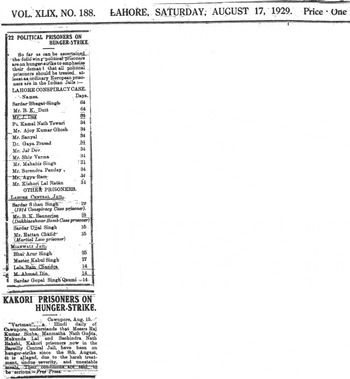
Jatinder Nath Sanyal and Ajoy Ghosh, fellow prisoners, remembered that the most difficult part of the strike was not the fight against hunger but ‘the fight against the instinct of self-preservation’.Footnote 38 Sanyal watched the dying Jatindra Nath Das in his last days: first his toes became paralyzed, then his legs, his hands, and finally his eyes. The archives have preserved daily medical reports that attest both to the determination of the hunger-strikers to maintain their protest and of the prison officers to forcibly feed them so that they could attend the trial. Their steady deterioration is evident from the earliest reports in June to later reports in September. In the middle of July, Major P.D. Chopra, Superintendent of the Central Jail in Lahore, noted that the pulse rate of convict Bhagat Singh was 82, ‘soft of weak tension and volume’, but after artificial feeding it rose to 105 per minute. B.K. Dutt's pulse rate was 64, which rose to 108 per minute after artificial feeding.Footnote 39 A week later both convicts offered so much resistance that the doctors did not recommend artificial feeding. (See Figures 1 and 2.)
Hunger-strikers make headlines: Gandhi's perspective.

Number of days spent on hunger-strike.

The Home Secretary's philosophy of containment—to avoid action and conciliate moderates—was undermined by the rapidly deteriorating health of some prisoners. In early August, Dr Gopi Chand Bhargava, a member of the Legislative Assembly and the Defense Committee, visited the prisoners. He advised the prisoners to take medicines and not hurt themselves while resisting artificial feeding. To the Punjab Government, he confessed his failure to convince the prisoners. He had used all manner of arguments—national, religious and general—and quoted that even Gandhi, who also resorted to hunger strikes, ‘always brought it to an end before getting to the extreme stage of committing the sin of taking his own life by his own deeds’.Footnote 40 When Jawaharlal Nehru visited the prisoners, they reiterated that they were fasting for a ‘principle’, viz., that they were ‘political prisoners’ and that all political prisoners should be treated as special class prisoners. The recent communiqué of the Punjab Government that permitted them a special diet did not deal with the larger question of motive in the classification of all political prisoners.Footnote 41 Meanwhile the Punjab Government revised the probable effect of the hunger strike on the situation in the Punjab. It also acknowledged the ‘principle’ that lay at the heart of the fast:
The spectacle of thirteen young men deliberately starving themselves to death for a principle would excite sympathy in a more phlegmatic and less sentimental country than India. It has excited sympathy in almost every quarter, and should one or two of the hunger-strikers die, this sympathy will beget anger against Government . . . I think some action . . . if taken at once, would pull up the agitation and give us time to consider whether Paris is worth a mess, or the peace of Lahore worth half a chatak of ghi for Dr Satyapal.Footnote 42
A whole month after the 14 under-trial prisoners had joined the strike and after repeated warnings that the condition of various prisoners was critical, the Government of India issued a communiqué requesting local governments to re-examine the rules relating to the classification of prisoners.Footnote 43 On 2 September members of the newly appointed Jails Committee including Lala Duni Chand of Ambala interviewed the hunger-striking prisoners. Their demands included status as special class prisoners for those convicted of violent offences; that all the under-trial prisoners in the Conspiracy Case should be placed together in a general association barrack; and the immediate and unconditional release of Jatindra Nath Das.Footnote 44 The Jails Committee promised that all their demands would be met in full and the prisoners agreed, accordingly, to suspend their hunger strike. But the government played for time at a juncture when there really was no time: they insisted on making recommendations regarding special class prisoners for all of India only after receiving the recommendations of all the local Jails Committees.
As the Punjab Jails Enquiry Committee's proposals became stuck in bureaucratic mire,Footnote 45 Das died on 13 September 1929 after a continuous fast of 63 days. On the same day that 50,000 funeral processionists marched through Lahore, the Central Legislative Assembly passed a motion of adjournment to censure the government for their policy regarding the hunger-striking prisoners in the Lahore Conspiracy Case.Footnote 46 Speaking on the motion, Motilal Nehru emphatically asserted:
It is not a question, Sir, of sections or of procedure or of substantive or adjective law. It is, Sir, a question of humanity, of the elementary duty of a Government to save life, to save the lives not only of those who seek its protection, but also of those who want to destroy their own lives.Footnote 47
The Home Secretary Emerson defended the British Government's decision to refer ‘the very great issues’ raised by Bhagat Singh to the local governments concerned since prisons were a provincial subject.
The ‘very great issues’ raised by Bhagat Singh and his comrades were directed at the very basis of British rule. To concede that they were ‘political prisoners’ would mean acknowledging that their motives were political, not personal, and that they were not common criminals. It would necessitate treating Indian political prisoners, even those accused of violent crimes, on equal footing with political prisoners guilty of violence in Ireland and England. The Secretary's contention that the government was defending the law was proving to ring hollow. When the hunger-strikers could not come to court because they were too weak to do so, Emerson pushed for an amendment to the Code of Criminal Procedure.Footnote 48 If passed, the bill would make it possible to hold trials and convict accused persons ex parte.
Several fiery speeches protested against this bill in the Central Legislature: Mohammed Ali Jinnah was particularly well prepared. He viewed the bill from three viewpoints: that of criminal jurisprudence, the political point of view and the treatment to the accused under trial. As for the definition of a ‘political prisoner’, Jinnah asked the government to use their ‘common sense’ and ‘intelligence’.
Well, you know perfectly well that these men are determined to die. It is not a joke. I ask the Hon'ble the Law Member to realise that it is not everybody who can go on starving himself to death . . . The man who goes on hunger-strike has a soul. He is moved by the soul and he believes in the justice of his cause; he is not an ordinary criminal who is guilty of cold-blooded, sordid, wicked crime.
Jinnah pointed out that the proposed bill ran against a fundamental doctrine ‘which goes to the very root of the criminal jurisprudence . . . that no man is to be condemned until he is given a hearing’. He argued that this amendment was unprecedented; he also suggested more humane ways to break the strike. After all, the prisoners were not asking for ‘dressing-tables’ or ‘spring mattresses’. They wanted ‘nothing but bare necessities and a little better treatment. I ask you in all decency, why cannot you concede this small thing? Did the Government want to prosecute these young men or persecute them?’ Jinnah reminded them that he was a ‘patient cool-headed man’ but there were thousands of young men outside, victims of ‘this damnable system of Government, which is resented by the people’. He pointed toward the incessant prosecutions in Bengal, Madras and Punjab and asked the government why these men would want to make seditious speeches and spend their time in jail. ‘Do you not realise yourself, if you open your eyes, that there is resentment, universal resentment, against your policy, against your programme?’Footnote 49
It was during the debate concerning this bill that under-trial prisoner Jatindra Nath Das had died. His martyrdom brought every leading political thinker on the same platform, except Gandhi. In the Punjab, Drs Muhammad Alam and Gopi Chand Bhargava resigned from the Punjab Legislative Assembly.Footnote 50 Subhas Bose led the miles-long funeral procession in Calcutta; flower wreaths from Das’ coffin were carried away as so many sacred remembrances.Footnote 51 It was only fitting that Rabindranath Tagore was inspired to compose a song. His own poem ‘Ekla chalo’ was sung by Das’ brother to him in his final moments. In honour of the martyr, Tagore now wrote:
From Ireland Mary MacSwiney, the sister of the late Lord Mayor of Cork Terrence MacSwiney, sent a telegram of sympathy to the Mayor of the Calcutta Corporation, with the hope and the promise: ‘Freedom will come’.Footnote 53
Defining Motive: Anti-colonial, Political, Reactionary
Several consequences flowed out of Das’ tragic end. In the first instance, the Hunger-Strikers Bill failed and the government decided to treat both Singh and Dutt on par with the other under-trial prisoners. However the general conduct of the case worsened. The ongoing tug of war between the Magistrate, the police and jail officials, press representatives, relatives of the accused and legal advisors to the accused in the jail-turned-courtroom has been discussed by A.G. Noorani.Footnote 54 He has detailed the degrading manner in which the prisoners were handcuffed and beaten, and the occasions they were unable to appeal to the High Court. The proceedings of the court, when the prisoners were able to attend, were widely published. Bhagat Singh and almost all the other accused defended themselves. They were more interested in the ‘moral effect’ of their trial: in revealing the egregious nature of colonial courts and the dissemination of revolutionary propaganda than with expecting justice. So the approver Phanindranath Ghosh was forced to concede that the HSRA considered it ‘improper to kill an innocent person’Footnote 55; approver Lalit Kumar Mukherjee was quizzed on the preparation of picric acid; Hans Raj Vohra's testimony begged the question why he had turned away from Gandhian methods for procuring India her swaraj; and, after a protracted demand for newspapers, The Tribune was rejected because the jail authorities refused to supply a vernacular paper for political prisoners who could not read English. With each intervention, Singh and his fellow accused prisoners were revealing their strategy and providing pointers on how to navigate the road ahead. They also give the historian little vignettes with which to piece together some of the complex motives that girded the trial.
But their demand for rights as political prisoners continued to have an uneven trajectory. The first phase of hunger strike ended with the death of Das and the promise that a new system of classifying prisoners was in the offing. When it became clear that the Government of India was in no mood to ‘redeem its promise’ to the prisoners and the public, the Lahore Conspiracy Case prisoners provided the Government with one week's notice before embarking on another hunger strike. The Punjab Congress responded with public meetings and a hunger strike week characterized by fund-raising for the defence of the accused and measures to induct new members into the Congress.Footnote 56 In a long letter that traced the history of the hunger strikes and the unfulfilled promise of prison reforms, the prisoners again raised the question of motive and pointedly referred to the difference between non-violent and violent offences:
It is through motive alone that the real value of any action can be decided. Are we to understand that the government is unable to distinguish between a robber who robs and kills his victims and a Kharag Bahadur who kills a villain and saves the honour of a young lady and redeems society of a most licentious parasite? Are both to be treated as two men belonging to the same category? Is there no difference between two men who commit the same offence one guided by selfish motive and other by a selfless one? Similarly is there no difference between a common murderer and a political worker even if the latter resorts to violence? Does not his selflessness elevate his place from amongst those of ordinary criminals?Footnote 57
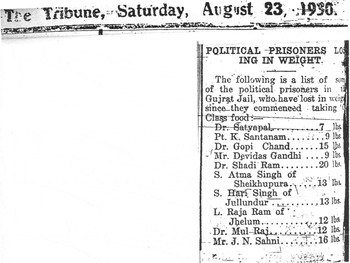
This indisputably logical demand was only half-heartedly conceded by the colonial government. Although the racial classification of prisoners was ended,Footnote 58 local magistrates continued to have the last word on whether or not political prisoners were worthy of special class treatment, thereby spurring lengthy appeals for particular political prisoners during the next phase of civil disobedience. The third and final hunger strike undertaken by the prisoners was a response to the arbitrary classification of prominent Congressmen during the Gandhi-led civil disobedience movement of 1930–31. Figure 3 shows the weight loss incurred by Congressmen who, although classified as deserving of ‘A’ and ‘B’ class treatment in the Gujrat jail, decided to consume ‘C’ class food for ordinary prisoners in sympathy with those political prisoners who had been misclassified. Riding on privileges fought for by the revolutionaries, Gandhi's trusted lieutenant Mahadev Desai described the classification of prisoners as a ‘grave scandal’.Footnote 59 At this particularly dramatic conjuncture, the Special Tribunal, cobbled together to pass judgement on the frequently absentee accused prisoners, declared its verdict.Footnote 60
Gandhian civil disobedience prisoners on hunger-strike in one Punjab jail.

When Bhagat Singh, Sukhdev and Rajguru were sentenced to death, Bhagat Singh Appeal Committees were established in every district of the Punjab. At a Bhagat Singh Day on 17 February 1931, colleges emptied out onto streets, 15,000 people met in Lahore. Over 138,000 signatures seeking the commutation of the death sentence were sent by the All Punjab Bhagat Singh Appeal Committee to the Viceroy.Footnote 61 In Amritsar, a public meeting organized by the Workers and Peasants Party demanded the immediate release of all political prisoners. The Tamil Nadu Congress Committee insisted that commuting the death sentence was an essential condition for peace.Footnote 62
In his final letters, Bhagat Singh showed an emotional and political maturity far beyond his 23 years. To his followers, he emphasized that compromise was a part of politics, but it was important to remain absolutely steadfast in the final goal. If they were fighting for 16 annas, they were to accept the 1 anna they received and continue fighting for the remaining 15. The problem with the moderates was that they fought for 1 anna and received nothing in return.Footnote 63 Crucially, Bhagat Singh dealt with the appellation ‘terrorist’. He used the word ‘aatankari’ and was emphatic: ‘mein aatankari nahin hoon, mein ek krantikari hoon’. I am not a terrorist, I am a revolutionary. He had always known that the bomb would not be the solution; it was evident in the history of the HSRA. The bomb would only be of use in certain cases; the main goal was to work with workers and peasants.Footnote 64
In his criticisms of Congress strategy and in his endeavour to chalk out a long-term strategy for the revolutionaries, Bhagat Singh returned to the relationship between means and ends. In their last letters both Sukhdev and Singh distanced themselves from the bomb attacks that engulfed the Punjab in late 1930: Sukhdev was also critical of the raid on the Chittagong Armoury.Footnote 65 Although calling for a military department in the future Communist Party, Bhagat Singh was emphatic that it would have to be subordinate to the political wing. He told his followers not to try and read between the lines. He wanted to inform them with his full strength that except for the first few days of his career as a revolutionary, he was never a terrorist. He was absolutely confident that they would not achieve anything by those means: ‘bam fainkna na sirf bekaar, balki nuksaandayak hai’, throwing a bomb is not only useless but could have negative consequences [for the revolutionary movement].Footnote 66 Bhagat Singh reminded his followers that it was important not only to die for your goals but also to live by them. To the All Punjab Students Conference, Bhagat Singh and Dutt sent a ‘wireless message’ advising them not to use bombs and pistols, but to follow the Congress program.Footnote 67 Yet the transformation in his politics and the sophistication of his reasoning has not been studied. The British damning of these prisoners as ‘terrorists’ has had a long afterlife in the writing of history.Footnote 68
The debate on whether or not Gandhi did enough to secure the commutation of the death sentence of Bhagat Singh, Sukhdev and Rajguru during his talks with Irwin has long been decided against him.Footnote 69 The greater question is that of Gandhi's attitude throughout the hunger-strike and tribulations in the prison-turned-court from 1929 to 1931. The Mahatma who sought to visit Delhi after the killings of peaceful demonstrators on 30 March 1919, Nankana Sahib after the massacre of non-violent Sikhs in February 1921 and the arrested communist leaders in the Meerut Conspiracy Case in 1929, never bothered to visit the Lahore Conspiracy Case prisoners. Even as Jinnah and Motilal Nehru damned the British Government for its inhumane and irresponsible attitude, Gandhi simply informed his inquiring and protesting readers that his silence on Das’ ‘self-immolation’ was in the ‘national interest’. The profuse author of a hundred letters in this period now held that there were ‘very many important questions affecting the nation’ on which he maintained absolute silence.Footnote 70 To Sukhdev's letter that he speak directly to the revolutionaries in prison rather than talk to them through the press—in a manner reminiscent of British bureaucrats—Gandhi simply replied that the revolutionaries’ methods were secret.Footnote 71 Even his sermon on the ‘Cult of the Bomb’, written soon after a prolonged period of hunger strike, focused only on the attempt of another set of revolutionaries to bomb the Viceregal train.Footnote 72 Gandhi did not engage with the revolutionaries’ criticism of the way he seemed to compromise with the British or with Indian capitalists: he focused on violence. When some revolutionaries employed non-violence, Gandhi continued to refer to their violent past. The distinction between the rights of political prisoners and the question of violence was blurred by Gandhi alone: numerous editorials in The Tribune, written as a way of presenting the ‘general opinion’ of the country to the British, admitted this difference.Footnote 73 Why did Gandhi refuse to acknowledge the pain and legitimacy of the hunger-strikers’ non-violent protest?
The historian Sabyasachi Bhattacharya has alluded to the ‘eternal debates about what-Gandhi-said, versus what-Gandhi-really-meant, and what-Gandhi-said-elsewhere’.Footnote 74 Yet what is so vexing has been the ability of an enormous range of scholars to study Gandhian non-violence without engaging with the greatest critic and successful emulator of his methods: Bhagat Singh.Footnote 75 A digression into Gandhi's views on satyagraha, jail reforms, and the rights of political prisoners is required before we can proceed further with this argument.
In Satyagraha in South Africa, Gandhi defined satyagraha as a ‘force which is born of truth and love or non-violence’.Footnote 76 Yet even as he recalled the moment of its birth in 1906, he was acutely aware of the inconsistencies with which he appeared to his readers. After all, he had, in subsequent years, offered his service to the British in the First World War. In a chapter in his autobiography appropriately entitled ‘A Spiritual Dilemma’, Gandhi admitted that his participation in the war effort could ‘never be consistent with ahimsa. But it is not always given to one to be equally clear about one's duty. A votary of truth is often obliged to grope in the dark’.Footnote 77 Gandhi's understanding of satyagraha developed over the years through particular struggles conducted by himself and those who claimed to perform satyagraha in his name. Early on, he distinguished between passive resistance and satyagraha. While the former appeared to Gandhi to be accompanied alongside the use of force against an adversary, satyagraha eschewed the use of physical force and could be offered to one's ‘nearest and dearest’.Footnote 78 Thus Gandhi characterized the hunger strikes deployed by British women suffragettes in prison in 1909, which elicited forcible feeding, as resorting to physical force.Footnote 79 In 1920 he was alone in his criticism of the Irish leader Terrence MacSwiney's final hunger fast.Footnote 80
With regard to jail reform, Gandhi's attitudes took many, often frustratingly conflicting, forms. In a series of articles written for Young India in 1924, he dwelt on his experiences in various jails in 1922–23. In these articles, Gandhi was critical of the prevailing system of forcing political prisoners and habitual offenders together in the same cell.Footnote 81 He regarded newspapers as ‘a necessity in no way inferior to breakfast’ and their deprivation a particularly harsh penalty for political prisoners.Footnote 82 However, he concluded with the hope that ‘civil resisters will not misunderstand this’, they were to ‘put up with the roughest treatment’ accorded to them.Footnote 83 Yet in the same series, Gandhi recounted episodes when he intervened on behalf of hunger-striking political prisoners. He allowed that under certain circumstances prisoners were entitled to protest: in the instance he elaborates, Gandhi's mediation consisted in explaining to the prisoners that their fast could not convince the Jail Superintendent of the wrongness of his flogging punishment, which could only be brought about by reasoning.Footnote 84 In a following article, Gandhi distinguished between embarrassing the government (patently not the goal of satyagrahis) and disillusioning the government (which was possible if they behaved in an exemplary fashion).Footnote 85 Some years later in December 1927, when admonished for not speaking on the cause of political prisoners often enough, Gandhi responded that he had lost faith in the British system and in the ‘power of making an effective appeal to the administrators of that system’.Footnote 86 But within a few months, we find Gandhi listing the terrible food and conditions of hard labour that were inflicted upon satyagrahi prisoners lodged in the Surat and Sabarmati Central jails, and appealing for ‘humaneness’ in the jails.Footnote 87
A brief glance at two other strictures given to satyagrahis will make my argument explicit. During the Vaikom temple satyagraha of 1924, Gandhi clarified that satyagrahis should not take the assistance of Sikhs or Christians in their struggle. Untouchability was a Hindu sin that could only be expiated by other Hindus.Footnote 88 And in the satyagraha to remove the O'Neill statue in Madras in 1927, Gandhi supported the agitation despite the fact that it would increase feelings of hatred towards the British. The Swarajist, according to Gandhi, was bound to expose ‘the blemishes of foreign rule’.Footnote 89 This reading of Gandhi's rules reveals his awareness of jail maladministration, his concern for the treatment meted out to some political prisoners and his order that satyagraha be undertaken by those most closely affected by the act they wanted to modify. Why then did he not support the satyagraha of Bhagat Singh and his fellow prisoners?
As an issue, the proper classification of political prisoners and the improvement of conditions in jails had been the subject of over 60 articles in The Tribune between 1925 and 1928. The prolonged incarceration of a whole range of prisoners arrested during martial law in 1919 and the Akali movement in the early 1920s brought various oppositional parties to vote together in the Punjab Legislative Council on the side of releasing these hapless prisoners. Indeed in late 1925, Lajpat Rai led the Congress sub-committee for the Jails Committee appointed by the British. He interviewed prominent Congressmen such as Gopi Chand Bhargava, Satyapal, Lala Duni Chand and Sardar Mangal Singh all of whom testified to the chaining of prisoners and other instances of maladministration that they had witnessed in their time spent in various jails since the first non-cooperation movement. In his statement to the Punjab Jails Committee, Lajpat Rai argued that prisoners should be classified according to their position in life and the nature of the crime they had committed.Footnote 90
If the cause was not alien to the anti-colonial movement in the Punjab, the means chosen by Bhagat Singh and his comrades could not have been more home-grown. Perhaps, as argued by Kevin Grant, a historian comparing fasting and hunger-strikers in England, Ireland and India, Gandhi distinguished between hunger-striking and fasting supporting the latter, not the former.Footnote 91 It is true that the hunger fasts that Gandhi often undertook were in the nature of a penance rather than a protest. Even during the Rowlatt agitation of 1919, when Gandhi's call for satyagraha first got India-wide publicity, he had insisted that the fast was not in the nature of a hunger strike, but public meetings and a general hartal were registers of protest. Yet Gandhi's extremely severe fasts (he only allowed himself water with a little lemon juice) were often used to pointedly mould public opinion. In March 1918 he focused on the mill owners of Ahmedabad; in September 1932 he wished that his desire to embark on a hunger fast to protest the Communal Award be broadcast.Footnote 92 In other words, the line between hunger fast as penance, self-purification and a form of political protest was blurred by Gandhi himself.
Located in the dreary prison cells of Lahore, Bhagat Singh and his co-conspirators could neither call for a hartal nor announce their aims at public meetings. They could only express their grievances through a general hunger strike. That these young men, otherwise so fond of life and food,Footnote 93 did not eat for months on end is a testimony to their pursuit of truth and their capacity for self-suffering—cardinal principles of satyagraha as Gandhi himself defined them. In the autumn of 1929, it was Bhagat Singh and his fellow prisoners who plucked at the contradictions in Gandhian satyagraha claiming the right to suffer, the most fundamental right of all, for the rights of all political prisoners in all of India.Footnote 94 It was Singh who wrote in his prison diary, sometime during his extended incarceration, these thoughtful, open-ended words from Trotsky's Lessons of October 1917: ‘But a moment comes when the habit of thinking that the enemy is stronger becomes the main obstacle to victory . . . What does it mean to lose the moment? All the art of tactics consists in this, to snatch the moment when the combination of circumstances is most favourable’.Footnote 95 With regard to the strategic use of non-violence and the relationship between means and ends, Bhagat Singh was ideologically closer to the Mahatma than the latter cared to acknowledge.
Although neglecting to analyse Bhagat Singh's protest, the historian Claude Markovits does refer fleetingly to the ‘risk, of which Gandhi was aware, of bringing about the birth of a new elite, characterised not by aggressive physical courage but by its capacity to endure sufferings of the flesh for the cause of the nation. Such an “elite of suffering” did not crystallize in the same way as an “elite of violence” might have’.Footnote 96 Might that have been intentional? In an article that provides a larger context for the 1930 civil disobedience movement, the historian Sumit Sarkar has suggested that late 1930 saw a push towards compromise with the British fuelled by an increasingly assertive bourgeoisie and ‘the absence of a coherent left alternative’. This is exemplified in the convergence of the concrete issues raised by the bourgeoisie with the 11 points presented by Gandhi to Viceroy Irwin.Footnote 97 Sarkar points out that salt provided Gandhi with a ‘universal rural grievance’ with ‘no socially divisive possibilities’.Footnote 98 However, once launched, the civil disobedience movement grew in directions not entirely foreseen. In villages and forests in Gujarat, Bengal, Bombay Presidency and the Central Provinces, pressures from below were pushing the movement to include no-rent and no-revenue campaigns, the picketing of liquor shops, anti-grazing fees, chowkidari taxes and forest satyagrahas. It was in this context that influential industrialists decided on a policy of compromise with the British. Neither the 11 points nor the separate demands spelt out during the Gandhi–Irwin talks of 1931 included the commutation of the death sentence of the political prisoners.
In the case of Bhagat Singh and his fellow prisoners, Gandhi's silence was particularly unfortunate. Bhagat Singh's protest had welded together an enormous and formidable array of political adversaries. Even more than the Congress-led boycott of the Simon Commission of 1928, Singh's support for the rights of political prisoners united public opinion across North India. Both the official historian of the Indian National Congress and the official compiler of revolutionary terrorism for the British Government admitted that the popularity of Bhagat Singh rivalled that of Gandhi in this period.Footnote 99
Contrary to the arguments of Christopher Pinney who dwells on the representation of Singh's mimicry of an Englishman in a Lahore Railway station in 1928 as a sign of his immense and mobile modernity and emphasizes his ‘structural negation of Gandhi's corporeal practices’,Footnote 100 the incredible popularity of Bhagat Singh and his fellow accused prisoners stemmed from their choice of a cause that had always bridged other ideological divides, i.e., the cause of political prisoners. The means used to fight this battle of principles was the hunger fast: a means at once vivid, emotional, intense and exacting, a toll on the human spirit as well as the body.Footnote 101 The immediate images that flashed across the minds of Punjabis in the late 1920s and early 1930s were not of the trilby hat but of the painful ordeal that the young men had undergone for the sake of all political prisoners. The deteriorating health of the hunger-striking prisoners graced the columns of newspapers. The myth of the violent (and therefore popular) Bhagat Singh does not face up to a meticulous scrutiny of the contemporary historical record.
***
In the beginning, it seemed transparent, clear and unequivocally anti-colonial. Before launching the first all-India satyagraha campaign, Gandhi had declared:
Satyagraha is self-dependent. It does not require the assent of the opponent before it can be brought into play. Indeed it shines out when the opponent resists. . . . Death in the fight is a deliverance, and prison, a way to liberty. . . . victory lies in the ability to die in the attempt to make the opponent see the truth, which the Satyagrahi for the time being expresses.Footnote 102
Gandhi did not see the truth of his opponent's satyagraha even after their death. By labelling them ‘murderers’ and ‘terrorists’, and invoking their history of violence, the British had sought to dismiss the revolutionaries’ non-violent demands for rights as ‘political prisoners’. This colonial narrative of ‘terrorism’ was accepted and promoted by the Gandhi-led Congress. In his insistence on controlling every satyagraha and failing to acknowledge the satyagraha of these prisoners, Gandhi sought to retain power in the hands of an overly centralizing Congress. Bhagat Singh's hunger strike provides us a glimpse into a different anti-colonial nationalism—radical yet willing to compromise; aware of the quality of anti-colonialism that would be needed to weld together truly disparate segments of Indian political society. For a Punjab that may have been, his hunger strike brought together a divided Punjab Congress—Satyapal, Duni Chand, Gopi Chand Bhargava, Sardar Mangal Singh, Zafar Ali Khan and others participated in processions, the Conspiracy Case Defence Committee and the Jail Enquiry Committee. Through a careful reading of multiple sources and by foregrounding the voices of the revolutionaries themselves, Bhagat Singh's protest offers us a glimpse into an alternative history of revolutionary anti-colonialism—unrequited but full of promise.