

Introduction
Adult Onset Epileptic Seizures (AOES) represents seizure activity that first occurs at 18-years of age or older. As a neurological disorder, epilepsy accounts for 6.3% of the global burden of disease (World Health Organization, 2006), of which 3% of the cases develop late epilepsy in the absence of early, child onset seizure activity (Rugg-Gunn & Sander, Reference Rugg-Gunn and Sander2012). Epileptic seizures are from abnormal excessive or synchronous neuronal activity in the brain manifesting in various levels of spontaneous loss of behavioural control (Fisher et al., Reference Fisher, van Emde Boas, Blume, Elger, Genton, Lee and Engel2005). The unpredictability of seizures places the individuals with epilepsy and family members under stress from anxieties on how best to manage a seizure occurrence and life course implications for the family member with the epilepsy (Bressi, Cornaggia, Beghi, Iandoni, & Invernizzi, Reference Bressi, Cornaggia, Beghi, Iandoli and Invernizzi2007).
AOES in a family member requires the family to provide the member with epilepsy instrumental support for day-to-day living (Mahrer-Imhof et al., Reference Mahrer-Imhof, Jaggi, Bonomo, Hediger, Eggenschwiler, Kramer and Oberholzer2013). For that reason, some family caregivers may experience unwanted time demands on them and restrictions on their community activities, the workforce and recreation. At the same time, some family members may find it socially rewarding caring for family member with a chronic health condition (Schembri Lia & Abela, Reference Schembri Lia and Abela2016).
Social outcomes vary for those with surgery for seizures, with high expectations held by family members and significant others that the surgery will provide a cure for the seizure activity. About 30% of people with epilepsy would benefit from lobectomy procedure (Wiebe, Blume, Girvin, & Eliasziw, Reference Wiebe, Blume, Girvin and Eliasziw2001). An estimated 81.9% of cases following partial lobectomy surgery achieve reduced seizure activity (Clusmann et al., Reference Clusmann, Schramm, Kral, Helmstaedter, Ostertun, Fimmers, Haun and Elger2002). Full remission occurred in 45%–56% of cases over a 10-year period (Englot, Wang, Rolston, Shih, & Chang, Reference Englot, Wang, Rolston, Shih and Chang2012). This rather poor remission rate can be disappointing to the people living with epilepsy, family and significant others.
Family may not understand the recovery prospects living with AOES following surgery in which seizure may be present but less frequent. Consequently, even the occasional seizure following surgery may be potentially demoralizing to the person with epilepsy and other family members (Bellon, Walker, Peterson, & Cookson, Reference Bellon, Walker, Peterson and Cookson2013). Though others who experience seizure relapse do live well with the partial remission following surgery (Spencer et al., Reference Spencer, Berg, Vickrey, Sperling, Bazil, Haut and Devinsky2007), evidence is needed on family functioning among men with AOES following surgery reporting partial or full remission from seizure activity. Findings would clarify the type of family relationship qualities that are important for living well with AOES following a lobectomy as well as the needed supports in the context of those relationships.
Family Relationships with Adult-Onset Disability
Previous studies on health-related quality of life have focused on the ‘three Ds'’: disease, disorder and disability (Keyes, Fredrickson, & Park, Reference Keyes, Fredrickson, Park, Land, Michalos and Sirgy2012). However, little regard of the importance of family relationship qualities to the management of health conditions has been considered. This is a serious knowledge gap in that healthy family relationships are an important influence on health-related quality of life (Marujo & Neto, Reference Marujo, Neto, Bruni and Porta2016). Yet, it is known that disability does not just impact the individual but also has an impact on the family and can lead to changes in relationships, expectations and roles (Padrone, Reference Padrone1994). ‘A fundamental component of family systems theory is the recognition that what affects one member of the family, in turn, affects the whole family’ (Jonzon & Goodwin, Reference Jonzon and Goodwin2012).
Health-related quality of life refers to physical, mental, emotional and social functioning well-being (Johnson, Jones, Seidenberg, & Hermann, Reference Johnson, Jones, Seidenberg and Hermann2004). It has a direct impact on a person's subjective well-being (SWB) and the person's self-evaluation of his or her feelings of happiness, peace and fulfilment (Diener & Ryan, Reference Diener and Ryan2009). Further complicating the issue is the uncertainty of the condition. Irvine, Davidson, Hoy, and Lowe-Strong (Reference Irvine, Davidson, Hoy and Lowe-Strong2018) found that the unpredictability of symptoms in individuals with multiple sclerosis caused additional stress. It's quite possible that this inability to predict when a seizure may occur impacts not only the individual's quality of life but the family as well. Kung (2016) found that caregivers of individuals with schizophrenia, another condition that has period of remission and exacerbation, worried about relapse even when their family members were doing better. The variable nature of seizure disorders may put additional stress on the family and result in role changes.
Gendered Response to Chronic Illness and Disability
Family is a source of social support for SWB. Men tend to respond to chronic health conditions differently from women in that they may be less likely to seek support (Barney, Griffiths, Jorm, & Christensen, Reference Barney, Griffiths, Jorm and Christensen2006), which in turn may compromise their coping strategies with their health condition as well as the quality of relationships within the family (Seidler, Dawes, Rice, Oliffe, & Dhillon, Reference Seidler, Dawes, Rice, Oliffe and Dhillon2016). With an invisible disability, such as epilepsy, the male person is even less likely to seek assistance (Courtenay, Reference Courtenay2000). This gendered response to disability can load the spouse and the family with a burden of care (Warner & Adams, Reference Warner and Adams2015). While there is evidence that reaction to a disability may be more important than the disability itself (Schembri Lia & Abela, Reference Schembri Lia and Abela2016), how the disability affects a person's ability to carry out their daily tasks and roles is important for successful living with disability (Madden et al., Reference Madden2015).
The current study sought to utilize qualitative enquiry to address the question: What characterizes family relations for men with AOES for which they received surgery? There have been few studies on AOES and effects on the immediate family environment following neurosurgery that have adopted a qualitative methodology. Qualitative enquiry has the advantage to yield a first-person perspective that people bring to their lives (Wallace, Reference Wallace1972; Yin, Reference Yin2009). Moreover, personal perspectives and narratives about their own illness impact health and functioning (Kellet, Mpofu, & Madden, Reference Kellet, Mpofu and Madden2013), perhaps more than the objective qualities of the illness (Fisher et al., Reference Fisher2000).
Methods
Research Design
Utilizing a multiple-case study approach (MCS) (Dickson & Looper, Reference Dickson and Looper2012) gathered ethnographic interview data (Green, Payne, & Barnitt, Reference Green, Payne and Barnitt2004) on the men's family relationships and the relationship circumstances following elective surgery.
With the use of a MCS approach within this study, each case contributes to clarifying the phenomenon exhibited in those incidents. The MCS approach increases the authenticity of the research through the implied ‘replication logic’ inherent in its design. Moreover, MCSs provide an understanding of what the participant in each case study has individually experienced, also providing an interpretive context for other cases (Dickson & Looper, Reference Dickson and Looper2012).
Participants and Setting
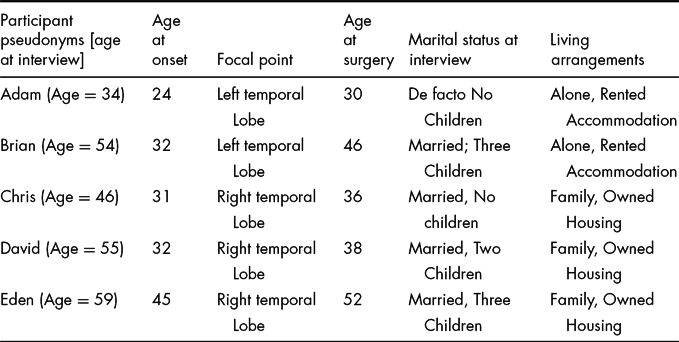
Five Australian men with AOES that had experienced at least one partial temporal lobectomy procedure were the informants in this study (see Table 1 for demographics). For the data reporting in relation to the five cases that were chosen, the following pseudonyms were used: Adam, Brian, Chris, David and Eden.
Study Participants Characteristics

The participants were recruited with the assistance of support foundations within the Epilepsy Australia group, including the Victorian Epilepsy Foundation and Epilepsy Action Australia. Inclusion criteria were males with AOES whom had previously experienced a partial lobectomy procedure with the intension of reducing their seizure frequency.
Procedure
The Human Research Ethics Committee of The University of Sydney approved this study. Participants consented for study in writing. The participants were informed of the study goals and of their right to withdraw from the study at any time without penalty. The first listed author gathered the data. They also were informed of counselling support services to access if they required any such during the study period. Participants did not receive any monetary incentives for the study. Data was collected over a three-month period at locations at times convenient to the participants.
Data Collection
The men responded to a grand tour (or broadly scoped) questioning on family relationship qualities following neurosurgery for AOES as follows: ‘Tell me about your family life after experiencing surgery to treat your epilepsy. Just tell me what comes to mind. There is no importance to what comes first’.
Following their responses, more focused questions were asked on the specific aspects of family relationships in relation to social interaction in several areas, including their SWB as part of family.
The first listed author audio recorded and transcribed each interview verbatim, with the verification of transcriptions by the second listed author for accuracy. For data credibility and trustworthiness checks, the first listed author returned transcript data to the interviewee for the participant to verify that the interviewer correctly interpreted the information shared by the participant. Subsequently, the second listed author audited the transcripts for narrative coherence.
Data Analysis
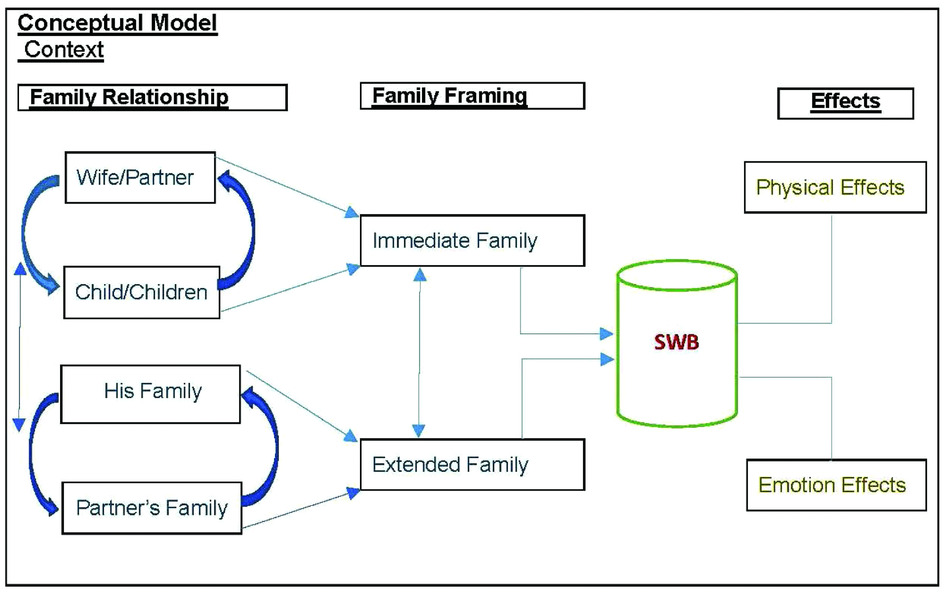
IPA was utilized (Biggerstaff & Thompson, Reference Biggerstaff and Thompson2008) with data visualization techniques (Henderson & Segal, Reference Henderson, Segal, Azzam and Evergeen2013) to capture the personal representation of the family relationships qualities that each of the men with AOES experienced following surgery and their responses to the family life dynamics. Figure 1 presents the preliminary schematic structure, in the Interpretive Phenomenological Analysis (IPA) for the analysis.
Preliminary schematic on effects and affects with SWB trailing elective surgery for AOES.

IPA is appropriate for understanding personal perspectives on social phenomenon; what the significance social experiences hold for him or her. In applying IPA to the data, each interview verbatim was transcribed, and conducted a line-by-line analysis followed by division of data into significant analytical entities (segmenting the data) and theme exposition. Data visualization was then applied to map the emergent themes for their salience to the family lives of the men with AOES.
Results
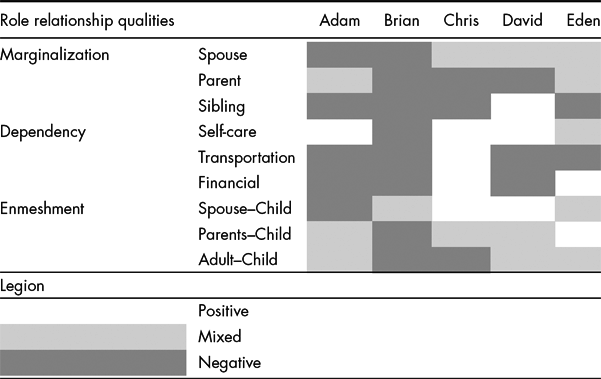
The following themes from the IPA were identified to characterize the family relationships of men with AOES and surgery for it: role marginalization, role dependency and role enmeshment or blurring of social boundaries (see Table 2). These themes are considered next.
Data Visualization of Family Relationship Qualities of Men with AOES Post-surgery

Changes in various aspects of family relationships influenced the SWB of participants following elective neurosurgery for AOES: role positioning, marginalization, escalating expectations for dependency, perceived reduced capacity for decision-making and enmeshment or loss of social boundaries. Each of these changes influenced specific aspects of participants’ SWB including happiness, peacefulness, fulfilment and self-perception. Table 2 shows the impact of role positioning and responsibility in the family environments of participants. In some cases, all participants experienced a positive or negative effect. At other times, there was a mixture of effects experienced, with some participants being positive and others negative.
Role Marginalization
All participants reported to experience significant role marginalization by members of the immediate and extended family environments. Role marginalization refers to exclusion from desired normative life activities for any reason (Billson, Reference Billson and Dennis2005).
Sibling bonding and affiliation
Adam reported on his experiences of role marginalization by siblings as follows:
My two brothers said: ‘Tell me why you are still so sick and have no energy? You need to get more exercise.’ They were thinking it would all get better straight away, like going and playing a game of tennis. They were embarrassed because I couldn't do these things with them anymore and so they just stop wanting me around.
Chris reported his siblings choosing to minimize regular contact with him as follows.
[other siblings] don't expect me to offer my help to cook when they are there. This has negatively affected my happiness and motivation.
Eden said:
My brother has kept a big distance from me. In fact, all three presently still don't discuss epilepsy or the operation with me. They seem uncomfortable when I'm around their children and they just won't talk about it.
Brian reported his two sisters’ role marginalize him by choosing to remain isolated from him post-surgery by saying:
To varying degrees, they really do not understand, and I don't think they've ever tried much to understand it. . .” one of my siblings for instance has never wanted to know. He has acted as if I had just had a cold, or I was a wuss if it was to be any more.”
Parent and Spousal Relationships
Brian reported role marginalization by his parents when recounting:
I'm never asked [by my parents] how I'm doing. I'm never asked, whether I have or haven't had a seizure (post-surgery). It's like been and gone. It's not like I can go to even ring my parents (to talk about the) grief and tension epilepsy still causes me. It's my problem.
Adam spoke about his wife role marginalizing him in social company presence. He reported; ‘Because my partner was embarrassed that I was still on a (Disability Support) pension, she didn't want her friends to see us together’.
Role Dependency
Adam, Brian, David and Eden self-perceived higher levels of social role dependency post-surgery. Role dependency refers to undue reliance on others for everyday kind of decisions. For instance; Chris believed to have a reduced decisional role within the family because of the surgery failing to cure his epilepsy.
Chris said, ‘I would be calling her [wife] several times a day just to say hello and ask her for her opinion on the decisions I should make. You know, whether they were the right ones’. Chris said he previously did less of asking for partner decisional input, as he enjoyed this dependency, which encouraged happiness and fulfilment.
Adam separated from his spouse and moved in with his mother who had a significant decisional role: ‘. . .it was hard at first [to move in with his mother], because she overprotected me. She wanted to make my decisions for me. . . It felt good to be looking after myself again’.
Eden activity role dependency was as follows: ‘I had to rely on her [wife] to do things like drive me around. Following the surgery for epilepsy, I didn't drive (for) three years’. Similarly, Chris reported as follows:
‘After the surgery, I wanted to start driving her wherever she needed to go and not the other way around. But I still remained dependent (on her) for transportation’.
Brian reported activity dependency in leisure and recreation thus: ‘I could [not] just pull out my guitar and not be worried about having a seizure. I feared I would have one on stage’.
David and Adam reported experiencing difficulties from financial dependency on the spouse post-surgery. For instance, Adam observed:
I think she was expecting everything to be ok straight away after [surgery]. I know she had got to the point where she was responsible for me. I think that she only thought that was ‘til we could get back to the life we were living before it all started.
Likewise, Brian said he lost his wife to a workplace boss due to his financial dependency on her:
Because . . .my pension [could not support us], [and were in financial hardship], my wife left me and moved in with her boss who gave her more money than I could ever do then. I did not blame her, I blamed myself.
Chris and Eden took their social role dependency on spouses positively. Chris said of his social role dependency: ‘I was happy [to be dependent on her financially] and we were not in any debt at all’. Similarly, Eden observed: I rely strongly on my wife, both physically and financially following the surgery for epilepsy, (I am) lucky to have her.
And:
I am lucky to have my wife and her income to support me, not having a job does take so much away from how I judge myself. I think just having the same work position to return to on a daily basis once gave me confidence. I realise that more now that I don't have it.
Role Enmeshment
Role enmeshment refers to blurring of social boundaries (Kivisto, Welsh, Darling, & Culpepper, Reference Kivisto, Welsh, Darling and Culpepper2015). Enmeshed family members have boundary issues that do not allow for separation or differentiation (McAdams et al., Reference McAdams2016). Kung (2016) found that enmeshment was increased when families were under stress. All five participants experienced role enmeshment in their families on three levels: spouse–child, parent–child and adult–child.
Spouse–Child
In this instance, the men perceived to be treated by their spouses as if they were childlike while also a spouse. For instance, Adam and Chris reported on their spouse–child role enmeshment as follows:
‘I felt like I was her child. I could not make money. All I could do was rely on her money’. [Adam]
I depended on my wife [like a child]. She was happy to look after me. I was able to get a job, but she still takes care of me like I was a child. [Chris]
David said he had to rely on his spouse for emotional support, as would a child on a parent. He said:
I needed my wife to take care of me when I had a bad mood [more like a child would]. That is hard for me because she used to rely on me.
Child–Parent
The men perceived their children to treat them as if they were minor children needing help with decision making, even as they also took them for a parent.
Brian and Eden spoke of the difficulties with their parent roles, as they now needed their minor children to make some of their choices for them. For some time following the surgery I still couldn't take full responsibility for my children, leaving them to make our decisions. To decided things for me and for themselves. [Brian]
I was increasingly the child of the family, and with diminished responsibility. [Eden]
Discussion
Findings on role marginalization effects are similar to those reported by Maschio (Reference Maschio2012) regarding restricted family participation by people with hemiparesis and speech problems. The family might perceive the person with AOES to be a burden of care despite the surgery (McPherson, Wilson, Chyurlia, & Leclerc, Reference McPherson, Wilson, Chyurlia and Leclerc2010). Role marginalization effects with chronic illness would be likely in patriarchal society where males self-perceive to be the dominant or lead partner in the relationship (Mikati, Comair, Ismail, Faour, & Rahi, Reference Mikati, Comair, Ismail, Faour and Rahi2004).
Participant's sense of role dependency may have arisen from their perceptions of social vulnerabilities associated with limitations in personal functioning and high emotional dependency on them. A study by Feddersen, et al. (Reference Feddersen, Herzer, Hartmann, Gaab and Runge2005) found that adults with temporal lobe epilepsy experienced emotional fluctuations post-surgery (Feddersen, Herzer, Hartmann, Gaab, & Runge, Reference Feddersen, Herzer, Hartmann, Gaab and Runge2005), demonstrating an increase in emotional dependency on family or significant others. The debilitations of chronic illness are associated with comprised sense of role identity (Voltzenlogel et al., Reference Voltzenlogel2016). This might show in self-perceptions of role dependency and lower SWB.
Wilson, Bladin, & Saling (Reference Wilson, Bladin and Saling2001) proposed actions of family role enmeshment to occur from a disablement process on a family member in which the family excludes him or her from roles within capability (Wilson et al., Reference Wilson, Bladin and Saling2001). Similarly, Gilbert (Reference Gilbert2012) was of the view that role enmeshment was likely from role responsibility discounting from perceptions that the family member was inherently incapable. Furthermore, enmeshment limits the autonomy of the individual and can result in guilt or resentment among the other family members (Barber & Buehler, Reference Barber and Buehler1996).
It is known that premorbid relationships and role expectations have an impact on future relationships and expectancies (Burman & Margolin, Reference Burman and Margolin1992), suggesting that people with AOES whom family perceived capable would likely continue to be more actively engaged in significant personal and family roles than those with a history of dis-ablement (Jacoby, Ring, Whitehead, Marson, & Baker, Reference Jacoby, Ring, Whitehead, Marson and Baker2014).
Ultimately, it is known that anything that affects one family member will affect the entire family (Johnson et al., Reference Johnson, Jones, Seidenberg and Hermann2004). Therefore, psychotherapy for the family might be beneficial (Jonzon & Goodwin, Reference Jonzon and Goodwin2012). Additionally, encouraging communication and finding social support for the family members might further help reduce inappropriate boundaries and enmeshment (Kung, Reference Kung2016).
Limitations of the Study
This was a rich text-descriptive and interpretive study with purposely selected people with a relatively rare condition: AOES. For that reason, the sample size of five men was realistic to purpose and setting. A limitation of the study was not interviewing family members for cross-validation of perceptions and creating for richness in the data not possible from interviewing the man alone. Future studies should seek to address this limitation.
Conclusions
The men with AOES reported experiencing role marginalization, dependency and enmeshment or reduced accountability and duty of care and decision making in post-surgery. On the surface, these findings are counterintuitive in view of the fact that post-surgery, the men self-reported with increased personal functioning from reduced seizure symptoms. Although surgery is increasingly utilized to reduce the frequency of seizures, it does not eliminate seizure activity altogether and is rarely a cure for the condition. Epilepsy recovery education with families and people with AOES might make for healthier family relationships with elective neurosurgery.
Appendix
1. How is your everyday family life influenced by living with epilepsy? Describe with examples involving how others reacted to you from having Adult-Onset Epilepsy after neurosurgery?
2. Did anything changed within the family environment for you following the surgery? (If so: What were the differences? How did that make you feel?
3. What help did you and your family receive from the specialists and following the surgery? How did that make you feel?
4. How do you perceive yourself since surgery for adult-onset seizure? Speak to any aspect important to you over the period since surgery? How is it different now?
5. What do you perceive to be the others’ knowledge about epilepsy and adult onset seizures from their interaction with you?
6. Do you have any questions at all that you would like to ask me?