The prevalence of obesity is growing worldwide and is reaching epidemic proportions in developed countries.Reference Ng, Flemming and Robinson 1 In the Netherlands, the prevalence of obesity (BMI, ≥ 30 kg/m2) has more than doubled from 5% in 1991 to 12% in 2016. Simultaneously, the percentage of overweight persons (BMI, 25–30 kg/m2) has increased from 25% to 31%. 2 Obesity has been associated with a higher risk of developing diseases such as type 2 diabetes, several cancer types including colon and breast cancer, musculoskeletal disorders, and cardiovascular disease.Reference Suleiman, Ortega and Ong’uti 3 – Reference Lauby-Secretan, Scoccianti and Loomis 9 As patients with these diseases more frequently require surgery, obese patients are becoming an increasingly large subset of surgical patients. Furthermore, being obese is described to result in poorer outcomes in several surgery typesReference Huttunen and Syrjanen 5 , Reference Anaya and Dellinger 10 and in an increased risk of infectious complications, especially surgical site infection (SSI).Reference Huttunen, Karppelin and Syrjanen 11 – Reference Gao, Sun and Young 13 Therefore, SSI in obese patients poses a substantial burden on the healthcare system.
In the last decade, laparoscopic surgery has been increasingly performed. This less invasive alternative to conventional surgery may result in less pain, shorter hospitalization, faster recovery, and fewer complications.Reference Al-Mulhim, Al-Hussaini, Al-Jalal, Al-Moagal and Al-Naijar 4 , Reference Tong, Fan and Law 14 , Reference Lujan, Frutos and Hernandez 15 However, the results are inconclusive regarding the benefits for obese patients with regard to the development of SSIs, since their risk of SSI might still be increased compared to patients with normal weight.Reference Makino, Shukla, Rubino and Milsom 16
Several multicenter studies have assessed the magnitude of risk caused by increasing BMI, although only a few compared the differences among surgery types and included laparoscopic surgeries.Reference Segal, Waller, Tilley, Piller and Bilimoria 17 – Reference Gurunathan, Ramsay, Mitric, Way, Wockner and Myles 20 In this study, we quantified the impact of obesity on the risk of both superficial and deep (including organ-space) SSIs in a range of conventional and laparoscopic surgery types.
Methods
SSI surveillance data
Data were derived from the SSI incidence surveillance of PREZIES, the Dutch national nosocomial surveillance network. SSI incidence surveillance within this network began in 1996 and has continuously been performed. Most Dutch hospitals participate in this voluntary surveillance and select on an annual basis one or several types of surgical procedures for surveillance. Hospitals within the network remain anonymous, and no pay for performance is linked to the outcomes. In 2012, major changes were implemented in the SSI surveillance protocol including the addition of patient’s length and weight for all surgery types and the restriction to primary surgeries only (no reoperations). Other patient- and surgery-related risk factors have been collected since 2012 for all types of surgery: age, gender, wound class, American Society of Anesthesiologists (ASA) score, duration of surgery, suspected malignancy, insertion of an implant, reoperation after initial surgery, complexity of surgery (single procedure versus multiple procedures during 1 session). Specific risk factors include diabetes, Euroscore I and Euroscore II (European System for Cardiac Operative Risk Evaluation),Reference Nashef, Roques, Michel, Gauducheau, Lemeshow and Salamon 21 , Reference Nashef, Roques and Sharples 22 extracorporeal circulation, perfusion duration, lowest body temperature, use of internal mammary artery (for cardiothoracic surgery), axillary lymph node dissection, immediate reconstructive surgery (for breast surgery), stoma, anastomotic leakage (for colon surgery) and scheduled versus emergency procedure (for Caesarean section). Furthermore, compliance with 4 SSI bundle elements has been facilitated, including antimicrobial prophylaxis according to local guidelines. Due to the voluntary nature of these elements and because local guidelines on antimicrobial prophylaxis may differ from hospital to hospital, these bundle elements were not included in this study.Reference Koek, Hopmans and Soetens 23 Collected variables related to the infection include the type of SSI (superficial or deep/organ-space) and the cultured microorganism. The surveillance uses definitions for diagnosing an SSI based on definitions of the ECDC and CDCReference Horan, Andrus and Dudeck 24 , 25 and are described elsewhere.Reference Verberk, Meijs and Vos 26 Deep and organ-space SSIs are combined as deep SSIs. A mandatory postdischarge surveillance protocol is in place to identify SSIs after the patient has been discharged from the hospital. Patients are surveilled for the development of an SSI up to 30 days after surgery or up to 90 days (or 1 year before 2015) for deep SSIs in surgeries that require an implant. No distinction is made between deep and superficial SSIs in mastectomy and lumpectomy without implant because of diagnosis difficulties.
Data selection
For this study we included surgeries performed from January 1, 2012, to December 31, 2017, in patients aged 18 years and older. Until 2015, the duration of follow-up for deep infections in surgeries with an implant was 1 year, and surgeries before 2015 were retrospectively reanalyzed to include only SSIs diagnosed within 90 days. For breast surgery we used only total SSI incidence. Patients were stratified based on body mass index (BMI) into 5 groups: underweight (BMI, <18.5 kg/m2), normal weight (BMI, 18.5–25 kg/m2), overweight (BMI, 25–30 kg/m2), obese (BMI, 30–40 kg/m2) and morbidly obese (BMI, ≥40 kg/m2). For Caesarean section, the patient’s weight before pregnancy was used. Only surgery types with at least 20 patients in every BMI category were considered for analysis.
Data analyses
Analyses were performed per surgery type for superficial and deep SSIs separately, and for all SSIs combined. Incidence and 95% confidence intervals (95% CI, Wilson score) were calculated per BMI category. Multivariable log binomial regression analysis was used to determine the effect of BMI category on the risk of SSI. Risk ratios (RRs) and 95% CIs were calculated with normal BMI (18.5–25 kg/m2) as the reference category. A random intercept was added to account for clustering of patients within hospitals. All patient- and surgery-related risk factors that were collected in the surveillance were assessed as potential confounders. The ASA score was not included in the model because BMI is part of the classification criteria and therefore was highly correlated with the ASA score. A backward selection method was used to develop the multivariable models, starting with a model including all risk factors with a P < .20 in univariate analysis (ie, the full model). This model was reduced until removal of another risk factor would result in a change of ≥10% in the RR estimates of any of the BMI categories. In surgery types with convergence issues, we first excluded the underweight BMI category, or if the model still did not converge, we grouped obese and morbidly obese patients. Additional convergence issues were solved using logistic regression instead of log binomial regression in the variable selection procedure. All analyses were performed using SAS version 9.4 software (SAS Institute, Cary, NC).
Results
Overall, 14 surgery types had at least 20 patients in all 5 BMI groups and were included in our study, comprising 421,855 surgeries and 9,670 SSIs within 7 surgical specialties in 95 hospitals. The surgery types included coronary artery bypass grafting, open aortic valve surgery, mastectomy, lumpectomy, laparoscopic appendectomy, laparoscopic cholecystectomy, open colectomy, laparoscopic colectomy, total and partial hip prosthesis, total knee prosthesis, vaginal hysterectomy, Caesarean section, and laminectomy. The number of surgeries per surgery type ranged from 3,457 for laparoscopic appendectomy to 126,005 for total hip prosthesis. BMI was missing for 33,936 surgeries (8.0%). The percentage of surgeries with missing BMI was lowest in cardiothoracic surgery (0.0%) and highest in partial hip replacement (30.2%).
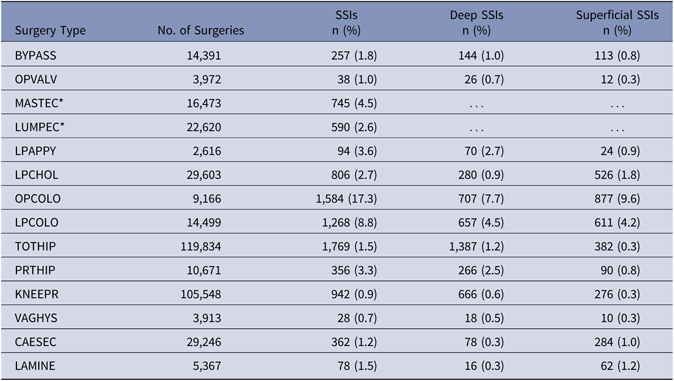
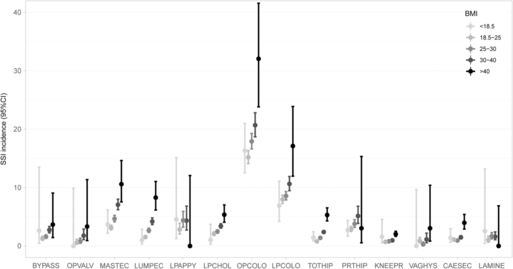
The analyses were performed on 387,919 patients with known BMI. The SSI incidence per surgery type is shown in Table 1. In total, 3,676 patients (0.9%) were underweight, 116,778 (30.1%) had normal weight, 154,339 (39.8%) were overweight, 104,288 (26.9%) were obese, and 8,838 (2.3%) were morbidly obese. The SSI incidence per BMI category is shown in Fig. 1 for every surgery type. In general, the SSI incidence increased when the patient’s BMI changed from the normal BMI category to the overweight, obese, and morbidly obese categories. The degree of the increase varied per surgery type, but it was less profound in vaginal hysterectomy, Caesarean section, and laminectomy. In most surgery types, the number of morbidly obese patients was limited, resulting in large confidence intervals. Supplementary Table S1 (online) shows the incidence per BMI group for total, superficial, and deep SSIs.
Number of Surgeries and Infections and Percentage of Infections per Surgical Procedure, for Surgeries With Body Mass Index (BMI) Registered From 2012 to 2107

Note. BYPASS, coronary artery bypass grafting; OPVALV, open aortic valve surgery; MASTEC, mastectomy; LUMPEC, lumpectomy; LPAPPY, laparoscopic appendectomy; LPCHOL, laparoscopic cholecystectomy; OPCOLO, open colectomy; LPCOLO, laparoscopic colectomy; TOTHIP, total hip prosthesis; PRTHIP, partial hip prosthesis; KNEEPR, total knee prosthesis; VAGHYS, Vaginal hysterectomy; CAESEC, Caesarean section; LAMINE, laminectomy.
Incidence of surgical site infections per body mass index category per surgery type, Dutch national surveillance network PREZIES 2012–2017. Note. BYPASS, coronary artery bypass grafting; OPVALV, open aortic valve surgery; MASTEC, mastectomy; LUMPEC, lumpectomy; LPAPPY, laparoscopic appendectomy; LPCHOL, laparoscopic cholecystectomy; OPCOLO, open colectomy; LPCOLO, laparoscopic colectomy; TOTHIP, total hip prosthesis; PRTHIP, partial hip prosthesis; KNEEPR, total knee prosthesis; VAGHYS, Vaginal hysterectomy; CAESEC, Caesarean section; LAMINE, laminectomy.

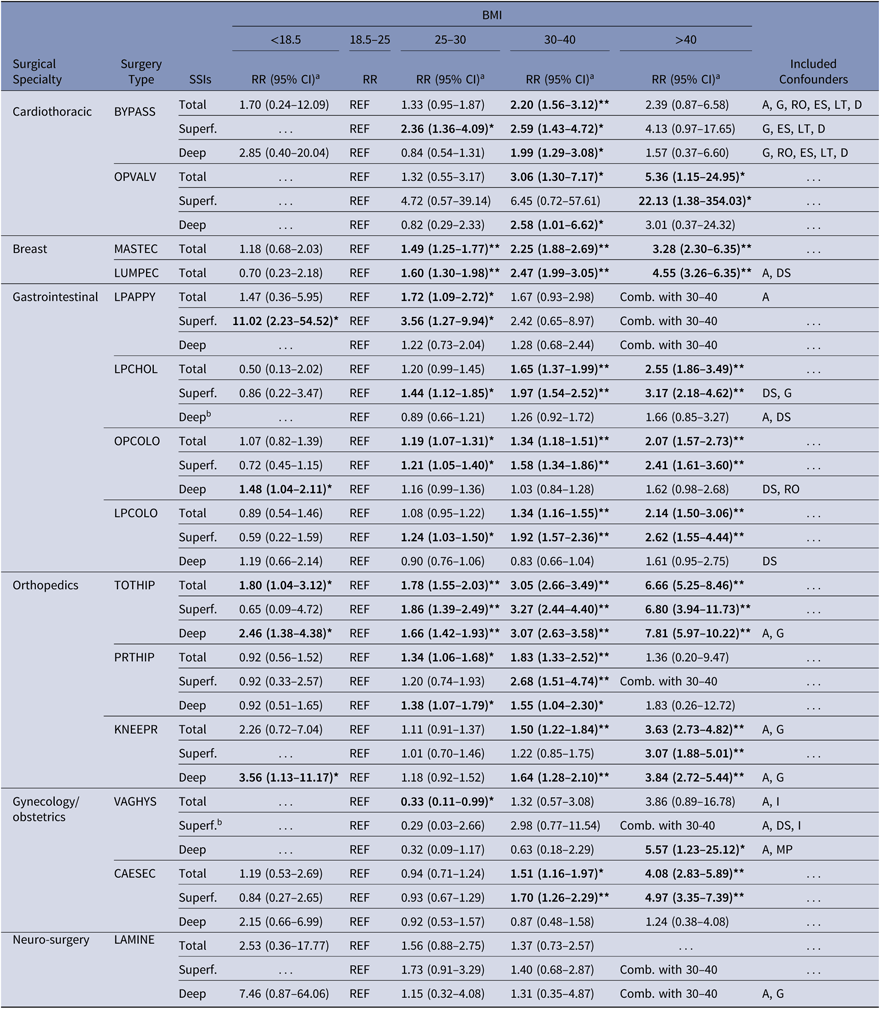
In multivariable regression modeling, a higher (ie, overweight, obese, or morbidly obese) BMI category resulted in an increased risk of SSI compared to normal BMI for most surgery types (Table 2). For instance, in cardiothoracic surgery, a higher BMI category resulted in an increased risk of both superficial and deep SSI, with the strongest increase in the risk of superficial SSI. For mastectomy and lumpectomy, the risk of developing an SSI increased with every BMI category, from 1.49 (95% CI, 1.25–1.77) and 1.60 (95% CI, 1.30–1.98) in overweight patients to 3.28 (95% CI, 2.30–6.35) and 4.55 (95% CI, 3.26–6.35) in morbidly obese patients, compared to patients with normal weight. Gastrointestinal surgeries showed no significant increased risk of deep SSI, whereas the risk of superficial SSI gradually increased with increasing BMI, except in laparoscopic appendectomy. The most profound association between BMI and risk of SSI was found for total hip prosthesis. This association was observed in both superficial and deep SSI, with risk increasing up to 7.81 times (95% CI, 5.97–10.22) for deep SSI in the morbidly obese. For vaginal hysterectomy, the risk of SSI was increased only for deep SSI in the morbidly obese group. Being overweight (BMI, 25–30 kg/m2) was a protective factor for the development of SSI (RR, 0.33; 95% CI, 0.11–0.99) in vaginal hysterectomy compared to patients with normal BMI. In laminectomy, the risk of SSI did not increase in any of the BMI groups. Finally, being underweight (BMI, <18.5 kg/m2) was associated with an increased risk of superficial SSI in laparoscopic appendectomy, deep SSI in open colectomy and total knee prosthesis, and both deep and total SSI in total hip prosthesis. Important confounders influencing the effect of BMI on the risk of an SSI were age, gender, and duration of surgery.
The Risk (RR) of Surgical Site Infections per BMI Category Compared to Normal BMI, Dutch National Surveillance Network PREZIES 2012–2017

Note. RR, risk ratio; REF, reference category; BYPASS, coronary artery bypass grafting; OPVALV, open aortic valve surgery; MASTEC, mastectomy; LUMPEC, lumpectomy; LPAPPY, laparoscopic appendectomy; LPCHOL, laparoscopic cholecystectomy; OPCOLO, open colectomy; LPCOLO, laparoscopic colectomy; TOTHIP, total hip prosthesis; PRTHIP, partial hip prosthesis; KNEEPR, total knee prosthesis; VAGHYS, Vaginal hysterectomy; CAESEC, Caesarean section; LAMINE, laminectomy. Confounders: A, age; D, diabetes; DS, duration of surgery; ES, Euroscore I and II; G, gender; I, insertion of implant; LT, lowest body temperature; MP, multiple procedures; RO, reoperation after initial surgery.
*P <.05; **P <.001.
a RRs are crude RRs unless confounders are described in the final column.
b Based on logistic regression model (odds ratio).
Discussion
In this large national study, for most surgery types, obese (BMI, 30–40 kg/m2) and morbidly obese (BMI, ≥40 kg/m2) patients in the Netherlands had an increased risk of developing an SSI (deep and superficial SSI combined) compared to normal weight patients (BMI, 18.5–25 kg/m2). An increased risk of deep SSI was found in 6 surgery types in these BMI groups. Not only patients with extreme BMI had an increased risk; in many surgery types, overweight patients also had an increased risk of SSI. The influence of BMI category was largest in surgeries with clean wounds, including total hip and knee replacement, lumpectomy, and mastectomy. Furthermore, a higher BMI category had a larger impact on the risk of superficial SSI compared to deep SSI in surgeries of the chest and abdomen (ie, cardiothoracic surgery, gastrointestinal surgeries and Caesarean section). This disparity was not found in the other surgery types. No impact of BMI was observed in laminectomy.
Several intrinsic mechanisms have been proposed to result in an increased risk of SSI in obese patients. Hypoperfusion of adipose tissue, which is generally less vascularized, is considered the main factor.Reference Anaya and Dellinger 10 , Reference Guo and Dipietro 27 The state of hypoperfusion predisposes obese patients to SSI via delayed wound healing and formation of dead space, which is associated with necrosis of local tissue.Reference Anaya and Dellinger 10 , Reference Huttunen, Karppelin and Syrjanen 11 Furthermore, due to the large volume of obese patients as well as the poorer tissue oxygenation, the required tissue concentrations of prophylactic antibiotics might not be achieved.Reference Anaya and Dellinger 10 Other factors associated with SSI risk in obese patients are technical difficulties during surgery, resulting in longer operation timesReference Anaya and Dellinger 10 and a larger wound surface area, causing tension on the healing wound, which contributes to wound dehiscence.Reference Guo and Dipietro 27 The increased risk of superficial SSI in comparison to deep SSI could be explained by these factors that mainly involve the wound area and the subcutaneous layers. In contrast, underweight patients (BMI, <18.5 kg/m2) had an increased risk of infection in several surgery types. This relationship could be explained in terms of nutritional status; an underweight BMI may reflect malnutrition or the presence of underlying disease or comorbidities.Reference Dobner and Kaser 28 , Reference Cho, Kang, Kim, Lee and Sohn 29
Obese patients are more prone to comorbidities, especially diabetes, which is an independent risk factor for SSI.Reference Martin, Kaye, Knott and Nguyen 30 In the PREZIES surveillance program, diabetes was only registered for cardiothoracic surgery. In coronary artery bypass grafting, the percentage of diabetic patients was 7% in normal weight patients, compared to 36% in the morbidly obese. In open aortic valve surgery, 4% of the normal weight patients was diabetic, compared to 28% of the morbidly obese. When diabetes was included in the model for coronary artery bypass grafting, it changed the RR in obese and morbidly obese patients from 2.43 to 2.20 and from 2.92 to 2.39, respectively. For open aortic valve surgery, diabetes was not selected in the multivariable models because it was not significantly associated with SSI in univariable analysis. Omar et alReference Omar, Salama and Allam 31 found that elevated fasting blood glucose concentrations (<80% of the time within the glycemic target of 6.0 to 8.1 mmol/L) resulted in a higher risk of SSI, even in the absence of diabetes. Higher BMI is associated with hyperglycemia, which could explain the limited influence of diabetes on the risk of SSIs in our study.
In our study, SSI incidence of laparoscopic colectomies was half the SSI incidence of open colectomies, for all BMI categories, which is in accordance with a previous randomized trial by Braga et al.Reference Braga, Vignali and Gianotti 32 Laparoscopic surgery in general is considered to result in decreased risk of infections and complications.Reference Al-Mulhim, Al-Hussaini, Al-Jalal, Al-Moagal and Al-Naijar 4 , Reference Tong, Fan and Law 14 However, laparoscopic surgery in obese patients might be more often converted to open surgery,Reference Lascano, Kaidar-Person, Szomstein, Rosenthal and Wexner 33 resulting in a longer operation time and more postoperative complications.Reference Belizon, Sardinha and Sher 34 The distribution of patients in the BMI categories in our study was similar between the two surgical approaches, meaning that one method was not preferred over the other depending on the patient’s BMI.
A few previous multicenter studies compared the risk caused by increasing BMI among different surgery types. A study by Segal et al,Reference Segal, Waller, Tilley, Piller and Bilimoria 17 using a dataset of the American College of Surgeons National Surgical Quality Improvement Program (ACS-NSQIP), found BMI > 25 kg/m2 to be associated with all SSI types in colon surgeries, with the strongest association for deep SSIs. Another study using the ACS-NSQIP database estimated the risk of SSI in open abdominal surgery and showed that obesity (BMI, >30 kg/m2) increased the risk of SSI, especially in clean and clean-contaminated surgeries, independent of the diabetes status.Reference Winfield, Reese, Bochicchio, Mazuski and Bochicchio 18 Thelwall et alReference Thelwall, Harrington, Sheridan and Lamagni 19 concluded that in a large cohort of patients from National Health Service hospitals in England morbid obesity (BMI, >40 kg/m2) resulted in increased odds for SSI compared to patients with normal weight, from an odds ratio (OR) of 2.7 in large-bowel surgery up to an OR of 4.4 in hip replacement. In a meta-analysis including 12 studies, the excess risk of SSI in obese patients (BMI, >30 kg/m2) after colorectal surgery was 20% to 50% higher compared to patient with normal weight. Reference Gurunathan, Ramsay, Mitric, Way, Wockner and Myles 20
Our study has several limitations. First, although the surveillance aims at a complete dataset, BMI data were missing for 8% of the surgeries included in our study. The percentage of surgeries with missing BMI was highest in surgeries frequently performed in emergency conditions, including Caesarean section and partial hip replacement (26% and 30%, respectively). Second, although we used a large national dataset, some surgical specialties included only a limited number of patients, especially in the extreme BMI groups. The underweight and morbidly obese BMI groups comprised only 0.9% and 2.3% of the patient population, respectively. Thus, results from these groups were less reliable, even for surgical specialties that were frequently registered. Third, because of the retrospective nature of this study, we did not have access to information other than BMI to quantify obesity. Although BMI is the most frequently used measure, it cannot distinguish between adipose mass and muscle mass and it does not measure the distribution of body fat. Several studies found that other anthropometric measures of obesity, such as percentage body fat and thickness of the subcutaneous fat, are more sensitive and predictive measurements of SSI risk than BMI.Reference Fujii, Tsutsumi and Matsumoto 35 , Reference Lee, Terjimanian and Tishberg 36 Finally, except for patients with cardiovascular surgeries, no information about the diabetes status was available for all other types of surgery and could therefore not be evaluated for these patients. Diabetes is an important factor because it is associated with both the outcome (SSI) and the primary determinant (BMI). However, diabetes only partly explained the increased SSI incidence in higher BMI categories in cardiovascular surgeries.
Obesity not only predisposes a patient to a higher risk of SSI but also increases the need for obesity-related surgeries such as hip or knee replacement and cardiothoracic surgeries. 37 , Reference Kotsis, Tsioufis and Antza 38 In our study, >40% of knee replacement surgeries were performed in patients with a BMI >30 kg/m2, whereas only 12% of the Dutch population has a BMI >30 kg/m2. Thus, BMI is an important target for interventions not only in the hospital but also in the general (healthy) population. The results of our research provide evidence for the need for preventative programs on an (inter)national level. Reducing the prevalence of obesity and therefore obesity-related diseases, could lower the number of surgeries needed and therefore lower the costs of the healthcare system in general. Meanwhile, several measures to reduce the risk of SSIs in overweight and obese patients must be considered, such as prevention of hyperglycemia, also in nondiabetic patients,Reference van den Berghe, Wouters and Weekers 39 prevention of hypoperfusion by supplementing oxygen,Reference Anaya and Dellinger 10 and higher doses of prophylactic antibiotics. Furthermore, laparoscopic procedures should also be considered; they are associated with a lower incidence of SSI, even among obese patients. Alternatively, if possible, a surgery could be postponed to give the patient time to lose weight.
In conclusion, being obese or morbidly obese increased the chance of developing an SSI after a wide range of surgeries, although the extent of the impact differed per surgery type. Since the average body weight is increasing, the number of obese patients that needs surgical care will grow, especially in clean surgeries. Therefore, increasing attention must be given to the nationwide prevention of overweight and obesity as well as the prevention of SSIs in patients with increased BMI.
Supplementary material
To view supplementary material for this article, please visit https://doi.org/10.1017/ice.2019.165
Acknowledgments
The authors thank all hospital staff who were involved in data collection.
Financial support
No financial support was provided relevant to this article.
Conflicts of interest
All authors report no conflicts of interest relevant to this article.