Introduction
The international context of democratization has been attracting growing scholarly attention since the end of the Cold War (e.g. Carothers, Reference Carothers1999, Reference Carothers2004; Burnell, Reference Burnell2004, Reference Burnell2006; McFaul, Reference McFaul2004). There has also been an upsurge of interest among scholars toward the European Union (EU) as a democracy promoter (e.g. Pinder, Reference Pinder1997; Schimmelfennig and Scholtz, Reference Schimmelfennig and Scholtz2008; Lavenex and Schimmelfennig, Reference Lavenex and Schimmelfennig2011). Scholars agree on the existence of a link between the democracy-promotion capacity of the EU and the accession incentives that it has offered to countries of Central and Eastern Europe (e.g. Schimmelfennig and Scholtz, Reference Schimmelfennig and Scholtz2008). Projects such as the European Neighborhood Policy (ENP) and Eastern Partnership (EaP), which do not offer an accession perspective, have been less successful in promoting democratic and economic reforms beyond European borders.
Belarus has been especially resistant to EU democracy-promotion strategies.Footnote 1 Local conditions such as the unwillingness of Belarusian state authorities to cooperate, uncoordinated opposition parties, and the weak civil society are limiting factors for a successful democracy transfer. Moreover, the current political regime still has support of a large part of the population (Korosteleva, Reference Korosteleva2012). However, external factors are also likely to account for the shortcomings of EU democracy promotion.Footnote 2 This paper aims to analyze whether and how autocratically ruled countries hinder the EU attempts to promote democratic forms of rule in its neighborhood. In doing so, I analyze the ineffectiveness of EU democracy promotion in Belarus, by looking at the alternative political actors in the region that have been identified as the main suspects for autocracy promotion, namely Russia and China (e.g. Burnell, Reference Burnell2010b). Specifically, with this study, I aim to examine the following research question: how do China, Russia, and the EU facilitate or hinder political liberalization in Belarus? In the theoretical framework, I conceptualize active and passive autocracy promotion. I also illustrate, with a simple model, interaction effects between active and passive autocracy promoters, on the one hand, and democracy promoters and stabilizers, on the other hand. Then, I use Belarus as a case study to test the explanatory power of the developed model. I do not argue that autocracy promotion is the sole factor of the regime outcome in Belarus. However, in the case of Belarus the role of autocratically ruled third countries cannot be underestimated. Although the discussion of Russia as an active autocracy promoter is not new, and has already been researched extensively,Footnote 3 this paper is the first to examine China’s role as a passive autocracy promoter and its growing influence in Belarus.
Belarus shares common borders with three EU members, and is therefore expected to be one of the building blocks for the EU’s ring of friends, namely neighbors sharing similar values to the EU.Footnote 4 At the same time, Moscow largely subsidizes Belarus, and provides it with political support. Hence, the EU and Russia are in a direct competition over influence in Belarus: the EU would like to be surrounded by democratic neighbors (see footnote 4), whereas Russia is interested in preserving the current Belarusian regime. The influences toward Belarus come not only from its eastern neighbor, but from China, too, which has recently increased its economic and political ties with Belarus. Chinese presence in Belarus illustrates the recent trend of its overall ‘increased international activism’ (Goldstein, Reference Goldstein2005: 119) and ambitions to become a great power. Indeed, China’s involvement has shifted toward regions that once were only marginal to its interests (Medeiros, Reference Medeiros2009). The recent large Chinese loans and investments in Belarus are not conditioned by democratic reforms, thus making China an interesting economic partner for Belarus. Hence, China is likely to put, indirectly, a competitive pressure on both the EU’s and Russia’s objectives in Belarus.
The recent rise of non-democratic and resource-rich regional powers is acknowledged (e.g. Gat, Reference Gat2007; Tolstrup, Reference Tolstrup2009; Youngs, Reference Youngs2010), and scholars have started to address, increasingly, autocracy promotion (e.g. Ambrosio, Reference Ambrosio2009, Reference Ambrosio2010; Bader et al., Reference Bader, Grävingholt and Kästner2010; Burnell, Reference Burnell2010b; Burnell and Schlumberger, Reference Burnell and Schlumberger2010; Jackson, Reference Jackson2010; Melnykovska et al., Reference Melnykovska, Plamper and Schweickert2012; Vanderhill, Reference Vanderhill2012; Bader, Reference Bader2013). Some scholars have analyzed and compared autocracy-promotion strategies of Russia and China in Central Asia (e.g. Bader et al., Reference Bader, Grävingholt and Kästner2010; Jackson, Reference Jackson2010; Melnykovska et al., Reference Melnykovska, Plamper and Schweickert2012). Unlike these studies, by relying on the qualitative case study method (e.g. Yin, Reference Yin1989), I analyze Belarus as a country where the democracy promotion of the EU is counterbalanced by the autocracy promotion efforts of China and Russia. Among the post-Soviet countries China is more present in Central Asia than in Belarus. This fact obviously makes Central Asian countries the most likely cases where EU democracy promotion competes with autocracy promotion of both Russia and China. However, Belarus is an interesting case. First, the Chinese presence in the country is not yet consolidated as in Central Asia. Nevertheless, both countries have been recently increasing economic and political ties. Second, the fact that EU democracy promotion faces difficulties in Central Asia is unquestionable, due to, for example, geographical distance and a few cultural ties. It is, instead, less clear why EU democracy promotion comes to a standstill in a country that shares, not only borders in Eastern Europe, but considerable cultural ties, too. Last, Belarus also has many cultural, historical, and economic ties with Russia, which openly acknowledges the existing competition between itself and other centers of power.Footnote 5 This last evidence motivates why this paper does not only focus on China and the EU. Taking into consideration the Russian role is important, as it allows examining the competition and interaction effects between two different (active and passive) autocracy promoters, as well as how a democracy promoter (the EU) competes and interacts with two different autocratic actors.
This paper continues as follows. In the next section, I provide some motivating evidence. In the third section, I introduce the theoretical framework, by conceptualizing the key actors in play: democracy promoters as well as active and passive autocracy promoters. Then, I build a simple model, providing the hypothesis of democracy–autocracy competition. In the fourth section, I empirically test the explanatory power of the model. In this respect, first, I analyze the EU’s attempts for democracy promotion in Belarus and the roles played by Russia and China; second, I highlight the competition between the different contrasting political pushes. In the fifth section, I conclude and provide some policy recommendations.
Motivating evidence
The EU democracy promotion
The European Council stresses that promotion of both democracy and respect for human rights is ‘one of the cornerstones of European cooperation as well as of relations between the Community and its Member States and other countries’.Footnote 6 Since 1995, the democracy clause is included in all cooperation and trade agreements of the EU with third countries (Knodt and Jünemann, Reference Knodt and Jünemann2007). The European Commission gives a fairly broad definition of democracy promotion as ‘all measures designed to facilitate democratic development’ (cited in Knodt and Jünemann, Reference Knodt and Jünemann2007: 16). EU’s role as a democracy promoter has been significantly strengthened after the collapse of the Soviet Union. The perceived wealth of the EU attracted countries of Central and Eastern Europe, and a credible membership incentive was strong enough to support democratization processes in these countries. In that time, the EU developed a number of strategies and instruments for external democratization in third countries that turned out to be effective.Footnote 7 It is widely recognized that democratic countries secure peace and foster peaceful inter-governmental relations (Geddes, Reference Geddes2009). They have reliable political systems with market-based economic structures suitable for durable cooperation. Hence, the EU is ready to provide assistance for building up democratic orders in its neighboring countries, thereby securing its own political and economic stability.
Nevertheless, security, political, and economic factors in the neighboring countries are likely to influence the EU’s commitment to promote democracy, as these factors are of crucial importance for the security and well-being of the EU itself. Aiming to generalize the analysis, one has to consider the fact that the EU may tend to prioritize stability over democratization (e.g. Youngs, Reference Youngs2002; Jünemann, Reference Jünemann2003; Bicchi and Martin, Reference Bicchi and Martin2006; Jünemann and Knodt, Reference Jünemann and Knodt2008; Bicchi, Reference Bicchi2010; Börzel et al., Reference Börzel, Pamuk and Stahn2013; Börzel and van Hüllen, Reference Börzel and van Hüllen2014). Indeed, the EU has supported non-democratic regimes, for instance in its Southern neighborhood, and even officially apologized to the peoples of North Africa for having stood by the dictators.Footnote 8 Hence, the assumption that external actors’ political systems shape the goals to pursue in their external relations cannot be applied to all countries.Footnote 9
Autocracy promotion
Freedom House reports that 2012 was the 7th consecutive year with more declines than gains in the democratic performance scores worldwide.Footnote 10 Tolstrup (Reference Tolstrup2009) suggests that autocracies have learned how to counterbalance democracy pushes and to resist them both at home and in their backyards. The issue of autocracy promotion is quite recent (e.g. Ambrosio, Reference Ambrosio2009, Reference Ambrosio2010; Bader et al., Reference Bader, Grävingholt and Kästner2010; Burnell, Reference Burnell2010b; Burnell and Schlumberger, Reference Burnell and Schlumberger2010; Jackson, Reference Jackson2010; Melnykovska et al., Reference Melnykovska, Plamper and Schweickert2012; Vanderhill, Reference Vanderhill2012; Bader, Reference Bader2013). However, in contrast with many countries and international organizations that promote democracy, autocracy promoters are only a handful, with Russia and China leading the list of suspects, along with regional organizations dominated by these countries (Ambrosio, Reference Ambrosio2008; Burnell, Reference Burnell2010a).Footnote 11
The existing literature on autocracy promotion highlights that both Russia and China mostly concentrate their autocracy-promotion efforts on countries in their geographic proximity. China is most likely to promote, actively, autocracy in countries such as Mongolia, Myanmar, Cambodia, and in Central Asia (e.g. Bader and Kästner, Reference Bader and Kästner2010; Bader et al., Reference Bader, Grävingholt and Kästner2010; Melnykovska et al., Reference Melnykovska, Plamper and Schweickert2012; Bader, Reference Bader2013). Russia promotes autocracy in the post-Soviet space instead (Bader et al., Reference Bader, Grävingholt and Kästner2010; Bader, Reference Bader2013). In this context, Eastern Europe (non-EU members) has already been called a field of ‘integration competition’ between the EU and Russia (e.g. Popescu and Wilson, Reference Popescu and Wilson2009). Indeed, Russia has never hidden its aspirations to control the neighborhood and its dissatisfaction with EU integration initiatives in the near abroad (e.g. Bendiek, Reference Bendiek2008; Popescu and Wilson, Reference Popescu and Wilson2009).
Unlike Russia, China does not openly claim a sphere of interest in Eastern Europe. However, the Chinese silent financial support for repressive regimes, such as North Korea and Sudan, and the principle of non-interference in internal political affairs of countries that China develops relations with, made China a de facto (or as better explained later, a passive) protecting power of dictatorial regimes (Bader and Kästner, Reference Bader and Kästner2010). Hence, China’s potential influence in Eastern Europe is not to be underestimated, as Beijing is constantly increasing its presence in the regions that once were of only marginal importance for Chinese national interests (e.g. Medeiros, Reference Medeiros2009). China might become an important actor on the EU’s Eastern border, especially in the light of its ambitions to be a great power.
Theoretical framework
Key concepts
I build on the concept of democracy promotion and counter-promotion (Burnell, Reference Burnell2006) and on the theory of positive and negative external actors (Tolstrup, Reference Tolstrup2009). In line with Burnell (Reference Burnell2006), I differentiate between active and passive democracy promotion, as well as active and passive autocracy promotion.
First, I conceptualize active democracy promotion (hereafter simply democracy promotion) as deliberate actions undertaken with a view to strengthen another country’s liberal performance, or to weaken the survival capacity of authoritarian rulers.Footnote 12 An actor aiming to promote democracy in another country has specific strategies and approaches to achieve objectives seen as steps toward the democratic development, such as releasing of political prisoners.
Second, active autocracy promotion can be defined as deliberate actions undertaken with a view to weaken another country’s liberal performance, or to strengthen the survival capacity of authoritarian rulers. Active autocracy promotion is characterized by intentionality, and might be driven by many reasons, such as economic interest or questions of national security.Footnote 13
Last, I conceptualize passive autocracy promotion as a support of an authoritarian regime through increasing economic and financial ties, and diplomatic support, namely, when deliberate actions aimed to strengthen the authoritarian regime are not evident, but what matters are self-regarding motives only (e.g. economic and commercial opportunities). The regime outcome in this case is a side-effect of pursuing economic interests.
The basic model
Here I build a simple model, by considering the motivating evidence discussed so far, as well as the key concepts presented above. This step helps to clarify the key concepts and to systematize the discussion of the empirical analysis in the next section. This should also allow applying and extending the arguments put forward to other cases where different external actors compete for influence.
I share with other scholars (e.g. Bader et al., Reference Bader, Grävingholt and Kästner2010) the opinion that an autocracy would not deliberately promote democracy.Footnote 14 For symmetry and simplicity, I assume that a democracy would not deliberately promote (strengthen) autocracy in another country, though it can prioritize stability guaranteed by authoritarian rulers in a given period.
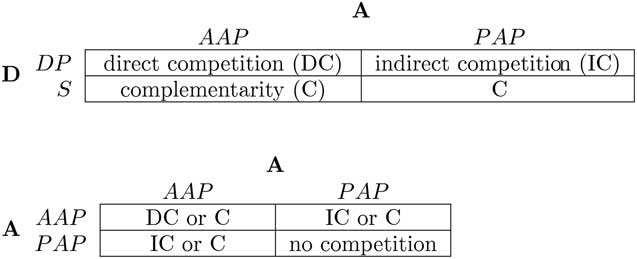
Figure 1 shows all possible cases of competition.Footnote 15 The (D-A) panel shows four cases. If a democracy prioritizes democracy promotion, then the democracy and autocracy will compete, either directly or indirectly. Indirect competition can be defined as a situation in which country A, with its actions in country B, undermines interests of country C in country B, without the intentionality to do so. Hence, what discriminates the indirect competition from the direct one, is the lack of intentionality in the former, with respect to the latter. If a democracy prioritizes stability instead, then the democracy and autocracy complement each other, the recipient country being an autocracy.
Outcomes of competition between democratic and autocratic external actors competing in a third non-democratic country. A democratic external actor (D) puts emphasis either on democracy promotion (DP) or on stability (S). An autocratic external actor (A) puts emphasis either on active autocracy promotion (AAP) or on passive autocracy promotion (PAP).

The (A-A) panel shows three cases. The (AAP, AAP) case represents either direct competition or complementarity; the discriminant between the two could be the type of conditionality attached to the autocracy promotion. The (PAP, PAP) case highlights no competition as the two autocratic actors are doing ‘business as usual’. The third case, the (AAP, PAP) case [and (PAP, AAP) case by symmetry] shows either indirect competition or complementarity, with the type of conditionality that could affect the outcome.
The presented model is a stylized one. In general, there exists no strict dichotomy in the choice. Instead, the preference is on the emphasis (weights) in favor of democracy promotion or authoritarian stability, considering the characteristics of the recipient in a given period (e.g. Youngs, Reference Youngs2004: 424–425). One could consider more complex specifications, but this task goes beyond the needs of this paper, which aims to crystallize the intuition of competition between different actors in play, and to test it empirically.
Empirical analysis
Here I analyze to what extent the EU is a democracy promoter or stabilizer, and Russia and China are active or passive autocracy promoters. Then, after having fledged a clear picture about the three competing actors, I investigate the outcome for Belarus.
The EU
The initial rather positive paradigm in the relations between the EU and Belarus finished in 1994, when the newly elected president started to build up an authoritarian political regime through the constitution changes with the referenda in 1995 and 1996.Footnote 16 To protest against the autocratic developments in Belarus, all of the EU members and associated countries froze intergovernmental contacts with Minsk. Although the EU lacked a common strategy toward Belarus, it employed negative conditionality, seeking to change the authoritarian course (Bosse, Reference Bosse2012a).Footnote 17 As an answer to the policy of isolation, Minsk initiated a diplomatic conflict, by obliging European diplomats to leave immediately their residences, using the arguments of a necessary reconstruction of the buildings. The EU reacted with the introduction of entry sanctions for the Belarusian president and hundreds of state officials.Footnote 18 The entry sanctions were suspended in 1999 after an agreement on the diplomatic residences was signed.Footnote 19 Belarus, however, remained de facto politically isolated at the European level.
The policy of isolation did not bring any results but a further deterioration of relations. Hence, the EU revised its policy, by introducing a ‘step-by-step’ approach, which intended a ‘gradual resumption of dialogue with the Belarusian government and broader assistance, ending with full normalisation of relations’.Footnote 20 Normalization of the relations and the European (financial) assistance would have come, however, only after clearly identified steps toward democratization (see footnote 20). The EU policy was significantly supported by the Organization for Co-operation and Security in Europe (OSCE), which obtained permission to establish the Advisory and Monitoring Group and started to operate in Minsk.
As a result of the cooperation between the EU, the Council of Europe, the Commonwealth of Independent States (CIS), and the American NGO ‘International Foundation for Election System’, the ‘Technical Assessment Mission’ was created for the parliamentary elections in 2000.Footnote 21 Despite three technical conferences, the parliamentary elections did not meet the OSCE standards. The ‘European Troika’ decided to suspend the decision on normalizing relations until an improvement of democratic institutions would have occurred (see footnote 21). The ‘step-by-step’ approach proved to be ineffective.
The EU launched the ENP in 2004, and decided to include Belarus under the condition of conducting free and fair elections.Footnote 22 Nevertheless, Belarus has never become a full participant of ENP, and no ENP Action Plan for Belarus is in force.Footnote 23 Hence, the EU turned to a two-track approach (see footnote 20). On the official track, the EU has continued to use ‘sticks and carrots’, in which a full participation of Belarus in neighborhood projects and more financial assistance have been promised as rewards for democratic reforms. ‘Sticks’, however, have been applied more often, mainly in the form of open critics and suspension of official contacts. On the other track, the European Union has actively supported civil society initiatives (Van Elsuwege, Reference Van Elsuwege2010).
A further deterioration in bilateral relations came after the announcement of a referendum in 2004 that changed the constitution and allowed the possibility to run for the presidential office for an unlimited number of times. After the non-democratic presidentional elections in 2006, the EU imposed visa sanctions for the president and government officials, and froze their economic resources in Europe.Footnote 24
Since 2007, EU-Belarus relations have improved (e.g. Dura, Reference Dura2008). This fact coincided with the crisis in Belarus–Russia relations. The Belarusian regime, which for years obtained subventions from Russia in the form of cheap energy resources, had to face a significant increase in the gas price.Footnote 25 The decision to increase the gas price for Belarus, and to bring it close to the European market price was an unexpected one, which obliged Belarus to reconsider its relations with the EU (e.g. Silitski and Jarabik, Reference Silitski and Jarabik2009). Following the Belarus–Russia energy dispute, bilateral trade relations also significantly deteriorated, and Belarus was constrained to turn its foreign policy vector westwards. Belarus also distanced itself politically from Russia, by not supporting the Russia-Georgia war in 2008, and not recognizing Abkhazia and South Ossetia as independent republics. Pleased about positive developments in Belarus, culminated in the release of political prisoners, the EU suspended visa sanctions for high-ranked officials and the president for 6 months.Footnote 26 An EU delegation was opened in Minsk in 2008. On the wave of this apparent liberalization, Belarus was included into the EaP. Despite the lack of democratic progress, the EU demonstrated once again its readiness to cooperate, by extending the suspension of the application of the travel restrictions.Footnote 27 Inclusion of Belarus into the EaP did not have the expected impact on political developments, and in 2010 the foreign policy vector of Belarus turned to its traditional direction, toward Russia. Indeed, the gas and oil ‘war’ between Russia and Belarus was over, and the preparation for a Customs Union (CU) between Russia, Belarus, and Kazakhstan was ongoing.
The EU continued to underline that the execution of free and fair elections was a condition for future bilateral relations. The Ministers of Foreign Affairs of Poland and Germany, Radoslav Sikorski, and Guido Westerwelle, visited Belarus before the presidential elections in 2010, and promised assistance with €3bn in the case where the elections would respect EU expectations.Footnote 28 Indeed, the electoral campaign was relatively free, with many oppositional candidates approved for candidacy. However, the day of the elections was marked by a mass protest that was brutally cracked-down. As a response to human rights violations, the EU designated to almost 250 individuals a visa-ban and assets freeze (the number of individuals targeted by sanctions was broadened in January 2012). Assets of 32 Belarusian companies (regarded as funding sponsors of the regime) were also frozen, along with the imposing of an arms embargo (Bosse, Reference Bosse2012b).
Summing up, the EU has mainly relied on (positive and negative) conditionality, political isolation and economic sanctions as the main ‘top-down’ instruments of active democracy promotion in Belarus. The EU has demonstrated that it keeps its door open for a constructive and mutually beneficial dialog with Belarusian authorities.Footnote 29 To date, however, the benefits of remaining in power are too high for the Belarusian regime with respect to what the EU can offer.
Russia
Belarus and Russia are closely connected through numerous agreements, such as the Union State, CIS, and the CU, which eventually represents the first viable post-Soviet integration initiative (Dragneva and Wolczuk, Reference Dragneva and Wolczuk2012). Inspired by the example of the European integration, or as Cameron and Orenstein (Reference Cameron and Orenstein2012: 32) put it, ‘mimicking the EU’, the CU has far-reaching plans for the inauguration of a full-fledged Eurasian Economic Union in 2015, and elements of a competition with the EU are evident.
The integration process started to develop dynamically in October 2007,Footnote 30 setting up the CU only 3 years after the launching of the ENP. For Russia, the project of Eurasian Union is of crucial importance, as it was launched with ambitions to be an attractive alternative to European integration (Dragneva and Wolczuk, Reference Dragneva and Wolczuk2012). The CU is also an interesting alternative for Belarusian leadership, who is unwilling to accept the EU democratic conditionality. Belarus and Russia are also military allies. Both countries regularly conduct joint military exercises, and Belarusian service members are regularly trained in the military schools of Russia’s Defence Ministry.Footnote 31 Although the Union State of Belarus and Russia has remained mostly declarative, their integration in the military sector has advanced a lot, making the Union State look like a military alliance (e.g. Deyermond, Reference Deyermond2004).Footnote 32 Participation in the Common Security Treaty Organization (CSTO) – a military alliance dominated by Russia – gives Belarus an additional source of regime legitimation. It is acknowledged that military organizations might be a source of ideas and norms promotion (e.g. Ambrosio, Reference Ambrosio2008; Melnykovska et al., Reference Melnykovska, Plamper and Schweickert2012). It is difficult to estimate the actual or potential impact of the CSTO on the regime outcome of the participant states, however, no CSTO member is democratically ruled.Footnote 33
Russian leadership rhetorically supports Belarus on numerous occasions, for example by praising the quality and outcomes of parliamentary and presidential elections. An institutionalized tool for assessing the elections in the post-Soviet region is the Commonwealth of the Independent States-Election Monitoring Organization (CIS-EMO), which was founded in 2003 and boosted by Russian authorities (Popescu, Reference Popescu2006). Elections in Belarus have been subsequently approved and legitimized by the CIS-EMO, although they have been never recognized as free and fair according to OSCE standards (e.g. Fawn, Reference Fawn2006).
Besides political support, Belarus is largely subsidized by Moscow. The long-lasting relations between Belarus and Russia created a strong economic interdependence between both countries, though with an evident asymmetry in favor of Russia. Russia’s main economic leverages over Belarus are favorable subsidies (mainly low prices for Russian gas and inexpensive duty-free crude oil) and loans (Tolstrup, Reference Tolstrup2009). In 2012 Russian subsidies accounted for about 16% of the Belarusian GDP, which is about US$10bn.Footnote 34 Thanks to the Russian subsidies, the Belarusian president was able to secure a stable, though relatively low, well-being in the country, immunizing himself from Western pressures. However, Russia’s economic support is not unconditioned. Kremlin has often used the Belarusian dependence on Russian cheap natural resources as a tool for influencing the ruling elites and their political course. For example, three big gas disputes between Russia and Belarus took place in 2004, 2007, and 2010, with transit interruptions in 2004 and 2007, and supply shortening in 2010. Taking advantage of Belarusian political and economic isolation after the presidential elections in 2010, and a heavy economic crisis that hit the country in 2011, Russia’s state-owned natural gas extractor company Gazprom took over Beltransgaz, the Belarusian pipeline operator.Footnote 35 In exchange, Belarus received a US$3bn stabilization loan from the Eurasian Economic Community (EurAsEC).Footnote 36 Further loan tranches, however, were conditioned by the privatization of Belarusian major assets.Footnote 37 Such conditionality threatens the public legitimacy of the regime. Selling major Belarusian assets to Russian businessmen would weaken the sovereignty, on which Belarusian leadership has largely built up its foreign strategy discourse (Korosteleva, Reference Korosteleva2011). Losing assets (and future financial flows from the sold stocks) also means that the current authorities would not anymore be able to control the economy as they do, and consequently to rule the country. Indeed, the Belarusian system is founded on neopatrimonialistic practices and is characterized by the fact that the economy is embedded into political practices (e.g. Pikulik, Reference Pikulik2012).Footnote 38
China
Due to few historical and cultural ties, Belarus and China do not have a long history of bilateral political relations, even though diplomatic relations were established already in 1992.Footnote 39 China’s policy toward Belarus is explainable by the concept of ‘charm offensive’, which is soft power in broader sense, including not only popular culture and public diplomacy but also more coercive economic and diplomatic levers like aid and investment and participation in multilateral organizations (Kurlantzik, Reference Kurlantzik2007: 6). As the Chinese role in Belarus is relatively new, here I aim to compare Chinese economic envolvement with those of the EU and Russia. Russia is the largest trade partner of Belarus, followed by the EU. However, Belarus–China economic relations are growing.
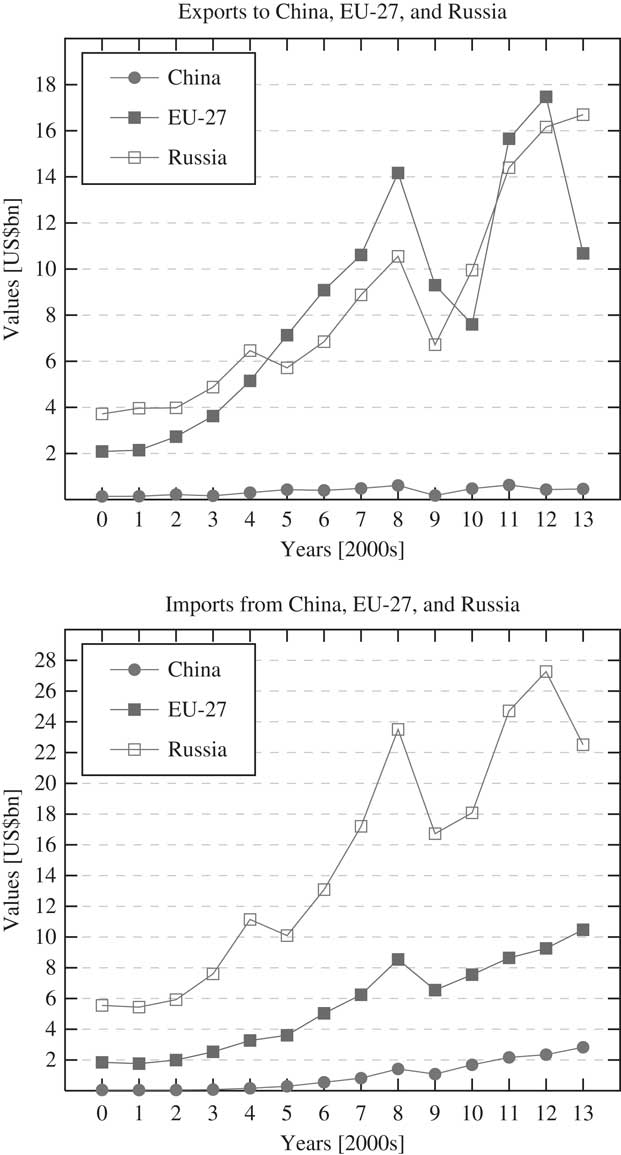
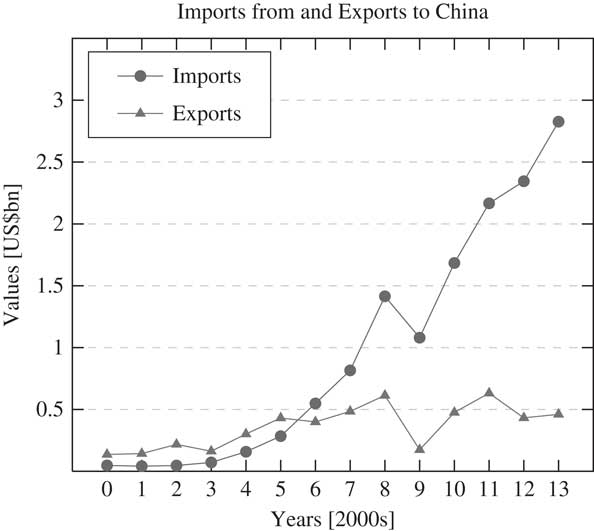
The Belarusian bilateral trade with the EU and Russia generally has a positive trend over time (Figure 2).Footnote 40 Trade with China has only a marginal role instead, given the large geographical distance between both countries and the low competitiveness of Belarusian products for the Chinese market. This (relatively) marginal role is further strenghtened by the peculiar geographical position of Belarus as a transit country for the Russian gas, and a reseller of oil products produced from Russian oil. However, although exports to China remained low since 2000s, there is an evident rise in imports from China (Figure 3), given the conditionality of Chinese loans to buy Chinese products. This type of conditionality, together with the important recent loans, are likely to imply a fast growth of bilateral trade (mainly Belarusian imports of Chinese products).
Bilateral trade flows between Belarus and the three competing actors (China, EU-27, and Russia). Source: UN ComTrade database (http://comtrade.un.org/db). Note: annual data; values in US$ billions; harmonized system (HS) as reported; all commodities; values for EU-27 as the sum of bilateral trade flows between Belarus and EU-27 member countries; Belarus as reporting country.

Bilateral trade flows between Belarus and China. Source: UN ComTrade database (http://comtrade.un.org/db). Note: annual data; values in US$ billions; harmonized system (HS) as reported; all commodities; Belarus as reporting country.

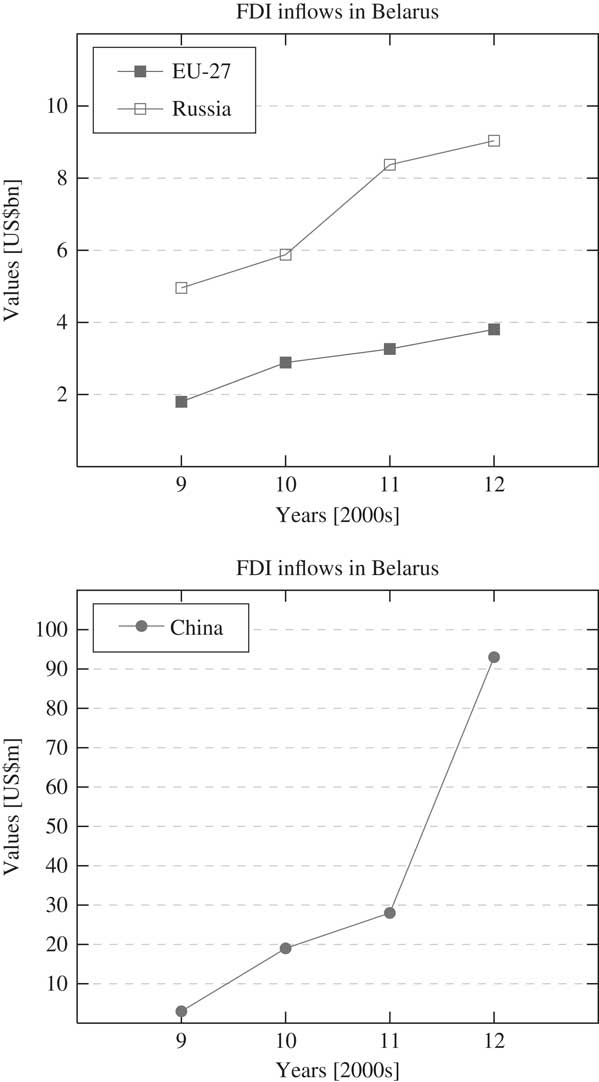
China has started to increase its economic ties with Belarus in the last decade, by increasing investments in the Belarusian economy.Footnote 41 Figure 4 shows, as already highlighted for bilateral trade, that China is a minor investor when compared with Russia and the EU.Footnote 42 However, the relatively fast growth of Chinese direct investments is evident. Moreover, many important projects with the Chinese capital are planned for the near future, as described below.
Foreign direct investment (FDI) inflows in Belarus from the three competing actors (China, EU-27, and Russia). Source: IMF, Coordinated Direct Investment Survey (http://cdis.imf.org). Note: annual data; values in US$ billions for EU-27 (sum of FDI inflows from EU-27 member countries) and Russia, and in US$ millions for China; time span restricted to the availability of data; Belarus as reporting country.

Korniyenko and Sakatsume (Reference Korniyenko and Sakatsume2009: 16–17) conclude that China invests in transition regions for five motives: (i) to seek foreign markets, (ii) to seek efficiency (lower-cost labor and lower-cost locations), (iii) to seek resources, (iv) to seek strategic assets (brand names and new technologies), and (v) to diversify. New markets and diversification could be important factors in driving Chinese economic rationale when investing in Belarus. Indeed, Belarus hopes to attract Chinese investments through ‘highly qualified and relatively low-cost labor force, advantageous geographical position’,Footnote 43 and membership in CU, opening the entrance to Russian and Kazakhstan markets. Chinese capital is more than welcome in Belarus, which is looking for resources to restore its economy and to modernize industrial sectors.
The financial crisis has intensified the relations between both autocracies. Belarusian president proclaimed: ‘We will always remember that our Chinese friends stretched out a helping hand to us in times of crisis’.Footnote 44 Indeed, in 2011, when Belarus was affected by the heaviest financial crisis since its independence, and was refused an International Monetary Fund (IMF) loan, China provided Belarus with loans worth about US$1.5bn for implementation of joint projects. It happened against the background of deteriorating relations with Russia, after Belarusian refusal to recognize Abkhazia and South Ossetia,Footnote 45 that led to an overall tension in relations with Moscow.
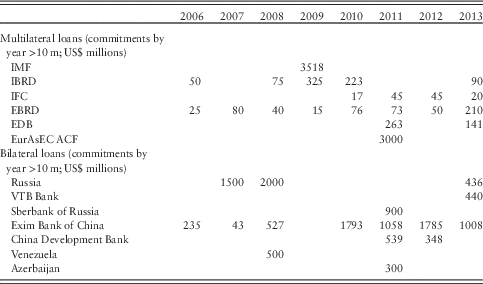
Table 1 shows that Russia is the main creditor of Belarus (besides relevant energy subsidies). The Russian role in financing Belarus is strengthened by the financial help of the EurAsEC ACF, in which Russia contributes with over 88% of total capital.Footnote 46 Other relevant, though minor, loans come from two important Russian banks (Sberbank of Russia and VTB Bank) and the Eurasian Development Bank. Financing from Western donors is of small magnitude, instead (the major Western loan in the recent years is the one worth US$3.5bn by the IMF). The recent Chinese loans, provided by two institutional banks in China, are comparable, in magnitude, to the Russian ones.Footnote 47
Foreign providers of main loans to Belarus over the recent years

Source: IMF=International Monetary Fund: http://goo.gl/6v3jTd; IBRD=International Bank for Reconstruction and Development: http://goo.gl/NFISCL); IFC=International Finance Corporation: http://goo.gl/ivuezD); EBRD=European Bank for Reconstruction and Development: http://goo.gl/ivuezD); EDB=Eurasian Development Bank: http://goo.gl/jgIuqY); EurAsEC ACF=Eurasian Economic Community Anti-Crisis Fund: http://goo.gl/Qrvtxh); Russia (http://goo.gl/aX62nI, http://goo.gl/s8PyF0), VTB Bank (http://goo.gl/aX62nI) Sberbank of Russia (http://goo.gl/eYikJn), China (http://goo.gl/aX62nI, http://goo.gl/wKb0Rg, http://goo.gl/K4IHDp, http://goo.gl/Gu3VB8, http://goo.gl/5472kH, http://goo.gl/2qPVOe, http://goo.gl/x0FohR, http://goo.gl/31vpS1, http://goo.gl/Nq4Ldt, http://goo.gl/IbYgug, http://goo.gl/MLIOXB, http://goo.gl/WD5Xy9, http://goo.gl/YYsnQE, http://goo.gl/gyaZns), Venezuela (http://goo.gl/eTDGAe), Azerbaijan (http://goo.gl/EFSRqE).
Note: annual data; values in US$ millions; medium- and long-term public and publicly guaranteed external debts; author’s own calculations.
In 2013, the two countries signed a joint declaration establishing an all-round strategic partnership.Footnote 48 In July 2013, when the Belarusian president visited China, a package of documents on the implementation of projects in energy, construction, industry, and road transport infrastructure were signed, worth US$3.5bn.Footnote 49 China will also invest US$5bn in a joint Belarus–Chinese industrial park in a strategic geographical location (near the Minsk international airport) occupying an area of about 80 square kilometers.Footnote 50 In this park investors can benefit, for example, from low personal and corporate income taxes, exemption from customs duties and VAT, and a free customs zone within the CU.
Chinese loans are with low-interest rates. However, most of them are tied to projects for buying Chinese goods and hiring Chinese contractors (see footnote 50). For example, China participates in the construction of the first Belarusian nuclear power plant, which should, at least partially, reduce the energy, though not the economic, dependence on Russia.Footnote 51 The Export–Import Bank of China granted $323.817m preferential-rate loan for the construction of the power grid linkup for 2013–2018. North China Power Engineering Company was chosen at the restricted participation tender among Chinese companies as the general contractor for this project.Footnote 52
To date, economic ties between both nations evidently prevail over political ones.Footnote 53 This fact is convenient for Belarus, which does not plan to voluntarily conduct any political liberalization that might threaten the current regime. The Belarusian president paid official visits to China in 1995, 1997, 2001, 2005, 2008, 2010, and 2013. Chinese high-ranked delegations officially visited Belarus in 1995, 1996, 2000, 2001, 2007, 2009, 2010, and 2011.Footnote 54 The then Belarusian Prime Minister Myasnikovich claimed in a meeting with the Chinese ambassador: ‘Our bilateral relations have gained scope. [...] We feel the support of Great China on the international arena’.Footnote 55 After the presidential elections in 2010, and the brutal crack-down of protests, China was one of the few countries that congratulated Belarusian leader for the re-election.Footnote 56 An additional proof of increasing political ties is the fact that Belarus joined the Shanghai Cooperation Organization as a dialog partner in 2010.Footnote 57 Belarus is the only European country with a dialog partner status in this Asia-dominated security organization, which is already actively supporting authoritarian stability among its members (Ambrosio, Reference Ambrosio2008). This status provides Belarusian authorities with an additional source of legitimation.
Belarus and China are also constantly augmenting military and military-technical cooperation. Joint Belarusian–Chinese military exercises were held in 2011 in Belarus and in 2012 in China.Footnote 58 Both countries regularly organize training for military staff. Moreover, China donated over two dozen cargo carrier trucks to the Belarusian armed forces. In October 2013, the Belarus–China agreement on army exercises was ratified.Footnote 59 Whereas Belarus has similar agreements with the CSTO members, it does not have such a kind of agreement with NATO, even though Belarus takes part in its Partnership for Peace Program. Observing the current trends in Belarus–China relations, one can assume that the bilateral relations will strengthen in the future, giving China even more levers in Belarus.
China’s approach toward Belarus, as in other countries, relies on non-interference in internal political affairs.Footnote 60 A possible explanation for this Chinese approach might be that Beijing aims to prevent external pressures against its own critical internal issues (e.g. human rights and territorial disputes). Moreover, Belarus and China have agreed that no one may interfere in the internal political affairs of states using the human rights issue.Footnote 61 A joint declaration states that ‘the universal principle of human rights should be reconciled with the specific circumstances of each state. Each country is entitled to its own vision of human rights that agrees with the domestic situation and a country’s historical and cultural traditions’ (see footnote 61). In exchange, Belarus supports Beijing in the One-China policy, by considering Taiwan as ‘an inalienable part of China’s territory’.Footnote 62
The competition in play in Belarus
Here I summarize the outcomes for Belarus. I have focused on two types of external support: economic and political ones, which are important for domestic ruling elites. Economic support such as trade, foreign investment, and loans are crucial for keeping the economy stable. For Belarus, which for many years has had a growing economy among post-Soviet countries, the economic factors were key for legitimacy of the regime. Political support is participation in international economic and military organizations, and overall rhetoric support on crucial political issues.
The EU, as a positive external actor, deliberately tries to achieve liberal performance in Belarus and to counter Russian influence there. European financial assistance is important for Belarus, however, it cannot outweigh the size of Russian subsidies and Chinese loans, which are not conditioned by democratic reforms. Accepting the conditions in the current formulations, and conducting democratic reforms would threaten the persistence of the leading elites. An elite-ruled democratization is the least likely scenario. Neither, signs of any possible popular uprising are not evident. Nevertheless, Belarus has often declared its readiness to cooperate in sectors of mutual interests. One possible strategy for the EU might be to transfer norms of democratic governance through sectoral cooperation that would contribute to democratization (Freyburg et al., Reference Freyburg, Lavenex, Schimmelfennig, Skripka and Wetzel2009).Footnote 63
Russia and China are negative actors instead, who are strengthening the survival capacities of the Belarusian regime, though in different ways. I argue, in line with Vanderhill (Reference Vanderhill2012), that Russia intentionally supports the status quo in Belarus, promoting autocracy in an active way (i.e. in direct competition with the EU). Russia’s interest in preserving the status quo in Belarus is explained by the preoccupations about the possible diffusion effect, which may spread from neighboring countries to the Russian territory, in case they become more democratic (e.g. Ambrosio, Reference Ambrosio2009). Moscow also connects democratic neighbors with their NATO membership, and would not like to see military bases close to its borders (e.g. Vanderhill, Reference Vanderhill2012).
For Moscow it is important to show progress in its integration initiative, the CU. The default of the Belarusian economy would damage the image of a successful economic union, which was launched in opposition to the European integration and the EU neighborhood projects. As Dmitri Trenin, director of the Carnegie Moscow Center, noticed, for Russia under the presidency of Vladimir Putin, ‘international relations are first and foremost about competition’.Footnote 64 Indeed, in his annual address to the Federal Assembly in 2013, Putin pointed out the growing military, political, economic, and informational competition with ‘other power centers’ (see footnote 5). All of the aforementioned factors are to some extent important in shaping Russia’s activities in supporting and strengthening authoritarian leaders in its vicinity.
Russia offers aid in return for access to state-controlled strategic and profitable assets, which are crucial to the regime’s capacity of ensuring economic stability, on which the regime’s legitimacy hinges. Hence, the careful reader might wonder that Russia is undermining rather than supporting the Belarusian regime, by demanding access to such assets that guarantee the regime’s survival. Indeed, this line of reasoning is correct. What one should bear in mind, however, is the difference between the short-run effect of autocracy promotion and its long-run feedback effect. The benefits of Russian aid (conditioned by privatization of assets in favor of Russian stakeholders) for the Belarusian elites are concentrated in the short run and tangibly evident (viz., the remaining in power). However, the plausible and consequent future costs for the Belarusian current authorities of losing the control over the economy, as a result of being supported by Russia, are spread out over time. This dynamic process (ceteris paribus) of autocracy promotion relying on (Russian) ‘bad’ conditionality can be represented as a J-shaped curve, showing the likelihood that the legitimacy of Belarusian elites, which receive support from Russia, is weakened over time.Footnote 65 After a first rise in legitimacy, the feedback effect begins, due to the selling of national assets. Given that at a certain point there are fewer assets than the ones before support, legitimacy should decrease to a new level, lower than the original one. After a first complete loop, taking into account feedback effects, one can draw another J-shaped curve. For reaching again the original legitimacy level, stronger support should therefore be needed. Hence, this type of autocracy promotion creates a sort of dependence and addiction. Notice additionally that Russia might even unintentionally facilitate, in the long run, the EU’s attempts to democratize Belarus.
In the annual speeches addressed to the nation, Lukashenko has increasingly highlighted the importance of Belarusian sovereignty, multi-vector foreign policy, and diversification of energy resources and economic partners.Footnote 66 On the one hand, Belarus cannot significantly diversify economic relations with the EU due to the democratic conditionality. On the other hand, it still avoids a complete dependence on Russia. Against this backdrop, strengthening ties with China might be an escape for Belarus from the EU-Russia dilemma. In the case of Belarus, China does not have any intention to export to Belarus any model of a particular form of rule or to shape its political system. Nevertheless, China is supporting the Belarusian regime, by offering loans and investments on favorable conditions, as well as providing diplomatic support, without any strings attached that could be perceived by the Belarusian elites as harmful. Beijing does not openly articulate its position on the political regime in Belarus, and even supports Belarus on politically controversial issues. Hence, China is doing passive autocracy promotion, by non-interfering in internal political affairs, and supporting both economically and politically the Belarusian regime.Footnote 67 This implies that China is in indirect competition not only with the EU, but with Russia, too. Indeed, Russia has already voiced its concerns about Chinese involvement in Belarus on some occasions. For example, against the backdrop of a Belarusian–Chinese joint venture assembling Chinese cars, the Russian ambassador to Belarus, Aleksandr Surikov, has declared that Russia would not welcome the assembly of Chinese automobiles in Belarus.Footnote 68 China is increasing its economic levers in Belarus. Even when investments in the Belarusian economy will not bring an immediate profit, China has far-reaching plans in securing its own economic interest in Europe. Belarus might become a launch pad into the EU market for Chinese products and a manufacturing springboard between the EU and Russia.Footnote 69 Having Belarus as a partner, China secures its own geopolitical and economic position on the European continent where it was rather under-represented, because it previously focused on other developing regions. It appears clear that China is an advantageous partner for Belarus, and adds an important dimension to the EU-Russia competition issues. Unlike the EU, it does not bind financial aid on democratic conditionality. Neither does it pretend to own Belarusian strategic assets as Russia does. Hence, China indirectly competes not only with the EU’s but also with Russia’s aims in Belarus.
What has been described as the EU vs. Russia and the EU vs. China competition in Belarus are examples of the (DP, AAP) and (DP, PAP) cases of the developed model, respectively.Footnote 70 Yet, the Russia vs. China competition is an example of the (AAP, PAP) case.
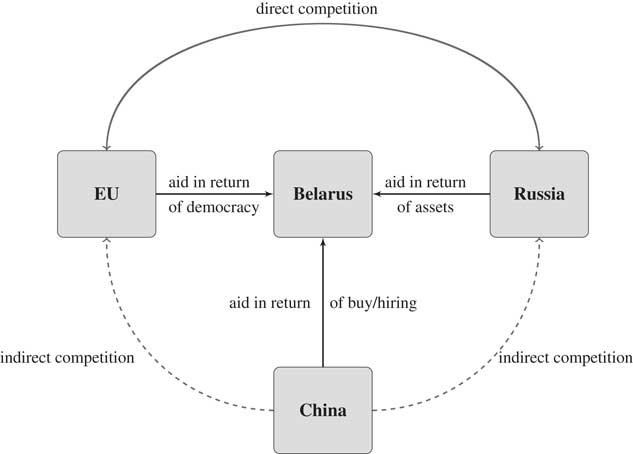
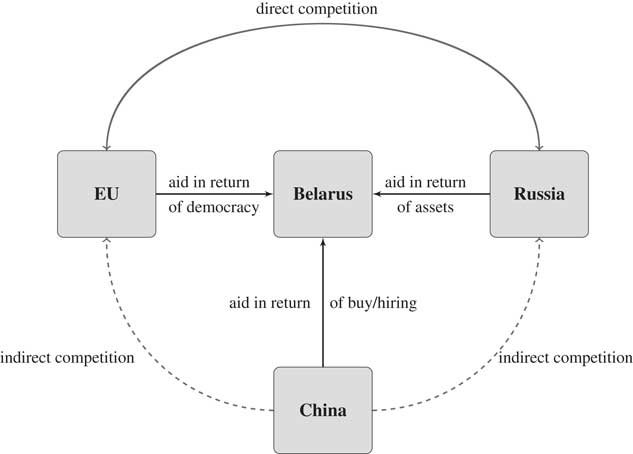
To sum up, the EU provides aid only in exchange for the promise of democratic and economic reforms, which might be very costly and danger the persistence of ruling elites. Russia, at the same time, offers economic and diplomatic support to Belarus, which is, however, conditioned by privatization of the Belarusian strategic assets in favor of Russian stakeholders.Footnote 71 For Belarus, whose leadership still enjoys legitimacy by a large part of the population due to the economic stability, losing major state enterprises might weaken sovereignty and, in turn, public legitimation, which is still important to them. Thus, diversification of economic partners is of crucial importance for Belarus. I have argued that Belarusian ruling elites have found an escape way from the cross-conditionality of the EU and Russia, by increasing linkages with China, though the majority of Chinese loans are tied on projects with Chinese goods and contractors. Hence, Chinese investments and loans help to keep the economy stable and to guarantee the sustainability of the regime. Figure 5 resumes, in a stylized way, both economic and political relations among the four actors in play.
The good, the bad, and the ambitious compete in Belarus.
Concluding remarks and policy recommendations
The EU democracy-promotion capacity has been decreasing after the Eastern enlargement. For many Soviet Bloc countries, the EU was an important center of gravitation. Having the EU accession perspective on the horizon, many countries of Central and Eastern Europe have undergone a process of peaceful democratic transition and joined the EU ‘club of democracies’. However, Belarus had a different developmental path, never articulating its ambitions for a possible EU membership, therefore remaining a special case among Eastern European countries. For Belarusian authoritarian elites, the incentives offered by the EU are scarce. Punishments, such as sanctions or political isolation, have not achieved significant positive changes, or more openness from Belarusian authorities. Political conditionality does not work in Belarus due to the high adoption costs for the political regime. Nevertheless, the EU remains committed to promote democratic forms of rule in Belarus. The perspective for democratization in Belarus is further complicated by the growing importance of China and Russia. The influence exercised by these countries has been captured by the concepts of active and passive autocracy promotion, which might represent an important competition factor for the EU in its Eastern neighborhood.
I do not claim that external autocracy promotion is the only factor responsible for the authoritarian regime outcome in Belarus. Preemptive measures taken by the regime to hinder bottom-up democratization, as well as the absence of a strong opposition, are undoubtedly important factors accounting for the authoritarian persistence. However, as Geddes (Reference Geddes1999: 125) stresses, ‘even very coercive regimes cannot survive without some support’. In cases like Belarus, where the political regime is still supported by a large part of the population, additional legitimation from great powers makes it much less vulnerable to the democratic pushes of Brussels. On the one hand, taking into consideration the economic wealth and geopolitical ambitions of both Russia and China, one might suggest that their support for authoritarian countries is not likely to cease in the near future. On the other hand, the EU relies on normative instruments in its foreign policy, which are strongly related to democratic performance. For Belarus, which is not willing to comply with the EU democratic conditionality, the normative dimension of the bilateral cooperation is not appealing.
Hence, the EU policy makers ought to reconsider their strategies of democracy promotion in Belarus. A better knowledge of the exact strategies of autocracy promoters would help the EU to develop more tailor-made strategies for every country in order to counterbalance the existing autocratic pushes from outside. In the light of the afore-described current situation of political competition in Belarus among the EU, Russia, and China, one could offer some possible policy recommendations. I believe that if the EU seriously aims to prevail over Russia’s and China’s autocracy support, then it should consider what Belarusian elites like of Russia’s and China’s support. At the same time, the EU should refrain from calling for what Belarusian elites do not like (i.e. a very stringent conditionality). More explicitly, (i) the EU should offer aid of a more consistent magnitude, as Russia does; and (ii) the EU should not link aid to comprehensive democratic and liberal reforms, whose accomplishment is rather unrealistic under current circumstances (viz., the lack of stringent conditionality is what makes China appealing to Belarusian elites).Footnote 72 After all, it is Europe that aims to export democracy in Belarus, not Belarusian current elites that are keen on importing it.
The EU democracy promotion is rhetorically ambitious. However, the EU lacks capabilities to shape the Belarusian regime, without an internal democratization process in progress. Democratic reforms, by definition, would undermine the Belarusian regime. Hence, the approach of the EU does not have to frighten Belarusian elites, who might fend against the direct overtures of the EU. This means that the EU should, in some way, imitate what China is doing: providing consistent aid in exchange for developing further economic relations. A more promising way to proceed could be increasing investments (to modernize infrastructure, too) in Belarus and joint ventures with Belarusian enterprises. Increased sectoral cooperation would raise linkages on which the EU could lever in the future, even after the regime change. This ‘Trojan horse’ process is more time-consuming and needs more patience, but may be more effective than the one pursued thus far. There will be few differences with China in the short run, with the EU paradoxically bolstering the regime, though indirectly only (e.g. backing Belarusian enterprises). In the long run, however, when the EU understands that the linkages with Belarus are mature and ready to be used as leverages, it can start to call for liberal reforms (i.e. stimulating but not provoking the regime). The EU has to put Belarusian enterprises on a path in which they will find it advantageous to liberalize the country in the future (i.e. the need for liberalization should endogenously emerge in the country). Yet, given the neopatrimonialist nature of the Belarusian regime, this (economic bottom-up) approach will be able to raise not only economic ties, but political ones, too. This approach should also involve lower trade tariffs, visa liberalization, and stronger support for the civil society. The EU might also take advantage of the already established economic ties of China with Belarus as a launch pad. Therefore, the EU should try to develop economic and commercial ventures with China in Belarus, pushing for its own rules of the game, to counter Russia’s attempts to influence Belarus.Footnote 73 After all, the proverb ‘if you cannot beat them, join them’ is not so unfitting in this competitive context, at least to avoid that the direct competitor, Russia, will beat the EU to the punch. These policy recommendations might sound as provocative, but I hope that they will encourage more research and debate over this topic.
The model developed in the theoretical framework is stylized and general. These characteristics allow going beyond the single analyzed case of Belarus, as well as applying and extending the analysis to other democracy and autocracy promoters. There are other countries worth studying with regard to democracy–autocracy competition (e.g. countries covered by the EaP). Moreover, it would be interesting to explore different autocracy promoters such as Iran, and other democracy promoters such as the United States. In addition, in the theoretical framework I have limited the model to the democracy–autocracy and autocracy–autocracy paradigms. However, one cannot exclude that a democracy could also compete with another democracy. Hence, it could be interesting to explore this additional paradigm, and to test its explanatory power by using other countries as case studies. These extensions go beyond the scope of this paper, leaving avenues for future research.
Acknowledgments
The author acknowledges the editors of this Review, five anonymous referees, and Rudy Colacicco for the useful and constructive comments that have greatly improved the quality of this paper. For valuable suggestions, the author also thanks Vera Axyonova, Daniel Göler, Rolf Friedrich Krause, and participants at the DAAD-CINTEUS Workshop (Fulda, Germany), at the Winter School 2014 ‘Europe in a Global Context’ (University of Padua, Italy), and at the Conference ‘Exporting Regimes? Interests and Strategies of Powerful States in the Post-Communist Space’ (Hertie School of Governance, Berlin). All errors are the author’s own. As pointed out by a referee, the title of the paper is suggestive but normative. However, the ‘Bad’ (Russia) may be ambitious; the ‘Ambitious’ (China) may be bad; and the ‘Good’ (the EU) may be ambitious. In the title, the author’s own perception (and the one of other scholars) of these political actors within the context relevant to this paper is highlighted.