It's like, if you have something good to say, you say it, but if you have something bad to say, just keep your mouth shut.
– Federico Thomsen, Chief economist, ING Baring’s office in Buenos Aires, 2001You will readily understand that in view of the aspect of affairs in the Argentine Republic, at present or for some time past, we have received numerous enquiries from our investing clients with respect to the government, city and provincial loans of that country held by them…We should be much obliged if you would favour us with any information in your power as to the present financial situation.
– Letter from Foster & Braithwaite, broker at the London Stock Exchange, to Baring Brothers, 1890I
On 16 November 1890, financial markets woke up to the news that one of the most respected merchant banks in the world, Baring Brothers, had overexposed itself by keeping a large amount of unsold and illiquid Argentine securities. It was only able to continue operations thanks to an international bailout orchestrated by the Bank of England, which injected a large amount of liquidity in order to prevent a banking panic that could have triggered an earthquake at the very centre of the international financial system, the City of London.
The Baring crisis of 1890 has been one of the major events in the history of international finance. It had international spillovers, as it occurred during one of the major periods of financial globalisation, also considered to be the first bond era of capital markets. This episode has been studied from a number of different perspectives, and now, after more than 100 years, it emerges once more as a reflection of the current crisis. Parallels can be drawn for a number of issues: it followed a major boom in international finance; financial intermediaries played a central role in originating and distributing a number of new securities into the markets including mortgage-backed ‘cedulas’; even though Lombard Street did sound the alarm and despite the associated macroeconomic risks, investors continued to pour capital into Argentina, the country in which the international crisis originated. Finally, the British authorities had to deal with Baring's near collapse. Baring Brothers was one of the most influential merchant investment banks in London and played an important part in the lending boom. As in most cases, this boom ended with a financial crash that caused sharp falls in international trade, foreign investment and economic growth.
One main difference with our current financial architecture is the array of services that banks such as Baring offered to their clients. In a world of strong information asymmetries and in the absence of rating agencies and international organisations, those banks were in charge of monitoring, pricing, securities issuing and other related activities. Therefore, they constituted important information producers; for this purpose they sent permanent representatives all over the world and even developed their own communication systems.Footnote 2
In addition, they were the first agents governments contacted when they sought funds in London. Though this dominant position in a financial sector offers a natural environment for scale economies, this also creates scope for conflicts of interest, and the Baring crisis may have been a consequence of this problem. This article analyses this episode from a microeconomic perspective, and attempts to contribute to the literature on nineteenth-century financial markets’ microeconomic structure. Finally, this article aims to improve the understanding of the Baring crisis. Previous studies have mainly dealt with macroeconomic issues and have left aside a number of important aspects related to investors’ continuous enthusiasm towards Argentina despite the warning signals. We focus therefore on the information level of investors and the behaviour of financial intermediaries. On the one hand, we describe, in detail, investors’ sources of information and what they published about Argentina. On the other, we analyse whether financial intermediaries properly monitored borrowing countries or whether some malfunction occurred during the lending boom. We look at whether financial intermediaries acted as ‘banksters’, hiding information on the solvency of Argentina in order to place additional securities and earn underwriting commissions, and whether this caused Argentina's over-indebtedness and led to its eventual default.Footnote 3 Was the Baring crisis a consequence of a strong conflict of interest faced by underwriters of Argentine securities; conflict which led to investors’ mistrust and the consequent sudden-stop of British capital exports to the rest of the world?
We proceed as follows. In the next section, we review the literature on the Baring crisis and on the economics of conflicts of interest in investment banking. In Section III, we demonstrate that there existed important information asymmetries among the leading underwriter, Baring, the other banks and investors. We find that investors could be aware of the deteriorating macroeconomic conditions in Argentina, but that for some reason this was not reflected in the prices of Argentinian securities. Moreover, we establish that Baring's main information advantage was the production of ‘soft information’ through its long-term relationship with Argentina and from direct communication with the government. In Section IV, we test the consequences of this information structure, and look for possible evidence of conflicts of interest and try to determine whether the most reputable banks played a certification role. Section V concludes.
II
Argentina became the favourite destination of European investors' capital during the 1880s. Economic growth had been impressive there since the previous crisis of 1876 (Cortés Conde Reference Cortes Conde1979; Della Paolera Reference Della Paolera1988; Cerro Reference Cerro2000), thereby attracting an increasing number of European immigrants. Exports were booming; agricultural profitability increased as a result of the discovery and conquest of new land, which in turn led to urban development and the construction of railways. Although Argentina had a bad debt service record similar to that of most other Latin American countries, it successfully managed to survive the 1870s world crisis and thus to disassociate itself from the rest of the region by becoming one of the few Latin American countries to avoid default. It also achieved a stable macroeconomic environment by controlling public expenditures, by channelling external funds to finance the construction of new infrastructure and by adopting the gold standard in 1882.
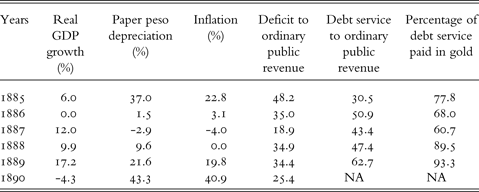
On the whole, however, this apparently prosperous economy was not as healthy as it seemed. Fiscal imbalances caused a short-term crisis in 1885 (causing fluctuations in the paper peso exchange rates, and prompting the country to abandon the gold standard), which marked the beginning of the debacle. The second half of the decade was, in fact, characterised by a deteriorating macroeconomic and financial situation – as shown, for instance, by Ford (Reference Ford1971), Cortés Conde (Reference Cortes Conde1989), Della Paolera (Reference Della Paolera1994) and Della Paolera and Taylor (Reference Della Paolera and Taylor2001). Some of the main indicators are presented in Table 1, in which the fiscal and monetary variables clearly show a deteriorating trend. Deficits grew and were financed through borrowing, at first, and later through monetary issues, which increased due to the free banking law introduced in 1887. This led to a sharp depreciation of the peso after 1888, creating a potential liquidity imbalance because most of Argentina's public debt was denominated in hard currency. In order to avoid debt servicing difficulties, the government introduced a 15 per cent export duty in 1885, increased its extraordinary revenues by selling state assets between 1887 and 1890, and decided to negotiate a new loan from London to support the short-term needs of the treasury.
Argentina's macroeconomic indicators
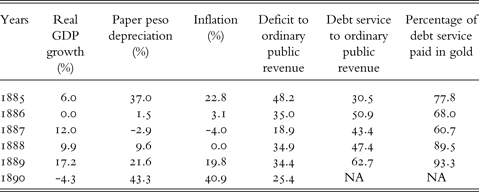
Sources: Della Paolera (Reference Della Paolera1988), Flores (Reference Flandreau and Zumer2004).
This situation did not deter foreign investors from continuing to bet on Argentina's economic miracle. Capital continued to flow into Argentina more than into any other Latin American country and reached a peak in 1888, two years before the crisis (Stone Reference Stone1999). Moreover, portfolio investment did not cease until political unrest and economic distress, including partial default in the first half of 1890, became known to all.
There is no consensus in Argentina's abundant historiography about whether Argentina's macroeconomic policy was inappropriate and whether its debt levels were sustainable in the long run. Ford (Reference Ford1962), for instance, argues that the Baring crisis was a ‘crisis of development’, as Argentina had to meet short-term debt service obligations, while the positive effects of investment projects on exports were long-term rather than short-term effects. He suggests that flows of capital in the 1880s were positive and necessary for the economic growth of the country. In a similar vein, Duncan (Reference Duncan1984) argues that although the government was perfectly aware that it could not avoid short-term default, it continued to borrow as part of a long-term development strategy. According to Duncan, the main victims of this strategy were investors.
Whether or not investors were aware that this situation would lead to a debt default is a different question. On the one hand, Wirth (Reference Wirth1893) argues that by 1886 investors already suspected that Argentina was over-borrowing. Joslin (Reference Joslin1963) notes that in 1888, the only reason the director of the London & River Plate Bank had to explain why funds continued to flow into the country was that the interest rates prevailing in England were low. Eichengreen (Reference Eichengreen1999) argues that the Baring crisis was expected. These authors agree with contemporary views. The general mood in the financial press, as we show below, was pessimistic. On the other hand, Argentina's long-term sovereign debt spreads over British consoles remained surprisingly stable during the years prior to the crisis – and only increased in the second half of 1890. Moreover, the last national government bonds issued in 1887 and 1889 continued to have long maturities – 1928 and 1926 respectively – suggesting that debt sustainability was taken for granted. These facts suggest three possibilities: first of all, investors did not expect a crisis, continued to believe in the Argentine miracle and underestimated the risk. This seems implausible given the amount of negative information in the press and in different economic publications (see next section). Secondly, there might also have existed a moral hazard problem, whereby investors were aware of the risk involved but continued buying Argentinian bonds because they expected Baring to act as Argentina's last resort lender, as it had done in previous defaults.Footnote 4 This also seems implausible, as the failure of issuers to place new securities on the markets was common in the late 1880s; in fact, these failures were at the origin of Baring's liquidity problems. Thirdly, secondary market spreads did not only reflect investors’ expectations about an incoming crisis. Evidence from the press, banks’ archives and historians’ works shows, for instance, that banks supported prices so that the market would remain stable and they could continue introducing additional issues.Footnote 5 Moreover, the effect of banks’ identity, their reputation and expected behaviour (such as a potential conflict of interest) must be taken into account in the analysis of sovereign risk.
Financial intermediaries provided an array of services to countries looking for external funding in European financial markets, and were paid fees for each service, including an underwriting fee that depended on the risk involved and the distribution and market placement used.Footnote 6 But they also played the role of rating agencies and could advise investors about the best investment opportunities (Flandreau Reference Flandreau2003). They were considered as a source of information to ordinary investors or as a press agency, as specific relationships developed with borrowing governments, and so financial intermediaries had the possibility of communicating information that could be relevant to investors. This created scope for a conflict of interest, which could only be resolved through the market mechanism as this was a repeated game and reputation mattered. Flandreau and Flores (Reference Flandreau and Flores2009) capture this fact in the extreme case of the 1820s, where the most reputable banks (measured as those with the highest capitalisation and market shares) were also those whose issues defaulted least. In their model, a highly reputable bank had no reason to exploit its informational advantage, as any bad choice would impact on its reputation and consequently on its market power. On the other hand, financial intermediaries with a low market share and no reputation to defend are prone to exploit their information advantage (selling bad securities as if they were good).
Nevertheless, market discipline alone cannot prevent conflicts of interest even among prestigious banks. We have reasons to believe that prestigious banks could, under certain circumstances, have incentives to take higher risks; and a sudden increase in competition would be the classic example (Bolton, Freixas and Shapiro, Reference Bolton, Freixas and Shapiro2007). Flores (Reference Flores2004, Reference Flores2010) suggests that this was the case in the 1880s.Footnote 7 In other words, the leading bank had the incentive to decrease monitoring costs or to enter into more aggressive competition or both. Negative externalities would emerge, affecting financial markets in general and investors in particular.
The extent to which the conflict of interest affected London's late nineteenth-century financial market has never been systematically tested. However, banking historians have already dealt with ‘reputation’ and the prominence of private banks such as the ‘Sixth great power’ (for Baring, Ziegler Reference Ziegler1988) or ‘The World's banker’ (for Rothschild, Ferguson Reference Ferguson1998) and their impact on capital markets. This system seems to have failed during the 1880s, as the contemporary press suggests. The general impression was that underwriters had adopted irresponsible management practices and sought to deceive investors. To quote but a few examples, The Economist commented on 22 November 1890: ‘Had Messrs Baring Brothers been able to shift the burden of their South American obligations upon the investment they would now have been standing erect … it must be admitted that they did not neglect to use all the means in their power to rid themselves in this way of their liabilities.’ On the same day, The Speaker came close to arguing that Baring had hidden information about Uruguay's level of floating debt (that country also defaulted), as otherwise the loan it had issued on behalf of that country ‘would probably not have been a success’. Some days later, The Economist severely concluded: ‘while the name of a well-known house must and should always be of value, it has never been an index to the permanence of a country's solvency, and we should learn to accept it for what it is worth, and no more’.Footnote 8
III
Ferns (Reference Ferns1960) differentiated information levels for investors and financial intermediaries, and concluded that the former depended to a large extent on the latter. In his description of how information flowed, Ferns emphasises British investors’ low level of information. According to him, investors neither knew nor had the means to know how the money would be used. Any investor eager to increase revenues could make decisions based on personal experience and invest in any asset that had already proved worthwhile. Financial intermediaries had a key role in recommending (or merely signalling via underwriting activities) particular investment choices. The names of Baring Brothers, Murrieta and other big banking houses meant much more to investors than abstract countries. The banks’ decision to enter Argentina's market served as a ‘certificate of confidence’ and thus as a substitute for knowledge, initiative and enterprise.
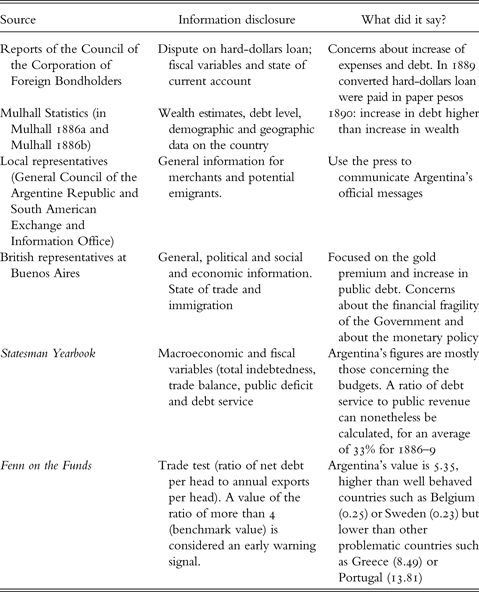
In the 1880s, however, there were means available to obtain accurate information about the economic situation of Argentina. Table 2 shows the main sources of economic and general information available to investors. In addition to private information which individuals could obtain through particular activities such as trade or migration, there were also the reports of the Council of the Corporation of Foreign Bondholders (CFB), the Mulhall Statistics, local representatives’ reports, the Statesman Yearbook, Fenn on the Funds, official documents and the press. However, these publications raised other questions. The CFB was mainly concerned with defaulting countries and did not publish any information regarding the general macroeconomic position of other borrowing countries. Rather, it collected ‘press clips’ and bought the official publications that contained all information relevant to investors. Still, the most detailed charter on debt figures about Argentina is published in the CFB report of 1890.Footnote 9 The Statesman Yearbook often published budget figures only, and realised data on debt, deficits or prices were not systematically provided. Even the main sources, the Memorias from Argentina's Ministry of Finance, were flawed due to a number of accountability ambiguities (Duncan Reference Duncan1984), and their publication appeared several months after a year's end.
Sources of information, other than official publications

Source: See text.
Table 2 also summarises what we mentioned earlier: these sources were pessimistic about the future of the country. Perhaps the most trusted source of information about Argentina's economic state at the time was Fenn on the Funds. It presented new calculations that took into account the wealth of the country – in a context where no GDP figures were available – and the interest rates on its debts, and published an indicator of debt sustainability. This indicator excluded the revenues earned from investments financed with loans. This amount was capitalised at a rate of 5 per cent and divided by the population (i.e. it was a per capita indicator). Fenn also measured the exports per capita in order to obtain a wealth indicator, although the publication recognised that this measure was far from a perfect ‘proxy’ for the wealth of a country. We looked at the resulting indicators for several countries in 1889. Argentina's indicator is 5.35. This debt/exports ratio is higher than that of ‘well-behaved’ countries (Belgium, 0.25; Sweden, 0.23; see Flandreau and Zumer Reference Flandreau and Zumer2004) but lower than that of the problematic countries of that period (Greece, 8.49; Portugal, 13.81). Argentina's ratio is also higher than that of South American countries in a comparable situation, such as Brazil (4.63) or Chile (1.12). Besides, Fenn's compendium gave a threshold of 4 to classify countries with possible indebtedness problems and Argentina was clearly on the wrong side of that threshold.
The banks had different levels of information and for this reason one cannot generalise. However, one bank – Paribas – competed with Baring for loan business in Argentina, and was representative of the new banks that entered the Argentine market in the 1880s. For the years 1879 and 1881, we found several reports in the archives that aimed to inform the director of the bank about the economic situation in Argentina and about the loans contracted by the country.Footnote 10 The reports pointed out the characteristics of the loans, the banks that issued them, the amount and the price of the bonds already in the market, the purpose of the loans and the guarantees for each of them. The bank made use of commercial houses in Buenos Aires in order to obtain information about the state of the market and to negotiate potential new loans for the government. In the 1880s, Bemberg was an intermediary between the Argentine government and the bank.Footnote 11 It sent telegrams (when a loan was negotiated) or more detailed letters about the financial movements and the country's state of affairs.
This bank possessed all the information necessary to decide whether or not to make a loan issue. It maintained a constant communication with other banks and with Bemberg. The letters, however, were only concerned with each loan or advance, and they frequently discussed market conditions for each new issue. At the same time, Bemberg was in charge of informing the bank about the movements of any potential competitor for new loans. When, after 1885, Paribas was restricted to the business of provincial loans, the only information the group obtained about Argentina concerned the provinces with which the bank did business.
Thus, we suspect that the information these banks obtained was at best imperfect, or, at worst, non-existent. For instance, in 1888 a syndicate formed by the Bank de Paris et des Pays Bas took firm a new loan from Cordoba province.Footnote 12 The loan terms were relatively favourable to the provincial government; they gave various guarantees, such as the shares of the Provincial Bank of Cordoba, and the dividends of the Mortgage Bank of the province, which were to be created with the funds from the loan, and the revenues of the province. But, as the correspondence between the different banks that participated in the syndicate reveals, the banks were unsure of the reliability of the guarantees. In a letter addressed to the governor of the province, dated 10 April 1890, the banks requested information about the revenues of the province, and the loan guarantee amount. The province defaulted on its debts eight months later.
Baring's level of information is best understood by examining the history of the relationship between this bank and Argentina, which has been described by historians such as Ferns (Reference Ferns1960, Reference Ferns1992), Jones (Reference Jones1972) and Ziegler (Reference Ziegler1988). These works describe in similar terms the origins of the long-term relationship between Baring and Argentina since the country got its first loan in 1824. As Argentina defaulted on its debt in 1828, Baring, unlike other banks involved in Argentine affairs, was the only one to defend the interests of investors, succeeding eventually with an agreement in 1857. This necessary relationship with Argentina's governments constituted its first source of information. Baring pursued this agreement not for the benefit of Argentina or even of the affected investors; it acted in its own interest to defend its reputation. Ziegler argues that in order to remain trusted Baring had to guarantee the revenues of investors. In fact, after 1857, eight years passed before Baring decided to issue a new loan on behalf of Argentina. Even this minor issue (£0.55 million) was not a success, and Baring had to buy £0.2 million. Before the 1880s, Baring only participated in two additional loans, although sharing Argentina's market with two other British banks (Morgan and Murrieta).
Apart from loans and short-term lending, Baring was also one of the main participants in the financing of Argentina's trade, and operated through the commercial houses established in Argentina. Zimmerman, Franzier and Co., from 1856, and then S. G. Hale & Co., from 1873 and during the 1880s, acted as intermediaries between Argentina's government and Baring. All these activities provided the bank with information about Argentina's state of affairs.Footnote 13 During the boom of the 1860s and early 1870s, Argentine bonds were in high demand in London and many of them were issued by Murrieta and Stern. In this regard, Ziegler agrees with Ferns about the particular position of Baring as a well-regarded provider of information, both directly and through the involvement of the bank in new issues. In other words, Baring possessed the information (which was expensive to acquire), but the benefits had to be shared with newcomers. This situation was to explode during the 1880s.
An additional factor to be taken into account is the quality of information from the most important source, Baring's representatives in Argentina. In an apparently contradictory manner, this channel was important and efficient during the 1870s, but then worsened in the 1880s, precisely at a time when it was the most necessary. A detailed examination of the Baring Archives reveals that most information Baring possessed about Argentina in the 1870s and 1880s came from correspondence with Nicholas Bower, one of its employees sent to Argentina after the 1873 crisis, and from some messages telegraphed when important events took place. Bower's reports covered several aspects of the country: trade, prices, immigration, financial position, banks, natural resources, tradable assets and so forth. Bower also established an almost personal relationship with Argentina's government. We have found written reports containing the exact same statistics as those published three months later in the Memorias, with additional comments expressing Bower's own point of view and derived from conversations with Argentine politicians. Between 1877 and 1883 Bower provided Baring with a constant flow of information about the economic situation of the state of their investments, and opportunities for new business. Financial markets were aware that Baring had information, because the latter provided news through the press whenever an extraordinary event occurred or in times of uncertainty.
However, this situation changed in 1883 for several reasons. On the one hand, there was increased competition (Jones Reference Jones1972; Marichal Reference Marichal1984; Flores Reference Flores2004, Reference Flores2010). When new banks started issuing loans on the financial markets of Europe, the relationship between Baring and Argentina deteriorated. Jones wrote that ‘Bower was at great pains to point out to the National Finance Minister the serious loss which the government had sustained through dealing with the French.’Footnote 14 In fact, Ferns argues that Baring was willing to formalise its relationship with Argentina and thereby block the entry of any new competitor. In 1880, Baring insisted on an ‘open line of credit secured by saleable assets’ and demanded that the government agree to only deal with Baring for any new loan issue. Both requests were declined by Argentina. On the other hand, the relationship between Bower and Baring also deteriorated after 1883. Baring decided to close its agency in Buenos Aires and continued to operate only through Hale & Co. Bower continued to work with Baring but in a rather different way. From 1883, his reports became much less detailed and frequent than those he had provided between 1877 and 1883.Footnote 15 Still, Baring made a final attempt at the end of 1889, sending John Baring to report and evaluate Argentina's economic situation and in particular the projects in which the bank had direct interest (Ziegler Reference Ziegler1988). However, John proved to be a poor risk analyst. In fact, he wrongly concluded: ‘Of a crash, I think there is no chance whatever … Of their defaulting on their bonds I do not believe there to be the least chance.’Footnote 16
As the Baring crisis approached, telegrams between Baring and Samuel Hale became more frequent while they were negotiating a loan with the government to avoid default.Footnote 17 The main questions discussed were the conditions Baring wanted the government to meet (i.e. that the government pledge customs revenue and that payment be made half in gold). Both conditions were initially refused in Buenos Aires, but by mid 1890, at Baring's insistence, the government ended up accepting.
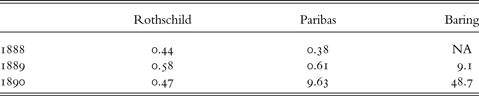
A final question concerns the fact that Baring went bankrupt in 1890 despite its information lead. Though there is no easy answer, looking at the stock portfolios of three banks – Paribas, Rothschild and Baring – enables us to see to what extent each bank was exposed to the ‘Argentine risk’ in the late 1880s.Footnote 18Table 3 shows that Baring held 9.1 per cent of its portfolio in Argentine securities in 1889 (excluding its participation in syndicates, which would increase the total to 48.7 per cent in 1890 as estimated by The Economist).Footnote 19 Neither of the other banks had such an amount, although Paribas's participation in syndicates amounted to 9.63 per cent in the same year. Rothschild, for instance, only held a small percentage of Argentina's securities. However, as the main underwriter of Brazilian securities, it held large amounts of these securities in its portfolio – about 8.9 per cent in 1889. After the crisis in 1892, Baring, again, held a comparable amount of Argentine securities (13.8 per cent). Though we cannot conclude that banks followed an unwritten ‘relationship banking rule’, whereby they held 10 per cent of their underwritten securities in their portfolio, we may safely assert that the banks that were the most affected by defaults were the ones that had close relationships with the defaulting countries. We therefore believe that in these cases there was little scope for a conflict of interest.
Portfolio of different banks, 1888–90 at end of year (figures include stocks and foreign bonds, market value from banks accounting books)
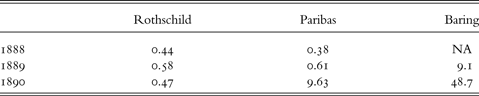
Sources: Rothschild: Stock Ledgers Bookkeepers Department, 1888-90. Baring: Baring ING Baring archives Ref. 101370. Balances, 1888, 1889 . For 1890: estimates from The Economist, 13 June 1891. Paribas: Archives Paribas, Portefeuille Siège Social.
IV
In a first set of tests we examine the effects of the reputation of different banks on the risk perception of investors in securities issued by these banks. Some works argue that investors take into account the fact that the less reputable banks have the most severe conflict of interest problem and the bonds they issue are therefore perceived as riskier. The more reputable banks have more to lose, and therefore the problem of conflict of interest is less severe. This first set of tests has two objectives. The first is to determine whether there is a difference between the ex-ante perceived risk associated with the bonds issued by the most reputable banks and that associated with the bonds issued by the other banks. The second objective is to establish whether these reputable banks acted as certifiers, which would reduce the cost of issuance of the bonds issued by these banks.
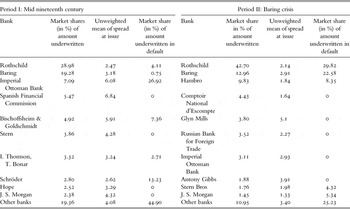
In Table 4 we present the league tables of sovereign debt underwriters and the spreads at issue per bank in the two periods, 1845–76 and 1877–95 (for comparison purposes, we have included the boom and bust period that preceded our period of analysis). We observe that, as contemporary records suggest, Rothschild and Baring acted as market leaders, both banks represented about half of the market in both periods. The unweighted average of the spreads at issue for Rothschild's loans is the lowest in the first period, and one of the lowest in the second. Baring follows as the second underwriter in both periods.Footnote 20 During the mid-century period, Baring's bond issue spreads were lower than other issues but high in comparison to the issues made in the second period. During the 1877–95 period, the spreads of issues from Baring were lower but the difference from the rest of the market is not very clear. Moreover, some banks were issuing loans that were perceived as less risky. In fact, it would be safe to assert that whereas during the mid-century period Baring differed from the other underwriters, this was no longer the case by the time the 1890 crisis occurred. We discuss this hypothesis in more detail below.
League tables and spreads at issue of top 10 underwriters, 1845–76 and 1877–95

Sources: See text.
A final remark on Table 4 concerns an ex-post measure, namely, the amount of defaulting bonds underwritten by each bank. Recall that in the absence of conflict of interest, reputable banks should also have better ex-post performances than the rest. Otherwise, we would be able to assert that underwriters fooled investors by bringing securities that were perceived as ‘safe’ but that performed badly. During the first period, Rothschild and Baring had a market share of 5 per cent of the total amount of bonds that later defaulted. The third bank, Imperial Ottoman Bank, concentrated about 26 per cent. This bad performance may explain why its market share dropped sharply during the second period. But the striking results concern the top banks’ performance in the second period. The ‘top three’ underwrote about 60 per cent of the bonds that were to default. The above mentioned criticisms made by the press were therefore not unjustified. Nevertheless, it would be premature to draw conclusions from this result. Those of Rothschild's issues that defaulted were mostly those of Brazil in 1898, that is to say 10 years after the initial issue. Rothschild itself organised a bailout that provided a high profit for holders of Brazilian bonds, as demonstrated by Flandreau and Flores (Reference Flandreau and Flores2010). Baring's Argentinian issues caused liquidity problems for the bank itself and it would therefore be irrational to assume that the bank consciously issued bad loans by selling them as good ones; but this will be discussed in the last section. Finally, defaults of the bonds issues from Hambro only concerned the Greek bonds, as otherwise this bank concentrated on the safe albeit small market of Scandinavian bonds. As we will see, Greek spreads at issue were also higher than the average spreads of Hambro's issues.
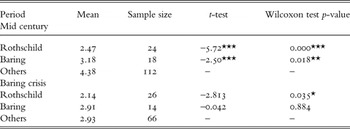
In order to formally test for differences between means of the spreads at issue, Table 5 compares the spreads at issue of Rothschild and Baring with spreads of bonds issued by other banks. The tests are the two-tailed t-test and the non-parametric Wilcoxon test.Footnote 21 Our null hypothesis states that there are no differences between Rothschild and Baring's spreads at issue and that of other banks. The upper part of the table shows the results for the first period. Rothschild issues are on average 191 basis points lower than issues from the rest of the market (excluding Baring). The difference is significant at 1 per cent for both tests. The difference between Baring and the rest of the market, which is 120 basis points, is also significant. Interestingly, these differences almost disappear in the second period. Between Rothschild and the rest of the market there is a difference of 79 basis points, and between Baring and the rest there is a 2 basis point difference. These differences appear to be insignificant, although the Wilcoxon test shows a 5 per cent significance for Rothschild. In other words, investors did not expect Rothschild and Baring issues to be less risky.
Univariate tests for differences in spreads at issue between the top two banks and the rest of the market

Sources: See text.
Note: *denotes significance at 0.05 levels, **at 0.025 levels and ***at 0.01 levels.
We have complemented this analysis by examining other variables affecting spreads: economic fundamentals and bonds’ particular characteristics (see the Appendix for a description of data sources). They include macroeconomic, fiscal and monetary variables, as well as variables measuring borrowers’ reputation (if the borrower had a previous default), as in previous studies such as those conducted by Bordo and Rockoff (Reference Bordo and Rockoff1996), Obstfeld and Taylor (Reference Obstfeld and Taylor2003), Flandreau and Zumer (Reference Flandreau and Zumer2004), and more recently by Cameron, Gai and Yong Tan (Reference Cameron, Gai and Yong Tan2009). Our analysis differs from previous works in that it looks at the primary market of bonds, and thus our dependent variable is spreads at issue. This allows us to take into account the second group of independent variables, such as the identity of the underwriter, the syndicate's size, whether or not it is a new issue, whether or not the bond is secured, and the number of years since the first issue by the borrower.
We estimate the following ordinary least squares (OLS) regression:

where fiscal variables (FiscVar) include the debt service to fiscal revenues ratio, the debt to GDP ratio, the public deficit to fiscal revenue ratio and the public deficit to GDP ratio. Monetary variables (MonVar) include a dummy variable that takes value 1 if the country has the gold standard and 0 otherwise; we also look for exchange rate volatility measured by the ratio between the standard deviation of the monthly nominal exchange rates to the sterling pound and its annual mean. The macroeconomic variables (MacroVar) include the inflation rate, exports to GDP ratio and a country's terms of trade measured by the deviation of log terms of trade from the panel mean. Reputation variables (RepVar) include an ‘age’ variable defined by the number of years since the first issue in London. It tests Tomz's (Reference Tomz2007) hypothesis that the seasoned borrowers have more favourable market access. The second variable is a dummy which takes value 1 if the issuer defaulted at least once and 0 for a clean defaulting record. Issue variables (IssueVar) include the characteristics of the new bonds: nominal amount, maturity, number of banks in the underwriting syndicate (syndicate size), the existence of a guarantee (through a dummy variable, 1 if the loan if secured, 0 otherwise).Footnote 22 Finally, the identity of the underwriter is captured in the bank variable (BankVar), with two dummy variables, one for Baring and the other for Rothschild.
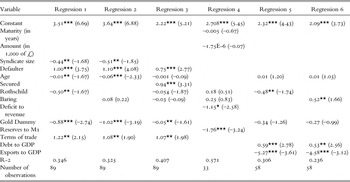
Table 6 summarises the main results. The estimates show that the group of economic variables (fiscal, monetary and macroeconomic) are significant and with the expected sign, with the significant exception of the terms of trade. Countries on the gold standard seem to enjoy lower spreads (the exchange rate volatility shows similar results but they are less significant and have been left out of the regressions in the table). The indebtedness level had a positive effect on spreads; furthermore, the governments of the more open economies also seem to have had more favourable access to capital markets.Footnote 23 The IssueVar group has mixed results, although the defaulter dummy was always significant and with the correct sign. The age variable also had the expected sign for some regressions, but not for all of them. The maturity and amount variables were not significant. Finally, the syndicate size variable was frequently significant.
Multivariate tests: OLS Regressions. Dependent variable: spreads at issue

Note: t-statistics in parentheses. *, ** and *** denote significance at 10%, 5% and 1% levels respectively.
Sources: See text.
The dummy variables for the identity of the underwriter also showed mixed evidence. Most regressions showed that the Rothschild variable did have a negative effect on spreads, though this was not consistent. Baring does not appear to have any significant impact on spreads. In fact, the inclusion of macroeconomic variables, as well as the default and age variables, minimises the importance of the bankers’ effect, although our sample size also decreased (due to data constraints) and the results are therefore less representative. Nonetheless, it is clear that there is a difference between Rothschild and Baring. The former seems to have a negative effect on spreads, albeit to a small degree. This is also consistent with the univariate tests, which show that spreads of Rothschild issues where lower, but the difference was not what it had been in the past. For our purposes, we may conclude that Baring had no ‘reputation’ or ‘certification’ effect. The bank was selling risky securities, just as the other banks did. Investors fixed prices according to the risk.
Underwriting fees: the case of the 1890 agreement
One way to know whether conflicts of interest existed in the late 1880s is to look at credit risk perception of financial intermediaries and investors. In normal, crisis-free times, spreads or securities risk premia should behave in a manner similar to underwriter fees. In times of ‘near crisis’, in a context of information asymmetries, this correlation breaks down and fees can react more rapidly than spreads.Footnote 24 The reason for this can be found in the vast literature on the factors determining underwriting fees.Footnote 25 They can be classified into three groups: bonds’ characteristics, underwriting's market structure (whereby competition reduces fees, see Gandes et al. Reference Gandes, Puri and Saunders1999) and credit quality. Previous studies have shown that the market for risky bonds is smaller and less liquid than the market for risk-free bonds, which makes their placement more difficult. In the event of default, the financial intermediary's reputation would suffer. Moreover, the higher the risk of a new issue, the more difficult it becomes to estimate the issue price; compensation is naturally required for the additional effort (Livingston, Pratt and Mann Reference Livingston, Pratt and Mann1995; Melnik and Nissim Reference Melnik and Nissim2006). Thus, underwriting fees and secondary market prices depend on the same variables: an economic shock may cause the prices of that country's bonds to fall. When a government presents a higher risk of default, the underwriters charge them higher fees on new issues ceteris paribus. Flandreau et al. (Reference Flandreau, Flores, Gaillard and Nieto-Parra2009a) show evidence about the long-term relationship between fees and spreads at issue in sovereign debt markets for the last 200 years and find a constant, negative relation between both variables.
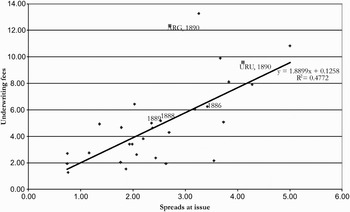
A final question concerns the mechanisms through which new information could have an immediate impact on spreads and fees. If information is public, then both variables should behave in the same way (though the elasticities of each variable to new events may differ). Now consider, for instance, the scenario in which a bank, willing to issue a new loan on behalf of the government of Argentina, suddenly receives a telegram from its agent in Buenos Aires about a new estimate of a higher deficit than previously expected. This is not a hypothetical case: as we mentioned above, figures about fiscal variables could take as long as three months to be published in the official Memorias or in the press. This negative shock may make the success of a new issue more uncertain, and the bank may therefore automatically adapt its underwriting fee to compensate for the increased risk, but would be unwilling to lower the issue price which would send a negative signal to the markets, thereby affecting secondary market prices and increasing the probability of failure of the new issue. This fact would be, per se, evidence of conflict of interest. In other words, selling risky securities is no evidence of ‘bad behaviour’ as long as there is a market for them. But selling risky securities as if they were good is a different story, and this explains why regulatory authorities have been interested in underwriting fees in later periods, when banks were suspected of inappropriate behaviour.Footnote 26 We have gathered data on fees – for the 1877–95 period – from debt contracts, archives and secondary literature. Sources are described in the Appendix. Figure 1 shows the positive relationship between spreads at issue and underwriting fees during the 1880s.Footnote 27 At first glance, Argentina does not seem to be an outlier.Footnote 28 But now, let us consider the case for the 1890 planned bailout. Two additional loans were negotiated – though eventually not issued – between Argentina, Uruguay and Baring as early as March 1890. The resulting debt underwriting fees were 9.6 for Uruguay and 12.4 for Argentina.Footnote 29 Both observations are outliers, and do not correspond to the normal relation between fees and spreads; for both observations, the fees were affected more rapidly by Argentina's bad economic situation. In other words, at the only time when Baring could have taken advantage of its information lead, the bank was overwhelmed by a wave of negative shocks (and publicly known) that lead to Argentina's accelerated collapse.
Underwriting fees and spreads at issue Sources: See text and Appendix.

V
An examination of the correspondence between Baring and its agents in Buenos Aires shows no evidence that Baring sought to hide information from investors. Instead, the correspondence suggests that Baring was confident that default could be avoided with the planned bailout. The conditions of the 1890 contract forced the country to modify its economic policy. Baring imposed three conditions: no further issues of paper money, until the gold premium reached a level of 140. The second was the prohibition of further borrowing from external sources for two years. Finally, half of the customs revenues had to be collected in gold pesos, reinforcing the government's capacity to service its debt.
From the analysis of the sources of information available to investors we also know that they could have known of the problems facing Argentina even though they had less information than banks. The tendency of financial intermediaries, however, was to send confidence signals by issuing new bonds as demand existed. This behaviour was motivated by a desire for short-term gains. Baring, in contrast, relied on a long-term relationship and had different incentives from those of competing banks.
The information model that prevailed at the time began to change in the early 1890s. Capital exports came to a ‘sudden stop’ during the 1890s, and the information structure began to change. The reports of the CFB began to be more detailed, other banks followed Credit Lyonnais's unit of analysis, and the financial press experienced a new boom. Argentina was excluded from capital markets for some years and Baring subsequently returned to business as the only merchant bank for the issues of the country's government, recovering its quasi-monopolistic position. Argentina did not experience additional crises before World War I. Nonetheless, even in this new context of increased information availability (and thus higher ‘transparency’), there continued to be financial crises throughout the world.
Appendix. Data sources
Primary market variables
(1) Bond data: the multivariate analysis of the ex ante tests of conflict of interest includes all the public offerings of foreign government sovereign debt on London excluding pure conversions (for which there was no price at issue). The complete list is taken from Suzuki (2004). That list includes data on nominal amounts and underwriters’ identity. It has been revised with data from the Investors’ Monthly Manual (IMM), The Times (London), Burdett's Stock Market Official Intelligence and debt contracts, from which we had data for prices at issue, maturity, underwiters’ syndicate size and bonds’ guarantees. A complete list since the beginning of the nineteenth century has been constructed with data from Clarke (Reference Clarke1878), CFB (1874) and the London Times with which we construct the variable age (number of years since first issue in London) and the dummy variable ‘New Borrower’, equal to one if the borrower issues for the first time a loan in London, 0 otherwise. The countries included in the list are the following: Argentina, Brazil, Bulgaria, Chile, China, Cuba, Denmark, Egypt, Greece, Holland, Hungary, Italy, Mexico, Nicaragua, Norway, Persia, Portugal, Russia, Salvador, Santo Domingo, Spain, Sweden, Turkey, Uruguay, USA.
(2) Spreads at issue: defined as the difference between the yield on long-term gold or sterling government bonds measured by the coupon-price ratio and the yield of UK consols (from Klovland Reference Klovland1994).
(3) Fees: China: HSBC Archives, Greece: Dritsas (Reference Dritsas1993), Japan: Suzuki (Reference Suzuki1994). Data on Norway's loans are from Klovland (Reference Klovland, Eitrheim, Klovland and Qvigstad2004) but we have excluded the first loan as data are not consistent with the issue price; data on Argentine, Brazilian and Chilean fees are from Flores (Reference Flores2004). Russia's fees are from Girault (Reference Girault1973) and from archives (Rothschild, Paribas and ING Baring). These archives were also used to obtain other fees for Italy, Portugal and Uruguay.
Macroeconomic variables
(4) Gold dummy variable: Flandreau and Zumer (Reference Flandreau and Zumer2004) for the period 1880-95 for the following countries: Argentina, Brazil, Chile, Denmark, Greece, Holland, Hungary, Italy, Norway, Portugal, Russia, Spain and Sweden. Otherwise: Meissner (Reference Meissner2005) and for countries that issued during 1877-9, Obstfeld and Taylor (Reference Obstfeld and Taylor2003).
(5) Volatility of exchange rate: Flandreau and Zumer (Reference Flandreau and Zumer2004) for the same countries and period than above. We have computed volatilities for exchange rates from the following sources: Chile from Flores (Reference Flores2004), otherwise Schneider et al. (Reference Schneider, Schwarzer and Denzel1997).
(6) Inflation: Flandreau and Zumer (Reference Flandreau and Zumer2004) and Obstfeld and Taylor (Reference Obstfeld and Taylor2003) as in (4). Chile: Braun et al. (Reference Braun, Braun, Briones and Díaz2000). Turkey: Schuler (Reference Kurt2010). Uruguay: Bértola (Reference Bértola1998).
(7) Reserves and M1: Flandreau and Zumer (Reference Flandreau and Zumer2004) for countries and period as in (4). Chile: Braun et al. (Reference Braun, Braun, Briones and Díaz2000).
(8) Deficits, revenues and public debt: Flandreau and Zumer (Reference Flandreau and Zumer2004) and Obstfeld and Taylor (Reference Obstfeld and Taylor2003) as in (4). Chile: Braun et al. (Reference Braun, Braun, Briones and Díaz2000). Mexico: Carmagnani (Reference Carmagnani1994). Uruguay: Bertino and Bertoni (Reference Bertino and Bertoni2004).
(11) Debt service: Flandreau and Zumer (Reference Flandreau and Zumer2004). Chile: Braun et al. (Reference Braun, Braun, Briones and Díaz2000). Mexico: Carmagnani (Reference Carmagnani1994).
(12) Nominal GDP: Uruguay: Bértola (Reference Bértola1998). Chile: Braun et al. (Reference Braun, Braun, Briones and Díaz2000). Otherwise Flandreau and Zumer (Reference Flandreau and Zumer2004) and Obstfeld and Taylor (Reference Obstfeld and Taylor2003) as in (4).
(13) Terms of trade: defined as in Obstfeld and Taylor (Reference Obstfeld and Taylor2003). The variable measures the deviation of log terms of trade from the panel mean. Source for the data is Blattman, Hwang and Williamson (Reference Blattman, Hwang and Williamson2004).
(14) Exports: same as (8).