



1 Introduction
The study of spectra associated with triangulated or stable
$\infty $
 -categories has played a central role in bridging abstract categorical structures with underlying geometry. Balmer [Reference BalmerBal05] introduced the tensor triangular spectrum
$\mathrm {Spec}_{\otimes }(T)$
 of a tensor triangulated category T, thereby providing a powerful framework for classifying thick tensor ideals. When
$T=\mathrm {Perf}(X)$
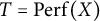 for a topologically Noetherian scheme X, the spectrum
$\mathrm {Spec}_{\otimes }(T)$
 recovers the scheme X together with its structure sheaf. More recently, Matsui [Reference MatsuiMat21, Reference MatsuiMat23] proposed a variant of the spectrum that applies to triangulated categories without tensor structures, thereby expanding the range of situations where spectra can be defined. It has since been further studied by Hirano–Ouchi [Reference Hirano and OuchiHO22, Reference Hirano and OuchiHO24], Hirano–Kalck–Ouchi [Reference Hirano, Kalck and OuchiHKO25], Ito [Reference ItoIto23, Reference ItoIto25], and Ito–Matsui [Reference Ito and MatsuiIM25].
In this article, we develop a relative version of the Matsui spectrum, which we call the relative Matsui spectrum. Given a stable
$\infty $
 -category D with an action of a stable
$\infty $
 -category S, we construct a ringed space

which simultaneously generalizes Balmer’s and Matsui’s construction. This spectrum is a universal space from which thick S-submodules of D can be recovered via supports, and it admits a canonical morphism to the Balmer spectrum of the base
$\mathrm {Spec}_{\otimes }(S)$
 . We establish fundamental properties of the relative Matsui spectrum, including universality, comparisons with existing spectra and Stevenson’s support, fiberwise decomposition, and descent. Moreover, we show that, under suitable hypotheses, the relative Matsui spectrum recovers classical geometric objects. For example:
-
(1) For a rigid tensor triangulated $\infty $
 -category T, taking
$D=S=T$
recovers the Balmer spectrum.
-
(2) For a stable $\infty $
-category D with
$S=\mathrm {Perf}(\mathbb {Z})$
or
$\mathrm {Sp}^{\omega }$
, it recovers the Matsui spectrum. -
(3) For a flat morphism of schemes $X\to Y$
with Y regular, the category
$\mathrm {Perf}(X)$
admits a natural
$\mathrm {Perf}(Y)$
-action, and the spectrum is a locally ringed space over Y, fiberwise given by the Matsui spectrum of
$\mathrm {Perf}(X_y)$
. Moreover, any relatively derived equivalent scheme appears as an open subscheme of the spectrum. -
(4) For twisted derived categories $\mathrm {Perf}(X,\mu )$
with canonical
$\mathrm {Perf}(X)$
-action, the spectrum is canonically isomorphic to X. -
(5) For a locally complete intersection scheme X, the derived category of coherent sheaves ${\mathrm {Coh}}(X)$
admits a natural
$\mathrm {Perf}(X)$
-action, and its spectrum is a space over X. This spectrum can be described explicitly. For instance, the Krull dimension of each fiber coincides with the embedding codimension at the corresponding point. Submodules of
${\mathrm {Coh}}(X)$
correspond bijectively to specialization-closed subsets of the spectrum. -
(6) For the category of singularities $\mathrm {Sing}(X)$
with its
$\mathrm {Perf}(X)$
-action, if X is locally a hypersurface, the spectrum recovers the singular locus of X. -
(7) For derived matrix factorization categories $\mathrm {DMF}(X,L,W)$
with canonical
$\mathrm {DMF}(X,L,0)$
-action, the spectrum recovers the relative singular locus, extending results of Hirano. -
(8) For a Severi–Brauer scheme $X\to Y$
, the spectrum encodes both X and additional copies of the base Y, reflecting semiorthogonal decompositions. When the relative dimension is one, we describe the spectrum explicitly and classify its submodules.





Thus, the relative Matsui spectrum extends the reach of tensor triangular geometry to settings without a global tensor product, while preserving geometric intuition through the classification of subcategories.
The article is organized as follows. In Section 2, we construct the relative Matsui spectrum and prove that submodules of D can be recovered from supports. In Section 3, we establish its universality. In Section 4, we compare it with the Balmer spectrum and the Matsui spectrum. In Section 5, we recall some basic properties of commutative localizations for later use. In Section 6, we construct a morphism from the relative Matsui spectrum to the Balmer spectrum of the base and establish a fiberwise decomposition. In Section 7, we define the support of large objects and compare it with Stevenson’s support. In Section 8, we apply the theory to concrete examples: categories of perfect complexes on schemes, twisted derived categories, derived categories of complexes with finitely generated homology over Koszul algebras, categories of singularities, derived categories of coherent sheaves, and derived matrix factorization categories.
1.1 Assumptions and notations
We adopt the same axioms concerning the existence of universes as in [Reference LurieLur09].
Triangulated categories and stable
$\infty $
 -categories are assumed to be small unless otherwise specified.
All schemes appearing in this article are assumed to be Noetherian. Let X be a scheme. We denote by
$\mathrm {Perf}(X)$
 the
$\infty $
 -category of perfect complexes on X. Similarly,
${\mathrm {Coh}}(X)$
 denotes the bounded derived
$\infty $
 -category of coherent sheaves on X, and
$\mathrm {QCoh}(X)$
 denotes the derived
$\infty $
 -category of
$\mathscr {O}_X$
 -modules with quasi-coherent cohomology. If X is separated, then
$\mathrm {QCoh}(X)$
 is equivalent to the derived
$\infty $
 -category
$\mathrm {D}(\mathrm {QCSh}(X))$
 of quasi-coherent sheaves on X (see [Reference Bökstedt and NeemanBN93, Corollary 5.5]). We write
$\mathrm {Sing}(X)$
 for the idempotent completion of the Verdier quotient
${\mathrm {Coh}}(X)/\mathrm {Perf}(X)$
 , called the category of singularities of X. The homotopy category of an
$\infty $
 -category D is denoted by
$\mathrm {Ho}(D)$
 or
$D_0$
 .
We denote the
$\infty $
 -category of idempotent complete stable
$\infty $
 -categories by
$\mathrm {Cat}_{\infty }^{\mathrm {perf}}$
 .
For an
$\infty $
 -category D and objects
$a,b\in D$
 , we denote the mapping space by
$\mathrm {Map}(a,b)$
 . If D is stable, then for an integer n, we denote the shift of a by
$a[n]$
 , and set
$\mathrm {Hom}^n(a,b):= \pi _0\mathrm {Map}(a,b[n]),\ \mathrm {Hom}^*(a,b):= \bigoplus _{n\in \mathbb {Z}} \mathrm {Hom}^n(a,b).$

2 Construction
In this section, we construct our spaces. In Theorem 2.13, we show that submodules can be recovered from their supports on these spaces. The same argument also proves the corresponding result, together with its corollaries, for the original Matsui spectra.
Starting from a triangulated category together with a family of thick subcategories, we define S-primes and quasi-S-primes and endow their sets with natural topologies.
Let T be a triangulated category, and let S be a set of thick subcategories of T. Assume that
$T \in S$
 and that, for any transfinite increasing sequence of thick subcategories
$I_1 \subset I_2 \subset \cdots $
 in S, the union
$\bigcup _i I_i$
 belongs to S.
Definition 2.1 In the above setting, we define:
-
(1) A thick subcategory $P\in S$
is called quasi-S-prime if
$P\neq T$
and, for any
$I_1,I_2\in S$
with
$I_1\supsetneq P$
and
$I_2\supsetneq P$
, one has
$I_1\cap I_2\supsetneq P$
. -
(2) A thick subcategory $P \in S$
is called S-prime if
$P \neq T$
and
$\bigcap _{\substack {I \in S, I \supsetneq P}} I \supsetneq P$
.



For an S-prime P, let
${P}^{+}$
 denote the intersection
$\bigcap _{I\in S,\ I\supsetneq P} I$
 . If S is closed under intersections, then
${P}^{+}$
 is the smallest element of S strictly containing P.
Let
$\mathrm {Spc}(T,S)$
 denote the set of S-primes, and
$\mathrm {Spc}'(T,S)$
 the set of quasi-S-primes. We define a topology on
$\mathrm {Spc}(T,S)$
 and
$\mathrm {Spc}'(T,S)$
 . For a subset
$W \subset T$
 , the support of W in
$\mathrm {Spc}(T,S)$
 is defined as

The family of closed subsets of
$\mathrm {Spc}(T,S)$
 is generated by
$\{\mathrm {Supp}(a)\mid a\in T\}$
 . Similarly for
$\mathrm {Spc}'(T,S)$
 . There is a natural dense embedding
$\mathrm {Spc}(T,S)\hookrightarrow \mathrm {Spc}'(T,S)$
 , as proved in Corollary 2.5.
Remark 2.2 (cf. [Reference BalmerBal05, Proposition 2.9] and [Reference Matsui and TakahashiMT18, Proposition 2.3])
Let P and Q be quasi-S-primes. Then
$Q \in \overline {\{P\}}$
 if and only if
$Q \subset P$
 . In particular, the spaces
$\mathrm {Spc}(D,S)$
 and
$\mathrm {Spc}'(D,S)$
 are
$T_0$
 -spaces. Moreover, for any
$W \subset T$
 , we have
$\mathrm {Supp}(W) = \mathrm {Supp}(\bigcap _{\substack {I\in S, W\subset I}} I)$
 , and this set is specialization-closed.
Definition 2.3 We define two presheaves of triangulated categories on
$\mathrm {Spc}(T,S)$
 and
$\mathrm {Spc}'(T,S)$
 as follows:

where
$\mathrm {Idem}$
 denotes the idempotent completion and
$T/I_U$
 the Verdier quotient.
Lemma 2.4 Let
$I \in S$
 and
$a \in T \setminus I$
 . Then there exists an S-prime
$P \supset I$
 such that
$a \notin P$
 .
Proof By Zorn’s lemma, the set
$\{J\in S \mid I\subset J,\ a\notin J\}$
 has a maximal element P with respect to inclusion. Then
$a \in \bigcap _{I\in S,\ I\supsetneq P} I$
 , so P is an S-prime.
Corollary 2.5 The obvious inclusion
$\mathrm{Spc}(T,S)\hookrightarrow \mathrm{Spc}'(T,S)$
 is a dense embedding.
Proof This inclusion is a topological embedding by construction. It remains to prove density. For any quasi-S-prime
$P'$
 , there exists an S-prime P containing
$P'$
 by Lemma 2.4. Such a P is a generalization of
$P'$
 in
$\mathrm {Spc}'(T,S)$
 by Remark 2.2.
Lemma 2.6 The following map is injective:

If S is closed under intersections, then its left inverse is given by

Proof This follows from Lemma 2.4.
Example 2.7
-
(1) Let T be a tensor triangulated category and S the set of radical tensor ideals of T. Then $\mathrm {Spc}'(T,S)$
is the Balmer spectrum of T defined in [Reference BalmerBal05]. Indeed, a radical tensor ideal I is a prime ideal in the sense of Balmer if and only if it is quasi-S-prime. To prove this, let I be a quasi-S-prime ideal, and take
$a,b\in T\setminus I$
. Replacing T with
$T/I$
, we may assume that
$I=0$
. Choose a nonzero object
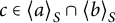
$c \in {\left \langle {a}\right \rangle }_{S} \cap {\left \langle {b}\right \rangle }_{S}$
, where
${\left \langle {x}\right \rangle }_S$
denotes the radical tensor ideal generated by x. Then
$c\otimes c\in \left ({\left \langle {a}\right \rangle }_{S}\cap {\left \langle {b}\right \rangle }_{S}\right )\otimes \left ({\left \langle {a}\right \rangle }_{S}\cap {\left \langle {b}\right \rangle }_{S}\right )\subset {\left \langle {a\otimes b}\right \rangle }_S$
. Since
$c\otimes c\notin I$
, it follows that
$a\otimes b\notin I$
. Hence, I is a prime ideal. The converse is straightforward. -
(2) Let T be a triangulated category and S the set of thick subcategories of T. Then $\mathrm {Spc}(T,S)$
is the Matsui spectrum of T defined in [Reference MatsuiMat23].






Definition 2.8 Let B be an algebra object in
$\mathrm {Cat}_{\infty }^{\mathrm {perf}}$
 . A datum
$(D,S)$
 over B consists of an algebra object
$S\in \mathrm {Cat}_{\infty }^{\mathrm {perf}}$
 equipped with a homomorphism
$B\to S$
 , together with a left S-module
$D\in \mathrm {Cat}_{\infty }^{\mathrm {perf}}$
 .
Here, D is the main object of interest, S plays the role of a base, and B that of coefficients. The relative Matsui spectrum is a way to study D relative to S.
In what follows, B will be fixed unless otherwise specified.
Definition 2.9 Let
$(D,S)$
 be a datum. A thick subcategory
$I \subset D$
 is called an S-submodule if it is closed under the S-action; that is,
$s \otimes a \in I$
 for all
$s \in S$
 ,
$a \in I$
 . The set of S-submodules of D is denoted by
$\mathrm {Sub}_S(D)$
 . For a subset
$W \subset D$
 , we write
${\left \langle {W}\right \rangle }_S$
 for the minimal S-submodule containing W.
If W is closed under the S-action, then
${\left \langle {W}\right \rangle }_S$
 coincides with
${\left \langle {W}\right \rangle }$
 , the minimal thick subcategory containing W.
Example 2.10
-
(1) Let $f:X\to Y$
be a morphism of schemes. Then
$\mathrm {Perf}(Y)$
acts on
$\mathrm {Perf}(X)$
by $$\begin{align*}G\otimes F := \mathbb{L} f^* G \otimes^{\mathbb{L}}_{\mathscr{O}_X} F \end{align*}$$for $G\in \mathrm {Perf}(Y), F\in \mathrm {Perf}(X)$
. Hence,
$(\mathrm {Perf}(X), \mathrm {Perf}(Y))$
is a datum over
$\mathrm {Perf}(\mathbb {Z})$
. Similarly,
${\mathrm {Coh}}(X)$
and
$\mathrm {Sing}(X)$
are
$\mathrm {Perf}(Y)$
-modules and thus form data.
-
(2) Let X be a scheme, and let $\mu =(\mu _0,\mu _1)\in \mathrm {H}_{ {\acute{\text{e}}t}}^2(X,\mathbb {G}_m)\times \mathrm {H}_{\acute {\text{e}t}}^1(X,\mathbb {Z})$
. Denote by
$\mathrm {Perf}(X,\mu )$
the twisted derived category of perfect complexes defined in [Reference ToënToë12]. If
$\mu _1=0$
, then
$\mathrm {Perf}(X,\mu )$
is the derived category of perfect complexes of twisted sheaves (see [Reference CaldararuCal00] for details). There is a natural action of
$\mathrm {Perf}(X)$
on
$\mathrm {Perf}(X,\mu )$
, and
$(\mathrm {Perf}(X,\mu ),\mathrm {Perf}(X))$
is a datum. -
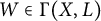
(3) Let X be a scheme, L a line bundle on X, and $W\in \Gamma (X,L)$
. Let
$\mathrm {DMF}(X,L,W)$
be the derived category of matrix factorizations defined in [Reference Efimov and PositselskiEP15, Reference PositselskiPos11]. Then
$\mathrm {DMF}(X,L,W)$
is naturally a
$\mathrm {DMF}(X,L,0)$
-module, and
$(\mathrm {DMF}(X,L,W),\mathrm {DMF}(X,L,0))$
is a datum. -
(4) Let D be a stable $\infty $
-category. Then D is naturally a module over the
$\infty $
-category of finite spectra
$\mathrm {Sp}^{\omega }$
, and
$(D,\mathrm {Sp}^{\omega })$
is a datum. -
(5) Let k be a commutative ring, and let $D_{\mathrm {dg}}$
be a k-linear dg-category. Then the associated stable
$\infty $
-category D has a natural
$\mathrm {Perf}(k)$
-action, so
$(D, \mathrm {Perf}(k))$
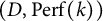
is a datum.
















Let B be an algebra object in
$\mathrm {Cat}_{\infty }^{\mathrm {perf}}$
 , let D and E be B-modules, and let
$F,G\colon D\to E$
 be exact functors. The
$\infty $
 -category
$\mathrm {Func}_B^{\mathrm {ex}}(D,E)$
 of B-linear exact functors and B-linear natural transformations is stable and hence is naturally enriched in spectra. We denote by
$\mathcal {N}\hspace {-0.08cm}\mathit {at}_B(F,G)$
 the spectrum of B-linear natural transformations from F to G. For an integer n, we write
$\mathrm {Nat}_B^n(F,G):= \pi _{-n}\mathcal {N}\hspace {-0.08cm}\mathit {at}_B(F,G)$
 . The
$\infty $
 -category
$\mathrm {Func}_B^{\mathrm {ex}}(D,D)$
 carries a canonical monoidal structure given by composition, with unit object
$\mathrm {Id}_D$
 . Hence,
$\mathcal {N}\hspace {-0.08cm}\mathit {at}_B(\mathrm {Id}_D,\mathrm {Id}_D)$
 is an
$\mathbb {E}_2$
 -algebra and
$\mathrm {Nat}_B^0(\mathrm {Id}_D,\mathrm {Id}_D)$
 is a commutative ring.
Definition 2.11 Let
$(D,S)$
 be a datum over B. We define a topological space and a sheaf of commutative rings on it by

where a denotes sheafification, and
$D_U$
 is naturally regarded as an S-module. The ringed space

is called the relative Matsui spectrum of the datum
$(D,S)$
 over B.
If B is clear from the context, we write
$\mathrm {Spec}(D,S)$
 instead of
$\mathrm {Spec}_B(D,S)$
 .
Remark 2.12 If
$S=B$
 , then one can show that
$\mathrm {Spec}(D,S)$
 is a locally ringed space, although we omit the proof here. By Theorem 6.8, many spaces
$\mathrm {Spec}(D,S)$
 embed into
$\mathrm {Spec}(D,B)$
 ; in this case,
$\mathrm {Spec}(D,S)$
 is also a locally ringed space. Moreover, we will see that under some suitable conditions on the datum
$(D, S)$
 (see Definition 6.1), if
$\mathrm {Spec}(D, S)$
 is a locally ringed space, then there exists a morphism of locally ringed spaces
$Spec(D, S) \to Spec(S, S)$
 (see Theorem 6.4).
Submodules
$\mathrm {Sub}_S(D)$
 are classified by certain subsets of
$\mathrm {Spc}(D,S)$
 . However, these subsets have not yet been characterized.
Theorem 2.13 (Recovery of submodules from supports)
Let
$(D,S)$
 be a datum. Then, the map

is injective and its left inverse is given by

Proof See Lemma 2.6.
Corollary 2.14 Every S-submodule of D is an intersection of prime S-submodules.
Proof By definition, for any subset
$Z \subset \mathrm{Spc}(D,S)$
 ,

Corollary 2.15
$\mathrm{Spc}(D,S)=\emptyset $
 if and only if
$D\cong 0$
 .
Proof If
$D\not \cong 0$
 , then D has at least two distinct S-submodules:
$0$
 and D. By Theorem 2.13, it follows that
$\mathrm {Spc}(D,S)\neq \emptyset $
 .
With our formalism, we can rephrase the original definition of Matsui spectrum in [Reference MatsuiMat23] as follows.
Definition 2.16 (Matsui spectrum)
Let k be an
$E_\infty $
 -ring, and let D be a k-linear stable
$\infty $
 -category (i.e., a
$\mathrm {Perf}(k)$
 -module). We define a topological space and a sheaf of commutative rings on it by

The ringed space
$\mathrm {Spec}_{\triangle }(D):= (\mathrm {Spc}_{\triangle }(D),\mathscr {O})$
 is called the Matsui spectrum of D.
Note that there is a natural homeomorphism
$\mathrm {Spec}_{\triangle }(D_0)\to \mathrm {Spec}_{\triangle }(D)$
 from the original Matsui spectrum of the homotopy category
$D_0$
 .
Remark 2.17 Matsui and Takahashi proved in [Reference MatsuiMat21, Theorem 4.5] and [Reference Matsui and TakahashiMT18, Theorem 2.9] that the Matsui spectrum
$\mathrm {Spc}_{\triangle } T=\mathrm {Spc}(T,\{\text {thick subcategories of }T\})$
 , together with the support map, classifies radical thick subcategories of a triangulated category T. In the same way as above, one can show that every thick subcategory is radical in the sense of [Reference MatsuiMat21]. In particular, thick subcategories are determined by their supports in the Matsui spectrum. Moreover, we can show that the Matsui spectrum
$\mathrm {Spc}_{\triangle } T$
 is empty if and only if
$T \cong 0$
 . This was proved in [Reference Hirano, Kalck and OuchiHKO25, Proposition 2.17] in the case where T is classically finitely generated, that is, finitely generated as a thick subcategory of itself.
3 Universality
In this section, we give a universal criterion for our spaces. Matsui [Reference MatsuiMat21] provided a characterization of the Matsui spectrum, but our result is slightly different and more general.
The considerations in this section were motivated by a discussion with Daigo Ito.
Definition 3.1 Let
$(D,S)$
 be a datum. A support datum of
$(D,S)$
 is a topological
$T_0$
 -space X equipped with a map
$\mathrm {Supp}:\mathrm {Ob}(D)\to 2^X$
 satisfying the following conditions:
-
(1) (Shift invariance) $\mathrm {Supp}(a)=\mathrm {Supp}(a[1])$
for any
$a\in D$
. -
(2) (Action) For any $a\in D$
,
$s\in S$
, we have
$\mathrm {Supp}(s\otimes a)\subset \mathrm {Supp}(a)$
. -
(3) (Direct sums) $\mathrm {Supp}(a\oplus b)=\mathrm {Supp}(a)\cup \mathrm {Supp}(b)$
for any
$a,b\in D$
. -
(4) (Exactness) $\mathrm {Supp}(b)\subset \mathrm {Supp}(a)\cup \mathrm {Supp}(c)$
for any exact triangle
$a\to b\to c$
in D. -
(5) (Distinguishability) For any two distinct submodules $I,J\subset D$
, we have
$\bigcup _{a\in I}\mathrm {Supp}(a)\neq \bigcup _{b\in J}\mathrm {Supp}(b)$
. -
(6) (Topology) The family of closed subsets of X is generated by $\{\mathrm {Supp}(a)\mid a\in D\}$
.











Let
$X,Y$
 be support data of
$(D,S)$
 . A map of support data is a continuous map
$f:X\to Y$
 compatible with
$\mathrm {Supp}$
 , that is,
$f^{-1}(\mathrm {Supp}_Y(a))=\mathrm {Supp}_X(a)$
 for all
$a\in D$
 .
A support datum X of
$(D,S)$
 is called universal if for any support datum Y, there exists a unique map
$X\to Y$
 of support data.
When dealing with triangulated categories without S-action, we also record the following variation on Definition 3.1. For a triangulated category T, a topological
$T_0$
 -space X together with an assignment
$\mathrm {Supp}\colon T\to 2^X$
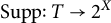 is called a support datum for T if it satisfies conditions (1), (3), (4), and (6) above, as well as condition (5) for any two distinct thick subcategories. Our conditions are stronger than Matsui’s original definition [Reference MatsuiMat21], where (5), (6), and the
$T_0$
 -condition are not imposed.
The goal of this section is to prove Theorems 3.2 and 3.3.
Theorem 3.2 Let
$(D,S)$
 be a datum. Then the relative Matsui spectrum
$\mathrm {Spc} (D,S)$
 is the universal support datum.
Theorem 3.3 Let T be a triangulated category. Then the Matsui spectrum
$\mathrm {Spc}_{\triangle }(T)$
 is the universal support datum of T.
We now prove this fact in a more general setting of semilattices.
A semilattice is a partially ordered set such that any two elements admit a supremum. A map of semilattices is a map preserving non-empty finite suprema. A semilattice is called ind-complete if any non-empty subset admits a supremum.
Definition 3.4 Let L be a semilattice. A subset
$S\subset L$
 is called an ind-object if it is closed under taking suprema of two elements, is non-empty, and satisfies: if
$s\in S$
 and
$l\le s,$
 then
$l\in S$
 . The ind-completion
$\mathrm {Ind}(L)$
 is the set of all ind-objects. It is partially ordered by inclusion and forms an ind-complete semilattice.
Remark 3.5 For any ind-complete semilattice
$L'$
 and a semilattice map
$f:L\to L'$
 , there exists a unique extension
$\tilde {f}:\mathrm {Ind}(L)\to L'$
 preserving arbitrary non-empty suprema. In fact, considering a semilattice as a category, it is easy to check that
$\mathrm {Ind}(L)$
 , together with the natural morphism
$L\to \mathrm {Ind}(L): l\mapsto \{l'\in L\mid l'\le l\}$
 , coincides with the categorical ind-completion.
For a set X,
$2^X$
 is partially ordered by inclusion and is an ind-complete semilattice.
Definition 3.6 Let L be a semilattice. A support datum of L is a topological
$T_0$
 -space X with a map of semilattices
$\mathrm {Supp}:L\to 2^X$
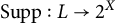 satisfying:
-
(1) (Distinguishability) The induced map $\mathrm {Supp}:\mathrm {Ind}(L)\to 2^X$
is injective. -
(2) (Topology) The family of closed subsets of X is generated by $\{\mathrm {Supp}(l)\mid l\in L\}$
.


Let
$X,Y$
 be support data of L. A map of support data is a continuous map
$f:X\to Y$
 such that
$\mathrm {Supp}_X(l)=f^{-1}(\mathrm {Supp}_Y(l))$
 for any
$l\in L$
 .
A support datum X of L is called universal if for any support datum Y of L, there exists a unique map
$X\to Y$
 of support data.
Remark 3.7 (Gabriel–Ulmer duality)
We say that a (small) semilattice L is locally finitely presentable (resp. finitely cocomplete) if it is so when regarded as a category. We say that an object
$l\in L$
 is compact if it is compact in the sense of category theory. We denote by
$L^\omega $
 the subsemilattice of compact objects. By Gabriel–Ulmer duality [Reference Gabriel and UlmerGU71], for any locally finitely presentable semilattice L, we have
$\mathrm {Ind}(L^\omega )\cong L$
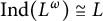 , and for any finitely cocomplete semilattice L, we have
$\mathrm {Ind}(L)^\omega \cong L$
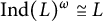 .
Example 3.8
-
(1) Let T be a triangulated category, and let S be a family of thick subcategories of T which is closed under arbitrary intersections and unions of transfinite increasing sequences. Assume that $T \in S$
and that S has a smallest element. Then S forms a locally finitely presentable semilattice. Its compact objects are precisely the finitely generated ones, namely, those of the form
$\bigcap _{I \in S,\; W \subset I} I$
for some finite subset
$W \subset T$
. In this case, both
$\mathrm {Spc}(T,S)$
and
$\mathrm {Spc}'(T,S)$
are support data for
$S^\omega $
. In fact, by the construction below,
$\mathrm {Spc}(T,S)$
is the universal support datum. -
(2) Let $(D,S)$
be a datum. Then
$\mathrm {Sub}_S(D)$
, ordered by inclusion, is a locally finitely presentable semilattice. Its compact objects are precisely the finitely generated submodules
$\mathrm {Sub}_S^{\mathrm {fin}}(D)$
, and hence
$\mathrm {Ind}(\mathrm {Sub}_S^{\mathrm {fin}}(D))\simeq \mathrm {Sub}_S(D)$
. Support data of
$\mathrm {Sub}_S^{\mathrm {fin}}(D)$
correspond bijectively to support data on
$(D,S)$
. This correspondence is given as follows. For a support datum Y of
$(D,S)$
, the map
$\mathrm {Sub}_{S}^{\mathrm {fin}}(D)\to 2^Y,\ I\mapsto \bigcup _{a\in I}\mathrm {Supp}(a)$
defines a support datum of
$\mathrm {Sub}_{S}^{\mathrm {fin}}(D)$
. Conversely, for a support datum
$Y'$
of
$\mathrm {Sub}_{S}^{\mathrm {fin}}(D)$
, the map
$\mathrm {Ob}(D)\to 2^{Y'},\ a\mapsto \mathrm {Supp}({\left \langle {a}\right \rangle }_S)$
defines a support datum of
$(D,S)$
. -
(3) Similarly, for a triangulated category T, support data of T correspond bijectively to support data of the semilattice of finitely generated thick subcategories $\mathrm {Th}^{\mathrm {fin}}(T)$
.











Let L be a semilattice. We set

We topologize
$X_L$
 by declaring the family of closed subsets to be generated by
$\{\mathrm {Supp}(l)\mid l\in L\}$
 .
Theorem 3.9
$X_L$
 is the universal support datum of L.
Proof First, we prove that
$X_L$
 is a support datum. Take
$S\in \mathrm {Ind}(L)$
 and
$l\in L\setminus S$
 . The set
$\{T\in \mathrm {Ind}(L)\mid S\subset T,\, l\notin T\}$
 has a maximal element P by Zorn’s lemma. Since
$l\in \bigcap _{T\in \mathrm {Ind}(L),\, T\supsetneq P}T$
 , it follows that
$P\in X_L$
 . This establishes the injectivity of
$\mathrm {Supp}:\mathrm {Ind}(L)\to 2^{X_L}$
 . The remaining conditions are straightforward.
Next, we prove universality. Let
$Y=(Y,\mathrm {Supp}_Y)$
 be another support datum. For
$P\in X_L$
 , let
${P}^{+}=\bigcap _{S\in \mathrm {Ind}(L),\, S\supsetneq P}S$
 . By definition,
$\mathrm {Supp}_Y({P}^{+})\setminus \mathrm {Supp}_Y(P)\neq \emptyset $
 . Choose a point
$y_P\in \mathrm {Supp}_Y({P}^{+})\setminus \mathrm {Supp}_Y(P)$
 . Define
$f:X_L\to Y$
 by
$P\mapsto y_P$
 . If
$l\notin P$
 , then
$\mathrm {Supp}_Y(l)\cup \mathrm {Supp}_Y(P)=\mathrm {Supp}_Y(\sup \{P,l\})\supset \mathrm {Supp}_Y({P}^{+})$
 . Thus,
$f^{-1}(\mathrm {Supp}_Y(l))=\{P\in X_L\mid l\notin P\}$
 , hence f is a map of support data. Since any map of support data is compatible with the natural injection
$Y\to 2^L: y\mapsto \{l\in L\mid y\notin \mathrm {Supp}_Y(l)\}$
 , uniqueness follows.
In fact, isomorphism classes of support data of L correspond bijectively to subsets of
$\mathrm {Ind}(L)\cup \{\emptyset \}$
 containing
$X_L$
 .
Proof (Proof of Theorems 3.2 and 3.3) We first prove Theorem 3.2. Let
$\mathrm {Sub}_{S}^{\mathrm {fin}}(D)$
 denote the semilattice of finitely generated submodules of D, ordered by inclusion. By Example 3.8(2),
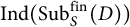
$\mathrm {Ind}(\mathrm {Sub}_{S}^{\mathrm {fin}}(D))$
 is isomorphic to the semilattice
$\mathrm {Sub}_{S}(D)$
 . Hence,
$X_{\mathrm {Sub}_{S}^{\mathrm {fin}}(D)}$
 is identified with the set of prime submodules. Therefore,
$\mathrm {Spc}(D,S)$
 is the universal support datum of
$\mathrm {Sub}_{S}^{\mathrm {fin}}(D)$
 . Again by Example 3.8(2), the categories of support data of
$\mathrm {Sub}_{S}^{\mathrm {fin}}(D)$
 and of
$(D,S)$
 are equivalent. It follows that
$\mathrm {Spc}(D,S)$
 is also the universal support datum of
$(D,S)$
 .
The proof of Theorem 3.3 is the same as that of Theorem 3.2, except that one considers the semilattice of finitely generated thick subcategories in place of the semilattice of finitely generated submodules.
Example 3.10 Let X be a
$T_0$
 -space, let
$\mathrm {SpCl}(X)$
 be the semilattice of specialization-closed subsets of X, ordered by inclusion, and set
$L=\mathrm {SpCl}(X)^\omega $
 . Then the universal support datum
$X_L$
 recovers the underlying set of X, and the specialization-closed subsets of X and
$X_L$
 correspond bijectively. In particular, for a datum
$(D,S)$
 and a
$T_0$
 -space X, if there is an order-preserving bijection
$\mathrm {Sub}_S(D)\cong \mathrm {SpCl}(X)$
 , then there is a bijection
$X\to \mathrm {Spc}(D,S)$
 .
Let us prove this. The semilattice L consists of finite unions of closed subsets of the form
$\overline {\{x\}}$
 for
$x\in X$
 . By Remark 3.7, we identify
$\mathrm {Ind}(L)$
 with
$\mathrm {SpCl}(X)$
 . For each point
$x\in X$
 , it is easy to see that
$P_x:= \{y\in X\mid x\notin \overline {\{y\}}\}$
 defines an element of
$X_L\subset \mathrm {Ind}(L)=\mathrm {SpCl}(X)$
 . Since X is
$T_0$
 , the assignment
$x\mapsto P_x$
 is injective. Conversely, let
$Z\in X_L$
 . Since Z is a specialization-closed subset of X, we have
$Z=\bigcap _{x\in X\setminus Z} P_x$
 . Therefore, by the definition of
$X_L$
 , we obtain
$Z=P_x$
 for some
$x\in X$
 , and hence
$X_L$
 is identified with X as a set. Moreover, the specialization-closed subsets of both X and
$X_L$
 are generated under arbitrary unions by the subsets
$Z\in L$
 . It follows that the specialization-closed subsets of X and those of
$X_L$
 correspond bijectively.
4 Comparison with the Balmer and Matsui spectra
In this section, we compare relative Matsui spectra with the Balmer and Matsui spectra. We first establish a basic property of relative Matsui spectra, namely, their behavior with respect to Verdier quotients.
Proposition 4.1 Let
$(D,S)$
 be a datum, and let
$I\subset D$
 be an S-submodule. Then there is a natural morphism

If I is finitely generated, this is an open embedding.
Proof The proof is the same as that of [Reference MatsuiMat23, Proposition 4.3 and Corollary 4.4], using the fact that the Matsui spectrum is invariant under idempotent completion (see [Reference MatsuiMat23, Proposition 4.2]).
Proposition 4.2 Let
$(D,S)$
 be a datum, and let
$I\subset S$
 be a two-sided ideal such that
$I\otimes D=0$
 . Then there is a natural isomorphism

Proof We have
$\mathrm {Sub}_S(D)=\mathrm {Sub}_{\mathrm {Idem}(S/I)}(D)$
 , and the isomorphism follows from the definition.
For a commutative algebra object D in
$\mathrm {Cat}_{\infty }^{\mathrm {perf}}$
 , the Balmer spectrum
$\mathrm {Spc}_{\otimes } D_0$
 classifies radical tensor ideals of D in the sense of [Reference BalmerBal05], whereas our space
$\mathrm {Spc}(D,D)$
 classifies all tensor ideals. If D is rigid, then every tensor ideal is radical, and hence our space is closely related to the Balmer spectrum.
Theorem 4.3 (Comparison with the Balmer spectrum)
Let D be a commutative algebra object in
$\mathrm {Cat}_{\infty }^{\mathrm {perf}}$
 , and let
$D_0$
 denote its homotopy category. Let
$\mathrm {Spec}_{\otimes }(D_0)=(\mathrm {Spc}_{\otimes }(D_0),\mathscr {O})$
 be the Balmer spectrum of
$D_0$
 . Assume D is rigid. Then there is a natural dense embedding

If
$\mathrm {Spec}_{\otimes }(D_0)$
 is topologically Noetherian, then this embedding is an isomorphism.
Proof Tensor ideals of
$D_0$
 correspond bijectively to submodules of D. By [Reference BalmerBal05, Remark 4.3], any tensor ideal is radical. Hence, the underlying space
$\mathrm {Spc}_{\otimes }(D_0)$
 is
$\mathrm {Spc}'(D,\mathrm {Sub}_D(D))$
 by Example 2.7. By Corollary 2.5, there is a natural dense embedding
$\iota :\mathrm {Spc}(D,\mathrm {Sub}_D(D))\to \mathrm {Spc}'(D,\mathrm {Sub}_D(D))$
 . The morphism of structure sheaves is induced by the isomorphisms

where
$1_{D_{0,U}}$
 denotes the unit object of
$D_{0,U}$
 . Note that
$D_{0,U}$
 is the homotopy category of
$D_{\iota ^{-1}(U)}$
 , and any
$\eta \in \mathrm {Nat}_D^0(\mathrm {Id}_{D_{\iota ^{-1}(U)}},\mathrm {Id}_{D_{\iota ^{-1}(U)}})$
 is determined by its evaluation at
$1_{D_{\iota ^{-1}(U)}}$
 , since every object of
$D_{\iota ^{-1}(U)}$
 is equivalent to a retract of
$d\otimes 1_{D_{\iota ^{-1}(U)}}$
 for some
$d\in D$
 .
Assume now that
$\mathrm {Spec}_{\otimes }(D_0)$
 is topologically Noetherian. Let P be a quasi-
$\mathrm {Sub}_D(D)$
 -prime, and let
$x\in \mathrm {Spec}_{\otimes }(D_0)$
 be the corresponding point. To prove that
$\iota $
 is surjective, we must show that P is in fact an
$\mathrm {Sub}_D(D)$
 -prime. We have
$\mathrm {Supp}_\otimes (P)=\{y\in \mathrm {Spec}_{\otimes }(D_0)\mid x\notin \overline {\{y\}}\}$
 . Let
${P}^{+}$
 be the tensor ideal with support
$\mathrm {Supp}_\otimes (P)\cup \{x\}$
 . By [Reference BalmerBal05, Theorem 4.10], such
${P}^{+}$
 exists and is the smallest tensor ideal strictly containing P. Thus, P is a prime submodule.
Remark 4.4 For a tensor triangulated category T, let
$\mathrm {Ideal}_{\otimes ,fin}(T)$
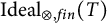 be the semilattice of radicals of finitely generated tensor ideals of T. Then the Balmer spectrum
$\mathrm {Spc}_{\otimes } T$
 is a support datum (Definition 3.6) of
$\mathrm {Ideal}_{\otimes ,fin}(T)$
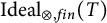 , but, in general, it is not universal. If T is rigid, then
$\mathrm {Ideal}_{\otimes ,fin}(T)$
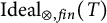 coincides with the semilattice of finitely generated submodules of T, and by universality, there is a natural embedding
$\mathrm {Spc}(T,T)\to \mathrm {Spc}_{\otimes } T$
 . If we take
$T=D_0$
 , this map coincides with the one in Theorem 4.3.
Theorem 4.5 (Comparison with the Matsui spectrum)
Let k be an
$E_\infty $
 -ring and
$(D,S,\mathrm {Perf}(k))$
 a datum. Assume S is classically generated by
$1_S$
 . Then there is an isomorphism

Proof By assumption, all thick subcategories of D are S-submodules. Hence, their underlying spaces coincide, and so do the structure sheaves by definition.
5 Commutativity of localizations
In this section, we recall some fundamental properties concerning the commutativity and composability of localizations. Most of them are probably well known to experts. We provide references whenever available.
Let D be a presentable stable
$\infty $
 -category. A presentable thick subcategory I of D is a thick subcategory such that I itself is presentable and the inclusion functor preserves small colimits. An object
$d\in D$
 is called I-local if
$\mathrm {Hom}^*(I,d)=0$
 . The Verdier quotient
$D/I$
 is a presentable stable
$\infty $
 -category, and the localization functor
$D \to D/I$
 , denoted by
$L_I$
 , has a fully faithful right adjoint. Thus, we may identify
$D/I$
 with the full subcategory of I-local objects in D. For a subset
$W\subset D$
 , we denote by
${\left \langle {W}\right \rangle }^{\mathrm {pr}}$
 the presentable thick subcategory generated by W.
Lemma 5.1 (cf. [Reference KrauseKra23, Lemma 3.1])
Let D be a presentable stable
$\infty $
 -category, and let
$I,J$
 be presentable thick subcategories. Then the following conditions are equivalent:
-
(1) For any $x\in I$
and
$y\in J$
, every morphism
$y\to x$
factors through some
$z\in I\cap J$
. -
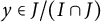
(2) For any $x\in I/(I\cap J)$
and
$y\in J/(I\cap J)$
, every morphism
$y\to x$
is zero. -
(3) $L_I\circ L_J= L_{{\left \langle {I,J}\right \rangle }^{\mathrm {pr}}}$
. -
(4) $L_I$
preserves J-local objects. -
(5) $L_J$
preserves I.






Proof First, we remark that if
$I\subset J$
 or
$J\subset I$
 , every condition is trivially satisfied (see [Reference Benson, Iyengar and KrauseBIK15, Lemma 2.16]).
Assume (4) and prove (3). For any
$x\in D$
 ,
$L_I\circ L_J(x)$
 is both I-local and J-local object. We have a natural isomorphism

hence (3) holds.
Assume (3). Then
$L_{I}\circ L_{J}(I)=0$
 , hence (5) holds.
Assume (5) and prove (2). Let z be the fiber of
$x\to L_{J}(x)$
 . The composition
$y\to x\to L_J(x)$
 is
$0$
 , so
$y\to x$
 factors through z. Since
$x,L_{J}(x)\in I$
 ,
$z\in I$
 . By definition,
$z\in J$
 . Hence, (2) holds.
By [Reference NeemanNee01, Lemma 2.1.26], (2) implies (1).
Assume (1) and prove (4). Let x be a J-local object, and
$y\in J$
 . It suffices to show that
$\mathrm {Hom}^*(y,L_I(x))=0$
 . Let k be the fiber of
$x\to L_I(x)$
 . Since
$x, L_{I}(x)$
 are
$I\cap J$
 -local, k is also
$I\cap J$
 -local. For any
$f\in \mathrm {Hom}^n(y,k)\ (n\in \mathbb {Z})$
 , it factors through some
$z\in I\cap J$
 . Since
$\mathrm {Hom}^*(z,k)=0$
 , we have
$f=0$
 , hence
$\mathrm {Hom}^*(y,k)=0$
 . The long exact sequence shows that
$\mathrm {Hom}^*(y,L_I(x))\cong \mathrm {Hom}^*(y,x)\cong 0$
 .
Lemma 5.2 Let D be a presentable stable
$\infty $
 -category and
$I,J$
 its presentable submodules. Then, the following conditions are equivalent:
-
(1) Both $(I,J)$
and
$(J,I)$
satisfy the equivalent conditions of Lemma 5.1. -
(2) The following diagram is Cartesian:
-
(3) $L_I\circ L_J= L_J\circ L_I$
.



Proof Since the localization functors have fully faithful right adjoints, (2) holds if and only if, for every
$x \in D$
 ,
$L_{I \cap J}(x)$
 is the pullback of
$L_I(x)\to L_{{\left \langle {I,J}\right \rangle }^{\mathrm {pr}}}(x)\gets L_J(x).$
 Equivalently, the long exact sequence in [Reference KrauseKra23, Theorem 1(2)] exists. By [Reference KrauseKra23, Theorem 1] or [Reference ScholzeSch19, Proposition 10.5], (1) implies (2). Conversely, if (2) holds, then (1) also holds by [Reference KrauseKra23, Theorem 1]. Trivially (1) implies (3). [Reference KrauseKra23, Lemmas 3.1 and 3.5] also shows that (1) implies (3). Assume (3), and let us prove (1). We have
$L_I\circ L_J(I)=L_J\circ L_I(I)=0$
 , hence
$L_J(I)\subset I$
 . By symmetry,
$L_I(J)\subset J$
 .
Let D be a (small) stable
$\infty $
 -category. The ind-completion is denoted by
$\mathrm {Ind}(D)$
 . For a thick subcategory
$I\subset D$
 , the ind-completion
$\mathrm {Ind}(I)$
 is a thick subcategory of
$\mathrm {Ind}(D)$
 , and there is a natural equivalence
$\mathrm {Ind}(D/I)\cong \mathrm {Ind}(D)/\mathrm {Ind}(I)$
 . We write
$L_I$
 instead of
$L_{\mathrm {Ind}(I)}:\mathrm {Ind}(D)\to \mathrm {Ind}(D/I)$
 .
Lemma 5.3 (cf. [Reference KrauseKra23, Lemma 3.1])
Let D be a stable
$\infty $
 -category, and let
$I,J\subset D$
 be thick subcategories. Then the following conditions are equivalent:
-
(1) For any $x\in I$
and
$y\in J$
, every morphism
$y\to x$
factors through some
$z\in I\cap J$
. -
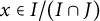
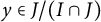
(2) For any $x\in I/(I\cap J)$
and
$y\in J/(I\cap J)$
, every morphism
$y\to x$
is zero. -
(3) The pair of presentable submodules $(\mathrm {Ind}~ I,\mathrm {Ind}~ J)\subset \mathrm {Ind}~ D$
satisfies the equivalent conditions of Lemma 5.1, and moreover
$\mathrm {Ind}~ I\cap \mathrm {Ind} ~J=\mathrm {Ind}(I\cap J)$
.





Proof (3) trivially implies (2). By [Reference NeemanNee01, Lemma 2.1.26], (2) implies (1). Assume (1), and let us prove (3). The inclusion
$\mathrm {Ind}(I\cap J)\subset \mathrm {Ind} ~I\cap \mathrm {Ind} ~J$
 is obvious. Thus, we may replace D by
$D/(I\cap J)$
 , and assume
$I\cap J=0$
 . Take
$x\in \mathrm {Ind} ~I$
 ,
$y\in \mathrm {Ind}~J$
 and filtered colimits
$\mathrm {colim}_\alpha x_\alpha \cong x$
 ,
$\mathrm {colim}_\beta y_\beta \cong y$
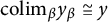 with
$x_\alpha \in I, y_\beta \in J$
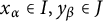 . By the compactness of
$x_\alpha $
 ,
$\mathrm {Map}(x,y)\cong \lim _\alpha \mathrm {Map}(x_\alpha ,y)\cong \lim _\alpha \mathrm {colim}_\beta \mathrm {Map}(x_\alpha ,y_\beta )\cong 0$
 . By symmetry,
$\mathrm {Map}(y,x)\cong 0$
 . This implies
$\mathrm {Ind}~I\cap \mathrm {Ind}~J =0$
 and Condition (1) of Lemma 5.1.
Let
$K\subset I\cap J$
 be a thick subcategory. Then
$(I,J)$
 satisfies the equivalent conditions of Lemma 5.3 if and only if
$(\mathrm {Idem}(I/K),\mathrm {Idem}(J/K))\subset \mathrm {Idem}(D/K)$
 satisfies them. Indeed, this follows by applying the equivalence (1)
$\Leftrightarrow $
 (2) in Lemma 5.3 twice.
Lemma 5.4 is essentially proved in [Reference KrauseKra23, Theorem 1]. It only remains to prove the essential surjectivity of the natural functor from
$\mathrm {Idem}(D/(I\cap J))$
 to the pullback of the diagram in Lemma 5.4(2).
Lemma 5.4 Let D be a stable
$\infty $
 -category, and let
$I,J\subset D$
 be thick subcategories. Then the following conditions are equivalent:
-
(1) Both $(I,J)$
and
$(J,I)$
satisfy the equivalent conditions of Lemma 5.3. -
(2) The following diagram is Cartesian:


Proof By [Reference KrauseKra23, Theorem 1], (2) implies (1). Assume (1). By Lemma 5.2,
$\mathrm {Ind}(D/(I\cap J))\cong \mathrm {Ind}(D/I)\times _{\mathrm {Ind}(D/{\left \langle {I,J}\right \rangle })}\mathrm {Ind}(D/J)$
 . By Lemma 5.2, we have
$\mathrm {Ind}(D/(I \cap J)) \cong \mathrm {Ind}(D/I)\times _{\mathrm {Ind}(D/{\left \langle {I,J}\right \rangle })}\mathrm {Ind}(D/J)$
 . Let
$E=\mathrm {Idem}(D/I)\times _{\mathrm {Idem}(D/{\left \langle {I,J}\right \rangle })}\mathrm {Idem}(D/J)$
 . Then E is a full subcategory of
$\mathrm {Ind}(D/(I \cap J))$
 . Hence, the natural functor
$\mathrm {Idem}(D/(I \cap J)) \to E$
 is fully faithful. It remains to prove essential surjectivity. Take
$x\in \mathrm {Ind}(D/(I\cap J))$
 such that
$L_{I}(x), L_{J}(x), L_{{\left \langle {I,J}\right \rangle }}(x)$
 are compact in
$\mathrm {Ind}(D/I), \mathrm {Ind}(D/J), \mathrm {Ind}(D/{\left \langle {I,J}\right \rangle })$
 , respectively. It suffices to show that x is compact. Let
$y=\mathrm {colim}_\alpha y_\alpha $
 be a filtered colimit with
$y_\alpha \in \mathrm {Ind}(D/(I\cap J))$
 . We have

Definition 5.5 (See [Reference KrauseKra23, Definition 3.2])
Let D be a stable
$\infty $
 -category, and let
$I,J\subset D$
 be thick subcategories. We say that
$(I,J)$
 is composable (resp. commutative) if it satisfies the equivalent conditions of Lemma 5.3 (resp. Lemma 5.4).
For a thick subcategory
$I\subset D$
 of a stable
$\infty $
 -category D, the opposite category
$I^{\mathrm {op}}$
 is a thick subcategory of
$D^{\mathrm {op}}$
 . Note that
$(I,J)$
 is composable (resp. commutative) if and only if
$(J^{\mathrm {op}},I^{\mathrm {op}})$
 is composable (resp. commutative) in
$D^{\mathrm {op}}$
 .
Lemma 5.6 Let D be a stable
$\infty $
 -category, and let I, J, and K be thick subcategories. The following statements hold:
-
(1) (See [Reference KrauseKra23, Lemma 3.1].) If $(I,J)$
is composable, then
$\mathrm {Idem}(I/(I\cap J))$
and
$\mathrm {Idem}({\left \langle {I,J}\right \rangle }/J)$
can be identified as thick subcategories of
$\mathrm {Ind}(D)$
. -
(2) If $(I,K)$
and
$(J,K)$
are composable, then
$({\left \langle {I,J}\right \rangle },K)$
is composable. -
(3) If $(I,J)$
and
$(I,K)$
are composable, then
$(I,{\left \langle {J,K}\right \rangle })$
is composable. -
(4) If $(I,J)$
,
$(J,K)$
, and
$(I,K)$
are composable, then
${\left \langle {I,K}\right \rangle }\cap {\left \langle {J,K}\right \rangle }={\left \langle {I\cap J,K}\right \rangle }$
. -
(5) If $(I,J)$
,
$(J,K)$
, and
$(I,K)$
are composable, then
${\left \langle {I,J}\right \rangle }\cap {\left \langle {I,K}\right \rangle }={\left \langle {I,J\cap K}\right \rangle }$
.









Proof Statements (3) and (5) are dual to (2) and (4), respectively.
(1) By composability, an object
$a\in \mathrm {Ind}(I)$
 is
$\mathrm {Ind}(J)$
 -local if and only if it is
$\mathrm {Ind}(I\cap J)$
 -local. Hence, inside
$\mathrm {Ind}(D)$
 , we have
$\mathrm {Ind}(I/(I\cap J))\subset \mathrm {Ind}({\left \langle {I,J}\right \rangle }/J).$
 Since
$L_J(J)=0$
 , the presentable thick subcategory
$\mathrm {Ind}({\left \langle {I,J}\right \rangle }/J)$
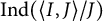 is generated by
$L_J(I)$
 , hence this inclusion is an isomorphism. Taking compact objects on both sides, we obtain the claim.
(2) By assumption,
$\mathrm {Ind}~ I$
 and
$\mathrm {Ind}~ J$
 are preserved by
$L_K$
 . Hence, so is
$\mathrm {Ind}{\left \langle {I,J}\right \rangle }$
 . It remains to prove that
$ \mathrm {Ind}{\left \langle {I,J}\right \rangle }\cap \mathrm {Ind}~ K=\mathrm {Ind}({\left \langle {I,J}\right \rangle }\cap K). $
 Define a functor by
$\psi (a):= \mathrm {Fib}(a\to L_K(a))$
 . Then
$\mathrm {Ind}{\left \langle {I,J}\right \rangle }\cap \mathrm {Ind}~ K=\psi (\mathrm {Ind}{\left \langle {I,J}\right \rangle })$
 , and this is generated by
$\psi (\mathrm {Ind}~ I)=\mathrm {Ind}~ I\cap \mathrm {Ind}~ K$
 and
$\psi (\mathrm {Ind}~ J)=\mathrm {Ind}~ J\cap \mathrm {Ind}~ K$
 . Since both are generated by compact objects, so is
$\mathrm {Ind}{\left \langle {I,J}\right \rangle }\cap \mathrm {Ind}~ K$
 .
(4) The inclusion
${\left \langle {I,K}\right \rangle }\cap {\left \langle {J,K}\right \rangle }\supset {\left \langle {I\cap J,K}\right \rangle }$
 is obvious. We prove the converse inclusion. The category
$\mathrm {Ind}({\left \langle {I,K}\right \rangle }\cap {\left \langle {J,K}\right \rangle })$
 is generated by
$\mathrm {Ind}~ K$
 and
$L_K(\mathrm {Ind}({\left \langle {I,K}\right \rangle }\cap {\left \langle {J,K}\right \rangle }))$
 . The latter is contained in
$ L_K(\mathrm {Ind}{\left \langle {I,K}\right \rangle })\cap L_K(\mathrm {Ind}{\left \langle {J,K}\right \rangle })\subset \mathrm {Ind}~ I\cap \mathrm {Ind}~ J=\mathrm {Ind}(I\cap J). $
 Thus,
$ \mathrm {Ind}({\left \langle {I,K}\right \rangle }\cap {\left \langle {J,K}\right \rangle })\subset \mathrm {Ind}{\left \langle {I\cap J,K}\right \rangle }, $
 and hence the statement follows.
Let
$(D,S)$
 be a datum, and
$W\subset D$
 a subset. Note that if W is closed under the S-action, then
${\left \langle {W}\right \rangle }_S$
 coincides with
${\left \langle {W}\right \rangle }$
 . Hence, Lemma 5.6 remains valid for submodules.
Let
$(D,S)$
 be a datum, and I a submodule. There are natural maps

The equality
${\left \langle {L_I(J)}\right \rangle }=\mathrm {Idem}({\left \langle {I,J}\right \rangle }/I)$
 is induced by the natural inclusion
$L_I(J)\subset L_I({\left \langle {I,J}\right \rangle })={\left \langle {I,J}\right \rangle }/I.$

Proposition 5.7 Let
$(D,S)$
 be a datum, and let I and J be submodules such that, for any submodule K, both pairs
$(K,I)$
 and
$(K,J)$
 are composable. Then the following diagram is Cartesian:

Proof Let P be the pullback of the above diagram. There is a natural map
$\mathrm {Sub}_S(\mathrm {Idem}(D/(I\cap J)))\to P$
 . We first prove surjectivity. Take
$K\in \mathrm {Sub}_S(\mathrm {Idem}(D/I))$
 and
$K'\in \mathrm {Sub}_S(\mathrm {Idem}(D/J))$
 with the same image
$K"$
 in
$\mathrm {Sub}_S(\mathrm {Idem}(D/{\left \langle {I,J}\right \rangle }))$
 . Then, by Lemma 5.4, the pullback
$K"'$
 of
$K\to K"\gets K'$
 is a submodule of
$\mathrm {Idem}(D/(I\cap J))$
 . By Lemma 5.6(3) and the discussion after Lemma 5.3, the pair
$(K',{\left \langle {L_J}\right \rangle }(I))$
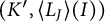 is composable. Hence, by Lemma 5.6(1), the essential image of the composition
$K'\to \mathrm {Idem}({\left \langle {K',L_J(I)}\right \rangle }/{\left \langle {L_J(I)}\right \rangle })\cong K"$
 is a dense triangulated subcategory. Therefore, by [Reference ThomasonTho97, Theorem 2.1], for any
$k\in K$
 , there exists
$k'\in K'$
 such that
$k\oplus k[-1]$
 and
$k'$
 have the same image in
$K"$
 . This shows that the image of
$K"'$
 in
$\mathrm {Sub}_S(\mathrm {Idem}(D/I))$
 is K, and similarly its image in
$\mathrm {Sub}_S(\mathrm {Idem}(D/J))$
 is
$K'$
 . Hence, surjectivity holds.
Via the map
$(L_I|_D)^{-1}$
 , submodules of
$\mathrm {Idem}(D/I)$
 correspond bijectively to submodules of D containing I, and similarly for the other terms. Under this identification, injectivity follows from Lemma 5.6(5).
Let
$(D,S)$
 be a datum and I an S-submodule of D. Let
$\mathrm {Spc}(D,S)_I$
 denote the subspace of
$\mathrm {Spc}(D,S)$
 consisting of primes P such that
$I\not \subset P$
 .
Proposition 5.8 Under the above assumptions, suppose moreover that for any submodule J of D, the pair
$(J,I)$
 is composable. Then there is a bijection between the underlying sets:

The complement of
$\mathrm {Spc}(D,S)_I$
 in
$\mathrm {Spc}(D,S)$
 is
$\mathrm {Spc}(\mathrm {Idem}(D/I),S)$
 .
Proof The last assertion follows directly from the definition. Let
$\iota \colon I\hookrightarrow D$
 denote the natural inclusion. To prove the well-definedness and bijectivity of the correspondence in the statement, we define the following auxiliary map and functor:

Let
$J, K \subset D$
 be submodules. We claim the following:
-
(1) Suppose that $J \subset K$
. Then
$J = K$
if and only if
$\phi (J) = \phi (K)$
. -
(2) We have $\mathrm {Ind}(J \cap I) = {\left \langle {\psi (J)}\right \rangle }^{\mathrm {pr}}$
. -
(3) Assume that $J \cap I \subset K \subset I$
. Then
$\phi ({\left \langle {J,K}\right \rangle }) = (K,\mathrm {Idem}({\left \langle {J,I}\right \rangle }/I)).$


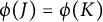



(1) The “only if” direction is clear. For the “if” direction, suppose
$\phi (J)=\phi (K)$
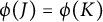 . By Lemma 5.6, in
$\mathrm {Ind}(D)$
 , the subcategory
$\mathrm {Idem}({\left \langle {J,I}\right \rangle }/I)$
 is identified with
$\mathrm {Idem}(J/(J\cap I))$
 , and similarly for K. The submodules of D containing
$J\cap I$
 correspond bijectively to the submodules of
$\mathrm {Idem}(D/(J\cap I))$
 . Thus, the equalities
$J\cap I=K\cap I$
 and
$\mathrm {Idem}(J/(J\cap I))=\mathrm {Idem}(K/(K\cap I))$
 imply
$J=K$
 .
(2) This follows from Lemma 5.1(5).
(3) The second components agree since
${\left \langle {J,K,I}\right \rangle }={\left \langle {J,I}\right \rangle }$
 . For the first component, by (2), we have

Therefore, we conclude that
${\left \langle {J,K}\right \rangle }\cap I=K$
 .
Now, let
$J\subset D$
 be a submodule such that
$I\not \subset J$
 . Set
$K=\{a\in D\mid \psi (a)\in \mathrm {Ind}(J\cap I)\}.$
 Then
$J\subset K$
 . We claim that J is prime if and only if
$J\cap I$
 is prime in I and
$J=K$
 . This claim shows that the correspondences in the statement are well defined and mutually inverse.
First, assume that J is prime. Let us prove that
$J=K$
 . We claim that
${\left \langle {J,I}\right \rangle }\cap K = J$
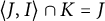 . By (2), we have
${\left \langle {J,I}\right \rangle }\cap K\cap I = K\cap I = J\cap I.$
 By (3), we have
${\left \langle {L_I}\right \rangle }(J)\subset {\left \langle {L_I}\right \rangle }({\left \langle {J,I}\right \rangle }\cap K)\subset {\left \langle {L_I}\right \rangle }({\left \langle {J,I}\right \rangle })={\left \langle {L_I}\right \rangle }(J),$
 and hence
${\left \langle {L_I}\right \rangle }(J)={\left \langle {L_I}\right \rangle }({\left \langle {J,I}\right \rangle }\cap K).$
 Thus, the claim follows from (1). Since J is prime and
${\left \langle {J,I}\right \rangle } \neq J$
 , it follows that
$K = J$
 . Let us prove that
$J\cap I$
 is prime in I. Since
$J=K$
 , we have
$\psi ({J}^{+})\not \subset \mathrm {Ind}(J\cap I)$
 . Hence, by (2),
${J}^{+}\cap I\supsetneq J\cap I$
 . Take
$a\in ({J}^{+}\cap I)\setminus (J\cap I)$
 . Let M be a submodule such that
$J\cap I\subsetneq M\subset I$
 . Then, by (3), we have
$a\in {J}^{+}\cap I\subset {\left \langle {J,M}\right \rangle }\cap I=M.$
 This proves that
$J\cap I$
 is prime in I.
Conversely, assume that
$J=K$
 and that
$J\cap I$
 is prime in I. Take
$a\in {(J\cap I)}^{+}\setminus (J\cap I)$
 . Let
$M\supsetneq J$
 be a submodule. Since
$J=K$
 , we have
$\psi (M)\not \subset \mathrm {Ind}(J\cap I)$
 . Hence, by (2),
$M\cap I\supsetneq J\cap I$
 . In particular,
$a\in M$
 . This proves that J is prime.
6 The morphism to the spectrum of the base
In this section, we construct a morphism from the relative Matsui spectrum of a given datum to the spectrum of the base.
We first introduce several conditions on a datum, which will be needed in order to construct this morphism.
Let
$(D,S)$
 be a datum. For a specialization-closed subset
$Z\subset \mathrm {Spec}(S,S)$
 , set

These are submodules of S and D, respectively.
Definition 6.1
-
(1) A datum $(D,S)$
is called admissible if it satisfies the following conditions:-
(a) $\mathrm {Spec}(S,S)$
is topologically Noetherian. -
(b) For any closed subset $Z\subset \mathrm {Spec}(S,S)$
and any S-submodule
$I\subset D$
, the pair
$(I,D(Z))$
is composable. -
(c) For any closed subsets $Z,W\subset \mathrm {Spec}(S,S)$
, we have
$D(Z\cap W)=D(Z)\cap D(W)$
. -
(d) For any family of closed subsets $\{Z_i\}_i\subset \mathrm {Spec}(S,S)$
, we have
$D(\bigcup _i Z_i)={\left \langle {\bigcup _i D(Z_i)}\right \rangle }$
.
-
-
(2) A commutative algebra object S in $\mathrm {Cat}_{\infty }^{\mathrm {perf}}$
is called Noetherian-rigid if S is rigid and
$\mathrm {Spec}_{\otimes }(S_0)$
is topologically Noetherian. We say that a datum
$(D,S)$
has a Noetherian-rigid base if S is Noetherian-rigid.











Proposition 6.2 Let
$(D,S)$
 be a datum.
-
(1) If $(D,S)$
has a Noetherian-rigid base, then it is admissible. -
(2) If $(D,S)$
has a Noetherian-rigid base, then for any
$F\in D$
, the natural morphism
$L_{S_Z}(1_S)\otimes F \to L_{D(Z)}(F)$
is an isomorphism.



Proof First, we prove (2). In the case
$D=S$
 , this follows from [Reference LongbottomLon25, Lemma 2.48]. Let
$-\widehat {\otimes }-$
 denote Lurie’s tensor product of presentable stable
$\infty $
 -categories. The functor
$L_{S_Z}(1_S)\otimes -$
 can be identified with the localization
$\mathrm {Ind}~ D \to \mathrm {Ind}(S/S_Z)\widehat {\otimes }_{\mathrm {Ind} S}\mathrm {Ind}~ D,$
 and the functor
$L_{D(Z)}(-)$
 can be identified with
$\mathrm {Ind}~ D \to \mathrm {Ind}~ D/(\mathrm {Ind}~ S_Z\widehat {\otimes }_{\mathrm {Ind} S}\mathrm {Ind}~ D).$
 Verdier quotients are a particular type of colimit, and Lurie’s tensor product preserves colimits separately in each variable. Hence, the statement follows.
For (1), we first prove the composability condition. Let
$x\in D$
 ,
$Z\subset \mathrm {Spec}(S,S)$
 a closed subset,
$S_Z$
 the corresponding submodule of S, and
$y\in D(Z)$
 . Let
$1_Z=\mathrm {Fib}(1_S\to L_{S_Z}(1_S))$
 . The object
$1_Z$
 can be written as a filtered colimit
$\mathrm {colim}\, z_i$
 with
$z_i\in S_Z$
 . Take any morphism
$f\colon y\to x$
 . Since the composite
$y\to x\to L_{D(Z)}(x)$
 is zero, f factors through
$\mathrm {Fib}(x\to L_{D(Z)}(x))=1_Z\otimes x$
 . Recall that every object of D is compact in
$\mathrm {Ind}(D)$
 . In particular, y is compact. Since
$1_Z\otimes x=\mathrm {colim}\, z_i\otimes x$
 , the morphism f factors through some
$z_i\otimes x\in {\left \langle {x}\right \rangle }_{S}\cap D(Z)$
 , as desired.
To prove
$D(Z)\cap D(W)=D(Z\cap W)$
 for closed subsets
$Z,W\subset \mathrm {Spec}(S,S)$
 , we characterize
$1_{Z}$
 . For any
$a\in D$
 , there is a fiber sequence

so, in particular,
$a\in D(Z)$
 if and only if
$1_Z\otimes a\cong a$
 . Moreover, if there exists
$a\in \mathrm {Ind}~ S_Z$
 such that
$a\otimes b\cong b$
 for all
$b\in S_Z$
 , then
$a\cong 1_Z$
 .
Let
$Z,W\subset \mathrm {Spec}(S,S)$
 be closed subsets. For any
$a\in S_{Z\cap W}$
 , we have
$1_Z\otimes 1_W\otimes a\cong a$
 , and
$1_Z\otimes 1_W\in \mathrm {Ind} ~S_Z\cap \mathrm {Ind}~ S_W=\mathrm {Ind} (S_Z\cap S_W)=\mathrm {Ind} ~ S_{Z\cap W}$
 . By the characterization of
$1_{Z\cap W}$
 above, it follows that
$1_Z\otimes 1_W\cong 1_{Z\cap W}$
 . This implies
$D(Z)\cap D(W)=\{d\in D\mid 1_{Z}\otimes 1_W\otimes d\cong d\}=\{d\in D\mid 1_{Z\cap W}\otimes d\cong d\}=D(Z\cap W)$
 .
Let
$\{Z_i\}_i$
 be a family of closed subsets of
$\mathrm {Spec}(S,S)$
 . To prove
$D(\bigcup Z_i)={\left \langle {\bigcup D(Z_i)}\right \rangle }$
 , it suffices to treat the case
$S=D$
 . In this case, the claim follows from [Reference BalmerBal05, Theorem 4.10].
The following lemma plays a key role in the construction of the morphism to the spectrum of the base.
Lemma 6.3 Let
$(D,S)$
 be an admissible datum. For
$P\in \mathrm {Spec}(D,S)$
 , the set
$\{s\in S\mid s\otimes D\subset P\}$
 is a prime submodule of S.
Proof Put
$Y=\mathrm {Spec}(S,S)$
 . A specialization-closed subset
$Z\subset Y$
 is said to satisfy condition (*) if
$D(Z)\not \subset P$
 , or equivalently, if
${\left \langle {P,D(Z)}\right \rangle }\supsetneq P$
 . Let
$Z,W\subset Y$
 be closed subsets satisfying (*). By Lemma 5.6(5) and the definition of a prime submodule, we have
${\left \langle {P,D(Z\cap W)}\right \rangle }={\left \langle {P,D(Z)}\right \rangle }\cap {\left \langle {P,D(W)}\right \rangle } \supsetneq P$
 , so
$Z\cap W$
 also satisfies (*).
Let
$\{Z_i\}_i$
 be a family of specialization-closed subsets of Y, and put
$Z=\bigcup _i Z_i$
 . Then Z satisfies (*) if and only if at least one
$Z_i$
 does. The “if” part is immediate. For the “only if” part, use the hypothesis
$D(Z)={\left \langle {\bigcup _i D(Z_i)}\right \rangle }$
 .
Define
$W=\{Z\subset Y \mid Z \text { closed and satisfies (*)}\}$
 . This set is non-empty since it contains Y, and it is closed under finite intersections by the previous argument. As Y is Noetherian, W has a smallest element
$Z_0$
 . We have the equality
$Z_0=\bigcup _{z\in Z_0}\overline {\{z\}}$
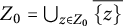 . By the previous claim, there exists
$z_0\in Z_0$
 such that
$\overline {\{z_0\}}$
 satisfies (*). By minimality of
$Z_0$
 , it follows that
$Z_0=\overline {\{z_0\}}$
 . Since Y is a
$T_0$
 -space, such a point
$z_0$
 is unique.
A specialization-closed subset
$Z\subset Y$
 satisfies (*) if and only if it contains
$Z_0$
 , equivalently, if it contains
$z_0$
 . Therefore,

which shows that the submodule is the prime corresponding to
$z_0$
 .
For an admissible datum, we construct below a natural map from the relative Matsui spectrum to the spectrum of the base. However, this map is not continuous in general. To overcome this difficulty, we introduce a finer topology on
$\mathrm {Spc}(D,S)$
 .
Let
$(D,S)$
 be a datum. Define
${\mathrm {Spc}^{\mathrm {fin}}}(D,S)$
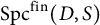 to be the topological space with underlying set
$\mathrm {Spc}(D,S)$
 whose closed subsets are generated by

We then define
${\mathrm {Spec}^{\mathrm {fin}}}(D,S)$
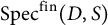 to be the ringed space whose underlying topological space is
${\mathrm {Spc}^{\mathrm {fin}}}(D,S)$
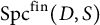 , with structure sheaf defined in the same way as for
$\mathrm {Spec}(D,S)$
 . The notation “fin” stands for “finer topology.” The space
${\mathrm {Spc}^{\mathrm {fin}}}(D,S)$
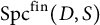 is well suited to defining the morphism to the spectrum of the base. On the other hand,
$\mathrm {Spc}(D,S)$
 has a simpler topology and is more convenient for comparing topologies (see, e.g., Theorems 6.6 and 6.8). There is a natural bijective morphism
${\mathrm {Spec}^{\mathrm {fin}}}(D,S)\to \mathrm {Spec}(D,S)$
 . If D is classically generated by a single object d, then
$\mathrm {Supp}(s\otimes D)=\mathrm {Supp}(s\otimes d)$
 , and hence this morphism is an isomorphism.
Theorem 6.4 (The morphism to the spectrum of the base)
Let
$(D,S)$
 be an admissible datum over B. Then there exists a natural morphism of ringed spaces

Proof By Lemma 6.3, the submodule
$\{s\in S\mid s\otimes D\subset P\}\subset S$
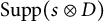
 is prime, hence the morphism is well-defined. The continuity follows because the inverse image of a closed subset of the form
$\mathrm {Supp}(s)$
 is
$\mathrm {Supp}(s\otimes D)$
 . Let
$U\subset \mathrm {Spc}(S,S)$
 be an open subset, and let
$V\subset {\mathrm {Spc}^{\mathrm {fin}}}(D,S)$
 be its inverse image. The induced morphism of structure sheaves is given by

Corollary 6.5 Let
$(D,S)$
 be a datum with a Noetherian-rigid base. Then there is a natural morphism of ringed spaces

Proof We have an isomorphism
$\mathrm {Spec}_{\otimes }(S)\cong \mathrm {Spec}(S,S,S)$
 by Theorem 4.3.
Let
$(D,S)$
 be an admissible datum. For specialization-closed subsets
$Z\subset W\subset \mathrm {Spc}(S,S)$
 , put
$D_{W\setminus Z}:= \mathrm {Idem}({\left \langle {S_W\otimes D}\right \rangle }/{\left \langle {S_Z\otimes D}\right \rangle })$
 , and let
$\mathrm {Spc}(D,S)_{W\setminus Z}$
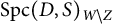 denote the set-theoretic fiber of the morphism in Theorem 6.4. Via the canonical bijection
${\mathrm {Spc}^{\mathrm {fin}}}(D,S)\to \mathrm {Spc}(D,S)$
 , we regard
$\mathrm {Spc}(D,S)_{W\setminus Z}$
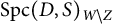 as a subspace of
$\mathrm {Spc}(D,S)$
 . In the notation of Proposition 5.8, we have a homeomorphism
$\mathrm {Spc}(D,S)_{W\setminus Z}\cong \mathrm {Spc}(D,S)_{D(W)}\setminus \mathrm {Spc}(D,S)_{D(Z)}$
 . If
$Z=\emptyset $
 , then
$D_W=D(W)$
 . If
$D=S$
 ,
$W=\mathrm {Spc}(S,S)$
 , Z is closed, and
$U=\mathrm {Spc}(S,S)\setminus Z$
 , then, in the sense of Definition 2.3, we have
$S_{W\setminus Z}=S_U$
 and
$S_Z=I_U$
 .
Theorem 6.6 Let
$(D,S)$
 be an admissible datum and
$Z\subset W\subset \mathrm {Spc}(S,S)$
 specialization-closed subsets. Then there is a natural continuous bijection

whose set-theoretic inverse is given by

If S is Noetherian-rigid and W is closed, then this map is a homeomorphism.
Proof Replacing D with
$\mathrm {Idem}(D/D(Z))$
 and Z with
$\emptyset $
 does not change either space, so we may assume that
$Z=\emptyset $
 . By Proposition 5.8, the map is well defined and bijective. Assume S is Noetherian-rigid and W is closed. By [Reference BalmerBal05, Proposition 2.14], there exists
$s\in S$
 such that
${\left \langle {s}\right \rangle }_S=S_W$
 . For any
$a\in D$
 , we have
$\mathrm {Supp}(a)\cap \mathrm {Spc}(D,S)_{W}=\mathrm {Supp}(s\otimes a)$
 . Thus, the map is closed, and hence a homeomorphism.
By Theorem 6.4, there are canonical maps of underlying sets
$\mathrm {Spc}(D_{W\setminus Z},S)\to \mathrm {Spc}(S,S)$
 and
$\mathrm {Spc}(D,S)_{W\setminus Z}\subset \mathrm {Spc}(D,S)\to \mathrm {Spc}(S,S)$
 . If S is Noetherian-rigid, then the map in Theorem 6.6 is compatible with them. In general, however, this is no longer true. Without the rigidity assumption, there is an explicit counterexample.
Theorem 6.7 Let
$(D,S)$
 be an admissible datum. Then the assignment

defines a sheaf on
$\mathrm {Spc}(S,S)$
 .
Proof The claim follows directly from Proposition 5.7.
Theorem 6.8 (Restriction of the base)
Let
$B,S',S$
 be algebra objects of
$\mathrm {Cat}_{\infty }^{\mathrm {perf}}$
 with homomorphisms
$B\to S'$
 and
$S'\to S$
 , and let D be a left S-module. Assume that S is commutative, that
$(D,S)$
 is admissible, and that there exists an open covering
$\{U_i\}_i$
 of
$\mathrm {Spec}(S,S)$
 such that, for every i,
$S_{U_i}$
 is classically generated by the image of
$S'$
 . Then there is an embedding

If S itself is classically generated by the image of
$S'$
 , then the morphism is an isomorphism. If D is a finitely generated
$S'$
 -module, then the morphism is an open embedding.
Proof First, assume S is classically generated by the image of
$S'$
 . Then
$\mathrm {Sub}_S(D)=\mathrm {Sub}_{S'}(D)$
 , hence
$\mathrm {Spec}(D,S)\cong \mathrm {Spec}(D,S')$
 .
In general, take the open covering
$\{U_i\}_i$
 of the hypothesis. Then
$\mathrm {Spec}(D_{U_i},S)\cong \mathrm {Spec}(D_{U_i},S_{U_i})\cong \mathrm {Spec}(D_{U_i},S')$
 , and we have embeddings
$\mathrm {Spec}(D_{U_i},S')\to \mathrm {Spec}(D,S')$
 . Since
$\mathrm {Spec}(D_{U_i},S)$
 covers
$\mathrm {Spec}(D,S)$
 , these local maps glue to a global morphism
$\mathrm {Spec}(D,S)\to \mathrm {Spec}(D,S')$
 . As their closed subsets are generated by
$\{\mathrm {Supp}(a)\mid a\in D\}$
 , this map is continuous and is an embedding.
Now assume D is a finitely generated
$S'$
 -module. Let
$d_1,\ldots ,d_n$
 be generators and put
$d=d_1\oplus \cdots \oplus d_n$
 . Since the sets
$\mathrm {Supp}(s)$
 for
$s\in S$
 form a basis of closed subsets of
$\mathrm {Spec}(S,S)$
 , we may assume that
$U_i=\mathrm {Spec}(S,S)\setminus \mathrm {Supp}(s_i)$
 with
$s_i\in S$
 . Note that, since
$\mathrm {Supp}({\left \langle {s_i}\right \rangle }_S)=\mathrm {Supp}(I_{U_i})$
 , Theorem 2.13 yields
${\left \langle {s_i}\right \rangle }_S=I_{U_i}$
 . It suffices to prove that the embedding
$\mathrm {Spec}(D_{U_i},S')\to \mathrm {Spec}(D,S')$
 is open. For any
$s\in S$
 ,

Hence,
${\left \langle {s_i\otimes d}\right \rangle }_{S'}={\left \langle {s_i\otimes d}\right \rangle }_{S}$
 . Therefore,
${\left \langle {I_{U_i}\otimes D}\right \rangle }_{S}={\left \langle {s_i\otimes d}\right \rangle }_{S}$
 is a finitely generated
$S'$
 -submodule, and the embedding is open by Proposition 4.1.
7 Support of large objects
We define the support for large objects and compare it with Stevenson’s support [Reference StevensonSte13] in Theorem 7.7. In this section, we identify
$\mathrm {Spc}(D,S)$
 with
$\mathrm {Spc}^{\mathrm {fin}}(D,S)$
 as sets, since we do not use any topological properties.
Definition 7.1 (Support of large objects)
Let
$(D,S)$
 be a datum, let
$P\in \mathrm {Spc}(D,S)$
 , and let
$a\in \mathrm {Ind}~ D$
 . We set
$\Gamma _P(a)=\mathrm {Fib}(L_P(a)\to L_{{P}^{+}}(a))$
 . The support of a is defined by

If
$a\in D$
 , then this definition coincides with the one given in Section 2.
Let
$(D,S)$
 be a datum with a Noetherian-rigid base (hence
$\mathrm {Spc}(S,S)\cong \mathrm {Spc}_{\otimes }(S)$
 ). For
$Q\in \mathrm {Spc}(S,S)$
 , we set
$1_Q=\mathrm {Fib}(L_Q(1_S)\to L_{{Q}^{+}}(1_S))$
 .
Definition 7.2 (Stevenson’s support [Reference StevensonSte13])
In the above setting, for
$a\in \mathrm {Ind}~ D$
 , Stevenson’s support is defined by

To compare Stevenson’s support with ours, we need additional conditions on
$(D,S)$
 .
Definition 7.3 Let
$(D,S)$
 be a datum. We say that
$(D,S)$
 has nondegenerate support theory if, for any nonzero
$a\in \mathrm {Ind}(D)$
 , we have
$\mathrm {Supp}(a)\neq \emptyset $
 .
Remark 7.4 A datum
$(D,S)$
 with a Noetherian-rigid base always satisfies the local-to-global principle, that is, for any presentable submodule
$I\subset \mathrm {Ind}~ D$
 ,

The proof is the same as that of [Reference StevensonSte13, Proposition 6.8]. In particular,
$\mathrm {Supp}_{\mathrm {st}}(a)=\emptyset $
 if and only if
$a\cong 0$
 .
Example 7.5
-
(1) If $(D,S)$
is a datum with a Noetherian-rigid base and each fiber of the morphism
$\pi :\mathrm {Spc}(D,S)\to \mathrm {Spc}(S,S)$
from Theorem 6.4 has at most one point, then
$(D,S)$
has nondegenerate support theory. Indeed, let
$a \in \mathrm {Ind}~D$
and
$P \in \mathrm {Spc}(D,S)$
, and set
$Q=\pi (P)$
. Then
$\Gamma _P(a)\cong 1_Q\otimes a$
. Hence, the claim follows from Remark 7.4. In particular,
$(S,S)$
has nondegenerate support theory. -
(2) Let $S'$
and S be algebra objects of
$\mathrm {Cat}_{\infty }^{\mathrm {perf}}$
with a homomorphism
$S'\to S$
, and let D be a left S-module satisfying the hypotheses of Theorem 6.8. If
$(D,S)$
has nondegenerate support theory, then so does
$(D,S')$
, since
$\mathrm {Spc}(D,S)$
embeds into
$\mathrm {Spc}(D,S')$
. -
(3) For any morphism $X \to Y$
of schemes, the datum
$(\mathrm {Perf}(X),\mathrm {Perf}(Y))$
has nondegenerate support theory. This follows from the preceding two examples and Theorem 8.7.










To describe the relation between Stevenson’s support and ours, we need the following lemma.
Lemma 7.6 Let
$(D,S)$
 be a datum with a Noetherian rigid base,
$\pi :\mathrm {Spc}(D,S)\to \mathrm {Spc}(S,S)$
 the morphism in Theorem 6.4,
$a\in \mathrm {Ind}~D$
 , and
$s\in \mathrm {Ind}~S$
 . Then
$\mathrm {Supp}(a)\cap \pi ^{-1}(\mathrm {Supp}_{\mathrm {st}}(s))=\mathrm {Supp}(s\otimes a).$
 In particular, for
$Q\in \mathrm {Spc}(S,S)$
 , we have
$\mathrm {Supp}(a)\cap \pi ^{-1}(Q)=\mathrm {Supp}(1_Q\otimes a).$

Proof By Remark 7.4, we have
${\left \langle {s}\right \rangle }_{\mathrm {Ind} S}^{\mathrm {pr}}={\left \langle {\{1_Q\mid Q\in \mathrm {Supp}_{\mathrm {st}}(s)\}}\right \rangle }_{\mathrm {Ind} S}^{\mathrm {pr}}.$
 Hence,
$\mathrm {Supp}(s\otimes a)=\bigcup _{Q\in \mathrm {Supp}_{\mathrm {st}}(s)}\mathrm {Supp}(1_Q\otimes a).$
 Thus, it suffices to treat the case where
$s=1_Q$
 . Take any
$P\in \mathrm {Spc}(D,S)$
 with
$\pi (P)=Q$
 . We first claim that
$\Gamma _P(1_Q\otimes a)\cong \Gamma _P(a)$
 . By Proposition 6.2, we have
$1_Q\otimes a=\mathrm {Fib}(L_{{\left \langle {Q\otimes D}\right \rangle }}(a)\to L_{{\left \langle {{Q}^{+}\otimes D}\right \rangle }}(a)).$
 Consider the following diagram:

The equalities in the diagram follow from Lemma 5.1. All rows and columns are fiber sequences. Since
${\left \langle {Q\otimes D}\right \rangle }\subset P\subset {P}^{+}$
 , we have
$L_{{\left \langle {P,Q\otimes D}\right \rangle }}(a)=L_{P}(a)$
 and
$L_{{\left \langle {{P}^{+},Q\otimes D}\right \rangle }}(a)=L_{{P}^{+}}(a).$
 Therefore,
$\Gamma _PL_{{\left \langle {Q\otimes D}\right \rangle }}(a)=\Gamma _P(a)$
 . It remains to prove that
$\Gamma _PL_{{\left \langle {{Q}^{+}\otimes D}\right \rangle }}(a)\cong 0$
 , or equivalently, that f is an equivalence. By construction, Q is the smallest thick subcategory such that
$Q\otimes D\subset P$
 . Thus,
${\left \langle {P,{Q}^{+}\otimes D}\right \rangle }$
 strictly contains P, and hence it contains
${P}^{+}$
 . It follows that
${\left \langle {P,{Q}^{+}\otimes D}\right \rangle }={\left \langle {{P}^{+},{Q}^{+}\otimes D}\right \rangle }$
 . Thus, f is an equivalence, as desired.
Next, take any
$P'\in \mathrm {Spc}(D,S)$
 such that
$\pi (P')\neq Q$
 . Now, it remains to prove that
$\Gamma _{P'}(1_Q\otimes a)\cong 0$
 . Put
$Q'=\pi (P')$
 . By the above discussion, we have
$\Gamma _{P'}(1_Q\otimes a) \cong \Gamma _{P'}(1_{Q'}\otimes 1_Q\otimes a) \cong 0.$

Theorem 7.7 (Comparison with Stevenson’s support)
Let
$(D,S)$
 be a datum with a Noetherian-rigid base, let
$\pi :\mathrm {Spc}(D,S)\to \mathrm {Spc}(S,S)$
 be the morphism in Theorem 6.4, and let
$a\in \mathrm {Ind}~ D$
 . Then we have
$\pi (\mathrm {Supp}(a))\subset \mathrm {Supp}_{\mathrm {st}}(a)$
 . Moreover, if a is compact or
$(D,S)$
 has nondegenerate support theory, then
$\pi (\mathrm {Supp}(a))=\mathrm {Supp}_{\mathrm {st}}(a)$
 .
Proof The inclusion
$\pi (\mathrm {Supp}(a))\subset \mathrm {Supp}_{\mathrm {st}}(a)$
 follows from Lemma 7.6.
Assume that
$(D,S)$
 has nondegenerate support theory, and choose
$Q\in \mathrm {Supp}_{\mathrm {st}}(a)$
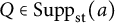 . By Lemma 7.6, we may replace a by
$1_Q\otimes a$
 . Then
$\mathrm {Supp}(a)\neq \emptyset $
 and
$\mathrm {Supp}(a)\subset \pi ^{-1}(Q)$
 . It follows that
$Q\in \pi (\mathrm {Supp}(a))$
 .
Assume that a is compact, let
$Q \in \mathrm {Supp}_{\mathrm {st}}(a)$
 , and choose a nonzero object
$s\in {Q}^{+}/Q$
 . Then
$\mathrm {Supp}_{\mathrm {st}}(s)=\{Q\}$
 and
$\mathrm {Supp}_{\mathrm {st}}(s\otimes a)=\{Q\}$
 . In particular,
$s\otimes a\not \cong 0$
 . By Lemma 7.6, it suffices to show that
$\mathrm {Supp}(s \otimes a)\neq \emptyset $
 . Set
$D_Q=\mathrm {Idem}({\left \langle {{Q}^{+}\otimes D}\right \rangle }/{\left \langle {Q\otimes D}\right \rangle }).$
 By Theorem 6.6, we have
$\pi ^{-1}(Q)\cong \mathrm {Spc}(D_Q,S)$
 . Moreover,
$s\otimes a$
 is compact in
$\mathrm {Ind}(D_Q)$
 . Applying Theorem 2.13 to
$D_Q$
 and
$s\otimes a$
 , we obtain
$\mathrm {Supp}(s\otimes a)\neq \emptyset $
 .
8 Applications
In this section, we illustrate how the relative Matsui spectrum appears in familiar geometric settings. We focus on derived categories of perfect complexes, twisted derived categories, bounded derived categories of coherent sheaves, categories of singularities of a scheme, and derived matrix factorization categories.
8.1 Some properties for calculating relative Matsui spectra
In this section, we establish several basic properties that will be useful in explicit calculations of relative Matsui spectra. We first study the behavior of submodules under change of algebras, and then prove descent-type results.
Let
$(D,S)$
 and
$(E,T)$
 be data, and let
$f_2\colon S \to T$
 be a homomorphism of algebras,
$f_1\colon D \to E$
 a morphism of S-modules, and
$f=(f_1,f_2)$
 . In this setting, we define two maps between
$\mathrm {Sub}_S(D)$
 and
$\mathrm {Sub}_T(E)$
 :

Lemma 8.1 In the above setting, the following conditions are equivalent:
-
(1) ${\left \langle {f}\right \rangle }_T$
is injective. -
(2) $f^{-1}$
is surjective. -
(3) For every prime S-submodule $P \subset D$
, we have
${\left \langle {f}\right \rangle }_T(P) \neq {\left \langle {f}\right \rangle }_T({P}^{+})$
. -
(4) For every prime S-submodule $P \subset D$
, there exists a prime T-submodule
$Q \subset E$
such that
$f^{-1}(Q) = P$
and
$f^{-1}({Q}^{+}) \supset {P}^{+}$
. -
(5) The composite $f^{-1} \circ {\left \langle {f}\right \rangle }_T$
is the identity map.





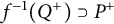

Proof (5) clearly implies (1), and (1) implies (3).
We now prove that (3) implies (4). Let
$P \subset D$
 be a prime S-submodule and take
$p \in {P}^{+} \setminus P$
 such that
$f_1(p)\notin {\left \langle {f}\right \rangle }_T(P)$
 . By Lemma 2.4, there exists a prime T-submodule
$Q \subset E$
 such that
${\left \langle {f}\right \rangle }_T(P) \subset Q$
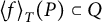 ,
$f_1(p) \notin Q$
 and
$f_1(p)\in {Q}^{+}$
 . Hence, (4) holds.
We prove that (4) implies (2). Let
$I \subset D$
 be any S-submodule. Then there exists a family
$\{P_i\}$
 of prime S-submodules such that
$I = \bigcap P_i$
 by Corollary 2.14. By (4), each
$P_i$
 is the inverse image of some prime
$Q_i \subset E$
 . Thus,
$f^{-1}\!\left ( \bigcap Q_i \right ) = \bigcap f^{-1}(Q_i) = \bigcap P_i = I,$
 and hence (2) holds.
We prove that (2) implies (5). Given any
$I \subset D$
 , there exists
$J \subset E$
 such that
$f^{-1}(J) = I$
 . Then clearly,
$f_1(I) \subset {\left \langle {f}\right \rangle }_T(I) \subset J$
 , so
$I \subset f^{-1}({\left \langle {f}\right \rangle }_T(I)) \subset f^{-1}(J) = I.$
 Hence,
$f^{-1} \circ {\left \langle {f}\right \rangle }_T = \mathrm {id}$
 , so (5) holds.
The discussion can be generalized to the presentable setting as follows. When E and T are presentable stable
$\infty $
 -categories, T is an algebra object, and E is a T-module, we write
$\mathrm {Sub}_T^{\mathrm {pr}}(E)$
 for the set of presentable T-submodules of E. For a subset
$W\subset E$
 ,
${\left \langle {W}\right \rangle }_T^{\mathrm {pr}}$
 denotes the presentable T-submodule generated by W. Let
$(D,S)$
 be a datum,
$f_2:\mathrm {Ind} ~S\to T$
 a homomorphism of algebras, and
$f_1:\mathrm {Ind}~ D\to E$
 a morphism of
$\mathrm {Ind}~ S$
 -modules. In this setting, we define

Note that
$\mathrm {Sub}_S(D)$
 naturally embeds into
$\mathrm {Sub}_{\mathrm {Ind} S}^{\mathrm {pr}}(\mathrm {Ind}~ D)$
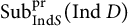 via
$I \mapsto \mathrm {Ind}~ I$
 .
Lemma 8.2 (Descent)
Let
$(D,S)$
 be a datum, and let
$S'$
 be an algebra object in
$\mathrm {Cat}_{\infty }^{\mathrm {perf}}$
 with a homomorphism
$\phi :S\to S'$
 . Assume
$\mathrm {Ind}(\phi )$
 has an adjoint
$\psi $
 , that
$\psi (s')\otimes s\cong \psi (s'\otimes \phi (s))$
 for all
$s\in S, s'\in S'$
 , and that
${\left \langle {\psi (1_{S'})\otimes d}\right \rangle }^{\mathrm {pr}}_{\mathrm {Ind} S}={\left \langle {d}\right \rangle }^{\mathrm {pr}}_{\mathrm {Ind} S}\subset \mathrm {Ind}(S\otimes D)$
 for all
$d\in D$
 (e.g.,
${\left \langle {\psi (1_{S'})}\right \rangle }^{\mathrm {pr}}_{\mathrm {Ind} S}=\mathrm {Ind}~ S$
 ). Then
$(\phi \otimes \mathrm {Id}_D,\phi ):(D,S)\to (S'\otimes _S D,S')$
 satisfies the equivalent conditions of Lemma 8.1.
Moreover, if the restriction
$\psi ':= \psi |_{S'}$
 factors through S, and
${\left \langle {\psi '}\right \rangle }_S:\mathrm {Sub}_{S'}(S'\otimes _S D)\to \mathrm {Sub}_S(D)$
 is injective, then
${\left \langle {\phi \otimes \mathrm {Id}_D}\right \rangle }_{S'}:\mathrm {Sub}_S(D)\to \mathrm {Sub}_{S'}(S'\otimes _S D)$
 is bijective.
Proof There are two maps

By assumption, the composite
${\left \langle {\psi |_{S'}\otimes \mathrm {Id}_D}\right \rangle }_{\mathrm {Ind} S}^{\mathrm {pr}}\circ {\left \langle {\phi \otimes \mathrm {Id}_D}\right \rangle }_{S'}$
 is given by
$I\mapsto \mathrm {Ind}~ I$
 . Since the composite is injective,
${\left \langle {\phi \otimes \mathrm {Id}_D}\right \rangle }_{S'}$
 is also injective.
In the case of the last assertion,
${\left \langle {\psi |_{S'}\otimes \mathrm {Id}_{D}}\right \rangle }^{\mathrm {pr}}_{\mathrm {Ind} S}$
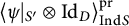 factors through
$\mathrm {Sub}_S(D)$
 ; it is injective, and its composite with
${\left \langle {\phi \otimes \mathrm {Id}_D}\right \rangle }_{S'}$
 is the identity on
$\mathrm {Sub}_S(D)$
 . This implies the bijectivity of
${\left \langle {\phi \otimes \mathrm {Id}_D}\right \rangle }_{S'}$
 .
Let
$S,S',T$
 be commutative algebra objects in
$\mathrm {Cat}_{\infty }^{\mathrm {perf}}$
 equipped with homomorphisms
$S\to S'$
 and
$S\to T$
 . Let D be an
$S'$
 -module and
$D'$
 a T-module. Set
$T':= S'\otimes _S T$
 . We denote by
$\mathrm {Func}_{\mathrm {Ind} S}^{\mathbb {L}}(\mathrm {Ind}~ D,\mathrm {Ind}~ D')$
 the
$\infty $
 -category of
$\mathrm {Ind}~ S$
 -linear colimit-preserving functors with
$\mathrm {Ind}~S$
 -linear natural transformations. This is a presentable stable
$\infty $
 -category, and it carries a natural action of
$\mathrm {Ind}~ T'$
 .
Lemma 8.3 In the above situation, let
$\Phi ,\Psi :D\to D'$
 be S-linear functors. Assume
${\left \langle {\mathrm {Ind}~ \Phi }\right \rangle }_{\mathrm {Ind} T'}^{\mathrm {pr}}={\left \langle {\mathrm {Ind}~ \Psi }\right \rangle }_{\mathrm {Ind} T'}^{\mathrm {pr}}$
 in
$\mathrm {Func}_{\mathrm {Ind} S}^{\mathbb {L}}(\mathrm {Ind}~ D,\mathrm {Ind}~ D')$
 . Then the induced maps
${\left \langle {\Phi }\right \rangle }_{T},{\left \langle {\Psi }\right \rangle }_{T}:\mathrm {Sub}_{S'}(D)\longrightarrow \mathrm {Sub}_T(D')$
 are the same.
Proof Let
$F'\to F\to F"$
 be an exact triangle in
$\mathrm {Func}_{\mathrm {Ind} S}^{\mathbb {L}}(\mathrm {Ind}~ D,\mathrm {Ind}~ D')$
 . Then for any
$d\in D$
 , the sequence
$F'(d)\to F(d)\to F"(d)$
 is an exact triangle. Similarly, the construction preserves shifts and direct sums. For any
$s\in \mathrm {Ind}~ S',\ t\in \mathrm {Ind}~ T,\ F\in \mathrm {Func}_{\mathrm {Ind} S}^{\mathbb {L}}(\mathrm {Ind}~ D,\mathrm {Ind}~ D')$
 , and
$I\in \mathrm {Sub}_{\mathrm {Ind} S}^{\mathrm {pr}}(\mathrm {Ind}~ D)$
 ,

This implies that for any
$G\in {\left \langle {F}\right \rangle }_{\mathrm {Ind} T'}^{\mathrm {pr}}$
 , we have
${\left \langle {G(I)}\right \rangle }_{\mathrm {Ind} T}^{\mathrm {pr}}\subset {\left \langle {F(I)}\right \rangle }_{\mathrm {Ind} T}^{\mathrm {pr}}$
 . In particular,
$\mathrm {Ind}~ \Phi $
 and
$\mathrm {Ind}~ \Psi $
 induce the same maps
$\mathrm {Sub}_{\mathrm {Ind} S'}^{\mathrm {pr}}(\mathrm {Ind}~ D)\to \mathrm {Sub}_{\mathrm {Ind} T}^{\mathrm {pr}}(\mathrm {Ind}~ D')$
 . These maps are compatible with
${\left \langle {\Phi }\right \rangle }_{T}$
 and
${\left \langle {\Psi }\right \rangle }_{T}$
 via the injections
$\mathrm {Sub}_{S'}(D)\to \mathrm {Sub}_{\mathrm {Ind} S'}^{\mathrm {pr}}(\mathrm {Ind}~ D), \qquad \mathrm {Sub}_T(D')\to \mathrm {Sub}_{\mathrm {Ind} T}^{\mathrm {pr}}(\mathrm {Ind}~ D')$
 , given by ind-completion. This proves the desired equality.
8.2 Derived categories of perfect complexes of schemes
For the rest of this article, all schemes are assumed to be Noetherian, and all data are taken over
$\mathrm {Perf}(\mathbb {Z})$
 unless otherwise specified.
A morphism of schemes
$X \to Y$
 gives rise to a datum
$(\mathrm {Perf}(X),\mathrm {Perf}(Y))$
 . In this section, we study the relative Matsui spectrum associated with this datum. This spectrum has several interesting properties; for example, schemes that are relatively derived equivalent to X appear in it as open subschemes. The Matsui spectrum has been used to study Fourier–Mukai partners in [Reference Hirano and OuchiHO24, Reference Ito and MatsuiIM25, Reference ItoIto23, Reference ItoIto25]. Our results make it possible to treat more general partners in relative settings. The main result of this section is Theorem 8.7.
We recall that for any scheme X, the triangulated category
$\mathrm {Perf}(X)$
 is classically finitely generated by [Reference Bondal and Van den BerghBB03, Corollary 3.1.2]. For a subset
$U \subset X$
 of the form
$U = W \setminus Z$
 with specialization-closed subsets W and Z, we denote by
$\mathrm {Perf}_U(X)$
 ,
${\mathrm {Coh}}_U(X)$
 , etc., the corresponding categories as in Theorem 6.6. If
$Z=\emptyset $
 , then
$\mathrm {Perf}_U(X)$
 denotes, as usual, the full subcategory of
$\mathrm {Perf}(X)$
 consisting of objects supported on U, and similarly for
${\mathrm {Coh}}_U(X)$
 . If U is open, then
$\mathrm {Perf}_U(X)=\mathrm {Perf}(U)$
 , and similarly
${\mathrm {Coh}}_U(X)={\mathrm {Coh}}(U)$
 .
Using Lemma 8.4 together with the properties established in the previous section, we prove the descent-type properties in Theorem 8.7.
For a dg-algebra A, we write
$D(A)$
 for the derived stable
$\infty $
 -category of dg-modules over A.
Lemma 8.4 Let R be a commutative ring,
$r_1,\ldots ,r_n\in R$
 , and let
$A=\mathrm {Kos}(R;r_1,\ldots ,r_n)$
 be the Koszul algebra. Then,

Proof Since
$\mathrm {Kos}(R; r_1,\ldots ,r_n) \cong \bigotimes _{i=1}^n \mathrm {Kos}(R; r_i)$
 , it suffices to treat the case
$n=1$
 . Put
$B=A\otimes ^{\mathbb {L}}_R A$
 and
$r=r_1$
 . Now, A is a dg-algebra of the form
$R\overset {r}{\to } R$
 , and B is of the form
$R\to R\oplus R\to R$
 . The kernel of the diagonal map
$B\to A$
 is
$A[1]$
 . Thus, there is a free resolution
$F_*=(\cdots \to B[2]\to B[1]\to B)$
 of A in the category of chain complexes of dg-B-modules. The stupid truncation
$\tau _{\ge 1}F_*$
 is a free resolution of
$A[1]$
 , and the cocone of the canonical map
$F_*\to \tau _{\ge 1}F_*$
 is B. This proves the assertion.
The following lemma is a key result in showing that restricting the base along a quasi-affine morphism does not change the relative Matsui spectrum (see Theorem 8.7(3)).
Lemma 8.5 Let
$f:X\to Y$
 be a quasi-affine morphism of schemes. Then,
$\mathrm {Perf}(X)$
 is classically generated by
$\mathbb {L} f^*\mathrm {Perf}(Y)$
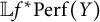 .
Proof It suffices to show that
$\mathrm {QCoh}(X)\cong \mathrm {Ind}\mathrm {Perf}(X)$
 is generated by
$\mathbb {L} f^*\mathrm {QCoh}(Y)$
 as a presentable
$\mathrm {QCoh}(Y)$
 -submodule. This follows from [Reference GrossGro17, Proposition 2.8(ii)].
Lemma 8.6 [Reference BalmerBal05, Theorem 6.3]
Let Y be a scheme. Then,
$\mathrm {Perf}(Y)$
 is Noetherian-rigid.
The following theorem is the main result of this section. Statements (1) and (4) generalize [Reference Ito and MatsuiIM25, Theorem 3.2] to Noetherian schemes. (Although the structure sheaf of our Matsui spectrum differs from the original one, this is a question concerning only the underlying spaces; see [Reference MatsuiMat23, Corollary 4.7].) Statements (5) and (6) are useful for computing the spectrum. For example, (5) is used in the next section to compute the relative Matsui spectrum of a Severi–Brauer scheme of relative dimension one.
Theorem 8.7 Let
$f:X\to Y$
 be a morphism of schemes, and
$(J,\mathrm {Perf}(Y))$
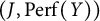 a datum with a
$\mathrm {Perf}(Y)$
 -linear equivalence
$\Phi :\mathrm {Perf}(X)\overset {\sim }{\to } J$
 . Let
$\pi _J:\mathrm {Spec}(J,\mathrm {Perf}(Y))\to Y$
 be the morphism of Theorem 6.4 with the canonical isomorphism
$\mathrm {Spec}_{\otimes }\mathrm {Ho}(\mathrm {Perf}(Y))\cong Y$
 [Reference BalmerBal05]. Then the following statements hold:
-
(1) There is a canonical open embedding
$$\begin{align*}\iota_{\Phi}:X\to \mathrm{Spec}(J,\mathrm{Perf}(Y))\end{align*}$$such that f decomposes as $\pi _J\circ \iota _\Phi $
.
-
(2) If $X=Y$
and
$f=\mathrm {Id}_X$
, then
$\mathrm {Spec}(J,\mathrm {Perf}(X))\cong X$
. -
(3) Let $g:Y\to Z$
be a morphism of schemes. Then there is a canonical open embedding
$\mathrm {Spec}(J,\mathrm {Perf}(Y))\to \mathrm {Spec}(J,\mathrm {Perf}(Z))$
. If g is quasi-affine, then it is an isomorphism. -
(4) If Y is quasi-affine, then $\mathrm {Spec}(J,\mathrm {Perf}(Y))\cong \mathrm {Spec}_{\triangle }(J)$
. -
(5) Let $h:Y'\to Y$
be a morphism of schemes,
$W\subset Y$
the image of h,
$X'=X\otimes ^{\mathbb {L}}_Y Y'$
, and
$\mathrm {pr}:X'\to X$
the projection. Then, for any prime
$\mathrm {Perf}(Y)$
-submodule
$P\subset \mathrm {Perf}(X)$
in the set-theoretic inverse image
$\pi ^{-1}_{\mathrm {Perf}(X)}(W)\subset \mathrm {Spec}(\mathrm {Perf}(X),\mathrm {Perf}(Y))$
, there exists a prime
$\mathrm {Perf}(Y')$
-submodule
$Q\subset \mathrm {Perf}(X')$
such that
$(\mathbb {L} \mathrm {pr}^*)^{-1}(Q)=P $
and
$(\mathbb {L} \mathrm {pr}^*)^{-1}({Q}^{+})\supsetneq P$
. -
(6) Let $Y'$
be a simplicial Y-scheme such that, locally on Y, it is isomorphic to the spectrum of a Koszul algebra of
$\mathscr {O}_Y$
. Let
$X'$
,
$\mathrm {pr}$
, and W be as above. Then there is a canonical homeomorphism $$\begin{align*}\mathrm{Spc}(\mathrm{Perf}(X),\mathrm{Perf}(Y))_{W}\cong \mathrm{Spc}(\mathrm{Perf}(X'),\mathrm{Perf}(Y')).\end{align*}$$
In particular, if $y\in Y$
is a regular point such that f is flat over y, then there is a homeomorphism
$\mathrm {Spc}(\mathrm {Perf}(X),\mathrm {Perf}(Y))_y\cong \mathrm {Spc}_{\triangle }(\mathrm {Perf}(X_y)).$
Moreover, there is a bijection between
$\mathrm {Sub}_{\mathrm {Perf}(Y)}(\mathrm {Perf}_W(X))$
and
$\mathrm {Sub}_{\mathrm {Perf}(Y')}(\mathrm {Perf}_W(X'))$
.








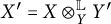


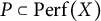










Proof First, let us prove (2). We have a homeomorphism
$\mathrm {Spc}(\mathrm {Perf}(X),\mathrm {Perf}(X))\cong \mathrm {Spc}_{\otimes }(\mathrm {Perf}(X))$
 by Theorem 4.3 and an isomorphism
$\mathrm {Spec}_{\otimes }(\mathrm {Perf}(X))\cong X$
 [Reference BalmerBal05, Theorem 6.3]. Let
$U\subset X$
 be an affine open subset, and
$j:\mathrm {Perf}(U)\to \mathrm {QCoh}(U)$
 the canonical embedding. By the universality of ind-completion ([Reference Ben-Zvi, Francis and NadlerBZFN10] and [Reference LurieLur09, Proposition 5.3.5.10]), we have

These isomorphisms give an isomorphism of structure sheaves.
(3) follows from Theorem 6.8 and Lemma 8.5.
For (1), the existence of the canonical open embedding follows from (2) and (3). The calculation of the composition
$\pi _J\circ \iota _\Phi $
 is straightforward.
(4) follows from Lemma 8.5 and Theorem 4.5.
For (5), after localizing, we may assume that Y has a unique closed point s,
$P\in \pi _{\mathrm {Perf}(X)}^{-1}(s)$
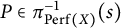 , and h is affine. By Theorem 6.6, we may replace
$\mathrm {Perf}(X)$
 by
$\mathrm {Perf}_{\pi _{f^{-1}(s)}}(X)$
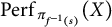 . Then, by Lemma 8.2, it suffices to show that
${\left \langle {\mathbb {R} f_* (\mathscr {O}_{Y'})}\right \rangle }_{\mathrm {QCoh}(Y)}^{\mathrm {pr}}$
 contains
$\mathrm {QCoh}_{\{s\}}(Y)$
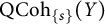 . Taking homotopy categories gives an embedding of
$\mathrm {Sub}_{\mathrm {QCoh}(Y)}^{\mathrm {pr}}(\mathrm {QCoh}(Y))$
 into the set of thick subcategories of
$\mathrm {Ho}(\mathrm {QCoh}(Y))$
 closed under arbitrary direct sums. Since Y is affine, the latter is in bijection with
$2^Y$
 by [Reference NeemanNee92, Theorem 2.8], and under this correspondence,
$\mathrm {QCoh}_{\{s\}}(Y)$
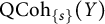 corresponds to the singleton
$\{s\}$
 . Since h is affine,
$\mathbb {R} h_* (\mathscr {O}_{Y'})\otimes ^{\mathbb {L}}_{\mathscr {O}_Y} k(s)\neq 0$
 , where
$k(s)$
 denotes the residue field at s. Hence, s belongs to the subset corresponding to
${\left \langle {\mathbb {R} h_* (\mathscr {O}_{Y'})}\right \rangle }_{\mathrm {QCoh}(Y)}^{\mathrm {pr}}$
 . Therefore,
$\mathrm {QCoh}_{\{s\}}(Y)\subset {\left \langle {\mathbb {R} h_* (\mathscr {O}_{Y'})}\right \rangle }_{\mathrm {QCoh}(Y)}^{\mathrm {pr}}$
 .
For (6), after localizing, we may assume that Y is affine and
$Y'$
 is a spectrum of a Koszul
$\mathscr {O}_Y$
 -algebra. By Lemma 8.2 and the above discussion, it suffices to show that
${\left \langle {\mathbb {L} \mathrm {pr}^*\mathbb {R} \mathrm {pr}_*}\right \rangle }_{\mathrm {Perf}(X')}: \mathrm {Sub}_{\mathrm {Perf}(Y')}(\mathrm {Perf}(X'))\to \mathrm {Sub}_{\mathrm {Perf}(Y')}(\mathrm {Perf}(X'))$
 is bijective. The functors
$\mathbb {L} \mathrm {pr}^*\mathbb {R} \mathrm {pr}_*$
 and
$\mathrm {Id}_{\mathrm {Perf}(X')}$
 are represented by

as integral transforms, respectively. By Lemma 8.3, it is enough to prove
${\left \langle {\mathscr {O}_{\Delta _{Y'}}}\right \rangle }^{\mathrm {pr}}=\mathrm {QCoh}(Y'\otimes ^{\mathbb {L}}_Y Y')$
 , which follows from Lemma 8.4.
Remark 8.8 It is known that the canonical embedding
$X \to \mathrm {Spec}_{\triangle }\mathrm {Perf}(X)$
 is an open embedding when X is quasi-affine [Reference MatsuiMat23, Corollary 4.7] or quasi-projective over an algebraically closed field [Reference Ito and MatsuiIM25, Theorem 3.2]. In fact, by Theorem 8.7, it is an open embedding whenever X is a (topologically) Noetherian scheme. Note that if one uses the original definition of Matsui spectra, X must be replaced by its reduced scheme
$X_{\mathrm {red}}$
 (see [Reference MatsuiMat23]).
Corollary 8.9 Let X be a scheme, and let
$f:Y\to X$
 be a simplicial X-scheme locally isomorphic to the spectrum of a Koszul
$\mathscr {O}_X$
 -algebra
$\mathrm {Kos}(\mathscr {O}_X;f_1,\ldots ,f_n)$
 . Let I be the ideal sheaf locally generated by
$f_1,\ldots ,f_n$
 , and let
$X_0$
 be the closed subscheme
$\mathrm {Spec}(\mathscr {O}_X/I)\subset X$
 . Then
$\mathrm {Sub}_{\mathrm {Perf}(Y)}(\mathrm {Perf}(Y))=\mathrm {Sub}_{\mathrm {Perf}(X)}(\mathrm {Perf}(Y))$
 , and this set is in bijection with specialization-closed subsets of
$X_0$
 . Moreover,
$X_0\cong \mathrm {Spec}_{\otimes }(\mathrm {Ho}(\mathrm {Perf}(Y)))\cong \mathrm {Spec}(\mathrm {Perf}(Y),\mathrm {Perf}(Y))\cong \mathrm {Spec}(\mathrm {Perf}(Y),\mathrm {Perf}(X))$
 .
Proof By Theorem 8.7,
$\mathrm {Sub}_{\mathrm {Perf}(Y)}(\mathrm {Perf}(Y))$
 corresponds bijectively to
$\mathrm {Sub}_{\mathrm {Perf}(X)}(\mathrm {Perf}_{X_0}(X))$
 , and by [Reference ThomasonTho97, Theorem 3.15],
$\mathrm {Sub}_{\mathrm {Perf}(X)}(\mathrm {Perf}_{X_0}(X))$
 corresponds bijectively to specialization-closed subsets of
$X_0$
 . Since
$\mathrm {Perf}(Y)$
 is classically generated by
$\mathbb {L} f^*\mathrm {Perf}(X)$
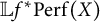 , we have
$\mathrm {Sub}_{\mathrm {Perf}(Y)}(\mathrm {Perf}(Y))=\mathrm {Sub}_{\mathrm {Perf}(X)}(\mathrm {Perf}(Y))$
 . This classification yields the homeomorphisms
$X_0\cong \mathrm {Spc}_{\otimes }(\mathrm {Ho}(\mathrm {Perf}(Y)))\cong \mathrm {Spc}(\mathrm {Perf}(Y),\mathrm {Perf}(Y))\cong \mathrm {Spc}(\mathrm {Perf}(Y),\mathrm {Perf}(X))$
 . To prove the isomorphisms of structure sheaves, after localization, we may assume that X is affine and Y is the spectrum of a Koszul
$\mathscr {O}_X$
 -algebra
$\mathrm {Kos}(\mathscr {O}_X;f_1,\ldots ,f_n)$
 , written as R. The natural isomorphism
$\mathrm {End}^0_{\mathrm {Perf}(R)}(R)\cong \pi _0(R)$
 gives the first isomorphism. The second and third isomorphisms are proved in the same way as in Theorem 8.7(2).
For a subset
$U\subset \mathrm {Spec}(D,S)$
 , we set
$I_U=\bigcap _{P\in U}P$
 . When U is open, this notation agrees with that of Definition 2.3. For general U, we have
$I_U=\bigcup _V I_V$
 , where V ranges over all open neighborhoods of U.
Definition 8.10 Let
$(D,S)$
 be a datum. We say that a subset
$X\subset \mathrm {Spec}(D,S)$
 is commutative if, for any subsets
$U,V\subset X$
 , the corresponding thick subcategories
$I_U,I_V$
 commute in the sense of Definition 5.5.
If X is open, then it suffices to consider open subsets
$U,V$
 , since commutativity is preserved under filtered unions. This can be checked using Lemma 5.3(1).
Any scheme that is relatively derived equivalent to X appears in the relative Matsui spectrum as an open subset in the sense of Theorem 8.7(1). It is natural to ask which open subsets of
$\mathrm {Spec}(\mathrm {Perf}(X),\mathrm {Perf}(Y))$
 arise in this way. Proposition 8.11 gives a partial characterization of such open subsets.
Proposition 8.11 Let
$X\to Y$
 be a morphism of schemes, and let
$\iota :X\to \mathrm {Spec}(\mathrm {Perf}(X),\mathrm {Perf}(Y))$
 be the natural open embedding. Then the image of
$\iota $
 is a maximal commutative subset.
Proof Since
$\mathrm {Perf}(X)$
 is rigid, the image of
$\iota $
 is commutative by [Reference KrauseKra23, Proposition 4.2] or Proposition 6.2. We now prove maximality. Let
$U\subset \mathrm {Spec}(\mathrm {Perf}(X),\mathrm {Perf}(Y))$
 be a commutative subset containing
$\iota (X)$
 , and let
$P\in U$
 be a prime submodule. It suffices to prove that
$P=\mathrm {Perf}_Z(X)$
 for some specialization-closed subset
$Z\subset X$
 . More generally, we prove that any thick subcategory
$I\subset \mathrm {Perf}(X)$
 such that
$(I,I_U)$
 is composable for every
$U\subset X$
 is of the form
$\mathrm {Perf}_Z(X)$
 for some specialization-closed subset
$Z\subset X$
 . Take a finite affine open cover
$\{U_i\}_i$
 of X, and set
$Z=\mathrm {Supp}(I)\cap X$
 and
$Z_i=X\setminus U_i$
 . Then
${\left \langle {\mathrm {Perf}_{Z_i}(X)\cup I}\right \rangle }=\mathrm {Perf}_{Z_i\cup Z}(X),$
 since submodules containing
$\mathrm {Perf}_{Z_i}(X)$
 correspond bijectively to submodules of
$\mathrm {Idem}(\mathrm {Perf}(X)/\mathrm {Perf}_{Z_i}(X))\cong \mathrm {Perf}(U_i)$
 , by the classification theorem [Reference ThomasonTho97, Theorem 3.15], together with the fact that every thick subcategory of an affine scheme is a tensor ideal. By Lemma 5.6(5), it follows that
$I={\left \langle {I,\bigcap _i\mathrm {Perf}_{Z_i}(X)}\right \rangle } =\bigcap _i {\left \langle {I,\mathrm {Perf}_{Z_i}(X)}\right \rangle } =\bigcap _i\mathrm {Perf}_{Z_i\cup Z}(X) =\mathrm {Perf}_Z(X).$

Let X be a scheme and let
$x\in X$
 . We denote by
$P_x=\{F\in \mathrm {Perf}(X)\mid x\notin \mathrm {Supp}(F)\}$
 the prime thick subcategory corresponding to x.
Proposition 8.12 generalizes [Reference HuybrechtsHuy06, Corollaries 5.23 and 6.14], since
$P_x$
 is determined by the residue field
$k(x)$
 in the sense that
$P_x=\{F\in \mathrm {Perf}(X)\mid \mathrm {Hom}^* (F,k(x))=0\}$
 .
Proposition 8.12 Let Y be a scheme, and let
$X,X'$
 be Y-schemes. Suppose
$\Phi :\mathrm {Perf}(X)\to \mathrm {Perf}(X')$
 is an equivalence of
$\mathrm {Perf}(Y)$
 -modules. Define

Then
$X(\Phi )$
 is an open subscheme of X, and there is an isomorphism
$X(\Phi )\cong X'(\Phi ^{-1})$
 . Moreover,
$X(\Phi )=X$
 if and only if
$X'(\Phi ^{-1})=X'$
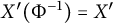 .
Proof Let
$\iota _1,\iota _2:X,X'\to \mathrm {Spec}(\mathrm {Perf}(X),\mathrm {Perf}(Y))$
 be the open embeddings associated with
$\mathrm {Id}_{\mathrm {Perf}(X)}$
 and
$\Phi ^{-1}$
 , respectively. Then we have
$X(\Phi )\cong \iota _1(X)\cap \iota _2(X')\cong X'(\Phi ^{-1})$
 . Let us prove the last assertion. By Proposition 8.11, the condition
$X(\Phi )=X$
 is equivalent to the condition that
$\iota _1(X)\cap \iota _2(X')\subset \mathrm {Spec}(\mathrm {Perf}(X),\mathrm {Perf}(Y))$
 is a maximal commutative subset. Again by Proposition 8.11, this is equivalent to
$X'(\Phi ^{-1})=X'$
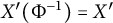 .
8.3 Twisted derived categories and Severi–Brauer schemes
In this section, we examine twisted derived categories and Severi–Brauer schemes. We show that the relative Matsui spectrum of a twisted perfect complex recovers the base scheme. For Severi–Brauer schemes, the spectrum contains the scheme itself together with countably many copies of the base. In relative dimension one, we obtain an isomorphism and classify submodules via a family of specialization-closed subsets.
Let X be a scheme, and let
$\mu = (\mu _0, \mu _1) \in \mathrm {H}_{\acute {\text{e}t}}^2(X, \mathbf {G}_m) \times \mathrm {H}_{\acute {\text{e}t}}^1(X, \mathbb {Z})$
 . The corresponding twisted derived category
$\mathrm {Perf}(X, \mu )$
 is naturally a
$\mathrm {Perf}(X,0)=\mathrm {Perf}(X)$
 -module (see [Reference ToënToë12] for the definition). There is a canonical isomorphism

When
$\mu _1=0$
 , the category
$\mathrm {Perf}(X, \mu )$
 is called the derived category of perfect complexes of twisted sheaves (see [Reference CaldararuCal00] for details).
Theorem 8.13 Let X be a scheme and
$\mu \in \mathrm {H}_{\acute {\text{e}t}}^2(X,\mathbf {G}_m)\times \mathrm {H}_{\acute {\text{e}t}}^1(X,\mathbf {Z})$
 . Consider the morphism

of Theorem 6.4, equipped with the canonical isomorphism
$\mathrm {Spec}_{\otimes }\mathrm {Ho}(\mathrm {Perf}(X))\cong X$
 . Then
$\pi $
 is an isomorphism. Moreover, specialization-closed subsets of X correspond bijectively to submodules of
$\mathrm {Perf}(X,\mu )$
 .
Proof Let
$F\in \mathrm {Perf}(X,\mu )$
 and
$F'\in \mathrm {Perf}(X,-\mu )$
 be classical generators, whose existence is shown in [Reference ToënToë12]. Then
$F\otimes F'$
 and
$F'\otimes F$
 are classical generators of
$\mathrm {Perf}(X)$
 . Hence, the maps

and

are inverse to each other, and thus bijections. Therefore,
$\pi $
 is a homeomorphism and submodules
$\mathrm {Sub}_{\mathrm {Perf}(X)}(\mathrm {Perf}(X,\mu ))$
 correspond bijectively to specialization-closed subsets of X.
Next, we prove the isomorphism of structure sheaves. Let
$U\subset X$
 be an open subset. Recall that for any
$\eta ,\eta '$
 , there is a canonical equivalence
$\mathrm {Perf}(U,\eta |_U)\otimes _{\mathrm {Perf}(X)}\mathrm {Perf}(U,\eta '|_U)\cong \mathrm {Perf}(U,(\eta +\eta ')|_U)$
 . Hence, there are
$\mathrm {Perf}(X)$
 -linear homomorphisms

which are inverse to each other and hence are isomorphisms. Therefore, it suffices to consider the case
$\mu =0$
 , which is proved in Theorem 8.7.
Let Y be a scheme, and let
$X\to Y$
 be a Severi–Brauer scheme of relative dimension
$r>0$
 . Let
$\mu \in \mathrm {H}_{\acute {\text{e}t}}^2(Y,\mathbf {G}_m)$
 be the class corresponding to X. For an integer k, let
$\mathrm {Perf}(Y,X)_k\subset \mathrm {Perf}(X)$
 be the full subcategory consisting of objects F such that, for any étale morphism
$U\to Y$
 with
$X_U\cong \mathbb {P}^r_U$
 , one has
$F|_{X_U}\in {\left \langle {\mathscr {O}(k)}\right \rangle }_{\mathrm {Perf}(U)}$
 . By [Reference BernardaraBer09, Theorem 5.4], each component
$\mathrm {Perf}(Y,X)_k$
 is equivalent to
$\mathrm {Perf}(Y,-k\mu )$
 . In particular, each of these categories is classically finitely generated by [Reference ToënToë12].
Lemma 8.14 In the above setting, for any integer k,
$\mathrm {Perf}(X)$
 admits a semiorthogonal decomposition of the form
$\mathrm {Perf}(X)=\left \langle \mathrm {Perf}(Y,X)_k,\ldots ,\mathrm {Perf}(Y,X)_{k+r}\right \rangle .$

Proof Note that this is proved in [Reference BernardaraBer09, Theorem 5.1] in the case
$k=0$
 . The semiorthogonality in the general case is proved in [Reference BernardaraBer09, Lemma 5.6]. It remains to prove the generation statement, namely,
${\left \langle {\mathrm {Perf}(Y,X)_k,\ldots ,\mathrm {Perf}(Y,X)_{k+r}}\right \rangle }=\mathrm {Perf}(X).$
 Note that both sides are
$\mathrm {Perf}(Y)$
 -submodules of
$\mathrm {Perf}(X)$
 . Let
$U\to Y$
 be an étale cover such that
$X_U\cong \mathbb {P}^r_U$
 , and let
$\mathrm {pr}\colon X_U\to X$
 denote the projection. To reduce the problem after base change, we first prove that
${\left \langle {\mathbb {L}\, \mathrm {pr}^*\mathrm {Perf}(Y,X)_n}\right \rangle }_{\mathrm {Perf}(U)}=\mathrm {Perf}(U,X_U)_n$
 for any integer n. As a
$\mathrm {Perf}(U)$
 -module,
$\mathrm {Perf}(U,-n\mu |_{U})\cong \mathrm {Perf}(Y,-n\mu )\otimes _{\mathrm {Perf}(Y)}\mathrm {Perf}(U)$
 is generated by the image of
$\mathrm {Perf}(Y,-n\mu )$
 . Since the equivalence
$\mathrm {Perf}(Y,X)_n\cong \mathrm {Perf}(Y,-n\mu )$
 is compatible with base change by construction [Reference BernardaraBer09, Lemma 5.3], this proves the claim. By Theorem 8.7(5) and Lemma 8.1, the equality
${\left \langle {\mathrm {Perf}(Y,X)_k,\ldots ,\mathrm {Perf}(Y,X)_{k+r}}\right \rangle }=\mathrm {Perf}(X)$
 may be checked after base change along
$U\to Y$
 . In this case, tensoring with
$\mathscr {O}(-k)$
 reduces the problem to the case
$k=0$
 .
Proposition 8.15 Let Y be a scheme, and let
$X\to Y$
 be a Severi–Brauer scheme of relative dimension
$r>0$
 . Then there is a natural open embedding

Proof The embedding from X on the level of underlying spaces follows from Theorem 8.7. The same argument used in the proof of Theorem 8.7 shows that this is in fact an open embedding of ringed spaces.
Let
$\mu \in \mathrm {H}_{\acute {\text{e}t}}^2(Y, \mathbf {G}_m)$
 be the class corresponding to X. By Lemma 8.14, for any integer k, the category
$\mathrm {Perf}(X)$
 admits a semiorthogonal decomposition of the form
$(\mathrm {Perf}(Y, X)_k, \ldots , \mathrm {Perf}(Y, X)_{k+r})$
 . Each component
$\mathrm {Perf}(Y, X)_k$
 is equivalent to
$\mathrm {Perf}(Y, -k\mu )$
 , and each is classically finitely generated by [Reference ToënToë12]. This yields an open embedding

For each k, the image of
$\iota _k$
 is disjoint from X, since
$X\subset \mathrm {Supp}(\mathrm {Perf}(Y,X)_{k+1})$
 while
$\iota _k(Y)\cap \mathrm {Supp}(\mathrm {Perf}(Y,X)_{k+1})=\emptyset $
 . Similarly, the images of
$\iota _k$
 and
$\iota _{k+1}$
 are disjoint.
Theorem 8.16 Let Y be a scheme, and let
$X\to Y$
 be a Severi–Brauer scheme of relative dimension
$1$
 . Then there is an isomorphism

Moreover, the set of submodules
$\mathrm {Sub}_{\mathrm {Perf}(Y)}(\mathrm {Perf}(X))$
 is in bijection with subsets
$Z\subset \mathrm {Spc}(\mathrm {Perf}(X),\mathrm {Perf}(Y))$
 satisfying:
-
(1) Z is specialization-closed.
-
(2) For each $y\in Y$
, the fiber
$Z_y$
is one of the following:-
(a) the empty set,
-
(b) there exists a non-empty specialization-closed subset $W\subset X_y$
such that
$Z_y=W\;\amalg \;\bigl (\coprod_{\mathbb {Z}}\{y\}\bigr )$
, or -
(c) there exists some $n\in \mathbb {Z}$
such that
$Z_y=X_y\;\amalg \;\bigl (\coprod_{\mathbb {Z}\setminus \{n\}}\{y\}\bigr )$
.
-





Proof If Y is the spectrum of an algebraically closed field, then X is the projective line, and the claim follows from [Reference Krause and StevensonKS19] and [Reference MatsuiMat23, Corollary 4.9]. In general, the morphism is given by Proposition 8.15, and it is an isomorphism by Theorem 8.7(5), taking
$X'$
 to be the spectrum of an algebraically closed field.
Next, we classify submodules of
$\mathrm {Perf}(X)$
 . The correspondence is given by the support map, which is always injective by Theorem 2.13. Condition (1) is standard. For (2), let
$s = \mathrm {Spec}~ \overline {k}$
 be the spectrum of an algebraically closed field, and take a morphism
$s \to Y$
 . Define

Then the following diagram commutes:

Thus, condition (2) is necessary.
Now, to verify existence: given a subset Z satisfying (1) and (2), set

Here,
$U,V_m$
 are specialization-closed subsets of Y, and
$U'$
 is specialization-closed in X. Define
$I={\left \langle {\mathrm {Perf}_{U'}(X)\cup \bigcup _{m\in \mathbb {Z}}\ \bigcup _{a\in \mathrm {Perf}_{V_m}(Y)} a\otimes \mathrm {Perf}(Y,X)_{m+1}}\right \rangle }$
 . It is straightforward to check that
$\mathrm {Supp}(I)=Z$
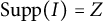 .
8.4 Koszul algebras
Liu and Pollitz [Reference Liu and PollitzLP25] gave a beautiful classification of thick subcategories over Koszul algebras of regular rings. Our construction generalizes their results to the setting of regular schemes.
For a graded commutative ring A, let
$\mathrm {Spec}^{\mathrm {gr}} A$
 denote the set of homogeneous prime ideals of A with the usual topology. There is a bijection
$\mathrm {Spec}^{\mathrm {gr}} A \cong \mathrm {Proj}(A) \amalg \mathrm {Spec}(A_0)$
 . Let R be a commutative ring, and let
$f_1,\ldots ,f_n \in R$
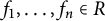 . Set
$E = \mathrm {Kos}(R; f_1,\ldots ,f_n)$
 , the Koszul R-algebra. Let
$A = R[x_1,\ldots ,x_n]$
 , where each
$x_i$
 is assigned homological degree
$-2$
 . Define
$\mathrm {Supp}^{\mathrm {coh}}(\mathrm {Spec} E)$
 and
$\mathrm {Supp}^{\mathrm {sing}}(\mathrm {Spec} E)$
 to be the subspaces of
$\mathrm {Spec}^{\mathrm {gr}}(A)$
 , denoted by
$\mathrm {Supp}(A,w)$
 and
$\mathrm {Sing}(\mathrm {Proj}(A/(w)))$
 in [Reference Liu and PollitzLP25], respectively. There is a bijection of sets

For a point
$x\in \mathrm {Spec} E$
 (where we identify
$\mathrm {Spec} E$
 with
$\mathrm {Spec} R/(f_1,\ldots ,f_n)$
 as a topological space), the topological fiber
$\mathrm {Supp}(\mathrm {Spec} E)_x$
 is given by

where
$c(x) = n - \bigl (\dim (\mathscr {O}_{\mathrm {Spec} R,x}) - \mathrm {embdim}(\mathscr {O}_{R/(f_1,\ldots ,f_n),x})\bigr )$
 .
Let Y be a simplicial scheme locally isomorphic to the spectrum of a Koszul algebra
$\mathrm {Kos}(R;f_1,\ldots ,f_n)$
 of a regular ring R. Denote by
$\mathrm {D}^f(Y)$
 the full subcategory of
$\mathrm {QCoh}(Y)$
 consisting of bounded complexes with
$\pi _0(\mathscr {O}_Y)$
 -coherent cohomology. By gluing together the spaces
$\mathrm {Supp}^{\mathrm {coh}}(\mathrm {Spec} E)$
 (resp.
$\mathrm {Supp}^{\mathrm {sing}}(\mathrm {Spec} E)$
 ), one obtains the topological space
$\mathrm {Supp}^{\mathrm {coh}}(Y)$
 (resp.
$\mathrm {Supp}^{\mathrm {sing}}(Y)$
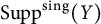 ) over Y.
Lemma 8.17 In the above setting,
$\mathrm {Perf}(Y)$
 is Noetherian-rigid.
Proof By [Reference Gaitsgory, Rozenblyum, Etingof, Khovanov and SavageGR14, Section 2.2.1],
$\mathrm {Perf}(Y)$
 is rigid. The space
$\mathrm {Spc}_{\otimes }(\mathrm {Ho}(\mathrm {Perf}(Y)))$
 is computed locally in Corollary 8.9. By gluing these local descriptions, we obtain
$\mathrm {Spc}_{\otimes }(\mathrm {Ho}(\mathrm {Perf}(Y)))\cong Y$
 .
Theorem 8.18 In the above setting, there is a bijection

The closed subsets of
$\mathrm {Spc}(\mathrm {D}^f(Y),\mathrm {Perf}(Y))$
 are generated by those subsets
$Z\subset \mathrm {Spc}(\mathrm {D}^f(Y),\mathrm {Perf}(Y))$
 that are, locally on Y, closed subsets of
$\mathrm {Spec}^{\mathrm {gr}}(A)$
 . Submodules of
$\mathrm {D}^f(Y)$
 correspond bijectively to specialization-closed subsets of
$\mathrm {Spc}(\mathrm {D}^f(Y),\mathrm {Perf}(Y))$
 .
Proof If Y is isomorphic to the spectrum of a Koszul algebra, then [Reference Liu and PollitzLP25] shows that
$\mathrm {Sub}_{\mathrm {Perf}(Y)}(\mathrm {D}^f(Y))$
 is in bijection with the specialization-closed subsets of
$\mathrm {Supp}^{\mathrm {coh}}(Y)$
 . In this case, the statement follows from Example 3.10. For general Y, the result is obtained by patching these local descriptions via Theorem 6.7.
If
$f_1,\ldots ,f_n$
 form a regular sequence, then Y is a classical scheme which is locally a complete intersection. In this case,
$\mathrm {D}^f(Y)={\mathrm {Coh}}(Y)$
 , and explicit arguments are given in the next section.
8.5 The categories related to singularities
In this section, we investigate the relative Matsui spectra associated with categories of singularities and coherent sheaves. We establish comparison diagrams and characterize fibers in terms of regularity, complete intersections, and hypersurface singularities. This provides a geometric interpretation of singular loci via the spectra of these categories.
A topological space S is called local if S has a unique closed point s, and every point
$s'\in S$
 is a generalization of s.
The embedding codimension
$\mathrm {ecodim}(R)$
 of a local ring R is defined as the difference between its embedding dimension and its Krull dimension. A local complete intersection ring is called a hypersurface if its embedding codimension is
$0$
 or
$1$
 .
Theorem 8.19 Let
$X\to Y$
 and
$Y\to Y'$
 be morphisms of schemes. Then there exists the following commutative diagram:

If
${\mathrm {Coh}}(X)$
 is finitely generated (e.g., when X is a separated scheme of finite type over a perfect field [Reference RosenbergRos96, Theorem 7.39]), then
$b,b'$
 are open embeddings; otherwise, they are injections. The maps
$s,s'$
 are always open embeddings.
Put
$X^{\mathrm {coh}}=\mathrm {Spc}({\mathrm {Coh}}(X),\mathrm {Perf}(X))$
 and
$X^{\mathrm {sing}}=\mathrm {Spc}(\mathrm {Sing}(X),\mathrm {Perf}(X))$
 . Fix a point
$x\in X$
 . Then the following statements hold:
-
(1) The following are equivalent: X is regular at x; the fiber $(X^{\mathrm {coh}})_x$
consists of a single point; and the fiber
$(X^{\mathrm {sing}})_x$
is empty. -
(2) X is a complete intersection at x if and only if the space $(X^{\mathrm {coh}})_x$
is local. -
(3) If X is locally a complete intersection, then there are bijections
$$ \begin{align*} X^{\mathrm{coh}} &\cong \mathrm{Supp}^{\mathrm{coh}}(X)\cong \mathrm{Supp}^{\mathrm{sing}}(X)\amalg X,\\ X^{\mathrm{sing}} &\cong \mathrm{Supp}^{\mathrm{sing}}(X), \end{align*} $$where $\mathrm {Supp}^{\mathrm {coh}}(X)$
and
$\mathrm {Supp}^{\mathrm {sing}}(X)$
are the spaces defined in the previous section. In particular, there is a canonical closed embedding
$X \hookrightarrow X^{\mathrm {coh}}$
. Submodules of
${\mathrm {Coh}}(X)$
and
$\mathrm {Sing}(X)$
correspond bijectively to specialization-closed subsets of
$X^{\mathrm {coh}}$
and
$X^{\mathrm {sing}}$
, respectively. For a point
$x\in X$
, there are bijections $$\begin{align*}(X^{\mathrm{coh}})_x \cong \mathbb{P}_{k(x)}^{\mathrm{ecodim}(\mathscr{O}_{X,x})-1}\amalg \{x\},\quad (X^{\mathrm{sing}})_x \cong \mathbb{P}_{k(x)}^{\mathrm{ecodim}(\mathscr{O}_{X,x})-1}. \end{align*}$$
-
(4) If X is a hypersurface at every point, then there is a homeomorphism
$$\begin{align*}X^{\mathrm{sing}}\cong \{\text{singular locus of }X\}. \end{align*}$$


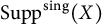


Proof The maps
$s,s'$
 of underlying sets are constructed as in Proposition 4.1, and
$b,b'$
 as in Theorem 6.8. Commutativity follows from the naturality of these constructions. Continuity of
$s,s',b,b'$
 also follows, since the topology on
$\mathrm {Spec}^{\mathrm {fin}}$
 is the weakest one containing that of
$\mathrm {Spec}$
 and making the maps to the spectrum of the base continuous.
(1) If X is regular at x, the claim is clear. Suppose X is not regular at x. Then
${\mathrm {Coh}}_x(X)$
 has at least three distinct submodules:
$0$
 ,
$\mathrm {Perf}_x(X)$
 , and
${\mathrm {Coh}}_x(X)$
 . By Theorems 2.13 and 6.6, the space
$\mathrm {Spc}({\mathrm {Coh}}_x(X),\mathrm {Perf}(X))\cong (X^{\mathrm {coh}})_x$
 must have at least
$\lceil \log _2 3\rceil =2$
 points. Since
$\mathrm {Sing}_x(X)$
 is nontrivial, Theorem 6.6 and Corollary 2.15 imply that
$(X^{\mathrm {sing}})_x\cong \mathrm {Spc}(\mathrm {Sing}_x(X),\mathrm {Perf}(X))\neq \emptyset $
 .
(2) This follows directly from [Reference PollitzPol19] (see also Remark 2.2).
(3) This follows from the previous section.
(4) After localization, assume X is affine. Then the statement follows from [Reference MatsuiMat21, Corollary 3.8].
8.6 Derived matrix factorization categories
Let X be a scheme, L a line bundle on X, and
$W \in \Gamma (X, L)$
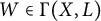 . The derived matrix factorization category
$\mathrm {DMF}(X, L, W)$
 was introduced by Positselski [Reference Efimov and PositselskiEP15, Reference PositselskiPos11]. There is a natural action of
$\mathrm {DMF}(X, L, 0)$
 on
$\mathrm {DMF}(X, L, W)$
 .
Let
$\iota :Z \to X$
 be a closed subscheme. Hirano [Reference HiranoHir19] introduced the relative singular locus
$\mathrm {Sing}(Z/X)$
 by

When
$2$
 is invertible on X and W is a nonzero-divisor, he reconstructed the relative singular locus of the zero scheme
$X_0$
 of W using the Balmer spectrum with a certain tensor structure. Our construction extends this result.
The author gratefully acknowledges Hirano and Ouchi, from whom he learned this idea.
Theorem 8.20 Assume that X is separated and admits an ample family of line bundles. If W is a nonzero-divisor, then there is a homeomorphism

Proof This follows from Hirano’s classification of
$\mathrm {DMF}(X, L, 0)$
 -submodules [Reference HiranoHir19] and Example 3.10.
Note that the underlying set of
$\mathrm {Spc}(\mathrm {DMF}(X, L, W), \mathrm {DMF}(X, L, 0))$
 is the same as that of
$\mathrm {Spc}^{\mathrm {fin}}(\mathrm {DMF}(X, L, W), \mathrm {DMF}(X, L, 0))$
 , but its family of closed subsets is generated by
$\{\, Z \subset \mathrm {Sing}(X_0/X) \mid Z \text { is closed in } X \,\}$
 .
Acknowledgements
I am deeply grateful to Seidai Yasuda, Takumi Asano, and Kango Ito for their invaluable support during the preparation of this article. I also thank Yuki Hirano, Daigo Ito, Hiroki Matsui, and Genki Ouchi for their helpful advice and insightful comments.



