Introduction
Species richness and their abundance are the most widely used measures of ecological biodiversity. These metrics have been extensively used to detect the impact of habitat modification in ecological communities and to suggest conservation priorities in human-impacted habitats. However, complementary approaches have been implemented in order to understand the magnitude of anthropogenic changes and their influence in biodiversity (Moreno et al. Reference Moreno, Castillo‐Campos and Verdú2009). The estimation of ecological, taxonomic and functional diversity concurrently allows for a better understanding of the impact of anthropogenic disturbances on all different aspects of biodiversity. More recently, ecological diversity can be estimated by using Hill numbers (Chao et al. Reference Chao, Gotelli, Hsieh, Sander, Ma, Colwell and Ellison2014, Jost Reference Jost2006, Murillo-Pacheco et al. Reference Murillo-Pacheco, Rös, Escobar, Castro-Lima, Verdú and López-Iborra2016). The use of Hill numbers permits comparing the magnitude of the differences of plant and animal communities between natural and perturbed habitats, but it does not always detect all changes in biodiversity.
The degree of species phylogenetic relatedness is an additional feature that can be used in the analysis of species diversity. A set of closely related species in a particular habitat should be considered as having low phylogenetic diversity. Some approaches have been proposed to measure distinctness among species, by taking into account the topology of their phylogenetic tree or by considering only the taxonomic arrangement of species as a crude approximation to their evolutionary distinctness (Clarke & Warwick Reference Clarke and Warwick1998, Faith Reference Faith, Forey, Humphries and Vane-Wright1994, Warwick & Clarke Reference Warwick and Clarke1995). This last approach, which only requires the taxonomic arrangement of species, allows the measurement of taxonomic diversity and is based on the assumption that a community with closely related species is less biodiverse, in a phylogenetic sense, than a community with low relatedness among species.
Functional diversity has received growing attention in studies of community ecology and conservation biology because it may provide a better understanding of ecosystem functioning (Vandewalle et al. Reference Vandewalle, de Bello, Berg, Bolger, DoleÂdec and Dubs2010). Functional diversity is the variability in roles played by species within ecosystems and represents the degree of trait differences among species, for example in the way species use resources (Weiher Reference Weiher, Magurran and McGill2011). Functional diversity can be quantified using different indices that detect differences in the distribution of functional traits within a community (Petchey & Gaston Reference Petchey and Gaston2006). Functional traits are phenotypic, observable or operational features that affect species performance or ecosystem processes (Weiher Reference Weiher, Magurran and McGill2011). An approach based on functional traits permits the understanding of the differential responses of species and communities to habitat modification (Mayfield et al. Reference Mayfield, Bonser, Morgan, Aubin, McNamara and Vesk2010).
Spiders are abundant and diverse generalist predators and are present in most terrestrial ecosystems (Foelix Reference Foelix1996). Spiders display a wide range of functional traits, including the following: dispersal abilities, foraging strategies and other behavioural patterns reflecting their essential relationship with the vegetation and habitat structure. Because of their ubiquity in different terrestrial ecosystems and habitat types, the Araneae has been widely used in studies that try to disentangle the different dimensions of biodiversity in perturbed ecosystems (Amaral-Nogueira & Pinto-da-Rocha Reference Amaral-Nogueira and Pinto-da-Rocha2016, Gavish & Ziv Reference Gavish and Ziv2016, Lowe et al. Reference Lowe, Wilder and Hochuli2017, Podgaiski et al. Reference Podgaiski, Joner, Lavorel, Moretti, Ibanez, Mendonça Mde and Pillar2013).
Spiders are one of the most abundant predator groups in tropical rain forests; they are also recognized as an excellent model for biodiversity inventories, mostly for being usually abundant and easy to collect (Coddington et al. Reference Coddington, Griswold, Dávila and Dudley1991). There is evidence that old-growth continuous tropical rain forests might function as a spider species-source for the re-colonization of nearby perturbed areas. Furthermore, old-growth forests have shown greater spider richness than open, disturbed areas and at early successional stages of the vegetation (Floren & Deeleman-Reinhold Reference Floren and Deeleman-Reinhold2005). Recently, some conservation priority areas in Brazil have been proposed based on spiders’ biodiversity dimensions (Gonçalves-Souza et al. Reference Gonçalves-Souza, Santos and Romero2015).
Habitat loss and fragmentation have been shown to affect microhabitat conditions for several arthropod communities, including spiders, with implications for species composition, richness and abundance. Changes of spider taxonomic diversity in fragments could be caused by the combined effects of changes in environmental conditions (e.g. microclimate, vegetation density and habitat structure), substrate availability, bottom-up and top-down controls of spider populations, local species extinction and invasions, changes in growth rates and reproduction, and spiders’ dispersal ability (Wirth et al. Reference Wirth, Meyer, Tabarelli and Leal2008). The former changes could affect the composition of trophic guilds and spider foraging strategies with consequences for predator–prey interactions and ecosystem functioning (Benítez-Malvido et al. Reference Benítez-Malvido, Dáttilo, Martínez-Falcón, Durán-Barrón, Valenzuela, López and Lombera2016). For instance, shifts in the assemblage of passive and active hunting strategies in a given spider community could lead to differential insect predation and the release and/or suppression of their populations with potential consequences for insect pollination and herbivory.
Taking into account that habitat loss and fragmentation are recognized as the greatest threats to the maintenance of global biodiversity (Brooks et al. Reference Brooks, Mittermeier, Mittermeier, da Fonseca, Rylands, Konstant, Flick and Pilgrim2002, Hanski Reference Hanski2011), the aim of this study was to examine from an ecological, taxonomic and functional perspective how habitat fragmentation affected the assembly of spider communities associated with an herbaceous tropical plant species, Heliconia aurantiaca Ghiesbreght ex Lamaire (Heliconiaceae). We tested the hypothesis that spiders’ ecological, taxonomic and functional diversity are modified as a consequence of habitat fragmentation. We predicted that within old-growth continuous forests all three aspects of spider biodiversity would be greater than in forest fragments (Benítez-Malvido et al. Reference Benítez-Malvido, Martínez-Falcón, Dáttilo and Del Val2014, Reference Benítez-Malvido, Dáttilo, Martínez-Falcón, Durán-Barrón, Valenzuela, López and Lombera2016).
Methods
Study area
The study was carried out in the region of the Lacandon rain forest, in the State of Chiapas, southern Mexico. This region corresponds to one of the most important biodiversity hotspots in Mesoamerica (CONABIO 2004), which includes the Montes Azules Biosphere Reserve (MABR; 16°06′N, 90°56′W, 120 m elev.). Land-cover changes in the past decades have dramatically reduced the original forested area (500,000 ha) by a third in 40 years. The MABR contains the majority of the remaining original forest in Mesoamerica (3310 km2) (Figueroa et al. Reference Figueroa, Sánchez-Cordero, Meave and Trejo2009, Myers et al. Reference Myers, Mittermeier, Mittermeier, Da Fonseca and Kent2000). Currently, the study landscape is composed of a mosaic of different land uses, including the following: forest fragments of several sizes and shapes, secondary forest of various ages, small human settlements, several cropland types, active and abandoned cattle pastures, and paved and unpaved roads. The number of vascular plants from the MABR region is ∼4000 species (Medellín Reference Medellín1994). Annual precipitation averages 3000 mm, whereas annual temperatures range from 18 °C (January–February) to 31.8 °C (April–May) (Meave del Castillo Reference Meave del Castillo1990).
Two replicates of contrasting but common habitat types in the study region were used for this study, including: old-growth continuous forests and small forest fragments (<10 ha with 20–30 years of isolation). Previous studies have shown that compared with fragments, continuous forest sites hold a greater number of large trees (>60 cm diameter at breast height) with lower canopy openness and temperatures (Benítez-Malvido et al. Reference Benítez-Malvido, Dáttilo, Martínez-Falcón, Durán-Barrón, Valenzuela, López and Lombera2016, González-Di Pierro et al. Reference González-Di Pierro, Benítez-Malvido, Méndez-Toribio, Zermeño, Arroyo-Rodríguez and Stoner2011). Due to our study sites being at least 4 km apart from each other and the low vagility of spiders, we assumed we sampled different populations of both H. aurantiaca plants and spiders. The forest fragments were located in the ‘Ejido Chajul’ (16°10′N, 90°59′W) in the vicinity of the MABR.
The study plant species
The focal species, Heliconia aurantiaca, is an herbaceous plant native to America, found from south-eastern Mexico to Costa Rica, between 60 and 500 m asl. Individuals of H. aurantiaca have a spiral bract arrangement with erect inflorescences, and are 0.5–2.0 m tall (Benítez-Malvido et al. Reference Benítez-Malvido, Dáttilo, Martínez-Falcón, Durán-Barrón, Valenzuela, López and Lombera2016, Santos et al. Reference Santos, Lombera and Benitez-Malvido2009). In the Lacandon rain forest, H. aurantiaca is generally found under the shaded conditions of the understorey inside the old-growth continuous forest and fragments. The local density of H. aurantiaca is more variable in fragmented (2–39 plants/314 m2) than in continuous forests (2–28 plants/314 m2), but the average density is similar between habitats (13.7 ± 2.2 vs. 9.8 ± 1.3 plants/314 m2, fragments and continuous forest, respectively) (Santos & Benítez‐Malvido Reference Santos and Benítez‐Malvido2012, Benítez-Malvido, unpublished data). In the Neotropics, the ecological importance of many Heliconia species relies on the large number of biotic and co-evolutionary interactions they maintain with different vertebrate and invertebrate species, including hispine beetles and hummingbirds (Benítez-Malvido et al. Reference Benítez-Malvido, Martínez-Falcón, Dáttilo and Del Val2014, Reference Benítez-Malvido, Dáttilo, Martínez-Falcón, Durán-Barrón, Valenzuela, López and Lombera2016, García-Robledo et al. Reference García-Robledo, Erickson, Staines, Erwin and Kress2013, Stiles Reference Stiles1975, Strong Reference Strong1977). Furthermore, it has been suggested that some common species of heliconia (e.g. H. collinsiana and H. latispatha) could be used as habitat elements for invertebrate and hummingbird conservation in human-impacted landscapes because they provide food and shelter for their associated fauna, including spiders, and several microhabitats for colonization (Benítez-Malvido et al. Reference Benítez-Malvido, Martínez-Falcón, Dáttilo and Del Val2014, Reference Benítez-Malvido, Dáttilo, Martínez-Falcón, Durán-Barrón, Valenzuela, López and Lombera2016).
Spiders in the study region
The few spider inventories in the Lacandon rain forest have found that most species recorded are within the family Salticidae (i.e. genera Acragas, Freya, Lyssomanes, Sidusa and Synemosyna; Benítez-Malvido et al. Reference Benítez-Malvido, Dáttilo, Martínez-Falcón, Durán-Barrón, Valenzuela, López and Lombera2016, Lucio-Palacio & Ibarra-Nuñez Reference Lucio-Palacio and Ibarra-Núñez2015, Valdéz-Mondragón et al. Reference Valdéz-Mondragón, Durán-Barrón and Castelo-Calvillo2005). Furthermore, some of the studies have shown that spider abundance and richness in the region are affected by vegetation structure and habitat type (Benítez-Malvido et al. Reference Benítez-Malvido, Martínez-Falcón, Dáttilo and Del Val2014, Reference Benítez-Malvido, Dáttilo, Martínez-Falcón, Durán-Barrón, Valenzuela, López and Lombera2016, Pinkus-Rendón et al. Reference Pinkus‐Rendón, León‐Cortés and Ibarra‐Núñez2006). For the present study, spiders were collected in three surveys during 2012 (May, August and November). A detailed description of the sampling methods can be found in Benítez-Malvido et al. (Reference Benítez-Malvido, Dáttilo, Martínez-Falcón, Durán-Barrón, Valenzuela, López and Lombera2016). Overall, we sampled the spiders present in the bracts, leaves and stems of 42 heliconia plants in continuous forest and 42 plants in forest fragments (in total, 84 different plants). All spider specimens were stored in 70% alcohol flasks and identified to the lowest possible taxonomic level using specialized keys (Ubick et al. Reference Ubick, Paquin, Cushing and Roth2005). Specimens were deposited at Colección Nacional de Arácnidos (CNAN) (Instituto de Biología) and Instituto de Investigaciones en Ecosistemas y Sustentabilidad, UNAM, México.
In a previous study, comparing continuous forest with fragments, the arthropods inhabiting H. aurantiaca were classified into three broad trophic guilds, including the following: herbivores, mainly leaf beetles; omnivores, mainly ants; and predators, mostly spiders from the family Saticidae (Benítez-Malvido et al. Reference Benítez-Malvido, Dáttilo, Martínez-Falcón, Durán-Barrón, Valenzuela, López and Lombera2016). The results showed that habitat type affects overall arthropod abundance, diversity and composition with greater abundance in fragments but greater diversity in continuous forest. According to trophic guilds, herbivores were more abundant in continuous forest and omnivores in fragments whereas no effect of fragmentation was detected on overall predator abundance. As in the previous study, many other studies on spider communities have focused on changes in species richness and abundance as a consequence of habitat modification (Benítez-Malvido et al. Reference Benítez-Malvido, Martínez-Falcón, Dáttilo and Del Val2014, Pinkus-Rendón et al. Reference Pinkus‐Rendón, León‐Cortés and Ibarra‐Núñez2006), overlooking the loss of behavioural and functional traits, two ecological aspects that are covered in the present study.
Spider’s functional traits
We assessed the functional response of spiders to habitat fragmentation by using five different functional traits. First, each spider species was classified according to its behaviour of building or not building a prey-capture web (passive or active) (Bradley Reference Bradley2013, Decae Reference Decae and Nentwig1986, Duffey Reference Duffey1966). Thereafter, web builders were sorted according to their web type as follows: sheet-web builders, tangle-web builders, sac-like, orb-weaver and irregular web (Jiménez Reference Jiménez, Llorente-Bousquets, García Aldrete and González Soriano1996, Kerr Reference Kerr2005). We also considered daytime activity (diurnal or nocturnal spiders), kleptoparasitism and araneophagy according to Foelix (Reference Foelix2011), Jocqué & Dippenaar-Schoeman (Reference Jocqué and Dippenaar-Schoeman2006) and Paquin & Dupérré (Reference Paquin and Dupérré2003). These five spider functional traits have been shown to present different responses to habitat structure and may indicate different effects on ecosystem processes (Podgaiski et al. Reference Podgaiski, Joner, Lavorel, Moretti, Ibanez, Mendonça Mde and Pillar2013, Rypstra et al. Reference Rypstra, Carter, Balfour and Marshall1999).
Data analysis
First, we evaluated the completeness of species sampling as the percentage of observed species with respect to the number of species for each habitat type, predicted by the bootstrapping method in R software (Colwell & Coddington Reference Colwell and Coddington1994). To detect differences in the abundance of spiders between and within habitats, we used generalized linear models (GLM) for count data with a Poisson error distribution and a logit link function; furthermore, we checked for overdispersion (Crawley Reference Crawley2007) in R (R Core Team 2016). We constructed rank abundance curves using the relative abundance of each species in both habitat conditions.
Second, we measured ecological diversity as true diversity of order q = 2 (2D) that is the inverse of Simpson’s concentration index, which can be interpreted as the effective number of ‘dominant’ species (Alencar et al. Reference Alencar, de Mello, Guimarães, Gil-Santana, dos Santos, Santos-Mallet and Gleiser2015, Chao & Shen Reference Chao and Shen2003, Hsieh & Linsenmair Reference Hsieh and Linsenmair2012, Jost Reference Jost2006, Reference Jost2010, Magurran Reference Magurran1988, Moreno et al. Reference Moreno, Calderón-Patrón, Arroyo-Rodríguez, Barragán, Escobar, Gómez-Ortiz, Martín-Regalado, Martínez-Falcón, Martínez-Morales, Mendoza, Ortega-Martínez, Pérez-Hernández, Pineda, Pineda-López and Rios-Díaz2017). We calculated it by using the minimum variance unbiased estimator (MVUE) (Benítez-Malvido et al. Reference Benítez-Malvido, Dáttilo, Martínez-Falcón, Durán-Barrón, Valenzuela, López and Lombera2016, Chao & Jost Reference Chao and Jost2015, García-López et al. Reference García-López, Martínez-Falcón, Micó, Estrada and Grez2016, Moreno et al. Reference Moreno, Barragán, Pineda and Pavón2011). This procedure was carried out in SPADE software (Chao & Shen Reference Chao and Shen2010). We compared the similarity between continuous forests and fragments by using Jaccard and Bray–Curtis indices.
Thirdly, the average taxonomic distinctness (Δ+) was calculated as a measure of taxonomic diversity (Clarke & Warwick Reference Clarke and Warwick1998, Reference Clarke and Warwick2001, García-de Jesús et al. Reference García-de Jesús, Moreno, Morón, Castellanos and Pavón2016, Moreno et al. Reference Moreno, Castillo‐Campos and Verdú2009, Warwick & Clarke Reference Warwick and Clarke1998). The Δ+ calculates the taxonomic level at which any two species are related and can be thought of as the average length between any two randomly chosen species present in the sample. This estimator is independent of sampling effort and of the species richness at each site (Abellán et al. Reference Abellán, Bilton, Millan, Sánchez-Fernández and Ramsay2006, Clarke & Warwick Reference Clarke and Warwick1998, Moreno et al. Reference Moreno, Castillo‐Campos and Verdú2009). To test the significance of the Δ+ values, we used the randomization funnel model proposed by Clarke & Warwick (Reference Clarke and Warwick1998). All taxonomic metrics were calculated in PRIMER (v 5.2.8.).
Finally, functional diversity was analysed using a functional richness estimator (FRic) that measures the volume of functional space filled by the community using species richness (Laliberté & Legendre Reference Laliberté and Legendre2010, Villéger et al. Reference Villéger, Miranda, Hernández and Mouillot2010). This metric was computed in the FD package in R software (R Core Team 2016). This method allows detecting the influence of trait-based assembly on species occurrences (Mason et al. Reference Mason, Bello, Mouillot, Pavoine and Dray2013). We selected this metric because it is a powerful index in species-poor communities (a richness level around 30 species) and has a great ability to successfully discriminate assembly rules (Mouchet et al. Reference Mouchet, Villéger, Mason and Mouillot2010). Because we have a small number or traits (five) and richness, we did not compute an ordination method as recommended by Mouchet et al. (Reference Mouchet, Villéger, Mason and Mouillot2010).
Results
Forest fragmentation and spider abundance
Overall, we collected a total of 110 spiders. The density of spiders was significantly greater in forest fragments than in continuous forest (χ2 = 1.45, df = 1, P = 0.03), where 2.00 individuals/plant (1.54 ± SD) were recorded for continuous forest, and 2.27 individuals/plant (1.50 ± SD) for forest fragments. In contrast, the abundance of spiders did not differ significantly within habitat types (χ2 = 1.38, df = 2, P = 0.08). Furthermore, there was a significant effect of habitat type on plant occupancy by spiders (U = 476.000, n small = 22, n big = 29, P = 0.044), from the 84 individuals of H. aurantiaca inspected, 22 plants were occupied by spiders in continuous forest (26%), and 29 in forest fragments (35%).
Forest fragmentation and spider richness
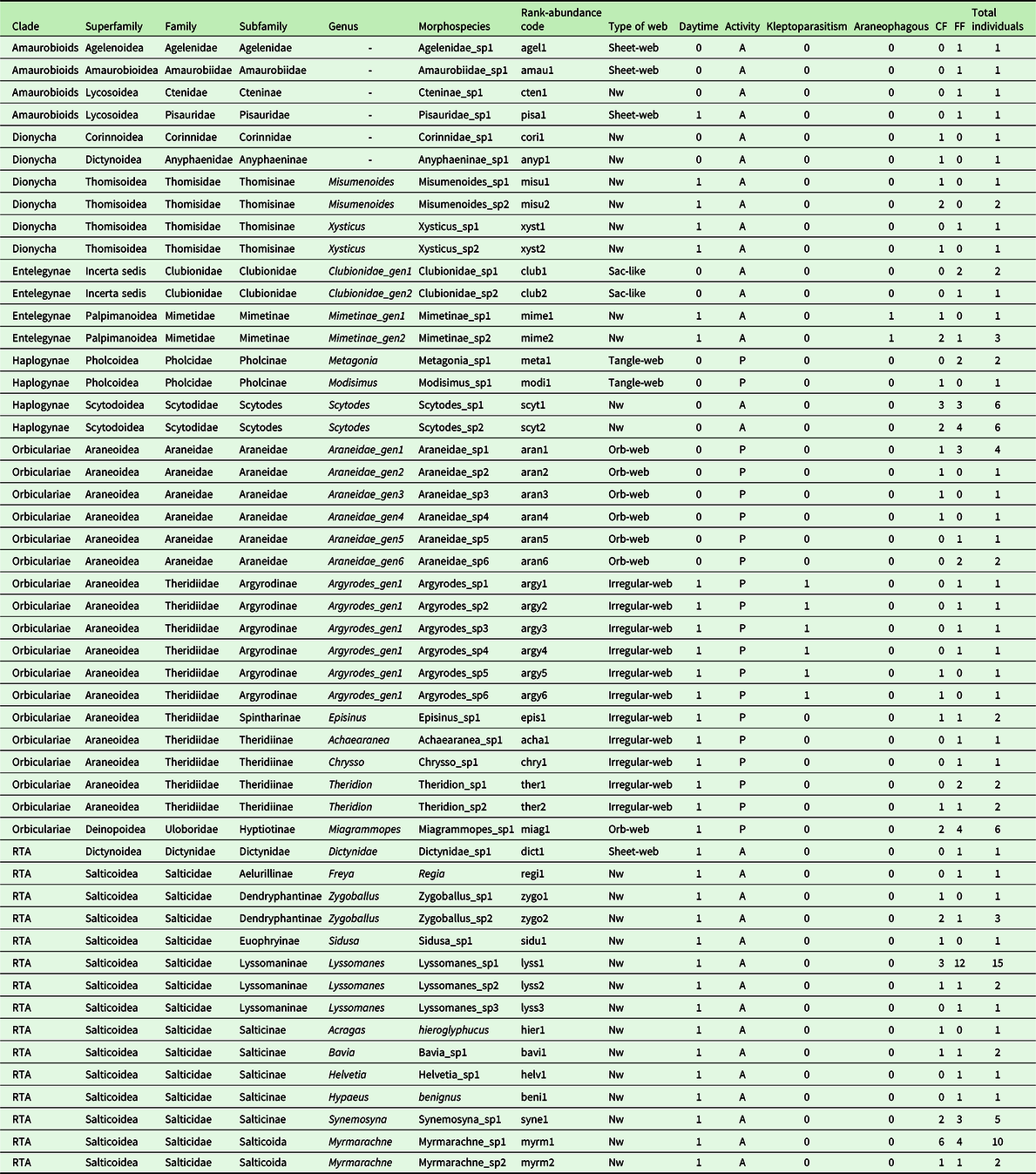
The 110 spiders recorded represent 16 families and 51 species, of which 10 families were present in continuous forests and 14 in forest fragments (Figure 1). There were no significant differences in family richness (χ2 = 0.05, df = 2, P = 0.08) and species richness (χ2 = 0.80, df = 2, P = 0.38) between habitat types. Nevertheless, the following patterns were observed: the family Salticidae represented the greater species richness with 14 spider species, followed by the Theridiidae with 11 species. Finally, the Araneidae had 6 species. These families were the most common in both habitat types (Table 1). The families with the greater number of individuals for both habitats were the Salticidae (46), the Theridiidae (14), Scytodidae (12) and Araneidae (10) (Table 1). In contrast, the Anyphaenidae and Corinnidae were exclusively recorded in continuous forest, whereas the Agelenidae, Amaurobiidae, Clubionidae, Ctenidae, Dyctynidae and Pisauridae were exclusively found in forest fragments (Figure 1).
Number of individuals within each of the spider’s taxonomic families inhabiting Heliconia aurantiaca plants present in continuous forest and forest fragments, in a tropical rainforest of south-east Mexico.

Taxonomic classification and functional traits of spiders associated with the tropical herb Heliconia aurantiaca in continuous forest (CF) and forest fragments (FF), southern Mexico

A = active spiders;
P = passive spiders;
For category data such as kleptoparasitism and araneophagy 0 = absence,
1 = presence;
Daytime = 1 as day, 0 as night;
Nw = No web.
Forest fragmentation and spider dominance
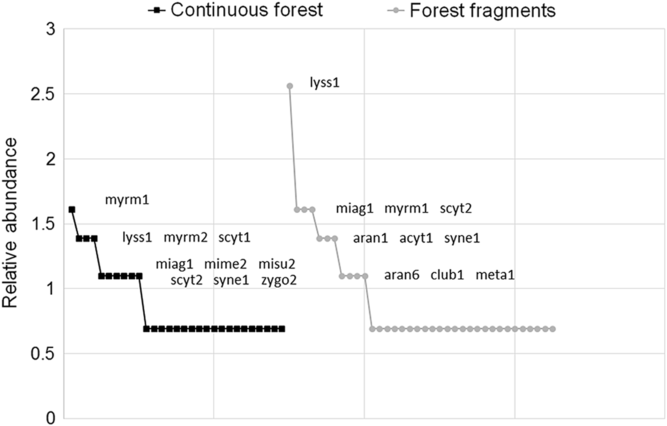
We obtained 80% of sampling accuracy for each of the two habitat types. The relative abundance of spiders decreased more steeply in forest fragments than in continuous forest where the spider community presented greater evenness (Fig. 2). For instance, the species Lyssomanes_sp1 (Salticidae) was the second most abundant species in continuous forest, whereas it was the dominant species in forest fragments and in the spider community overall. Furthermore, the species Myrmarachne_sp2 (Salticidae) showed the greatest relative abundance in continuous forest and was absent from forest fragments (Figure 2). In addition, both habitat types showed a high number of rare species (singletons, i.e. represented by only one individual).
Rank abundance curves for spider species associated with Heliconia aurantiaca plants in continuous forest and tropical rainforest fragments in south-east Mexico. Only the most abundant species are labelled. Species codes are: myrm1, Myrmarachne_sp1; lyss1, Lyssomanes_sp1; myrm2, Myrmarachne_sp2; scyt1, Scytodes_sp1; miag1, Miagrammopes_sp1; mime2, Mimetinae_sp2; misu2, Misumenoides_sp2; scyt2, Scytodes_sp1; syne1, Synemosyna_sp1; zygo2, Zygoballus_sp2; aran1, Araneidae_sp1; aran6, Araneidae_sp6; club1, Clubionidae_sp1; meta1, Metagonia_sp1.

Forest fragmentation and spider diversity
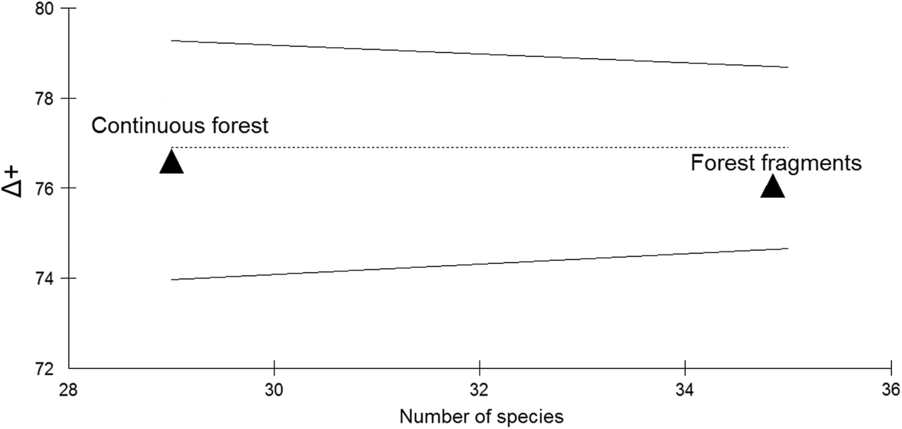
The 2D index indicated that ecological diversity is two times greater in continuous forest (45.04 effective species) than in forest fragments (22.11 effective species). Forest fragments and continuous forests shared 14 species and showed low similitude in the Jaccard’s index = 0.27 and medium with the Bray–Curtis index = 0.43. The two habitat types have almost the same average taxonomic distinctness (Δ+) and are within the 95% confidence interval of the randomization model, so we did not detect differences in taxonomic diversity between continuous forest and forest fragments (Figure 3).
Taxonomic distinctness (Δ+) of spider species inhabiting Heliconia aurantiaca herbs in tropical rainforest fragments and continuous forest. Species were plotted with theoretical mean taxonomic distinctness (dotted line) and 95% confidence funnel obtained from the global species list.

Functional richness (FRic) was significantly greater in forest fragments than in continuous forest (U = 223, n small22, n big = 29, P = 0.04) (Table 1). We did not find differences between web-builder richness (S = 26) and active-spider richness (S = 25), however. The most common functional trait found in our spider communities that construct webs was the irregular web, followed by the orb-web; on the other hand, sac-like web, sheet-web and tangle-web were rare. Taking into account abundance, the active spiders were more abundant (70 individuals) than web-building spiders (40 individuals). Sac-like web spiders were exclusively recorded in forest fragments. Most of the active spider species recorded were diurnal, while only five species were nocturnal. The species that construct webs exhibited both diurnal and nocturnal habits in the family Theridiidae and all of the six Argyrodes species showed kleptoparasitism.
Discussion
Overall, we found that forest fragmentation affected the spider community inhabiting H. aurantiaca plants but not as predicted. Continuous forest did not hold greater taxonomic and/or functional diversity than fragments and only ecological diversity was greater in continuous forest than in forest fragments, while forest fragments had higher functional diversity. Abundance patterns differed between habitat types but not species diversity. The mobility of the spider species found in the present study may explain these findings because most of the recorded spiders were active hunters and few of the species used webs to catch their prey. The rank abundance curves showed a main set of species that dominates the continuous forest and forest fragment spider communities. Salticidae and Scytodidae species are active spiders that use H. aurantiaca plants as a shelter and/or for hunting sites. These spider families were the most common in both habitat types. Our records were limited to spiders exclusively inhabiting H. aurantiaca, suggesting that this tropical plant is important for sustaining some spider species in the study region.
Only half (50%) of the 84 H. aurantiaca plants sampled were inhabited by spiders. These findings suggest that spiders may only occupy heliconias with certain morphological traits or those present under particular forest environmental conditions (e.g. open canopy). In contrast, the greater number of taxonomic families and abundance of spiders in forest fragments may be explained by the greater abundance of their prey in open areas (Benítez-Malvido et al. Reference Benítez-Malvido, Martínez-Falcón, Dáttilo and Del Val2014). There is evidence that fragmented and other types of tropical disturbed landscapes tend to have greater insect abundance, providing spiders with more prey (Benítez-Malvido et al. Reference Benítez-Malvido, Martínez-Falcón, Dáttilo and Del Val2014, Reference Benítez-Malvido, Dáttilo, Martínez-Falcón, Durán-Barrón, Valenzuela, López and Lombera2016, Lowe et al. Reference Lowe, Wilder and Hochuli2017). Spider population attributes may, as well, determine the occupation pattern at our study sites (e.g. mobility, sex proportion, age, etc.). Therefore, further research is needed to provide evidence of habitat preference of spider communities in fragments and continuous forest of the Lacandon rain forest.
Forest fragmentation and spider functional traits
Contrary to our expectations, there were more spider foraging strategies within forest fragments than in continuous forests. Compared with continuous forests, fragments could have more exposure to matrix (i.e. pastures) spiders with different traits (probably a combination of native and non-native spider species). Furthermore, it is likely that H. aurantiaca plants are important substrates for sustaining all spiders foraging strategies in fragments; whereas in continuous forest spiders could select many other plant species to construct their webs.
Functional traits of spiders varied significantly between habitat types; however, active hunters were well represented in both habitats, suggesting that H. aurantiaca provides a good habitat for this functional group. Furthermore, the foliage of H. aurantiaca was suitable for orb- and irregular-web builders. There is evidence that functional diversity of spiders is related to the growth form and morphology of the plant species and also to the feeding behaviour of spider species (Podgaiski et al. Reference Podgaiski, Joner, Lavorel, Moretti, Ibanez, Mendonça Mde and Pillar2013). Our research was based only on spider behavioural traits, so further research incorporating potentially useful traits such as morphological, life-story and physiological may elucidate other functional mechanisms that are affected by forest fragmentation (Bertelsmeier Reference Bertelsmeier2017, Eggs & Sanders Reference Eggs and Sanders2013).
There is evidence indicating that spider communities occurring in more functionally diverse plant communities are more functionally diverse (e.g. in traits such as body, chelicerae and eye size, as well as web building type) because, according to the habitat heterogeneity hypothesis, plant communities with more functional biodiversity provide additional ecological niches and a greater possibility of resource exploitation by the fauna (Podgaiski et al. Reference Podgaiski, Joner, Lavorel, Moretti, Ibanez, Mendonça Mde and Pillar2013). We need to explore such fundamental spider traits to construct significant functional groups and their influence on functional biodiversity. Our research only considered one species of a native herb as habitat for spiders, but individual plant traits may also explain the incidence of spiders. The next step is considering plant morphology to explain spider incidence and functionality. Vegetation structure around heliconia herbs may influence the spider communities, and therefore, habitat context must be measured in order to understand the occurrence of spiders and their ecological function.
Forest fragmentation and the spider community
Generalist predators tend to respond favourably to habitat fragmentation (Debinski & Holt Reference Debinski and Holt2000). This is partly because generalist arthropod predators, such as web-building spiders, are more abundant in forest fragments, particularly along edges, where they can profit from the aerial ‘drift’ of insects (Debinski & Holt Reference Debinski and Holt2000). Despite some differences in species composition, our results indicate that the taxonomic composition of spiders essentially has the same structure in both habitat types. Furthermore, the spider’s lineage in this study did not change significantly between habitat types. Habitat fragmentation may not generate changes in taxonomic diversity and in lineages of spiders associated with H. aurantiaca plants since continuous forest and forest fragments maintain a good representation of all taxa and their evolutionary trends, suggesting that heliconias are important landscape elements for the conservation of spiders in human-impacted habitats (Benítez-Malvido et al. Reference Benítez-Malvido, Martínez-Falcón, Dáttilo and Del Val2014, Reference Benítez-Malvido, Dáttilo, Martínez-Falcón, Durán-Barrón, Valenzuela, López and Lombera2016). Nevertheless, for some biological taxa, the phylogenetic information is incomplete, so the use of taxonomic distinctness is recommended in such circumstances (Moreno et al. Reference Moreno, Castillo‐Campos and Verdú2009). Further research should focus on the relationships between ecological mechanisms for species coexistence and taxonomic distinctness or phylogenetic diversity in spider communities.
Implications for conservation
Compared with taxonomic diversity, studies on ecological and functional diversity are scarce for spiders and even more so those studies analysing the three facets concurrently. To our knowledge, this is the first attempt to study the three facets of biodiversity using spiders in a Mexican tropical rain forest. Taxonomic diversity gives a neutral perspective when compared with ecological and functional diversity. Our results for the spider community suggest that according to ecological diversity the conservation of large tracks of continuous forests is relevant because of their high taxonomic diversity. On the other hand, based on functional diversity, forest fragments held a novel variety of spiders’ traits not present in continuous forest. Based on this information, habitat fragmentation affected the spider communities associated with H. aurantiaca by disrupting species composition and function, which may lead to other ecological changes including predator–prey interactions, insect pollination and insect herbivory which may affect ecosystem functioning.
Our research supports the idea that to measure the diversity of the spider community properly we need to use complementary tools that provide a more realistic measurement of biodiversity for understanding the impact of human activities on natural communities (Moreno et al. Reference Moreno, Calderón-Patrón, Arroyo-Rodríguez, Barragán, Escobar, Gómez-Ortiz, Martín-Regalado, Martínez-Falcón, Martínez-Morales, Mendoza, Ortega-Martínez, Pérez-Hernández, Pineda, Pineda-López and Rios-Díaz2017). Ecological biodiversity through species richness inventories is the most common of the dimensions studied for conservation decisions, but our research shows the importance of considering different biodiversity metrics concurrently in order to follow the different trends of the biological community patterns caused by forest fragmentation. Nevertheless, further replication of both habitat types is needed to strengthen the conclusion that tropical rain forest fragmentation differently affects diversity metrics of spider assemblages associated with H. aurantiaca plants.
Acknowledgements
We are grateful to JM Lobato-García for technical assistance in the field and in the laboratory and to Dr W Maddison for identifying the Salticidae species.
Financial support
We appreciate the financial and logistic support from Universidad Nacional Autónoma de México (UNAM) Project PAPIIT IN214014 and IN202117 to JBM and to APMF through a postdoctoral scholarship from UNAM (DGAPA grant). The Comisión Nacional de Áreas Naturales Protegidas (CONANP, permit number SGPA/DGVS/07830) granted permission to work in the MABR.
Ethical statement
Compliance with ethical standards, the authors declare no potential conflicts of interest. This research did not involve human participants and we had the permission required to capture the arthropods collected in this project (CONANP, permit number SGPA/DGVS/07830).