I. INTRODUCTION
Before the advent of modern textbooks, general treatises were essential to education. A prominent example is John Stuart Mill’s The Principles of Political Economy (Reference Mill1848), which became a key work in mid-nineteenth-century economic theory and served as a foundational textbook. Later, Alfred Marshall’s Principles of Economics (Reference Marshall1890) fulfilled a similar role.
Part of the literature emphasizes the role of the textbooks as knowledge repositories (in line with Thomas Kuhn’s traditional view), while others underscore their active function not merely as passive depositories but as essential tools in training future generations. Regardless of the perspective on studying textbooks, the history of economic theory is increasingly acknowledging their crucial role in the field’s development. For instance, James Forder (Reference Forder2015) analyzed the presentation of the Phillips curve in various textbooks, Yann Giraud (Reference Giraud2018) scrutinized Paul Samuelson’s seminal publication, and Pedro Teixeira (Reference Teixeira2014) investigated the mass production of textbooks associated with the Massachusetts Institute of Technology.
This paper aims to analyze general treatises in mathematical economics, specifically focusing on the Walrasian general equilibrium theory in the first decades of the twentieth century. The goal is to explore the emergence of mathematical economics as a distinct and separate field particularly from the perspective of classroom instruction. For this analysis, three key books have been selected: The Mathematical Groundwork of Economics: An Introductory Treatise (1924) by Arthur Bowley, The Theory of Social Economy (1924) by Gustav Cassel, and Principes d’économie pure: la théorie de l’échange sous le régime de la libre concurrence (1914) by Étienne Antonelli. The three authors unequivocally stated that one of the goals of their work was to provide a resource intended for utilization by students. Given that the three works were published in three different countries, an analysis of their structures also can provide insights into how Walrasian theory was disseminated in different places in the early twentieth century.Footnote 1
Joseph Schumpeter ([1954] Reference Schumpeter2006, p. 796) argued that Marshall’s influence in England remained unchallenged until Bowley introduced the Walras-Pareto model in his 1924 textbook. Mauro Boianovsky (Reference Boianovsky2016, p. 310) maintained that Cassel’s presentation of the Walrasian system of simultaneous equations was instrumental in familiarizing German economists and English speakers with the general equilibrium system. Schumpeter ([1954] Reference Schumpeter2006, p. 829) also discussed Cassel’s role in popularizing the Walrasian system. Cassel’s formulation gained prominence largely due to its more accessible exposition compared with Léon Walras’s, and it was the standard reference for mathematicians and economists participating in the Vienna Colloquium in the 1930s (Walker Reference Walker, Samuels, Biddle and Davis2003, p. 290).
Economic education held significant importance for Walras, and he advocated for a reform of the education system in France (for example, Walras Reference Walras1879). He argued that the system, “so bourgeois in its narrowness,” compartmentalized into two extremes: on one side, it produced calculators lacking knowledge in sociology, philosophy, history, or economics; and on the other, it cultivated individuals with literary pursuits devoid of mathematical understanding. Walras advocated for an arrangement that would produce students capable of both inductive and deductive thinking (Walras Reference Walras1954, p. 48).
In his final decade, despite illness, Walras dedicated significant time to crafting an Abrégé, the concise version of his ideas specifically designed for classroom instruction (the first English translation was published in 1954). Although he hoped for its adoption by his French disciple Albert Aupetit, this aspiration went unfulfilled. Walras made multiple unsuccessful efforts to secure an English translation (Jaffé Reference Jaffé1965). Antonelli became the first French professor to teach mathematical economics in France using this material, at the Collège Libre des Sciences Sociales (Diemer Reference Diemer2006, p. 5; Walker Reference Walker2006, p. 248). He published his exposition of the Walrasian system, based on Walras’s Abrégé, in 1914.Footnote 2
The next section of this paper delves into the intellectual background of each author, shedding light on the motivations that influenced their decision to produce their respective general treatises. The third section provides a content analysis of the works. Content analysis is a commonly used approach in educational literature.Footnote 3 The analysis explores how each book addresses, first, fundamental questions of general equilibrium, such as the existence, uniqueness, and stability of equilibrium, as well as the defense of mathematics in economic analysis. It then expands to broader questions, such as the definition and scope of economics as a science and each author’s engagement with the past of economic theory. The section concludes with some reflections on the rhetorical strategies employed in presenting this content. The conclusion follows.
II. A STATISTICIAN, A MATHEMATICIAN, AND A POLITICIAN
Arthur Bowley (1869–1957), an English economist and statistician educated at Trinity School during Marshall’s tenure, became a professor at the London School of Economics in 1895. Alongside Lionel Robbins, he helped shape the school’s structure. In 1901, he authored the well-received Elements of Statistics, a textbook that contributed to his reputation in the field. Bowley was among the first to estimate British national income, but his book Mathematical Groundwork contained no statistical content, focusing instead on equations with indeterminate coefficients.
On the first page of his book, Bowley highlighted the gap it aimed to fill: “No existing book, at least in English, presents a coherent mathematical treatment of political economy developed over the past eighty years” (Bowley Reference Bowley1924, p. v). He noted that well-known aspects of the theory were often assumed or buried in footnotes, while less familiar ones required thorough study in original works. Different authors used varied hypotheses and notations, making it hard for students to understand and compare their ideas (Bowley Reference Bowley1924, p. v).
Bowley clarified the book’s target audience, stating: “Though the simpler applications of mathematics made by competent writers and lecturers can be appreciated by any intelligent readers and students, the more complicated analyses are only within the power of those who have mathematical aptitude, and it is for them that this book is arranged” (Bowley Reference Bowley1924, p. v).
Although the book targeted students with mathematical aptitude, Bowley acknowledged the challenge of mathematical language. To help those students less familiar with algebra, he included an appendix. Bowley noted that while the number of mathematical theorems used was small, some applications of calculus, not typically covered in elementary courses, were included in the appendix (Bowley Reference Bowley1924, p. v). He introduced equilibrium equations and also presented indifference curves from Francis Edgeworth and Irving Fisher.
Gustav Cassel (1866–1945), a Swedish mathematician, defended his thesis at the University of Uppsala in 1894 and was a professor of national economics and finance at the University of Stockholm from 1903 to 1936. His book Theoretische Sozialökonomie, published in 1918, was translated into English in 1924 as The Theory of Social Economy and had five German editions. It was also translated into French, Japanese, and Swedish. The book was undoubtedly intended for students. It aimed to make knowledge more accessible and was not limited to those readers with prior mathematical aptitude: “I hope that English students will find the present treatise, although its reading without doubt requires a certain amount of thinking, to be the easiest and most direct way to get access to those great economic and social problems of the day for the understanding of which they undertake the trouble of economic training” (Cassel Reference Cassel1924, p. vii).
Cassel’s book is unique in offering explicit guidelines for how students should approach their study. In his analysis of the exchange economy, Cassel advised that, due to the complexities of economic phenomena, students ideally should read the text twice (Cassel Reference Cassel1924, p. 52). Only after the first reading provides an understanding of the whole could the student fully grasp the individual parts.
Cassel’s work is the one that most prominently portrayed a typical characteristic of past general treatises, offering original contributions to economic science. He advanced Walras’s theories by introducing the concept of stationary equilibrium with capital reproduction and offered an early formulation of the multiplier-accelerator process (Walker Reference Walker, Samuels, Biddle and Davis2003, p. 290). His theory on the optimal depletion of mines highlighted an overlooked issue (Brems Reference Brems1986, p. 1). His model of business cycles was relevant, although some critics argued that he was unable to identify the ultimate cause of fluctuations due to the limited scope of his work (Phillips Reference Phillips1924, p. 239). Cassel also introduced the concept of purchasing power parity and emphasized the central role of interest in the economic process.
Étienne Antonelli (1879–1971), a French economist, shared a similar commitment to advancing the study of mathematical economics, though his career was also politically driven. Antonelli was a prominent French politician and a key figure in the establishment of the modern French social security system. Collaborating closely with Aristide Briand, former prime minister of France, Antonelli played a vital role in crafting the legislation that laid the foundation for the country’s modern social security framework. He studied law, and his teaching career began in 1910 at the University of Paris Faculty of Law, though he initially lacked a stable position. In 1910, for instance, Antonelli took the concours d’agrégation, the examination for a stable academic position, but Paul-Émile Cauwès failed him, stating that he disapproved of the way Antonelli was attempting to advance economics (Morini-Comby Reference Morini-Comby1953, p. 358). He was failed for the exam a second time after that as well. In 1919, he became a professor of the history of economic thought at the Lyon Faculty of Law. After retiring from politics in 1934, Antonelli focused on teaching at Montpellier University for the rest of his life.
At the beginning of Antonelli’s book, Georges Renard, the author of the preface, highlighted that the book represented an endeavor to introduce and popularize the name of Walras and his doctrine in France (Antonelli Reference Antonelli1914, p. v). Renard pointed out that Walras, until his death, remained unrecognized in his own country, despite his methods’ gaining widespread acknowledgment in universities worldwide (Antonelli Reference Antonelli1914, p. v). For Renard, Antonelli had launched a campaign for justice and recognition of Walras’s work, motivated by a love of truth. However, Antonelli faced alienation early in his career, especially, according to him, from authorities protective of their monopoly on dogmatic teaching (Antonelli Reference Antonelli1914, p. viii).
At the beginning of his text, Antonelli outlines the book’s purpose. He notes that in countries such as England, the United States, Austria, Russia, and Germany, pure economics was being taught using the works of theorists such as Vilfredo Pareto, Maffeo Pantaleoni, Enrico Barone, Irving Fisher, Thomas Moore, Francis Edgeworth, and Ladislaus Bortkiewicz. However, Antonelli pointed out a stark contrast in France, where there was a deliberate neglect of pure economics. He referenced a 1900 statement by Charles Gide, who lamented that France—renowned for its achievements in mathematical sciences and as the birthplace of mathematical political economy through Augustin Cournot—offered no courses in pure economics, and perhaps lacked a professor even capable of teaching it. Gide highlighted the irony that this field was flourishing in Lausanne, led by a Frenchman known globally as being Swiss: Léon Walras.
Antonelli noted that despite Gide’s observation in 1900, no significant efforts had been made to change this, leaving pure economics still absent in French education (Antonelli Reference Antonelli1914, p. 4). This motivated Antonelli to publish his exposition of Walras’s Abrégé, focusing on its essential components rather than the entire work (Antonelli Reference Antonelli1914, p. ix). Unlike Bowley, who sought to consolidate scattered knowledge, and Cassel, who aimed to make advanced ideas more accessible, Antonelli’s goal was explicitly to promote Walras’s work. He also emphasized that the Abrégé was accessible, requiring no more than a knowledge of two-dimensional analytic geometry and algebra to understand (Antonelli Reference Antonelli1914, p. 7).
It is noteworthy that, although Antonelli’s Reference Antonelli1914 work predominantly engages with Walrasian pure economics, his initial interest in Walras was politically motivated. Walras, the “socialist economist,” first caught his attention (Frobert Reference Frobert1997, pp. 1530, 1534). Some scholars suggest that Antonelli viewed the theory of general equilibrium as a tool for analyzing the stability and evolution of both economic and social systems (Frobert Reference Frobert1997, pp. 1534–1535). Among the three authors, he is likely the only one who has fully comprehended the scope, methodology, and intellectual framework of Walras’s economic system.
Despite being an exposition of Walras’s Abrégé, Antonelli’s work, as noted by Renard in the preface, had its own merits. It countered unfounded objections to using mathematics in economics. Beyond Walras’s framework that distinguished pure economics, social economics, and applied economics, Antonelli introduced another key differentiation. He identified a divide among mathematical economists: one school (Mathematical-Psychological), mainly Anglo-Saxon and Italian, was criticized for relying on the difficult measurement of desire, while the other, French and represented by Cournot and Walras, focused on exchange—a social, collective factor—thus avoiding that issue. The Anglo-Saxon approach was a psychological analysis, whereas the French approach was more sociological (Antonelli Reference Antonelli1914, p. ix).
This distinction made Antonelli different from Bowley and Cassel, as he was the only one to emphasize the existence of various schools of mathematical economics, highlighting the lack of a singular perspective. Antonelli’s textbook aligns with Thomas Kuhn’s view of social sciences textbooks by presenting students with a range of competing solutions, encouraging them to engage in an autonomous analysis (Kuhn Reference Kuhn1970, p. 165).
Despite supporting Walras’s ideas, Antonelli did not present Walrasian theory uncritically. For instance, when discussing Cournot’s demand equation as a function of prices, Antonelli argued that Walras repeated some of Cournot’s errors, particularly regarding the assumption of continuity in functions, which should, according to him, be questioned (Antonelli Reference Antonelli1914, p. 18).
III. THREE APPROACHES TO THE PRESENTATION OF THE GENERAL EQUILIBRIUM THEORY: CONTENT ANALYSIS
A First Overview
Antonelli’s work spans 206 pages, while Bowley’s is only ninety-eight pages, of which a fifth is dedicated to the appendix. In contrast, Cassel’s work is nearly 700 pages long, divided into four main sections: 1) a general survey, where he introduced general equilibrium; 2) pricing of the factors of production; 3) money; and 4) business cycles. Unlike Bowley and Antonelli, Cassel placed much more emphasis on production, addressing it further in two chapters of his fourth section, and dedicating his entire second book to the topic.
Antonelli’s and Bowley’s work emphasized a key feature of the original Walrasian model, which started by examining a simple economy with two goods and two individuals. Cassel, however, criticized this common approach of beginning analyses with a hypothetical economy based on pure exchange and no money, arguing that such an economy was imaginary and irrelevant for real-world economic analysis. He also challenged the assumption of perfect competition, used by both Antonelli and Bowley, asserting that “to take free competition as the starting-point for a general theory of prices is of very little use” (Cassel Reference Cassel1924, p. 126).
The cornerstone of Cassel’s book was to construct a theory of prices. He states:
From the first beginnings of my studies of this science I have felt that it ought to be possible to do away with the whole of the old theory of value as an independent chapter of economics and build up the science from the beginning on the theory of prices, and that we in this matter would be able to rid ourselves of a lot of unnecessary discussions, mostly of a rather scholastic nature, which had burdened earlier treatises on economics. (Cassel Reference Cassel1924, p. v)
Cassel argued that any concept of “value” not synonymous with “prices” should be dismissed. He believed that when value lacks a quantitative measure, it becomes a subjective notion, unsuitable for scientific analysis. Cassel criticized both the marginal utility theory and the labor theory of value, viewing the latter as a barrier to developing a scientific theory, as it moved the discussion into ethical and political realms (Cassel Reference Cassel1924, p. 193). However, this position made him vulnerable to a critique: merely excluding the word “value” does not eliminate the concept of value (Moll Reference Moll1947).
Bowley did not delve into the issue of value. He simply stated that the utility represented by the function
 $ U\left(x,y,\dots \right) $
is “generally” referred to as “utility” or “value in exchange” (Bowley Reference Bowley1924, p. 3). This is the only point in his book where he provided a definition of value. Antonelli, on the other hand, emphasized that “contemporary” economists viewed value as merely an exchange relation (Antonelli Reference Antonelli1914, p. 57), aligning somewhat with Cassel’s view that debates about value were outdated. He defined “exchange value” (valeur d’échange) as a natural phenomenon arising from human activity in markets (p. 48), and the “relations of exchange values” as what we call “prices” (p. 78).
Bowley’s book stands out by placing a greater emphasis on mathematical equations over textual explanations. For example, the terms “equation” and “equations” appear 266 times, exceeding the second most frequent term, “curve,” which appears 131 times. The title, Mathematical Groundwork, reflected his aim to establish a mathematical foundation for economic science. One review described the book as a fundamental framework, stating, “Like a skeleton, it is closely articulated, bare of softer parts and white, with the white light of reason” (Tappan Reference Tappan1925, p. 334).
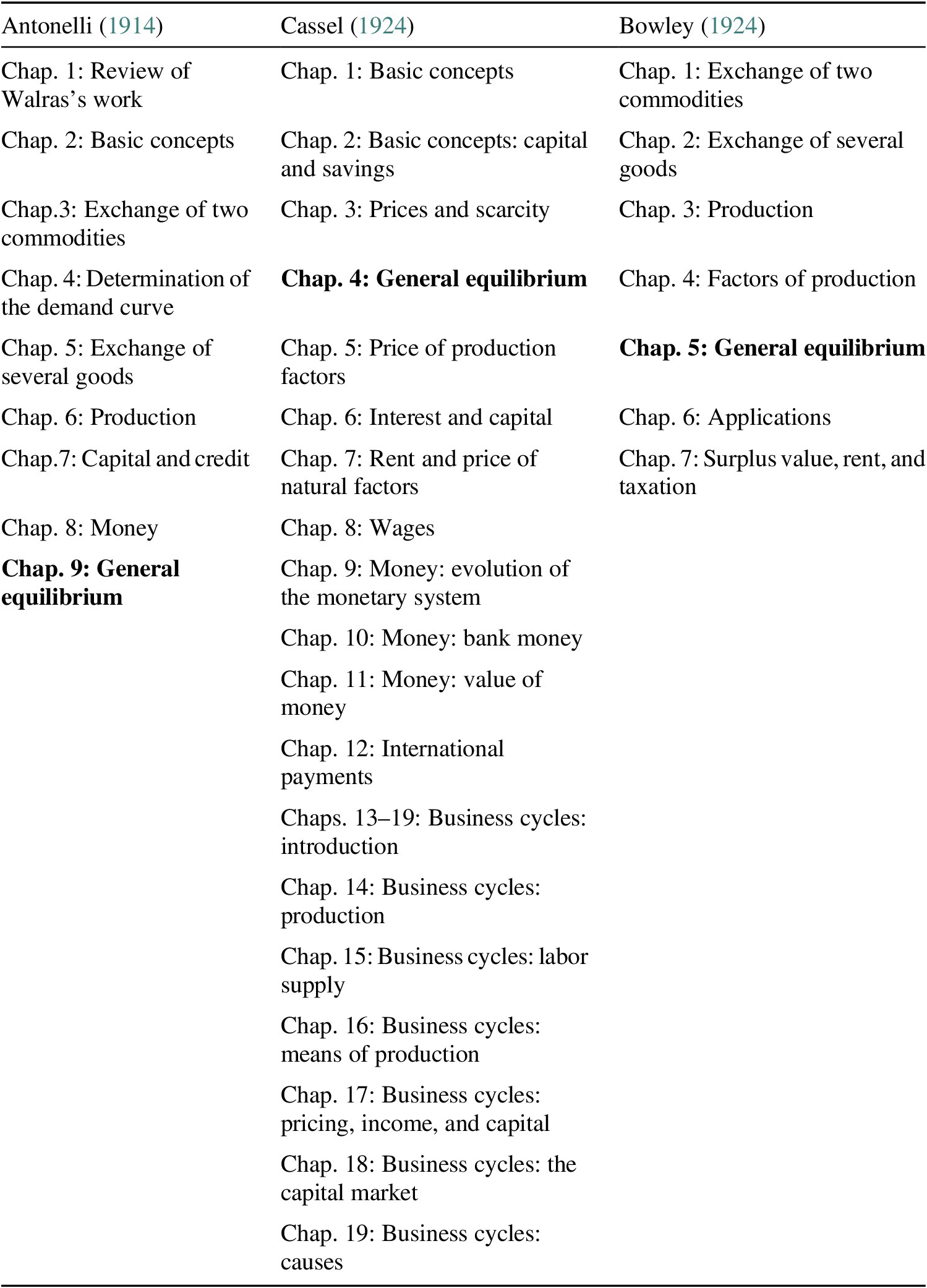
Table 1 summarizes the chapters of the three books. Cassel’s book stands out for including a chapter on international payments and a large section on business cycles, where he used statistical data to support his theoretical framework—something absent in Antonelli’s and Bowley’s works, which do not incorporate empirical elements. Chapters on general equilibrium equations are highlighted in bold. Antonelli covered them last, and Bowley did likewise. Cassel, however, introduced them early in the general survey, where he addressed economic theory fundamentals.
Summary of Antonelli (Reference Antonelli1914), Bowley (Reference Bowley1924), and Cassel (Reference Cassel1924)

Source: My own elaboration.
Bowley noted that applying mathematics to economics was still incomplete, with many unexplored areas. He presented the general equilibrium equations and argued that, in static analysis, it was possible to predict how the system would shift with changes like increased land or capital. However, in dynamic analysis, where changes occur continuously, the complexity increased, and little progress had been made (Bowley Reference Bowley1924, p. 53). Antonelli also pointed out that the theory was unfinished, with many issues left for future generations, encouraging further work by them (Antonelli Reference Antonelli1914, pp. 201–202). Cassel acknowledged the challenge of determining prices dynamically, considering factors like population shifts or social composition. However, he emphasized that solving the static problem was relevant to dynamic issues (Cassel Reference Cassel1924, p. 153).
Antonelli, following Walras, emphasized that equilibrium could be found if the number of equations matched the number of unknowns (Antonelli Reference Antonelli1914, p. 215). Bowley acknowledged the possibility of multiple solutions but believed that with numerical values, selecting the most suitable set would likely not be difficult (Bowley Reference Bowley1924, p. 53). He also explored equilibrium stability, suggesting that in the absence of a dominant producer, prices would likely oscillate around equilibrium (Bowley Reference Bowley1924, p. 37). Cassel explained that economic systems tend to oscillate around equilibrium due to forces counteracting deviations from the cost principle (Cassel Reference Cassel1924, p. 127). He noted that abrupt changes could disrupt equilibrium, forcing goods produced at equilibrium cost to be sold at a different price, violating the cost principle. After the transition, prices in a system following “sound economy” standards would generally align with the cost principle (Cassel Reference Cassel1924, p. 153). Cassel, however, did not define what constitutes a “sound” economy.
The Defense of the Use of Mathematics in Economics
Antonelli emphasized the versatility of the mathematical method, arguing that its application extended beyond the analysis of exchange. He pointed out its effectiveness in tackling various economic issues, such as the study of bimetallism (Antonelli Reference Antonelli1914, p. 41). In Chapter 2, he addressed objections from orthodox economists, sociologists, and mathematicians, providing detailed responses to their critiques.
The initial objection claimed that pure economics had failed to introduce anything new, as noted by authors such as John Ingram and Karl Knies (Antonelli Reference Antonelli1914, p. 52). Antonelli understood this critique as being aimed specifically at mathematical economics, which he viewed as a method. He argued that the goal of a method is not always to reveal something entirely new. Instead, mathematical economists could contribute by refining and clarifying existing theories (Antonelli Reference Antonelli1914, p. 52). He further pointed out that pure economics had already uncovered previously unrecognized issues, such as the problem of general economic equilibrium (Antonelli Reference Antonelli1914, pp. 53–54). To some extent, this might align with Walras’s critics, such as Maurice Block, who contended that algebraic formulas might be useful for presentation purposes but not as tools for discovery (Potier Reference Potier and Potier2019, p. 226).
Antonelli argued that the mathematical method was uniquely suited to handle relationships more complex than simple causality. Its strength lay in its ability to introduce functional relationships, allowing for a deeper understanding of intricate economic dynamics (Antonelli Reference Antonelli1914, p. 55).
In response to objections from sociologists, Antonelli referenced François Simiand’s Reference Simiand1909 critique in L’année sociologique, which focused on mathematical economics, particularly the works of William Stanley Jevons, Pareto, and Marshall. Simiand advocated for an experimental and historical approach in economics, arguing that although Pareto and Marshall recognized the need to align theories with facts, their works often lacked practical engagement with reality. Antonelli pointed out that Simiand’s critique did not specifically target Walras’s ideas, focusing instead on Marshall, Jevons, and Pareto. However, it is noteworthy that, despite Antonelli’s claim, Simiand did include both Walras and Cournot in his list of mathematical economists (Simiand Reference Simiand1909, p. 520).
Antonelli argued that Simiand’s criticism was based on a debatable conception of science (Antonelli Reference Antonelli1914, p. 59). According to Antonelli, the primary goal of science was to explain observed facts in a reasonably satisfactory manner, without requiring perfect alignment between theory and reality. He maintained that the assumptions used by mathematical economists are meant to address specific aspects of social life, rather than offer an all-encompassing explanation of social life.
Antonelli argued that it seemed absurd to question the practical utility of discussing the exchange of two commodities, as it would be equally meaningless to ask about the utility of half or a quarter of a solution. He contended that one could assess the practical utility or uselessness of research only once the entire problem had been solved (Antonelli Reference Antonelli1914, pp. 74–75). Antonelli further argued, in response to those claiming a significant gap between theory and real facts, that, for Walras, pure economics in its mathematical form was merely the skeleton (squelette) of the living social science (Antonelli Reference Antonelli1914, p. 31). It is worth noting that Bowley’s work was also referred to as a skeleton (Tappan Reference Tappan1925, p. 334).
Antonelli explored objections raised by mathematicians (Antonelli Reference Antonelli1914, p. 63), particularly Joseph Bertrand’s critique of Walras for addressing exchange in its static form rather than its dynamic form. Antonelli explained that Walras countered by stating that the market he modeled represented the virtual tendencies of the real market at any given moment. Bertrand also criticized the exchange theory for not considering production phenomena. In response, Walras clarified that, in the exchange problem, he initially treated quantities as given, but in later problems involving production and capitalization, he introduced quantities as unknowns, making Bertrand’s objection irrelevant (Antonelli Reference Antonelli1914, p. 64).
The primary objection raised by mathematicians, for example, as described by Antonelli, was that satisfaction could not be measured, as it is a subjective and individual aspect of consciousness (Antonelli Reference Antonelli1914, p. 65). In response, Antonelli argued, following Walras, that even immeasurable quantities could still be analyzed. He used the example of temperature, which was once thought to be immeasurable but became analyzable with the advent of thermodynamics (Antonelli Reference Antonelli1914, pp. 65–66).
According to Antonelli, the mathematical method was the indispensable method of pure economics (Antonelli Reference Antonelli1914, p. 38). He argued that without mathematics, researchers quickly became overwhelmed by the complexity of relationships between economic phenomena. Even critics of the mathematical approach often found themselves using mathematical language when discussing equilibrium problems. For instance, Antonelli pointed to Yves Guyot, then president of the Société d’Économie Politique, who frequently used mathematical expressions in his book, such as references to geometric and arithmetic progressions (Antonelli Reference Antonelli1914, p. 38). Guyot made a harsh critique of the third edition of Walras’s Éléments, arguing that economics is an observational science, while mathematics relies on too few observations (Potier Reference Potier and Potier2019, p. 227).
The mathematical method could be applied beyond pure economics, as Walras had done in some cases for applied economics. However, the role of the method was no longer the same (Antonelli Reference Antonelli1914, p. 39). While it might be useful in certain situations, it was not essential. Some areas of economic science, such as understanding the nature of economic phenomena, could not support the use of mathematical methods (Antonelli Reference Antonelli1914, p. 40). In such cases, approaches like the historical method were likely more appropriate. Again, pure economics was a doctrine, while mathematical economics was merely a method (Antonelli Reference Antonelli1914, p. 40).
Antonelli, however, did not address key critiques of Walras’s work in France, such as those by Émile Levasseur and engineer-economists like Émile Cheysson, who argued that political economy involved a variable that could not be reduced to algebraic formulas: human freedom (Potier Reference Potier and Potier2019, pp. 225, 234).
Cassel, in presenting the general equilibrium equations, argued that although the equations were expressed in mathematical terms, any educated person familiar with systems of equations involving several unknown variables could understand them. However, he noted that the chapter in which he made this argument could be skipped without breaking the flow of the book, though doing so would provide a less profound understanding of the issues (Cassel Reference Cassel1924, p. 134). For Cassel, the mathematical language offered deeper insights, but these were not essential for comprehending the economic problems at hand.
However, Cassel used the term “quantitative” as a synonym for “impartial” in some passages. For instance, when defining what “progress” meant to him, he indicated that “we give the world, in harmony with the whole of our economic terminology, an entirely impartial meaning, as purely quantitative as is possible” (Cassel Reference Cassel1924, p. 34). Discussing interest rates, Cassel argued that “a theory of interest must necessarily be quantitative. It must not only explain why there is interest, but why it is generally about the level which we actually find” (Cassel Reference Cassel1924, p. 247).
Cassel also justified the use of general equilibrium equations, asserting that it was the only method capable of representing the pricing process, which had an intrinsic consistency that could be captured only through a system of simultaneous equations (Cassel Reference Cassel1924, p. 146). He emphasized the need for a simultaneous and general analysis of the pricing process, arguing that economic phenomena are so interconnected that isolating individual elements is impossible (Cassel Reference Cassel1924, p. 52). He further noted that production costs were not isolated phenomena, despite being sometimes represented that way (Cassel Reference Cassel1924, p. 145). However, Cassel acknowledged that certain problems, like distribution, could be approached from different perspectives beyond the system of equations (Cassel Reference Cassel1924, p. 147).
Bowley not only did not defend the use of mathematics in economics but was also unique among these works for introducing postulates—statements accepted as true without proof—at the very beginning of his text (Bowley Reference Bowley1924, p. 1). His belief that there are postulates in economics aligns with the idea of presenting mathematical economics as a science that possesses a degree of unity and consensus.
The Employment of Marginal Analysis
In addition to introducing postulates, Bowley also addressed marginal utility early in his work. Throughout his book, Bowley consistently applied marginal calculus as a key analytical tool. He developed a basic exchange model based on the marginal utility of each traded good. This marginal principle was then extended to monetary prices, incorporating the marginal utility of money into his analysis. In his theory of production, Bowley asserted a proportional relationship between the marginal increment and the price of each production factor (Bowley Reference Bowley1924, p. 30). He highlighted price fluctuations, noting that they occur when the marginal price of each good equals the selling price (Bowley Reference Bowley1924, p. 38).
Antonelli, following Walras, introduced marginal principles by arguing that maximum satisfaction is achieved when the scarcity (rareté) of the last fulfilled desire equals prices, although he criticized, as mentioned, the Mathematical-Psychological school (Antonelli Reference Antonelli1914, p. 103).
Cassel rejected the theory of marginal utility, arguing that it was unnecessary in economic science and merely an attempt to express the psychology of demand in abstract mathematical terms. He critiqued it as relying on artificial constructions that distorted reality, stating: “this deductive inference of the nature of the demand from a single principle, in which so much childish pleasure has been taken, was impossible without artificial constructions and a considerable distortion of the reality” (Cassel Reference Cassel1924, p. 82). In Cassel’s view, the proposition that the price equated to the marginal cost seemed unfounded. Cassel questioned the idea that price equals marginal cost, arguing that even if a good could be consumed in successive doses, this did not necessarily mean that the price of the last dose was equivalent to the marginal utility (Cassel Reference Cassel1924, p. 82).
Instead, Cassel emphasized that prices were determined by the cost of production, which he called the “principle of cost”: “every finished article receives a price that corresponds with the cost of producing it; or, more generally, that every demand shall bear the whole cost of satisfying it” (Cassel Reference Cassel1924, p. 91). He viewed this principle as a governing force in the economy, shaped by the price system. While acknowledging occasional deviations from the principle of cost, Cassel likened his approach to the study of economics to an astronomical analogy, suggesting that economists, like astronomers studying planetary motion in isolation, should first examine the economic system without external influences (Cassel Reference Cassel1924, p. 82). Edgeworth criticized Cassel’s dismissal of marginal values, remarking, “Our author has not much use for margins. What competent economist of any school can deny it? The fear of making the weak brother to offend should not deter us from using the principle” (Edgeworth Reference Edgeworth1920, p. 533).
Cassel also argued that the pricing process depended not only on scarcity but also on what he called “supplementary principles” to account for the complexities of real-world situations (Cassel Reference Cassel1924, p. 98). For example, when goods were produced by companies operating under different conditions, Cassel’s first supplementary principle stated that the price should cover the costs of the company with the highest production cost, a concept he referred to as the “differential principle” (Cassel Reference Cassel1924, p. 99).
Definition of Economics and Its Scope
Bowley’s book begins with a concise definition of “economics”: “Economics deals with the production, exchange, possession, consumption, and use of material goods and immaterial services” (Bowley Reference Bowley1924, p. 1). While he did not directly challenge the classical distinction between productive and unproductive labor, he expanded the field by including “immaterial services” as a subject of study.
He emphasized the dual nature of wealth and welfare, distinguishing between the subjective—moral or psychological aspects—and the objective, or material aspect. The subjective side, like the satisfaction from acquiring a good, could not be measured arithmetically, while the objective side could be quantified in terms of quantity or monetary value. Although the subjective aspect could not undergo operations like addition or multiplication, properties such as equality, continuity, and relationships could still be identified. Thus, the objective side served as a “measurable shadow” of an undefined object (Bowley Reference Bowley1924, p. 1).
Cassel argued that “the ultimate aim of economic science must be to discover those necessities which are purely economic and cannot be arbitrarily controlled by human will” (Cassel Reference Cassel1924, p. vi). He titled his work Theory of Social Economy to focus on the economic relationships within a society as a whole, and disregarding factors like its size, organization, or property laws (Cassel Reference Cassel1924, p. vi).
Cassel criticized efforts to distinguish between rational and irrational economic behavior, arguing that restricting economics to rational conduct would distance the theory from reality (Cassel Reference Cassel1924, p. 11). Instead, he focused on human desires that were quantifiable in monetary terms and marked by relative scarcity. For Cassel, the quantity of a product demanded at a given price was a measurable fact, but the psychological process behind it fell outside the scope of economic theory (Cassel Reference Cassel1924, p. 81).
Cassel emphasized that economic science should avoid making value judgments and must not evaluate conduct from ethical or subjective perspectives (Cassel Reference Cassel1924, p. 11). He also argued that paternalistic policies, like taxing brandy to reduce consumption, should not be part of economic discussions (Cassel Reference Cassel1924, p. 86). However, economic theory could help prevent policy errors: “The numerous and often fatal blunders of the State-regulation of prices could have been avoided for the most part if there had been more knowledge of the socio-economic object of pricing” (Cassel Reference Cassel1924, p. 634).
Cassel strongly opposed the classical distinction between productive and unproductive work, calling for its complete abolition. He also rejected the traditional view that the main goal of economic activity was merely the production of material goods (Cassel Reference Cassel1924, p. 22). He emphasized that an economist’s role was to fully understand the social economy and the entire economic process (Cassel Reference Cassel1924, p. 4). He distinguished their work from that of businesspeople, noting that economists stay within their professional domain, with a natural division of labor between practical knowledge and scientific inquiry (Cassel Reference Cassel1924, p. 4).
Antonelli shared the view that exchanges were not psychological facts; they were social facts. He was the only one to explicitly state that two competing theories existed: the Mathematical-Psychological school (Anglo-Germanic) and the French school. He traced the psychological school’s roots to its origins in psychology, referencing the work of German author Johann Herbart.Footnote 4 Antonelli included figures like Hermann Gossen, Léon Winiarski,Footnote 5 Pareto, and Edgeworth.Footnote 6 An Italian commentator reviewing Antonelli’s work criticized him for overstating the distinction between the two categories of mathematical economists. However, the reviewer also noted that what might seem excessive in Italy could be significant in France, where new economic trends were generally slower to gain acceptance (V. 1914).
In his work, Antonelli specifically emphasized that he focused solely on presenting general economic equilibrium. He also stressed the importance of not equating “pure economics” with “mathematical economics,” as this confusion had historically led to misunderstandings between “orthodox” economists and mathematicians. Antonelli further highlighted Walras’s distinction between pure, applied, and social economics: pure economics studies the natural forces affecting social wealth, applied economics examines the effects of human actions on wealth, and social economics explores the relationships between individuals resulting from wealth (Antonelli Reference Antonelli1914, p. 34). Pure economics, Antonelli added, investigates the natural relationships among elements of social wealth without human intervention altering these conditions (Antonelli Reference Antonelli1914, p. 43).
The Past of Political Economy Theory
In addition to emphasizing that an economist’s role is to thoroughly understand the social economy, Cassel viewed economic science as a field of linear development, where certain questions could be resolved and set aside to make room for new inquiries. He stated: “A progressive science will always find it necessary, in order to make room for new investigations, to leave out such old matters and old discussions as are no longer of essential importance, and introducing the student as directly as possible to the questions of actual interest” (Cassel Reference Cassel1924, p. v). Cassel sought to distance himself from prevailing theories, highlighting the distinctiveness of his ideas. He criticized several authors, calling Adam Smith and David Ricardo’s labor theory of value “sterile” dogmatism (Cassel Reference Cassel1924, p. 183), and describing his own work as a radical departure from their ideas (Cassel Reference Cassel1924, p. 51). He rejected Carl Menger and Eugen von Böhm-Bawerk’s theory of interest, which he saw as a regression, based on valuing future enjoyment less than the present (Cassel Reference Cassel1924, p. 185). Cassel argued that Jevons’s views on capital were unnecessarily restricted (Cassel Reference Cassel1924, p. 187). He also challenged Marshall’s ideas on consumer surplus (Cassel Reference Cassel1924, p. 84) and the notion that cost is a sacrifice for obtaining a good (Cassel Reference Cassel1924, p. 90). He disputed Mill’s law of decreasing returns on land (Cassel Reference Cassel1924, p. 266).
Cassel occasionally praised past ideas, especially when he saw early traces of concepts he supported. For instance, he noted that even during the mercantilist era, despite government intervention, there were some discussions about freedom, though narrowly defined (Reference Cassel1924, p. 114). He also commended French authors Jacques Turgot and Jean-Baptiste Say for recognizing interest as a price, although Cassel believed that in places like England, the definition of interest still needed refinement (Reference Cassel1924, p. 181). Cassel, like others of his time, viewed the history of economic thought not as a progression toward orthodoxy but as an accumulation of outdated ideas, gradually replaced by more appropriate contemporary theories. Böhm-Bawerk, for example, used the metaphor of the history of economic thought as studying the “diseases of scientific infancy and childhood” (Goodwin Reference Goodwin, Durlauf and Blume2008, p. 5891).
Despite Cassel’s claims of breaking away from past ideas, his work faced criticism for lacking originality. H. Phillips (Reference Phillips1924, p. 237) argued that “the novelty of his discoveries is to that extent exaggerated,” while Homer Jones and Albert Hart (Reference Jones and Hart1934, p. 556) suggested that Cassel’s progress beyond Marshall “may not be so great as he believes.” Edgeworth (Reference Edgeworth1920, p. 535) critiqued Cassel for his disregard for past thinkers, noting, “Professor Cassel is the last man to appreciate this reverence for the past,” and wished that Cassel had used his insight to uncover the “wisdom latent in the practice of the classical economists.” Hans Brems (Reference Brems1986, p. 23) further noted that Cassel incorporated much of the work from the Lausanne school, stating: “Cassel followed Walras and Pareto, mentioned neither, and never paid tribute to anybody.”
Bowley acknowledged that his work built on the contributions of past economists, stating: “I have attempted to reduce to a uniform notation, and to present as a properly related whole, the main part of the mathematical methods used by Cournot, Jevons, Pareto, Edgeworth, Marshall, Pigou, and Johnson” (Bowley Reference Bowley1924, p. v). He made it clear that he did not aim to introduce new theorems or claim originality in mathematical results (Bowley Reference Bowley1924, p. vi). However, some economists disagreed with his modest claim. Marjorie Tappan (Reference Tappan1925, p. 337) argued that Bowley created a whole that was greater than the sum of its parts, and Allyn Young (Reference Young1925, p. 134) noted that relating two previously unrelated theorems effectively advanced a new one. Unlike with Cassel, who was called an “orthodox iconoclast” by Hugh Dalton (Reference Dalton1924, p. 223) for challenging mainstream economics, Bowley’s work was seen as a synthesis of existing knowledge. This synthesis was described as neutral, with Tappan (Reference Tappan1925, p. 337) stating that Bowley offered “the most complete and uniform and … neutral treatment” of the mathematical problem of static equilibrium in exchange. Bowley’s work was also considered a comprehensive survey. Young, then president of the American Economic Association, noted that before Bowley’s book, the best survey of economic mathematics was Les mathématiques appliquées à l’économie politique by Wladyslaw Zawadzki, but Bowley’s broader, more systematic scope surpassed it (Young Reference Young1925, p. 133).
Antonelli used the history of economic theory to emphasize the originality of Walras’s work. He noted that Cournot, while brilliant, was underappreciated, and acknowledged that Jevons had reached similar results at the same time as Walras. However, Antonelli highlighted that the economists who used mathematics before or alongside Walras either focused on determining market prices or addressed applied economics. Walras, unquestionably, was the only one to tackle the problem of general equilibrium (Antonelli Reference Antonelli1914, p. 9).
Systems of Economic Organization and Market Structures
Reflecting his aim to align economic theory with real-world contexts, Cassel argued that his ideas were equally applicable to both capitalism and socialism. He claimed that the conclusions of his work were universally valid for any exchange-based economy, regardless of its organizational structure (Cassel Reference Cassel1924, p. 113). In fact, Cassel saw theoretical value in studying the pricing system within a socialist economy, suggesting it could demonstrate that the free competition hypothesis was unnecessary for validating the principle of cost, and could highlight the importance of the cost principle across all economic systems (Cassel Reference Cassel1924, p. 129).
Cassel also found the study of pricing in socialism interesting because he considered it a simpler system compared with capitalism. By examining socialism, more complex aspects of capitalist economies could be clarified (Cassel Reference Cassel1924, p. 130). A comparative analysis of capitalism and socialism, according to Cassel, could reveal fundamental institutions. Additionally, he believed that such a study could dispel unrealistic and romanticized views about socialism by rigorously examining its economic principles (Cassel Reference Cassel1924, p. 130).
Cassel pre-emptively addressed a potential objection to his book by including an appendix that demonstrated the relevance of his economic theory even in the context of war economies. Some critics argued that the significant changes brought by the world war could render his theory obsolete: he had written the book before the First World War but published it only afterward. To refute this, Cassel analyzed war economies through the lens of his price theory. His conclusion affirmed that the theory was broad enough to apply in the complex conditions of wartime economies (Cassel Reference Cassel1924, p. 629).
As previously mentioned, Cassel opposed analyzing the economy from the perspective of perfect competition. He gave verbal examples of monopoly. For instance, when discussing natural resources, he stated that if the supply of such a resource was monopolized, the monopolist would profit more by restricting production (Cassel Reference Cassel1924, p. 283).
Bowley did not explore different economic systems but instead concentrated on the dynamics of free competition and monopoly. In his chapter on the applications of general equilibrium theory, he examined scenarios involving a single producer. Bowley, in line with conventional wisdom, concluded that equilibrium prices under monopoly were higher than those under free competition. However, he noted that this outcome depended on the elasticity of consumption (Bowley Reference Bowley1924, p. 60).
Bowley examined scenarios like bilateral monopoly, full monopolization of commodities, and taxation under monopoly. His detailed analysis of monopolies stands out, especially considering his book is only ninety-eight pages. This focus might stem from his skepticism of the Fabian approach, given his ties to the London School of Economics, which had connections to the Fabian Society. The Fabians accepted monopolies, seeing them as beneficial for workers’ conditions.
Bowley admitted his work was not original but noted it “perhaps” made a more deliberate effort than previous literature to treat competition and monopoly equally. He aimed to show that perfect competition and perfect monopoly were the mathematical extremes of a general conception (Bowley Reference Bowley1924, p. vi).
Antonelli avoided directly addressing monopoly but used it to justify applying mathematics in economics. He argued that in the analysis of monopolies, the mathematical school significantly advanced classical theories (Antonelli Reference Antonelli1914, p. 52). He credited Cournot and Jules Dupuit with developing the mathematical theory of monopolies (Antonelli Reference Antonelli1914, pp. 19, 201). Since his primary focus was on presenting Walrasian theory, it is understandable that he did not emphasize monopolies, as they were not a central subject for Walras. Antonelli also noted that Walras’s conclusions, based on free competition, needed to be adjusted when applied to monopolies (Antonelli Reference Antonelli1914, p. 46).
Contentious Topics: Taxation, Gender Inequality, Races, Measurement of Capital
In addition to addressing socialist economies, overall, among the three authors, Cassel stands out as the one who delves most deeply into contentious topics. On land rent, he challenged the idea that land supply was fixed, arguing that higher prices could increase supply artificially. For example, uncultivated land, especially overseas, could become viable if higher prices offset transportation costs. Cassel saw land as a factor in pricing, with its value shaped by scarcity. He criticized figures like John Stuart Mill in England and Henry George in the United States, condemning the “radical” group that advocated confiscating ground rents, and proposed a single tax (Cassel Reference Cassel1924, p. 254). Notably, Walras supported the nationalization of lands.
Cassel was a strong critic of government intervention and fiercely opposed socialist economic principles, as detailed in his 1928 book (Cassel Reference Cassel1928). This stance led to accusations that he was an uncritical advocate of the “invisible hand” (Jones and Hart Reference Jones and Hart1934). However, Cassel made an exception for central banks.
He defined a “socialistic” community as one where all production was organized and carried out by the community for its own benefit, through appointed officials, with the community owning all means of production. Despite this, freedom of labor and consumption still existed. Cassel clarified that his definition was a theoretical simplification, or a “pure type,” and did not apply to all systems labeled as “socialist” (Cassel Reference Cassel1924, p. 129).
In his chapter on wages, Cassel explored why female labor often received wages lower than the equilibrium value suggested by supply and demand. He proposed that this discrepancy could stem from factors like women’s weaker bargaining power or limited geographic mobility. However, he argued that if women were truly underpaid, employers would increasingly replace male workers with female labor. Since this trend was not observed, Cassel asserted, “there you have the heart of the question” (Cassel Reference Cassel1924, p. 315). He questioned the assumption that women and men produce work of the same quality, emphasizing that differences in the types of work performed by men and women largely explain wage disparities. Cassel concluded that the demand for equal pay for women, based on theoretical or emotional “grounds of justice,” was akin to the typical socialist wage program (Cassel Reference Cassel1924, p. 316). Still about this matter, it is crucial to note that Cassel dedicated approximately a quarter of the book to examining economic fluctuations, and his primary motivation was to address critics who challenged the rationality of the capitalist system. Therefore, his argument that wages reflected the production structure could be viewed as a part of his defense of the system.
Regarding taxation, Cassel advocated for a tax system that balanced the needs of society with those of individual households, stressing its importance in fostering economic growth (Cassel Reference Cassel1924, p. 71). He argued that imposing higher taxes on wealthier individuals could harm capital formation, as they play a crucial role in promoting savings (Cassel Reference Cassel1924, p. 229). In his view, a more equitable income distribution would reduce overall community savings (Cassel Reference Cassel1924, p. 220).
In contrast, Antonelli did not explore taxation in depth. He briefly noted that Walras had written on the subject but offered no detailed discussion or critique (Antonelli Reference Antonelli1914, p. 198). Antonelli argued that it was impossible to determine whether a tariff was beneficial or harmful, viewing the issue as outside the scope of pure economics (Antonelli Reference Antonelli1914, p. 201). Bowley, on the other hand, addressed taxation in the contexts of both competition and monopoly, dedicating the final two sections of his book to this topic (Bowley Reference Bowley1924, p. 72–77).
In Chapter 1 of his book, while discussing fundamental economic definitions, Cassel introduced the concept of races, suggesting that races are the result of population growth: “The community may be at first no more than the population of a village, but it steadily increases until it becomes a whole people, and in the end, it means the community of the race” (Cassel Reference Cassel1924, p. 3).
Cassel criticized the iron law of wages, arguing that it did not apply to modern democratic societies. He noted that wages had systematically risen without leading to faster population growth. In fact, it was the upper strata of the working class who adopted birth control and used higher wages to improve their living standards. However, he emphasized that these observations primarily applied to advanced nations, “the people of our own race” (Cassel Reference Cassel1924, p. 296). Despite claiming his ideas were universal in any exchange economy, whether capitalist or socialist, Cassel’s discussion on wages revealed exceptions in structures associated with other races. He further argued that variations in workers’ attributes—such as health, physical ability, and mental capacity—differed between countries and were even more pronounced when comparing different races (Cassel Reference Cassel1924, p. 322).
In 1914, Antonelli’s work notably excluded any discussion of race. However, in his 1939 revised textbook, he added a comprehensive chapter on the subject. Instead of focusing on Darwinian theories of race origins, Antonelli introduced Moritz Wagner’s theory of migration.Footnote 7 From an economic sociology perspective, he classified humanity into four major groups: the inferior races, the Mongolian race, the Semitic race, and the Indo-European race (les races inférieures, la race mongole, la race sémite, la race indo-européene). He suggested that individuals from “inferior races,” such as “Indians” and “Eskimos,” had intelligence limited to processing obvious observations (Antonelli Reference Antonelli1939, p. 97). Despite this categorization, Antonelli concluded the chapter by warning against overstating the economic and social significance of races (Antonelli Reference Antonelli1939, p. 101).
The authors do not explicitly address the question of how to measure capital. However, Bowley argued that knowing the nominal value of capital was unnecessary; instead, what mattered was the total output produced using various factors of production, like labor and capital, over a specific time period, such as a year (Bowley Reference Bowley1924, p. 42). Bowley further noted that this issue did not arise within the framework of general equilibrium: “The nominal value of capital may be found either by its cost of replacement or by discounting its yield, problems which do not arise in the general equations of equilibrium” (Bowley Reference Bowley1924, p. 42). In these cases, the quantity of capital could be treated as fixed (Bowley Reference Bowley1924, p. 42).
Cassel defined “real fixed capital” as durable goods used in the production process, excluding land (Cassel Reference Cassel1924, p. 30). He classified materials, semi-finished products, and consumable goods used in production as circulating real capital. The sum of fixed and circulating capital made up the total real capital of the economy (Cassel Reference Cassel1924, p. 32). Antonelli, following his usual reliance on Walras, defined capital as any form of social wealth consumed over the long term, lasting beyond its initial use, such as furniture or a house (Antonelli Reference Antonelli1914, p. 137).
Sources Used in the Books
Antonelli relied not only on Walras’s published works but also on his letters and speeches in both his 1914 and 1939 works. For instance, when discussing the definitions of pure economics, Antonelli included excerpts from letters exchanged between Walras and Jules du Mesnil-Marigny. These letters were presented as a distinct “note” between chapters, rather than being confined to specific sections or appendices (Antonelli Reference Antonelli1939). He also referenced Walras’s jubilee speech at the University of Lausanne (Antonelli Reference Antonelli1914, p. 11). Additionally, Antonelli cited an 1874 article by Walras in the Journal des Economistes, which explored the connection between the price problem and the theory of general equilibrium.
Cassel, while refraining from acknowledging any intellectual precursors, consistently cited his own works, with The Nature and Necessity of Interest (Reference Cassel1903) being one of his most frequently referenced publications. Though he occasionally mentioned other works, his citations were largely critical. Cassel employed various statistical data, drawing from British labor statistics, the Journal of the Royal Statistical Society, and the Statistical Abstract of the United States. For instance, when examining interest rates and life expectancy, he referenced a survey by the Swedish Ministry of Finance on hereditary wealth (Cassel Reference Cassel1924, p. 236), and in discussions on money, he cited annual minting reports (Cassel Reference Cassel1924, p. 381).
Bowley, while claiming to build his theory on prior works, generally avoided citing specific sources. Notable exceptions include Marshall’s Principles (Bowley Reference Bowley1924, p. 65) and an article by W. E. Johnson (Bowley Reference Bowley1924, p. 57).
Rhetorical and Literary Arguments
Bowley’s emphasis on basing his work on previously developed theories makes him the author who, among the three, most relied on an appeal to authority to support his arguments. He acknowledged that his research was influenced by prominent figures in economic science, such as Cournot, Jevons, Pareto, Edgeworth, Marshall, and Arthur Pigou.
Antonelli and Cassel stand out as distinctive cases. Antonelli relied heavily on the authority of Walras, who was a less favored figure in France in the early twentieth century. He highlighted disagreements between different schools of economic thought, and his approach can be understood in different ways. By showing the disagreements, Antonelli could challenge the dominance of mainstream schools, suggesting that their authority was not beyond question and introducing a theory that was not widely accepted in France. He highlighted that science thrives on diverse perspectives and continuous debate.
By highlighting these divisions, he countered some of the criticisms aimed at the mathematical approach. He emphasized that even Walras had reservations about how some scholars conducted their research within this school.
An alternative interpretation of Antonelli’s portrayal of economics as a science marked by divisions suggests that by showing Walras as a follower of Cournot, Antonelli was affirming his connection to a specific intellectual tradition, notably a French one. This strategy served to isolate other competing schools of thought, similar to the later approach taken by John Maynard Keynes, who declared his allegiance to Thomas Malthus over Ricardo (Arida Reference Arida1983).
In contrast, Cassel sought to break with the past, aiming “to do away with the whole of the old theory of value, … mostly of a rather scholastic nature, which had burdened earlier treatises on economics” (Cassel Reference Cassel1924, p. v). His approach represented a clear departure from traditional theories, rejecting the established frameworks.
Simplicity, also sometimes mentioned as a rhetorical argument, though not easily defined, is evident in Cassel’s work through the inclusion of fewer variables in his explanations. First, he tried to replace the abstract concept of “value” with the tangible concept of “price.” Furthermore, he contended that the entire price-determination process primarily relied on one element: the scarcity principle. Cassel criticized his opponents, characterizing them as overly complex and pedantic “scholastics,” accusing them of overlooking what he considered fundamental points. For example, regarding the Marshallian theory, Cassel argued that Marshall’s entire system aimed to circumvent the principle of scarcity or reject scarcity as a determining factor of prices (Cassel Reference Cassel1924, p. 162).
While Cassel grounded the simplicity of his theory in a single variable, the scarcity principle, Antonelli and Bowley pursued a different approach to simplicity. They sought to simplify their theory by abstracting as many complications as possible, and, following Walras, beginning with exchanges between two individuals and two goods. Additionally, Antonelli and Bowley endeavored to enhance the accessibility of their theories by employing graphics to illustrate their ideas, a strategy not utilized by Cassel. Bowley made an attempt to enhance the accessibility of his theory by incorporating the mathematical appendix, aiming to assist students who might struggle with notations. However, this effort fell short in convincing readers about the book’s accessibility. A review in the Journal of the Royal Statistical Society pointed out that few individuals would likely have the patience to navigate his economic theories presented in mathematical form. The critique suggested that the notation seemed primarily useful only to the author and that even those with strong mathematical skills who might be tempted to read the work would likely find it less enjoyable than anticipated (F. 1924, p. 620). Even sympathetic critics acknowledged the challenge of following the author’s work, with one remarking, “Professor Bowley’s excellently proportioned book is not for us if we have not reached the alphabet of mathematics” (Tappan Reference Tappan1925, p. 334).
A comparable critique was leveled at Antonelli’s work. A reviewer expressed concern that excessive technicality in economic writing could jeopardize popular interest, posing a significant loss for both professional economists and the general public (P. 1914, p. 884).
Antonelli and Cassel both discredited theories by asserting that they simply did not belong to the domain of economic science. Cassel argued that the labor value theory hindered the development of a scientific labor theory by shifting the debate to ethics and politics. Antonelli used similar reasoning, claiming that the school he criticized, including Pareto and Edgeworth, was rooted in psychology. Regarding Pareto, Antonelli highlighted that his entire system was built on the concept of ophélimite, characterized as fundamentally psychological (Antonelli Reference Antonelli1914, p. 15). Concerning the school as a whole, Antonelli asserted that their mathematical economics also rested solely on a psychological principle—and not on economics principles (Antonelli Reference Antonelli1914, p. 15).
IV. CONCLUDING REMARKS
Given the relatively recent emergence of mathematical economics, one might have expected a need to justify the application of mathematics in this field. However, except for Antonelli, the authors did not put forth significant effort in providing such justification. Cassel, in a straightforward manner, pointed out that readers could choose to skip the mathematical sections of the book, although he justified the use of simultaneous equations. Bowley used mathematics without justification, employing postulates to present some indisputable truths of economic science.
In a sense, textbooks serve as indicators of a science’s maturity and degree of standardization. An examination of the works of Antonelli, Bowley, and Cassel reveals a lack of consensus on foundational elements, including the definition and scope of economics, assumptions about market structure and individual rationality, the adoption of marginal calculations, and the concept of value. In the broader context of disseminating the Walrasian general equilibrium theory, it becomes apparent that Walras’s model was presented to students within diverse frameworks, reflecting underlying conflicting beliefs about economic science during the early decades of the twentieth century. Despite these fundamental disagreements, the analysis of the content and the books’ organization reveals a shared structural framework. All three authors delve into topics like exchange, production, factors of production, and, evidently, equilibrium. While they differ in additional subjects covered—such as Cassel’s analysis of economic cycles and Bowley’s emphasis on monopolies and taxation—the overarching structure remains similar.
It is also noteworthy how each author utilizes the historical aspects of economic theory: Cassel employed it as a literature review, indicating that the past contains everything that was incorrect and has been surpassed; Bowley used it substantially as a rhetorical argument based on authority; and Antonelli employed it as a means to demonstrate that science is constructed through debates.
Examining the comments in the books’ reviews, it seems that Bowley’s book was comparatively better received than the other two, perhaps owing to his restrained criticism of others’ works. However, readers still found the book inaccessible. This prompts the question of the significance of the tone in presenting ideas—whether as a continuation of the past or as a departure—in relation to how the application of mathematics in economics was received in the early twentieth century.
COMPETING INTERESTS
The author declares no competing interests exist.