


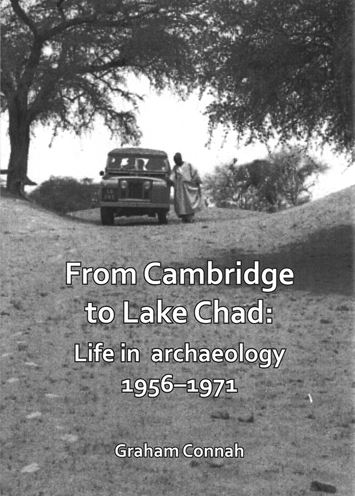
Graham Connah was one of the few archaeologists who worked in Nigeria in the years immediately after the country attained independence in 1960. For Connah, it was important to demonstrate that archaeology in Nigeria should not be limited to the discovery of ancient art works. His contributions to the development of the practice of archaeology in Nigeria are well noted in the publication of his works at Benin and the Lake Chad Basin. It is surprising that he did not choose to stay on as one of the pioneers of the Department of Archaeology established in 1971 at the University of Ibadan, opting instead to move to the University of New England, Australia; he does not reveal his reasons for this.
Stating from the outset that From Cambridge to Lake Chad is not focused on his archaeological research, as this had already been published elsewhere, Connah's 15 chapters detail instead his personal journey in archaeology. Illustrated with photographs, maps and line drawings throughout, the volume is also written in very accessible language.
Chapter 1 describes Connah's life between leaving the Navy and going to the University of Cambridge, with the opening line proclaiming that “At the end of March 1956 the Royal Navy, which had looked after me fairly well for two years, cast me adrift” (p. 1). Before his naval service, and again afterwards, he volunteered at the Liverpool Museum. To support himself during this time of volunteering, he worked in a tropical fish shop. During August and September 1956, Connah was a volunteer at the excavation of a group of round barrows on New Barn Down, east of Amesbury in Wiltshire.
With the experience he had acquired, one would have thought Connah ready for a degree in archaeology at Cambridge, but alas he was to study history to please his parents. He did, however, join the Archaeological Field Club and continued to participate in archaeological excavations during holidays. In his third year of study, he switched from history to archaeology, “taking on three years’ study in only one year” (p. 29). At the end of the final year, he did not achieve the II.i degree required to support his application for a state scholarship to pursue a PhD. He was, however, able to secure a job as a graduate research assistant at Cambridge on a project researching archaeomagnetism.
Connah's status as an employee of the university was unclear; at the bottom of the pecking order and answerable to two very different individuals in separate departments, he felt the truth of Matthew's (6:24) words that “no one can serve two masters”. A year later, worried that his future was not assured without participation in mainstream archaeology, he planned an excavation at Knap Hill, a causewayed camp in Wiltshire. The dig was funded by his earnings serving as deputy director on a training excavation for London University's external studies department. Thereafter he applied for other jobs, unsuccessfully, and was unable to accept the offer of external part-time postgraduate study at the Institute of Archaeology because he could not satisfy the condition of residency in London. In the summer of 1961, Connah applied for an archaeology position in Nigeria. The formal interview at Nigeria House in London had an unpromising start as he was trapped in a lift en route. On his eventual late arrival, he learnt that the members of the all-Nigerian interview panel had themselves not yet arrived. He “was later to realize, Nigerians were nearly always late for appointments” (p. 51). What a generalisation! Although the other candidate had completed a full three-year degree, compared with Connah's single year, Connah was offered the post, perhaps, to judge from his own words, due to his more extrovert personality.
On his journey to Nigeria by sea, Connah amused himself by studying the passenger manifest to identify unmarried women travelling on the ship. The exercise revealed Beryl Fletcher, 11 years his senior, whom he married in 1963. From 1962–1964, Connah excavated several sites in Benin and mapped sections of the city wall. He had the luxury of staying in his residence and enjoying his evenings at the Benin Club as the sites were located within the city. The situation was different when, in 1964, he was appointed research fellow at the University of Ibadan and assigned to conduct research in Borno in north-eastern Nigeria. Connah was based in Maiduguri but worked at remote sites in very difficult terrains. Speculating that a Nigerian Cambridge graduate in his team probably left archaeology after his experience in Borno, Connah writes that “Oyenuga had gone to Lagos because (he said) his child was sick, but I never saw him again nor had any further communication from him […] he had worked well but had apparently decided that field archaeology was not for him” (p. 135).
Connah's interests seemed to focus on establishing a long sequence for sites. This was almost certainly based in his early experience of excavating barrows in the UK. Connah acknowledges that excavations by a German archaeologist on a site in the Lake Chad Basin that he himself had previously excavated “recovered a substantial amount of botanical evidence by methods already known in the 1960s but difficult to apply at that time” (p. 144). Connah did not state what the particular difficulty was in applying this method of recovery in the Lake Chad Basin, suggesting that his focus was on establishing a long sequence rather than collecting botanical evidence.
Despite being largely an autobiographical account of Graham Connah's time in Cambridge and Nigeria, the book offers an illuminating glimpse into the history of archaeology in Nigeria, highlighting the role of a number of archaeologists whose work there is not well-recognised in the published literature. The accounts of sites in the Lake Chad Basin are amazing, and there are revealing insights about methodologies—who would otherwise have known that a small aircraft was used in Nigeria to take aerial photographs of sites at this date? In sum, the book is a valuable insight into the history of archaeology in Nigeria in which Graham Connah presents an honest and transparent account of his time in that country.


