INTRODUCTION
Maize (Zea mays L.) is one of the most important food crops in the world, and together with rice and wheat provides at least 0·30 of the daily calories to more than 4·5 billion people in 94 developing countries. Maize is also a key constituent in animal feed and is used extensively in industrial products, including biofuel production. The estimate of worldwide annual yield loss in maize due to pests ranges from 7 to 20%. The European (ECB) (Ostrinia nubilalis Hübner)- and Mediterranean-corn borers (MCB) (Sesamia nonagrioides Lefèbvre) are the most destructive maize pests in southern Europe (Velasco et al. Reference Velasco, Revilla, Monetti, Butrón, Ordas and Malvar2007; Brookes Reference Brookes2009). Corn borers contribute to stalk lodging as well as to direct yield losses. Breeding for increased resistance to borers has been effective for reducing the length of tunnels made by borers but has provoked undesirable changes in traits such as grain yield, days to silking, plant and ear heights and 100-kernel weight (Russell et al. Reference Russell, Lawrence and Guthrie1979; Klenke et al. Reference Klenke, Russel and Guthrie1986; Sandoya et al. Reference Sandoya, Butrón, Santiago, Alvarez and Malvar2010; Butrón et al. Reference Butrón, Romay, Peña-Asin, Alvarez and Malvar2012).
Ferulic acid (FA) is one of the main secondary metabolites identified in maize cell walls (Saulnier et al. Reference Saulnier, Crepeau, Lahaye, Thibault, Garcia-Conesa, Kroon and Williamson1999). More than 0·50 of cell wall-bound FA can undergo dimerization via oxidative radical coupling reactions catalysed by phenoloxidases leading to formation of a wide range of dimers between the FA units (Fry et al. Reference Fry, Willis and Paterson2000; Grabber et al. Reference Grabber, Ralph and Hatfield2000). A large body of literature suggests that diferulates have an important role in maize resistance to corn borers (Bergvinson et al. Reference Bergvinson, Arnason and Hamilton1997; Santiago & Malvar Reference Santiago and Malvar2010; Santiago et al. Reference Santiago, Barros-Rios and Malvar2013a ). The present authors previously reported a successful divergent selection programme for total ester-linked diferulate concentrations in stalk pith tissues of mature maize internodes (Barros-Rios et al. Reference Barros-Rios, Malvar, Jung, Bunzel and Santiago2012). The populations developed in this selection programme were previously used as model plant material to study the relationship between diferulates, rumen degradability and corn borer resistance. These studies concluded that maize stalk resistance to borers and cell wall biodegradability can be indirectly improved by modulating the content of diferulates, albeit in opposite directions: higher diferulate concentrations improve resistance to borers but reduce rumen degradability (Barros-Rios et al. Reference Barros-Rios, Santiago, Jung and Malvar2013, Reference Barros-Rios, Santiago, Jung and Malvar2015).
Breeders traditionally noted that maize yield and resistance to pests and diseases were lowered by selection for increased forage nutritional value, mainly based on reduced lignin deposition (Wolf et al. Reference Wolf, Coors, Albrecht, Undersander and Carter1993; Pedersen et al. Reference Pedersen, Vogel and Funnell2005; Casler & van Santen Reference Casler, van Santen, Boller, Posselt and Veronesi2010). Detailed genetic analyses of this antagonist association have indicated that this could be due to multiple causes including genes with multiple specificities, linkage between genes controlling diverse traits and random processes such as genetic drift (Casler Reference Casler2005).
In the present research, agronomic evaluations of the maize populations that had been divergently selected for diferulate concentrations were conducted under diverse environmental conditions: assorted locations, sowing dates and biotic stresses. The main objective was to assess the effects of the divergent selection programme for diferulates on maize agronomic performance.
MATERIALS AND METHODS
Evaluation trials
The original maize population (CO125 × PB130) F2 (P0) and two cycles of divergent selection for total diferulate concentration in the pith of stalks [the first and second cycles of selection for high diferulate content (PH1 and PH2, respectively) and the first and second cycles of selection for low diferulate content (PL1 and PL2, respectively)] were obtained as described previously by Barros-Rios et al. (Reference Barros-Rios, Malvar, Jung, Bunzel and Santiago2012). These five maize populations were evaluated for agronomic traits in 2010 at four environments: combinations of two geographically distinct locations in Spain (Pontevedra, 42°24′N, 8°38′W and Zaragoza, 41°44′N, 0°47′W; 20 and 230 m a.s.l, respectively) and two planting dates (late April and late May). At each location and planting date, the experimental units were arranged following a split-plot design; infestation treatments (infested with MCB, infested with ECB and protected with insecticide) were assigned to main plots and genotypes to sub-plots. The sub-plot had two rows with 15 plants per row, with plants spaced 0·21 m within row and 0·8 m between rows. Plots were overplanted and thinned, and the final density was c. 70 000 plants/ha. Trials were irrigated once, and cultural operations, fertilization and weed control were carried out according to local practices.
At flowering, five to seven competitive plants in each row of the infestation plots were artificially infested. Infestation was achieved by placing a mass of c. 40 eggs of the corresponding corn borer species between the stem and the main ear. Damage by borers was guaranteed by artificial infestation (Butrón et al. Reference Butrón, Malvar, Velasco, Vales and Ordas1999). Rearing of MCB eggs followed standard procedures (Eizaguirre & Albajes Reference Eizaguirre and Albajes1992), while ECB eggs were purchased from the Research Centre of Poitou-Charentes (INRA, Luisignan, France). Natural infestations by other borers in the area were low and, where any occurred, were not significant in comparison with the artificial infestations performed. The insecticide applied was the granular formulation Clorifos 5-G (5% chlorpyrifos) at 40 kg/ha; chlorpyrifos is an organophosphate insecticide Category II. The insecticide was applied locally in the leaf axils of maize plants. Four insecticide applications were applied, the first at the early flowering stage (growth stage 50) (Zadoks et al. Reference Zadoks, Chang and Konzak1974) and then every 20 days thereafter. The efficacy of this insecticide in reducing corn borer damage has been noted previously (Ordás et al. Reference Ordás, Butrón, Alvarez, Revilla and Malvar2012; Santiago et al. Reference Santiago, Cao, Malvar and Butrón2013b ).
Observations were recorded for days to anthesis (days from planting to the date at which half of plants shed pollen), days to silking (days from planting to the date in which half of plants show silks) and plant height (recorded on ten competitive plants as the distance from the ground to the top of the plant) in the insecticide treatment; including stalk lodging (percentage of prostrate plants in the plot or with the stem broken below the main ear), grain moisture at harvest (g of water in 100 g of kernels) and grain yield (t/ha of kernels at 140 g H2O/kg) as traits affected by borer damage.
Statistical analysis
An analysis of variance including location, sowing date, treatment (infested with ECB, infested with MCB and protected with insecticide) and maize population was computed for each agronomic trait. All sources of variation were considered fixed. Individual analyses for each treatment were also performed. Means were compared using the Fisher's protected least significant difference test. To analyse the effects of the diferulate selection programme on agronomic performance, linear regression analyses on selection cycles (values 2, 1, 0, –1 and –2 were assigned to populations PH2, PH1, P0, PL1 and PL2, respectively) incorporating environmental effects in the model [environment (combination of location and sowing date), and replication (environment)] were performed for the traits evaluated. All statistical analyses were performed using the SAS software package (SAS 2007).
RESULTS
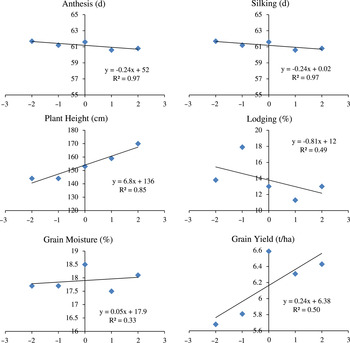
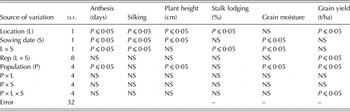
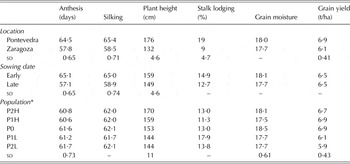
The treatment protected with insecticide was analysed separately in order to characterize the agronomic performance of populations under optimal conditions. There were significant (P ⩽ 0·05) differences among locations for all agronomic traits except for grain moisture. Differences among sowing dates were significant (P ⩽ 0·05) for all traits except for stalk lodging and grain yield; differences among populations were significant (P ⩽ 0·05) for days to anthesis, plant height, stalk lodging and grain yield (Table 1). The population × location and population × sowing date interactions were not significant for any trait (Table 1). Populations grown at Pontevedra showed pollen and silks later, had taller plants, and higher stalk lodging and grain yield (Table 2). Populations sown later showed pollen and silks earlier, and had smaller plants (Table 2). High diferulate populations showed a significant (P ⩽ 0·05) reduction in days to anthesis (60·7 v. 61·4 days), were taller (164·5 v. 144 cm), and more productive (6·8 v. 6·0 t/ha) compared with low diferulate populations. The influence of the selection on the percentage of lodged plants was not noticeable under protected conditions (Table 2). Regression analysis shows that populations were negatively correlated with anthesis (P < 0·001), and positively correlated with plant height (P < 0·001) and grain yield (P < 0·001) in a linear response (Fig. 1).
Simple linear regression analyses incorporating random effects in the model [environment and replication (environment)] were performed for agronomic traits evaluated (dependent variable) and population (independent variables) in the insecticide treatment. Values of 2, 1, 0, –1 and –2 represent the maize populations P2H, P1H, P0, P1L and P2L, respectively.

Analysis of variance for agronomic traits in the protected treatment in four environments: two locations (Pontevedra and Zaragoza) and two sowing dates (early: late April and late: late May)

d.f., degrees of freedom; NS, not significant.
Location, sowing date and population comparisons for main agronomic traits measured in the protected treatment in four environments: two locations (Pontevedra and Zaragoza) and two sowing dates (early: late April and late: late May)

sd: not significantly different at P ⩽ 0·05.
* Population: maize populations in the high (H) and low (L) direction of maize hybrid CO125 × PB130 divergently selected for diferulates.
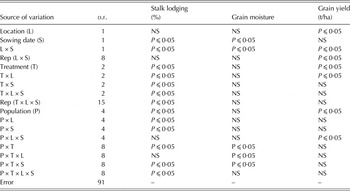
Combined analysis of treatments (protected with insecticide, infested with MCB and infested with ECB) was performed for stalk lodging, grain moisture and grain yield because these traits could be affected by corn borer damage. There were significant (P ⩽ 0·05) differences among treatments for stalk lodging and grain yield, but treatment × location, treatment × sowing, treatment × population interactions and most three-factor interactions were significant (P ⩽ 0·05) for stalk lodging, while location × treatment interactions were significant (P ⩽ 0·05) for yield. Grain moisture did not show significant differences among treatments, likewise most of the interactions between sources of variation were not significant either (Table 3).
Analysis of variance for agronomic traits affected by borer damage measured in three treatments (infested with Sesamia nonagrioides, infested with Ostrinia nubilalis and protected with insecticide) in four environments: two locations (Pontevedra and Zaragoza) and two sowing dates (early: late April and late: late May)

d.f., degrees of freedom; NS, not significant.
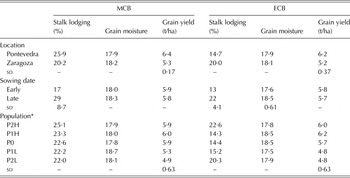
In individual analysis of treatments infested with MCB or ECB, there were significant (P ⩽ 0·05) differences for lodging between sowing dates under both corn borer infestations. Late sowing showed higher stalk lodging (25·2 v. 15·2%) (Table 4). Moreover, late sowing showed significantly (P ⩽ 0·05) higher grain moisture than earlier under ECB infestation. On the other hand, there were no significant differences between sowing dates for yield, but there were between locations (6·4 t/ha at Pontevedra v. 5·3 t/ha at Zaragoza) (Table 4). No significant differences were observed between higher and lower populations for stalk lodging and grain moisture, whereas higher diferulate populations yielded significantly (P ⩽ 0·05) more than lower diferulate populations under infestation (6·0 v. 4·9 t/ha) (Table 4).
Location, sowing date and population comparisons for agronomic traits affected by borer damage in the borer treatments [infested with Sesamia nonagrioides (MCB), and infested with Ostrinia nubilalis (ECB)] in four environments: two locations (Pontevedra and Zaragoza) and two sowing dates (early: late April and late: late May)

MCB, Mediterranean corn borers; ECB, European corn borers.
sd: not significantly different at P ⩽ 0·05.
* Population, maize populations in the high (H) and low (L) direction of maize hybrid CO125 × PB130 divergently selected for diferulates.
Although the insecticide treatment did not offer complete protection against borer attack, grain yield was increased and stalk lodging reduced compared with infestation treatments. The highest differences between protected and infestation conditions for stalk lodging (8·9% in the protected treatment v. 20·1% in the infested by borers) and grain yield (6·1 t/ha in the protected treatment v. 5·3 t/ha in the infested by borers) were recorded in Zaragoza (Tables 2 and 4). With regard to differences among populations, yield losses due to infestation with corn borers were 0·8 t/ha for the PH populations and 1·05 t/ha for the PL populations.
DISCUSSION
Performance of diferulate populations under protected conditions
The original divergent selection programme was carried out at Pontevedra; nevertheless, maize populations were also evaluated at Zaragoza because it is one of the major Spanish maize-producing regions, where, in addition, corn borers constitute an important constraint (Meissle et al. Reference Meissle, Romeis and Bigler2011). Therefore, better agronomic performance was expected at Pontevedra because plant materials were probably better adapted to these environmental conditions. The average thermal sum units for May–July (period between planting and anthesis) was higher at Zaragoza than at Pontevedra (data not shown); therefore, maize populations shed pollen 6–7 days earlier in Zaragoza and consequently produced 0·8 t/ha less yield than in Pontevedra.
In temperate environments growing conditions are expected to be more favourable for grain set and grain growth in early than in late sowings (Cirilo & Andrade Reference Cirilo and Andrade1994), but in the present study no differences between sowing dates were detected for grain moisture and yield, although maize in late sowings shed pollen and showed silking 1 week earlier. These results suggest that the period among sowing dates (<1 month) do not differ enough to interfere in grain development.
The interactions between population × location and population × sowing date were not significant, suggesting that the diferulate populations are fairly stable under diverse environments for agronomic performance. Maize populations selected for higher concentration of ester-linked diferulates in maize pith showed a reduction in days to flowering, and were taller and more productive than populations with lower diferulate concentrations. In addition, higher cell wall cross-linkage through diferulates shows neutral effect on grain yield because no differences for yield were detected between high diferulate populations and P0, but decreased cross-linkage below P0 levels shows significant negative impact on grain yield.
Selection for fibre content and composition of maize stover may influence carbohydrate partitioning between endosperm and stover. If so, changes in stover fibre might be associated with changes in grain yield and stalk strength. However, Wolf et al. (Reference Wolf, Coors, Albrecht, Undersander and Carter1993) showed only weak and inconsistent correlations between lignin content and various agricultural fitness parameters (height, grain yield, total yield, lodging, days to silk) on individuals selected for extreme divergence in fibre concentration. These results are similar to those of Allen et al. (Reference Allen, O'Neil, Main and Beck1991), who did not observe relationships between grain yield and whole-plant composition, or Vattikonda & Hunter (Reference Vattikonda and Hunter1983) who concluded that grain yield and stover digestibility were unrelated. In the present study, disorders with an effect on yield are described through the modification of the concentration of diferulates in maize stems.
In addition, alterations in lignin composition and content due to punctual mutations have been associated with agronomical changes. Four brown midrib mutations are known in maize (bm-1, bm-2, bm-3 and bm-4) and they are associated with significant alterations and/or reductions in lignin polymers (Vignols et al. Reference Vignols, Rigau, Torres, Capellades and Puigdomenech1995; Vermerris et al. Reference Vermerris, Thompson and McIntyre2002; Marita et al. Reference Marita, Vermerris, Ralph and Hatfield2003; Barrière et al. Reference Barrière, Ralph, Mechin, Guillaumie, Grabber, Argillier, Chabbert and Lapierre2004). Diverse studies have shown that brown midrib genes, associated with low lignin in maize and sorghum (Sorghum bicolor L.) stover, are associated with lower grain yield and increased stalk lodging (Miller et al. Reference Miller, Geadelmann and Marten1983; Lee & Brewbaker Reference Lee and Brewbaker1984; Pedersen et al. Reference Pedersen, Vogel and Funnell2005). In contrast, Lewis et al. (Reference Lewis, Lorenzana, Jung and Bernardo2010) found a genetic correlation between lower lignin and higher grain yield among bm-3 polymorphisms: based on these results, they propose that lignin concentration in the B73 × Mo17 population could be controlled by many minor loci that have little or no pleiotropic effect on grain yield, while the bm-3 gene would be a major gene.
Maize populations selected for low diferulates had higher total cell wall and glucose, arabinose, mannose, uronic acids than PH populations (Barros-Rios et al. Reference Barros-Rios, Malvar, Jung, Bunzel and Santiago2012). So it could be hypothesized that maize genotypes with lower concentrations of diferulates may influence carbohydrate partitioning; more resources are expended in the biosynthesis of cell wall polysaccharides and less energy is diverted to primary metabolism, consequently, plant height and grain yield are reduced. Therefore, the present experimental results, from populations with the same genetic background, support the idea that the reduced grain yield observed in maize populations selected for low diferulates is related to alterations in the strengthening of the cell wall matrix due to genes with pleiotropic effects. However, specific experimental research is needed in order to know whether correlations between diferulate concentration and grain yield are due to linkage or pleiotropic effects.
The PL populations presented more days to shedding pollen than PH, agreeing with the association between the bm-1 mutation and earliness found by Vermerris & McIntyre (Reference Vermerris and McIntyre1999). Since lignin is crucial for the transport of water through the vascular system of the plant, the growth rate of bm mutants could be affected, which could, in turn, be the underlying reason for modifications in the time to flowering (Vermerris & McIntyre Reference Vermerris and McIntyre1999; Vermerris et al. Reference Vermerris, Thompson and McIntyre2002), Applying the same argument, plants with higher diferulate concentrations could grow and develop at a faster rate (although the difference was ⩽1 day among populations).
Evaluation of lodging is complex because this trait varies with meteorological conditions and growing environments, and significant lodging may not occur every time. In the present study, undefined effects were observed for lodging in diferulate populations. The lack of correlation between either root lodging or stalk lodging with stover components such as neutral detergent fibre, acid detergent fibre and lignin indicates that quality improvements can be achieved without sacrificing resistance to lodging (Wolf et al. Reference Wolf, Coors, Albrecht, Undersander and Carter1993). Similar results were reported by Albrecht et al. (Reference Albrecht, Martin, Russel, Wedin and Buxton1986) and Lourenco et al. (Reference Lourenco, Anderson, Wedin, Dolstra and Miedema1986). Furthermore, increased lodging is also assumed to be associated with bm maize; however, an increase in lodging attributable to this mutation has not been detected in more than a few studies (Weller et al. Reference Weller, Phipps and Cooper1985; Inoue & Kasuga Reference Inoue and Kasuga1989).
Performance of diferulate populations under borer's infestation
The common goals of maize breeding programmes are high yield and adaptation to biotic and abiotic stresses. High grain yield indicates the need for alleles that positively affect all the pathways and functions affecting seed production, including stalk lodging or dropped ears; whereas wide adaptation indicates that the genotype requires traits that protect yield from abiotic and biotic stresses (Troyer Reference Troyer1996).
Maize stem borers are one of the most economically important insect pests. Every stage of the plant is susceptible to borer attack; however they are characterized by spending the majority of their life-cycle hidden within the stalk, feeding mostly on the pith (Cherry et al. Reference Cherry, Lomer, Djegui and Schulthess1999). Damage to the pith makes water and nutrient transport difficult, affecting plant growth and grain size and producing malformations in the ears. The tunnels cause weak stems that can be broken easily by wind or strong rain, increasing yield losses. Phenotypic selection has been successful in order to reduce stem tunnelling by borers (Sandoya et al. Reference Sandoya, Butrón, Alvarez, Ordas and Malvar2008; Butrón et al. Reference Butrón, Romay, Peña-Asin, Alvarez and Malvar2012, Reference Butrón, Samayoa, Santiago and Malvar2014; Samayoa et al. Reference Samayoa, Butrón and Malvar2014, but diverse studies noted a negative correlation between improved resistance and grain yield (Sandoya et al. Reference Sandoya, Butrón, Alvarez, Ordas and Malvar2008; Butrón et al. Reference Butrón, Samayoa, Santiago and Malvar2014). Indirect selection for traits genetically correlated with tunnel length and favourably associated with yield could be used instead of direct selection for tunnel length.
The structural and functional roles of plant cell walls are controlled by the composition and organization of their individual constituents [cellulose, hemicellulose or phenylpropanoids (such as lignin or hydroxycinnamates)], and these components have shown a determinative role in limiting insect feeding and disease progression. The link between cell wall cross-linking and insect resistance was first suggested by Fry (Reference Fry1986). The content of diferulates in maize leaves was highly and negatively correlated across genotypes with field leaf damage by the ECB (Bergvinson et al. Reference Bergvinson, Arnason, Hamilton, Mihm and Jewell1994, Reference Bergvinson, Hamilton and Arnason1995). The mechanism of resistance proposed suggests that an early cell wall fortification through phenolic cross-linking of hemicellulose by diferulates increases the leaf tissue toughness. Additional evidence for the role of diferulates was provided by the observation that diferulate content increased in different tissues over cycles of selection for borer resistance in the population BS9 (Bergvinson et al. Reference Bergvinson, Arnason and Hamilton1997). Ramputh (Reference Ramputh2002) suggested that resistance to important tropical and sub-tropical stem borers could be sensitive to early cell wall fortification by phenolic cross-linking. Finally, the present research group has consistently noted a link between diferulate cross-linkage and ECB and MCB resistance (Santiago et al. Reference Santiago, Butrón, Arnason, Reid, Souto and Malvar2006, Reference Santiago, Sandoya, Butrón, Barros and Malvar2008; Barros-Ríos et al. Reference Barros-Rios, Malvar, Jung and Santiago2011). Under borer infestation, less yield reduction was observed in the populations with high concentrations of diferulates, stem tunnelling by corn borer species was 9·1 cm lower in PH populations than in PL (Barros-Ríos et al. Reference Barros-Rios, Santiago, Jung and Malvar2015), and selecting for higher diferulate concentration had no detrimental effect on yield. Therefore, indirect selection for increased diferulates is recommended.
CONCLUSIONS
Understanding the role of cell wall constituents as defence mechanisms may help to develop varieties able to withstand pests and diseases. Nevertheless, account must be taken of the fact that this defence is inter-connected with other biological processes, because many genes and pathways involved in resistance to insect attack could be associated with genes implicated in agronomic performance. Modifications to the cell wall structure and composition need to be evaluated on various pest combinations in order to assess the usefulness of these materials in breeding programmes. The divergent diferulate selection programme had an indirect effect on important agronomic traits of maize. Populations selected for high esterified diferulate concentrations were slightly earlier in male flowering, taller and showed higher grain yield than populations in the low path. These indirect effects are considered advantageous changes in breeding programmes for developing maize genotypes more resistant to corn borers; on the other hand, it must be noted that reducing diferulate deposition in order to increase cell wall degradability could lead to reduced borer resistance and grain yield. The end use of selected maize varieties will determine the most appropriate way of selection for diferulates.
This research was supported by the National Plan for Research and Development of Spain (Projects Cod. AGL2006-13140, AGL2009-09611, and AGL2012-33415). Authors acknowledge a grant from the Ministry of Science and Innovation (Spain) and a postdoctoral contract ‘Ramón y Cajal’ financed by the Ministry of Economy and Competitiveness (Spain), Vigo University and the European Social Fund.