Clomazone has been a staple preemergence (PRE) herbicide for midsouthern US rice producers utilizing the direct-seeded, delayed-flood production system (Bond et al. Reference Bond, Golden and Lawrence2016; Street and Bollich Reference Street and Bollich2003). Residual grass herbicides common in direct-seeded, delayed-flood rice production include quinclorac, pendimethalin, and thiobencarb; however, none of these provide the same level of grass control as does clomazone (Baldwin Reference Baldwin1995; Crawford and Jordan Reference Crawford and Jordan1995; Jordan et al. Reference Jordan, Bollich, Burns and Walker1998; Smith and Hill Reference Smith and Hill1990; Street and Mueller Reference Street and Mueller1993; Webster et al. Reference Webster, Baldwin and Dillion1999).
Clomazone is readily absorbed by roots and emerging shoots, with translocation occurring via xylem to the foliage (Shaner Reference Shaner2014). Clomazone inhibits 1-deoxy-D-xyulose 5-phosphate synthase (DOXP), causing an accumulation of plastid pigments. Inhibition of DOXP causes a bleaching symptomology in susceptible plants (Duke et al. Reference Duke, Paul, Becerril and Schmidt1991; Shaner Reference Shaner2014). Clomazone is labeled PRE in various crops including cotton (Gossypium hirsutum L.), pumpkin (Cucurbita mixta Pang.), soybean [Glycine max (L.) Merr.], sugarcane (Saccharum officinarum L.), tobacco (Nicotiana tabacum L.), and rice for controlling numerous broadleaf and grass weed species (Shaner Reference Shaner2014). Barnyardgrass [Echinochloa crus-galli (L.) Beauv.] is the most troublesome weed in Mississippi rice (Webster Reference Webster2012). Evolution of resistance to propanil and quinclorac in barnyardgrass biotypes has led to reliance on other herbicide mechanisms of action for barnyardgrass control (Baltazar and Smith Reference Baltazar and Smith1994; Malik et al. Reference Malik, Burgos and Talbert2010). Malik et al. (Reference Malik, Burgos and Talbert2010) reported 99% control of propanil-resistant barnyardgrass 56 d after emergence following clomazone applied PRE.
Differences in herbicide tolerance among rice cultivars are common. This has been widely reported for acetolactate synthase–inhibiting and auxin herbicides (Bond et al. Reference Bond, Walker, Webster, Buehring and Harrell2007; Bond and Walker Reference Bond and Walker2011, Reference Bond and Walker2012; Pantone and Baker Reference Pantone and Baker1992; Zhang and Webster Reference Zhang and Webster2002). Although rice possesses an acceptable degree of tolerance to clomazone, rice injury can occur and may differ among cultivars (Mudge et al. Reference Mudge, Webster, Leon and Zhang2005; O’Barr et al. Reference O’Barr, McCauley, Bovey, Sensman and Chandler2007; Zhang et al. Reference Zhang, Webster and Blouin2005). Zhang et al. (Reference Zhang, Webster, Blouin and Linscombe2004) reported differential tolerance to clomazone among inbred rice cultivars; however, most cultivars were able to overcome initial injury without reduction in grain yield.
Rice in Mississippi is ideally seeded between April 1 and May 20 (Buehring et al. Reference Buehring, Walker and Bond2008); however, rice injury from clomazone is of particular concern when rice is seeded outside optimum planting dates, especially prior to the optimal seeding window. O’Barr et al. (Reference O’Barr, McCauley, Bovey, Sensman and Chandler2007) concluded that rice injury at 16 to 22 d after treatment was greater when rice was seeded in March than it was when rice was seeded in April; however, rice injury declined to ≤4% 45 d after treatment with all treatments except clomazone at 560 g ha−1. Jordan et al. (Reference Jordan, Bollich, Burns and Walker1998) suggested that clomazone injury to rice delayed grain maturity and development. Zhang et al. (Reference Zhang, Webster and Blouin2005) reported more severe rice injury with clomazone applied delayed-PRE, which is defined as delaying a residual herbicide application for 3 to 5 d after planting, after seeds have imbibed water for germination, compared with PRE; however, injury from clomazone rates ≥670 g ha−1 did not result in yield reduction.
Hybrid rice cultivars have been commercially grown since the mid-1970s in many Asian countries for their potential yield advantage over inbred cultivars (Tsuchiya et al. Reference Tsuchiya, Bastawisi, Yan, Moon and Ikehashi2003; Virmani Reference Virmani2005, Yang et al. Reference Yang, Peng, Laza, Visperas and Dionisio-Sese2007). Hybrid rice production in the midsouthern United States has increased rapidly since RiceTec’s release of ‘XL6’ rice hybrid in 2000 (Sha et al. Reference Sha, Linscombe, Blance and Groth2009). Hybrid rice cultivars are utilized in midsouthern US rice production due to increased yield and disease resistance compared with inbred rice cultivars.
Starter nitrogen (N) fertilizer treatments applied during the early stages of vegetative growth are beneficial for increasing yield in numerous crops including cotton (Bednarz et al. Reference Bednarz, Harris and Shurley2000), corn (Zea mays L.) (Lamond and Gordon Reference Lamond and Gordon2001), soybean (Osborne and Riedell Reference Osborne and Riedell2006), and rice (Walker and Norman et al. Reference Walker, Norman, Ottis and Bond2008). Nitrogen fertilizer applied prior to rice tillering, i.e., preflood application, influences grain yield more than application at any other time; however, when starter N fertilizer was applied to two-leaf rice, grain yields increased ≥200 kg ha−1 compared with the yield achieved with no starter N (Walker and Bond et al. Reference Walker, Bond, Ottis and Harrell2008). Walker and Norman et al. (Reference Walker, Norman, Ottis and Bond2008) reported that starter N fertilizer applied to two-leaf rice not only increased grain yield, but also increased early-season plant height compared with a no-starter-N control. Increased early-season rice plant height can improve crop management by allowing earlier flooding, thereby potentially reducing herbicide applications (Walker and Norman et al. Reference Walker, Norman, Ottis and Bond2008).
Previous research suggests that there may be a positive response to starter N fertilizer applied to rice injured by clomazone. Furthermore, producers annually raise concerns over field observations of differential responses of rice cultivars (hybrid vs. inbred) to clomazone. However, no literature specifically addressing the response of different rice cultivars to starter N fertilizer treatments following application of clomazone was identified. Therefore, research was conducted to compare the responses of ‘Cocodrie’ and ‘XL723’ rice cultivars to applications of clomazone and to determine if starter N fertilizer treatment reduces clomazone injury on rice seeded early in the growing season. Our main goal was to determine if a differential response to clomazone exists between Cocodrie and XL723 rice cultivars and if starter N treatment would offset reductions in rice plant performance.
Materials and Methods
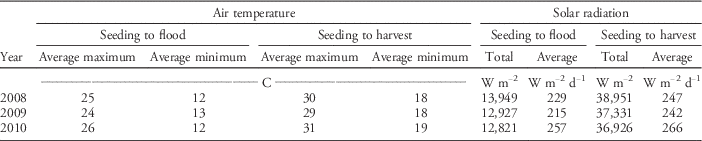
A study to evaluate rice response to clomazone and starter N fertilizer treatments was conducted in 2008 (33.43°N, 90.91°W), 2009 (33.44°N, 90.90°W), and 2010 (33.43°N, 90.91°W) at the Mississippi State University Delta Research and Extension Center in Stoneville, Mississippi. The soil was a Sharkey clay (very fine, smectitic, thermic Chromic Epiaquert) with a pH ranging from 8.0 to 8.3 and an organic matter content of approximately 2.0%. The experimental sites were in a 1:1 soybean to rice rotation. Field preparation each year consisted of fall disking and field cultivation in October. Experimental sites were left undisturbed following the last tillage pass until seeding each year. Emerged vegetation was controlled using glyphosate (Roundup® Weathermax® 4.5 L, Monsanto Company, 800 N. Lindburgh Blvd., St. Louis, MO 63167) at 1,120 g ae ha−1 prior to planting. Rice was drill-seeded to a depth of 2 cm on March 24 each year using a small-plot grain drill (Great Plains 1520, Great Plains Mfg, Inc., 1525 East North St., Salina, KS 67401) equipped with double-disk openers and press wheels spaced 20 cm apart. March 24 represents an early seeding date in Mississippi (Buehring 2008). Plots were kept weed-free by an application of quinclorac (Facet® 75 DF, BASF Crop Protection, 26 Davis Dr., Research Triangle Park, NC 27709) at 560 g ai ha−1 plus pendimethalin (Prowl® H2O 3.8 CS, BASF Crop Protection) at 1,120 g ai ha−1 plus halosulfuron (Permit® 75 DF, Gowan Company LLC, 370 Main St. Yuma, AZ 85364) at 12 g ai ha−1 applied at the three- to four-leaf rice stage. Nitrogen fertilizer at 168 kg ha−1 as urea was applied immediately before flooding, when rice was in the one- to two-tiller stage. Direct-seeded, delayed-flood rice production typically produces maximal grain yields on clay-textured soil previously cropped to soybean when urea is applied at the one-tiller stage (i.e., preflood) at rates ranging from 168 to 235 kg N ha−1 (Buehring 2008). Standard agronomic and pest management practices were used during the growing season each year. The dates of several agronomic events are listed in Table 1. Ambient air temperature and solar radiation data were collected from seeding to harvest and are summarized in Table 2.
Rice seeding, emergence, flood, and harvest dates, and date of starter nitrogen fertilizer treatment application, in a study evaluating the rice cultivar response to clomazone and starter nitrogen treatments at Stoneville, MS from 2008 to 2010.

Air temperature and solar radiation for periods from seeding until flood establishment and from seeding until harvest at Stoneville, MS in 2008, 2009, and 2010.

The study was designed as a randomized complete block with treatments defined by a factorial of two rice cultivars (Cocodrie and XL723), three clomazone (Command® 3ME, FMC Corporation, 1735 Market St., Philadelphia, PA 19103) rates (0, 420, or 672 g ha−1), and two starter N fertilizer treatments (0 and 24 kg N ha−1), with four replications. The long-grain rice cultivars Cocodrie (inbred) and XL723 (hybrid) were drill-seeded into randomly assigned plots at 95 kg ha−1 (400 to 450 seeds m−2) for Cocodrie and 28 kg ha−1 (125 seeds m−2) for XL723. Because of heterosis, a lower seeding rate is recommended by the hybrid rice manufacturer (Anonymous 2016). Each plot contained 8 rows of rice that were 5.5 m in length and spaced 20 cm apart. Plots were flooded to an approximate depth of 6 to 10 cm when rice reached the one- to two-tiller stage.
Immediately after seeding, clomazone treatments were applied to designated plots using a CO2-pressurized backpack sprayer equipped with extended range flat-fan nozzles (XR11002 TeeJet® nozzles, Spraying Systems Co., PO Box 7900, Wheaton, IL 60189) set to deliver 140 L ha−1 at 137 kPa. Approximately 1 wk after emergence (WAE), when rice reached the two-leaf growth stage, starter N fertilizer treatments in the form of ammonium sulfate were applied to designated plots.
Rice injury consistent with clomazone application was visually estimated 1 and 3 WAE on a scale of 0% (no injury) to 100% (rice death). Plant heights were determined by calculating the mean height of ten plants in each plot, measured from the soil surface to the tip of the extended leaf 1 and 3 WAE. Data collection intervals of 1 and 3 WAE corresponded to the day of and 2 wk after starter N fertilizer treatment, respectively. Rice density was calculated by counting all plants in two 1-m2 quadrats in each plot prior to starter N fertilizer application. Rice was harvested with a small-plot combine (Wintersteiger Delta, Wintersteiger, Inc., 4705 W Amelia Earhart Drive, Salt Lake City, UT 84116) at a moisture content of approximately 20%. Grain weights and moisture contents were recorded and rough rice grain yields were adjusted to a uniform moisture content of 12% for statistical analysis.
All statistical analyses were conducted with the Mixed Procedure in SAS version 9.4 (SAS Institute Inc., 100 SAS Campus Drive, Cary, NC 27513-2414). Type III statistics were used to test all possible fixed effects or interactions among the fixed effects. Data for all measurements were analyzed with year as a fixed effect. Year was designated a fixed effect because of differences in environmental conditions, particularly average daily solar radiation from planting until flooding, among the three years of the study (Table 2). For all measurements and analyses, block was considered a random effect, with cultivar, clomazone rate, starter N fertilizer treatment, and their potential interactions considered fixed effects and significant if P≤0.05. The square roots of visual injury data were acrsine transformed. The transformation did not improve homogeneity of variance based on visual inspection of plotted residuals; therefore, nontransformed data were used in analyses. Nontransformed data were used for rice density, height, and rough rice yield. Least-square means were calculated, and mean separation (P≤0.05) was produced using PDMIX800 in SAS, which is a macro for converting mean separation output letter groupings (Saxton Reference Saxton1998).
Results and Discussion
Early-Season Parameters
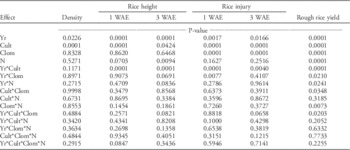
Environmental conditions across the three years of this experiment differed and had a direct impact on the results as each parameter measured was influenced by year (Table 3). Numerous publications have reported rice growth and development to vary greatly with environment (De Datta Reference De Datta1981; Moldenhauer and Gibbons Reference Moldenhauer and Gibbons2003; Nemoto et al. Reference Nemoto, Morita and Baba1995; Yoshida Reference Yoshida1973). In the midsouthern United States, environmental conditions consistent with early seeding dates (prior to April 1) often result in delayed seedling development owing to low air temperature, abundant rainfall, and limited solar radiation. The duration between seedling emergence and flooding generally requires at least 25 d. In the current research, cool, wet conditions and delayed crop growth and were associated with greater rice injury from clomazone (Table 2). Furthermore, differences in rice density and height could partially be attributed to differences in environment (Table 3).
Significance of the main effects of year (Yr), cultivar (Cult), clomazone rate (Clom), starter nitrogen fertilizer treatment (N), and interactions among the main effects, for rice density, height and injury determined 1 and 3 wk after emergence (WAE), and rough rice yield, in a study evaluating the rice cultivar response to clomazone and starter nitrogen fertilizer treatments.Footnote a

a Starter nitrogen fertilizer treatments had not been applied prior to the 1 WAE evaluation.
Rice density was only influenced by the main effects of year and cultivar (Table 3). Pooled across years, clomazone rates, and starter N fertilizer treatments, rice density 1 WAE for Cocodrie was 210 plants m−2 and greater (P=0.0001) than the density for XL723, which was 69 plants m−2 (data not presented). Differences in rice density among cultivars were expected and resulted from the discrepancy in seeding rates between the inbred and hybrid cultivars (Anonymous 2016; Buehring et al. Reference Buehring, Walker and Bond2008). However, densities for both cultivars were within accepted ranges for optimal stand establishment. Mean rice density 1 WAE for each cultivar was greater in 2010 than it was in 2008, while rice density in 2009 was similar to that seen in the other two years (data not presented). Differences in rice density across the three years can be explained by the quantity of rainfall between planting and the date rice density was determined. Rainfall received from planting to 1 WAE was 8.3, 6.5, and 1.2 mm in 2008, 2009, and 2010, respectively. Early-season stress from cool, wet conditions hampered rice emergence, with average daily solar radiation accumulation limited during 2008 and 2009 compared with that accumulated during 2010 (Table 2).
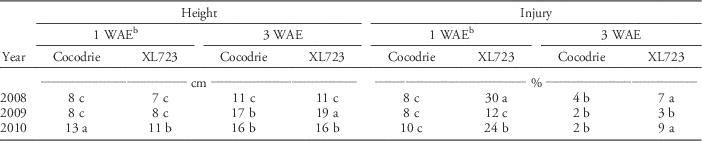
The year by cultivar interaction affected rice height 1 WAE (Table 3). Averaged across clomazone rates and starter N fertilizer treatments, height of Cocodrie 1 WAE was greater than that of XL723 in 2010, but was not greater than that of XL723 in 2008 or 2009 (Table 4). Furthermore, for each cultivar, height 1 WAE was greater in 2010 compared with that in 2008 or 2009. Differences in height between Cocodrie and XL723 in 2010 were likely a result of greater clomazone injury in XL723 than in Cocodrie 1 WAE (Table 4). Injury was also greater in XL723 compared with that seen in Cocodrie in 2008, but heights were similar for the two cultivars in that year.
Rice height and injury 1 and 3 wk after emergence (WAE) influenced by year and cultivar in a study evaluating hybrid (XL723) and inbred (Cocodrie) rice cultivars’ responses to clomazone and starter nitrogen fertilizer treatments at Stoneville, MS.Footnote a

a Data pooled over three clomazone rates and two starter nitrogen fertilizer treatments. Means followed by the same letter for each parameter and evaluation interval are not different at P≤0.05.
b Starter nitrogen fertilizer treatments had not been applied prior to evaluation.
Similar to height recorded 1 WAE, rice height 3 WAE was influenced by the interaction of year and cultivar as well as the main effect of starter N fertilizer treatment (Table 3). Rice height 3 WAE averaged across years, cultivars, and clomazone rates was greater (P=0.0094) in plots receiving 24 kg N ha−1 than it was in those receiving 0 kg N ha−1 starter fertilizer (data not presented). Walker and Norman et al. (Reference Walker, Norman, Ottis and Bond2008) reported a similar response in rice height to starter N fertilizer treatments. No differences in height at 3 WAE were detected for Cocodrie in two of three years when data were pooled across clomazone rates and starter N fertilizer treatments (Table 4). Heights for XL723 differed at 3 WAE each year. The greatest height for each cultivar was recorded in 2009, while the shortest rice heights were measured in 2008. Furthermore, rice height 3 WAE across the three years fluctuated 55% and 73% for Cocodrie and XL723, respectively.
Average solar radiation from seeding to flood was 12% greater in 2010 than it was in 2008 (Table 2). Yoshida (Reference Yoshida1981) reported that photosynthesis accounts for >84% of total carbohydrates in rice plants by the second week of growth and 100% of total carbohydrates by the second true leaf stage. Inconsistency in average solar radiation likely caused both the differences in height between cultivars in 2010 and the lack of differences in height between cultivars in 2008. Air temperatures have been shown to greatly impact rice growth rate in the first week after seeding (Yoshida Reference Yoshida1973). Although average maximum temperatures in the current research fell within the optimal range for early-season plant growth, the average minimum temperatures were low. More recently, Deng et al. (Reference Deng, Ling, Sun, Zhang, Fahad, Peng, Cui and Nie2015) reported that average air temperature prior to panicle initiation was positively correlated with total aboveground biomass, plant height, and crop growth rate for rice grown in China.
Visual estimates of rice injury 1 WAE were influenced by year by cultivar and year by clomazone rate interactions (Table 3). Pooled across clomazone rates and starter N fertilizer treatments, injury was similar across years for Cocodrie, but different each year for XL723 (Table 4). The greatest injury (30%) was observed for XL723 in 2008. Across clomazone rates and N fertilizer, injury to XL723 in 2009 was similar to that seen in Cocodrie all three years (Table 4). Injury from clomazone was greater for XL723 in 2008 and 2010 compared with that for Cocodrie; however, severity of injury for XL723 varied across years.
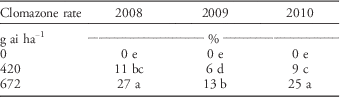
Averaged over starter N fertilizer treatment and cultivar, rice injury 1 WAE differed among clomazone rates across years (Table 3). Within each year, injury increased as clomazone rate increased, and the greatest injury was observed following clomazone at 672 g ha−1 (Table 5). Injury was similar following clomazone at 420 and 672 g ha−1 in 2008 and 2010, and these injury levels were greater than those seen with either rate in 2009. Rice injury 1 WAE was similar across the three years for Cocodrie, but varied for XL723 (Table 4). Scherder et al. (Reference Scherder, Talbert and Clark2004) also reported differences in early-season clomazone injury among rice cultivars in different years. Differences in injury 1 WAE in XL723 were likely related to both average air temperatures and average solar radiation (Table 2). Average solar radiation between seeding and flood in 2009 was 6% and 16% lower compared with that in 2008 and 2010, respectively. Differences in injury have been documented in corn (Keifer Reference Kiefer1989), rice (Mudge et al. Reference Mudge, Webster, Leon and Zhang2005; Scherder et al. Reference Scherder, Talbert and Clark2004; Zhang et. al. Reference Zhang, Webster, Blouin and Linscombe2004), soybean (Ross et al. Reference Ross, Eubank, Norsworthy and Scott2015), and sweet potato [Ipomoea batatas (L.) Lam.] (Harrison and Jackson Reference Harrison and Jackson2011) cultivars following herbicide applications.
Rice injury 1 wk after emergence influenced by year and clomazone rate in a study evaluating the rice cultivar response to clomazone and starter nitrogen fertilizer treatments at Stoneville, MS.Footnote a

a Data pooled over two cultivars and two starter nitrogen fertilizer treatments. Starter nitrogen fertilizer treatments had not been applied prior to evaluation. Means followed by the same letter are not different at P≤0.05.
The year by cultivar interaction and the main effect of clomazone rate affected the level of injury 3 WAE (Table 3). Pooled over starter N fertilizer treatments and clomazone rates, injury was similar across years for Cocodrie. Alternatively, injury for XL723 was similar in two of three years (Table 4). Rice injury was greater for XL723 in 2008 and 2010 compared with that for Cocodrie in all 3 years or XL723 in 2009 (Table 4). Averaged over years, cultivars, and starter N fertilizer treatments, injury increased with increasing clomazone rate 3 WAE (data not presented). Injury was 7% following clomazone at 672 g ha−1 compared to 1% following clomazone at 420 g ha−1, which was similar to the rate of injury seen in plots receiving no clomazone (data not presented).
Although similar to the 1 WAE evaluation in that the level of rice injury was greater for XL723 than it was for Cocodrie in 2008 and 2010, rice injury 3 WAE was <10% for all cultivar and year combinations (Table 4). Furthermore, injury 3 WAE was similar for Cocodrie across the three years, but injury on XL723 was greater in 2008 and 2010 than it was in 2009. Differences in response between hybrid and inbred rice cultivars has been reported. Zhang and Webster (Reference Zhang and Webster2002) reported that rice tolerance to bispyribac-sodium was dependent on both cultivar and growth stage at application. Hybrid imidazolinone-resistant rice cultivars ‘CLXL729’ and ‘CLXL745’ were less tolerant to imazamox applications than was the inbred ‘CL161’ (Bond and Walker Reference Bond and Walker2011). Bond and Walker (Reference Bond and Walker2012) reported variable tolerance among rice cultivars to postflood quinclorac applications, with rough rice yields of the inbred ‘Cheniere’ and the hybrid XL723 reduced more than those of the inbred cultivar ‘Bowman’.
The reason for differences in rice height and injury were less obvious 3 WAE compared with 1 WAE. However, more noteworthy was that rice injury 1 and 3 WAE was similar across years for Cocodrie, but differences in injury varied by a factor of 2.5 to 3 across years for XL723. This observation alone indicates that, when seeded early in the season during times when environmental conditions are variable (Table 2), the inbred cultivar Cocodrie performs more consistently through the first 5 to 6 wk after seeding than does the hybrid cultivar XL723. This information is valuable for producers, as cultivar selection and seeding date decisions are critical for optimum production.
Rough Rice Yield
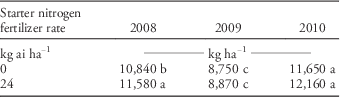
Rough rice yield was influenced by year by starter N fertilizer treatment, clomazone rate by starter N fertilizer treatment, and year by cultivar by clomazone rate interactions (Table 3). With data pooled over cultivars and clomazone rates, rough rice yield varied across the three years regardless of whether plots received a starter N fertilizer treatment (Table 6). Rough rice yield was lowest in 2009 and greatest in 2010, with no difference in rough rice yields across starter N fertilizer treatments in those years (Table 6). However, differences between starter N fertilizer treatments were observed in 2008, with rice receiving 24 kg N ha−1 producing the greatest rough rice yield. Rough rice yield following 24 kg N ha−1 in 2008 was greater than that for any treatment during 2009 and similar to that for starter N fertilizer treatments in 2010 (Table 6). Walker and Norman et al. (Reference Walker, Norman, Ottis and Bond2008) reported similar mean rice grain yield when ammonium sulfate (244 kg ha−1) or diammonium phosphate (198 kg ha−1) was applied at 22 kg N ha−1 to two-leaf Cocodrie planted at an optimum seeding rate for Sharkey clay soils.
Rough rice yield influenced by year and starter nitrogen fertilizer treatment in a study evaluating the rice cultivar response to clomazone and starter nitrogen fertilizer treatments at Stoneville, MS.Footnote a

a Data pooled over two rice cultivars and three clomazone rates. Means followed by the same letter are not different at P≤0.05.
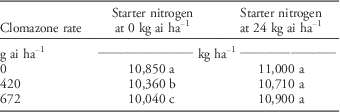
The influence of clomazone rate and starter N fertilizer treatment on rough rice yield pooled across years and cultivars is presented in Table 7. In the absence of a starter N fertilizer treatment (0 kg N ha−1), rough rice yields were lower in plots treated with clomazone compared with those in plots receiving no clomazone. Additionally, rough rice yields were lower following clomazone at 672 g ha−1 compared with those following clomazone at 420 g ha−1. In plots receiving a starter N fertilizer treatment (24 kg N ha−1), no effect of clomazone rate on rough rice yield was observed. In the absence of clomazone, rough rice yields were not improved following starter N fertilizer treatment. Walker and Bond et al. (Reference Walker, Bond, Ottis and Harrell2008) hypothesized that starter N fertilizer applied to rice planted at below-optimum seeding rates would improve yield, and they reported that a starter N fertilizer rate of 22 kg ha−1 increased yield 200 kg ha−1 compared to the yield obtained when no starter N was applied. The low seeding rates in the work of Walker and Bond et al. (Reference Walker, Bond, Ottis and Harrell2008) were utilized to simulate suboptimal early-season conditions such as poor environment, pest pressure, seedling mortality, or herbicide injury. Although our data show no grain yield response to starter N fertilizer in the absence of clomazone, starter N fertilizer increased rice grain yield in the presence of clomazone at each application rate (Table 7).
Rough rice yield influenced by clomazone and starter nitrogen fertilizer treatment in a study evaluating the rice cultivar response to clomazone and starter nitrogen fertilizer treatments at Stoneville, MS, from 2008 to 2010.Footnote a

a Data pooled over two rice cultivars and three years. Means followed by the same letter are not different at P≤0.05.
Pooled across starter N fertilizer treatments, rough rice yield varied across years, cultivars, and clomazone rates (Table 8). Regardless of clomazone rate, rough rice yields of Cocodrie were similar in 2008 and 2010 but lower in 2009. Clomazone rate also did not influence rough rice yield of Cocodrie in any single year. Rough rice yield of XL723 was greatest in 2010 regardless of clomazone rate. In 2008 and 2010, rough rice yields of XL723 were not influenced by clomazone rate. The same trend was noted for Cocodrie across all three years.
Rough rice yield of one inbred (Cocodrie) and one hybrid (XL723) rice cultivar influenced by year and clomazone rate in a study evaluating the rice cultivar response to clomazone and starter nitrogen fertilizer treatments at Stoneville, MS.Footnote a

a Data pooled over two nitrogen rates. Means followed by the same letter are not significantly different at P≤0.05.
The main goal of this research was to determine if a differential response to clomazone might exist between selected hybrid (XL723) and inbred (Cocodrie) rice cultivars, and if starter N fertilizer treatment would offset reductions in rice plant performance. In this research, clomazone injured the hybrid cultivar XL723 more than it injured the inbred cultivar Cocodrie. Additionally, in some years rough rice yields were lower for XL723 in plots where clomazone was applied than they were in plots where clomazone was not applied. This trend was not observed for Cocodrie. Therefore, early-season response and rough rice yield data suggest a differential susceptibility to clomazone between Cocodrie and XL723.
Positive early-season response to starter N fertilizer treatments was detected (height 3 WAE), and may shorten the time from emergence to flood. Starter N fertilizer may improve rough rice yields in some years, depending on environmental conditions, particularly average air temperature and solar radiation. The use of starter N fertilizer appears to be more beneficial to XL723 than it is to Cocodrie within the environmental constraints of this research. Ultimately, rice yield can be reduced by clomazone, but yield losses may be offset by the application of a starter N fertilizer.
These results are important as hectarage of hybrid rice in the midsouthern United States has increased and now accounts for >50% of rice production in the region. Clomazone is a foundation herbicide for direct-seeded, delayed-flood production systems and is recommended in weed management programs for barnyardgrass control. However, many producers express concern over injury following clomazone application. This research suggests that producers who choose to seed XL723 should apply a starter N fertilizer treatment to minimize the potential reduction in rough rice yield that may occur as a result of clomazone application.
Acknowledgments
The authors thank the Mississippi Rice Promotion Board for their funding of this research. We thank personnel at the Mississippi State University Delta Research and Extension Center for their assistance.