Introduction
Individuals diagnosed with mild cognitive impairment (MCI) are the main target for early interventions delaying dementia onset (Luck et al., Reference Luck2007) because they are at 31–44% higher risk of developing dementia compared to normal control subjects (Busse et al., Reference Busse, Hensel, Gühne, Angermeyer and Riedel-Heller2006; Zanetti et al., Reference Zanetti, Ballabio, Abbate, Cutaia, Vergani and Bergamaschini2006). Persons diagnosed with MCI are at an intermediate stage between normal cognitive aging and dementia: although they do have cognitive impairment to some degree, diagnostic criteria for dementia are not fulfilled. Over recent decades many different concepts regarding mild cognitive impairment have been published (e.g. Kral, Reference Kral1962; Crook et al., Reference Crook, Bartus, Ferris, Whitehouse, Cohen and Gershon1986; Levy, Reference Levy1994; Petersen et al., Reference Petersen2001; Winblad et al., Reference Winblad2004). Recent operationalized definitions provide the opportunity to differentiate several subtypes of MCI associated with different conversion rates to specific types of dementia (Panza et al., Reference Panza2005). Progress in research on MCI was also made in identifying brain changes and biomarkers as well as genetic and social risk factors associated with MCI (Jackson and Snyder, Reference Jackson and Snyder2008; Petersen and Negash, Reference Petersen and Negash2008; Ries et al., Reference Ries2008).
In order to diagnose MCI, different neuropsychological instruments have been used (CERAD, Thalmann et al., Reference Thalmann, Monsch, Schneitter, Ermini-Fünschilling, Spiegel and Stähelin1998; SIDAM, Zaudig and Hiller, Reference Zaudig and Hiller1995; CAMDEX, Roth et al., Reference Roth1986; MMSE, Folstein et al., Reference Folstein, Folstein and McHugh1975; GDS, Reisberg et al., Reference Reisberg, Ferris, De Leon and Crook1982; CDR, Hughes et al., Reference Hughes, Berg, Danziger, Coben and Martin1982). Having the advantage of being in regular and long-term contact with their patients, general practitioners, however, often do not apply these comprehensive neuropsychological assessments (Brodaty et al., Reference Brodaty, Howarth, Mant and Kurrle1994). So far, just 8% of MCI cases are detected by the general practitioner (Scanlan et al., Reference Scanlan, Brush, Quijano and Borson2002). It is therefore crucial to establish efficient yet short screening tests that are simple and easy to administer.
In recent years the clock drawing test (CDT) has been widely used particularly as a cognitive screening instrument for the diagnosis of dementia (Shulman, Reference Shulman2000). Despite variations in administration and scoring systems, the CDT basically includes drawing a clock face, adding all numbers and setting a specific time. To pass the clock drawing task, different cognitive abilities – like auditory and visual comprehension, concentration and knowledge – and also executive control are needed (Paganini-Hill et al., Reference Paganini-Hill, Clark, Henderson and Birge2001; Shulman, Reference Shulman2000). The key benefits of CDT are therefore the simple and quick application and evaluation in order to survey global cognitive functions. Although the CDT has already been used widely for diagnosing dementia, it is still a subject for debate on whether the CDT is valid as a screening instrument for MCI.
This article reviews systematically all published studies of the utility of CDT in detecting MCI, in order to evaluate the applicability of CDT for MCI screening.
Methods
In order to identify relevant publications of the value of CDT in screening for MCI, a systematic literature search was conducted. Relevant publications were identified in the databases PubMed, Web of Science, Cochrane Library and PSYNDEX (with no limits on publication date) and in the bibliographies of published studies or reviews. Search criteria were “clock” or “clock drawing” and “cognitive impairment”, “cognitive decline”, “mild cognitive impairment”, “mild dementia” or “questionable dementia”.
Studies were included if the following criteria were met:
• the study deals with persons with the diagnosis of MCI, regardless of the underlying theoretical concept; if, however, the MCI group included cases of dementia, the study was excluded;
• the CDT was used as a screening instrument in the study, independent of the scoring system applied;
• the study provides basic information about sample selection, operationalization of MCI and the CDT scoring system used.
Results
Literature search results
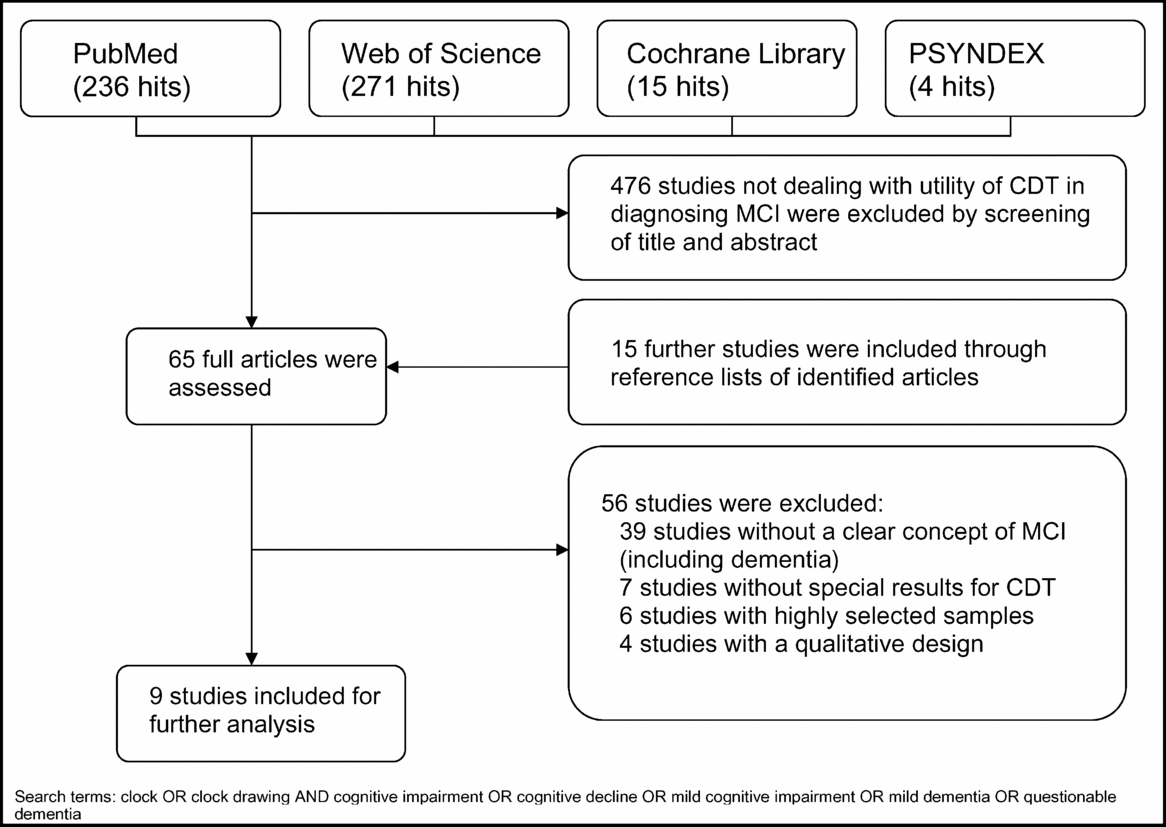
The initial search strategy conducted in July 2008 identified 526 potentially relevant papers. An initial review of the abstracts led to the exclusion of 476 papers because they referred to physical diseases. Fifteen further studies were included from the reference lists of identified articles. The remaining 65 full articles were retrieved and reviewed for final inclusion; 56 of these had to be excluded because they did not fulfill the selection criteria. The literature search (Figure 1) finally identified nine studies dealing with the utility of the CDT in identifying MCI.
Results of the systematic literature search.
General characteristics
Papers were published between 2004 and 2008, reflecting the development of the MCI-concept. The studies were conducted mainly in Germany (n = 2) and the U.S.A. (n = 2). Other studies came from Canada, Italy, Japan, China and Brazil.
Methodological characteristics of the studies
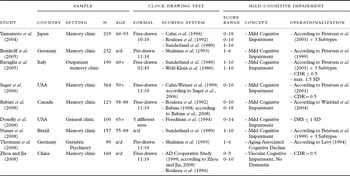
Table 1 provides an overview of the methodological characteristics of the nine studies included. In order to evaluate the utility of CDT in screening for MCI, most of the studies compared the CDT scores of clinically diagnosed MCI patients with the CDT scores of cognitively unimpaired subjects. Despite this general approach, the studies differ regarding further methodological aspects.
Methodological characteristics of the studies

n = sample size; CDR = Cognitive Dementia Rating Scale (Hughes et al., Reference Hughes, Berg, Danziger, Coben and Martin1982); DRS = Dementia Rating Scale (Folstein et al., Reference Folstein, Folstein and McHugh1975); MMSE = Mini-mental-State Examination (Folstein et al., Reference Folstein, Folstein and McHugh1975); SD = Standard Deviation.
n/d = no data.
First, there are differences in the sample characteristics of these studies. The sample size ranged from 89 to 364 subjects, with samples consisting mainly of cognitively healthy and cognitively impaired persons, including individuals with different degrees of impairment. In almost every study the individuals have been recruited in memory clinics. Only one study is based on a sample recruited in general clinics (Donelly et al., Reference Donelly, Donelly and Cory2008). All studies dealt with the elderly, but the age range varies among the studies.
Secondly, the studies differ in relation to considerably diverse versions of the CDT. These variants of the CDT are related, on one hand, to the formal administration and, on the other, to the scoring system used. The majority of the studies used a blank sheet of paper and instructed the patient to draw a circle freehand. However, other authors presented their subjects with a pre-drawn circle for the clock drawing task (Beinhoff et al., Reference Beinhoff, Hilbert, Bittner, Grön and Riepe2005; Thomann et al., Reference Thomann, Toro, Dos Santos, Essig and Schröder2008). In more than half of the studies the patients are instructed to set the clock hands at 10 past 11 (11:10). The instruction to set the hands at 2:45 (Ravaglia et al., Reference Ravaglia2005) or 10:10 (Yamamoto et al., Reference Yamamoto2004) was less frequently used. The applied scoring systems also varied: from simple five-level up to 18-level scoring systems. But, in general, the scoring systems of Shulman et al. (Reference Shulman, Shedletsky and Silver1986; Reference Shulman, Gold, Cohen and Zucchero1993), Sunderland et al. (Reference Sunderland1989) and Rouleau et al. (Reference Rouleau, Salmon, Butters, Kennedy and McGuire1992; Reference Rouleau, Salmon and Butters1996) are most commonly used.
Thirdly, there are some differences among the studies regarding the underlying MCI concept and its operationalization. The majority of the authors used recent MCI criteria according to Petersen et al. (Reference Petersen, Smith, Waring, Ivnik, Tangalos and Kokmen1999; Reference Petersen2001) or Winblad et al. (Reference Winblad2004). One study (Zhou and Jia, Reference Zhou and Jia2008) examined vascular cognitive impairment exclusively, which does not meet the criteria of dementia. Another single study (Thomann et al., Reference Thomann, Toro, Dos Santos, Essig and Schröder2008) examined aging-associated cognitive decline (AACD; Levy, Reference Levy1994). The operationalization of MCI differed among the studies as well. Most of the studies used detailed neuropsychological assessment based on current MCI concepts for MCI diagnosis (Petersen et al., Reference Petersen, Smith, Waring, Ivnik, Tangalos and Kokmen1999; Reference Petersen2001; Winblad et al., Reference Winblad2004). Besides the exclusion of dementia cases, Zhou and Jia (Reference Zhou and Jia2008) used a level of 0.5 on the Cognitive Dementia Rating scale (CDR; Hughes et al., Reference Hughes, Berg, Danziger, Coben and Martin1982) for categorizing MCI, and Donelly et al. (Reference Donelly, Donelly and Cory2008) graded MCI with the aid of the Dementia Rating Scale (DRS; Folstein et al., Reference Folstein, Folstein and McHugh1975).
Results of the studies
To evaluate the screening utility of the CDT for the diagnosis of MCI, most of the studies compared the mean CDT score of cognitively healthy subjects with the score of persons diagnosed with MCI. In this respect, many authors could not identify significant differences between MCI patients and cognitively normal subjects (Beinhoff et al., Reference Beinhoff, Hilbert, Bittner, Grön and Riepe2005; Sager et al., Reference Sager, Hermann, La Rue and Woodard2006; Nunes et al., Reference Nunes2008) or could identify only significant differences between multiple-domain MCI patients and cognitively healthy subjects (Ravaglia et al., Reference Ravaglia2005). Babins et al. (Reference Babins, Slater, Whitehead and Chertkow2008) did a further evaluation of CDT and verified no significant mean differences of MCI patients who would progress to dementia within the next 48 months and MCI patients who did not develop dementia on follow-up-assessment. In contrast, Babins et al. (Reference Babins, Slater, Whitehead and Chertkow2008), Donelly et al. (Reference Donelly, Donelly and Cory2008), Thomann et al. (Reference Thomann, Toro, Dos Santos, Essig and Schröder2008) as well as Zhou and Jia (Reference Zhou and Jia2008) reported significant mean differences between both groups.
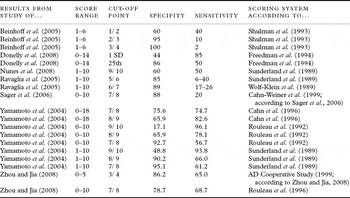
Furthermore, the majority of the studies calculated the specificity and sensitivity for certain cut-off scores. These values of specificity and sensitivity varied widely among the studies (Table 2); most of them ranged between 50% and 80% (sensitivity) or 65% and 90% (specificity). In order to obtain high discriminatory power, a reliable diagnostic instrument should have a value of sensitivity higher than 80% and a specificity-value higher than 60% (Blake et al., Reference Blake, McKinney, Treece, Lee and Lincoln2002). Only one study (Yamamoto et al., Reference Yamamoto2004), applying the scoring system of Cahn et al. (Reference Cahn, Salmon, Monsch, Butters, Wiederholt and Corey-Bloom1996), could diagnose MCI with the aid of CDT with satisfying sensitivity and specificity.
Sensitivity and specificity of CDT in diagnosing MCI

SD = standard deviation.
Discussion
Although the CDT is widely used as a diagnostic tool for cognitive impairment, only nine studies were identified on the diagnostic utility of the CDT in MCI.
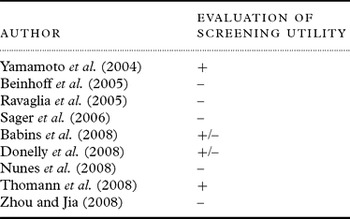
When comparing the mean CDT scores of cognitively healthy subjects with the scores of persons diagnosed with MCI, the majority of the studies reviewed could not identify significant differences. However, four authors reported significant differences between both groups (Babins et al., Reference Babins, Slater, Whitehead and Chertkow2008; Donelly et al., Reference Donelly, Donelly and Cory2008; Thomann et al., Reference Thomann, Toro, Dos Santos, Essig and Schröder2008; Zhou and Jia, Reference Zhou and Jia2008). These results should still be considered with caution. First, dementia rating scales to diagnose MCI were used in two of these studies (Donelly et al., Reference Donelly, Donelly and Cory2008; Zhou and Jia, Reference Zhou and Jia2008). Secondly, MCI individuals were recruited at memory or geriatric psychiatry clinics (Babins et al., Reference Babins, Slater, Whitehead and Chertkow2008; Thomann et al., Reference Thomann, Toro, Dos Santos, Essig and Schröder2008; Zhou and Jia, Reference Zhou and Jia2008) and such samples would be expected to have a higher degree of cognitive complaints and impairment than a representative group of individuals suffering MCI and should therefore perform worse in cognitive tasks generally. Finally (Table 3), only one (Thomann et al., Reference Thomann, Toro, Dos Santos, Essig and Schröder2008) out of the four authors who identified significant differences concluded that the CDT is a good screening tool for MCI. Two authors (Babins et al., Reference Babins, Slater, Whitehead and Chertkow2008; Donelly et al., Reference Donelly, Donelly and Cory2008) avoided a final decision or recommended the use of the CDT in combination with other screening tools in order to diagnose MCI. Zhou and Jia (Reference Zhou and Jia2008) found the CDT to have no screening utility in MCI as did all the authors who could not identify significant differences (Beinhoff et al., Reference Beinhoff, Hilbert, Bittner, Grön and Riepe2005; Sager et al., Reference Sager, Hermann, La Rue and Woodard2006; Nunes et al., Reference Nunes2008).
Evaluation of the value of the CDT as a screening tool for the diagnosis of MCI

+ = recommendation; – = no recommendation.
A closer look at the sensitivities and specificities shows that the particular values may be related to the scoring system used as well as the maximal number of achievable scores in CDT. However, there is no general and clear influence of score range and values of diagnostic accuracy. Both the simpler five-level scoring systems (e.g. the AD Cooperative Study, 1999 in Zhou and Jia, Reference Zhou and Jia2008) and the more complex 18-level system (Cahn et al., Reference Cahn, Salmon, Monsch, Butters, Wiederholt and Corey-Bloom1996 in Yamamoto et al., Reference Yamamoto2004) reach similar values in detecting MCI. Furthermore, the values of diagnostic accuracy are influenced by the applied cut-off point: the authors differ in fixing a certain cut-off point to discriminate between patients diagnosed with MCI and cognitively healthy subjects, even though the same scoring system was used. Additionally, the cut-off-points used were often equivalent to the cut-off scores published by the authors of the original scoring systems, which differentiate between cognitive impairment, mostly symptoms of dementia, and no cognitive impairment. Conclusively, only one scoring system (Cahn et al., Reference Cahn, Salmon, Monsch, Butters, Wiederholt and Corey-Bloom1996 in the study of Yamamoto et al., Reference Yamamoto2004) achieved high discriminatory power according to the aforementioned recommendations of Blake et al. (Reference Blake, McKinney, Treece, Lee and Lincoln2002). However, these sensitivity and specificity results were only achieved when using the more complex 18-level scoring system.
In general, no scoring system was consistently accepted. There is merely an overall agreement among authors that a scoring system should be easy learnable and applicable. Nishiwaki et al. (Reference Nishiwaki, Breeze, Smeeth, Bulpitt, Peters and Fletcher2004) add the need of greater rating skill and increased training time when using more complex scoring systems. Shulman (Reference Shulman2000) concludes that the simpler the scoring system, the better. The published studies concerning the utility of the CDT in diagnosing MCI could not make any contribution towards defining the best scoring system. There was no consensus on the optimum number of levels in the scoring system to diagnose MCI, nor on the most appropriate scoring system.
With regard to methodological aspects, the studies also differ in their sampling characteristics. Some studies recruited their subjects in non-representative settings such as memory clinics (see Table 1), with an obvious tendency for such subjects to complain more often about a reduction in their cognitive abilities than normal subjects. Hence generalization of results, based on non-representative samples, is problematic. In addition, the sample size varies between the studies. Results based on small samples (Thomann et al., Reference Thomann, Toro, Dos Santos, Essig and Schröder2008) are limited in their applicability.
Different versions of the CDT regarding formal administration were applied in the studies. A few authors used a pre-drawn circle, whereas the majority instructed their patients to draw their own a clock face. Drawing a circle freehand enhances the cognitive demands of the task. An additional tendency to draw smaller clock circles can be found in patients with early dementia (Chiu et al., Reference Chiu, Li, Lin, Chiu and Liu2008). By contrast, Juby et al. (Reference Juby, Tench and Baker2002) prefer to use pre-drawn circles in order to minimize the possible influence of education. There is also disagreement concerning the specific time patients are requested to draw on the clock, with three different times being used among the nine studies. Most commonly, the demand to set the hands at 10 past 11 (11:10) was used, as recommended by Shulman (Reference Shulman2000). This task requires visual-spatial functions (including both visual fields) and the inhibition of the instinct to put the hands towards 10 instead of 2. The studies reviewed could not identify which kind of formal administration of the CDT should be used.
Two studies examined CDT scores for different MCI subtypes (Yamamoto et al., Reference Yamamoto2004; Ravaglia et al., Reference Ravaglia2005). Ravaglia et al. (Reference Ravaglia2005) identified the worst CDT scores among persons diagnosed with multidomain MCI (criteria of MCI according to Petersen et al., Reference Petersen2001) when compared with normal control groups and single MCI-subtypes. Therefore, Ravaglia et al. (Reference Ravaglia2005) and Chiu et al. (Reference Chiu, Li, Lin, Chiu and Liu2008) concluded that very severe cognitive symptoms are needed, similar to forms of dementia, in order to diagnose cognitive impairment using the CDT. In accordance with Yamamoto et al. (Reference Yamamoto2004), more planning deficits and fewer conceptual deficits in MCI patients result in bad performances in the CDT task. Babins et al. (Reference Babins, Slater, Whitehead and Chertkow2008) noticed mistakes among MCI patients primarily in hand-setting, which is why more focus should be placed on the minute and hour hands when diagnosing MCI.
There is a great need for suitable, short and easy applicable screening methods for MCI. Nine studies on the diagnostic utility of the CDT for MCI are available. The studies reviewed show substantial methodological differences regarding selection of the sample examined as well as the modality of CDT being administered and scored (scoring system, cut-off score). Therefore, the comparability of the studies is somewhat limited, and it is assumed that the results of the studies are influenced by methodological issues.
We conclude that, although the CDT may have an independent diagnostic utility in combination with other cognitive test procedures, it should not be advised as a screening instrument for MCI. However, the original intention was to identify a simple test that could be readily carried out in general practice for MCI screening. The search for a better single and simple-to-administer MCI screening instrument must continue.
Conflict of interest
None.
Description of authors' roles
L. Ehreke, M. Luppa, H.-H. König and S.G. Riedel-Heller formulated the research questions; L. Ehreke and M. Luppa analyzed the data; and L. Ehreke wrote the paper.
Acknowledgment
This publication is part of the consortium “Comorbidity and multimorbidity in primary health care” (MultiCare) and was funded by the German Federal Ministry of Education and Research; Grant Number: 01 ET 0728.