Introduction
Auditory-verbal hallucinations constitute a major symptom of schizophrenia, with up to 70% of patients experiencing them at some point during their illness (Bentall, Reference Bentall1990). Several cognitive mechanisms have been advanced to explain the genesis of hallucinations. The most widely accepted hypothesis proposes that speech hallucinations arise from the misattribution of an internally generated event to an external source (Bentall, Reference Bentall1990; Frith, Reference Frith1992; Seal et al. Reference Seal, Aleman and McGuire2004). Defective self-monitoring has been advanced as the fundamental cognitive error underlying this process (e.g. Larøi et al. Reference Larøi, Collignon and Van der Linden2005). According to this theory, to distinguish between self-generated and external signals, we rely on a feed forward signal of our intention to act. Hallucinations are conceptualized as a breakdown in the system monitoring those intentions. If the signal about our plans and goals does not reach this internal monitor, the action following the intention is not recognized as self-generated. Specifically, in the case of hallucinations, inner speech could be misinterpreted as coming from an outside source.
Recent work, however, has provided evidence that such an externalizing tendency is not specific to schizophrenia patients with auditory hallucinations, and seems to be linked to positive symptoms in general (Johns et al. Reference Johns, Rossell, Frith, Ahmad, Hemsley, Kuipers and McGuire2001; Keefe et al. Reference Keefe, Arnold, Bayen, McEvoy and Wilson2002). Moreover, self-monitoring theory does not address why hallucinations take on sensory characteristics, such as variations in loudness, pitch and vividness. A number of researchers have looked into the perceptual aspect of hallucinations, and have suggested that a perceptual deficit might underlie the development of hallucinations. For instance, hallucinating patients seem to be especially prone to misperceive speech stimuli when phonetic clarity is reduced experimentally (Alpert, Reference Alpert1985) and to experience meaningless sounds as meaningful (Bentall & Slade, Reference Bentall and Slade1985). However, the design of these studies allowed for suggestibility to play a major role, in addition to deficits in perception. Hoffman et al. (Reference Hoffman, Rapaport, Mazure and Quinlan1999) assessed narrative speech perception with a masked speech tracking task in healthy controls and schizophrenia patients with and without hallucinations. They concluded that hallucinated voices derive from disrupted speech perception and verbal working memory rather than from non-language cognitive or attentional deficits. In reaction, however, Aleman & de Haan (Reference Aleman and de Haan2000) remarked that the disruption of non-language cognitive processes should not be discarded as a possible contribution to the occurrence of hallucinations. The most complete assessment of auditory perception to date was undertaken by McKay et al. (Reference McKay, Headlam and Copolov2000), who used a comprehensive battery of nine auditory perception assessments in patients with schizophrenia to investigate whether auditory hallucinations are associated with abnormal central auditory processing. Results were characterized by a large inter-individual variability. Group differences between hallucinating and non-hallucinating patients were absent on the majority of tests, although hallucinating patients performed worse on a left monaural speech perception test and had an abnormal response pattern on a spondaic word test. The authors concluded that the auditory abnormalities observed in hallucinating patients probably expressed a greater degree of the same kind of dysfunction that results from schizophrenia itself. In sum, there is some evidence of speech perception deficits but it has not been established whether these deficits truly constitute a specific trait marker for schizophrenia with auditory hallucinations.
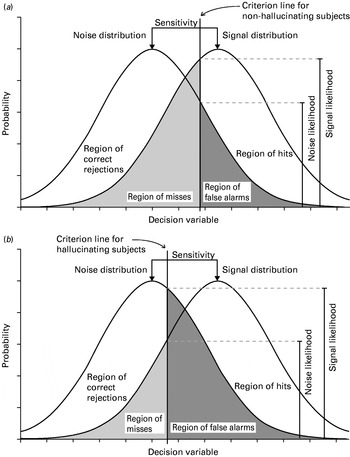
Dolgov & McBeath (Reference Dolgov and McBeath2005) have proposed a theoretical framework within signal detection theory (SDT) that could explain the occurrence of hallucinations in absence of a perceptual deficit. SDT can be applied when measuring the way decisions are made under uncertain or ambiguous conditions. It is applied to accuracy data to analyze the underlying cognitive mechanisms of task performance. According to SDT there are a number of psychological determiners of how an individual detects a signal. In a typical signal detection task, each trial requires the subject to discriminate between two possible stimulus types: ‘noise’ or ‘signal plus noise’. On a given trial, subjects respond based on the value a decision variable reaches on a signal intensity scale. If the value of the decision variable reaches the individual's response criterion, the subject will answer ‘yes’ (a stimulus was present). If the value remains below that criterion, the subject will answer ‘no’ (only noise was present). Thus, four different perceptual instances can occur: veridical perception (a hit), veridical non-perception (a correct rejection), erroneous perception (a false alarm) and lack of perception (a miss) (Fig. 1a). Based on these error proportions, two measures can be derived: perceptual sensitivity and response bias. Perceptual sensitivity is represented by the distance between the means of the ‘noise’ and ‘signal plus noise’ distributions, and refers to the general effectiveness of the perceptual system. Response bias represents the individual's criterion for deciding whether a perceived event is an actual stimulus. Dolgov & McBeath (Reference Dolgov and McBeath2005) suggested that when the decision criterion shifts to the left, it creates a larger proportion of false alarms (or hallucinations). In addition, the number of misses (or instances where a stimulus is not picked up) will decrease (Fig. 1b). This is potentially advantageous in that it results in an increased recognition of weakly indicated stimuli. In this theory it is also suggested that attentional processes play a role in this criterion shift. Thus, applied to the case of auditory hallucinations, this theory implies not a speech perception deficit, but rather the possibility of perceptual enhancement due to attentional processes.
The x axis represents the vividness of the percept, or the convincingness that the stimulus is veridical. The y axis represents the frequency of the occurrence of such an event. In a signal detection task, two distinct distributions can be identified: a noise distribution, which represents the convincingness of the stimulus over all trials where only noise was presented; and a signal plus noise distribution, which in turn represents the convincingness of the stimulus over all trials where a stimulus was present. A criterion line is drawn that represents the observer's threshold for interpreting a stimulus as a real percept. The hypothesized thresholds are shown for (a) non-hallucinating and (b) hallucinating subjects. A criterion shift to the left creates a greater proportion of false alarm errors but also a greater probability of determining real occurrences of signals, or hits.

Previously, Schneider & Wilson (Reference Schneider and Wilson1983) posited a similar theory. They examined the performance of schizophrenia patients and healthy controls on a perceptual discrimination task, where subjects had to respond to frequent and infrequent tones with different button presses. Analogous tasks were used in the auditory and visual modality to ascertain the differential effect of auditory hallucinations. The patients were divided into three groups: those who currently hallucinated, those who were currently not hallucinating but who had hallucinated in the past, and those who had never hallucinated. The authors observed the fastest reaction times and most accurate responses in normal controls. Of the schizophrenic groups, the currently hallucinating group was generally most accurate and they showed faster reaction times in the auditory task, compared to the other patient groups. Normal controls and currently hallucinating individuals were the only groups who displayed a reaction time advantage in the auditory modality. The authors explained this seemingly paradoxical finding of greater accuracy and faster reaction times associated with hallucinations by referring to the attentional salience of auditory stimuli for hallucinating individuals. Thus, there is some indication that hallucinating patients may scan their environment for auditory input more than non-hallucinating patients do and seem to be more reactive to it. However, Schneider & Wilson used nonsensical tone stimuli, and their relationship to auditory-verbal hallucinations is unclear. It thus remains to be demonstrated whether hallucinating individuals are also more sensitive to speech stimuli and which cognitive processes underlie this effect.
Our study aimed to clarify this mechanism of hallucination genesis by applying SDT to a speech discrimination task in hallucinating and non-hallucinating schizophrenia patients and healthy controls. We used more ecologically valid auditory-verbal stimulus material, referenced to hallucination content. SDT is especially instrumental in this issue, as it allows an investigation of the underlying cognitive mechanisms of task performance and can assist in determining whether hallucinations are the product of anomalies of perceptual sensitivity or response bias.
Method
Subjects
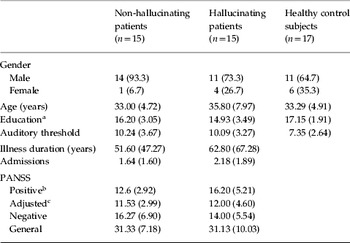
Fifteen hallucinating patients (four females), 15 non-hallucinating patients (one female) and 17 healthy individuals (six females) participated in the experiment. Patients were included in the hallucinating group if they reported hallucinations in the week prior to testing, and if they obtained a hallucination score of at least 3 on the Positive and Negative Syndrome Scale (PANSS). Patients were included in the non-hallucinating group if they had not experienced hallucinations for at least 3 months prior to testing (six had never hallucinated). All patients had received a diagnosis within the schizophrenia spectrum, according to DSM-IV criteria, confirmed with the Comprehensive Assessment of Symptoms and History (CASH) interview (Andreasen et al. Reference Andreasen, Flaum and Arndt1992). The three groups of subjects were matched according to age, gender and education level. The severity of the disorder in patients was assessed with the PANSS interview. The two groups of patients did not differ in terms of general psychopathology, negative symptoms or positive symptoms (provided an adjustment for hallucination score), nor did they show any differences in terms of illness duration or number of psychiatric hospital admissions. Subject characteristics are summarized in Table 1.
Demographic and clinical characteristics of schizophrenia patients with and without hallucinations and healthy controls

PANSS, Positive and Negative Syndrome Scale.
Values are n (%) or mean (standard deviation).
a Hallucinating patients had a marginally lower education level than healthy control subjects [t(26)=2.04, p<0.10].
b Scores on the total positive subscale of the PANSS were significantly higher in the group of hallucinating patients [t(28)=2.33, p<0.05].
c The adjusted score is the total positive PANSS score minus the score on the hallucination item P3.
Procedure
Participants first gave their informed consent. Then, a perceptual threshold task with pure tones was undertaken. Absolute detection thresholds for loudness of a target tone presented in 74 dB(A) white noise were determined using a standard adaptive staircase rule (1-up 2-down). Steps were 5 dB prior to the fourth turnaround and 1 dB thereafter. Signal levels at each turnaround after the fourth were averaged to yield an estimate of the signal level at which 50% of stimuli were detected.
Subsequently, participants performed the speech detection task. Subjects were seated in front of a computer screen. On each trial a target word was presented at 60–65 dB, superimposed on white background noise at 72 dB, through the computer's speaker boxes. The target words were audible but hardly discernable. Stimuli consisted of verbs and nouns. After a 2-s delay a probe stimulus, consisting of a spoken word, was presented, free of noise, and thus clearly audible. During this phase the screen showed only a fixation cross. The question ‘have you heard the word “X” in the noise?’ was then presented on screen, with ‘X’ referring to the probe stimulus. Subjects indicated their answer on a five-point scale, ranging from ‘certainly not’ to ‘certainly’. A rating scale was used because this allows for a graded response, fitting with the ambiguous conditions. The experiment consisted of 50 trials. On half of the trials the target word (embedded in noise) and the probe word were the same.
We used SDT to process the data. The rating scale data were first converted into hit and false alarm rates. Then, according to the procedure for rating tasks, described in detail by Stanislaw & Todorov (Reference Stanislaw and Todorov1999), two measures were calculated: the response bias (β), and the sensitivity in the detection of the signal (Az).
Results
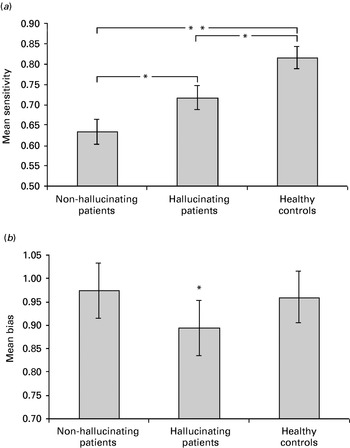
We performed separate ANOVAs with group as a between-subjects factor with three levels and the two measures derived from the signal detection analysis, Az and β, as dependents. A significant main effect of group was observed on Az [F(2, 44)=11.81, p<0.01] but not on β [F<1]. We added auditory thresholds as a covariate in the analysis. The main effect of group on Az remained significant [F(2, 43)=16.06, p<0.001] but again no main effect of group on β emerged [F<1]. The effect was then further analyzed by means of planned contrasts. With regard to the variable Az, both patient groups showed significantly lower scores than normal controls [F(1, 44)=5.77, p<0.05, d=0.94 and F(1, 44)=23.61, p<0.001, d=1.65, for hallucinating and non-hallucinating patients respectively]. Within the patient group, non-hallucinating patients had lower scores than hallucinating patients [F(1, 44)=5.68, p<0.05, d=0.82]. We performed t tests to check whether β values differed significantly from 1 for each of the groups, as a deviation from 1 indicates an abnormal value or a bias in responding. Only in the case of hallucinating patients did we find β to be significantly lower than 1, demonstrating a positive response bias [t(14)=−2.27, p<0.05, d=1.21] (Fig. 2).
(a) Mean sensitivity and (b) mean bias on the speech discrimination task for patients with hallucinations (n=15), patients without hallucinations (n=15) and healthy matched comparison participants (n=17).

Because of technical difficulties, for the control group data for only 11 subjects were available for the auditory threshold task. Patients had higher perceptual thresholds than controls [t(30)=2.624, p<0.05, d=0.92 for hallucinating patients; t(30)=2.576, p<0.05, d=0.90 for non-hallucinating patients]. However, the two patient groups did not differ in terms of auditory threshold (p>0.10).
To investigate whether groups differed in terms of response patterns, we performed an additional repeated measures analysis on the raw rating scale data, with condition (target and probe word identical or not) as a within-subjects variable and group as a between-subjects variable. We observed a condition by group interaction (F=4.947, p<0.001). Planned contrasts revealed that the subject groups differed in terms of response patterns on trials where the target stimulus was not identical to the probe stimulus. Hallucinating patients were more likely than either non-hallucinating patients or healthy controls to (erroneously) indicate that they were certain the same stimulus had been presented (F=4.86, p<0.05, d=3.09 and F=10.73, p<0.01, d=4.58 respectively]. Non-hallucinating patients did not differ from controls (F=1.01, p>0.10).
Discussion
In this experiment we used SDT to investigate differences in speech discrimination between patients with and without auditory hallucinations, and healthy control subjects. We observed a significant difference in perceptual sensitivity between the three subject groups. Our primary interest, the comparison between the patient groups, revealed that hallucinating patients presented higher perceptual sensitivity to speech stimuli. Furthermore, a significant response bias was found in the hallucinating patients.
Schizophrenia is characterized by a number of cognitive problems, including working memory deficits, distractibility and perseveration (Heinrichs & Zakzanis, Reference Heinrichs and Zakzanis1998). Therefore, a significant performance deficit on the sensitivity variable in the degraded speech perception task would be expected for schizophrenia patients in general, whether presenting with hallucinations or without. Accordingly, both patient groups had lower sensitivity scores when compared with the healthy controls. This finding is in partial accordance with the observations of Hoffman et al. (Reference Hoffman, Rapaport, Mazure and Quinlan1999), who reported impairments on a masked speech tracking and a sentence repetition task. By contrast, we found a smaller speech perception deficit in hallucinating patients than in non-hallucinating patients. This different pattern of results may be explained by task characteristics. Both speech processing tasks in the study by Hoffman et al. relied heavily on working memory, as subjects were asked to ‘shadow’ narrative passages masked in phonetic ‘babble’ and to repeat sentences of up to 18 words. Although the authors ruled out basic auditory attentional effects, other non-language deficits, such as working memory capacity, could explain the performance deficit of hallucinating patients. Our task, however, required the maintenance of only one item in working memory, and more specific task variables may have influenced task performance to a greater extent. The task set-up requires maintenance of an auditory trace of a stimulus (the word in noise) and subsequent matching of a new stimulus (the target word) to that trace. If the degree of overlap is sufficient, the subject will answer affirmatively. Performance on this task benefits from efficient interaction between a memorized perception and a current perception. This process can be construed as a form of top-down processing, and has previously been termed imagery–perception interaction (Aleman et al. Reference Aleman, Böcker, Hijman, de Haan and Kahn2003). Aleman et al. (Reference Aleman, Böcker, Hijman, de Haan and Kahn2003) reported that hallucination severity correlated positively with imagery–perception interaction in a tone perception task. In a similar vein, Schneider & Wilson (Reference Schneider and Wilson1983) suggested that top-down influences could account for their finding of superior performance of normal controls and currently hallucinating patients, compared to non-hallucinating patients, on a complex tone discrimination task. They proposed that hallucinating patients may scan their environment more for auditory input. Our results may extend these findings in the domain of speech perception, which relates more clearly to the phenomenology of auditory hallucinations in schizophrenia.
The higher sensitivity observed in hallucinating patients relative to non-hallucinating patients is remarkable, considering the fact that both patient groups had similar and relatively high perceptual thresholds for simple tones. Indeed, the group differences in perceptual sensitivity remained significant when we controlled for the tone perception threshold. This seems to indicate that it does not represent a general characteristic of auditory perception in these patients, but rather a peculiarity in the processing of auditory-verbal information. It may be considered an attentional prepossession towards perceiving auditory-verbal information, analogous to some extent to the attentional bias for threatening stimuli described in anxiety disorders (Mogg & Bradley, Reference Mogg and Bradley1998). Furthermore, the observed effect cannot be ascribed to severity of psychopathology, illness duration or demographic characteristics, because neither of the groups differed with respect to these measures.
We then wondered why the normal subjects did not report auditory hallucinations, as they outperformed the hallucinating subjects in terms of perceptual sensitivity. Our observation of a positive response bias in hallucinating patients may explain this apparent discrepancy. A positive response bias has previously been linked to hallucinations in general and to a subclinical predisposition for hallucinations (Bentall & Slade, Reference Bentall and Slade1985; Rankin & O'Carroll, Reference Rankin and O'Carroll1995; Böcker et al. Reference Böcker, Hijman, Kahn and De Haan2000). In terms of SDT, when the subject favors neither a ‘positive’ nor a ‘negative’ response, the response bias, β, equals 1. Values less than 1 signify a bias towards responding ‘yes’, whereas values greater than 1 indicate a bias towards a ‘no’ response (Stanislaw & Todorov, Reference Stanislaw and Todorov1999). In our study, the hallucinating patients were the only group where β was significantly less than 1. However, we are cautious in interpreting these results because the group difference did not reach statistical significance. Thus, the response bias itself may not necessarily constitute a defining abnormality. However, a relatively increased perceptual sensitivity (in the context of general cognitive dysfunction characteristics of schizophrenia), together with a positive response bias, may contribute to a greater willingness to err more on the side of false positives in hallucinating patients. This finding is in accordance with the prediction of Dolgov & McBeath (Reference Dolgov and McBeath2005), who stated that hallucinations may occur as a kind of trade-off to maintain high hit rates for the perception of veridical stimuli.
Our findings may be analogous to the Jumping to Conclusion (JTC) bias observed in delusional patients (Moritz & Woodward, Reference Moritz and Woodward2005). The JTC bias refers to a tendency to make decisions extremely hastily, on the basis of insufficient evidence. Possibly, hallucinating patients show a similar cognitive fault in the domain of speech processing. Closer observation of the raw rating scale data supports this suggestion. This analysis revealed that hallucinating patients more often made very confident judgments (giving a rating of 5, meaning ‘very certain the same word was presented’) than either non-hallucinating patients or healthy controls, in the condition where the probe word was different from the target word presented in noise. This again supports the contention that hallucinating individuals seem more likely to err on the side of false-positive identifications. In sum, compared with non-hallucinating patients, individuals with auditory-verbal hallucinations seem particularly sensitive to speech information, possibly due to the influence of top-down factors on perception, such as increased salience of auditory-verbal information. Furthermore, they generally appear more prone to accept the presence of an auditory stimulus, based on a liberal acceptance criterion.
A number of issues remain unresolved. First, our account of hallucinations does not explain why the cognitive system commits erroneous interpretations at a certain moment in time. In continuously hallucinating patients this may be a stable state, but in intermittent hallucinators it is not clear why the cognitive system would ‘get it right’ most of the time but err on other occasions. In the same vein, our non-hallucinating sample included both patients who had never hallucinated and patients who where hallucination free at the time of testing but who had hallucinated in the past. Therefore, we cannot distinguish whether our findings refer to a state or a trait characteristic of the perceptual-cognitive system. Second, the current design does not allow inference of a causal mechanism. Is this cognitive state an antecedent of hallucinatory experience? Or does the experience of hallucinations lead to such a disposition? Perhaps because they often experience hallucinations, patients become more tuned to their auditory environment, learn to pick up subtle sensations and interpret them in light of the expectations they have. Thus, this cognitive state may be the result rather than the cause of auditory hallucinations. Third, because we controlled for tone perception thresholds, we concluded that our findings reflect specific alterations in speech processing and not in general audition. However, as the tone detection task is cognitively less demanding than the speech perception task, the possibility exists that the different pattern of results is due to the specific cognitive demands posed by the tasks, rather then differences in the type of stimulus presented. In future research we would recommend disentangling these factors by using a closely matched control task.
Finally, as we only investigated the auditory modality, it is impossible to determine whether our findings reflect a modality specific effect. Ishigaki & Tanno (Reference Ishigaki and Tanno1999) attempted to tackle this issue by using a visual SDT task. Both hallucinating and non-hallucinating patients were found to have a lower discriminatory ability compared to normal controls. Patients with auditory hallucinations showed a positive response bias, as did the normal controls. It thus appears that, in the visual domain, patients with auditory hallucinations do not differ from other patients; they show a significant sensory attention deficit. In our auditory-verbal task, however, they showed a smaller deficit. Moreover, hallucinating patients showed a normal decision criterion in the visual task of Ishigaki & Tanno, whereas they may have an abnormally biased criterion in the auditory domain. It could be argued, therefore, that changes in response bias and perceptual sensitivity, linked to auditory hallucinations, are modality specific and do not represent a general cognitive decline but rather a circumscribed alteration in a specific processing domain. In subsequent research, examining both an auditory task and a similar visual SDT task in the same group of patients could be illuminating in this respect.
To summarize, in the current SDT experiment we observed increased perceptual threshold for tones in both hallucinating and non-hallucinating patient groups. Although auditory-verbal discrimination ability was affected in both patient groups, it was less so in patients with auditory hallucinations. Moreover, only hallucinating patients appeared to show a positive response bias. These findings in hallucinating patients are consistent with a cognitive state where increased focus on auditory-verbal information and a willingness to err more on the side of false positives, in the context of general cognitive dysfunction, predisposes the perceptual-cognitive system towards false perceptions or hallucinations.
Acknowledgments
The work described in this paper was carried out at the University Medical Center Utrecht and the University Medical Center Groningen.
Declaration of Interest
None.