There is no mark that concentrates the mobile gestures of writing more forcefully than graffiti. Authored by an always-absent hand, graffiti fractures the categories that critics rely on both to read literature and to engage visual art. The death of the author, the opacity of identity, access to literacy, imagined publics and global markets, and local acts and digital dissemination—all of these are subject to the unauthorized tagging of the graffiti writer. As a writer who infused his work with the gestures of graffiti's well-heeled patrician cousin, calligraphy, Abdelkébir Khatibi brought not only calligraphy and literature into the same spaces of thought and reading, but also, as we will see, graffiti. This essay identifies the poetics of gesturalism in Khatibi's writing on Arabic calligraphic art (or hurufiyya) and explores the central role that such gestures play in his own writing. Khatibi's “graffiti,” understood as both thought and act, vandalizes the colonial language that was his chosen medium—French—to mark this language as property, in an act that blurs the line between appropriation and disappropriation.
Khatibi writes of graffiti precisely once in his oeuvre. The following extended passage from his nuanced and labyrinthine treatise “L'art contemporain arabe” (“Contemporary Arab Art”) from 2001Footnote 1 allows us to read Khatibi's own gestural aesthetics from the perspective of graffiti:
L'univers onirique du graffiti sur les murs, dans la rue populaire, est un laboratoire d’indicateurs sociaux. Ils ont toujours doublé l'ornementation intérieur des demeures luxueuses. C'est le porte-parole des humbles, des déclassés, des silencieux, dépouillés de la notion du livre et de la peinture. Ces indicateurs nous initient à l'art qui descend dans la rue, hors musée, dans le tumulte de la vie. Ce n'est point un hasard si des artistes contemporains, en récupérant le graffiti, l'ont domestiqué. Ils l'ont gravé, peint, mis en scène hors de son champ de bataille. Qui ne connaît à Fès l'apparition et la disparition de cet étrange personnage nommé Abdallah Grillo, lequel, après avoir laissé ses graffiti sur les murs et les arbres, disparut de la ville comme un voleur clandestin de signes dont l'enquête (artistique et policière) n'a pu saisir que des traces effaçables! (279)
The dreamlike universe of graffiti on walls, on public streets, is a laboratory of social indicators. They have always doubled the interior ornamentation of luxurious homes. It's the voice of the humble, of the fallen, the silent, stripped of any idea of books and painting. These indicators initiate us into the art that goes out into the street, outside the museum, into the tumult of life. It's not by chance if contemporary artists, by recuperating graffiti, have domesticated it. They have carved it, painted it, staged it outside of its own battle field. Who doesn't know about the appearance and disappearance in Fès of that strange character named Abdallah Grillo, who, after having left his graffiti on the walls and trees, disappeared from the city like a clandestine thief of signs whose investigation (artistic and criminal) was able to seize only erasable traces!Footnote 2
This passage presents graffiti as a mode of inscription that operates unsheltered by book, canvas, or museum, that performs experiments along the dividing line between interior and exterior, public and private, writing and erasure, literacy and illegibility, and art and crime. This change of perspective on the literary will reveal a “nomad grammatology” (Fieni, “What a Wall Wants”) in Khatibi's writing practice, which itself scrambles the codes of theory and literature. I will not be applying Khatibi's aesthetic theories to his own “literary” texts, however; rather, I will be giving an account of the poetics of this supposedly more theoretical piece of writing, which I will explore as a gestural mode of tracing gestural aesthetics. I will have occasion to move between the graffiti of Abdallah Grillo (whose last name is a nickname meaning “cricket” in Spanish, close to the French grillon) and the literary grafting of Khatibi, and also to push Khatibian gesturality beyond itself by examining how the specific gesture of superimposition—of writing on—operates in works of contemporary Maghrebi visual art. My exploration of these issues will demonstrate the growing relevance of Khatibian gestural aesthetics in an age of accelerated connections and disconnections, across fields of creative production, and in a range of media.
My reading of Khatibi's treatise on art is based partly on the conceit that Khatibi neither seeks to give an account of the development of Arab art (both within the Arab world and in relation to European art history) nor merely describes the style of individual artists or works of art. While “L'art contemporain arabe” does indeed fulfill these pedagogical tasks, Khatibi also sculpts his text into the form of a labyrinth into which he sets miniature works of lettrist poetry,Footnote 3 where visual art acts on language and language, in turn, distorts, crosses, and, in many cases, slows down the acceleration of contemporary images. Then, in conclusion, Khatibi tells us why he built his book this way and links the construction of his textual maze to his anxiety about the future of “Arab civilization”:
Peut-être avons-nous voulu présenter ce texte en arabesque, une arabesque à plusieurs entrées et sorties de lecture. Oui, nous entrons presque sans magie dans ce siècle que chaque pays ou communauté célébrera avec plus ou moins de gloire. Où va le monde arabe? Sa civilisation? Qu'en sera-t-il de ses arts, en cette vitesse informatisée des images, des sons et des techno-sciences de mémorisation? (294–95)
Perhaps we have wanted to present this text as an arabesque, an arabesque with several entrances and exits of reading. Yes, we enter almost without magic this century that each country or community will celebrate with more glory or with less. Where is the Arab world headed? Its civilization? What will remain of its arts in this computerized rush of images, of sounds, and of techno-sciences of memorization?
It is important to note that the form (arabesque) does not imitate the content (contemporary Arab art), but rather provides shelter for it, opens a space of hospitality for images, a formal habitation that still allows them to circulate. Khatibi's text describes and enacts the mobility of letters, signs, and images through external and internal spaces. This kind of internal mobility is everywhere in Khatibi; we can see an example in his description of the work of the Algerian artist Mahjoub Ben Bella, which he describes as “une mémoire en devenir, une vitesse, une machine à produire du signe” (“a memory in becoming, a speed, a machine for producing signs”; 282). Khatibi's arabesque thus also allows the circulation of his expressions of anxiety regarding the techno-scientific future of Arab art.
If Khatibi's book on contemporary Arab art takes the form of an arabesque, it is calligraphy that renders it navigable. In addition to “multipliant les entrées et sorties de lecture” (“multiplying the entrances and exits of reading”), calligraphy, in Khatibi's formulation, “introduit le lecteur ou le spectateur à un espace poétique qui n'est plus linéaire et qui suspend la ligne de lecture en une grille de sens où se dissout l'opposition entre forme et contenu, signifiant et signifié” (“introduces the reader or the viewer to a poetic space that is no longer linear and that suspends the line of reading against a grill of signs where the opposition between form and content, and signifier and signified, dissolves”; 272). The gestures of Arabic calligraphy (fan al-khaṭṭ), deeply enmeshed with both musicality and mathematics in classical Islamic thought and aesthetics,Footnote 4 bring movement to the text, engage the eye, transform reading into singing, and open not just doors into the text but escape hatches out of it. They dislocate the time of the signified from the spatial sequencing of right-to-left phonocentric writing. Indeed, Khatibi does not simply provide an overview of Arab art from the perspective of a supposedly objective critic, but rather demonstrates the transmedial pleasures of circulating inside the forms of Arabic calligraphy. At the same time, he offers the reader a poetics of his own writing practice, imbued with the destabilizing gestures of both classical calligraphic art and contemporary experiments with the Arabic letter by visual artists.
Khatibi's account of Arab art depends on the distinction he makes between two modes of abstraction in twentieth-century art: the first grounded in the symbolic register of the letter or character, such as in the Arabic script, and the second stemming from mimesis. The work of such artists as Charles Hossein Zenderoudi (Iran, born 1937), Hassan Massoudy (Iraq, born 1944), Rachid Koraïchi (Algeria, born 1947), Kamal Boullata (Palestine, 1942–2019), and Ahmed Cherkaoui (Morocco, 1934–67) fall into the former category, which has sometimes been termed hurufiyya or “Arabic Lettrism” and has a completely different genealogy, Khatibi tells us, than the abstraction of Pablo Picasso, Wassily Kandinsky, or Henri Matisse. For instance, Boullata, Khatibi writes,
analyse la relation secrète entre la rhétorique de la langue arabe et l'arabesque; classification en bilittères et trilittères chez les grammairiens, leur transformation, par inversion, suppression, adjonction, changement de lettre, toute cette arborescence du corps linguistique qui est à la base de l'arabesque. Ce qu'on appelle par métaphore l'arabesque de Matisse par exemple, n'a pas de fondement dans la langue et sa répartition en signes écrits, mais dans l'art du trait, la couleur, le glissement subtil entre les plans de composition.(264)
analyzes the secret relationship between the rhetoric of the Arabic language and the arabesque; classification in biliterals and triliterals by the grammarians, their transformation, by inversion, suppression, adjunction, changing letters, all this arborescence of the linguistic body that is at the base of the arabesque. What one metaphorically calls Matisse's “arabesque,” for example, has no foundation in language and its distribution into written signs, but in the art of the line, of color, of the subtle slippage between planes of composition.
Abstraction in Arabic hurufiyya developed out of attention to and experiments with Arabic script, in relation to distinctive features of Arabic grammar such as its system of roots (judhūr) and morphological permutations of this system (such as ibdāl). Arabic calligraphic abstraction conjures a visual grammar out of the study of language; a painter like Boullata or Massoudy thus animates the letters and words that nourished the “arborescence of the linguistic body” that Khatibi discusses above. By contrast, the abstraction of Matisse and of the other artists whom Khatibi references in the text is primarily visual, an abstraction of images changed into geometric forms in compositional relation to one another.
In this distinction between two modes of abstraction, Khatibi provides a formal definition of “Arab art,” thereby avoiding essentialist or culturalist claims. He includes European artists such as Jean Degottex (France) and Brion Gysin (Great Britain) as exemplars of symbolic abstraction of this same kind (271). Khatibi's definition of calligraphic art plays with the notion of roots in multiple registers, refusing to identify Arabic lettrist art as a kind of national, religious, or ethnic property. In “Envol des racines” (“Flight of the Roots”), a short essay written in 1975, Khatibi describes the knotted brush strokes that distinguish Cherkaouis's brand of hurufiyya as “la calligraphie des racines” (“calligraphy of roots”; “Envol” 218; “Flight” 146), akin to a monogram. He provides the definition of monogramme in the French dictionary Le Robert: “un chiffre composé de la lettre initiale ou de plusieurs lettres (initiales ou autres) d'un nom, entrelacées en un seul caractère” (“a figure composed of the initial letter or several letters (initial or not) of a name, combined into a single character”; 215–16; 143). This definition aptly describes the graffiti tag, that monogram designating the pseudonym of the writer or the initials of the graffiti crew.Footnote 5 The calligraphic roots of the monogram evoke the roots of Arabic words, the genealogical rhizome of names, but also tattoos from the “symbolique tribale: rites, guérison, marquage guerrier” (“tribal symbolic order—rites, healing, war markings”; 218; 146). In monograms and graffiti tags alike, issues of origin, filiation, and identity become tangled in the opacity of the hand-drawn name. Yet Khatibi also expresses anxiety about the future of these culturally specific markings in the international art market, which he locates within “la civilisation de l'intersigne” (“the civilization of the intersign”), a cultural zone driven by performance, scenography, and “la diffusion techno-scientifique” (“techno-scientific diffusion”; “L'art” 295). His solution to this problem is to reimagine the calligraphic gesture as a creative procedure independent of the media on which it is written and painted.
In the final section of “L'art contemporain arabe,” which treats installation and video art, Khatibi figures calligraphy as a kind of postliterary act avant la lettre that also prefigures sculpture and even digital and video art:
Le livre, le Livre, était le lieu privilégié de la connaissance et de la sacralité. Pour bien lire, il faut beaucoup imaginer. C'est le rôle de la calligraphie: rythmer le texte, le laisser respirer, prendre racine dans les nervures de notre imaginal. Elle a transformé la linéarité en partition de signes, faisant décoller le texte vers sa scène plastique: temps dessiné et chanté du graphe, sa filature entre le son et le sens qui s'y entretissent. On dirait une araignée, géométrie mobile et captive, qui construit ce qu'elle voit. Figure de la duplication, la calligraphie met en scène la fin du livre et sa linéarité. . . . Rien ne nous interdit de penser que la civilisation de l'intersigne qui se développe avec une telle autorité en refoulant les différences des civilisations et leurs territoires, donne à la calligraphie une nouvelle vie, dans l'espace techno-scientifique et ses multimédias. (295)
The book, the Book, was the privileged site of the knowledge of sacredness. To read well, one must imagine much. That is the role of calligraphy: to give rhythm to the text, to let it breathe, to take root in the nervous system of our imaginal. It transformed the linearity into a partition of signs, ungluing the text toward its plastic scene: drawn and sung time of the mark, its spinning between the sound and sense interweaving there. One might call it a spider, a mobile and captive geometry constructing what it sees. Figure of duplication, calligraphy stages the end of the book and its linearity. . . . Nothing prohibits us from thinking that the civilization of the intersign that is developing with such authority by repressing the differences among civilizations and their territories, gives calligraphy a new life, in the techno-scientific space of multimedia.
This passage exemplifies how Khatibi superimposes multiple functions onto the same text: art historical presentation of the material, critical theorization, and poetic expression that pushes beyond the other pedagogical and critical modes into another realm. That realm is precisely the sheltering of mobile bodies and symbols and signs and letters and works of art. The generation of Arab visual artists coming of age at the dawn of the millennium would certainly agree with Khatibi's affirmation about the future of Arabic calligraphic art. In the work of artists such as Ayad Alkhadi (Iraq / United States, born 1971), who uses Arabic calligraphy to scar and silence human figures, and Sharif Waked (Palestine, born 1964), who paints the spoken Arabic commands of contemporary Israeli soldiers inside the calligraphic imperial monogram, or tughra, of the Ottoman sultan Sulayman the Magnificent (1494–1566), hurufiyya continues to adapt the Arabic script to emerging multimedia grammars of the visual.Footnote 6 The work of Mounir Fatmi (Morocco, born 1970) can also be seen as an extended, ongoing conversation with Khaitibi's assertions about calligraphy, the arabesque, and technology.Footnote 7
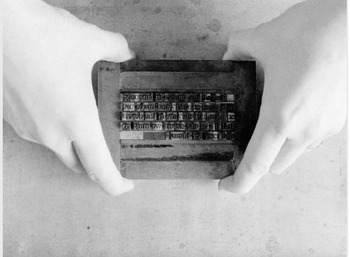
One might well imagine Khatibi, struck by the same envy that led Guillaume Apollinaire to exclaim “moi aussi je suis peintre” (“I too am a painter”), similarly declaring “moi aussi je suis khaṭṭāṭ” (“I too am a calligrapher”).Footnote 8 While Khatibi's writing effervesces with the gestures of Arabic calligraphy and the inventions of hurufiyya, it is important to remember that he visited these gestures on the French language. A recent piece by the Moroccan-born artist Bouchra Khalili (born 1975) links the gestural aesthetics that Khatibi derives from calligraphy to the question of Khatibi's unique brand of transmedial bilingual writing and to the type of nomad grammatology performed by graffiti. Khalili's The Typographer (2019) is a silent black-and-white film that shows the typesetting of the sentence that serves as an epigraph to Jean Genet's Un captif amoureux (Prisoner of Love), which is said to be the last sentence Genet wrote before his death (fig. 1). The text accompanying the piece tells the viewer that Genet the orphan was trained as a child to be a typesetter. Just as the film short-circuits the time of Genet's life, from his childhood apprenticeship to his final sentence, so too does it invert and translate Genet's words. The Typographer shows a moving image of movable type being selected and set into the print box, where the words appear upside down and in reverse order, and where one must try to read the Latin characters from right to left (as one does with Arabic) to decipher them. “Mettre à l'abri toutes les images du langage et se server d'elles, car elles sont dans le désert, où il faut aller les chercher,” reads the sentence, for the time being, in French (Genet, Un captif 7). Finally, the English translation is printed on paper: “Put all the images in language in a safe place and make use of them, for they are in the desert, and it's in the desert we must go and look for them.” The film follows the curious translation by Barbara Bray, who renders “les images du langage” as “the images in language” (Genet, Prisoner 7; emphasis mine). The French possessive du (“of”) becomes the English preposition of place in. This slippage between French and English, which mobilizes the eye to read as one reads Arabic, recalls Khatibi's two modes of abstraction, yet here the images of language and those in language merge.
Still from Bouchra Khalili's The Typographer (2019).
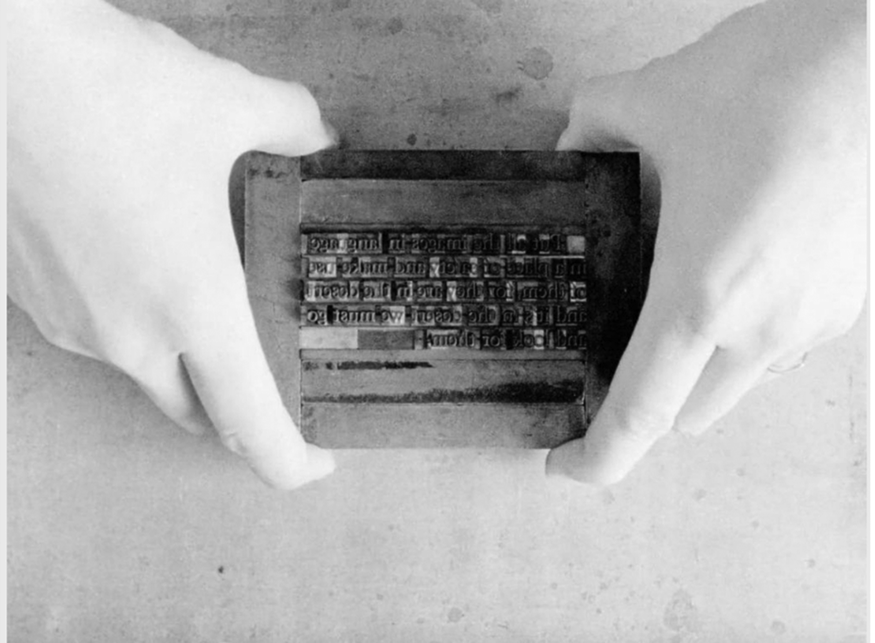
Not only does Khalili's The Typographer bring Arabic calligraphic gesturalism to French (and English), but the film visualizes the very sheltering gesture that Khatibi demonstrates in “L'art contemporain arabe,” as he does throughout his work, and that Genet enjoins us to make, from beyond the grave. Letters, words, and their images all belong to the wild openness of the desert; sentences, books, screens, and frames provide a place of safety for their unprescribed mobilities. What is key here is that the abri, the place of shelter or safety, does not determine the movement—of syntax, of brushstroke, of filmic image—that the images of or in language may make. Stated otherwise, Khatibian gestural aesthetics transform structures of exclusion into sites of noncoercive hospitality. Colonial language, religious dogma, architectures of control and surveillance are opened up, smoothed out, suspended, and dispossessed of their possessive properties. Instead of the rules of language dictating what messages may circulate in it and how, the images of or in language distribute the field of language. Khalili's typesetting of Genet reveals how Khatibi tracks with Gilles Deleuze's nomad thought: instead of monolingual words filling a monolingual language, the gestures of Arabic calligraphy remake the French language into an intersemiotic space that blurs the limits of its self-identity and makes the langue de Molière (“language of Molière”) emit static.Footnote 9 Deleuze's formulation of the way that the nomadic occupies and shares out space could well describe Khatibi's graffiti:
Tout autre est une distribution qu'il faut appeler nomadique, un nomos nomade, sans propriété, enclos ni mesure. Là, il n'y a plus partage d'un distribué, mais plutôt répartition de ceux qui se distribuent dans un espace ouvert illimité, du moins sans limites précises. . . . Remplir un espace, se partager en lui, est très différent de partager l'espace. (Différence et répétition 54)
There is a completely other distribution [of space] which must be called nomadic, a nomad nomos, without property, enclosure or measure. Here, there is no longer a division of that which is distributed but rather a division among those who distribute themselves in an open space—a space which is unlimited, or at least without precise limits. . . . To fill a space, to be distributed within it, is very different from distributing the space. (Difference and Repetition 36)
Just as Deleuze's nomadic distribution of space undoes the classical opposition between space and movement within a space, so too does Khatibi's graffiti “dissolve” the opposition between form and content, suspending “la ligne de lecture en une grille de sens” (“the line of reading against a grill of signs”; Khatibi, “L'art” 272). Such markings radically reimagine not just the literary page but also urban topography as spaces of enclosure. “Peut-être aussi faut-il bâtir dans le futur” (“Perhaps in the future one must also build”), Khatibi muses, “le plan d'une ville entire en damier avec un texte en écriture kufi” (“the plan of an entire city on a checkerboard with a text written in the kufi script”; 275).Footnote 10
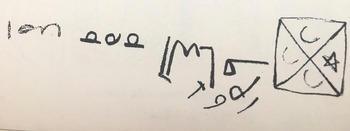
Just as we entered the labyrinth of this meditation through graffiti, so too shall we exit through graffiti. In returning to the opening passage, let us dwell a moment in Khatibi's assertion regarding graffiti as “social indicators” prowling the streets. While this essay has thus far dwelt on the aesthetic at the expense of the social, let me conclude by looking at this aesthetic from the perspective of graffiti as a social fact. My own investigation into Abdallah Grillo had me chasing these erasable traces online, leading me ultimately to a dissertation that Jacques Defert submitted to the École des Hautes Études en Sciences Sociales in 1982, entitled De la possession au bricolage prophétique: Changement social, folie et manipulation individuelle inédite des représentations traditionnelles à Fès au Maroc: Le parcours d'Abdellah “Grillo” (From Possession to Prophetic Bricolage: Social Change, Madness, and Unpublished Individual Manipulation of Traditional Representations in Fès, Morocco: The Route of Abdellah “Grillo”).Footnote 11 Defert recounts how one night the young Abdallah was possessed by a water djinn (“spirit”), which caused him to scribble all over Fès. Defert also confirms what Khatibi only hints at: that Grillo was imprisoned for his writing—like so many other Moroccans in the 1970s—and never seen again. Defert sees Grillo's illegible writing in the Ville Nouvelle as an inversion of the colonial distribution and marking of urban space, represented by General Lyautey's illegible street signs written in Latin characters and placed in the streets of the medina, and he focuses on the conjuncture of space and writing in Grillo's graffiti: “Il est significatif que la projection à travers la ville nouvelle d'une dynamique graphique multidirectionnelle et fusionnelle vienne justement en bousculer les deux verrous socio-culturels essentiels, l'ordonnancement conjoint de l'espace et de l’écriture—comme si l'ombre du labyrinthe brouillait soudain les cartes” (“It is significant that the projection throughout the Ville Nouvelle of a multidirectional, fusional, and dynamic graphics comes to rattle precisely the two essential sociocultural locks: the joint organization of space and of writing—as if the shadow of the labyrinth had suddenly scrambled the maps”; “Une topographie” 193; see figs. 2 and 3).
Two examples of graffiti done by Abdallah Grillo.

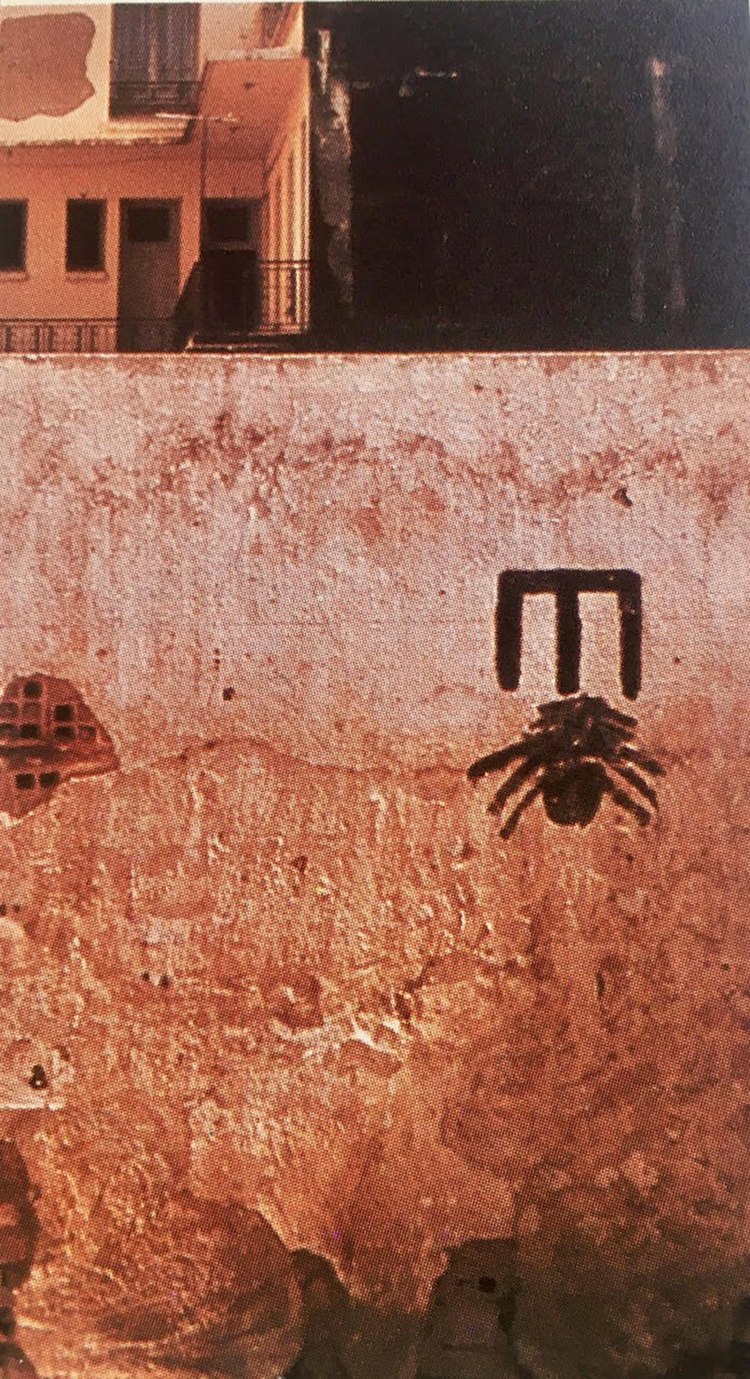
Grillo's personal language rewrites the text of the city, of clothing, of books in the library, evoking Khatibi's claim, from his essay on the Tunisian writer Abdelwahab Meddeb's writing included in Plural Maghreb, that “ce serait une sorte de folie de croire qu'une langue (n'importe laquelle) puisse écrire et récrire une autre de l'intérieur” (“it would be a kind of madness to think that a language (no matter which) can write and rewrite another from within”; “Bilinguisme” 205; “Bilingualism” 137). I would like to suggest that Grillo's language can be read as rewriting Khatibi's both from within and without. The letters, signs, images of a writer like Grillo live outside in the wild, undomesticated. They also wander outside the confines of book, gallery, home, or museum. Despite the six thousand kilometers separating Fès from the Bronx, Grillo's graffiti exhibit, in Khatibi's understanding, a kind of “wild style” that emerges contemporaneously with, and independently from, signature graffiti in New York and Philadelphia in the 1970s. At the same time, graffiti double “l'ornementation intérieur” (“the interior ornamentation”; Khatibi, “L'art” 279) of such luxurious containers. Not only do Grillo's graffiti double the interiors of such spaces, they also double the words sheltered by books, the books sheltered on shelves in homes and libraries, the calligraphy and gestural art contained within the frames of canvases, the canvases hung safely inside these homes and galleries. They inscribe the walls that separate them from domesticated writing. This is what Khatibi's graffiti point at: a vibratory partition between mobilities—one that would circulate within their own stasis or hypostasis, and another that would circulate within a “place of safety,” another abri. The walls, leaves, stones, and books that Grillo writes on show us a secret of Khatibi's writing practice, namely that Khatibi writes on language at least as much as he writes in language.
What, then, is the status of writing on language, and of graffiti, as concepts for literary theory and cultural critique? Graffiti tags freeze the illusory mobilities of literature, offering a raucous desecration of language as property, whether national, intellectual, or institutional. They initiate a writing commons, not without its dangers, that cuts against the grain of the aesthetics of the literary as such. They draft walls and words signifying exclusion into the service of shelter, transforming relations of public space and private property. In the context of the work of Khatibi, who writes on French with the gestures of Arabic calligraphy, we witness both the bombing of French and the unhousing of Arabic calligraphy from the Arabic script. While Khatibi's graffiti would trace a literary utopia of autonomous mobility, the graffiti of Abdallah “Grillo,” both cricket and spider, marks a desire to write that exists outside literature, without shelter, a writing on language as an act of invented literacy.