… a poet on canvas is exactly the same species of creature as a poet in song.Footnote 1
John Ruskin, Pre-RaphaelitismBoundaries are transportable limits and transportations of limits.Footnote 2
Michel de Certeau, The Practice of Everyday LifeThroughout the late nineteenth and early twentieth centuries, theorists of Russian Symbolism acknowledged a conceptual affinity with Pre-Raphaelite art. In his genre-defining essay “Dve stikhii v sovremennom simvolizme” (Two Elements in Contemporary Symbolism, 1908), Viacheslav Ivanov lists the Pre-Raphaelite Brotherhood among the major formative influences on Russian poetic Symbolism. This locus classicus of Russian Symbolism acknowledges not only the Brotherhood's cultural impact, but also other influences on Russian Symbolism that initially seem somewhat incongruous:
… on the one hand, the canons of the Renaissance and Classicism, the Parnassians, the continuity with antiquity and a profound but complacent understanding of its decline; … on the other hand … medieval mysticism … the premonition of a new revelation of the inner life of the world and its meaning, realism, romanticism and the Pre-Raphaelite Brotherhood—these two streams flow in the veins of modern Symbolism and make it a hybrid, ambiguous, undifferentiated unity.Footnote 3
The eclectic assortment of inspirations evoked by Ivanov resonates with those that had informed the aesthetic vision of Dante Gabriel Rossetti, William Holman Hunt, John Everett Millais, William Morris, and Edward Burne-Jones, and produced the paradoxical Pre-Raphaelite style that, to paraphrase Elizabeth Prettejohn, has “a modernist implication [that is] difficult to disentangle from its archaizing one.”Footnote 4 This Janus-faced nature of Pre-Raphaelitism, which strives to translate the inspirations of the glorious past into a modernist idiom, is what Ivanov saw as a common ground between the art of the Brotherhood and Russian Symbolism.
This self-conscious combination of conflicting elements into a reconsideration of the historical and cultural past is a common method of western modernism.Footnote 5 Martin Hägglund recognizes the modernist narrator's propensity for “rearrang[ing] the course of historical events,” which he considers partly rooted in nineteenth-century technological progress; Irina Paperno names the “mixing of historical styles” among the features of Russian modernism; Stuart Goldberg emphasizes Aleksandr Blok and Osip Mandel΄shtam's juxtaposition of “disparate historical time frames.”Footnote 6 Indeed, from neoclassical architecture to the Nazarenes, from Mikhail Nesterov's mystical paintings to Oscar Wilde's Salome (1891), European modernism encompasses many attempts to reconceptualize time and history. Visual and conceptual affinities between Russian Symbolists and Pre-Raphaelites, as expressed by Ivanov, possibly stem from the very conditions of modernity, its technological advancements (higher-quality reproductions and international art exhibits) and economic conditions (growing art markets). How, then, can we reconcile this possibility of shared historical determination with the gulf between the British and Russian experiences of modernity? Why and how did two countries where trains, telegraph towers, and industry spread at vastly different rates expound matching ideals of beauty and embark on parallel quests for the spiritual and transcendental in the machine age? Moreover, while Ivanov was writing in 1908, sixty years after the establishment of the Pre-Raphaelite Brotherhood, how can we explain the similar imagery we find in Pre-Raphaelite art and Russian Symbolism in the second half of the nineteenth century, almost at the same time?
Considering the popularity of Pre-Raphaelitism, it is unsurprising that scholars usually assess anything resembling Pre-Raphaelite art as mere imitation. Conceptual and visual parallels are attributed to the cultural prestige of Rossetti, Millais, Holman Hunt, and their cohort. Founded in 1848, in the family home of the nineteen-year-old Millais, the youngest “brother” and a prodigy of the Royal Academy of Arts, these young British artists were consumed by their dream to revolutionize British art and break away from the Academy. All of them, barely in their twenties, with the passionate, if reckless, Rossetti at the helm, became known as “the Pre-Raphaelite Brotherhood.” A self-chosen name, it provoked scathing ridicule after their exhibition in 1850, when pundits at London magazines The Athenaeum and The Spectator labeled them “slavish imitators,” “absurd,” “monstrously perverse,” “puerile,” and finally, “frantic trash.”Footnote 7 This exceptionally bad start took a turn in less than a year, when John Ruskin himself penned a letter to The Times in which he promised the Pre-Raphaelites а future beyond their wildest dreams, concluding that “if they do not suffer themselves to be driven by harsh or careless criticism into rejection of the ordinary means of obtaining influence over the minds of others, they may, as they gain experience, lay in our England the foundations of a school of art nobler than the world has seen for 300 years.”Footnote 8 With Ruskin's blessing, the expansion of transnational art networks, and the advent of photographic reproduction, the Pre-Raphaelite Brotherhood—originally just another group of “Young Turks” seeking to break with the establishment—became the tastemakers of Europe, influencing artists and poets from Lisbon to St. Petersburg.
In English Literature and the Russian Aesthetic Renaissance, Rachel Polonsky shows the popularity of the Pre-Raphaelites in Russia, particularly in Symbolist circles, discerning features of “stunners”—the Pre-Raphaelite feminine ideal—in verses by Aleksandr Blok and Andrei Belyi. Avril Pyman discusses the similarly zealous study of Pre-Raphaelitism in the Abramtsevo circle and in Mir Iskusstva. Pamela Davidson reveals how Rossetti's Beata Beatrix (1864–70, Tate Gallery) influenced Vyacheslav Ivanov.Footnote 9 All three identify undeniable correspondences. In this article, I will expand on these findings, yet contend that the Russian Symbolists' relationship to the Pre-Raphaelites was not one of passive, voguish imitation of a popular style. In fact, this scarcely studied influence on Russian Symbolism challenges the model of Russia's participation in the cultural exchanges of the mid-nineteenth and early twentieth century as merely imitative, derivative, or unalterably peripheral to those of western Europe.
It has become a critical commonplace that the development of Russian modernism was greatly influenced by Russia's existence on the outskirts of modern Europe. But exactly how peripheral was Russia in the nineteenth century? There is little scholarly consensus. Raymond Williams puts St. Petersburg next to the “great imperial capitals” of Paris and Berlin; Harsha Ram calls Russia “semiperipheral”; Piotr Piotrowski refers to it as “the close other.”Footnote 10 Meanwhile, Pascale Casanova famously omitted Russia from her “world republic of letters” altogether. Russia's major cities were undoubtedly distant from the powerhouses of early capitalism, but to what extent did the course of modern Russian culture deviate from that of western Europe? Two popular scholarly perspectives on the subject further problematize the conundrum. Given its liminal position between Europe and the east, Russia and its culture can be seen as peripheral to its European counterparts. Russia's tradition can be viewed as stronger for its isolation from Europe, however, allowing for a modernism like no other. Despite their difference, both views presuppose that Russia had some fixed relationship with the west, determined according to the iron law of history throughout its entry into cultural modernity. Did modernists in St. Petersburg and Moscow share this assumption? Do their works reflect the problematics of center and periphery that characterize the analysis of Russia's cultural history?
In her stellar study The Russian Canvas: Painting in Imperial Russia, 1757–1881, Rosalind P. Blakesley offers an innovative vision of Russian painterly tradition “both as constitutive of local and national identity, and as a spectacular arena of intercrossing and circulations in a much broader cultural sphere.”Footnote 11 To a considerable extent, she ascribes this duality of Russian painting to the “ebb and flow of patriotic rhetoric behind the walls of the Imperial Academy of Arts in St. Petersburg.”Footnote 12 Using Blakesley's formulation as a point of departure, I argue that in the late nineteenth and early twentieth century this dual nature—simultaneously peripheral and a part of the transnational cultural exchange—is characteristic not only of painting, but of Russian culture more broadly. It is not merely a result of state educational policies but a complex phenomenon of nascent modernism in Russia. In this study of Russian Symbolist poetry and painting, I argue that the Symbolist movement invented and reinvented Russian modernism through a kaleidoscope of “shifting peripheries.” The intelligentsia's ever-evolving visions of Russia's cultural relationship with western Europe were so mercurial that within the work of a single artist or poet, at any moment, Russia could be seen as either woefully backward or right on time, as a far-flung periphery or a cultural center in its own right. “Shifting peripheries” thus offers a transactional model for the influence of European modernism on Russian culture that avoids the pitfall of presenting the developments of Russian modernism—and specifically Russian Symbolism—as strictly peripheral, linear, or teleological. By using the example of Russian Symbolists' engagement with Pre-Raphaelitism, a vastly popular trend in mid-to-late nineteenth-century European art, I will gauge the limits of existing approaches to the subject and challenge the notion of Russia's peripheral relationship to western Europe as a determining influence on Russian modernism.
I will focus on the philosopher and poet Vladimir Solov΄ev, the painter Mikhail Vrubel΄, and the poet Aleksandr Blok in considering Russian Symbolism both chronologically and across media. All three were justly considered among the leading figures of the movement and were no strangers to Pre-Raphaelite art. The distinct ways in which they engaged with it provide an example of the constantly shifting vision of Russia's position vis-à-vis European modernism. By questioning the popular model of a fixed center/periphery cultural exchange through the examination of correspondences between Pre-Raphaelites and Russian Symbolists, I will explain how the notion of “shifting peripheries” reconciles the undeniable international influences on Russian modernism with its national particularity. In so doing, Russia becomes displaced from its fixed peripheral position on the critical map of modernism into the multiple positions that Russian modernists were able to envision.
Vladimir Solov΄ev: Voluptuous Goddesses and Saintly Women
Vladimir Solov΄ev's poem “Three Meetings” (“Tri Svidaniia,” 1862–75/76) has been taken as proof of the debt the Symbolists owed to the Pre-Raphaelites.Footnote 13 The often-allegorical paintings of the Pre-Raphaelites—depicting mystical, transcendent female subjects—must have resonated deeply with Solov΄ev's own spiritualism and, more specifically, his visions of the divine Sophia. Still, while the popular topoi derived from the Pre-Raphaelites informed Solov΄ev's depictions of Sophia in “Three Meetings,” his affinities with the Pre-Raphaelites operate on a deeper level than visual resemblance, demonstrating shared sensibilities and conceptual parallels.
The fusion of the human (erotic) and the divine (ethereal, disembodied) in the image of Sophia constitutes a complex affinity between Solov΄ev's visions of his “eternal companion” (podruga vechnaia) and the female types of the Pre-Raphaelites.Footnote 14 This fusion becomes the poem's central theme, engaging formal structural elements and Symbolist imagery. Sophia is simultaneously eroticized and ascribed to the highest realm of the divine. This dynamic tension manifests in the opening quatrains of the poem, which blur the line between the divine and the earthly by referring to Sophia as both a “companion” (podruga) and a “deity” (bozhestvo). The markedly secular “companion” attenuates the lofty tone set by the “eternal” (vechnaia). The ambiguity of its meaning—podruga can mean either a platonic female friend or an inamorata—amplifies the dissonance. After the poem's first four lines stress the human elements of the hero's “mystical lover,” the next stanza subverts this impression and deifies Sophia, adorning her image with symbolic attributes.Footnote 15
Sophia's divine nature is further emphasized through color symbolism. The recurring evocation of azure, gold, dark blue, and royal purple (purpur, porfira) conjures images of the Virgin Mary of Renaissance frescoes and Byzantine icons. One also cannot ignore the significance of celestial azure in a larger Symbolist context, in, for example, Stéphane Mallarmé’s 1864 poem “The Azure” (“The Azure triumphs, I hear it sing / In all the bells”) or Charles Baudelaire's 1857 “Beauty” (“I preside in the heavens [dans l'azure] like a misunderstood sphinx”).Footnote 17 Notably, the Pre-Raphaelites' rich palette also features these jewel-like hues: French Ultramarine, Purple Madder, Ochre, Ultramarine Ash, and Vermillion.Footnote 18
The tension between the divine and the human reaches its apex in the poem's description of the last vision of Sophia in the Egyptian desert. It is during this final transformative meeting that divine knowledge is revealed to the hero:
This revelation is complimented by the erotically charged motif of Sophia's exposed body (“In the desert I saw all of you”) and a highlighting of the hero's sexual maturity, the transition from boy to man (“That which you did not begrudge the child / You must not refuse the youth”).Footnote 20 At the same time, this vision of Sophia is implicitly likened to the Transfiguration of Christ (Luke 9:32). Solov΄ev works a similar narrative line into “Three Meetings”: his hero is summoned to the desert by Sophia's divine voice. Unable to quell his drowsiness, he falls asleep and awakens to the resplendent glory of the transfigured Sophia. Solov΄ev's use of “obraz” renders the allusion more explicit, since the Russian word for transfiguration is “preobrazhenie.”
In the Russian literary tradition, obraz was perhaps best explained by Robert Louis Jackson in his study of Dostoevskii: “obraz (image, form, icon) … is the axis of beauty in the Russian language. It is aesthetic form, and it is also the iconographic image … the visible symbol of the beauty of God.”Footnote 21 Solov΄ev and Dostoevsky were longtime friends, and Dostoevskii's conception of obraz as defined by Jackson is close to Solov΄ev's: his obraz, too, fuses aesthetic and religious elements.Footnote 22 It is both an embodied beauty (“a single image of female beauty”) and the miracle of the word becoming flesh.Footnote 23 Zinaida Vengerova, a leading Russian literary critic, discerned similar ideas in Pre-Raphaelite art, calling Rossetti's Sibylla Palmifera (1866–1870, Lady Lever Art Gallery) “the embodiment of the highest spiritual beauty” (voploshchenie vysshei dukhovnoi krasoty) and Elizabeth Siddal, the Brotherhood's foremost model, “the embodiment of the ideal beauty” (voploshchenie ideal΄noi krasoty).Footnote 24 It is unsurprising, then, that the eroticization of the pursuit of divine knowledge and of the “divine feminine” herself do not debase Sophia and her godlike nature; even overtly sexualized, she remains a heavenly being. Paradoxically, it becomes a necessary component of accessing mystical truth; the hero is transformed only after seeing Sophia fully made flesh.Footnote 25
Similar tensions between the divine (disembodied) and the human (erotic) are central to Pre-Raphaelite art. As early as 1850, William Michael Rossetti, the painter's brother, determined “one of the influences which guided th[e Pre-Raphaelite] movement: intertexture of a spiritual sense with a material form.”Footnote 26 Dante Gabriel Rossetti's art attests to this influence. Rossetti's artistic trajectory is defined by a lifelong negotiation between the transcendental and the material, the spiritual and the sensual. Eventually, Rossetti moved from ethereal maidens and Ruskinian realism in paintings like The Girlhood of Mary Virgin (1849) to the dark temptresses and abstract symbolism in the manner of Astarte Syriaca (1877). This evolution is evident in Rossetti's choice of models: from the delicate Christina Rossetti (Ecce Ancilla Domini, 1850) and Elizabeth Siddal (The Blue Closet, 1856–57) to the voluptuous Fanny Cornforth (Lady Lilith, 1867) and the sultry Jane Morris (Proserpine, 1874). Closer examination of Rossetti's works reveals a more complex trajectory, however, one by no means unidirectional or linear. His depictions of Beatrice Portinari, the “eternal beloved” of Dante Alighieri, attest to a lifelong quest to reconcile the earthly and the heavenly in a single female image, similarly to Solov΄ev's in “Three Meetings.”
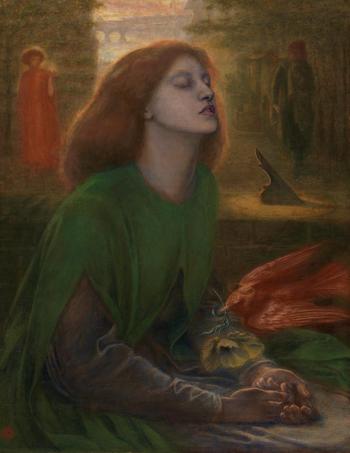
The son of a prominent Dante scholar, Rossetti was profoundly interested in the great poet, even publishing his own translation of La Vita Nuova (1295) in 1861. As Prettejohn notes, Rossetti was well-versed in the debates of whether Beatrice was “a real person, or … an allegorical figure to represent an abstraction, Love, Poetry, Faith[.]”Footnote 27 It is the latter, allegorical option that makes Rossetti's depiction of Beatrice relevant to this study. Presumably human, Beatrice is also a variation on the divine feminine: at the end of Vita Nuova, Dante describes Beatrice as she “gazeth continually on His [God's] countenance qui est per omnia sæcula benedictus,” and in The Divine Comedy (1320), she is one of the three heavenly women venerated by Dante.Footnote 28 To trace the interplay between the divine and the human in Rossetti's vision of Beatrice, I will focus on his most famous rendition of her—Beata Beatrix Footnote 29 (see Figure 1).
Dante Gabriel Rossetti, Beata Beatrix, © Tate, London 2019, c. 1864–70. Oil on canvas, 86.4 × 66 cm. Tate Gallery, London.

Beata Beatrix shows Beatrice at the moment of her death, “rapt visibly into Heaven,” to quote Rossetti.Footnote 30 She is captured with her eyes closed, her figure, at half-length, forming a vertical axis that bisects the painting. To her right, in the distance, is the dark figure of Dante. Mirroring it on the left is the figure of romantic Love, clad in crimson robes. In the background, Ponte Vecchio arches over the glimmering waters of the Arno. Together, Dante's figure and glimpses of Florentine architecture allude to Beatrice's earthly life. In the lower half of the painting, a dove—a heavenly messenger, as the small nimbus over its head suggests—places a poppy, the symbol of death, in Beatrice's hands. The evening light endows the painting with remarkable luminosity and forms a halo around the blessed Beatrice's head. The sundial to the right of Beatrice points to nine—the hour of her death—suggesting she is captured at the moment of her transcendence into a higher realm. The soft colors and the chiaroscuro, atypical of Rossetti, accentuate the otherworldly feeling of the painting, a sense of witnessing a transcendental rite: Beatrice's ascent to heaven.
A different interpretation of Beata Beatrix is also possible. The dove's plumage has a distinct red hue that reflects the crimson robes of Love; the bird may be a symbol of earthly love, rather than a messenger of the Holy Spirit. This chromatic doubling becomes a triad: Beatrice's copper-red hair harmonizes in color with both the dove and the figure of Love. I argue here that the painting can thus be seen not as a portrait of Beatrice alone, but rather of a group of three: Love, Beatrice, and the dove, which are one and the same—a symbolic embodiment of romantic love. Beatrice's pose and countenance support this reading: what initially appears to be an expression of beatitude reveals to be intensely erotic. Her heavy-lidded eyes, parted lips, and stately neck—all staples of Rossetti's ideal of beauty—accentuate her sensuality, portraying not a god-like maiden but a sensuous, earthly woman in the throes of passion. Similarly to Solov΄ev's “Three Meetings,” the sublime experience of a divine, spiritually transformative encounter becomes inextricable from its erotic overtone: “a moment, both temporal and eternal, when flesh and spirit are wed.”Footnote 31
Another element exists in Beata Beatrix that highlights the tension between the divine and the human, the spiritual and the corporeal in the painting's central figure. Beatrice is modelled on Elizabeth Siddal, Rossetti's muse, lover, and eventually wife. Since their momentous meeting in 1849, Rossetti saw Siddal as the Beatrice to his Dante. Her death in February 1862 was a shock to Rossetti, and marked a turning point in his career.Footnote 32 Seen through the lens of Rossetti's own life and tempestuous relationship with Siddal, Beata Beatrix becomes further grounded in the profane. One could argue, of course, that Siddal appears in numerous paintings by Rossetti, including others of Beatrice. However, none of them has the emotional intensity of Beata Beatrix, nor bears such a striking resemblance to Siddal.Footnote 33 In Beata Beatrix, Siddal is not just the model—she is also the subject. The depiction of the central figure bespeaks Rossetti's intimate knowledge of his subject—of Siddal, rather than of the abstract Beatrice. The details and colors of the painting, then, invite alternate readings. The white poppy in the dove's beak may be an allusion to Siddal's addiction to opiates: she died of a laudanum overdose. The soft, warm tones and the chiaroscuro are reminiscent of Siddal's own watercolors. The bridge in the background, as Prettejohn suggests, doubles as the Blackfriars Bridge, beside which Rossetti lived with Siddal.Footnote 34
In sum, the combination of the divine and the human in Beata Beatrix rests on three possible interpretations of the central figure: Beatrice as a blessed saint; Beatrice as a sensual woman, a vision of erotic love; and Beatrice as Siddal—Rossetti's own lover and muse. Only by considering them together can one see how Beata Beatrix resolves Rossetti's “inner conflict between longing for … spiritualization of love and an intense attraction to the pleasure of earthly eroticism,” depolarizing the divine and the human, the disembodied and the erotic in a manner similar to Solov΄ev's Sophia in “Three Meetings.”Footnote 35 However, the question of who or, more likely, what Solov΄ev's divine Sophia is problematizes the poet's engagement with the art of the original Pre-Raphaelite Brotherhood.
Solov΄ev “introduces” Sophia in Lecture Seven of his Lectures on Divine Humanity (Chteniia o bogochelovechestve, 1878): “The unity of the second kind, the produced unity, in Christian theosophy bears the name of Sophia … which is thus the expressed, realized idea … i.e. it is the idea which God had before Him in His [work of] Creation and which he, consequently, realizes.”Footnote 36 Later, the notion of unity resurfaces in Solov΄ev's Russia and the Universal Church (Rossiia i vselenskaia tserkov΄, 1889): “a true unity which … includes, determines and reveals the living powers.”Footnote 37 Without delving too deeply into Solov΄ev's esoterica, one can infer that, strictly speaking, Sophia does not have a female or, for that matter, human form. It is difficult to ascertain who or what she is because, as Judith Kornblatt remarks, “she—or sometimes … he or it—is so many things at once.”Footnote 38 Rossetti, Millais, and Hunt eschewed such embodied philosophies for their female subjects, no matter how alluring or allegorical they appeared. Solov΄ev's Sophia, on the other hand, is an idea that has taken human form, the epitome of embodiment. This connects Solov΄ev to a painter who belongs to the second generation of Pre-Raphaelites, and whose mature work Solov΄ev was less likely to have seen: Edward Burne-Jones.Footnote 39
Burne-Jones was an avid admirer and disciple of Rossetti; his earlier paintings bear the imprint of his mentor in both subjects and technique. His mature work, however, demonstrates more pronounced Symbolist qualities, his dream-like subjects attesting to the artist's preoccupation with the idea of embodiment.Footnote 40 A series of four drawings by Burne-Jones held at the Ashmolean Museum at Oxford University attest to this interest. Each drawing (respectively titled Love, Generosity, Hope, and Wisdom) captures a female figure against a blank background. The drawings lack narrative and demonstrate Burne-Jones's attempts to endow an abstract notion with corporeal form. Arguably, Sophia in “Three Meetings” is the product of a similar attempt. What makes this affinity truly striking, however, is that Solov΄ev's early conceptualizations of Sophia often predate Burne-Jones, problematizing an easy conclusion that Solov΄ev was inspired by the artist or copied from the Pre-Raphaelites.
An image of a female godhead with both corporeal features and philosophical meanings has deep roots in Christian and Jewish mysticism. Consider the apocrypha on Mary Magdalene, or the Divine Feminine (the Shekhinah) in Kabbalistic literature. But why does this imagery reappear in the late nineteenth century, in places as different as Russia and Britain? This strange, out-of-sync parallel between Solov΄ev and Burne-Jones can be explained by the spiritual crisis of nineteenth-century Europe. In his 1893 essay “On the Causes of the Decline and on the New Trends in Contemporary Russian Literature,” Dmitrii Merezhkovskii formulates the “[t]he tragic contradiction of the nineteenth century … —the need to believe, the impossibility of believing … a hopeless need for faith, an unquenchable thirst for God.”Footnote 41 The dizzying speed of modernity's scientific breakthroughs brought about a crisis of faith, spurring the search for alternative forms of spirituality across Europe. Flirting with the occult and dabbling in ancient mysticism was not merely a passing fad of the European beau monde but a byproduct of modernity that found its reflection in the arts.Footnote 42 Russia was no exception to this trend; suffice it to remember the fame of the occultist Elena Blavatskaia, the philosophy of Nikolai Fedorov, or even Merezhkovskii's own poetry.Footnote 43 During his stay in London, Solov΄ev also became interested in the mystical: he studied the Kabbalah and attended séances, fashionable in England at that time.Footnote 44 Thus, Solov΄ev's visions of Sophia are as much a product of modern(ist) sensibilities as the enigmatic half-human, half-godlike Pre-Raphaelite maidens. The conundrum lies precisely here, however: how could such exceptionally similar ideas have arisen almost simultaneously in two countries with such dramatically different experiences of modernity?
Anne Lounsbery explained such temporal discrepancies by looking at Russia's position in relation to the space of the provinces:
[P]rovintsiia … represents a way of thinking not about backwardness or behind-the-times-ness per se—not about trying to get in line, as [Pascale] Casanova implies everyone feels compelled to do—but about the relationship between cultural syncretism and Russian time. … Literary representations of provintsiia as hodge-podge draw on precisely this sense of simultaneity and non-synchronicity, often … without even thinking of measuring themselves against any Greenwich Meantime of Literature.Footnote 45
In other words, Russian authors were aware of the country's peripheral status vis-à-vis Europe and productively used it to select the west European cultural trends that they saw most fitting, sometimes while said trends were still popular in Europe, but mostly with a noticeable lag. Lounsbery's idea of “simultaneity and non-synchronicity” endows Russian cultural producers with more independent creative agency, and can be applied to Solov΄ev and the Pre-Raphaelites. Still, one wonders whether Russia should always be postulated as a European cultural periphery, especially since such assumptions are often made without determining whether Russian authors viewed their peripherality as somewhat advantageous or entirely detrimental.
A radically decentralizing view of European cultural developments throughout history is offered in Milan Kundera's essay “‘Die Weltliteratur’: European Modernism and Novelists.” He writes, “all the nations of Europe are living out a common destiny, but each is living it out differently, based on its own distinct experience. This is why the history of each European art … seems like a relay race in which the various nations pass the baton from one to the next.”Footnote 46 This claim may seem exceedingly totalizing, practically suggesting that the categories of centers and peripheries are irrelevant in the European context. However, Kundera adduces conclusive evidence that in a broader historical perspective, the status of European cultural centers was hardly fixed, with geography having little bearing on it.Footnote 47 This suggests that any cultural hierarchy in Europe should be assessed with attention to its historical moment and to an understanding that physical geography and cultural geography may not overlap. In the age of modernity, due to the accelerated rate of transnational cultural exchanges, the hierarchy of European cultural centers and peripheries was more in flux than ever before, and Russia's place was hardly as invariably peripheral as it is often portrayed. Kundera gives another clue as to why this could be possible, claiming that the “provincialism” of large nations is determined by “the inability (or the refusal) to imagine one's own culture in the large context.”Footnote 48 The possibility of such a refusal, a conscious decision to deviate, suggests that, for an empire like Russia, cultural “provincialism” is always at least partly self-determining.
The emphasis on the Russian technological lag, an argument used ad nauseum to prove that Russia limped behind the developments of European modernism, often fails to take into consideration that these developments were known to Russian authors who hardly considered themselves insufficiently modern. The many ways in which Russian cultural producers chose to inscribe Russia into a European cultural context continued to shift Russia's position on the map of European modernism for decades. Therefore, it is this multiplicity of visions—the phenomenon I refer to as “shifting peripheries”—that can account for the unexpected, out-of-sync coincidences and parallels between Solov΄ev's poems and Pre-Raphaelite paintings. The poet's own spiritual search resonated with that of the Pre-Raphaelites, resulting in a work that was equally modern—and modernist—and not mere imitation or borrowing. Once again challenging the determining impact of geographical and historical coordinates, “Three Meetings” shows that, in the case of Solov΄ev, Russia's peripheral status shifted in a way that almost perfectly aligned with the cultural developments in the “centers” of European modernity.
Mikhail Vrubel΄: Redrawing the Peripheral
Another enigmatic figure of Russian Symbolism, the painter Mikhail Vrubel΄, can also be explored in terms of his relationship to the Pre-Raphaelites and the attendant issues of European cultural peripherality. In 1883, the Imperial Academy of Arts in Saint Petersburg celebrated the 400th anniversary of Raphael's birth with a grand exhibit that included photographic reproductions of his masterworks. Mikhail Vrubel΄, then a student of the Academy, was in attendance. He wrote to his sister: “[O]nce again, we peered into [Raphael's] work with much attention and thanks to the photographic reproductions of his paintings we could formulate our own conclusion about him … he is deeply realistic. … It is the realism that begets his depth and scope … it is as if he studied nature next to our contemporary naturalist Fortuny!”Footnote 49 Vrubel΄’s admiration for the old master is unsurprising; there was practically a cult surrounding Raphael in Russia, as we know from recurring images of the Sistine Madonna in Russian literature. Paradoxically, the realism that Vrubel΄ saw in Raphael brings the former closer to Pre-Raphaelite idea(l)s.
The Pre-Raphaelites sought realist elements in the painterly tradition of the Quattrocento in order to wed the cultural legacies of the past to Ruskin's dictum: “From young artists … nothing ought to be tolerated but simple bona fide imitation of nature. … They should … go to nature in all singleness of heart, and walk with her laboriously and trustingly, having no other thoughts but how best to penetrate her meaning, and remember her instruction, rejecting nothing, selecting nothing, and scorning nothing.”Footnote 50 Vrubel΄’s letter suggests that what he saw in Raphael was similar to the simplicity and realism the Brotherhood saw in the generation preceding the great Renaissance master. The comparison Vrubel΄ makes between Raphael and the nineteenth-century painter Marià Fortuny, praising both for the equally life-like quality of their work, is likely informed by the same sensibility as the so-called Pre-Raphaelite paradox: “[a] combination of yearning for the past with an intensely modern, mid-nineteenth-century realism.”Footnote 51 Two years later Vrubel΄’s preferences shifted further back in time. He began to veer away from the mannerism of the high Renaissance and embraced the Venetian school, aligning himself with the Pre-Raphaelite vision more closely: in his 1885 letter to Vasilii Savinskii he proclaimed Bellini and Tintoretto to be the best.Footnote 52 Vrubel΄’s attempt at endowing Raphael and Bellini with realist qualities sheds light on his complex vision of Russo-European cultural relationships and Russia's place on the map of European modernism.
Despite the distinctly Symbolist quality of his later works, Vrubel΄’s early talent developed when realism still occupied the dominant position on the Russian art scene. In painting, the fame of the Wanderers resounded throughout Russia; in literature, the realist novel flourished. Vrubel΄’s mentor was Pavel Chistiakov—the teacher of Il΄ia Repin, Vasilii Polenov, and Vasilii Surikov. If we look at Vrubel΄’s letters from the 1880s in this context, his views on Bellini, Tintoretto, and Raphael attest to something more than the espousal of ideals similar to those of the Pre-Raphaelites; they demonstrate an attempt to establish continuity between the legacy of the Renaissance and realism that continued to reign in Russia. Creating this kind of continuity, however tenuous, would allow Vrubel΄ to integrate contemporary developments in Russian art, including his own work, into a larger European context. Such an attempt suggests that the artist recognized Russia's position on the periphery of modern Europe and its complex relationship to west European cultural histories. What complicates Vrubel΄’s standpoint is that it was not just the European painterly tradition that he chose to engage with. His life-long admiration for the Venetians coexisted with another formative influence—the Russo-Byzantine tradition.Footnote 53 Vrubel΄’s exploration of the latter allows us to consider Russia's “peripheral” modernism in the context of revivalism, an artistic trend in late nineteenth-century Europe that was heavily influenced by the Pre-Raphaelites.Footnote 54
In his 1876 article “The Impressionists and Edouard Manet,” Stéphane Mallarmé summarizes the essence of revivalism in this manner: “In extremely civilized epochs the following necessity becomes a matter of course, the development of art and thought having nearly reached their far limits—art and thought are obliged to retrace their own footsteps, and to return to their ideal source, which never coincides with their real beginnings.”Footnote 55 As Mallarmé points out, the Pre-Raphaelites were among the first to follow this tendency. The circumstances in which the Pre-Raphaelites (re)discovered one of their founding texts illustrate the nature of European revivalism.
In 1856, William Morris and Edward Burne-Jones visited a Birmingham bookshop where they happened upon a volume that would exert formative influence on Pre-Raphaelite art and its revivalist aesthetic: Thomas Malory's Le Morte d'Arthur (1485). J. W. Mackail, Morris's friend and biographer, wrote: “[Le Morte d'Arthur] at once became for both [Morris and Burne-Jones] one of their most precious treasures: so precious that even among their intimates there was some shyness over it, till a year later they heard Rossetti speak of it and the Bible as the two greatest books in the world, and their tongues were unloosed by the sanction of his authority.”Footnote 56 Rossetti's response to Malory's texts marks a crucial feature of European revivalism: it posits two types of texts as cultural sources—one shared and pan-European (The Bible), and one national, English in the case of the Pre-Raphaelites (Malory). This method of unearthing the national past, of combining historicism with realism, spoke both to the local and the cosmopolitan and offered a way of “[e]nsuring the survival of native traditions and national identity in the face of modernization.”Footnote 57 Through this, revivalism became increasingly popular in Europe and quickly reached Russia.
Of course, dabbling in historicism was hardly absent from the Russian cultural scene before the late nineteenth century. The art historian David Jackson discerns a harbinger of revivalism in the Cathedral of Christ the Savior (1839–89), although one could trace this interest in a native past to Aleksandr Pushkin's Ruslan and Ludmila (1817–1820) or The Song of the Wise Oleg (1822).Footnote 58 It was the 1880s, however, that endowed Russian revivalism with its defining paradoxical feature; while developing in the wake of a popular European artistic trend, it emphasized the uniqueness of the Russian past and dissociated this cultural tradition from the European, which it considered fundamentally different, perhaps even inimical. This insistent disengagement, as Jackson demonstrates, originated in the conservative turn in Russian politics under Tsar Aleksandr III (1881–94), whose nationalist agenda quickly spread to the fine arts. Reasons other than the political climate played a significant role as well.
The peculiarity of Russian revivalism can be clarified through Michael Kunichika's concept of “elective antiquities.” He writes: “For Russian modernists, there were myriad antiquities of different provenance and varying degrees of prestige from which to choose. … Indeed, one way to distinguish [different] camps [of Russian modernists] is to identify the elective antiquity, as it were, to which they laid claim and whose legacy they claimed as their heritage.”Footnote 59 Thus, the phenomenon of an “elective antiquity” suggests that for the Russian intelligentsia of the late nineteenth century, the vision of Russia's past and its relation to European legacies and “antiquities” was not fixed. If an antiquity could be “selected,” then so could Russia's place on the European cultural map. This unanchored state and the Sisyphean task of negotiating Russia's cultural roots resulted in diverse visions of the Russian cultural tradition: from unique and emphatically not European to fundamentally syncretic. Consequently, the perspectives of the place that Russia occupied on the European cultural map—peripheral or not—shifted from decade to decade, from art movement to art movement, and sometimes within the oeuvre of a single painter or writer. Vrubel΄’s approach to revivalism, and especially his first extended exploration of the Russo-Byzantine style, offers an example of this volatility.
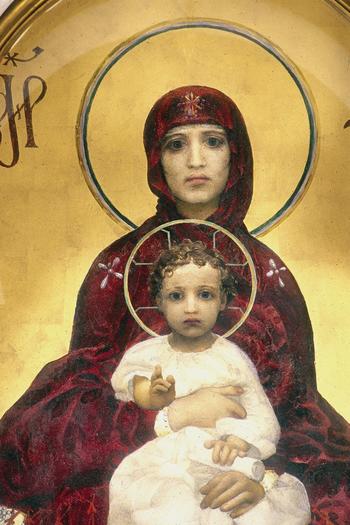
In 1884, Vrubel΄’ was commissioned to paint the frescoes in St. Cyril's Church in Kiev. Years later, Aleksandr Benois described Vrubel΄’s work there as a “marvelous page in the history of Russian painting.”Footnote 60 Another fellow artist, Nikolai Ge, went so far as to claim that with this commission, Vrubel΄ invented the Russo-Byzantine style and surpassed Viktor Vasnetsov.Footnote 61 Vrubel΄’s biographer, Stepan Iaremich, even suggested that Vasnetsov copied Vrubel΄’s frescoes at St. Cyril's church, but Vasnetsov's imitations were “watered-down and drab.”Footnote 62 Truly, Vrubel΄’s attention to detail reveals his careful study of Byzantine mosaics and his painstaking endeavor to revive them in his frescoes. Yet, his variation on Russo-Byzantine aesthetics is hardly unalloyed and demonstrates Renaissance and modern European influences.Footnote 63 Vrubel΄’s work at St. Cyril's church, particularly his icon Madonna with Child (Bogomater΄ s Mladentsem, 1885), (see Figure 2), attest to the synthesis of the Russo-Byzantine and Venetian elements, as well as the archaic and the modern in Vrubel΄’s art.
Mikhail Vrubel΄, Madonna With Child (Bogomater΄s mladentsem), 1885. Oil on zinc, 202 × 87 cm. St. Cyril's church, Kiev.
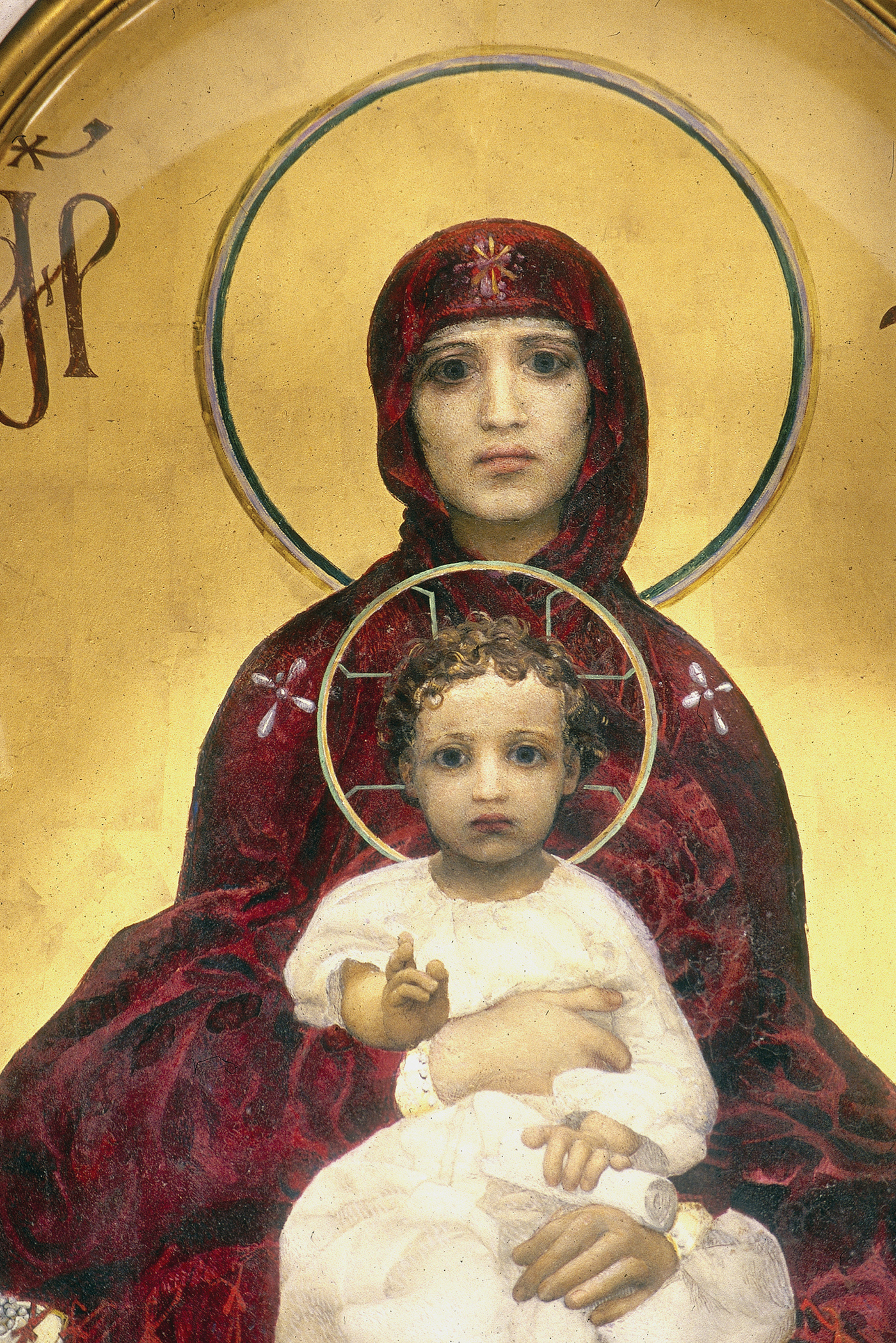
Despite following the type of iconographic depiction known as Panachranta (the Virgin enthroned, with the Christ Child on her lap), Vrubel΄’s Madonna with Child is hardly canonical in style or technique. Elena Prakhova, the wife of Vrubel΄’s patron in Kiev, was the model for the Madonna, which already represented a departure from the iconographic tradition and endowed the image of the Virgin with an uncommonly lifelike quality.Footnote 64 As Aline Isdebsky-Pritchard remarks, the icon shows Vrubel΄’s debt to the Renaissance in its “new intensity in the sustained vibrancy of large areas of deep red, which derives directly from the Venetian experience.”Footnote 65 At the same time, Vrubel΄’s Madonna is at least partly a product of contemporary European trends: her big dark eyes and full lips recall Rossetti's sensuous The Beloved (1865–66) or Solov΄ev's divine Sophia—“a single image of female beauty.”Footnote 66
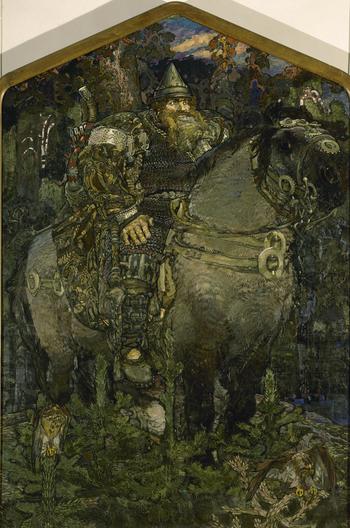
Vrubel΄’s foray into revivalism went beyond the rediscovery of the Russo-Byzantine style. Separated by one year, Vrubel΄’s The Bogatyr΄ (1898–99, State Russian Museum) and Pan (1899, State Tret΄iakov Gallery) form another strand in his conflicted approach to the artistic trend. When compared to emblematic forerunners like Vasnetsov's Knight at the Crossroads (1882, State Russian Museum) or The Bogatyrs (1881–98, State Tret΄iakov Gallery), The Bogatyr΄ (see Figure 3) appears intentionally unrealistic, almost cartoonish. The thickset body of the folk hero astride an equally hefty, somewhat bovine-looking horse spills out of the frame, distorting the painting's perspective and proportions. The impression is intensified by the painting's chromatic harmony, which blends the figure of the bogatyr΄ into the surrounding landscape. The Bogatyr΄ possesses a tension similar to that of Rossetti and Solov΄ev's works, but is multiplied by Vrubel΄’s ambition to create the embodiment of a folk hero. Likely inspired by Byzantine mosaics, the brushstrokes and the gemstone colors of the painting—from the amethyst sheen on the horse's hide, echoed in the lilac shimmers of the sky, to the dark emeralds of bristly fir boughs—emphasize the magical nature of the legendary bogatyr΄. Taken together, the strange proportions, the color scheme, and even the perspective allude to a conscious departure from European revivalist techniques, suggesting that for Vrubel΄, the Russian revivalist tradition had to differ not only in subjects but also in style and technique. In his 1899 Pan, Vrubel΄ goes even further and situates the creature from Greek mythology against a recognizably Russian landscape. In this eccentric “russification” of the subjects of European revivalism, Vrubel΄ transforms Russia, the ostensible periphery, into a cradle of European culture.
Mikhail Vrubel΄, The Bogatyr ΄ (Bogatyr ΄), © Государственный Русский Музей, Санкт-Петербург, 1898. Oil on canvas, 321.5 × 222 cm. State Russian Museum, St. Petersburg.

As Harsha Ram writes in relation to Georgian modernism, the rediscovery and assertion of a national tradition, different from the dominant one but equally grand, is common to peripheral modernisms, especially in colonized and otherwise subjugated territories.Footnote 67 Although an imperial power and geopolitical center in its own right, Russia produced a kind of revivalism that had the features of both the centers and the peripheries of the European cultural map. Vrubel΄’s constant vacillation between the desire for artistic autonomy, rooted in the uniqueness of the Russian cultural tradition, and the wish to be part of the modern European art scene allowed him to produce works as different as Hamlet and Ophelia (1888, State Tret΄iakov Gallery) and The Bogatyr΄, or the frescoes of St. Cyril's Church and his endless studies of demons. His zeal for studying Byzantine mosaics is only rivaled by his reverence for the Renaissance. His desire to fit in with the developments in contemporary European art was as strong as his wish to follow what he saw as the native tradition. In the same year that he somewhat arbitrarily compared himself to Lawrence Alma-Tadema, he also claimed that there is nothing better or more beautiful than the native art and the native land, especially Kiev.Footnote 68 And while he may have claimed to distance himself from western art and turn to more “Russian” subjects, this life-long ambivalence casts Vrubel΄ as a bona fide modernist painter who is neither restrained by geographical borders nor narrowly defined by a national painterly tradition. To paraphrase Jane Sharp, though Vrubel might have declared west European modernism inferior, his art proves “beyond all doubt that [he] spoke as one of its key exponents.”Footnote 69 This tension between Russian artistic traditions and European art tendencies would inform Vrubel΄’s career for years to come, demonstrating that, for him, the cultural hierarchy between Europe and Russia could be reconstructed in a multitude of ways. In other words, Vrubel΄ felt at liberty to draw and redraw the border between Russia and Europe, shifting Russia's peripheral position wherever and however he thought fitting.
From Periphery to Centrality: Aleksandr Blok's Long Goodbye
This study would be incomplete without an examination of Aleksandr Blok, a Symbolist poet so infatuated with the Pre-Raphaelites that he created his own “brotherhood”: the “Knighthood of the Divine Sophia.” As Rachel Polonsky notes, “Blok … came to poetic maturity during the years of the greatest enthusiasm for Pre-Raphaelite tastes and ideas in Russian literary society.”Footnote 70 In fact, young Blok considered himself somewhat of a Pre-Raphaelite: in a letter to Sergei Solov΄ev he joked, “let's joyfully ‘reproach’ ourselves for the ‘untimely’ … ‘Pre-Raphaelitism.’”Footnote 71 His engagement with the art of the Brotherhood differed from the cases discussed above, however. First, unlike Solov΄ev, Blok discovered their art nearly fifty years after the establishment of the Brotherhood, by which time Pre-Raphaelitism was already a multinational phenomenon. Second, Blok was almost thirty years younger than Solov΄ev and Vrubel΄, and his poetic persona was formed when Russian Symbolism was already a full-fledged movement. Thus, his engagement with the Pre-Raphaelites was partially mediated through the previous generation of Symbolists, specifically Solov΄ev, whose ideas captivated Blok and informed his oeuvre. Unsurprisingly, Blok's earlier poetry, particularly the collections Ante Lucem (1898–1900) and Verses About the Beautiful Lady (1901–1902), bear the imprint of both Solov΄evian mysticism and the Pre-Raphaelite aesthetic.
Blok's fascination with Pre-Raphaelitism was likely spurred by his interest in painting and interart dialogues. In his 1903 essay “Kraski i slova” (Colors and Words), he praises painters for the honesty of their medium and their proximity to nature, echoing Ruskin's philosophy. Blok applauds Pre-Raphaelites' endeavors to work in two media—poetry and painting. In his own syncretic artwork, however, Blok went further than the Pre-Raphaelites ever had.
The first entry (May 15, 1849) of The P.R.B. Journal, the diary of the Brotherhood kept by William Michael Rossetti suggests interest and aptitude for working in different media.Footnote 72 In practice, however, the Pre-Raphaelites did not insist on the conflation of arts in quite the same way as did the Russian Symbolists. Pre-Raphaelite poetry and painting do not attempt to erase the boundary between word and color, but rather to bring them closer together. The Brotherhood's habit of accompanying paintings with frame inscriptions epitomizes this relationship: the two arts are inseparable but occupy different planes, as it were—one on the canvas and one on the frame. Blok's comments in “Colors and Words,” on the other hand, indicate a longing for the erasure or at least the blurring of this boundary between the arts, and advocate for a mutually beneficial rapprochement between painting and literature: [T]he paint preserves the artist's childlike sensitivity, while the … writers can only eagerly cherish what is left of their feelings …. [T]hey replaced the careful process of drawing with a quick word; they turned blind, impervious to visual impressions. They say that there are more words than there are colors but maybe a talented poet only needs the kind of words that correspond to colors.Footnote 73
This synesthetic desire to unite the arts is unsurprising in the context of Symbolism and in a larger modernist perspective. An artistic method and trope, rather than an elusive neurological phenomenon, synesthesia can be viewed as a reaction to modernity, a “fusion of the arts [that] would help overcome the fragmentation of the modern world and the divisions imposed by rationalist thought,” as Polina Dimova observes.Footnote 74 The Pre-Raphaelites also sought synesthetic effects by not only bringing together painterly and literary pursuits, but also in the composition of their paintings. For example, the arrangement of Rossetti's watercolor The Wedding of St. George and Princess Sabra (1857, Tate Gallery) demonstrates an attempt to engage the senses other than just vision by focusing “on the relationship between art and music, sight and sound, as indicated by the bell-ringing angels.”Footnote 75 For Blok, however, synesthesia was not just a trope or an artistic method. Abetted by his interest in mysticism, his striving to break the boundaries between the arts became a desire to annihilate the border between art and life: zhiznetvorchestvo.Footnote 76 Blok's marriage to Liubov΄ Mendeleeva, whom he considered a living incarnation of the divine Sophia, the mystical female ideal, is perhaps the strongest testament to this larger-than-life ambition to unite life and art. More importantly, it suggests numerous Pre-Raphaelite influences. As I demonstrated in my analysis of Beata Beatrix, a desire to give human form to the abstract idea of beauty, to find and celebrate the perfect embodiment of an ideal is a central motif of Pre-Raphaelite art. This is particularly true of later Pre-Raphaelite works, such as Rossetti's Sybilla Palmifera, meant to represent the incarnation of the “Soul's Beauty.”Footnote 77 Moreover, Pre-Raphaelites often ascribed this role to their models and lovers: for instance, not only did Rossetti consider Siddal his Beatrice, he also saw Jane Morris, his model and paramour after Siddal's death, as his Donna della Finestra (1879)—another character from Vita Nuova who “pitied Dante in his grief at the death of Beatrice.”Footnote 78 Although no equivalent of zhiznetvorchestvo as an articulated philosophy of life and art can be found in the biographies of the Brotherhood, it is perhaps these parallels that prompted contemporaries to call Blok's wedding to Mendeleeva “a Pre-Raphaelite event.”Footnote 79
The gradual change in Blok's attitude towards European art is perhaps best captured in Italian Verses (1909), a collection of poetry written during his sojourn in Italy, among which “Ravenna” and “Florence” are particularly revealing.Footnote 80 In the former, the rhythm of the iambic tetrameter with alternating feminine-masculine rhymes accentuates the poem's lament for the city's bygone glory. Blok breathes life into the mausoleums of Galla Placida and King Theoderic in Ravenna, resurrecting the heroes of the past, while denying any meaningful existence to his own, modern generation. “Florence” amplifies the dramatic effect of “Ravenna.” From the opening stanza, the poet forcefully dissociates himself from the cradle of the Renaissance:
The reason for this indignation is that Florence, like Ravenna, betrayed its lofty image by succumbing to modernity and trading its beauty and riches for industrial and technological advancements.Footnote 82
At the same time, Blok's frustration with the current state of European cultural centers in “Ravenna” and “Florence” coexists with a poem that speaks of his long-standing interest in west European art and his former infatuation with the Pre-Raphaelites: “The Annunciation” (Blagoveschenie), written in Perugia. In it, Blok changes his usual iambic tetrameter to the lull of trochee with caesuras and pyrrhics, making this poem stand out against the other Italian Verses. He transports the Annunciation scene from Nazareth to Umbria, mimicking the Renaissance painters who often transferred biblical scenes onto an Italian landscape. However, the poem's culminating moment subverts this initial impression: Blok's Annunciation is hardly an ekphrasis of Perugino or Fra Angelico. Rather, it creates an unsettling impression, similar to Rossetti's Ecce Ancilla Domini (1850)—an unorthodox vision of the Annunciation scene, “couche[d] in disturbing and unfamiliar terms”: a wingless angel pointing a lily stem towards Mary's womb, while Mary herself flinches in fear.Footnote 83 If anything, Blok makes this mood of unwelcome intrusion more explicit:
This strange rendition of the Annunciation scene speaks of Blok's quest for the purity of form and expressions of spirituality unsanctioned by the imprimaturs of the church, similar to the one on which the Pre-Raphaelites embarked fifty years earlier. A tribute to Blok's erstwhile love of Pre-Raphaelite art, “The Annunciation” is also a farewell to it. By the 1910s, Blok would turn to new topics and develop a very different poetic persona; he would disavow Pre-Raphaelite aesthetics for being unable to “address our own time” and reject zhiznetvorchestvo.Footnote 85 Pyman writes: “from 1906 on, [Blok] began to differentiate … between mysticism and religion, though it took him until 1910 to call publicly for ‘sobriety and spiritual diet’ and to state that the time had come to stop turning life into art.”Footnote 86 Likely sparked by the tumultuous events of 1905 and 1917, Blok would begin to reconsider Russia's relationship with European history, intentionally distancing himself from Europe and turning to “Russian” themes.
In 1908, Blok wrote “On the Field of Kulikovo” and “Russia.” Тen years later, he published “The Scythians,” a poem in which Blok once and for all reevaluated Russia's relationship to Europe. Later in his life, Blok no longer saw himself as Hamlet, Dante, or a knight-errant of his Beautiful Lady—all part of the west European cultural imagination and favorite subjects of the Pre-Raphaelites—but rather as the “barbaric lyre” (varvarskaia lira) of “The Scythians,” invoking lines from “The Lay of Igor's Campaign.”Footnote 87 As Pyman remarks, this was also a period in which it became important for Blok to see his poetry as a “succession to the cumulative heritage of Russian literature throughout the ages.”Footnote 88 But unlike Vrubel΄, Blok's interest in Russian themes and his view of Russia's position in the hierarchy of European cultural geographies was no longer about negotiating its peripheral status—it was about redefining it as a centrality unto itself. As “The Scythians” suggests, he saw Russia as manifestly—even aggressively—different from Europe. With its roots in a different antiquity, Blok's Russia was a center of its own episteme, existing outside of and negating the center/periphery binaries of western Europe. If anything, he saw Russia as Europe's (much more powerful) rival and redefined its peripheral position as that of an independent cultural and civilizational center in its own right.
As the cultural boundaries between Russia and Europe were constantly reimagined, so were the borders between the arts themselves. The phenomenon that I have defined as the “shifting periphery” provides a conceptual apparatus for analyzing the changing vision of Russia's cultural relationship to Europe and the development of nineteenth-century modernism. In his study Five Faces of Modernity: Modernism, Avant-Garde, Decadence, Kitsch, Postmodernism, Matei Calinescu speaks of the fundamental issue that lies at the core of modernism:
It is impossible to say precisely when one can begin to speak of the existence of two distinct and bitterly conflicting modernities. What is certain is that at some point during the first half of the nineteenth century an irreversible split occurred between modernity as a stage in the history of Western civilization—a product of scientific and technological progress, of the industrial revolution, of the sweeping economic and social changes brought about by capitalism—and modernity as an aesthetic concept.Footnote 89
One can, therefore, assume that the uneven development of the first type of modernity does not preclude the development of the second. In other words, it is this rift between two modernities that sets former peripheries in motion, as it were: being geographically distant and/or technologically backward no longer translated into being culturally peripheral. Paradoxically, the shifting periphery thus becomes both a product and a characteristic of modernism, rendering the conventional, pre-modernist perception of periphery obsolete and calling for the reconceptualization of cultural hierarchies. This dynamic conception of cultural space can more seamlessly integrate Russian modernism into a global context. And while the bedeviling paradoxes of Russian modernism can hardly be accounted for in their entirety, the idea of “shifting peripheries” shows that nineteenth-century Russian art, both literary and visual, is far too readily and undeservedly marginalized in narratives of Western and global modernism, leading to reductive interpretations and perpetuating “myths of uniqueness and difference [appended] to national schools,” to quote Blakesley.Footnote 90 By experimenting with certain elements of Pre-Raphaelitism, the Russian Symbolists proved that the nature of boundaries—be they those between countries or between the arts—is not in separation, but in the promise of mobility.