Introduction
The poultry industry in Egypt has experienced huge transformations in the last three decades, primarily in response to the increasing human population and the corresponding demand for more food resources and land, but also due to increasing availability of improved production technologies (Hosny, Reference HOSNY2006). Egyptian poultry production systems engage about 1.4 million individuals (≥6% of the total Egyptian workforce and ≥15% of the agricultural workforce; CAPMAS, 2006) and between five and seven million households are involved in household poultry production (HHPP). The industry is broadly categorised into Sectors 1, 2, 3 and 4 as outlined by the Food and Agricultural Organization of the United Nations (FAO, 2006). In the Egyptian poultry industry, Sector 1 includes the integrated industrial producing companies characterised by a high level of biosecurity, automated feeding, watering and environmental control systems while Sector 2 are large commercial farms including some of the breeder farms that produce broilers, layers and day-old birds with moderate to high biosecurity and capacity of >15000 birds per farm. The small scale commercial farms are structurally similar to the Sector 2 but with a smaller production capacity and lower level of biosecurity and are referred to as Sector 3. The household production systems using commercial (Exotic or Baladi) or traditional breeds comprise Sector 4 (Hosny, Reference HOSNY2006; MALR, 2007; Geerlings et al., 2007; Fasina et al., Reference FASINA, ALI, YILMA, THIEME and ANKERS2011).
Household poultry have market shares of approximately 53% and up to 40% in the meat and egg production sectors in the 90s (Hosny, Reference HOSNY2006). The production system sometimes widely referred to as ‘rooftop’ originated from the fact that the majority of the household poultry production in Egypt are done on the topmost floor, or in certain instances, in uncompleted flats (or parts thereof) within the multi-storey buildings. A sizeable portion of household poultry is raised within the yards of many households, while a few may be raised on agricultural land or the street (Geerlings et al., 2007).
The most important factor for the Egyptian human population in keeping poultry appears to be to meet household food availability, but up to 45% of annual household incomes may be provided by HHPP (Geerlings et al., 2007). Other benefits of HHPP in addition to food security may include forms of investment, social status, a regular income and employment (Croppenstedt, Reference CROPPENSTEDT2006; Geerlings et al., 2007; Yakout et al., Reference YAKOUT, KOSBA and THIEME2009).
The HHPP sector in Egypt is typical in that it is an ‘almost intensive’ system with an apparent contrast to the zero- or low-input backyard setting elsewhere in resource-poor countries (Akinola and Essien, Reference AKINOLA and ESSIEN2011), and are comprised of indigenous (Baladi) birds (chicken, ducks, geese and turkeys) as described by Geerlings et al. (2007). It is similar to the smallholder family poultry production (SFP) model previously described by Sonaiya (Reference SONAIYA2005).
It should be emphasised that the HHPP system has undergone tremendous transformation into a near absolute intensive system mainly because of the challenges faced due to the scarcity of arable and grazing lands since Egyptians live in densely populated towns and villages along the Nile valleys and delta which is less than 5% of the total surface area of the country, and the remaining 95% of the land does not support livestock keeping.
Data on Egyptian poultry keeping
To date, literature varies widely in the available datasets on HHPP in Egypt. While the Ministry of Agriculture and Land Reclamation (MALR), stated an average of 33.24 birds per household (MALR, 2007), others have reported figures ranging from 51.7 (Geerlings et al., 2007), 20.7 and 5.4 (Governorates Information Units as cited by Geerlings et al., 2007), 10 to 20, a few hundred (Hosny, Reference HOSNY2006) or 90 (Yakout et al., Reference YAKOUT, KOSBA and THIEME2009). Since the systems for input provision has gained acceptance among household poultry farmers and are deeply entrenched in Egypt, a comprehensively qualitative and quantitative assessments of their merits will be needed and centralised data for economic feasibility needs to be undertaken. This empirically-based background information becomes useful in other technical, operational and financial assessments, as well as in the quantification of the introduction of major changes affecting the poultry industry in Egypt. This paper reviews important production parameters, assesses profitability and outlines key inputs, limitations and innovations for household poultry production systems in Egypt. Key contributions and observations, including areas of improvement that may be useful in other resource-poor settings are discussed.
Surveys
A questionnaire survey (Appendix 1) was conducted amongst household poultry farmers in Menoufia, Qalyubia and Gharbia Governorates, in the north of Egypt. These governorates are some of the largest producers of broilers and layer birds in Egypt with a combined human population of >11.5 million and approximately three million households, with an average family size of more than four people. Many such households raise poultry (CAPMAS, 2006; Hosny, Reference HOSNY2006; Geerlings et al., 2007; MALR, 2007) and they play major role in overall national poultry production. This has been supported with an opinion surveys of key informants and experts (n=10) using Delphi survey technique (Linstone and Turrof, Reference LINSTONE and TURROF2002; Ferri et al., Reference FERRI, PRINCE, BRAYNE, BRODATY, FRATIGLIONI, GANGULI, HALL, HASEGAWA, HENDRIE and HUANG2006).
Districts were selected using abstract transects and villages, including households, were randomly selected within each district. A validated and pre-tested questionnaire was used to collate key poultry production parameters. Between five and 22 interviews were conducted in each village and efforts were made to sample producers within each category of flock sizes (<20; 21-40; 41-60; 61-80; >80) in every village. A total of 191 households interviews in 15 villages were conducted in the three governorates, and 188 interviews were included in the analysis. To ensure the reliability of data collected from the farmers, physical observations/counting of the flocks and photographic documentations were done. These were correlated with the interview responses. Where minimal disparities were noticed, observed data were used.
Although pigeons are commonly kept in the households, they were excluded from the survey because they occupy a different stratum of the household poultry ecosystem (roof-adapted), cannot be easily counted because of their movement dynamics and are not restricted by intensive system of management.
All data on flock parameters, composition, performance indicators, inputs and outputs, including prices were evaluated using descriptive statistics at 95% confidence levels. The mean scores produced from the statistics were used to assess profitability of the household poultry production using cost and returns analytic tool (Alemdar et al., Reference ALEMDAR, BAHADIR and OREN2010).
Results
flock parameters and population structures
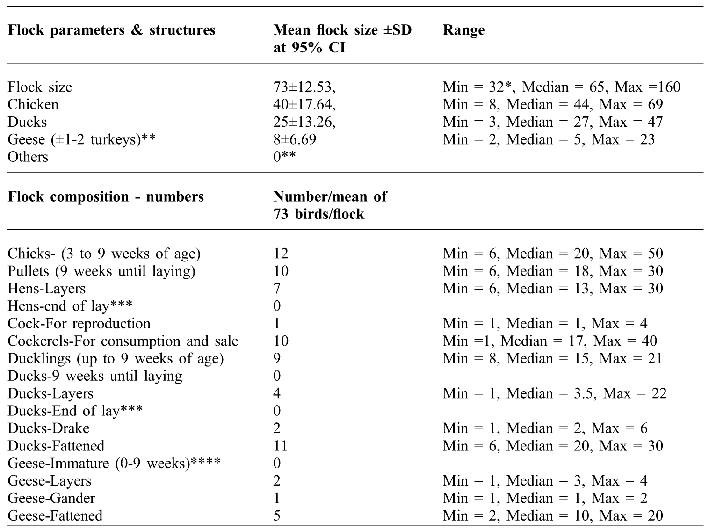
A total of 6439 chickens, 2475 ducks, 211 geese and 48 turkeys were studied from 188 households. In the standing population of households within Menoufia, Gharbia and Qalyubia, 50% of the households had chicks, 33% growing chickens, 96% laying hens (spent hen being almost non-existent), 96% breeding cockerels and 54% broilers. Furthermore, 22% kept duckling, although none had growing ducks, 87% had layer ducks (only 4% had spent ducks), 87% kept breeding drakes and 70% reared fattening ducks. In addition, only about 67% of the households reared other avian species, with about 54% of the household keeping layer geese, 54% with breeding ganders, 25% rearing fattened geese and less that 8% keeping turkeys. These structures supervene for the regular season but change slightly during the festive and post-festive periods.
Of the 188 households, 109 (57.98%) raised chickens and ducks only; 50 (26.60%) raised mixed species of chickens, ducks, geese with or without turkeys; 25 (13.30%) raised only chickens; 2 (1.06%) raised only ducks and 2 (1.06%) raised only ducks and geese with or without turkeys. None of the households in the survey raised geese or turkeys only.
The mean number of birds per household was approximately 73 birds during the regular season (Table 1), though this figure varied widely based on financial statuses of the different families (widows and extremely poor families tend to keep less than 10 birds). However, mean flock size of 57.1 and 58.8 were respectively obtained for the pre-festive and post-festive seasons. No statistically significant difference exist between the three seasonal mean flock sizes (p = 0.575102, χ2 = 5.71159; Tables 1 and 2), It was observed that more fattened birds were kept prior to major festivities and more younger birds and growing ones were kept after festivals (Table 3).
Observed Flock Parameters and structures in the Egyptian Household Poultry (n = 188).

*A flock size of 5 was observed but was not included in the analysis because it is not a typical flock size. In this case, all of the birds in the flock were donated to the poor widow as a form of social security/assistance to earn some incomes.
**±1-2 turkeys may exist in few households. Its presence will affect geese number.
*** Removed as soon as are available (rapid dynamics).
**** Goslings are produced 2x a year. They are removed 4-7days after
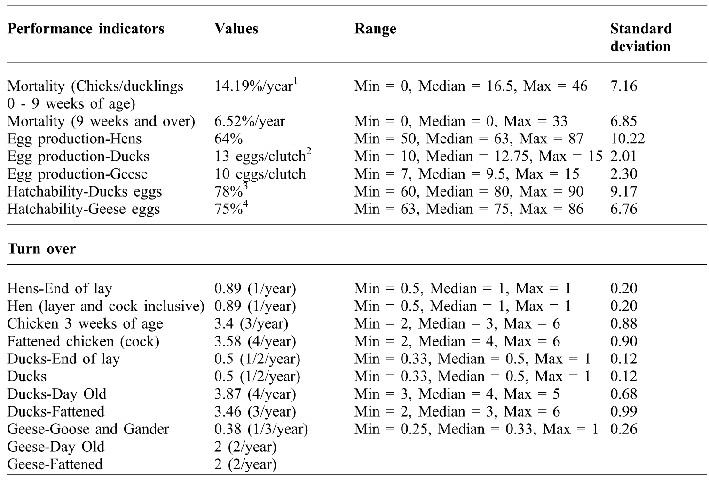
Flock Performance indicators of the Egyptian Household Poultry based on farmers responses (n = 188).
1 Value of 75% death in the chicks was taken as outlier and was not included in the analysis. The farm with this value had HPAI H5N1.2 These values are for the Baladi ducks. It was observed that the Muscovy ducks produced an average of 25 eggs per clutch.
3 3.74 clutch is obtainable per annum, SD = 0.71 (3.39-4.08), Min = 3, Median = 3.5, Max = 5.
Total offspring per annum observed is 36.72, SD = 9.65 (31.92-41.52), Min = 21, Median = 38.5, Max = 54
4 2.39 clutch is obtainable per annum, SD = 0.46 (2.11-2.67), Min = 2, Median = 2, Max = 3.
Total offspring per annum is be 17.69, SD = 5.59 (14.32-21.07), Min = 10, Median = 18, Max = 30
Comparison of observed mean flock size during the regular, pre-festive and post-festive periods in Egypt (n = 111).

P-value = 0.58. No statistical significance exists between the periods studied.
Using the means obtained for each category, the approximate percentages of household birds are chickens 55% (40/73), ducks (including Baladi, Muscovy, mule and Peking) 34% (25/73) and geese ± turkey 11% (8/73; Table 1). For the means obtained for the chicken category, the approximate percentages of chicks, growing chickens, layers, cocks and fattened chickens in the standing population were be 31% (12/40), 24% (10/40), 18% (7/40), 3% (1/40) and 24% (10/40) respectively. Spent hens was almost non-existent in the poultry population because the dynamics of the spent bird within the flock is very rapid (removal for household consumption almost immediately a bird is spent).
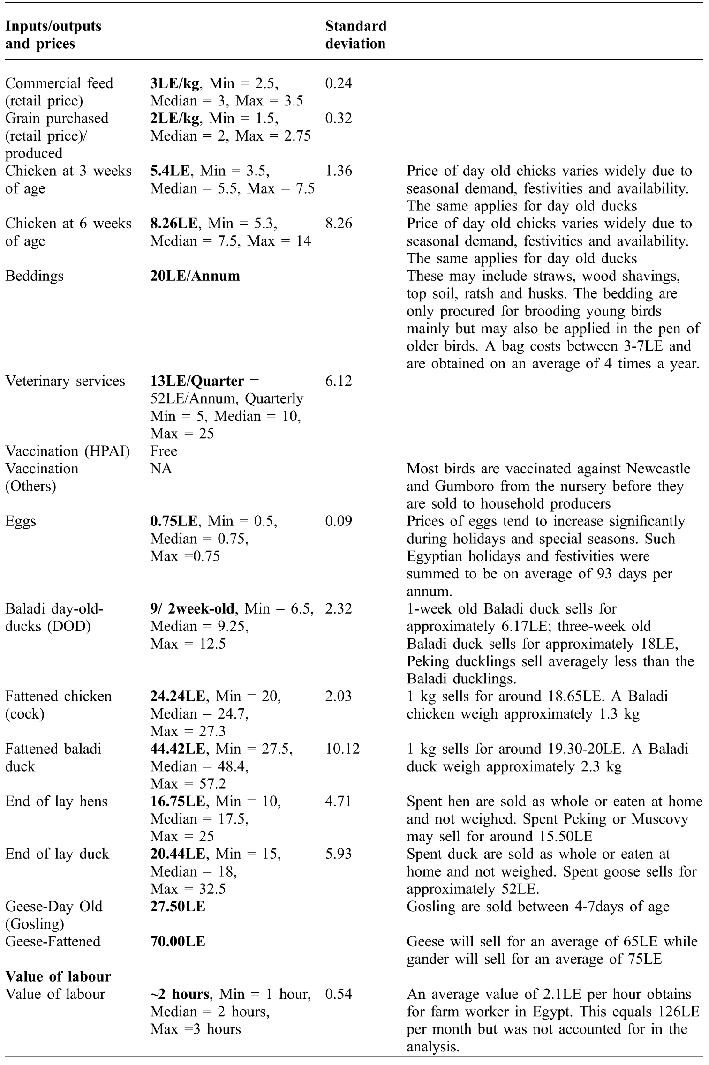
Inputs and Outputs in the Household Poultry, Egypt based on Market survey (n = 56).
Using the data obtained for ducks, the approximate percentages of ducklings, growing ducks, layer ducks, spent ducks, drakes and fattened ducks in a standing population were 34% (8-9/25), 0-2% (0-1/25), 15% (3-4/25), 2-3% (1/25), 4% (2/25) and 43% (10-11/25) respectively. Growing ducks are rarely encountered because of the following reasons: the period of the survey was at the end of the period when households keep minimum numbers of ducks due to heat stress associated with summer months (approximately May-October) or because of the practice of selling-off of Baladi day-old-ducks and buying of three to six week old Peking ducks for fattening.
Similarly, for other species, the geese population was approximately 96% of the total population of other species raised while turkey was only about 4%. Among the geese category, no young geese were encountered, again possibly because this period was at the end of heat stress when geese eggs were rarely laid and incubated. However, layer geese compromised approximately 20 while gander and fattened geese were 6% and 68-73% respectively, while turkeys ranged from 0-6%.
flock performance indicators
Average mortality was 14.19% in young birds and 6.52% in adults. Mean hen-day egg production in chickens was 64% while 13 and 10 eggs per clutch were laid on average in the ducks and geese, respectively. Hatchability of duck and goose eggs was 78% and 75%, respectively (Table 2).
The turnover for chicken was once per annum while it was once every two years for ducks and once every three years for the geese. However, age-biased turnovers were observed in the different species (Table 2). The inputs and their prevailing prices are summarised in Table 4. Feed, veterinary services, vaccination (HPAI H5N1, Newcastle and Gumboro), labour and stock (birds) were determined as the main inputs but commercial feed and grain supplements, remained by far the most important.
diseases
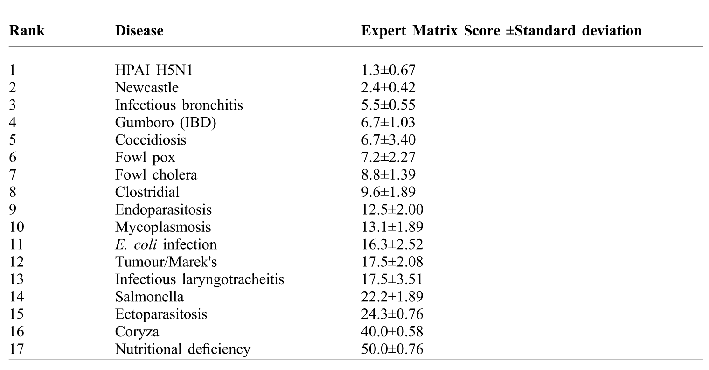
Both poultry experts and farmers are of the opinion that highly pathogenic avian influenza H5N1 (HPAI H5N1) is the most important disease in household poultry in Egypt. The perception of importance is defined in terms of level of economic losses/fatality and based on which disease major decisions on HHPP will be taken. This disease is followed by Newcastle disease, infectious bronchitis, infectious bursal disease (Gumboro), coccidiosis (sometimes with clostridial infection), helminthiasis and other poultry diseases in that order (Table 5).
profitability
Using the cost and return analysis, and based on the key parameters observed and assumptions taken, it was judged that the household poultry production in Egypt is a profitable business. Over the period of one year, the household poultry involving a total of 73 mixed flock birds yielded a return of approximately 2389.67LEFootnote 1 (~US$415.00) or 2287.67LE (~US$397.34), discounting for the current level of biosecurity as observed in the poultry flocks (Fasina et al., Reference FASINA, ALI, YILMA, THIEME and ANKERS2011).
However, it should be stated that ‘profitability’ in these circumstances was more to do with non-financial values since most of the poultry produced were meant for household consumption. It is important to emphasise that though the value of labour was estimated to be 126.00LE/month (US$21.88) or 1512LE/annum (US$262.61), this was not included in the analysis since no household poultry producer was willing to pay for such services. Furthermore, labour cost significantly reduces profitability of the project by a margin of 63.27% (1512LE/2389.67LE), and this is not feasible for household poultry production.
Important poultry diseases in the Egyptian household poultry based on opinion ranking (n = 10).
Discussion
In this study, household poultry in Egypt was quantified in terms of parameters and its profitability estimated using survey data and questionnaire-based studies. Critical inputs/output balances were evaluated and by far, feed (including concentrates and grains) was the most important input. While feed is critically important for household poultry in other reports elsewhere, the amount it contributes to the total input may not be as high as we have seen in this report (Sonaiya and Swan, Reference SONAIYA and SWAN2004; Akinola and Essien, Reference AKINOLA and ESSIEN2011). According to estimates, feed took approximately 87% of the total costs of production, a situation that is similar to the commercial sector (Ravindran and Blair, Reference RAVINDRAN and BLAIR1993). This approximate percentage, however, differs within individual households since no uniform standard of feeding was used. It is impracticable and not economically feasible to feed HHP with 100% commercial feed and remuneration for labour is equally not financially viable at the current level of productivity and prevailing market prices.
Though the mean flock size achieved in this analysis was 73, district-based mean flock size differs significantly in view of key inter-districts and inter-governorates differences in flock structures and compositions based on certain prevailing circumstances. From the current observations, flock compositions depended partially on the availability of supply of day-old-birds and supplement feeds. In areas where there were major hatcheries, chickens tended to play more prominent roles compared to more distant regions. The mean flock size described in this report fell within the wide range of 10-20 and up to a few hundred, as described by Hosny (Reference HOSNY2006). This was higher than that previously described (52 birds) by Geerlings, et al. (2007) but slightly lower than that (90 birds) described by Yakout, et al. (2009). The composition of chickens, ducks and other birds (geese and turkeys) were similar to those reported by other workers (48-52%-chickens, 22-25%-ducks; Geerlings et al., 2007).
Although flock structures and composition varied based on season, no significant differences were observed. This is associated with the dynamics of replacement and restocking of young and fattened birds all year round. It is important to state that many of households avoided raising waterfowl (ducks and geese) in the summer months (~May-September) due to the extreme heat that caused high mortalities (up to 50%) in young birds. The current survey was out just before a major festival and revealed that an increasing numbers of fattened birds were reserved for such occasions as well as immediately after the festivities, and the increase was seen in the younger and growing birds. These seasonal variations have been studied by Yakout et al. (Reference YAKOUT, KOSBA and THIEME2009), who reported that the winter months saw the highest population of birds.
The method of household poultry production described in this paper was innovative in view of the optimisation of limited land resources at the disposal of producers and improvements in the management system of Sector 4 poultry. Such methods improved the health component as it excluded birds from certain soil/land related poultry diseases (e.g. internal parasites) and represented a key contribution to the twin goals of hunger reduction and poverty alleviation amongst rural communities. However, raising birds inside accommodation where humans reside comes with the risks of human being exposed to poultry diseases due to high intensification and the close association between man and birds (Fasina et al., Reference FASINA, BISSCHOP and WEBSTER2007; Fiebig et al., Reference FIEBIG, SMIESZEK, SAURINA, HATTENDORF and ZINSSTAG2009; Hogerwerf et al., Reference HOGERWERF, WALLACE, OTTAVIANI, SLINGENBERGH, PROSSER, BERGMANN and GILBERT2010).
The production parameters were deemed good to excellent for household poultry production. The mean mortality of 14.19% was comparable to those obtained in controlled studies in Ethiopia (Demeke, Reference DEMEKE2007) but are far less than the 30% (Hosny, Reference HOSNY2006) and 60% reported for field studies with scavenging and rural poultry (Maphosa et al., Reference MAPHOSA, KUSINA, KUSINA, MAKUZA and SIBANDA2004). It was concluded that the intensification of household poultry in Egypt was responsible for this observed reduced mortality.
Hatchability of approximately 78% and 75% respectively for ducks and goose were good for profitability (Sonaiya and Swan, Reference SONAIYA and SWAN2004). On average, 37 ducklings and 18 goslings were expected from each layer duck and goose per annum, respectively. It would be desirable to improve the percentage egg production in chickens, where values as low as ~33% were observed in certain instances. Fortunately, farmers who reported that they used vegetables and other household food leftovers in the diet, had sustained higher percentage hen-day. Such feeding habits should be employed on a wider scale as it will also help recycle leftover materials.
While the profitability of the project as described in this analysis may be subjected to a variety of risks and uncertainties, it can be confirmed that such variations can be compensated for by the increased price of key outputs (eggs and poultry meat) especially during important occasions and holidays, which represent about 93 days per annum (Geerlings et al., 2007). Since it is highly unlikely that the price of feed will remain high throughout the year as assumed in this model, this can positively influence the profitability of the project.
It should be stressed that the proportions of the meat and eggs arising from the households analysed in this survey were mainly utilised within the household. However, poorer families tended to sell products and buy lesser qualitative food items or pay for other household needs. In addition to meeting these needs and generating incomes, the birds and their products played key roles in the form of investment, social security and benevolence (especially for supporting widows, women with new born children and newlyweds).
As stated in other reports, avian influenza and Newcastle diseases are important family poultry diseases (Branckaert, Reference BRANCKAERT2007). The current findings affirm these assertions. The emergence of HPAI H5N1 in Africa has become of particular concern to farmers and operators in the industry. This disease is of major concern in view of its lethal potential and economic losses (Sonaiya, Reference SONAIYA2007; Akunzule et al., Reference AKUNZULE, KONEY and TIONGCO2009; Sipahi et al., Reference SIPAHI, YALCIN, CEVGER, ARAL and GENC2011).
Household poultry is important in Egypt, and will remain so for the foreseeable future. Advocacy for improved biosecurity within the sector is needed to reduce the chances of human infections by zoonotic diseases because of close co-habitation (Fasina et al., Reference FASINA, BISSCHOP and WEBSTER2007; Hogerwerf et al., Reference HOGERWERF, WALLACE, OTTAVIANI, SLINGENBERGH, PROSSER, BERGMANN and GILBERT2010). The data provided in this report can serve as baseline information for future quantitative studies involving the Egyptian household poultry sector, while assisting in policy formulations by government.
Conclusions
The Egyptian family poultry sector is profitable and compares favourably with data obtained elsewhere and can be used to improve livelihood of rural women and their families (Bagnol, Reference BAGNOL2009).
Acknowledgements
The authors are grateful to the whole hearted cooperation received from Chief Veterinary Officer, Prof. Dr Mohammed ElGarhy and Governorate Agricultural authorities in Menoufia, Qalyubia and Gharbia in conducting the study. We are also thankful to the districts/village veterinarians who considerably assisted in field data collections. This project was sponsored as part of the ECTAD, FAO, Egypt Strengthening Avian Influenza Detection and Response (SAIDR) project. The lead author (FASINA, Folorunso Oludayo) was sponsored by the IFAD/FAO/INFPD Associate Poultry Adviser (APA) 2010 program/international consultant (GCP/INT/197/IFA).