I was motivated to write this account because I finally bought a copy of Walter W. Taylor and Dissension in American Archaeology, edited by Allan L. Maca, Jonathan E. Reyman, and Williiam J. Folan (Reference Maca, Reyman and Folan2010), and the contents convinced me that I could add some perspective not included in the volume, as well as perhaps enforce or refute some of the accounts of others based on my personal experience with Walt Taylor.
When I first learned about the Taylor volume, I wondered why neither Dick Pailes nor I had been included, since we both are archaeologists who, as graduate students (the last ones I must add), assisted Walt in fieldwork. We did so during the summer of 1964 on his NSF-supported project to investigate cultural interactions on the Chalchihuites/Chichimec frontier in Zacatecas. Both Dick and I had the opportunity to observe Walt in a fieldwork context. When I asked Jonathan and Willie about this omission, I was told that Dick had been invited to participate but had declined, and that they had apparently forgotten about my being on the summer expedition with Walt in Zacatecas!
Before I get to my impressions of the Zacatecas experience, I want to give some background to my experience with Walt (prior to Zacatecas) in the graduate program at SIU. Having just graduated with a bachelor's degree in Anthropology from the University of Illinois, and having been accepted to continue in the graduate program there in the fall, I spent the summer of 1963 on an archaeology project and summer fieldwork course directed by archaeologist Elaine Bluhm, who was on the faculty of the University of Illinois at the time. I am compelled and delighted to add here for the record that Elaine was the best field archaeologist under whom I ever worked as a student.
We first focused on an Archaic site on an island in the Rock River, including a deep shell midden, along with several pits and lots of Archaic artifacts. There were five students on the project and the only ones to continue on in the profession were Don Johanson and myself, although Elaine's graduate assistant, Patricia O'Brien, went on to a distinguished career in Midwestern archaeology.
Elaine had an old tan Ford station wagon, and in the back was a copy of Walt's (Reference Taylor1948) A Study of Archeology. As we bounced to and from the site, I passed the time reading Walt's book. It had never been assigned in any of my undergraduate archaeology classes. Don Lathrap assigned us the nearly incomprehensible (for an initiate) and horribly uninspiring Willey and Phillips (Reference Willey and Phillips1958) volume on time, space, and typology in American archaeology. By contrast, I found Walt's arguments stimulating, fascinating, and quite comprehensible.
By the end of the summer experience, along with many discussions with an incredibly patient Elaine Bluhm, she suggested that, based on my interests, I scuttle my plans for graduate studies in archaeology at the University of Illinois and try to get accepted into the graduate program in anthropology at Southern Illinois University where Walt Taylor was located and where they had built a very strong program in archaeology.
I could not attend to this matter right away because I was committed to participate in a three-week singing tour of Europe with the University of Illinois Concert Choir. After the tour, I settled into my 1954 dark green Chevrolet with rusted-out floorboards and set out from my home town in Atlanta, Illinois in the center of the state to courageously make the trip into the unknown, Carbondale, Illinois, in the distant southern tip of the state.
I never cease to marvel at how crazy this idea was, although it seemed just fine to me at the time. It was only about two or three weeks before classes were to begin at SIU! I got a meeting with Walt (then head of the Anthropology Department) and explained my desire to enroll in the graduate program because I had read and was so impressed by his A Study of Archeology. I also showed Walt a copy of my summer project that involved the chemical analysis of the edges and bottom of the pits in the Archaic site that suggested they might have been used for leaching acorns.
In this initial interview, I also discussed with Walt my great interest in pursuing a career in the Paleolithic archaeology of France. Apart from the lure of Paleolithic archaeology, I had studied French for two years and had just taken advantage of the opportunity our concert tour provided to review and then practice speaking French in Paris. Walt said he had an archaeologist friend at Harvard, Hal Movius, who had a project at Abri Pataud in the Les Eyzies area of the Dordogne in southern France, and that Walt would write to Movius to see if he needed an assistant for the coming summer.
Walt said I could enroll in the graduate program but only “on probation” status since my grade average from the University of Illinois was only barely a B+. I protested a bit by calling his attention to the fact that not even the valedictorian of our huge graduating class had a perfect A average, but Walt held his ground and, of course, I had no choice but to accept his decision if I wanted to get into the program.
Elated on the prospect of getting to do archaeology in France, I found local accommodations in a boarding house in Carbondale, settled in, and within the first month or so passed the graduate school exam in French. This seemed to impress Walt, since most of the anthropology students seemed to put the language exams (we had to pass reading comprehension exams in two different foreign languages) off as long as possible, sometimes to the bitter end, or as it turned out, never.
Southern Illinois University was on the “quarter” system, with yearlong “pro-seminars” required in archaeology, physical anthropology, linguistics, ethnology, and social anthropology. I enrolled in the pro-seminars in archaeology and physical anthropology. In archaeology, we had a quarter with Walt, then another with Mike Fowler, and finally a quarter with J. Charles Kelley.
Walt's seminar was inspiring. He stressed the crucial difference between culture with a capital “C” and culture with a lower case one, a distinction I would later stress in the introductory anthropology classes I taught. Walt also stressed Alfred Lord Whitehead's concept of science being “ever closer approximations to the truth”.
Each of us students was assigned an archaeology book to analyze. What Walt wanted was a thorough examination of the “underlying assumptions” of the author and how they might have, perhaps even unconsciously, influenced the author's conclusions. This was right down my alley since I had taken several courses in English literature and poetry at the University of Illinois in which we occasionally spent a whole class analyzing the meaning of one or two lines.
I was assigned a book on European archaeology (translated into English) by a Belgian archaeologist. Walt gave me an A for his class. Another beginning student, however, who came into the program from Boston University, was called into Walt's office at the end of the course and dismissed entirely from the graduate program due to a performance that according to Walt did not meet the program's high standards!
By the end of the first quarter, I had achieved A's in all my classes. One Monday in December, Walt called me into his office. As I remember it, he said: “Joe, I recently got a letter from Hal Movius and he does need an assistant for his project of excavations at the Abri Pataud cave in southern France. However, we have decided to recommend Berle Clay for the position because you have only been here for a quarter and Berle has been here for over a year. However, I have a summer archaeology project in Zacatecas, Mexico and I can offer you a position as one of my assistants on that project.”
I was stunned. Walt was backing out of a commitment that had been an essential part of my decision to enroll in the program at SIU! And I was prepared to do work in a French-speaking country, not a Spanish-speaking one. I asked Walt if I could have until Friday to ponder his offer.
During that week, I spoke to other graduate students, including Berle Clay and Phil Weigand, and found that Walt had offered the same opportunity to each of them but they had turned him down because of the reputation Walt had of being extremely hard on his students. I learned, however, that Dick Pailes had taken Walt up on his offer, one that in Dick's case apparently included the opportunity to use the data from the Zacatecas fieldwork for a doctoral dissertation. What could I do? Friday I told Walt I would go to Zacatecas with him the coming summer.
In the second and third quarters, I had the parts of the pro-seminar offered by Mike Fowler and by J. Charles Kelley. Among the things that impressed me was the incredibly fine stratigraphic work done by Mike at the Coxcatlán cave in Puebla, preceded by his groundbreaking excavation and analysis of the remains at Modoc Rock Shelter in southern Illinois.
J. Charles's showed us photographs of his superb excavations in Zacatecas and Durango, although he did admit in class that when he began excavating there he had unknowingly dug through “more floors than the Empire State building” before he got a hang of the nature of the constructional deposits. This was because he had been trained on excavating structures with stone floors in the Southwest United States Such candor was refreshing. J. Charles also had some intriguing views on archaeological interpretation. He presented it as being like a sort of “fuzzy rubbing or vague impression” of what really happened in the past.
J. Charles saved my graduate career that first year by giving me an assistantship in the SIU Museum when he learned that my financial resources had been drained down to a mere $80 and because of that I might have to drop out of the program. J. Charles put me to work on the preparation of exhibits and I also guided groups of school children through the museum. This experience made such an impression on me that preparing museum exhibits and guiding people through them has been an important part of my archaeological career ever since.
As the summer approached, I bought and read The Children of Sanchez by Oscar Lewis as preparation for the trip to Mexico. Lewis had been one of my favorite anthropology professors at the University of Illinois. I also purchased two Spanish language texts: the one I found most useful was published by the University of Chicago. In addition, I gave A Study of Archeology a second, thorough reading in preparation for the summer experience.
The Zacatecas expedition began by driving out to Walt's house in Santa Fe, New Mexico, a beautiful home he shared with his second wife, two sons, Pete and Natch, and I believe also his daughter, although I do not remember meeting her at that time. Walt's wife (the second one) was a lovely woman who had a great interest in art, especially paintings. They were abundantly evident everywhere on the walls of their house. I heard that she and Walt had met at Clyde Kluckhohn's funeral. When I met her, she had been confined to a wheelchair for quite some time.
There was a big swimming pool out in back of the house, and a separate “office” building for Walt where the walls were covered floor to ceiling with an amazing collection of books, especially on Southwestern archaeology. These books impressed me in part because Dick Pailes and I had just taken a class with Walt on Southwestern archaeology that involved reading everything we could find in the SIU library about Southwestern archaeology and filling out annotated 3×5 bibliographic cards in triplicate for Walt's files. But also, Walt seemed to possess the entire collection of the publications of the Bureau of American Ethnology, and at that time I could not afford to buy even one of the books in that series.
Pete, Walt's oldest son (about 21 years old at the time), was, as they say, “the spitting image” of Walt: manly, brash, self-confident, and charming with the girls. But Walt and Pete seemed to have a long-running, intense personality conflict. Pete told me he wanted more than anything to become an archaeologist, but that Walt had told him he did not have the “right stuff” to ever become an archaeologist, and therefore he would not allow Pete to accompany us on the Zacatecas project.
On the other hand, Natch, the younger son (about 16 at the time) and one who never expressed any interest in archaeology at all, was to accompany his father and the rest of us to Zacatecas. At the time, Natch seemed to be (and certainly turned out to be later on) the polar opposite of Pete: slight of build, thin blondish hair, blue eyes, retiringly shy, and, as became apparent in Sombrerete, completely uninterested in the girls, who, by the way, nearly swooned and fainted at his feet when he walked along the sidewalks downtown. This was a situation that confused me then, and which has been the subject of much psychological speculation on my part ever since.
I believe it was in Santa Fe that we were joined by the fourth “assistant,” Mike Whiteford from Beloit College in Wisconsin. Mike was the son of a renowned anthropologist on that faculty and a young man who had grown up in Colombia and was thus fluent in Spanish. He professed a primary interest in cultural anthropology, not archaeology.
We bought a lot of our fieldwork equipment at an Army Surplus store in Albuquerque, and visited several of the local sites such as Bandelier. The rest of my time was spent double-dating local girls with Pete and trying to find Spanish speakers who could help me with my vocabulary. I remember a local friend once proudly telling me the Spanish term for “necktie,” though that seemed of little use given where I was headed.
Finally, we loaded up the vehicles and our Airstream trailer and drove south to El Paso/Ciudad Juárez. We stopped in El Paso to eat enchiladas at what Walt said was his favorite restaurant for Mexican food. Walt seemed to have a somewhat more sinister motive: the enchiladas were the hottest/spiciest I have ever eaten, producing a reaction among us initiates that seemed to delight Walt. We had to wash down every bite of the fiery enchiladas with a hearty gulp of cold beer.
We had two field vehicles for the expedition. One was Walt's pumpkin-orange Chevrolet Suburban. The other was a dark green Chevrolet pickup with SIU decals and behind which we towed an Airstream trailer. In Santa Fe, Walt had hidden two shotguns and multiple boxes of shotgun shells in the walls of the Airstream because he wanted to be able to bond with Natch through shooting doves together in the wilds of Zacatecas. So guess who drove the pickup and Airstream across the border while Walt, Natch, Mike, and Dick rode across in the Suburban?
This is not funny! After over 50 years of living and working in Mexico, it infuriates me that Walt placed me in such a dangerous situation. He should have driven that damn arms-and-ammunitions-loaded Airstream across the border himself. Of course the Airstream, with me in it, was boarded by several serious-looking border guards in drab green garb, all of them speaking seriously to Walt in Spanish, none of which I could understand. My fear of course was that they were intent on ripping the trailer apart looking for contraband. If they had found the shotguns and shells, I doubt I would be writing down this account in the comfort of my office.
Then there was some sort of group conference at the front of the trailer, some money exchanged hands, and we were shortly on our way. When we stopped to buy some groceries in Ciudad Juárez, I asked Walt what had happened at the border. He said the guards were concerned that we were bringing too much toilet paper into Mexico. We had a huge box full of rolls of the stuff. He had explained to the guards that we were going into the boondocks of Zacatecas where we could not get proper soft toilet paper, only rough local stuff. A generous “gratification” greased the importation process.
So, my first “taste” of real Mexico on this trip was Ciudad Juárez. While Walt was off buying the groceries, I was left guarding the vehicles. Adolescent boys kept running up to me and asking in broken English if I wanted to “buy” their sister. I had not come across this particular ethnographic curiosity in my reading of The Children of Sanchez.
Walt was a self-proclaimed authority on all things Mexican. After all, he had done archaeological fieldwork in Mexico and, according to J. Charles Kelley, Walt had taught in Mexico for some years at Mexico City College before taking a position at Southern Illinois University. Walt was admirably fluent in Spanish, especially, I learned first-hand, when cussing someone out. So there was not any reason to doubt Walt's advice, at least not at first.
The first gem of advice from Walt was that someone entering Mexico could avoid Montezuma's Revenge by gradually acclimating their gut to the local flora of the tap water. This could be done simply by drinking a quarter of a glass of tap water with the first meal, a half a glass with the second meal, and a full glass of water with the third meal. Dick Pailes followed Walt's advice to the letter; the end of the prescription was at a restaurant in Chihuahua where he drank a full glass. Fortunately, I was skeptical of Walt's advice and stuck with drinking Coca Cola.
We camped out that night in the desert along a lonely stretch of the highway that ran south of Chihuahua. I counted at least 10 trips that Dick took with our little green Army Surplus “latrine spade” that had a roll of toilet paper skewered on the handle, shuffling off through the sand into the darkness of the desert. The next morning, Dick was visibly washed out, but at least Walt was right about one thing: we might actually go through that whole box of toilet paper during the summer.
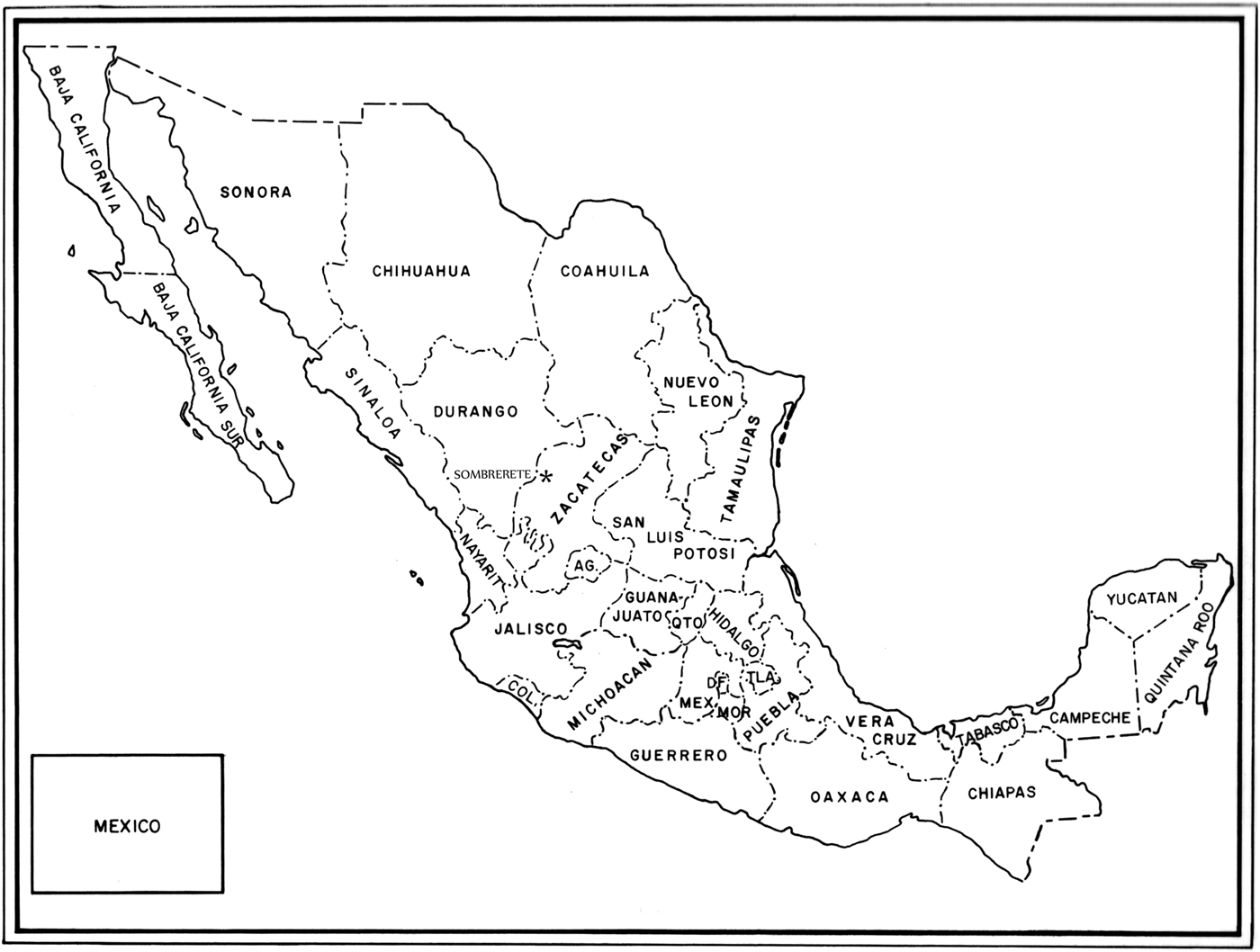
Finally, we arrived in Sombrerete, Zacatecas (Figure 1), where we were to set up our field station for the archaeological study of interaction between the nomadic, barbaric Chichimecs and the settled, agricultural Chalchihuites people. We drove into the exact center of the small town, which at the time looked to me like the very end of the world, and we parked the trucks in the little plaza so Walt could go looking for a cook.
Map of Mexico showing the location of Sombrerete in the state of Zacatecas. Map by author.

While Walt was gone, a local guy, Martín Barajas Cortés, approached the trucks and asked us what we were doing in Sombrerete. Mike Whiteford explained that our professor had gone looking for a cook for our field camp. Martín said: “Well, I am a cook.” Walt returned, took Martín at his word, and we summarily acquired for the duration of the summer project a “cook” who turned out to know how to prepare exactly one thing: roasted goat. He would keep a young goat tied up to a tree and when he saw us on the horizon coming in from the field he would kill the thing, skin it, and toss it into an open pit fire.
Martín did get better as the summer wore on, by taking cooking lessons from his wife. She was contracted by Walt to prepare our field lunches. These lunches were always tamales that we could heat in the field over an improvised fire. Near the end of the fieldwork, I made Martín quite angry merely by suggesting his wife might vary our lunch menu a bit. I have rarely eaten tamales since, and have never eaten roasted goat again since that summer in Zacatecas.
I must add that, a few times during the summer, Walt took pity on us and did the cooking himself. The first time was roasted doves that he (and possibly Natch) had shot. The doves were certainly tasty. Another couple of times, Walt cooked us his Santa Fe enchiladas. They were made with equal parts of ground beef and sausage, covered with cheese, stacked like pancakes, and then heated in the Airstream's oven. Those enchiladas were delicious! Years later, Walt was kind to give me the recipe and I have prepared the Santa Fe enchiladas for friends on several special occasions.
During World War II, Walt had served as a Marine on a ship in the Mediterranean Sea, sent there for the purpose of smuggling spies into Germany via Italy. As Walt related to me, when, near the end of the war, they ran out of spies, he went in himself, eventually getting caught by the Germans, and imprisoned in a prisoner-of-war camp. He and some others escaped from the camp twice but they had to return because they could not find anything to eat in the by-then devastated countryside. Walt passed some of his time in the camp teaching an anthropology course to the other internees. It was there he found a close, lifelong friend in Philip Dark.
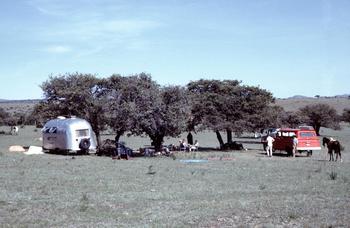
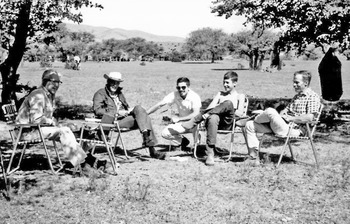
As a manly Marine, Walt was determined that we would “rough it” in the field. It was no big problem for me since I had grown up camping out over weekends in rural central Illinois. But we could have gotten rooms in a modest, cheap hotel in Sombrerete where we could have slept in a bed, gotten a hot shower, and eaten a varied fare at local restaurants. Instead, we set up camp in a cow and burro pasture about six miles outside of Sombrerete (Figures 2 and 3), where we slept on the ground and ate Martin's roasted goat most evenings.
The base camp near Sombrerete, Zacatecas. Photograph by author.

Left to right: Walt Taylor, Joe Mountjoy, Mike Taylor, Natch Taylor, and Dick Pailes at the base camp near Sombrerete, Zacatecas. Photograph by author.

At the Army Surplus store in Albuquerque, Walt had purchased a large bag that he could hang from a tree limb and fill with water. There was just enough water for each of us “assistants” to fill two plastic wash basins, one to soap up with and the other to rinse off, when we got to bathe once a week, on Saturday afternoon. This sure was not southern France, but then again Berle Clay later told me that Hal Movius even rationed the toilet paper on the Abri Pataud project. At least scarcity of toilet paper was not a problem for us in Zacatecas.
I am compelled to add for the record that one Saturday, as we were finishing our weekly bath, the rest of us had rinsed off and Dick Pailes was lathered up from head to toe when a friend of mine, Bill Marshall, along with his sister, could be seen in the distance approaching the camp in Bill's Volkswagen (VW) Beetle. The rest of us rushed into the Airstream trailer and locked the door behind, leaving a soapy, naked Dick outside with nowhere to hide. We finally relented to his frantic pounding on the trailer door, punctuated with words unfit to print here. Dick was enraged and I am sure has never forgiven us for the “dirty” trick, but, sorry Dick, the memory of that event still brings a big smile to my face as I write this.
Walt initiated the fieldwork by a sort of “trial by fire” mapping activity. He said he had to make a base map of the area, and to do so he needed to “triangulate” three mountain peaks with his Brunton compass from the perspective of the highest mountain peak in the area, Papantón. So he had each of us fill backpacks with all the gear we would normally need during site survey: Brunton compass, 30-meter steel tape, 35-millimeter camera, and collection bags, and we set out to trudge up Papantón. As I remember, Dick Pailes made it half way up the mountain then had to stop to vomit. I think that Natch turned around and went back to the camp. We did finally reach the summit. Walt set up his Brunton tripod, recorded an azimuth sighting to two other peaks and we summarily descended back to our field camp. “Trial by fire” completed.
A second example of bad advice from Walt: “It never rains in Zacatecas.” I had bought a sleeping bag in Carbondale in anticipation of our camping out in Zacatecas. Walt slept in the Airstream and the rest of us out on the ground under the amazing star-studded Zacatecas sky. Well, it does rain in Zacatecas and it took only a few nights for me to find that out. I got completely soaked before I could manage to wriggle under the shelter of the green Chevy truck. In the morning, I crawled out of my sleeping bag colored bright red! The dye of the interior of the bag was not colorfast!
Walt had, of course, done fieldwork in Mexico prior to this, but his idea of site survey was to apply a model he seemed to have gotten from reading about European Paleolithic archaeology. In this model, every isolated artifact discovered was to be recorded as a “site.” So, we were divided into two crews and set out from the field camp on different compass azimuths. We were to walk along our azimuth looking for artifacts. Each time an artifact was found, we were to put it in a bag, write a name and site number on the tag, take photographs of the immediate area, and fill out a detailed site form that included such things as local flora and fauna (In case a rabbit happened to hop across the site?).
After doing this for about a week, we had some 30 to 40 sites recorded and were still in sight of the base camp! This strategy was clearly not working, and it was completely unclear what the results could ever tell us about Chichimec/Chalchihuites interaction along the presumed “frontier.” I bravely volunteered to bring the matter up with Walt in the evening at the end of the week.
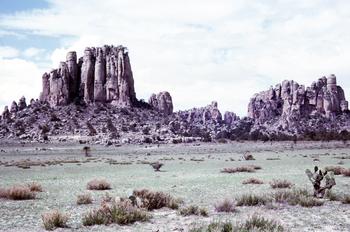
To his great credit, Walt agreed and the following week he changed our strategy. He decided our two crews should survey the nearby picturesque Los Organos area of basalt column monuments and mountains (that had frequently been used as a backdrop for movies) in search of rock shelters that we might excavate (Figure 4). We were to walk out into an area of Los Organos as far as we could get until midday, eat lunch, and then walk back to the truck.
The Los Organos area. Photograph by author.

One day out on survey, Natch and I came across a huge open cave that looked like a great place to excavate, but it had a family living in it along with their whole herd of goats. We thought this was remarkable, but Dick and Mike reported that on their side of the valley they had come across a young girl bathing nude in a pool in the arroyo, under the watchful eye of her mother, and she had calmly walked out of the pool in full view of the survey crew to dry herself with a towel. I, at least, preferred to be skeptical of that account rather than readily accepting the possibility that Natch and I had chosen the wrong side of the valley to survey that day, winding up with the goats instead of the girl.
For his part, Walt had found a buddy in Sombrerete who was intimately familiar with the local area. They would meet in Sombrerete at a restaurant for a breakfast of scrambled eggs and then set out in the orange Suburban to scout for rock shelters that could be seen from the road. We would return from the field each day to find Walt in camp drinking “moonshine” mescal (that I obtained for him at a saloon in town, where the proprietor filled a plain bottle from a tin can through a funnel) and “doing the books.” I became impressed by how much “bookwork” was required on an NSF project.
Once, Walt and his pal saw a rock shelter way off the road up in the mountains, and Walt decided we should excavate the thing. So the following day we climbed up to the shelter, loaded with stakes, hammer, sifting screen, shovels, and collection bags. Walt decided exactly where we should place the trench and decided on its dimensions. We set about staking out the excavation area but I could not drive the first stake into the dirt. I moved the stake: still not possible. The deposit was only about 10 centimeters deep! We packed up our gear and headed down the mountain and back to the base camp.
Walt had each of us keep two dairies: a “day book” and a “field book,” both of them written apart from our actual field notes. This daily documentation took up a good bit of our after-supper time. Walt could never explain to my satisfaction why we could not write all of the information in just one diary.
I spent much of the time left before sleeping working up Spanish vocabulary words along with the English translation that I would write on 3 × 5 cards and take with me on the weekends to Sombrerete to practice my Spanish. I found that by noting down only what were to be obviously useful words the next Saturday, I could increase my vocabulary from between 20 to 40 words per week. Phrases were more difficult. I thank Mike Whiteford for providing me with three variations on pick-up lines for local girls.
Some evenings I would get into a conversation/discussion/debate with Walt. Usually this would be at the end of the nightly two-way discussion between Walt and Dick about one or more aspects of the fieldwork. Dick already had an master's degree from Arizona State University and, with good reason, this made him “number one son” on the project. I sat and listened. Later on, however, after Dick had departed to sleep, Walt and I sometimes got into discussions on non-fieldwork-related topics. I especially remember two of these.
Walt had brought along on the expedition a book to read: Carleton Coon's recent treatise On the Origin of the Races (Reference Coon1962). Walt thought Coon's arguments were pretty convincing (Coon was after all a professor of physical anthropology at Harvard): basically that the three major races or stocks of humankind had different, isolated evolutions in Africa, Asia, and Europe. But the implication of this argument was that such evolution might have resulted in different inherent intellectual capacities of the races. Having been through Roger Heglar's yearlong pro-seminar in physical anthropology at SIU, I was strongly antagonistic to Coon's position, and debated Walt on several different aspects of Coon's argument.
The other debate we had that made a lasting impression on me, especially as to what it seemed to reveal about Walt's character. This had to do with whether love or hate were the more basic or fundamental aspect of human nature. You may be ahead of me here. Yes, Walt argued for hate and I for love. Curiously, Walt could vividly display both of these basic emotions, as well as stimulate their overt expression in others.
To pursue this line of analysis a little further, Walt went to Sombrerete every Saturday morning to pick up the mail. We all knew that if no letter was there from his wife in Santa Fe, his mood for the weekend would be absolutely unbearable, so we had better get out of the camp if at all possible. I was lucky in this respect because I had made friends with Bill Marshall, son of the Canadian who was in charge of the San Martín mine that pretty much underpinned the whole economy of Sombrerete. Bill and I were both about the same age (22), Bill had a VW Beetle, and we both liked to socialize with local girls, dance, and drink an occasional Corona beer on the weekends.
Based on our friendship, Walt came to know Bill's father, mother, and sister, eventually enough so that we were invited to eat supper at their house, a beautiful abode built on the mountainside overlooking the entrance to the mine. Bill's mother served us scrambled eggs. I absolutely hate eggs, but they sure were good that evening given the steady daily fare of roasted goat and tamales.
Drinks were served, and then served again. Walt became tipsy, then inebriated and he brazenly began to try to seduce Bill's mother! This affront on Walt's part brought on an abrupt cessation to the festivities and we were all summarily hustled out of the house by Bill's father. The rest of us were absolutely furious, both at Walt's disgraceful behavior, and that it had ended such a delightful evening for the rest of us. There was utter silence in the Suburban on the drive back to the camp. Walt passed out in bed and the rest of us commiserated angrily until after midnight.
Aided considerably by my reading of The Children of Sanchez and my increasing fluency in Spanish, plus the mobility provided by Bill's VW Beetle, I was finding Mexican culture far more interesting and stimulating than the comparatively dull archaeological work wherein we were dutifully toiling most of the week. Walt took note of this and seemed displeased by it, although in the long run it worked out just fine for me. My fascination with Mexican culture and its people kept me returning to Mexico long enough for a passion for the archaeology to take hold, as is clearly evident in this essay.
Sombrerete in the 1960s was an anthropological case study in machismo. Bill Marshall told me that he once stopped for a beer at a bar in a town near Sombrerete. Given his lanky height, pale complexion, and reddish hair, Bill was easily recognized as a foreigner, although he did speak fluent Spanish. A guy seated at the bar took a long look at Bill and pulled out of his pocket the large curved-blade type of work knife that most all ranch hands carried. He planted his left hand on the bar and cut a slice around the circumference of his thumb. Looking at Bill, the blood streaming down his hand, he said: “The color of my blood is red; what is the color of yours?” Startled, Bill meekly said “Mine is red too,” and quickly exited the bar and took refuge in his car.
My interaction with Mexican buddies in Sombrerete was commonly through drinking a beer or two in a bar that often evolved into an arm wrestling contest. Growing up doing chores on a farm in Illinois had given me great arm and upper-body strength. The guys thought it hilarious when one of them would ask me: “Quién es cabrón?” I would point my finger at one of them. Some “friends” would try to get me drunk enough to fight outside by buying me beers and increasingly insult the United States, as per: “The United States is a great country, but…” and wait for my reaction. The locally acceptable way out of this situation was with the excuse that I had to meet some local girl.
But in Sombrerete, I did date my first Mexican girl, one with coal-black, sparkling eyes, smooth, brown skin, and who was wearing a white lace dress when I first saw her among a group of girls who were exiting the door of the church the first Sunday I spent in town. Rushing back to camp to consult with Mike Whiteford on handy Spanish phrases, I managed to get back to Sombrerete in time to ask her to let me walk her home. We headed down the street with a gaggle of dumbfounded and giggling young boys following us. We could only get within a block or two of her house for I was told that if her brothers found out we were together they would likely beat me up.
I went to local dances and learned that, although they were supposed to start at 10:00 PM, midnight was far more likely, with the festivities breaking up about 4:00 AM, a fact for which Walt would made me suffer terribly but deservedly during work the next day.
Walt did take the time to show us one famous nearby archaeological site, Alta Vista. The road we took to get there was in terrible condition. The site, having not been worked on for years, was not in much better shape. Walt gave us some information on the long history of archaeological work there, and, as I remember, he mentioned that the number of columns in the Hall of Columns might have had some calendrical significance for the builders.
Anyway, the Alta Vista site, even in its dilapidated state, looked a great deal more appealing to me than the sites left by hunters and gatherers that we had been investigating. J. Charles and Ellen Kelley would later spend several field seasons at Alta Vista, and their work there would be the crowning achievement of their research on the Chalchihuites archaeological culture. They left the local people an excavated site fully prepared for public viewing, as well as an excellent on-site museum containing exhibits that explained the work that had been done there and the significance of the discoveries.
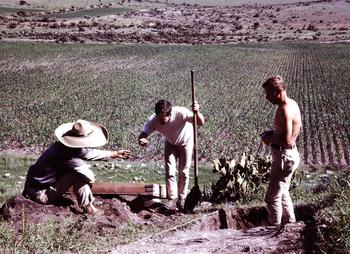
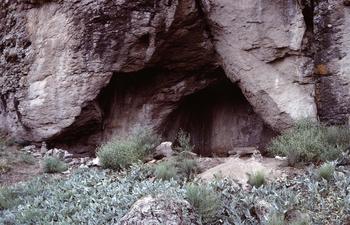
Back to our archaeological fieldwork. We finally settled on the excavation of a cave and a rock shelter in the Los Organos area. Dick and Mike were at the rock shelter (Figure 5) while Natch and I dug at Dog Cave (Figure 6). Our trench stretched from the drip line of the cave mouth back about 6 to 8 meters to the wall. On the back wall, I found some pictographs in red paint that included some parallel vertical lines and one circle with a cross inside. I enthusiastically recorded these designs, but Walt was uninterested.
Dick Pailes and Mike Whiteford excavating on a talus slope below a rock shelter in Los Organos. Photograph by author.

Dog Cave in Los Organos. Photograph by author.

As I remember, we dug the trench in two-meter sections, in 20-cm levels. There was a pretty thick layer of modern powdered goat dung on the top of the cave floor. Underneath, we found a few potsherds in the upper part of the deposit and then miscellaneous Archaic-type stone tools in the lower part. The lower part had the consistency of talcum powder, but also had randomly occurring rocks that, when unexpectedly struck with a shovel, caused a jolt of the deposit so that powered dung would sprinkle down my neck and itch like crazy as I dug. Natch worked on the screen.
We had gone about halfway down to the floor of the cave, taking out three full units per day, but Walt was not at all pleased with the pace of our progress. So one evening he announced his displeasure with our work and firmly stated his intent to accompany us the next day to see why we were so slow. I did the digging at the cave that day and Walt and Natch worked on the screen. By the end of the day, we had only managed to finish two units, and when we returned to the camp, Walt went straight to bed. There were no more recriminations from Walt about the pace of our work at Dog Cave.
Dog Cave was on ejido property and president of the ejido was purported to think that his father or grandfather had buried a treasure in the cave. So, he sent a guy with a rifle and a band of bullets across his chest to sit on a rock at the entrance to the cave and watch over our work. While digging one day, I found a basin-shaped grinding stone with traces of red pigment, presumably the pigment used to paint the designs on the cave wall. This was the most exciting find of the whole dig. Natch and I were delighted. We drew a floor plan, took the Brunton compass orientation of the stone, and wrote copious notes, at least copious notes for us.
The guard did not show up, the next day nor the following one, but on the third day we were stopped on the road out of Los Organos by several armed men riding in the back of a large truck. Natch was scared out of his wits and pleaded with me not to shut off the motor, presumably so we could make a run for it. I told Natch he was nuts, and I complied with our assailants every request. They made us dump the contents of several cloth bags onto the ground to make sure they did not contain “treasure” and, finally satisfied, let us go. Then they went after Dick and Mike, dividing into two groups to assault the rock shelter military style, cutting off any possible route of escape. Mike diffused the situation by telling them neither he nor Dick could speak Spanish.
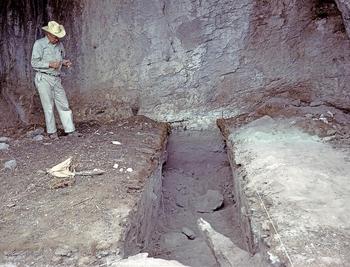
When we got back to the camp, I was furious with Walt and most definitely told him so, saying that he had no business sending us out to work in such a dangerous situation and with no protection. I suggested that he accompany us daily with his shotgun in order to defend us. The next day we returned to Dog Cave to find it had been vandalized by our attackers (Figure 7).
Walt Taylor inspecting vandalism of the trench at Dog Cave. Photograph by author.

Not long after the assault on us, the president of the ejido got drunk, beat up his wife, and was thrown in the jail in Sombrerete. We had the pleasure of seeing him in the jail, dangling a tin can out the window asking for a few pesos so he could buy food. No, I don't remember if we put any pesos in his can.
This whole conflict with the ejido was reported in the Fresnillo, Zacatecas newspaper, publicity that infuriated Walt. Turned out that our cook, Martin, occasionally freelanced as a newspaper reporter.
We did manage to finish the excavation at the cave. When we finally reached the stone floor of Dog Cave, I discovered a discarded tin can of sardines, the rubber heel of a shoe, and a piece of green-glazed pottery, not the usual inventory of Archaic hunting and gathering Chichimecs. I interpreted this archaeological assemblage as evidence of the activities of a pack rat, and, of course, it clearly demonstrated the lack of pure stratigraphic integrity of the cave deposit. When I described the find to Walt, he was visibly angry, but what followed was telling about the man and the archaeologist. Walt told me to throw the intrusive material away and delete the description of the find from the field notes!
Not far from Dog Cave, actually pretty much just around the corner from the cave, Natch and I had discovered an intriguing site during our survey. This site was located alongside a small spring and we found red and black monochrome-painted potsherds there. It seemed to me that we should excavate at that site since it was the only possible Chalchihuites site we had discovered in Los Organos, an area that was otherwise characterized by Chichimec-type Archaic sites. If we were looking for evidence of Chalchihuites/Chichimec interaction, this seemed to me to be the perfect spot to investigate. Walt, for some reason that he never explained to me, refused to let us excavate at that site. The problems we had been having with the ejido guys in Los Organos could well have been his reason, but that site had been discovered and recorded before we began the excavations in Dog Cave.
By this time it was becoming clearly apparent to me that not only did the fieldwork we were doing have no direct relation to any of the tenets Walt had set out in the explanation of his Conjunctive Approach in A Study of Archeology, neither did the fieldwork seem to have much to do with the stated goals of the NSF project. It was hard for me to see how the data we were recovering could be brought to bear on addressing the central problem of the research in which we were engaged.
Next, we transferred our operation out of Los Organos to a large rock shelter on the outskirts of the town of Vicente Guerrero. The whole crew worked at that site. It was a picturesque location. From our daily viewpoint, we could watch the local women, baskets of clothes on their heads, walking single file down to the river to do their laundry. I remember being impressed by finding splendid atlatl dart points that, as I remember, were of the Coxcatlán type recovered in abundance by Scotty McNeish and associates in the Tehuacán valley of Puebla.
From Vicente Guerrero, we transferred our effort to a site on a hill overlooking an arroyo near the town of Sain Alto, at a place known locally as Atotonilco. Walt had chosen this site, loaded with Chalchihuites pottery, as he put it because: “I want to prove that Kelley's Chalchihuites pottery sequence is all wrong”. We had now migrated from an inept attempt to address the Chichimec/Chalchihuites problem to mounting a personal vendetta against J. Charles Kelley that had nothing to do with the stated goals of the NSF project! Given how kind J. Charles had been to me, this bothered me considerably.
This professional orientation was, of course, being displayed by a person who had spent about half of his classic dissertation-based book on archaeological method and theory criticizing several of the most outstanding archaeologists of his day because the stated goals and the derived conclusions of their research appeared to have little to do with the methods employed to get from one end of the process to the other.
A third bit of bad advice from Walt: “This low-lying, flat spot right alongside the arroyo at Atotonilco looks like the perfect place to set up our camp.”
Each day we would climb the hill just above the campsite to excavate the Atotonilco site. Dick and I dug in the main plaza, Dick on the “altar,” and I on an edge of the plaza. Since Walt's main goal was to prove that J. Charles's Chalchihuites pottery sequence was erroneous, digging erosional slump fill in the plaza seemed a strange place to approach that problem, but we did what we were told to do. We did recover lots of potsherds. Later analysis of them by Kelley surprised him in that this site was unusual in having the whole chronological range of Chalchihuites ceramic types. But as far as I am aware, our investigations at Atotonilco did nothing to overturn Kelley's sequence of Chalchihuites pottery development.
It was during this time that Walt had to leave the camp to attend the inauguration of the Mexican National Anthropology Museum in Mexico City. Walt was one of the invited dignitaries. Mike Whiteford, as I remember, had already returned to Beloit, and I believe Natch left for Mexico City with his father and from there returned to Santa Fe. Dick's newlywed wife, Roberta, took surreptitious advantage of Walt's absence. She was banned from the project because, according to Walt, women had no place in fieldwork or in archaeology generally except maybe, sometimes, in the laboratory. Roberta came all the way down from Carbondale to visit Dick at our little camp in Atotonilco. I doubt Walt ever knew about this. I certainly never had any intention of telling him.
Martín, the cook, was still with us, and since I had become fluent enough in Spanish, Walt had assigned me the job of accompanying Martín on trips to buy groceries in Sombrerete. In the late afternoon, Dick and I would descend from the excavations and drink a Corona in the flat area between the trucks, Airstream, and the arroyo. One such afternoon, we had noticed that there were menacing dark storm clouds in the distant mountains. We quit work, descended to the camp, got a Corona from the case, and sat in our folding chairs to enjoy the refreshment.
Then I noticed that the trickle of water in the arroyo had suddenly become a stream and that the water was still rising. In the time it took to call this to Dick's attention, the water had reached the banks of the arroyo and begun to overflow them. We made a mad dash to drive the Suburban to higher ground and attach a steel cable to the other truck and Airstream to help tow them out as the water was rising above the wheels of the Airstream. We barely made it. Our beloved Army Surplus water bag was ripped from the tree where it hung and bobbed away downstream. We were extremely lucky. It could have been us.
A few days later, Walt returned from Mexico City and was immediately angered to see that we had moved the camp to much higher ground than the “choice” spot he had personally selected. We were finally allowed to speak to explain, and did so in vivid detail.
Not long after, Walt and Dick packed up the artifacts we had recovered and headed to Santa Fe in the Suburban. They were to spend the fall quarter there washing, labeling, and analyzing the materials. I was left to drive the SIU Chevy pickup alone back to Carbondale, the Airstream trailer in tow. I remember that, as soon as I got across the border into the U.S., I immediately located a restaurant where I could devour two cheeseburgers and slurp down a chocolate malt.
At that time, the one and only Mexican archaeological expedition I thought I would ever be on was finally finished. I had survived and was headed back to SIU to see what the future in archaeology held for me. But something strange had happened to me. Some odd bug or amoeba had invaded my bloodstream, or my brain. Carbondale, Illinois seemed like a foreign country. I soon longed to be back in the Zacatecas, in the desert, with the local girls, with my buddies, with the music and the dancing. It did not take me long to wear out the records of Mexican music I had bought in Fresnillo the one time Walt took us there on a shopping trip.
As soon as possible, I took the Graduate School exam in Spanish, and passed it with a higher score than I had gotten on the French exam. I was aided considerably because the passage the examiners chose for translation from a book about the assassination of Pancho Villa. It was a subject with which I was now intimately familiar.
After the Zacatecas project, I had little contact with Walt. There was a major problem with the study of the materials we had recovered in Zacatecas. In Santa Fe, Walt hired a couple of local high school boys to wash up the artifacts. Sometime later Walt discovered that the boys were filching the projectile points. Walt told me that he threatened them with legal action and because of that they returned the stolen points, but, of course, the excavated context of the points was lost. Since Archaic projectile points are the key aspect for determining age and cultural relationships, this situation pretty much doomed any plans for Dick Pailes to use the Zacatecas material for a doctoral thesis, which was Walt's intention. It was possible, however, for Walt to produce the requisite report for the National Science Foundation. I have a copy of the report. It is purely descriptive.
By 1966, over the Christmas holiday, I was back in Sombrerete with a friend from SIU, John DeBord, who had a Jeep. We enjoyed the “posadas” and then drove on to Nayarit, Colima, Jalisco, Michoacán, Mexico City, and eventually back to Carbondale via Tamaulipas. In the spring, I accompanied Mike Fowler to map the site of Amalucan in Puebla. In the summer, I returned again to Mexico as an assistant to Pedro Armillas on his Aztec chinampas and terraces project in the area of Xochimilco. It was during this project, with Jody Hopkins and Meg Conkey, that I met Emilia Gaitán González, who eventually became my wife.
Meanwhile, Walt took Dick with him to Spain on what I heard was an ill-fated NSF-supported project based on a term paper that Dick had written for Walt on the Bell Beaker culture. I was told that the Spanish archaeologists had never heard of Walter Taylor and they were not about to let Walt dig in the national patrimony. The focus of the project was shifted to museum collections.
Later, Walt, who had a house in Los Alamos, Sonora, helped Dick with doctoral thesis research Dick did on the archaeology of Sonora that was focused on contacts between Mesoamerica and the Southwestern United States. I visited them in Los Alamos in 1967 on my way from a meeting with Clem Meighan at the University of California, Los Angeles down to San Blas, Nayarit to do my dissertation research on the archaeology of that area, under the direction of J. Charles Kelley. In the end, Carroll Riley became the director of Dick's doctoral thesis on the archaeology of highland Sonora.
After I had finished my dissertation, had gotten an academic job, and was engaged in fieldwork at Cholula, I wrote to Walt to thank him for diverting me from French archaeology to a career in the archaeology of Mexico. I expressed my gratitude to Walt for setting me on a career that was to me fascinating and rewarding, in a wonderful country, and now with a lovely Mexican wife and daughter to boot. My wife Emilia and I later visited Walt and his third wife in New Mexico when we were on a trip to professional meetings in Tucson. That was when I asked Walt to give me the recipe for those fabulous Santa Fe enchiladas he made for us at the camp outside of Sombrerete.
To state that Walt Taylor had a strong impact on me personally and professionally would be a tremendous understatement. As a person, Walt could be arrogant, verbally abusive, and, I was told, even physical aggressive. But, he could also be kind and considerate, as well as exhibit impressive vulnerabilities and weaknesses. While my memories of Walt include some that still infuriate me, I also retain a great respect and affection for him, maybe in part precisely because of the vulnerabilities and insecurities he seemed to work so hard to mask.
As for Walt's place in American Archaeology, there are plenty of others better prepared to judge that than I. He has certainly stimulated decades of enduring controversy in the field. Walt once saw me pass by his office and called me in. He said, in a moment of quiet reflection: “Joe, I don't have many friends in this profession.” We commiserated about that. In spite of our differences, I was still someone in which Walt could confide about this aspect of his life. It was clear to me then that “friendship” was more important to Walt than it had certainly seemed to be to the rest of us.
On the occasion of the fiftieth anniversary of the Society for American Archaeology (SAA) in Colorado in 1985, a key symposium was held that was focused on the development of American archaeology during the last 50 years. The panel on the stage included at least two of the archaeologists who Walt had criticized in his book, and they were still smarting 37 years later.
Emil Haury said: “Archaeology dissertations prior to 1948 were primarily descriptive, and Walt changed that. This change was much needed, but Walt should have made his criticisms in a less irritating way.” Jimmy Griffin said: “Taylor's dissertation would have been excellent without the first half (in which Jimmy was criticized). Walt laid out an excellent program for archaeological research, but nobody carried it out. Also, there was no gratitude expressed for the publications Taylor criticized. I did my best, and I don't begrudge what Walt had to do to get his Ph.D.”
Walt stormed out of the symposium room while the session was still in progress, grumbling directly to me as he passed by: “You'd have thought they would have included me in the panel!” Of course, he was undeniably correct about that.
Walt was very proud of the fact that the American Anthropological Association had published his book as a Memoir (Number 69) of the Association, instead of it having been published by the Society for American Archaeology. He considered his work to be an anthropological treatise rather than an archaeological one. In class, Walt stressed the spelling “archeology,” as opposed to archaeology, as a way of distinguishing American anthropological archaeology from the Classically-based European archaeology.
I have never been part of the clique that sometimes vehemently criticized Walt for not being able to personally demonstrate his conjunctive approach in archaeological practice. His classic monograph was at the time, and remains today, a brilliant treatise, in both its criticisms of archaeological practice and in promoting a new, conjunctive way of understanding archaeological remains through multiple lines of technical/scientific analysis and of understanding archaeological sites through the spatial interrelationships between objects the objects found therein.
As far as I am concerned, the fact that Walt could not practice what he preached does not detract from the importance of the method and theory he espoused. But it remains to me a singular curiosity that Walt seemed so entirely inept at carrying out in his fieldwork the kind of research he had proposed. Indeed, Walt did not even seem to me to understand the fieldwork implications of the very approach he had so elegantly promoted in his book.
I also came to ponder another curious aspect about this controversy both at the time it was churning in the profession, as well as later on. It seemed clear to me that Mike Fowler, who was a member of the SIU faculty at the same time as Walt, had already and quite skillfully managed to demonstrate, through his 1950s work at and his monographs about Modoc Rock Shelter in southern Illinois (Fowler Reference Fowler1959), how Walt's conjunctive approach could be carried out in archaeological fieldwork practice.
Perhaps even more curious to me was the fact that, when I brought this up with Mike in the lounge of the host hotel one evening at a meeting of the SAA, he said he was unaware of any such connection. But when I explained to him my analysis of the matter and probed the subject further, Mike said that Walt's monograph had been assigned and thoroughly analyzed in graduate classes he took at the University of Chicago. Mike was pleased enough with the connection I had made that he suggested that someday I should publish my ideas about it.
It is certainly possible to argue that the Tehuacan Archaeological Botanical Project of the 1960s (MacNeish Reference MacNeish1967–1972) was another early model of the application of Walt's conjunctive approach, as was the later follow-up archaeology by Kent Flannery (Reference Flannery1976) and Marcus Winter in Oaxaca in the 1970s. As for myself, I did what I could to apply the tenants of the conjunctive approach in my dissertation-based analysis of the ecology of the San Blas complex, as evidenced in material excavated in 1968 on the outskirts of San Blas, Nayarit (Mountjoy Reference Mountjoy and Bell1974), and later (Mountjoy Reference Mountjoy1982) on the analysis site patterns and house floors excavated in the Tomatlán valley of coastal Jalisco.
It is no exaggeration to state that Walt Taylor's analysis of archaeological practice and his exhortations about a very different way it should be done have greatly impacted generations of archaeologists who have read his arguments, taken them to heart, and attempted to apply his approach whenever appropriate archaeological remains were available to do so. As for me, I do owe Walt a lot. He diverted me from French Paleolithic archaeology and initiated me into what has been for me a fascinating and fulfilling now 53-year career in Mexican archaeology. Walt's influence continues to be present in many aspects of my personal and professional life, sometimes as a model of what I should do, and sometimes as the opposite.
EDITORIAL NOTE
The editor-in-chief wishes to thank Professor Mountjoy for giving him his first field experience in Mesoamerica. That experience was slightly less adventurous than the one described in this essay, but the impact was equally deep and long-lasting.