Somatic cell count (SCC) is the most widely accepted criterion for measuring udder health and milk quality in all major milk-producing countries throughout the world. Quarter and cow SCC directly represent the inflammatory status of the mammary gland. Herd and population SCC are related to the inflammatory process in individual cows, but these much more reflect the udder health status of the herd and the quality of the raw milk (Schukken et al. Reference Schukken, Wilson, Welcome, Garrison-Tikofsky and Gonzales2003). Both in Europe and the USA the most important characteristics of raw milk hygienic quality are the standard plate count (SPC) and SCC of bulk tank milk (BTM) samples [Commission Regulation (EC) No 1662/2006; FDA, 2001].
Mammary gland pathogens and the somatic cells of mastitis-injured mammary glands have been a focus of interest as important contributors to the bacterial count and SCC in BTM samples for many years. The significance of mammary pathogens as a factor increasing the bacterial count in herd bulk milk has been studied by Hayes et al. (Reference Hayes, Ralyea, Murphy, Carey, Scarlett and Boor2001), Jayarao et al. (Reference Jayarao, Pillai, Sawant, Wolfgang and Hegde2004), Zadoks et al. (Reference Zadoks, Gonzalez, Boor and Schukken2004). Likewise, the relationship between bulk tank somatic cell count (BTSCC) and mastitis prevalence in the herd has also been reported over the past 20 years (Gonzales et al. Reference Gonzalez, Jasper, Bushnell and Farver1986; Barkema et al. Reference Barkema, Schukken, Lam, Beiboer, Wilmink, Benedictus and Brand1998; McDougall, Reference McDougall2003; Niza-Ribeiro et al. Reference Niza-Ribeiro, Noordhuizen and Menezes2004; Lukas et al. Reference Lukas, Hawkins, Kinsel and Reneau2005).
The significance of mammary pathogens as a factor in increasing the SCC of herd bulk milk was studied. Fenlon et al. (Reference Fenlon, Logue, Gunn and Wilson1995) found a significant correlation between the number of mastitis streptococci (Str. agalactiae, Str. dysgalactiae, Str. uberis) in a sample of BTM and the BTSCC. As stated by Barkema et al. (Reference Barkema, Schukken, Lam, Beiboer, Wilmink, Benedictus and Brand1998) clinical mastitis caused by Staph. aureus, Str. agalactiae and Str. dysgalactiae occurred more often in herds with a high BTSCC. Clinical mastitis caused by Gram-negative pathogens, such as Escherichia coli, Klebsiella spp., or Pseudomonas spp., occurred more often in herds with a low BTSCC.
As demonstrated by Zadoks et al. (Reference Zadoks, Gonzalez, Boor and Schukken2004) the total bacterial counts and streptococcal counts were significantly higher in BTM samples that exceeded the limit of 750 000 cells/ml. For staphylococcal and Gram-negative bacteria, the differences were nonsignificant. Olde Riekerink et al. (Reference Olde Riekerink, Barkema, Veenstra, Poole, Dingwell and Keefe2006) noted a significant association between the isolation of Staph. aureus from BTM samples and the mean BTSCC. Jayarao et al. (Reference Jayarao, Pillai, Sawant, Wolfgang and Hegde2004) have shown that an increase in the frequency of isolation of Staph. aureus and Str. agalactiae was significantly associated with an increased BTSCC. However, paired correlation analysis showed that there was a non-significant correlation between different bacterial counts and BTSCC. BTM with a low standard plate count (<5000 cfu/ml) also had a significantly low level of mean BTSCC. In a previous article (Rysanek et al. Reference Rysanek, Babak and Zouharova2007) we showed that BTSCC rose sequentially in the following order: pathogen free, Pseudomonas aeruginosa, Str. uberis, Esch. coli and Staph. aureus. The differences between means for BTSCC in pathogen-free and single-pathogen contaminated samples revealed significance for the Esch. coli and Staph. aureus groups.
At the herd level, microbiological examination of BTM samples is recommended as a useful tool for improving milk quality and herd udder health (Farnsworth, Reference Farnsworth1993; Jayarao & Wolfgang, Reference Jayarao and Wolfgang2003; Jayarao et al. Reference Jayarao, Pillai, Sawant, Wolfgang and Hegde2004; Howard, Reference Howard2006; Olde Riekerink et al. Reference Olde Riekerink, Barkema, Veenstra, Poole, Dingwell and Keefe2006). Analysis of BTM samples is less expensive, more convenient and faster than testing milk samples from individual animals or groups of cows (Jayarao & Wolfgang, Reference Jayarao and Wolfgang2003).
As generally known and mentioned for example by National Mastitis Council (Anonymous, 2006) and by Murphy & Boor (Reference Murphy and Boor2008), methods of BTM sample culture are limited and more applicable for identifying contagious mastitis pathogens and monitoring the presence of pathogens over time. The number of mammary pathogens in samples of BTM depends on the occurrence of specific pathogens, the prevalence of mammary gland infections within the herd, and the number of different pathogens being shed at that moment by infected animals in the herd. Culture of a BTM samples from a herd with a low prevalence of infection caused by specific pathogens need not always reveal the presence of those pathogens. Accordingly, the herd should be evaluated according to the results of a series of tests performed over a certain period. Results of BTM sample testing need not always reflect only the presence of mammary pathogens in a herd but can also reflect milk contamination from the teat surface and the environment.
Our previous study revealed a relationship between the frequency of finding specific mammary gland pathogens in BTM samples and BTSCC at the population level (Rysanek et al. Reference Rysanek, Babak and Zouharova2007). In light of this, we decided to elucidate the proportional and bacterial counts of major contagious and environmental mastitis pathogens in BTM samples, and to judge the relationship between these bacteria and BTSCC. Moreover, we used this study to identify the actual prevalence and importance of specific mastitis pathogens in dairy herds at the population level. To do this, we used a bacteria count of specific pathogens in BTM samples to determine the dominant herd pathogen.
Materials and Methods
Experimental design
BTM samples were collected from 268 dairy herds (with approximately 29 000 dairy cows) on regular test days scheduled for raw milk hygiene quality determination during January–July and September–November 2007. The anonymous BTM samples were randomly selected. Therefore size proportions of herds in the study were inferred from the general proportions existing in the Czech Republic (Czech-Moravian Society of Stock Breeders, 2007). In 2006, there were an estimated 575 844 cows in the Czech Republic, with a mean milk lactation yield of 6370 kg (Czech Statistical Office, 2007).
The dairy herds were randomly selected over a 3-week test-day interval with a limitation of 30 herds per test day. Plate counts for specific major mammary gland pathogens and BTSCC were then determined. Staph. aureus, other coagulase-positive staphylococci (CPS), Str. agalactiae, Str. dysgalactiae were grouped as contagious pathogens and Str. uberis, Esch. coli, Ps. aeruginosa, Enterococcus faecalis and Enterococcus faecium as environmental pathogens accordingly with categorization by Fox & Gay (Reference Fox and Gay1993) and by Harmon (Reference Harmon1994). In addition, the standard plate count (SPC) was also undertaken. Frequencies and combinations of the pathogens were analysed, and differences were determined between the BTSCC in groups of pathogen-free and dominant pathogen contaminated samples. Correlations were calculated for the bacterial counts of relevant pathogens and for the relevant pathogens BTSCC.
Sampling procedure
Samples of BTM intended for checking the hygienic quality of raw milk were collected in accordance with European Standard EN ISO 707:1997, using auto-samplers (AutoSampler, Foss Electric, Hillerød, Denmark). Samples were transported without a preservative to our laboratory in polystyrene boxes containing freezer packs and examined immediately after transport. The technical design of the polystyrene boxes prevented the samples from being frozen. The samples were collected by schooled technicians from the BTM on farms of raw milk suppliers.
Microbiological examination
BTM samples were examined for SPC and the following bacteria: Staph. aureus, CPS, Str. agalactiae, Str. dysgalactiae, Str. uberis, Ec. faecalis, Ec. faecium, Esch. coli and Ps. aeruginosa.
The cultivation procedure was performed as per Jayarao et al. (Reference Jayarao, Pillai, Sawant, Wolfgang and Hegde2004). Milk samples were mixed thoroughly by gently inverting the milk vial 20–25 times. One millilitre of milk was transferred to a sterile tube containing 9 ml of sterile phosphate-buffered saline (Sigma, Saint Louis MO, USA). The 10-fold diluted sample was then vortexed at high speed for 15 s, and 50 μl was plated onto selective and nonselective media.
Plate count agar (HIMEDIA, Mumbai, India) was used for enumeration of SPC. Counts of streptococci were estimated using modified Edward's medium (Oxoid, Basingstoke, UK) supplemented with colistin sulphate (Sigma) and oxolinic acid (Sigma) (Sawant et al. Reference Sawant, Pillai and Jayarao2002). MacConkey's agar no. 3 (MCA) (Oxoid) was used to determine Esch. coli counts. Baird Parker's agar (Oxoid) was used to determine the number of staphylococci. Plates for enumeration were incubated at 37°C for 48 h. Cetrimide agar (Merck, Darmstadt, Germany) and incubation at 35°C for 48 h was used for isolation of Ps. aeruginosa.
Colonies suggestive of Staph. aureus and CPS from Baird Parker's agar were randomly selected, streaked onto 5% sheep blood agar (BA) and incubated at 37°C for 24 h. Colonies expressing both typical and atypical (without zones of lipolysis and proteolysis) appearances were taken into consideration. Isolates were examined for haemolysis, catalase production, and for free coagulase using the tube coagulase test (ITEST, Hradec Kralove, Czech Republic). Coagulase-positive strains were examined using the VPtest for production of acetoin (Voges-Proskauer test, PLIVA-Lachema, Brno, Czech Republic) and were finally identified using STAPHYtest (PLIVA-Lachema).
Colonies suggestive of Str. agalactiae, Str. uberis, Str. dysgalactiae, Ec. faecalis and Ec. faecium from Edward's agar supplemented with colistin sulphate and oxolinic acid were randomly selected and streaked onto BA and incubated at 37°C for 24 h. All isolates were examined for haemolysis and catalase production, differentiated using the CAMP-aesculin test, and their growth capabilities assessed on agar containing 6·5% NaCl and on agar supplemented with bile (4%). Isolates were classified in Lancefield groups using the latex agglutination test (ITEST STREPTO GROUP, ITEST). A test for detection of pyrrolidonyl arylamidase (PYRtest, PLIVA-Lachema) was conducted and the isolates were finally identified using the STREPTOtest (PLIVA-Lachema).
Colonies suggestive of Esch. coli from MCA were subcultured onto BA and incubated at 37°C for 24 h. Isolates were examined for oxidase production (OXI test, PLIVA-Lachema), citrate utilization (Simmons citrate agar, Merck), lactose, sucrose and dextrose fermentation (Triple Sugar Iron Agar, Merck) and motility (Motility Test Medium, HIMEDIA, Mumbai, India). After their assessment, a test for detection of β-glucuronidase and indol (COLI test, PLIVA-Lachema) was carried out.
Colonies suggestive of Ps. aeruginosa from Cetrimide agar were subcultured on BA and, after incubation at 37°C for 24 h, were examined for oxidase production, citrate utilization, and lactose, sucrose and dextrose fermentation, as well as for motility.
The analogical procedure as for determination of Staph. aureus counts (European Standard EN ISO 6888-1, 1999) was used to enumerate specific bacterial counts.
We used specific bacterial pathogen counts to determine the dominant pathogens (i.e. the bacterial species with the highest count, where two or more bacterial species were detected), and these formed the basic characteristics for this study.
Somatic cell count
SCC was estimated using a Fossomatic 90 instrument (Foss Electric, Hillerød, Denmark) and a standard procedure in accordance with EN ISO Standard 13366-2:2006.
Statistical analysis
In order to be able to work with normally distributed data, we carried out a logarithmic transformation (log base 10) of BTSCC, SPC and the bacterial counts of specific pathogens.
All statistical analyses were performed using the GraphPrism 5 for Windows software (GraphPad Software Inc., San Diego CA, USA). Significance of differences between SCC in BTM samples that were mammary pathogen-free and BTM samples containing specific pathogens was assessed using the unpaired t test.
As the transformed data were normally distributed, we expressed the dependency between the bacterial counts of specific pathogens and SCC using Pearson's correlation coefficient (r). Significance of the respective correlation coefficients was verified by testing the null hypothesis, r=0.
Results
The descriptive statistics for SCC, SPC obtained from BTM samples in this study are documented in Table 1. Major mammary pathogens were detected in 76·5% of BTM samples and 23·5% of the samples were pathogen-free. In the microbiology-positive samples, 33·2% of samples contained a single pathogen, whilst 4·5% of samples had a combination of up to four different pathogens. The most frequent finding was of a single pathogen per BTMS.
Descriptive statistics for somatic cell count and standard plate count in bulk tank milk samples

† Arithmetic means for logarithmic transformed data
‡ sd for logarithmic transformed data
§ Back-transformed (i.e. geometrical) means
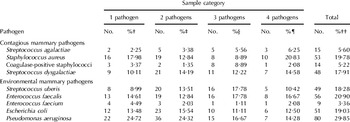
The profile and dominance of different pathogens is illustrated through their percentage proportions in categories classified by number of mammary pathogen species found (Table 2). Based on the total percentages for environmental and contagious pathogens, Ps. aeruginosa (29·8%) and Staph. aureus (19·8%) were found most frequently, whilst Str. agalactiae was found markedly less often (5·6%).
Proportions of specific mammary pathogens in categories classified by number of pathogens per bulk tank milk sample

† 100%=89 samples
‡ 100%=74 samples
§ 100%=30 samples
¶ 100%=12 samples
†† 100%=268 samples (including 63 pathogen-free samples)
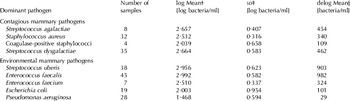
Descriptive statistics of bacterial pathogen count (Table 3) revealed that the highest counts were found for Ec. faecalis and Str. uberis (geometric means of 982 and 903 cfu/ml, respectively) and for the contagious pathogens Str. dysgalactiae and Str. agalactiae (geometric means of 462 and 454 cfu/ml, respectively). This indicates that environmental pathogens predominated in BTM samples.
Descriptive statistics for bacterial counts of dominant pathogens in bulk tank milk samples

† Arithmetic means for logarithmic transformed data
‡ sd for logarithmic transformed data
§ Back-transformed (i.e. geometrical) means
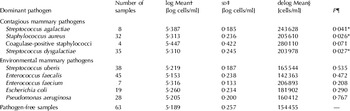
Significant differences (P<0·05) were documented in BTSCC between BTM samples containing Str. agalactiae, Staph. aureus and Str. dysgalactiae and BTM samples that were pathogen-free (Table 4). The geometric mean of BTSCC where these pathogens were present was noticeably higher than the overall BTSCC (Str. agalactiae 243 628; Staph. aureus 205 610; Str. dysgalactiae 203 978; overall 173 000/ml) (Table 4; Table 1). It follows that the SCC associated with these pathogens contributed to the overall BTSCC increase. On the other hand, no significant differences in BTSCC were observed for samples containing environmental mastitis-causing pathogens.
Differences between somatic cell counts in bulk tank milk samples that are hosting dominant pathogens or mammary pathogen free

† Arithmetic means for logarithmic transformed data
‡ sd for logarithmic transformed data
§ Back-transformed (i.e. geometrical) means
¶ Samples with pathogens v. pathogen-free samples (two-tailed P value for unpaired t test; *P<0·05)
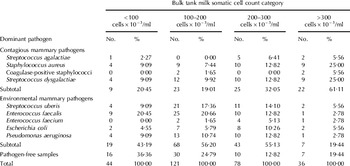
Analysis of the occurrence of different pathogens categorized according to BTSCC (Table 5) revealed a cut-off level where a change occurs between the percentages of contagious and environmental pathogens. Environmental pathogens predominated in BTM samples with SCC <300×103/ml, and contagious pathogens predominated in BTM samples with SCC >300×103/ml. No correlations were found between any bacterial pathogen count and BTSCC.
Proportions of dominant mammary pathogens in categories based on bulk tank milk somatic cell counts

Discussion
The objective of this study was to determine the proportions and bacterial counts for major contagious and environmental mastitis pathogens in samples of BTM and to judge the relationship between counts of these bacteria and BTSCC. The study showed dominance in the Czech Republic of environmental pathogens over the contagious mammary pathogens and the dominance of Staph. aureus over Str. agalactiae amongst the contagious mastitis pathogens in samples of BTM. Our findings for the dominance of environmental pathogens are in accordance with other authors' results at the BTM sample level. BTM samples with elevated microbial counts (SPC spikes) were analysed by Hayes et al. (Reference Hayes, Ralyea, Murphy, Carey, Scarlett and Boor2001) who found that Str. uberis was isolated from 11 of 20 total spikes; Esch. coli was isolated from 4 of 20 total spikes; and Str. dysgalactiae and Str. acidominimus were each isolated from one spike. Holm et al. (Reference Holm, Jepsen, Larsen and Jespersen2004) analysed the microflora of down-graded Danish BTM and found that Gram-negative, oxidase-positive bacteria were found in the majority of the samples. Bacillus spp., Enterococcus spp., Staph. aureus, Str. dysgalactiae, Str. uberis and yeasts were found in less than 25% of the samples. Howard (Reference Howard2006) referred to mastitis pathogens in BTM from herds in the Waikato region of New Zealand. Counts >1000 cfu/ml for total aesculin-positive streptococci, coagulase-negative staphylococci (CNS) and coliforms were present in 48%, 51% and 11% of BTM samples, respectively. Counts of Staph. aureus ranged from zero to 1000 cfu/ml.
Jayarao et al. (Reference Jayarao, Pillai, Sawant, Wolfgang and Hegde2004) analysed the microflora in BTM samples in Pennsylvania, though they presented the data as percentages of BTM samples contaminated with contagious mastitis pathogens only. Staph. aureus was dominant, followed by Str. agalactiae and Mycoplasma spp. The dominance of Staph. aureus over Str. agalactiae was comparable with our study. Further, the highest bacterial counts of environmental streptococci detected in the present study were also comparable with the data obtained by Jayarao et al. (Reference Jayarao, Pillai, Sawant, Wolfgang and Hegde2004).
In the present study, we documented significant differences in BTSCC among BTM samples containing Str. agalactiae, Staph. aureus, Str. dysgalactiae, and pathogen-free samples of BTM. The geometric mean of BTSCC associated with these pathogens was noticeably higher than the overall BTSCC. The differences determined in our study are in accordance with the findings of Jayarao et al. (Reference Jayarao, Pillai, Sawant, Wolfgang and Hegde2004), in that isolation rates of Staph. aureus and Str. agalactiae are significantly associated with BTSCC in BTM samples, and with the finding that there exists a significant association between the isolation of Staph. aureus from BTM samples and the mean BTSCC (Olde Riekerink et al. Reference Olde Riekerink, Barkema, Veenstra, Poole, Dingwell and Keefe2006).
The fact that environmental pathogens predominated in BTM samples with SCC <300×103/ml and contagious pathogens predominated with a SCC >300×103/ml is in accordance with the findings of Barkema et al. (Reference Barkema, Schukken, Lam, Beiboer, Wilmink, Benedictus and Brand1998) in that Gram-negative pathogens, such as Esch. coli, Klebsiella spp. or Pseudomonas spp., occurred more often in herds with low BTSCC. However, it must be noted that 19·4% of samples were free of pathogens in category of BTM samples with SCC >300×103/ml. It is likely that other causes than infections are involved in these cases or other mammary pathogens than those under study here. Detailed consideration should be given to this problem in future.
No correlation was observed in this study between bacterial counts for different pathogens and BTSCC. This is noteworthy if we consider the significant difference in BTSCC between pathogen-free BTM samples and samples contaminated with Str. agalactiae, Staph. aureus and Str. dysgalactiae. Nevertheless, similar results have been found by other authors. For example, Jayarao et al. (Reference Jayarao, Pillai, Sawant, Wolfgang and Hegde2004) found no significant correlation between BTSCC and counts for CNS and environmental streptococci. Pritchard (Reference Pritchard2004) found all paired correlations between BTSCC and different bacterial counts to be low. And Holm et al. (Reference Holm, Jepsen, Larsen and Jespersen2004) reported that no relationship existed between SCC and the presence of mastitis bacteria.
It follows from our study that the importance of major mammary pathogens in herds of dairy cows (i.e. among the general population) can be determined by detection of bacterial counts of mammary pathogens in samples of BTM in relation to BTSCC. This finding opens the way for the monitoring of dynamic changes in occurrence of specific mastitis pathogens in cattle herds at a national level.
Conclusions
This study based on the assessment of bacterial counts of the dominant mammary pathogens found that SPC was largely influenced by environmental pathogens. Their source may be environmental, rather than from an infected mammary gland because no significant difference in BTSCC was found in comparison with pathogen-free samples of BTM. In contrast significant differences were documented in BTSCC between BTM samples containing Str. agalactiae, Staph. aureus and Str. dysgalactiae and BTM samples that were pathogen-free. Counts for mammary pathogens in BTM samples were relatively low, not exceeding 1000 cfu/ml on average. Environmental pathogens predominated in BTM samples with SCC <300×103/ml, and contagious mastitis pathogens predominated in BTM samples with SCC >300×103/ml. No significant correlation was detected between bacterial counts of different pathogens and BTSCC. Our study revealed that the assessment of bacterial counts of dominant mammary pathogens in BTM samples in relation to BTSCC is applicable for monitoring of the major mammary pathogens in herds of dairy cows at the population level and of dynamic changes in the occurrence of major mastitis pathogens in cattle herds at a national level.
This work was supported by the Ministry of Agriculture of the Czech Republic (Grant No. MZE 0002716201). The authors express their thanks to Miss Libuse Spevakova for technical assistance.