




No CrossRef data available.
Article contents
- Abstract
- THE BCOHTA PROJECT
- THE TMS TEST
- SOCIAL DETERMINANTS AND SOCIAL IMPACT: WHO IS AFFECTED?
- HOW ARE POPULATION GROUPS AFFECTED?
- INFORMED CHOICE: INDIVIDUAL AND COLLECTIVE
- CHANGING DEFINITIONS OF DISABILITY
- DISABILITY RIGHTS AND THE BC DOWN SYNDROME COMMUNITY
- COST IMPACT
- DISCUSSION
- CONCLUSIONS
- References
Improving population health or the population itself? Health technology assessment and our genetic future
Published online by Cambridge University Press: 28 May 2004
Article contents
- Abstract
- THE BCOHTA PROJECT
- THE TMS TEST
- SOCIAL DETERMINANTS AND SOCIAL IMPACT: WHO IS AFFECTED?
- HOW ARE POPULATION GROUPS AFFECTED?
- INFORMED CHOICE: INDIVIDUAL AND COLLECTIVE
- CHANGING DEFINITIONS OF DISABILITY
- DISABILITY RIGHTS AND THE BC DOWN SYNDROME COMMUNITY
- COST IMPACT
- DISCUSSION
- CONCLUSIONS
- References
Abstract
The province of British Columbia (BC), Canada is developing its first population-wide prenatal genetic screening program, known as triple-marker screening (TMS). TMS, initiated with a simple blood test, is most commonly used to screen for fetuses with the chromosomal abnormality known as Down syndrome or neural tube disorders. Women testing TMS-positive are offered diagnostic amniocentesis and, if the diagnosis is confirmed, selective second-trimester abortion. The project described in this study was initiated to address the broad range of issues arising from this testing technology and provides an example of the new type of health technology assessment (HTA) contribution emerging (and likely to become increasing necessary) in health policy development. With the advent of prenatal genetic screening programs, would-be parents gain the promise of identifying target conditions and, hence, the option of selective abortion of affected fetuses. There is considerable awareness that these developments pose challenges in every dimension (ethical, political, economic, and clinical) of the health-care environment. In the effort to construct an appropriate prenatal screening policy, therefore, administrators have understandably sought guidance from within the field of HTA. The report authors concluded that, within the restricted path open to it, the role of government is relatively clear. It has the responsibility to maintain equal access to prenatal testing, as to any other health service. It should also require maintenance of medical standards and evaluation of program performance. At the same time, policy-makers need actively to support those individuals born with disabilities and their families.
Information
- Type
- Research Article
- Information
- International Journal of Technology Assessment in Health Care , Volume 20 , Issue 2 , April 2004 , pp. 106 - 114
- Copyright
- © 2004 Cambridge University Press
There was a strong sense in the 1980s and 1990s that it should be possible to achieve optimal population health, and at the same time secure best use of economic resources, through examining the scientific evidence on new technologies. By embracing effective interventions—and avoiding interventions of little value—decision-makers might hope to have a beneficial effect on health care and, therefore, upon health. The field of HTA materialized at this time, able to provide the rigorous summaries of evidence (principally clinical effectiveness and cost-effectiveness) necessary to the policy-formulating effort.
Currently, however, under a wave of powerful new technologies, notably in clinical genetics, health-care decision-makers and professionals alike are finding their roles undergoing something of a sea change. As the new technologies have come on stream, the scope of decision-makers to influence overall population health has been enlarged considerably. Powers have materialized through which it is feasible to circumscribe and set limits on the inherent quality of individuals that comprise the population.
This dramatic new factor in the health-care equation has been introduced mainly with the advent of prenatal genetic screening programs, that is, population-wide testing of women who do not have a family history of a genetic disorder or have not given birth to a child afflicted with a genetic disorder. These technologies, several of which are already in use, offer would-be parents the promise of identifying target conditions and, hence, the option of selective abortion of affected fetuses. In crude terms, if influences can be brought to bear on the constitution of a population, its future health demands may become more predictable and, some may consider, more “manageable.”
There is considerable awareness that these developments pose challenges in every dimension (ethical, political, economic, and clinical) of the health-care environment. In the effort to construct an appropriate prenatal screening policy, therefore, administrators have understandably sought guidance from within the HTA field.
The expertise sought, however, is outside normal HTA parameters and represents a significant departure from established models of evidence development and analysis. This is because, in relation to prenatal genetic testing (i) health policy has to be formulated independent of establishing health benefit, and (ii) program costs must be evaluated independent of their relation to costs of caring for individuals with disability.
Policy must be independent of health benefit because prenatal detection and abortion cannot reasonably be argued as a “benefit” to an affected, unborn fetus. Any claim of benefit is limited to the parents of an affected fetus. Their rights are recognized in law, and parents who claim they have not been given the opportunity to avoid the demands of an affected child they would otherwise have chosen to abort, may sue for what is known as “wrongful birth.” Outside these parental rights, however, jurisdictions claiming population-health “benefits” through the identification and abortion of affected fetuses would clearly be criticized for advocating eugenics.
Similar ethical considerations apply to the second issue. Health policy in relation to prenatal genetic testing is (in Canada at least), costed independently of the cost of caring for individuals with a disability, because it is unethical to make savings by eliminating children with disabilities. To be clear, the cost of caring for people with a disability is to be distinguished from the cost of a prenatal program to detect that disability. Policy aimed at reducing the cost of caring for people with disability cannot ethically be used to justify a program. But once the program is implemented, the cost of program provision is a reasonable target for cost-efficiency evaluation.
The province of British Columbia (BC), Canada, is developing its first population-wide prenatal genetic screening program, known as triple-marker screening (TMS). TMS, initiated with a simple blood test, is most commonly used to screen for fetuses with the chromosomal abnormality known as Down syndrome (the most commonly occurring chromosomal disorder, estimated to occur with an incidence of approximately 1 in 600 to 700 births per year in BC [60–70 births per year] or neural tube disorders also known as spina bifida [estimated incidence of 1.3/1000 live births per year]). Women testing TMS-positive are offered diagnostic amniocentesis and, if the diagnosis is confirmed, selective second-trimester abortion.
The project described in this study was initiated to address the broad range of issues arising from this testing technology and provides an example of the new type of HTA contribution emerging (and likely to become increasing necessary) in health policy development.
THE BCOHTA PROJECT
Provincial policy-makers asked the BC Office of Health Technology Assessment (BCOHTA) some orthodox questions regarding the effectiveness and costs of TMS genetic screening programs and, as has been alluded to, some novel questions regarding their social, ethical, and legal dimensions. In particular, context-specific information was requested to understand why, despite universal technical capability (at least in developed countries), prenatal genetic testing is neither available in all jurisdictions nor uniformly utilized within any particular jurisdiction (4;7;15;25;31).
The ensuing HTA report summarized several policy options for shaping future funding and suggested a provincial process to guide future prenatal genetic screening programs. The HTA project concluded that, at minimum, policy-makers have a duty (as in all health services) to ensure equitable access to prenatal genetic-screening programs, and consistent quality in provision.
A conclusion of possibly greater significance, however, was that the province needs to establish a socially acceptable mechanism to set limits on which fetal conditions are proper to detect inside, or by purchase outside, the publicly-funded system. In addition, policy-makers need to balance support for women who choose prenatal testing and abortion with corresponding support for women and families who choose to raise children with disabilities.
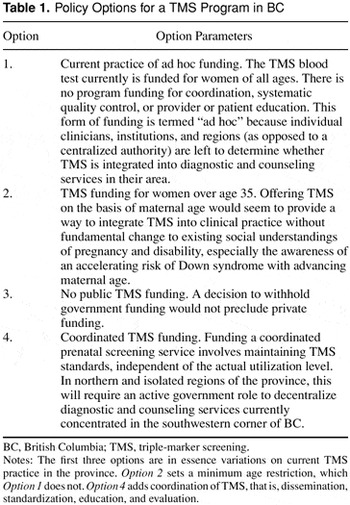
The structural design of the project was necessarily complex. The HTA authors (whose fields of expertise included genetic counseling, feminist anthropology, medical anthropology, general practice, and health economics, in addition to HTA critical appraisal) helped policy-makers in their understanding of TMS in relation to clinical effectiveness and population health, social issues, individual rights, and professional standards, as well as cost. These findings were related to four TMS funding options considered by the province of BC (Table 1).

From its earliest stages, it was also considered necessary that the project should be conducted with particular attention both to the interests of groups who may be seen in some respects as vulnerable, i.e., women and members of the Down syndrome community, and also to the concerns of TMS providers.
The issues examined were those relevant to large-scale population screening of women considered at low pretest risk of carrying an affected fetus. Not addressed were issues of particular relevance to women identified as being at high pretest risk, owing to individual or family history of affected births. In the interest of clarity, the options are discussed as much as possible in relation to Down syndrome, the most common condition traced through TMS.
In developing the evidence, BCOHTA incorporated both primary research conducted using quantitative and qualitative methods, and systematically gathered secondary research from published and unpublished literature. The methods adopted have been reported in detail elsewhere (3).
THE TMS TEST
TMS is a simple blood test designed to test pregnant women of all ages. It measures three fetal biochemical “markers,” which in minute amounts spill into maternal serum throughout pregnancy. Abnormal levels of TMS markers are used primarily to identify those women at increased risk of carrying a fetus with Down syndrome or neural tube disorders.
Women testing TMS-positive are offered noninvasive and, in some cases, diagnostic ultrasound examination for detection of primarily structural abnormalities, some of which are associated with Down syndrome (9). Initial TMS-positive women who have not had dating ultrasound are asked to have the gestational age confirmed by scan. The TMS risk estimate must be recalculated if the ultrasound date estimate is greater than 10 days different from nonultrasound estimates.
TMS-positive women are offered diagnostic testing with amniocentesis. In contrast to TMS, amniocentesis is an invasive test, whereby amniotic fluid is obtained by inserting a needle (guided ultrasonographically) transabdominally into the amniotic sack. Fluid is aspirated and fetal cells are separated for culture. The fetal cells are analyzed for chromosomal patterns, a process which takes approximately 2–3 weeks.
The virtue of amniocentesis is its ability to discriminate between a true positive and a false positive TMS test for conditions such as Down syndrome. This power is, however, materially mitigated by significant numbers of abortions resulting from the procedure. The best currently available estimate of fetal loss comes from a randomized controlled trial of amniocentesis, which reported a procedure-related risk of 0.9 percent (mid-range estimate 15–75 percentile of 0.6–1.2) of pregnancies (29). This study was conducted in the 1980s and may overestimate loss. Techniques have since improved.
Using TMS before amniocentesis increases the percentage of affected fetuses detected among women undergoing amniocentesis and reduces unaffected fetal loss due to amniocentesis. TMS screening of pregnant women of all ages is proposed as a replacement for more limited amniocentesis testing of women 35 years of age and older (approximately 15–20 percent of women).
SOCIAL DETERMINANTS AND SOCIAL IMPACT: WHO IS AFFECTED?
Health policy-makers need to appreciate that those likely to be affected by the introduction of a prenatal testing program fall into two main groups of women, with their partners and families. The first group includes three distinct subsets of women already pregnant or contemplating pregnancy and, therefore, candidates for pre-natal screening:
- (i) The first set includes those women, who, given the option, will want TMS. This is likely to be the majority. Utilization of TMS by the majority of women has been found in Canadian jurisdictions (4–6;16) and suggested as likely in large population surveys conducted for the Royal Commission on Reproductive Technologies and reported in its summary:
“The vast majority of those surveyed would be prepared either to use PND (prenatal diagnosis) themselves (79 percent) or to allow others that option (81 percent). Approximately 18 percent were opposed to either personal use or wider availability of PND services.
A marked majority of those surveyed also support the availability of the option to terminate a pregnancy after PND, with only 16 percent opposed in all circumstances. The level of support depends on the severity of the disorder. For example, 73 percent of people surveyed strongly supported the availability of abortion if a disorder that is fatal early in life is diagnosed in the fetus, while approximately 60 percent supported the availability of abortion for disorders that make it almost certain that independent living will not be possible” (21).
- (ii) The group further includes women who, given the option, do not want the test. They may decline because (among other reasons) they are either willing to accept the possibility that their baby may be disabled, or unwilling to contemplate the possibility of follow-up tests and ultimately abortion if the fetus is found to be affected.
- (iii) This first group must also include women who would want the test, but who are not given the option. They or their primary-care provider may simply be unaware of the existence or applicability of TMS; or they may be denied access because they live outside the areas of BC where anything beyond the primary laboratory test is all but unavailable. Some of these women may believe that failure to provide the service and, therefore, the option of ending the pregnancy represents a violation of their rights, entitling them to pursue a case for damages in a “wrongful birth” lawsuit.
Of those women who subsequently have a baby with one of the relevant disorders, many will accept the challenges of raising their child, usually with the guidance of the one of the provincial support organizations. For this first group, however, TMS, accepted or declined, has the potential for a direct effect on the outcome of their pregnancy.
By contrast, the second main group is only indirectly affected by the test: it comprises those women and families who are already living with a child with disability. It may seem paradoxical to consider those for whom (except for subsequent children) the test would seem to serve no purpose. It is, however, fundamental to the ethical issues raised here that their voices be heard.
The principal concern of this group is that any testing procedure seeking to identify a disorder such as Down syndrome has a eugenic purpose, namely to cleanse the population of imperfection. This they regard as not merely bad for society, diminishing both its genetic and moral base, but also as perpetuating discriminatory attitudes toward individuals with Down syndrome as being unworthy to participate as equal citizens.
In raising these issues in relation to TMS, the clear expectation of this second group is that the ethical questions must be addressed not just by individuals, but at the policy-making level. They assert, for example, that it is unjust to channel public funds almost exclusively toward TMS and diagnostic services, instead of providing social support for affected individuals and families. The inadequacy of such support, they argue, is a major inducement for women to take the screening option.
HOW ARE POPULATION GROUPS AFFECTED?
Most studies of women's experiences with maternal serum screening use standardized scales to assess the psychological impact of these tests. Some research focuses on explaining variations in emotional and psychological responses to maternal serum screening in terms of women's lack of proper information about it. A few studies have examined women's experiences of maternal serum screening along multiple dimensions, including attitudes toward disability, feelings of being at risk, and attitudes toward abortion. While such assessments may explore the psychological-emotional dimensions of maternal serum screening in some detail, the entire experience in which women make sense of and negotiate prenatal genetic technology is intricate, and certainly more complex than simply assessing what women know about serum screening or about detectable conditions.
Asking “what women know” addresses whether women understand the medical meanings and rationale for the test. By contrast, asking “how women make serum screening meaningful” reminds us that women make sense of new technologies in ways that reflect existing cultural frameworks, social relationships of family and community, financial circumstances, and individual histories.
Ethnographic studies of women's experiences with prenatal screening and diagnosis include maternal serum alpha-fetoprotein in California (17;18), amniocentesis in New York City (19;20), amniocentesis in Manitoba (30), and ultrasound fetal imaging in Quebec (14). Several studies examine women's experiences, for example, with the detection of Down syndrome in BC (11), with ultrasound-detected anomalies in BC (28), and with amniocentesis in Quebec (12).
These studies specifically address how women's experiences are shaped by the social and cultural configurations of their lives, and how women come to undergo, or to refuse, prenatal diagnosis. Unfortunately, while richly detailed, most of these ethnographies examine prenatal screening in the United States rather than in Canada, and none specifically addresses TMS.
INFORMED CHOICE: INDIVIDUAL AND COLLECTIVE
The principle of “individual informed choice and consent” is well established in medicine, law, and ethics. Yet to facilitate informed choice about TMS by as many as 30,000 individual women a year is a very considerable challenge in itself, a task that would in all probability fall to primary-care givers (almost exclusively general practitioners and obstetricians, whose formal training in genetic knowledge and counseling varies widely).
A second relevant principle, however, is that of “collective informed choice,” which in relation to prenatal screening, means a population-wide support for a genetic testing program that could lead to selective abortion. This notion remains far less developed and without an institutional, professional, or political home. The question to be resolved is: Does society support a universal prenatal genetic screening option, and if so, for which conditions, and with what testing accuracy?
The literature contains several well-described examples of this aspect of “collective informed choice.” The most often cited instance is support for genetic screening for Tay-Sachs disease, a rare condition resulting in early infant death. Although not a test during pregnancy but a test of prospective parents for recessive gene carrier status, it provides an example of how several Jewish communities in large American cities collectively agreed that funding of this genetic testing program was warranted (13).
The Canadian Royal Commission on New Reproductive Technologies provided evidence of broad public-support across Canada for the availability of prenatal testing to detect conditions such as Down syndrome and neural tube disorders: “A substantial majority (approximately three-quarters) say that if the fetus has a severe anomaly, the parents should have the option to terminate the pregnancy” (22).
Knowing that women would seek this service or think that this service ought to be made available is merely the starting point for consideration, however. Another question might consider whether women would rather allocate scare resources to other programs, known to prevent congenital disorders (for example, programs to reduce neural tube disorders through folic acid supplements or to reduce toxic injuries to the fetus by supporting drug and alcohol addiction programs for women)?
At this interface between the broad social issues and resource allocation, significant questions emerge as to where TMS and requests for program support might fit within government. The issues are not only of spending priorities, important though these are, but also of how TMS is to be evaluated and prioritized and who its champions should be.
The public-policy process that has set current prenatal testing limits has been particularly difficult to discern. The present authors examined the more common cutoff levels that have been applied, such as age 35 as the age of amniocentesis eligibility (5). However, very little has been established about other prenatal tests such as routine ultrasound, its distribution, justification, or relationship to genetic counseling and informed choice, although the latter has been studied in some jurisdictions (2).
CHANGING DEFINITIONS OF DISABILITY
A further critical issue that arises in the social context is the expanding power of the technologies to identify conditions that may be collectively assembled under the heading of “disabilities.” Provincial policy-makers face an era of rapid technological improvement in maternal serum screening innovations already proven accurate (32) or alternate prenatal programs with ultrasound as the primary prenatal screening maneuver (10). It is probable that prenatal programs may change appreciably in the near future, with increasing technical capability to detect a wide range of conditions during pregnancy. The challenge for policy-makers is how to set funding limits within and alongside changing definitions of disability.
Although voiced primarily by disability-rights groups, the issues go beyond narrow sectional interest. In fact, the principal argument is one of accelerating importance within what we properly regard as a free society. At base, it asserts that, where the interest of society as a whole are affected, simply because the technology exists to enable a choice does not mean a person should necessarily be obliged, or even entitled, to make it.
In all probability, therefore, questions on the utilization of any given test turn to questions over which conditions should be tested for at all. Asche (1) discusses this in the US context: “Given that more than 50 million people in the U.S. population have disabling traits and that prenatal tests may become increasingly available to detect more of them, we are confronting the fact that tests may soon be available for characteristics that we have until now considered inevitable facts of human life, such as heart disease.”
In Asche's argument, the growth of prenatal testing and selective abortion should be accompanied by a public policy obligation to support those individuals born with disabilities: “[O]ur clinical and policy establishments must communicate that it is as acceptable to live with a disability as it is to live without one and that society will support and appreciate everyone with the inevitable variety of traits…. When our professions can envision such communication and the reality of incorporation and appreciation of people with disabilities, prenatal technology can help people to make decisions without implying that only one decision is right” (1).
The emphasis on heredity and individual disease, however, risks overwhelming equally important and largely overlooked environmental and social factors with potential to affect population composition. For example, a strong public policy framework is in fact already in place to limit prenatal testing for socially unacceptable reasons such as sex selection.
Even so, simply to limit certain types of prenatal testing is unlikely to achieve total control. So, for example, to ban sex selection and selective abortion of female fetuses would not necessarily prevent alternatives such as infanticide, or social conditions discriminatory against female children.
DISABILITY RIGHTS AND THE BC DOWN SYNDROME COMMUNITY
The HTA authors actively solicited the perspectives of mothers of children with Down syndrome, and professionals who work with affected families. The investigators explored personal experiences, asking how members of these groups confront a technology designed selectively to abort a fetus with the very condition that is an integral part of their lives (11).
The two major support groups in the province have, in summary, asserted that reproductive technologies are predominantly a woman's issue; that they can only be considered positive if they support and enhance women's right to control their own bodies and make meaningful choices about when and whether to give birth; and that in general, reproductive technologies do not support and enhance the equality of either nondisabled women or of disabled people.
Significantly however, the Down syndrome and disability rights communities recognize that TMS will inevitably continue, with or without public funding. Therefore, they oppose licensed private funding, believing that this would give them less opportunity to influence educational messages provided to physicians and women.
COST IMPACT
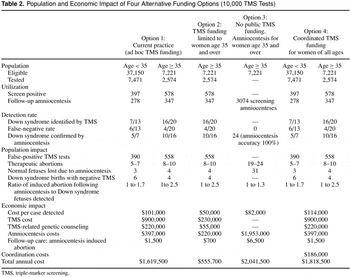
The HTA project provided health policy-makers with costing estimates for various TMS options, and these are summarized in Table 2. These estimates were to some extent based on current data and to a further extent substantially speculative. The first problem facing policy-makers, however, is not the level of accuracy of costing but whether it is material to policy considerations at all.

This question was first asked in the province almost 20 years ago (23;24), and, although largely side-stepped since, it is still central to the matters under review. Simply put, if the utility of TMS is to be measured only by financial savings, then a full program should be introduced without delay. Allowing for even a broad degree of uncertainty in costing estimates, introduction of TMS with its corollary, the termination of affected pregnancies, will undoubtedly secure substantial savings in public expenditure.
Several generally accepted reports have estimated the more quantifiable health, as opposed to social, costs associated with Down syndrome. One of the more widely cited appraisals, derived in part from primary data from children in BC with Down syndrome, estimated that, in 1997 dollars, the excess cost of health care for a person born with Down syndrome is $350,000 (assuming 75 percent inflation since 1981; 24). A similar estimate, after adjusting for inflation, puts the net present value (in 1987) of the excess cost to society of a child with Down syndrome at around $300,000 (8).
These estimates of excess health-care costs for children with Down syndrome, although crude, support the generally accepted conclusion that even for younger women at lowest pretest risk, prenatal screening for Down syndrome is cost-beneficial to society. The maximum estimate for the cost of TMS per detected fetus with Down syndrome in the younger age groups is $100,000, resulting in a minimum cost-savings ratio of 3:1.
Even the much lower lifetime excess health costs associated with a child with neural tube disorders are estimated at $150,000 (assuming 75 percent inflation since 1983; 23). A cost-benefit analysis of prenatal detection of Down syndrome and neural tube defects in older mothers is sufficient alone to make TMS screening a cost-saving exercise.
Given these figures, why was a comprehensive screening policy not adopted 20 years ago? It is, simply, because the value of a life, disabled or otherwise, is not to be calculated in the columns of credit and debit. The ethical questions, that is, the human questions, are not usefully illuminated by bare arithmetic.
In summary, if policy-makers had only to consider whether to meet the financial cost of extending these facilities throughout the province, it would be an easy decision to make. But the ethical dilemma is far less easy to accommodate and should be expected to have fundamental importance in establishing policy.
It is important to note also that the costing issues relate to cost of program, not cost of “caring.” As Sheldon and Simpson argue (26), cost-benefit analyses can help if a health jurisdiction decides to provide prenatal screening for a condition such as Down syndrome, in that such analyses assign a cost figure to evaluate which prenatal program might provide a cost-benefit versus alternatives. However, cost-benefit analyses provide no assistance with the more difficult judgments of which conditions to test for, or what constitutes adequate testing accuracy.
DISCUSSION
HTA Evidence Development
Despite the diversity of preferences in our pluralistic society, a strong public policy on TMS has precedence, and in this area of prenatal obstetrical care, is very much needed. This aspect of the HTA project took the unusual form of mainly one-on-one discussions with policy-makers and hearing oral presentations at policy meetings. It emerged that policy-makers saw the need to negotiate two opposing lines of ethical claim.
The first is voiced most often by clinicians. These providers now say: “the new technology has made the search for the relevant conditions so easy and free of risk that we must offer this serum screening test to women because it is the standard of care and because we expose ourselves to risk of malpractice litigation if we do not.”
The second is the counterclaim, mentioned above, of the disability rights' groups and of humanitarian concerns generally, that to identify the targeted conditions as unworthy of existence is to adopt a policy of eugenics unsuited to the Canada of today. Our supreme commitment, they argue, must be to humanitarianism and the Charter of Rights, which enshrines guiding principles of constitutional rights in Canada.
Until now, the apparent resolution of these claims has been to pass the question off to individual women, under the guise of freedom of choice. But this freedom has proved largely illusory, only truly available to those advantaged women living in the urban centres in the southwestern part of British Columbia. Only in this location can a bare laboratory test result be given the full range of support: follow-up ultrasound, amniocentesis, counseling, and abortion facilities.
The problem highlighted by the HTA researchers is that, in contrast to diagnostic screening with amniocentesis, prenatal screening with a simple serum-screening test makes particular demands on public policy. In BC, it was first noted in 1983 by Sadovnick and Baird (23) that introducing a serum-screening test (at that time testing for neural tube disorders) could easily create a potentially harmful imbalance in prenatal services.
These authors argued that such a test should not be made available without preestablished standards of pretest counseling, and referral networks able to provide efficient diagnostic facilities. They judged that, from an overall program perspective, if all aspects of a screening process were not in place, harm would exceed benefit.
Yet TMS has diffused into widespread use without meeting many of the necessary conditions outlined by Sadovnick and Baird. Public policy has neither promoted nor discouraged this trend. Instead, diffusion has occurred incrementally, expanding within and between clinical practices. In consequence, while public policy has not been responsible for TMS utilization, it now faces what seems to be an unavoidable need to set the conditions in which TMS utilization occurs, since if such conditions are not set, harm may be regarded as inevitable.
In the instance of maternal serum screening, public policy might take the form of necessary “conditions” for serum screening introduction. For example, if training in pretest counseling, regional amniocentesis services, and second trimester abortion services are available and adequate in the province, then maternal serum screening can proceed. Not having these necessary conditions in place leads to unnecessary anxiety through misinformation and delays, as has been found in Ontario (4) and in the United Kingdom (27).
Although the need for public policy regarding TMS seems paramount, it must be borne in mind that any mandated service provision may contradict the ongoing consumer movement for home testing (blood pressure and pregnancy and also genetic testing), which some people regard as a means of having “control” over their health. In this sense, any insistence on genetic counseling may be seen as paternalistic and controlling, particularly by disability rights activists who are inclined to be suspicious of genetic counselors, and who generally prefer to offer their own counseling advice.
CONCLUSIONS
The report authors concluded that, within the restricted path open to it, the role of government is relatively clear. It has the responsibility to maintain equal access to prenatal testing, as to any other health service. It should also require maintenance of medical standards and evaluation of program performance. At the same time, policy-makers need actively to support those individuals born with disabilities, and their families.
Clearly preferred among the available funding options therefore, was Option 4, that is, specific funding to a single institutional body to coordinate TMS with other prenatal screening services in the province. Any such coordinating group should include medical specialists and regional representatives, either clinical, administrative or both. The responsibilities of the prenatal screening coordination group should include establishing a province-wide standard of care, able to disseminate accurate information about TMS among providers and potential users. Furthermore, the information provided to women should be developed in conjunction with disability rights and support groups to provide accurate and balanced information about caregiving for people with Down syndrome and neural tube disorders.
There is also a clear need for a “provincial prenatal-screening advisory committee,” made up of primary-care physicians, midwives, public-health professionals, and women's health and disability rights representatives. This body would provide an organized forum for discussion among the interest groups and provide a platform for making recommendations to government and to the group responsible for coordinating prenatal screening services.
Funding to coordinate TMS and more general prenatal screening program is small relative to the cost of TMS, while the potential benefits are significant. These include reduction in harm due to inadequate regional counseling and the establishment of an efficient and reliable diagnostic referral infrastructure. Local and international experience unanimously recognizes that, to pay for TMS without adequately funding infrastructure support for quality assurance and education as well as diagnostic and abortion services, risks unnecessary harm to women who lack ready access to adequately informed clinicians or diagnostic facilities.
The work of the BCOHTA was funded by the BC Ministry of Health through a grant to the University of British Columbia, 1990–2002.
References
Asch A.
1999
Prenatal diagnosis and selective abortion: A challenge to practice and policy.
Am J Public Health.
89:
1649–
1657.Google Scholar
Baillie C,
Hewison J.
1999
Antenatal screening: Obtaining selective consent to scanning, rather than screening, is possible. Letter.
BMJ.
318:
805.Google Scholar
Bassett KL,
Lee P,
Green CJ, et al.
2000
Triple marker screening in British Columbia: Current practice, future options.
Final Report made to Minister's Advisory Council on Women's Health.
Vancouver, BC:
University of BC,
BC Office of Health Technology Assessment Report 00:14T.
Carroll JC,
Reid AJ,
Woodward CA, et al.
1997
Ontario Maternal Serum Screening program: Practices, knowledge and opinion of health care providers.
CMAJ.
156:
775–
784.Google Scholar
Chodirker BN,
Evans JA.
1993
Maternal serum AFP screening programs: The Manitoba experience.
In: Current practice of prenatal diagnosis in Canada,
vol. 13.
Ottawa:
Royal Commission on New Reproductive Technologies
536–
610.
Dick PT.
1996
Periodic health examination, 1996 update: 1: Prenatal screening for and diagnosis of Down syndrome: Canadian Task Force on the periodic health examination.
CMAJ.
154:
465–
479.Google Scholar
EUCROMIC Workshop.
1997
Proceedings (1996: Paris) Prenatal diagnosis in Europe: Proceedings of an EUCROMIC Workshop, Paris, May 23-24, 1996.
Eur J Hum Genet.
5
(Suppl 1):
1–
90.
Gill M,
Murday V,
Slack J.
1987
An economic appraisal of screening for Down syndrome in pregnancy using maternal age and serum alpha feto-protein concentration.
Soc Sci Med.
24:
725–
731.Google Scholar
Green CJ,
Hadorn D,
Bassett K,
Kazanjian A.
1996
Routine ultrasound imaging in pregnancy: How evidence-based are the guidelines?
Vancouver, BC:
BC Office of Health Technology Assessment
Aug;96:
2D.
Howe DT,
Gornall R,
Wellesley D,
Boyle T,
Barber J.
2000
Six year survey of screening for Down's syndrome by maternal age and mid-trimester ultrasound scans.
BMJ.
320:
606–
610.Google Scholar
Lee PM,
Sroka H.
1999
The missing voices in the BC experience of maternal serum screening. A Report.
Lippman A.
1999
Embodied knowledge and making sense of prenatal diagnosis.
J Genet Counseling.
8:
255–
274.Google Scholar
Mitchell L.
1994
The routinization of the other: Ultrasound, women and the fetus.
In: Basen G,
Eichler M,
Lippman S, eds.
Misconceptions: The social construction of choice and the new reproductive technologies,
vol. 2.
Hull, Quebec, Canada:
Voyageur Press
146–
160.
Palomaki GE,
Knight GJ,
McCarthy JE,
Haddow JE,
Donhowe JM.
1997
Maternal serum screening for Down syndrome in the United States: A 1995 survey.
Am J Obstet Gynecol.
176:
1046–
1051.Google Scholar
Permaul-Woods JA,
Carroll JC,
Reid AJ, et al.
1999
Going the distance: The influence of practice location on the Ontario maternal serum screening program.
CMAJ.
161:
381–
385.Google Scholar
Press N,
Browner C.
1998
Characteristics of women who refuse an offer of prenatal diagnosis: Data from the California maternal serum alpha fetoprotein blood test experience.
Am J Med Genet.
78:
433–
445.Google Scholar
Press N,
Browner C.
1993
Collective fictions: Similarities in reasons for accepting maternal serum alpha-fetoprotein screening among women of diverse ethnic and social class backgrounds.
Fetal Diagn Ther.
8
(Suppl 1):
97–
106.Google Scholar
Rapp R.
1993
Accounting for amniocentesis.
In: Lindenbaum S,
Lock M, eds.
Knowledge, power, and practice: The anthropology of everyday life.
Berkeley, CA:
University of California Press
55–
78.
Rapp R.
1993
Sociocultural differences in the impact of amniocentesis: An anthropological research report.
Fetal Diagn Ther.
8
(Suppl 1):
90–
96.Google Scholar
Royal Commission on New Reproductive Technologies.
1993
Prenatal Diagnosis for Congenital Anomalies and Genetic Disease.
In: Proceed with care. Final report of the Royal Commission on New Reproductive Technologies,
vol. 2.
777.
Royal Commission on New Reproductive Technologies.
1993
Prenatal Diagnosis for Congenital Anomalies and Genetic Disease.
In: Proceed with care. Final report of the Royal Commission on New Reproductive Technologies,
vol. 2.
804.
Sadovnick AD,
Baird PA.
1983
A cost-benefit analysis of a population screening programme for neural tube defects.
Prenat Diagn.
3:
117–
126.Google Scholar
Sadovnick AD,
Baird PA.
1981
A cost-benefit analysis of prenatal detection of Down's syndrome and neural tube defects in older mothers.
Am J Med Genet.
10:
367–
378.Google Scholar
Santalahti P.
1994
Literature review.
Prenatal screening in Finland: Availability and women's decision-making and experiences.
Research report.
Stakes National Research and Development Centre for Welfare and Health
13.
Sheldon TA,
Simpson J.
1991
Appraisal of a new scheme for prenatal screening for Down's syndrome.
BMJ.
302:
1133–
1136.Google Scholar
Smith DK,
Shaw RW,
Marteau TM.
1994
Informed consent to undergo serum screening for Down's syndrome: The gap between policy and practice.
BMJ.
309:
776.Google Scholar
Stephenson P,
Mitchell L.
1998
Social and cultural determinants of parental experiences with ultrasound detected foetal anomalies.
British Columbia:
British Columbia Medical Services Foundation Grant No. BCM98-0012.
Tabor A,
Madsen M,
Obel EB.
1986
Randomized controlled trial of genetic amniocentesis in 4606 low-risk women.
Lancet.
1:
1287–
1292.Google Scholar
Tudiver S.
1993
Manitoba voices:
A qualitative study of women's experiences with technology in pregnancy. Prenatal diagnosis: Background and impact on individuals.
Ottawa, Ontario:
Royal Commission on New Reproductive Technologies
347–
460.
Wald NJ,
Kennard A,
Hackshaw A,
McGuire A.
1998
Antenatal screening for Down's syndrome.
Health Technol Assess.
2:
1–
112.Google Scholar
Wald NJ,
Watt HC,
Hackshaw AK.
1999
Integrated screening for Down's syndrome based on tests performed during the first and second trimesters.
N Engl J Med.
341:
461–
467.Google Scholar
Policy Options for a TMS Program in BC
Population and Economic Impact of Four Alternative Funding Options (10,000 TMS Tests)
 You have
Access
- 6
- Cited by