INTRODUCTION
Polychaetes show a spectacular diversity of sexual reproduction and developmental modes. Some groups of polychaetes may contain taxa that spawn many small eggs. These eggs are fertilized in the water column then developed into planktonic feeding larvae that can remain in the planktonic stage for weeks or months before settling and metamorphosing into a juvenile. Other groups may carry a few large, yolky embryos that develop directly into juveniles, while others may be ovoviviparous and give birth to young worms (Schroeder & Hermans, Reference Schroeder, Hermans, Giese and Pearse1975). Many major polychaete groups that are probably monophyletic are known to have more than one mode of fertilization and larval development (Wilson, Reference Wilson1991). For example, Capitellidae, Dorvilleidae, Maldanidae, Nereididae, Sabellidae, Serpulidae, Spionidae and Syllidae, all include taxa having external fertilization and swimming larvae, while other taxa in these groups have sperm transfer, associated with some form of larval protection and direct development (Jamieson & Rouse, Reference Jamieson and Rouse1989).
Perinereis nuntia brevicirris (Grube, 1857) (Nereididae), Lumbrineris funchalensis (Kinberg, 1865) (Lumbrineridae) and Halla parthenopeia (Delle Chiaje, 1828) (Oenonidae) are free-living marine polychaetes species found in the Suez Canal. They are extensively used as fishing bait by thousands of sea anglers fishing from the shore or from small boats. At present, there is intensive fishing with these species as the price is good on the market. Intensive wild harvesting might lead to over exploitation of these species. This intensive exploitation can impact the population structure and physical disturbance of the substrata in the short term and may also affect the ecosystem in the long term as these species are considered as food for many economically important fish (Scapes, Reference Scapes2003). Genetically, it is known that, intertidal populations of bloodworms are not recruiting from the subtidal populations and that heterozygosity of common alleles has become reduced, altering the genetic structure of the population (Scapes, Reference Scapes2003). Nereididae such as P. nuntia brevicirris (rag worm) are one of the most familiar polychaetes due to their occurrence on most seashores around the world (Rouse & Pleijel, Reference Rouse and Pleijel2001). This particular species is referred to by Egyptian hobbyists as El-mesharshar or El-addad. Por (Reference Por1978) recorded Perineries nuntia brevicirris as a lessepsian species. Lumbrineridae have a worldwide distribution mainly in shallow waters but occur down to abyssal depths and are more common in temperate and tropical regions. The majority live as burrowers in mud and sand (Rouse & Pleijel, Reference Rouse and Pleijel2001). Lumbrineris funchalensis has been reported from the Mediterranean (Selim, Reference Selim1978; Abd El-Naby, Reference Abd El-Naby2005) through to the Suez Canal and Suez Bay (Barbary, Reference Barbary1992; Belal, Reference Belal2001).
The oenonid worm, H. parthenopeia is distributed from the eastern Mediterranean (Selim, Reference Selim1978), through the Suez Canal (Barbary, Reference Barbary1992), and down to Suez Bay (Belal, Reference Belal2001). Typically this species is reported from sublittoral water on fine to coarse sediment (Osman, Reference Osman2007).
Studies of the reproductive biology are particularly important in species that have a fishery potential; these studies provide essential information for understanding their reproductive patterns and strategies, and, therefore vulnerability to abiotic and biotic impacts. Extensive studies have been carried out for a number of commercially economic polychaete species. Durchon (Reference Durchon1956) observed the reproduction of Perinereis cultrifera in the Mediterranean. Ansaloni et al. (Reference Ansaloni, Pellizzato, Prevedelli and Zunarelli Vandini1986) and Scapes (Reference Scapes1992) studied the spawning season of Hediste diversicolor. Many aspects of reproductive biology of Perinereis rullieri such as spawning season, fertilization and hatched larvae were studied by Prevedelli & Zunarelli Vandini (Reference Prevedelli and Zunarelli Vandini1997) and Cassai & Prevedelli (Reference Cassai and Prevedelli1998). Comparatively few studies have been carried out on the reproductive biology of polychaetes in the Suez Canal (Ghobashy et al., Reference Ghobashy, Abdel-Hamid and Mona1981; Barbary, Reference Barbary1992; Mona, Reference Mona1992).
This is the first detailed study of the reproductive biology of these three species in the Suez Canal, based on specimens taken through one annual period (2002–2003). The present investigation attempted to follow up the reproductive biology of the three targeted polychaete species in the area, including, sex-ratio, maturity stages, spawning season and fecundity. Information about spawning of these species will contribute to knowledge of their population dynamics and management of the stocks.
MATERIALS AND METHODS
Sampling sites and sampling technique
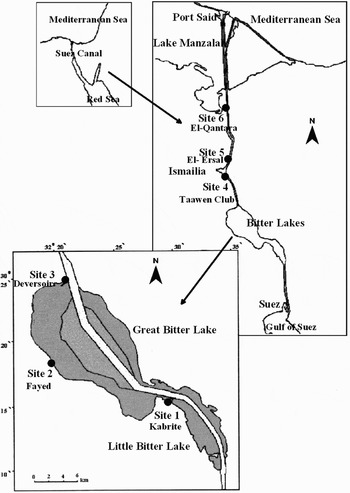
Specimens of P. nuntia brevicirris were collected from the upper intertidal region at six stations along Bitter Lakes and Lake Timsah: Kabrite, Fayed, Deversoir, Taawen Club beach, El-Ersal and El-Qantara. The Bitter Lakes and Lake Timsah constitute the main water bodies in the Suez Canal area (Figure 1).
Map showing the locations of the sampling sites: Lake Timsah and Bitter Lakes, Suez Canal, Egypt.

At each site, three transects were positioned perpendicular to the shoreline from the high water mark to a maximum depth of 1 m. These three transects were located at regular intervals along the shoreline. The distance between transects depended upon the length of the site and the abundance of the target species. Along each transect, three quadrates (1 m2) were set at an innermost point (high water mark), middle point and an outermost point, respectively. The enclosed sand of the quadrate was dug out to a depth of 10 cm and was wet-sieved at the study site with a 1.0 mm mesh screen. Perinereis nuntia brevicirris specimens were isolated individually and preserved.
Samples of L. funchalensis and H. parthenopeia were bought from sea bait fishermen. The fishermen collect these species by hand during snorkelling at depths ranging between 1 and 5 m, with water clarity ranging from 40 cm (Bitter Lake) to 100 cm (Lake Timsah).
Sampling was carried out monthly from January 2002 until February 2003. All of the specimens were preserved with 10% buffered formalin.
Salinity and water temperature were recorded monthly throughout the study period using a refractometer and digital thermometer respectively.
Processing of samples
For the three studied species, the sexes cannot be distinguished externally; the sex of specimens was determined by puncturing the body wall with a fine needle and examining the extruded coelomic contents under a compound microscope for the presence of eggs or cloudy white fluid which indicates males.
A sub-sample of 3–5 animals (representing the full size-range) from each species were selected from each monthly sample for histology. The worms were fixed for 24 hours in Bouin's solution, and then transferred to 70% ethyl alcohol for preservation. Clearing and paraffin embedding were performed using standard histological techniques; sections were cut at 6 µm thicknesses and stained with haematoxylin and eosin. The described system of maturity stages is in agreement with those identified by Dumont (Reference Dumont1969) and Rouse & Tzetlin (Reference Rouse and Tzetlin1997).
Estimation of fecundity and oocyte measurements
Fecundity was determined in 10 mature females of each species. A total number of oocytes for each female were estimated. Oocytes were obtained by opening the segments of the gravid females and carefully washing out all the oocytes from the body cavity with a stream of seawater. Because of the large number of oocytes produced by the studied worms, it was more practical to reduce the volume of seawater to 10 ml. Counts were then carried out on three 1 ml sub-samples using a dissecting microscope, the averages were calculated and the data were expressed as number of oocytes/female. The diameters of 50 oocytes representing all sizes of coelomic oocytes were measured. Oocytes counting and measurements were carried out with a binocular dissecting microscope equipped with an ocular micrometer.
RESULTS
Sampling site temperature and salinity
Table 1 shows the monthly mean seawater temperature and salinity at the sampling sites. Temperature follows the normal conditions of the northern hemisphere. It ranged from 16.7ºC ± 1.1 in January to 29.7ºC±0.75 in August. There was a slight difference in salinity between different months. Salinity ranged from 34 ± 8.1 in February to 40.6 ±4.5 in June.
Monthly mean water temperature (temp. C°) and salinity (Sal.‰) during sampling period.

Size-range and sex-ratio
The size of Perinereis nuntia brevicirris ranged from 2 cm to 20.9 cm. The size of Lumbrineris funchalensis ranged from 5.4 cm to 35 cm, while that of Halla parthenopeia ranged from 12.3 cm to 90 cm.
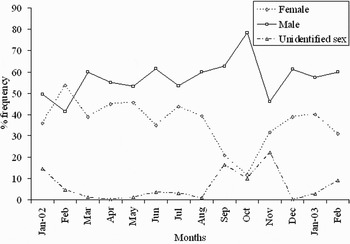
Figure 2 shows the annual change in the sex-ratio for Perinereis nuntia brevicirris. Throughout the sampling period, there were a small percentage of worms less than 4 cm long, in which coelomic gametes could not be recognized. These are represented in Figure 2 as worms of unidentified sex, and they probably represent a recruitment of juvenile worms. During most of the year, there was a predominance of males (3 male: 2 female). Of a total of 1444 individuals of P. nuntia brevicirris collected, 800 were male (55.4%), 511 were female (35.4%) and 133 were juvenile (9.2%). For Lumbrinereis funchalensis, 328 males comprised 81.1% (266 individuals), while females were 18.9% (62 individuals) with a sex-ratio 4.3:1. For Halla parthenopeia (381 individuals), males comprised 72.4% (276 individuals), while females were 27.6% (105 individuals) with a sex-ratio 2.6:1. The number of individuals of L. funchalensis and H. parthenopeia were relatively low so the sex-ratio variation throughout the year was not analysed in detail. Juveniles were not represented in the samples of these two species due to catch bias for the large individuals.
Monthly percentage frequency of females, males and unidentified sex of Perinereis nuntia brevicirris collected from the Suez Canal.

Oogenesis of Perinereis nuntia brevicirris
Oogenesis in Perinereis nuntia brevicirris can be divided into four stages, the first two stages were at previtellogenic phase and the next two stages occurred during vitellogenic phase. The two previtellogenic stages involved the primary and secondary oocytes where no yolk has been deposited yet.
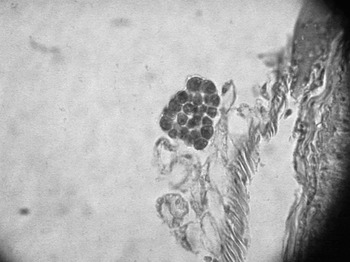
- Stage 1:
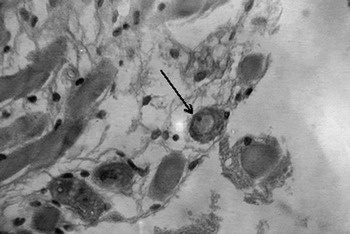
Primary oocytes are in clusters and distinguished from the other coelomic cells by their relatively large size (up to 4.8 µm) and highly stained chromatic nuclei (Figure 3).
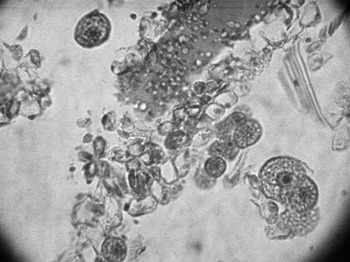
- Stage 2:
Secondary oocytes are squared or hemispherical in shape. They range between 6 and 15 µm in diameter. The cytoplasm is basophilic and the nucleus is large and heavily blue stained (Figure 4).
(Stage 1): Cluster of primary oocytes of Perinereis nuntia brevicirris with highly chromatic nuclei stained by haematoxylin and eosin (400X).

(Stage 2): Secondary oocytes of Perinereis nuntia brevicirris (note the variation in the oocyte size within the same individual) (400X).

The following two vitellogenic stages involve the maturing and mature oocytes:
- Stage 3:
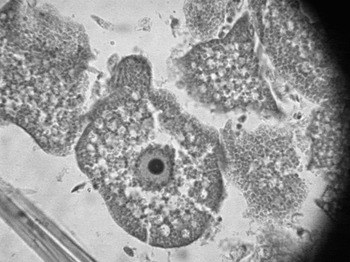
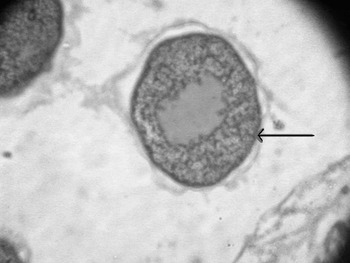
In this stage, maturing oocytes measured between 96 and 120 µm in diameter and increase in size as yolk accumulates. Oocytes are pink in colour (acidophilic). Yolk deposition begins peripherally around the wall with central vacuoles (Figure 5).
- Stage 4:
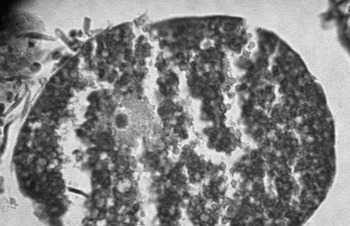
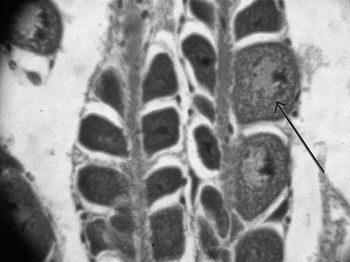
Mature oocytes are free in coelom, larger than those of maturing oocytes. Full grown oocytes can reach up to 250 µm in diameter. Mature oocytes are full with yolk granules and lipid droplets. They are deeply pink stained (Figure 6).
(Stage 3): Maturing oocytes of Perinereis nuntia brevicirris with peripherally deposited yolk and vacuoles (400X).

(Stage 4): Mature oocyte of Perinereis nuntia brevicirris full with yolk granules stained by haematoxylin and eosin (400X).

Monthly variation of oocyte diameters of Perinereis nuntia brevicirris
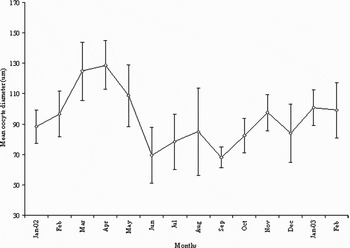
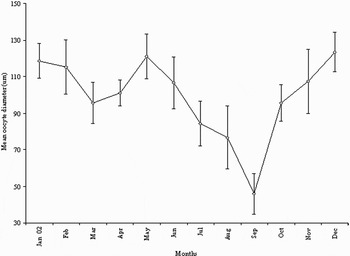
The oocytes of Perinereis nuntia brevicirris undergo vitellogenesis while floating in the coelomic fluid. The largest oocytes encountered had a diameter of about 250 µm, and the smallest oocytes found in the coelom had a diameter of about 20 µm. For each sample, there was considerable variation in oocyte size. Over one annual reproductive cycle, the monthly variations in the mean oocyte diameter of female P. nuntia brevicirris is shown in Figure 7. The figure illustrated that, the mean oocyte diameter increased rapidly from February 2002 to March and April. Then the mean oocyte diameters declined in May until it reached the minimum value from June to September. A second increase was observed from October to February 2003 indicating the beginning of a new reproductive cycle.
Monthly variation of mean oocyte diameter of Perinereis nuntia brevicirris collected from the Suez Canal. Vertical lines indicate standard deviation.

Oogenesis of Lumbrineris funchalensis
Oogenesis in this worm can be defined by three maturity stages according to yolk deposition. The first one was previtellogenic and the other two were within the vitellogenic phase and they were described as follows:
- Stage 1:
This represents previtellogenesis. Oocytes in this stage are characterized by a large nucleus and basophilic stain where no yolk has been deposited; oocytes reach to 33.6 µm (Figure 8).
Fig. 8.(Stage 1): Primary oocytes of Lumbrineris funchalensis with large nucleus (400X).

- Stage 2:
In this stage, maturing oocytes were recognized by early yolk deposition around the periphery with numerous vacuoles around the nucleus. Oocyte diameters ranged between 190 and 200 µm (Figure 9).
Fig. 9.(Stage 2): Maturing oocytes of Lumbrineris funchalensis with peripherally deposited yolk and numerous vacuoles (400X).
- Stage 3:
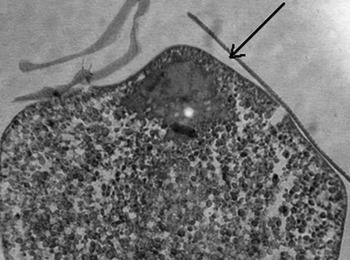
Full grown oocytes were observed as disappeared vacuoles and the oocytes are full of yolk. Mature oocytes (ripe egg) reached up to 280 µm in diameter and the nucleus migrates to the free end of the cell, the animal pole, being ready for spawning (Figure 10).
Fig. 10.(Stage 3): Mature oocyte of Lumbrineris funchalensis, the nucleus at the free end of the cell (100X).


Monthly variation of oocyte diameters of Lumbrineris funchalensis
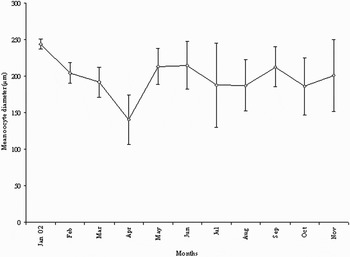
The monthly variation in the mean oocyte diameter of female Lumbrineris funchalensis is illustrated in Figure 11. The maximum oocyte diameter encountered was 280 µm while the smallest oocyte was about 40 µm throughout the entire period sampled. Figure 11 shows that the maximum mean oocyte diameter (~250 µm) was observed in January 2002 and decreased gradually to reach the minimum (~140 µm) in April, where the smallest mean oocyte diameter started to appear in the coelom. Another increase in mean oocyte diameter was observed in May and continued to November. No oocyte carrying females were detected from December 2002 to February 2003.
Monthly variation of mean oocyte diameter of Lumbrineris funchalensis. Vertical lines indicate standard deviation.

Oogenesis of Halla parthenopeia
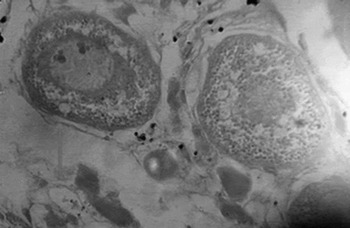
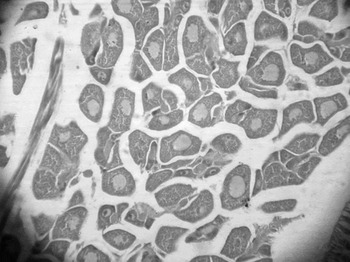
Oogenesis in Halla parthenopeia can be defined by three maturity stages. The first one represents a previtellogenic phase where small oocytes emerge in a raceme-like structure and were held together by a type of connective tissue forming lobes. The last two stages represent a vitellogenic phase where the raceme-like structure starts to break up and oocytes become free in the coelomic cavity.
- Stage 1:
Oocytes in this stage are characterized by marked increase in the nucleus size compared to the volume of cytoplasm. Cytoplasm is granulated, basophilic and deeply blue. Oocytes are irregular in shape due to being compact with each other and their diameter varied from 24 to 48 µm (Figures 12 & 13).
- Stage 2:
This represents the vitellogenic stage; the major part of oocytes breaks up and become free in the coelom. The connective tissue loosens up. Oocytes still irregular in shape and their diameters range from 48 to 76.8 µm (Figure 14).
- Stage 3:
Vacuolation stage with clear vacuoles surrounding the nucleus and they fill all the cytoplasm. In this stage oocytes are completely free in the coelom and the onset of yolk deposition was observed. Oocytes are rounded and range in size from 9.6 to 115.2 µm (Figure 15).
(Stage 1): Oocytes of Halla parthenopeia forming raceme-like structures (100X).

(Stage 1): Oocytes of Halla parthenopeia are irregular shaped with large nucleus (400X).

(Stage 2): Oocytes of Halla parthenopeia are broken up in the coelom (100X).

(Stage 3): Halla parthenopeia rounded oocytes with yolk deposition (400X).

Monthly variation of oocyte diameters of Halla parthenopeia
The monthly variation in the mean oocyte diameter of female Halla parthenopeia is illustrated in Figure 16. The maximum oocyte diameter encountered was 160 µm while the smallest oocyte found in the coelom was about 29 µm. The figure shows that there is a pronounced peak in May (~120 µm). From June onwards there is a steady gradual and continuous decrease in mean oocyte diameters and by September they have reached their minimum diameters (~40 µm). The oocytes started to increase gradually in size from October onwards to form a second peak in December 2003.
Monthly variation of mean oocyte diameter of Halla parthenopeia. Vertical lines indicate standard deviation.

Fecundity
Fecundity, is defined as the number of eggs produced by an animal in the single reproductive event of its life cycle. In Perinereis nuntia brevicirris, it varied from 51,629 in a female of 1.08 g total weight to 444,444 in a female of 1.10 g total weight with a mean value of 208,358±2080 per female. In Lumbrineris funchalensis, fecundity varied from 2103 in a female of 0.81 g total weight to 3380 in a female of 1.17 g total weight with a mean value of 2660 ± 654 per female, while in Halla parthenopeia it varied from 6246 in a female of 29.10 g total weight to 375,333 in a female of 34 g total weight with a mean value of 142,068 ±2005 per female.
DISCUSSION
In temperate regions most of the larger marine invertebrates exhibit seasonal patterns of reproduction which in the polychaetes is expressed in two fundamentally different ways: in the majority of polychaete families seasonal reproduction is expressed in an iteroparous life history but in the Nereidae, seasonal reproduction, when it occurs, is expressed as a component of a semelparous life history. In iteroparous forms, individual animals will breed repeatedly at annual intervals, whereas with the semelparous forms such seasonality is a population level phenomenon, individuals breeding only once (Olive et al., Reference Olive, Porter, Sandeman, Wright and Bentley1997).
The release of gametes is perhaps the most conspicuous event during the reproductive cycle of polychaetes, and due to the simplicity in measuring the oocyte growth, oogenesis has been studied in much greater detail than spermatogenesis (Clark, Reference Clark1965). On the other hand, the method most frequently used in oocyte growth analysis is the average diameter of a sample of oocytes contained in the coelomic cavity. For the three studied worms (Perinereis nuntia brevicirris, Lumbrineris funchalensis and Halla parthenopeia), the sex-ratio results showed a high proportion of males. It is possible that the difference between male and female abundance of L. funchalensis and H. parthenopeia could be due to catch bias rather than to population structure. The sex-ratio should be based on a comparison of the number of mature males and the number of mature females during the pre-spawning period, when both sexes are easily recognizable (Olive & Garwood, Reference Olive and Garwood1981; Costa, Reference Costa2003).
There is no previous published data on sex-ratio of Lumbrinereis funchalensis and Halla parthenopeia, therefore, the comparison of sex-ratio of these worms with data from different areas was not possible.
The detailed annual changes in sex-ratio of Perinereis nuntia brevicirris indicated that males outnumbered females for most of the year with a ratio of 3:2. Departure from 1:1 ratio disagrees with that reported for P. nuntia brevicirris in Chinese waters (Hardege et al., Reference Hardege, Bartels-Hardege, Yang, Wu, Zhu and Zeek1994) where the ratio was 1:1 throughout the whole period of observation. Hardege collected the heteronereids at swarming–just prior to spawning, where all the worms are ready to shed their gametes. In the present study, the samples were collected from the intertidal area and mostly at low tide. Yoshida (Reference Yoshida1984) showed that females outnumbered males in two varieties of P. nuntia; the sex-ratio was 1:0.6 in P. nuntia vallata and 1:0.9 in P. nuntia brevicirris. He attributed that to the larger size of females than males so that the sea bait collector has a catch bias toward females. Barbary (Reference Barbary1992) observed that females outnumbered males with ratio 4:1 when he studied the reproductive biology of Nereis (Neanths) brandti in Lake Timsah, but he did not give any detailed data or any explanation. The predominance of females over males of Hediste diversicolor was observed by Costa (Reference Costa2003) in Portugal and he related that to time of collection.
Like almost all nereidids, Hediste diversicolor is strictly semelparous, and in natural populations always breeds in the spring (Linke, Reference Linke1939; Dales, Reference Dales1950; Smidt, Reference Smidt1951; Olive & Garwood, Reference Olive and Garwood1981). In these semelparous animals, reproduction will inevitably be followed by a genetically programmed death shortly after spawning (Olive & Garwood, Reference Olive and Garwood1981).
In the present study, the oogenesis cycle and the monthly variation of the oocyte diameters of Perinereis nuntia brevicirris indicated that the spawning peak of females occurs during spring (March to May) where the maximum oocyte diameter was recorded. The breeding season of Nereididae has been the subject of several papers. Hardege et al. (Reference Hardege, Bartels-Hardege, Yang, Wu, Zhu and Zeek1994) collected the ripe swarming of P. nuntia brevicirris from the beginning of June to the end of September in Chinese waters at water temperature ranges between 12.4 and 23°C. This coincided with the water temperature of the spawning season in the present study (18.4 to 21.9°C). Yoshida (Reference Yoshida1984) observed that, under laboratory conditions the spawning season of P. nuntia vallata was from April to August at water temperatures of 18–28°C. Barbary (Reference Barbary1992) found that the spawning season of N. brandti in Lake Timsah covers all the spring months. The spawning season of H. diversicolor on the south coast of Finland is very restricted only to May (Smith, Reference Smith1963), while Chambers & Milne (Reference Chambers and Milne1975) determined two spawning periods for the same species in Scottish waters, one in summer and the other one between the end of winter and early spring. In English waters, Mettam (Reference Mettam, Nylor and Hartnoll1979) observed larval recruitment of H. diversicolor only during summer (May–July).
The above results indicate that the spawning season and the reproductive peak for Nereididae are flexible and probably closely linked to environmental conditions. Orton (Reference Orton1920) considered the temperature as the most important external factor influencing breeding season of nereidid worms. Similarly, Goerke (Reference Goerke1984) showed that spawning of nereidid species depends on species-specific minimum temperatures.
The monthly variations in the mean oocyte diameter for Perinereis nuntia brevicirris showed two pronounced peaks, the first was in March and April while the second was from October to November with conspicuous smaller sized oocytes. These small oocytes would be expected to be spawned during the following or a subsequent breeding season and this may indicate the presence of two populations. The regulation of semelparous life cycles presents particular problems when the average life span is greater than one year because the seasonal reproductive event occurs in only a part of the population. Nereididae are mostly not short-lived species, as it is generally supposed to be the case for semelparous organisms (Pianka & Parker, Reference Pianka and Parker1975; Roff, Reference Roff1992; Stearns, Reference Stearns1992). In most Nereididae, the generation time is greater than the phase length of the breeding cycle. Therefore, the proportion of sexually mature worms in the population at the time of breeding will be less than unity as observed in natural populations of N. virens (Snow & Marsden, Reference Snow and Marsden1974; Creaser et al., Reference Creaser, Clifford, Hogan and Sampson1983; Olive, Reference Olive1993). The mean generation time is itself controlled by environmental factors, such as temperature (Olive et al., Reference Olive, Fletcher, Rees and Desrosiers1998). High growth rate reduces both the generation time and the mean size at maturity; consequently there is an inverse relationship between growth rate and size at maturity (Olive et al., Reference Olive, Grant, Cowin, Porchet, Andries and Dhainaut1986, Reference Olive, Fletcher, Rees and Desrosiers1998).
Unlike Perinereis, Lumbrineris funchalensis does not have a defined breeding season; the oogenic cycle shows little variation from month to month. The ripe females with oocytes size above 140 µm were found throughout the year. In addition, the majority of the females obtained, had a narrow modal coelomic oocyte diameter of 140 to 250 µm. Certain small groups of polychaetes breed all the year round. Spirorbis spp. and Fabricia sabella (Olive, Reference Olive1970) produce a succession of small broods throughout the year. Also a species that does breed in a manner similar to that of L. funchalensis is Arenicola ecuadata where mature females can be found all year round (Olive, Reference Olive1970). As oogenesis continues, the oocytes can be released into the coelom at different times. Furthermore, oocyte growth rates vary during the course of coelomic development; giving rise to substantial differences among oocytes sizes (Olive, Reference Olive, Clark and Adams1980). This means that when oocytes reach their maximal size they will exhibit low or no growth (Olive, Reference Olive, Clark and Adams1980). This implies the case of the studied worm where there was little variation in oocyte diameter from month to month.
From the gametogenetic cycle of Halla parthenopeia, it is apparent that this species has two reproductive periods, one in May and the second in November, and lasting to January at average water temperatures of 18–22°C. Most species of polychaetes breed annually or biannually, and spawning is usually restricted to a definite breeding season, which may be very short (i.e. all the population breeding during a few days) or which may last several months. In such cases there is a period prior to the breeding season when the gametes are ripening, and a period after the breeding season when the worms do not contain coelomic gametes (Olive, Reference Olive1970). Such a pattern of reproductive behaviour was recognized in a Halla parthenopeia population in Kojima Bay Japan (Okuda, Reference Okuda1933). Our results may agree with Itazaki & Yoshida (Reference Itazaki and Yoshida1983) who observed that under laboratory rearing, H. parthenoeia has one spawning season from July to November with the peak occurring from September to October when the water temperature was 23–24°C. Owenia fusiformis also showed a dynamic of reproduction similar to that described in the present work, where this species has two reproductive periods (Gentil et al., Reference Gentil, Dauvin and Ménard1990).
The diameter of mature oocytes in Perinereis nuntia brevicirris was comparatively small, it ranges from 200 to 250 µm with maximum average diameter of 130 µm. Hardege & Bartels-Hardege (Reference Hardege and Bartels-Hardege1995) indicated a similar oocyte diameter value (250 µm) for the same species in a laboratory study. Rouabah & Scapes (Reference Rouabah and Scapes2003) indicated a similar oocyte diameter for Perinereis cultrifera. Generally, most species of Nereididae showed a wide range of oocyte diameter; Olive et al. (Reference Olive, Fletcher, Rees and Desrosiers1998) indicated oocyte diameter values from 170 to 200 µm for Neanthes virens, while Hediste diversicolor has a small range of oocyte diameter from 130 to 140 µm at three different latitudes in south-western Portugal (Costa, Reference Costa2003).
Considerable variation in the fecundity of the three polychaete worms was observed in the present study. Perinereis nuntia brevicirris was the most fecund (51,629–444,444 oocyte/female). This is higher than that observed for other nereid species, P. nuntia vallata (22,000–87,000 oocyte/female) (Yoshida, Reference Yoshida1984), P. cultrifera (7000–26000 oocyte/female) and P. rullieri (4080–15000 oocyte/female) (Cassai & Prevedelli, Reference Cassai and Prevedelli1998). The high fecundity of P. nuntia brevicirris may be attributable to the smaller oocyte size where the maximum diameter of mature oocytes is 250 µm, while the maximum diameter of mature oocytes of P. nuntia vallata is 300 µm, and those of P. cultrifera and P. rullieri are 300 µm and 370 µm respectively (Cassai & Prevedelli, Reference Cassai and Prevedelli1998).
Lumbrineris funchalensis in the present study has moderately low fecundity (2103–3380 oocyte/female) compared with the relatively high fecundity of Halla parthenopeia (6246–375,333 oocyte/female). This may be considered as an adaptive feature to the large oocyte diameter (280 µm) of L. funchalensis, and consequently due to the limited space available for the accumulation of oocytes inside the coelom.
In conclusion, this study provides the first known account of the reproductive pattern and fecundity of the most highly commercial polychaete species in the Suez Canal. Future study is required to describe the life cycle of these species that will open up research aiming to validate its appropriateness for cultivation.
ACKNOWLEDGEMENTS
We are especially grateful to Dr Paul Schroeder for his help and advice about the histological sections. We also wish to express our thanks to Mrs Faten for her help in preparation of the histological slides. This study is part of MSc dissertation in Marine Biology, Suez Canal University.