As the babyboomers near retirement, assurance of a decent standard of living has become one of the most debated economic issues of recent times. There is a measure of agreement that while a role for government is appropriate, the accumulation of unfunded public liabilities might place too much of a burden on the next generation and, all round, is not a good idea. Yet there is much less agreement as to what the optimal scheme should look like, even absent the problem of transition from existing arrangements.Footnote 1 Some countries and states have put into place funded schemes via a public investment fund that essentially mimics private investment funds, while others have adopted taxation incentives to stimulate contributions to private sector investment funds. Such arrangements differ from the old schemes in several ways. Typically, they do away with the idea of defined benefits, i.e. promises to pay an assured amount in the future, either in dollar or real terms. They may replace this with defined contribution schemes, exposing the retiree to the subsequent performance of the fund and its investments, with or without a public bail out provision in worst case scenarios such as collapse. Thus in recent years there has been substantial swing toward ‘unit linked’ or ‘equity linked’ arrangements, in which what can be taken out is simply what has been earned on what has been put in – in the case of lifetime annuities, less heavy administrative, fund management and insurance costs (SEC, 2004). Alternatively, as in the public funds, there may be little assurance that even performance provisions will apply. The amount to be distributed is not fixed by any pre-set formula, with an ill-defined moral commitment on the part of the government to continue to make provisions, and exposure to the policy inconsistency problem.
Further risks are provided by the preference on the part of governments that all investment rewards should be distributed in the form of annuities rather than made available as a lump sum on retirement. This effectively gives an official mandate to the duration mismatch of private arrangements, for contributions are made up front and benefits are only received many years later. Hence, there is not only heavy performance risk arising from the market risk of investments, but also credit risk, hardly reassuring in the light of recent financial difficulties of insurance companies and similar providers. Venerable does not mean permanent, the most prominent recent instance being the forced closure in 2000 of Equitable Life Assurance, after 288 years of business in the UK. For a general review of annuity schemes in this context, see Brown et al. (Reference Brown, Mitchell, Poterba and Warshawsky2001).
The present paper adopts the starting point that annuities (suitably enhanced) are indeed an appropriate mechanism for the distribution phase and that the responsibility should be at least partly placed on people to provide for their own retirement. We depart from prevailing wisdom by suggesting: (a) that an important role remains for defined benefit schemes; (b) for this purpose, fixed interest securities are a better base than equities, reinforcing in this as aspect doubts about the ‘equity cult’ raised by Sutcliffe (Reference Sutcliffe2005).
Planning for retirement requires a measure of certainty as to investment outcomes or government assurances, even if the tranche so secured is only part of the individual's portfolio of retirement assets or public promises, and used to assure the ‘consumption floor’. Unit linked schemes do not provide the needed level of certainty. Mitchell et al. (Reference Mitchell, Poterba, Warshawsky, Brown and Brown2001) have drawn attention to the substantial risk premium that people would be prepared to pay for an assured income in the face of an unknown time to death following retirement (these days, increasingly long and variable). They also draw attention to a disconcerting variation in the expected net present value of historical annuity payouts by insurance companies, and also to the apparent deadweight costs of this form of contract. One implication is that if people had a basic tranche of retirement income that was defined benefit in nature, then they might adopt a more effective investment policy for the remainder. This would imply a portfolio layering approach to the lifecycle portfolio solution. The certain defined benefit assures the future consumption floor and layers of successively higher risk/expected return are superimposed.
‘Defined benefit’ has had a bad press – it need not imply open-ended public or private liability. Investing in a very high grade fixed coupon government or corporate bond will always provide an assured defined benefit. It is also easy to price. There are no difficulties with ascertaining the appropriate cost of capital for an estimated net present value calculation; the latter can be done off standard market instruments rather than idiosyncratic institutional portfolios. Provided the bond has not been issued solely for the purpose of providing retirement income (i.e. the bond has a solid asset backing or achieves some other economic purpose), there is no deadweight economic loss in such an arrangement.
The problem is that such bonds are unexciting in their investment returns; it is in seeking higher coupons on private sector instruments or investments that older people get into so much trouble. Moreover, the temporal pattern of payments does not correctly align with the requirements of retirement and death. The only way to assure oneself of income support right to the end automatically means that the bequest motive is treated as of equal importance with the retirement income motive. A menu of choice would be more useful, enabling the individual to shift benefits and burdens forward or backward according to intertemporal risk preferences.
The intertemporal risk shifting and coupon enhancement can be accomplished using financial technology. The volatility inherent in long duration bonds, as well as swap driven rearrangements, can be used constructively to align preferences as between cash flow support so long as still living, and the bequest motive when the end finally does come. Achieving this does not at all violate the ‘no free lunch’ principle of efficient financial markets. Financial instruments can be designed to rearrange temporal profiles for both income and risk. Using annuity swaps is a rearrangement of certain cash flows. Options are an even more attractive alternative. By giving up a measure of certainty in bequest, a greater certain income can be attained while still alive by reinvesting option income to create higher coupons. In this way, the user can trade risk for income certainty. In less developed or liquid capital markets, these could be structured in the form of callable bonds.
The approach taken highlights the multifunctional role of high grade long-term debt. Raising government debt in different maturity bands is not solely a matter of perceived financing costs at the time; there are some important externalities involved. The use of treasury interest rates as market reference rates is well established, and the same function could potentially apply as a benchmark for the payouts achieved in annuity schemes. A function of this kind has been cited in connection with the recent issue of 50-year UK gilts. Other uses are familiar in markets for risk, e.g. the use of long bonds as the physical in futures contracts, or the engineering of long dated high grade zero coupon bonds and their use in capital-guaranteed equity investment schemes. We point up another in connection with the underpinning for realistic defined benefits retirement incomes, namely their use as the physical in income enhancing derivatives. Externality benefits of such kinds should be factored into public sector debt management decisions, for they diminish the effective costs to the government of retirement provision. Decisions as to how much government debt to issue, or in what maturity bands, have to consider more than just the interest cost, especially if the formal cost of funds difference amounts to no more than a few basis points. Public debt programs are not zero sum games. Nor need the debt be nominally that of the government – the constructive use of a government guarantee in appropriate circumstances could help to underpin the credit status of debt nominally issued by the private sector, such as student loans.
The scheme of the rest of the paper is as follows. In Section 1, a short discussion of portfolio and cash flow requirements precedes a review of difficulties with existing retirement arrangements, notably the adverse exposures to credit and performance risks, and the lack of common ground for pricing. What is needed in this respect is a high-grade debt instrument to act as benchmark and to serve as the physical for derivatives-based enhancement programs.
Section 2 establishes generic types of derivatives that between them can cater for income enhancement and a menu of choice as between income and bequest motives. The first type is lifetime annuity swaps, essentially the equivalent of insurance industry annuities but with a more unambiguous pricing benchmark based on swaps pricing. In the second category are the variable lifetime coupon options (LCOs), wherein the coupons are enhanced by successive reinvestment of the premium income and the strike price is used to balance income and bequest motives. Technically, there is no advantage of one over the other, as both as derived from efficient market pricing. But together they provide a menu of choice, especially where intertemporal income and risk preferences do not coincide with those of the representative market agent. The LCOs turn out to be more robust to the adverse selection problem than do the swap-based enhancements.
Section 3 turns to the physical debt underpinning. While a role might exist for general purpose private and government debt, it is suggested that public long-term asset vehicles (LTAV's) would provide desirable asset cover, matched as to duration, as well as helping to solve policy consistency problems. LTAV's could encompass infrastructure funds, dedicated retirement investment funds, and other government agencies with a natural backing of long-term asset cover, or could extend to the packaging of semi-government or private debt with attached government guarantees. The paper concludes in Section 4 with some remarks concerning lifetime portfolio planning, pricing technology, and operational aspects, together with further aspects of public finance and the role of universal retirement planning in this context. It is suggested that the use of LTAV's and their debt programmes to underpin enhancement-based retirement schemes leads to a mix of public and private provision that is more transparent in its pricing, equity, and moral obligations than are existing arrangements.
1 Motivation: lifecycle planning and institutional provision
1.1 Personal portfolio and income risks
The financial needs of retirement can be formalized in a somewhat parallel fashion to the risk management of financial institutions. In the latter case, value at risk (VaR) sets boundaries on allowable institutional net worth outcomes in adverse states of the world; investment and trading activities are designed to minimize the probability of the values at risk. One could certainly apply a model of this kind to investment activities of the individual, though we later suggest it might be a more useful way to approach the bequest motive. However, the consumption support needs of personal old age can be better thought of in terms of cash flows at risk. Thus there is a minimum cash flow required to support a basic life style, the ‘consumption floor’ (Brown et al., Reference Brown, Mitchell, Poterba and Warshawsky2001). The latter might well depend upon financial history as well as personal preferences and circumstances. Nevertheless, it is seen as important to at least achieve this in old age. Beyond that, a variety of behavioural preferences can apply (e.g. Barsky et al., Reference Barsky, Juster, Kimball and Shapiro1997). The implied utility function is similar to those employed in VaR studies (Bowden, Reference Bowden2006), in that utility drops sharply past a certain subsidence point. This being the case, it becomes necessary to immunize the cash flow required to support the subsistence consumption stream. The immunization function becomes more important because investment errors in old age can no longer be compensated by subsequent returns from human wealth, or by borrowing. Even for the more affluent, it is useful to think of a layered approach to portfolio choice, executed in the decision phase. The base layer provides the income assurance for a minimal lifestyle over an uncertain time until death. Once this is met, a more adventurous stance is possible for the investment of the remaining wealth. Equity fund managers implicitly recognize the layered approach when they promote capital-guaranteed funds, the base tranche of which is a long maturity zero coupon bond of impeccable credit but modest accumulation rate. The present proposals have some points of similarity with this idea, except that they apply to an entire stream of future income, and moreover allow for that stream to extend to an uncertain time to death. A further point of contact is with Guaranteed Minimum Withdrawal Benefit (GMWB) riders to equity linked annuities, which are discussed in Section 4.2.
A second planning consideration is longevity risk, for as post-retirement life expectancies lengthen, so too does the risk of running down capital, with income deficiency as a consequence. Longer life tables can also mean more dispersion in the time to death. Retirement support should immunize against ‘time to death’ risk.
Bequest motives are a third consideration. Utility is generally also attached to the sum available on death to fulfil bequests, meet funerary expenses, or in some cases to continue support for dependents. It is possible to extend the lifetime portfolio allocation model of Merton (Reference Merton1969) by allowing the individual to purchase life insurance, as in Fisher (Reference Fisher1973) or Richard (Reference Richard1975), which assures the bequest motive. Yet in many cases, there is a sense that what is left at death is a residual and lesser certainty imperatives apply. This suggests that enhanced security during life could be bought at the expense of certainty at death. Thus in the approach of the present paper, the individual could be interpreted as selling life insurance on his own life, rather than buying it. Differential risk preferences are signalled by a willingness to pass income forward or backward through planning time. A good system should allow for a menu choice as to the extent of substitution between income while still alive and terminal value at death.
The above considerations necessarily impact on the choice as to whether the income and/or bequest to be provided is defined benefit in nature, or whether it is unit linked, and therefore performance dependent. If income certainty during life is of paramount importance, then defined benefits are called for. In addition, they should be realistic defined benefits and should be watertight as to risk, which can mean not only longevity risk, but also the performance or even survival of the provider.
1.2 Provider risk
Private sector annuities schemes are now generally unit linked in nature, with the payout tied to what is available in the unit holder's account at the time. This immediately implies performance risk. The latter may arise from the fortunes of financial markets at the time, especially longer-term trends not foreseen at inception of the contract. It can also arise from various elements of corporate risk, such as the departure of key investment personnel, to corporate takeovers by other institutions, or to funds outflow from the rise of new competitors or investment opportunities.
Also of concern is the issue of credit risk. The purchase of annuities typically involves the more upfront provision of funds to the institution (at a time when they are less needed by the purchaser) in exchange for a more back-loaded provision of income benefits (at a time when they are needed). A credit exposure duration mismatch therefore arises, adverse to consumers (purchasers). If the credit of the institution deteriorates, this affects the pricing of its liabilities, even if the institution itself does not collapse. Deteriorating performance may or may not be readily detectable (it can often be disguised or obscured), especially if the institution does not actually issue debt and therefore have a publicly visible credit rating. But it is important to remember that the institution's liabilities are still there, in the form of any defined benefit elements, such as reversionary bonuses or guarantees. Nor is the credit exposure automatically extinguished by unit-linked securitization of the scheme, where this path is followed.
A third concern with private sector insurance-based schemes is the less than transparent pricing of their annuities. Many studies have pointed up large variations between institutions in this respect even where their asset composition is roughly the same. A systematic problem arises via the expected present value framework for pricing annuities, with informal adjustment for risk via more or less arbitrary risk premiums derived from CAPM or similar models. Practice in this respect contrasts with more formal market-based pricing frameworks in finance theory and derivatives pricing, which are tied to observable interest rates and asset prices. A further problem is the variable overlay of management and insurance costs, which is the case of lifetime annuities can mount to 2.5% or more per annum, contrasting with the standardized and competitive margins or bid–ask spreads of the traded market.
Public provision has some risks of its own, notably the policy inconsistency problem, wherein the government having announced one payout policy can subsequently change it, citing either a change in its economic circumstances or else priorities and contingencies unforeseen at the time. Moreover, demographics – especially the baby boomers – have loomed large in the ability and continued willingness of governments to continue funding retirement schemes for the general population. Capacity to pay has become a risk to the provider in this case.
Nevertheless, risks of this kind should not be allowed to obscure a potential role of the government in underpinning the certainty required of a retirement scheme, even if it does not provide the scheme itself. Governments of OECD countries have some key advantages in this respect: they are long lived, they have sovereign power and the ability to levy taxes, and they are capable of influencing the economic environment and hence the ultimate performance of financial assets. It is for such reasons that their debt typically carries the highest credit ratings in the economy. This can be used to underpin the provision of retirement income certainty, in its basic tranche. The use of dedicated long-term asset vehicles (see below) would help to resolve agency problems by providing a formal corporate liability structure.
1.3 High grade debt as the physical anchor
To achieve the desired basic tranche of risk free income in the face of risks of performance, time to death, and provider credit, there has to be an asset anchor. In this paper, the anchor role is played by high-grade long-term debt. The derivative instruments or facilities to be described are all enhancements of such an underlying physical. The type and sources of such bonds are considered at more length in Section 4.
Basic requirements are as follows:
(i) The bond should be of long duration. This is needed to create volatility in its price, as well as to outlive the retiree. In this connection, uncertainty in interest rates is seen as a positive source of value to be unlocked. Although governments these days do not generally issue perpetuities (UK consols are still available but only on the secondary market), some of the longer bonds now being issued are almost equivalent in their pricing and interest rate volatility.
(ii) The credit underpinning the bond should be extremely strong and perceived to remain so over all horizons. For this reason, the instrument will likely be a government or agency bond, although this does not rule out very high-grade debt from other sources. Being able to ignore credit spreads does facilitate standardized pricing and benefit calculations.
(iii) The physical should itself be an income instrument. This will give the holder the facility to freely restructure the flow of coupons, including the ability to stay with the instrument in the form in which it was originally issued. Depending on the tax jurisdiction, there may also be taxation considerations; for instance, there may be a requirement to view the instruments as intended to yield income rather than pure capital gain. There might also be reasons derived from credit arguments. An instrument such as a very long dated zero coupon bond might tempt the issuer to delay consideration of just how the debt would be serviced and hence create an adverse prospect for future repayment of principal.
(iv) The debt instrument should ideally be inflation protected, certainly as to coupons. A margin of choice exists as to whether or not to also protect the principal, if the chosen instrument has finite maturity. The latter will be long and the alternative always exists of sacrificing the principal protection to ensure a higher real coupon yield. The exposition that follows is in nominal terms, but can readily be adapted to handle inflation indexed debt.
2 Lifestyle derivatives: structure
The underlying physical has one attractive feature, namely its credit rating and the comfort that this brings to retirees faced with the need to assure income in old age. But straight government bonds (for instance) also have some unattractive features: (a) In recent years the coupon has been low, driving investors to seek higher yields and therefore riskier investments, with inevitably adverse outcomes. (b) In some countries, their maturity is not all that long (10 years or less) and therefore subject to coupon reinvestment risk when rolled over into new bonds; needed is more motivation for the issue of longer dated bonds. (c) Taxation provisions may be unfavourable. Ideally, one would like to delay coupon receipt to later years at a lower marginal tax rate. (d) On death, all remaining balances by default become part of the estate, leaving far more financial value than the individual might have chosen with the advantage of flexible allocation in advance. Given the inherent uncertainty of the time to death, or the onset of mental or physical incapacity, it is well nigh impossible to schedule with any confidence a rundown to match the precise pattern of needs in future years and also leave the individual with an optimal bequest.
The derivatives are designed to achieve payouts that more closely align the temporal pattern of effective coupons with the needs of retirement income. Given efficient markets, higher coupons over an indefinite period until death cannot be conjured out of nothing; something has to be given up. Higher lifetime coupons require compensatory sacrifice when death does eventually occur (or vice versa in rarer cases). However if this can be done, there are welfare gains.
The two generic types of enhancement to be discussed are as follows:
1 Lifetime annuity swaps, under which the individual swaps the perpetuity coupon for a higher coupon while still alive together with a compensating sacrifice of the value of the bond at the time of death. The proportion of terminal value to be sacrificed is set in advance by the individual. These can be piggybacked on forward start swaps, in which the individual with less need of income at the present time swaps the interim coupons for higher coupons at a designated future time.
2 Lifetime coupon options (LCOs), written by the perpetuity holder, with uncertain maturity set at the time of death. The strike price is chosen as the sacrifice parameter, in exchange for an option premium up front. The latter is then reinvested in the underlying perpetuity, and a second round option written on its price. The process is continued until convergence, in effect constituting an option in which the premium appears in the form of an enhanced coupon payable only during the life of the individual. The LCO refers to the entire compound option.
The swaps are not in themselves novel instruments, indeed they are simply lifetime annuities with a death benefit, the only special wrinkle being their uncertain maturity. They can be viewed as the debt market-based equivalent of many of the products offered by the insurance industry. However, they are a good point to start in order to establish some early notation and conventions.
2.1 Lifetime annuity swaps
To avoid notational confusion with other maturity concepts such as time to death, the physical bond will be taken for expositional purposes as a perpetuity, i.e. a bond that pays off a constant coupon for ever. Even if notional in character, the pricing of such bonds is in fact quite close to that of very long government bonds currently issued by several OECD governments. In addition, we will imagine that the term structure is flat and assumed to remain so, although the interest rate can itself vary up or down. Extensions to non-flat term structures are considered below in connection with options. Thus if the coupon on the bond is y, and the current (time 0) interest rate is r, then the price of the perpetuity  .
Under the terms of the swap, the individual chooses a sum A to retain at death. Define the ‘sacrifice ratio’ as  . Thus A=(1−θ)P 0, so that if θ=75%, the individual elects to retain a bequest on death priced at 25% of the current value of the bond. Investor attitudes towards the sacrifice ratio would depend upon circumstances such as the need to provide for heirs, as well as the existence of other portfolio layers. Thus an investor who chooses the annuity payout as layer 1 – the basic tranche – could well elect a 100% sacrifice, in effect treating the annuity as the basic income assurance instrument.
Remark
The sacrifice ratio could alternatively be defined in term of the current forward price, as having a reference to the future value of the bond. The two are equivalent for a perpetuity under a flat term structure. Assume provisionally that the time of death is T and let F T be the time 0 forward price of the physical for maturity T. If the bond is a perpetuity and the term structure is flat, then the forward price is independent of T and in fact F=P 0, the current price of the bond, a convenient feature (see Appendix A).
The simplest way to price such a swap is to equate expected present values of the two sides, where the expectation is taken with respect to the probability distribution of the time of death. The process corresponds to expected present value annuity pricing, which is the predominant way of doing things in the insurance industry. There is an implicit assumption that the probability density of death is constant, not dependent on the economy, and interest rates in particular. A more precise specification is covered below in connection with options pricing, with adverse selection aspects also ignored for the moment.
Proposition 1
If the probability density of time to death is φ (T), then under expected annuity pricing with a flat term structure, the lifetime coupon obtainable is given by

where

Proof: Take time as continuous (for later comparability with the options) so that r is the continuous time rate of interest. Suppose that the agreed lifetime coupon under the proposed swap is a. Conditional on death at future time T, the present value of the lifetime coupons is

Taking the expected value over different lifetimes (T) gives

Setting this equal to the value of the perpetuity P 0 and solving yields the required result (1). The same formula holds if we reinterpret time as discrete with r now referring to discrete time discounting.
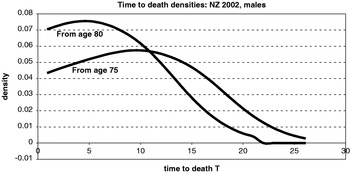
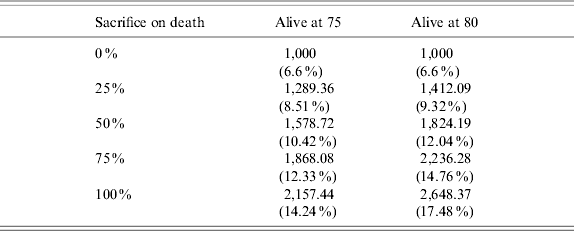
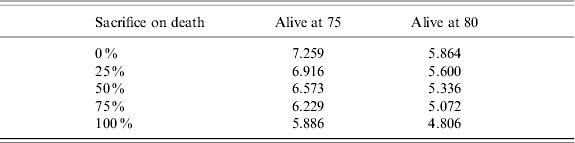
According to equation (1), the apparent coupon is multiplied up by a factor that depends upon the sacrifice ratio and the density of time to death. Table 1 gives some indicative results derived from the official 2002 NZ life tables. The associated time to death density appears as Figure 1. It is assumed that there is $1,000 worth of base perpetuity income (this is y), and the continuous time interest rate is 6.6%, calibrated off NZ long-term rates at the time. The numbers in brackets are the apparent lifetime yield relative to the bond price of $1,000/0.066=$15,151.52. There is no gain unless some of the bequest is given up, thereafter increasing sharply with the sacrifice ratio. Substantial enhancement is possible even at age 75.
Conditional density functions for time to death Source: Original data source is Official Lifetables 2002, Statistics NZ.

Lifetime swap coupons

As earlier noted, lifetime annuity swaps utilize fixed interest pricing to provide a benchmarking or price setting functionFootnote 2 for private sector annuity schemes. The only source of variation would become different assumptions about the time to death density and how to hedge it.
2.2 Forward start facilities
Coupon gains from lifetime annuity swaps (or options as below) can be further enhanced by a choice of forward start facilities, executed at some prior date. These allow the individual to invest now but receive later. For example, the investor could invest a lump sum at age 65 in a structure that carries no coupons until age 75. At that point, the accumulated value is taken out in a higher perpetual coupon. At some time during the coupon period, the individual might elect to write a lifetime annuity swap, or LCO, further building on the higher coupons until the time of death.
The coupon gains from a forward start arrangement appear quite dramatic, even without further augmentation via lifetime annuity swaps or LCOs. For instance, if the current rate is 6.6% per annum, then with a 10-year forward start, the coupon at age 75 becomes $1,934.79 instead of the original $1,000. The investor has given up $1,000 in the zero coupon period to be rewarded with $1,934 in the coupon period until death, which could be further enhanced at the time via lifetime annuity swaps or LCOs.
Of course, there is no real financial gain in return terms. To see this, note that a forward start of this kind can be structured as a swap, in which the counterparty (say a bank) receives the straight perpetuity and an annual flow of $1,000 starting immediately, while the retiree receives from the bank the perpetuity starting at age 75 with the enhanced coupon. The forward start coupon of $1,934 is solved by equating the present values of the two sides to the swap, following standard market practice. Thus no new financial value has been created; indeed in practice there would be a slight loss in value to the individual due to swap spreads and other transactions costs. See also below on credit risk to the individual.
Gains in financial value could arise from tax considerations, depending upon whether accrual or cash rules were followed in assessing tax. It could be argued that this was an investment scheme under which money was put aside now to earn income later on. If taxation rules applied that are based on cash, rather than accrual or capital gains, then the taxation would be delayed until the coupons are actually received. By that time, the individual could be on a lower marginal rate of tax. The forward start instrument is therefore an intertemporal tax smoothing device. If this is the case, there would indeed be a tax source of financial value and the swap would have positive value.
Absent tax non-neutralities of this kind, there could still be a gain arising from the interplay of lifetime financial planning and risk. Suppose tax was levied on the accrual of gains during the zero coupon period. The individual would lose wealth and some utility from this, but would know that an assured (and enhanced) income is going to be available during the later coupon period. This assurance would diminish the risk premium applied to the coupon period, enabling the individual to undertake riskier investments at the outset. In other words, the forward start facility would lower the risk premium applicable to intertemporal portfolio optimization. The gain from lifetime planning is taken up at a later point.
2.3 Lifetime coupon options (LCOs)
The LCOs work as follows. At some point during the life of the basic physical bond, the investor can choose to sell (write) call options on the bond. The maturity of such (European) options is variable and is determined by the time of death. The strike price is set by the investor from bequest motives as above, balancing these up with his or her own likely needs as long as alive. The premium from the option is reinvested in the purchase of further units of the underlying debt physical, and further options written.
To see how this works, take the bond as above with coupon of $1,000 and current market value of $15,152.52. A strike price is set as 60% of the current bond value, equivalent to a sacrifice ratio of 40%. This means that if the price of the bond at death exceeds $9,091.51, the investor's estate will lose the surplus. But the option that he or she has sold has a current market value of $3,530.85, which can be reinvested in the same bonds to yield additional coupon income of $233.04 per annum. Moreover, further options can be written on the $3,530.85 of new bonds, and the whole process continued until convergence. The LCO refers to the complete arrangement. The enhancement to the basic coupon stems from two effects: (a) Even with a strike set at the current value of the bond (defined as zero sacrifice), the volatility of interest rates will ensure that the option has value, constituting a further income stream. (b) To the extent that the investor chooses to sacrifice terminal value, this can be brought forward to further enhance the coupon, which will last as long as he or she is still living.
The option can be priced under various assumptions about the probability density of the time to death, and the way that this is related to the economy. The simplest assumption is that a specific individual's time to death bears no relationship to the state of the economy between now and then, or more precisely that the economy is not affected by the morbidity of its agents. In that case, one can price the option knowing the volatility of the interest rate and the density of time to death. More technical aspects of the above assumption are covered in Appendix B.
As with the annuity swaps we make the simplifying assumption that the term structure is currently flat (see below for remarks on non-flat structures). The forward interest rate volatility is denoted σ. It is assumed to remain constant over time, and the same for any forward maturity (e.g., the term structure remains flat, in which case σ is just the volatility of the physical perpetuity price). Section 4.3 considers possible extensions. For any given maturity T we assume that the option is priced off the forward price model (Black, Reference Black1976), which uses the forward price as basic input (also see Barone-Adesi and Whaley, Reference Barone-Adesi and Whaley1987 or Briys et al., Reference Briys, Bellalah, Mai and de Varenne1998). As pointed out earlier, this is just the same as the current spot price for the perpetuity. The following result prices the compound death option (i.e. with reinvestment at each stage).
It is convenient in this context to define the sacrifice ratio θ in terms of the strike price of the option. Thus X=(1−θ)P 0, and the ratio θ of the strike to the value of the physical remains the same for each reinvestment stage.
Proposition 2
Suppose the sacrifice ratio θ is the same for the strike prices set for options written at each reinvestment stage of the option premiums. Given any given maturity T, define Black pricing factors as follows

where

Let the expected value of the Black pricing factors taken over time to death be

Then the compound death option is equivalent to one with strike value

written on a perpetuity paying a coupon

with market value

Proof: see Appendix C.
As with the annuity swaps, there is an enhancement of the coupon while still alive. In effect the individual ends up owning 1/(1−λ(θ)) perpetuities instead of just one. This is achieved by giving up the gains if the value of the perpetuity at death exceeds the strike price. This feature aligns with the trade off between certainty of income while still alive and a lesser or more variable bequest motive on death.
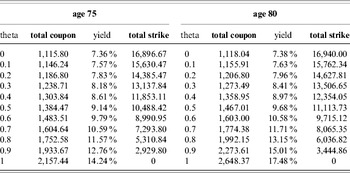
Table 2 presents some results with r=6.6% and a volatility of 18%, calibrated off recent NZ 10-year bond yields. At zero sacrifice levels, i.e. the strike price set equal to the forward value of the bond, the coupon enhancement is superior to the lifetime annuity (see Table 1). The individual has gained from the volatility, giving up any potential gain in the price at death. Note also that the individual remains exposed to any shortfall in the terminal bond value relative to the strike price (see below).
Trade offs for LCOs

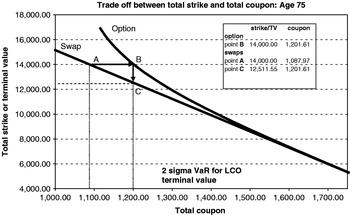
Figure 2 below compares the death option with the lifetime annuity swap in terms of the trade-off between total coupon achieved and the value at death. To generate this trade-off we vary the sacrifice ratio between 0% and 100% in each case, so that the latter becomes the generator of the trade off curves. There is little difference for high sacrifice levels. The latter means that the options are well out of the money and virtually equivalent to the swaps. Hence, the horizontal axis has been truncated to omit higher coupon rates received as a result of high sacrifice rates.
Market equivalences between LCOs and annuity swaps

A difference does appear for low sacrifice levels with higher lifetime coupons achievable in the options. However, the superiority of the options to the swap is more apparent than real, for it should be recalled that there is residual risk in the option case where the terminal bond price falls below the strike price and this is borne by the purchaser. If the individual dies at age T, then the terminal payoff is equal to min [P T*, X*(θ)]. The expected value, taken over the random time to death and the bond price, is certainly less than the strike price and would plot somewhere between the two curves of Figure 2, depending on particular assumptions about the drift of the physical bond price. In Figure 2, we have also plotted the two sigma (approx 5%) terminal value at risk (TVaR) for the lifetime coupon option, assuming that the term structure remains flat and there is zero drift in bond prices. At very high sacrifice ratios, the strike price is being set at a large discount to the current bond value and there is less risk of further loss at maturity. At lower sacrifice ratios, the strike is priced at or near to the money and there is appreciable risk to the terminal value.
In an efficient market, there should be no net pricing advantage of the death swap over the death option. A more appropriate interpretation is that the annuity swap represents a market certainty equivalent to the option. With reference to Figure 2, points B and C are certainty equivalent. Points A and B are not, for A carries no risk while B does, namely the bequest shortfall should the physical price fall below the strike price at maturity. Thus if the individual specifies a sacrifice ratio to give a coupon of $1,200 in each case, then the expected terminal payout under the LCO, taken over all possible times to death, is less than $14,000, which is the nominal strike on the option. The certainty equivalent terminal payout is given by $12,511.55, which is the terminal payout for the annuity swap that yields the same coupon.
It is worth remarking that the certainty equivalence involved is that of the representative market agent. Point B could still judged as be superior to C, where the individual was less risk averse than the market as a whole. As remarked earlier, this might happen because of the particular role played in retirement planning by the bequest, namely as a less sensitive item than is income while the individual is still alive. Thus the individual's risk premium in this respect could be less than that for the market as whole. The relationship with the remainder of the retiree's investment portfolio might also be relevant. The risk to the option arises when the time of death physical price drops below the strike price. Such a contingency suggests higher interest rates but by the same token, this might benefit earnings to that point on the rest of the portfolio, cushioning the risk of the bequest loss. Thus non-neutral risk considerations arising from lifetime risk profiling could lead to preferences for the option.
The LCOs might also have some psychological advantages over the straight annuity swaps. Suppose the latter were chosen with a non-zero sacrifice specified. The individual would know that if he or she died early, the sacrifice of terminal value would have been expensively bought, and a source of annoyance to the estate beneficiaries. The regret effect is less a feature of the option, where shortfalls in terminal value may well occur but are more a result of market forces on the price of the underlying physical, and outside the control of the individual.
Finally, the basic form of the compound solution as in Proposition 2 remains intact if the term structure is not flat. What happens in this case is that the current forward rates differ according to maturity. Given any maturity T, the pricing factor can be written as  and λ(θ) is the expectation of this over the time to death T, as in Proposition 2.
2.4 Directional risk shifting: calls versus puts
The effect of the LCOs is to shift risk forward in time on to the terminal value, so that the terminal value or bequest becomes uncertain downwards. This enables the individual to derive income from writing the corresponding call premium. A more common arrangement in the insurance industry is to set a floor to the terminal value, so that the individual is guaranteed a base amount and is paid more if the balance of the account at death is worth more. In option terminology, this would amount to the individual purchasing a put option on the terminal value. Doing this means that he or she is giving up existing income while still alive. This amounts to assuming that the individual is relatively less risk averse for lifetime income and more risk averse for terminal value. This could be justified in certain cases, e.g. where a dependent will remain present after the death of the retiree.
If both calls are sold and puts purchased, this amounts to a straight annuity swap. Appendix D shows that the lifetime annuity swap payoffs can be nested within the option framework by imagining that the individual both sells a call and buys a put, at the same strike price X=A. The total effect is to secure a certain payoff in any state of the world at death. The coupon achievable reduces to that of the annuity swap, demonstrating the consistency of pricing between the two structures.
2.5 Enhancements: credit risks, and institutional provision
A government instrumentality or another high-grade issuer could write the core perpetuity or long-term liability. Who would supply the enhancements, and is there is a role for the private sector? The two kinds of enhancements proposed differ materially in this respect according to who bears the credit risk.
LCOs are written by the individual and the purchaser pays the premium up front. The individual has no intrinsic exposure to the purchaser with respect to future cash flows. The purchaser is exposed only to the extent that the underlying core perpetuity (written by the government) is not deliverable for some reason upon death of the writer. However, this is a minor risk easily resolved by an escrow or senior claim arrangement on the underlying physical.
Thus there is no reason why the lifetime coupon options could not be arranged and purchased by banks, insurance companies, or fund managers. Indeed, there could be tranches of LCOs according to their expected maturity, which would thereby carry different degrees of interest rate risk. The earnings on such instruments could derive from fees, which would be set competitively, or from different views about the options volatility or pricing, in the normal way. In less developed or liquid capital markets, the option feature could be implicit in the form of callable bonds, with the enhanced coupons characteristic of such bonds.
The forward start feature could be structured as a swap, as earlier outlined. Banks would like such a swap because the individual pays up front, whereas the bank pays in arrears at the end of the zero coupon period. All that would be necessary is some institutional arrangement to bundle the multiplicity of small transactions into economic parcels.
On the other hand, individuals are now exposed to the bank. They have passed the early coupons through to the bank, but as retirees are to receive on the swap at a later date and effectively do so in perpetuity (especially if the death option is sold). Thus much depends upon confidence in the longevity of the banks or on the seniority of the swap liability should there be trouble. It could be pointed out that banks, especially clearing banks, are more closely supervised and therefore the more unlikely to fail in the first place, though the same security might not necessarily apply if the functions in question were to be undertaken by a special purpose subsidiary.
If this is thought to be a problem, an obvious solution is to have both the core perpetuity and the forward start written by the government instrumentality. However, this does increase the complexity burden for the latter – it is in many respects cleaner to have the government confine its activities to the issue of the core debt instrument and leave it to the market to devise enhancements, just as happens now with zero coupon bonds and coupon strips.
Lifetime annuities structured as a swap create a duration mismatch that is potentially adverse to the creating institution. From their point of view, the payments they are making are limited by the time to death of the individual and the need to pay a certain sum on death (A). But on the asset side, they are receiving a perpetuity. Corresponding to Table 1 above, Table 3 shows the durations for a lifetime annuity swap at various sacrifice ratios. They range from 4–7 years. Compared with the asset duration of 16.15 years for the perpetuity at 6.6%, there is evidently a substantial duration mismatch for the writing institution. The institution is exposed to the reinvestment risk of the coupons it receives on the perpetuity, as well as to the capital values of the perpetuity down the track that might be used to meet any bequest motives. Particularly damaging would be an initial fall in interest rates (penalizing the early reinvestment of coupons) and a rise later on (hampering the cover of any terminal bequest motive). To handle this risk it will be necessary for the institution to shorten the duration of its assets by means of further swaps or physical transactions.
Annuity durations

2.6 Adverse selection
The problem of adverse selection is well known in the annuities trade. Thus an 80-year old would receive the higher perpetuity payouts designated for this age. But his private information might well be that his health and life expectancy are more like those of a 75-year old. He will therefore end up receiving the higher 80-year old rewards for a longer period of time. Conversely, a 75-year old whose expectancy is less than the norm, and privately suspects it, will feel less inclined to contract under an annuity arrangement of any kind.
The adverse selection arises because the population of purchasers is not the same as the general population in a material aspect. Most solutions to this adverse selection problem impose conservative probabilities, relative to national life tables. So the death options or annuities for an 80-year old would be priced according to the 75-year old probabilities, so the payout would be the lower payout of the first column of the table. A similar problem arises where the options cannot be priced because the time to death cannot be perfectly hedged. In both cases, there is mispricing risk for the option.
The issue arises as to whether the possible enhancements are respectively neutral as to the incidence of adverse selection. Table 2 showed that the lifetime coupons achieved with the LCO arrangement are not much affected by the age at which the options are purchased. Only at higher sacrifice ratios, where they become priced like an annuity, does this become the case. This suggests that when taken near the money, the LCOs are less exposed to the adverse selection problem.
3 Debt as the physical underpinning
The defined benefit schemes earlier described all arise as enhancements of an underpinning debt issue as the physical. The debt has to be very long term and it has to have very high credit rating. Whose debt, and what economic considerations are involved?
(a) The private sector
Some corporations issue very long dated debt in the form of bonds, debentures or, more rarely, senior notes. Maturities of 20–30 years are reasonably common, but in recent years there have been some issues even longer. IBM and Apache both issued 100-year bonds (century bonds) in 1996, while Walt Disney's 100-year issue in 1993 quickly became part of financial folklore as ‘sleeping beauty’ bonds, taking the fizz out of Coca Cola's 100-year issue in the same year. These issues represented something of a throwback to practice at the turn of the century; in the 1890s, two thirds of bonds issued bore either 50 or 100-year maturities.
Private sector debt of this kind has the advantage of a higher yield, but has two disadvantages. First, the necessary degree of liquidity may be lacking. Second, credit ratings always refer to the here and now. A high current credit rating may have little reference to what can happen down the track following major change in product markets, technology or in corporate control. Doubts may still be felt as to whether the debt will still be viable or marketable in 20 years time. Moreover, the rating agencies can simply make mistakes; the underlying information may have been window dressed or adverse exposures hidden in special purpose vehicles.
(b) International agencies
Some international agencies issue very long dated debt, notably the World Bank and the Asian Development Bank (ADB). The former issues out to 50 years and the ADB to 30 years. Both are agencies of the UN, and their debt could therefore be considered to derive comfort from the implied backing of the OECD nations. Although residual doubts remain about the commitment of the US as the major contributor, the rise of China and India may in the future years shore up the financial support base. The World Bank and the ADB have AAA (S&P) or equivalent credit ratings, the highest possible. The debt of such institutions remains a possible underpinning.
The drawbacks might be liquidity (long-term issues are only one of many maturity bands in many currencies by these organizations), and the absence of any commitment to continue to issue in these bands. It cannot be expected that the World Bank should subscribe to supporting the retirement planning of OECD countries as a primary objective, even if it turned out to be a happy consequence.
(c) Sovereign or state governments
Long-term debt issues are once again back on the agenda for several OECD governments. The French and UK governments have both recently announced 50-year issues, with the German government reportedlyFootnote 3 also actively considering an introduction. Such moves have been driven by both demand and supply. There has been a recent upsurge of investor interest in very long dated government issues, driven in part by the appetite for market risk from hedge funds and wealthy investors, and in part from annuity funds seeking to better match their assets and liabilities. In addition, the need to rebuild decaying social infrastructure has helped to motivate the supply side.
Debt used to back retirement schemes could always be issued as part of the general government funding programme, backed by servicing out of general revenue. A more transparent arrangement, however, is to duration-match the debt with designated asset cover arising from a specific economic asset base. These could be described as long-term asset vehicles (LTAV). They are not set up just for the purpose of providing debt, but their existence can be exploited in a synergistic fashion to underpin a debt programme of the required kind. Depending on the nature of the assets, the asset cover could be used to back debenture issues, the collateral servicing to act as an alternative security to a general government guarantee.
Thus some governments, notably Norway, Ireland, New Zealand, and the State of Alaska, have established partly or fully funded retirement schemes. These dedicated funds are supported as to the inflow of investment monies via taxation or similar levies arising from current budget surpluses. The funds invest in a variety of assets, including equities, bonds, and real estate, both at home and abroad. A government instrumentality of this kind could supplement its inflow by issuing bonds to the general public. The maturity of these bonds could be tailored to the assets of the fund as a whole, which in any case would be fairly long, if not indefinite. The investment earnings of the fund underpin the resulting debt servicing, with the government as guarantor of the fund assuming any residual liability. The assets of the fund could alternatively be used to provide collateral, as earlier noted in connection with debenture bonds. If the fund is reasonably successful in riding the risk premium on equities and similar assets, it should generate a surplus or margin – indeed the investment target is commonly to exceed the return on government bonds. The investment margin generated by the issue of the new bonds is then available for consolidation with the fund's own general revenue and can be used for future distribution according to its established policy guidelines, including the social goal of subsidizing retirement income for those who cannot be counted on to make their own provision. Finally, the ability of the public to commit discretionary amounts for longer-term goals would enhance the savings performance.
A second type of LTAV might take the form of a public sector infrastructure fund, perhaps with the creation of a public infrastructure financing corporation as a special purpose vehicle of the government.Footnote 4 Infrastructure is by nature a long-term investment, matching the required maturity of the bonds. If such investment is to be worthwhile, it should generate economic returns either explicitly via tolls or other use charges, or implicitly via increased incomes and taxation to general government revenue. In the latter aspect, it has the advantage that the expected earnings stream encompasses externalities and is therefore not limited to income arising from the project itself. Moreover, these social returns should meet or exceed a benchmark provided by the government bond rate. On the other hand, the risks of the public sector infrastructure LTAV would also span pork barreling and other control or management risks as well as commercial risk arising from the projects themselves. Its debt would continue to be underpinned by a government guarantee. The creation of an infrastructure fund is therefore seen as a devolved part of the overall government debt program and administered in this context.
A third type of LTAV is the government agency, such as Fannie Mae or Freddie Mac in the US, which have a dedicated type of long duration asset backing and large-scale issue programs to finance them. See Fabozzi (Reference Fabozzi2002: ch. 5) for a review of US federal agency securities. State-owned enterprises for power generation etc. would also be of this kind. Another interesting possibility is the constructive use of government guarantees on debt issued by the private sector, e.g. to finance student loans. Debt of this kind could be packaged together by a special purpose entity.
The view taken here is that the long-term debt of national governments or their agencies is the most natural underpinning for certainty in private savings-based retirement income. At first sight, issue of more long-term public debt is an unpopular move especially among conservative commentators, who appear at times to forget the constructive role of debt in private enterprise. However, it need not be. The central issue is what is done with the proceeds, the asset cover, the risks involved, and the intergenerational debt-servicing burden. Moreover, negative current attitudes to public debt generally fail to consider its beneficial aspects, not least in helping to solve some of the economic discipline problems that are otherwise commonly associated with government deficits. In this respect, an advantage of debt is that it is a first call on the government's assets. Reneging or defaulting become much less possible and carry many more far-reaching penalties for the government. In other words, one is imposing a financial markets discipline on the government as our collective agent, in much the same way suggested by Jensen (Reference Jensen1986) for private sector debt. The same discipline forestalls the policy inconsistency problem referred to earlier. Once the debt is in the hands of the public, the government cannot change its terms; the holders have an asset secure against any changes in policy. The government has too much to lose.
Finally, debt enhancements such as those suggested in the present paper can assist the government in its own future obligations in adverse states of the world. For example, the LCOs can be regarded as callable bonds. When times are bad, interest rates are often low (Japan is a recent example). Exercise of the implied call option at a pre-set strike price will result in a gain to the government.
4 Concluding remarks
4.1 Lifecycle planning and portfolio layering
In theory, instruments such as lifecycle options or annuities can be encompassed in standard intertemporal models of investment and consumption. As earlier noted, the Merton model and its more recent extensions (e.g. Duffie, Reference Duffie1996: ch. 9) allow for a bequest motive on death as well as an ongoing consumption stream while still living. Expected intertemporal utility is maximized subject to a budget constraint that all trading strategies must be self-financing. However, there are some complicating factors: (a) Any intertemporal trading strategy must allow for a random time to death. The same problem creates a credit risk that limits the supply of debt and it would be more realistic to suppose that debt was simply unavailable past a certain age. This would mean that, at any time, consumption is limited by the available financial wealth, i.e. a cash in advance constraint at each point in time. (b) Even absent transactions costs, people simply do not have the time, expertise, or resources to implement an appropriate trading strategy, including any attempt to replicate the payoffs of options or swaps from more basic securities. The situation is analogous with the huge volume of swaps and options created for and used by the corporate sector in their risk management and funding processes. Provision of death options and swaps would effectively complete market instrument availability for the personal sector just as they do for the corporate sector.
The role of such instruments would be to simplify lifetime portfolio planning, even if this remains suboptimal in theory – a case of ‘satisficing’ rather than true optimization. There are now two sources of risk to handle, namely investment risk and time to death risk. The coupon stream available from derivatives backed by perpetuities of strong credit helps to assure the basic immunization tranche of future cash flow in old age. It remains compatible with an overlay of more aggressive investments that may carry higher yields at the cost of more risk. If financial circumstances allow it, the portfolio can be structured as a layered investment mix of successively higher risk classes. Only if the latter carried substantial short sell positions would the immunization function of the primary layer be endangered and few, if any, older people would have the credit or courage to do this. Derivatives such as LCOs or lifetime annuity swaps are open ended as to the time of death, and hence cover lifespan risk arising from this source.
The lifecycle planning prescription calls for an initial accumulation of wealth via any preferred mix of risky assets; the aim is simply as much accumulation as is reasonably consistent with desired consumption in this phase. By the time the retirement review and decision phase is reached, the individual will have decided what level of old age consumption is desirable and feasible, setting immunization levels for future cash flow. The basic tranche of cash flow needed to support this can now be locked in by means of forward start facilities, or by immediately entering into annuity or options arrangements if the desired conversion point is seen as sooner rather than later.
The choice between LCOs and lifetime annuity swaps is governed by preferences as between ongoing consumption risk and the bequest motive. Many people would have a more relaxed attitude to the latter, with lower risk aversion parameters, and might therefore choose options, which trade off terminal risk for a higher assured coupon while still alive. Circumstances such as the continued need to support dependents might force others to a more risk averse stance for bequests, and they would be more likely to elect the certainty of annuity swaps.
4.2 Other lifecyle derivatives
As a general proposition, the use of derivatives to provide certainty in retirement income has become quite common in recent years. A currently popular variant runs under the name of guaranteed minimum withdrawal benefits (GMWB). In addition to the primary portfolio of investments (usually equities), the investor acquires title to a parallel guarantee fund capable of supporting a designated annual withdrawal amount, so that the balance of this fund will diminish following any withdrawals that have been made. In effect, the investor is holding a call option on the primary portfolio value, with strike price set at the current value of the guarantee fund. The option can be exercised at any time after any qualifying period, so this is similar to a US call option.
The offering fund manager will bear the risk should the primary portfolio value fall short of the value of the guarantee fund. A common way of laying off the GMWB risk is for the manager to purchase long dated structured equity put options, which are in effect exotic options. Given high stock market volatility, this will cost money, and the cost must ultimately be borne by the investor via a charge on the earnings of the fund equivalent to an annual option premium, together with additional management charges. In a complete capital market it is likely that this sort of arrangement will be price-equivalent to just holding a coupon bond with credit rating equivalent to that of the fund manager or guarantor. It would be of future interest, and a possible marketing angle for either, to compare the returns available on a typical equity-based GMWB with those attainable by the more straightforward path of high quality LTAV debt with lifecycle derivatives attached.
4.3 Pricing technology
Proposition 2 and related results concerning the compound death option are appealing in form, and useful in illustrating some of the economic gains to be derived from LCOs and similar structures. However, the underlying Black option pricing model does make a number of simplifying assumptions, for example that the volatility of the bond forward rate process is independent of the time to maturity (T), and is moreover constant over time. The pricing technology can be extended in various ways. One is to assume a factor structure for the interest rate process, as in Cox Ingersoll and Ross (Reference Cox, Ingersoll and Ross1985) for the spot rate process, or the forward rate processes of Heath, Jarrow, and Morton (Reference Heath, Jarrow and Morton1992). An alternative is to specify stochastic interest rate volatility, as in Heston (Reference Heston1993), Ball and Torous (Reference Ball and Torous1999), Chacko and Das (Reference Chacko and Das2002) ; or a combination of stochastic volatilities and factors, as in Hoffman, Platen, and Schweizer (Reference Hoffman, Platen and Schweizer1992). Application of the Heston solution, in particular, would preserve the general form of expressions (2) and (3) of Proposition 2 by adjusting the two probabilities that make up the factor in λ(T, θ) in expression (Aiii) of Appendix C. An approach of this kind could be supplemented by analytical life table calibrations such as the Gompertz–Makeham component model (e.g. Gavrilov and Gavrilova, Reference Gavrilov and Gavrilova1991) to potentially derive closed-form expressions for the value of the LCOs. A further possible extension is to encompass formal models of credit risk for the underlying bonds, following Duffie and Singleton (Reference Duffie and Singleton1999), the general effect of which is to inflate the spot interest rate with a risk premium at any point in time.Footnote 5 This diminishes the rewards available under lifecycle swap or option arrangements, underlining the point earlier made as to the necessity for a high-quality credit to underpin them.
4.4 Some public finance aspects
Publicly mandated retirement provision has typically been viewed as a straight choice between public funded schemes with taxation as the ultimate source of funds, and privately sourced provision, with or without tax incentives. The former entails a moral delivery obligation on the part of the government, with risks of policy inconsistency. The latter imposes default and investment performance risk on both the annuity purchasers and the government as the welfare support of last resort, as well as considerable deadweight costs in the form of expensive management fees, always a first call on distributions whether good or bad. Neither arrangement is fully transparent as to where the risk is, who bears it, and whether it has been priced or otherwise factored into the decision to legislate for that type of retirement support.
The use of public long-term asset vehicles represents a more corporate model, with the same transparency of ownership and formal commitments to distribute the resulting free cash flow. As with a private sector corporation, LTAV funding could be via both debt and equity. Equity would be provided from tax income, either as general revenue or from special purpose taxation. Relying solely on equity is a limitation, just as it would be for most private sector corporations. This would be a valid model only when the government has set its face against any form of private ownership of the cash flows of the LTAV, perhaps on equity grounds. However, such concerns can be solved by the use of means testing and similar devices, which amounts to distributing the equity dividends to those whose circumstances most demand it. The debt of the LTAV is now privately owned but the equity is publicly owned, so that what is entailed is a mixed private–public provision for assured retirement income.
The issue of relatively large amounts of new public debt has potential consequences for interest rates (such as ‘crowding out’ private sector debt) and other externalities for the economy. To the extent that the debt has a captive market, namely of future retirees, the interest consequences need not be a worry, especially if the national financial market is linked to the global markets, with an almost limitless appetite for high grade debt. Indeed it could be argued that some OEDC countries have in recent years instituted debt redemption programmes that have actually penalized the efficient operation of financial markets, resulting in a shortage at the long end and contributing to an inverse term structure (New Zealand and Norway have been instances). In such circumstances, the effect of the new debt programmes could see a diversion of funds from the housing or stock markets and other competing assets. In itself, that may not be a bad thing, helping to curb speculative excesses in the latter, created in part by a necessity to build up cushioning capital for old age.
Moreover, if interest rates are already high, for foreign exchange risk premiums or other reasons, then the use of public debt to back retirement schemes becomes a constructive exploitation of what is otherwise an unavoidable evil. Small open economies commonly fall into this category, and so might larger economies from time to time as a result of public funding contingencies.
Finally, the problem of interpersonal equity arises in any mix of public and private retirement provision. Not everyone will have the wealth necessary to purchase the underlying debt instruments as a basis for the enhancement process. For such people, government support will continue to be necessary. As a consequence, a potential inequity arises as between those who have made their own provision and those who have not. Devices such as income or wealth testing for government or agency benefits only emphasize the inequity and the implied penalty for prudence. One solution is simply to make the same distribution to everyone, whether from general government revenue or from LTAV free cash flow to equity. A more economical solution might be to allow tax deductions or deferrals during the life of the recipient for the coupons received from the LCOs or annuity swaps, i.e. those based on the designated debt instrument. A distinction could be drawn between the coupon and bequest elements in this respect, with the latter not eligible for any tax benefit to the estate.
4.5 Operational aspects
The general idea of lifetime coupon options and related annuity products would not appear to be unduly difficult for the typical client to grasp, certainly no more so than current GMWB products based on equity portfolios. He or she is presented with: (i) a choice of sacrifice ratios upon death; (ii) what can be achieved under each as an augmented coupon stream while still alive; and perhaps (iii) a risk analysis based on VaR or a similar presentation for the terminal residual value of the physical bond, as in Figure 2. In addition to the current state and volatility of the physical bond market (which determines pricing), the actual choice made will likely depend upon a variety of personal circumstances: the existence of dependents and their economic prospects, the existence of other financial assets to provide further contingent bequest payoffs, and just who should bear their risk, if so. Advising financial planners might also consider further dimensions, such as just when the retiree should enter upon contractual schemes involving lifetime derivatives.
This leaves the final question as to who should be constructing and selling such products. Answers to such questions are implicit at various points in the preceding development. As noted in connection with pricing (Proposition 2 and Appendix B), it is not possible to devise market instruments to completely hedge every single life, so that a statistical approach is called for. The counterparty must therefore have commensurate size or resources, which means in practice a large fund, perhaps associated with a bank, to provide the necessary long-term credit comfort. It was also noted that in some smaller countries the state has assumed a funded responsibility for retirement assurance. To be sure, these enjoy arms-length independence from the government itself. But there is nothing to stop the government offering the fund very long dated infrastructure bonds or similar, and the fund using these to underpin an on-tap offering of retirement derivatives on an individual account basis. The fund would then on-sell the bonds to the retirees, on a linked basis with the derivatives attached, just as a corporate might offer convertible notes or similar option enhancements. As with a private sector provider, the physical bonds would conveniently be held in escrow on behalf of the beneficial owner, coupons passed through, and the residual passed to the estate upon death, or any alternative agreed prior date. Provision should also exists for unwinding or surrender, as of market values current at the time, just as is now the case for commercial forwards, swaps, and other OTC instruments.
In a more general sense, that is what the current proposals are all about. Financial market offerings are full of enhancements of one kind or another, mostly associated with equity or foreign exchange positions or derivatives. From such a viewpoint, enhancing bonds in the manner suggested in the present paper is a natural extension of financial technology, that can be used to construct a defensive support level for retirement funding. In this aspect, they share some features with the GMWB schemes that have proliferated over the last 3–4 years. To the extent that most of the latter are based on equities, and therefore subject to equity index volatility in their pricing, they are likely to be more expensive. That could be a further point of comparison for financial planners and advisers, once experience with both has accumulated.
Technical appendices
A Perpetuity properties
Forward price
Suppose at time 0 the term structure is flat at rate r 0.The forward price for a perpetuity is the same for any maturity T, and is given by the current price of the perpetuity.
Proof
For any fixed maturity T the coupons y earned between time 0 and time T are treated as a negative carry cost. Thus the forward price is given by

Note that if the term structure is always flat, the volatility of the forward price will just be the same as the volatility of the interest rate.
Duration and convexity
Let P be the price of the perpetuity, so  , where r is the current rate of interest (flat term structure). Modified Macaulay duration is
 and modified convexity is
 . The corresponding unmodified duration (or just ‘duration’) and unmodified convexity are respectively given by
 and
 . Relative convexity is a normalization that expresses the convexity relative to that of a zero coupon bond with the same duration:

Thus relative convexity for the perpetuity is equal to  . At low interest rates this is almost twice the convexity for the zero coupon bond of the same duration.
B Pricing the core bond option
Denote by Ω={w} an event space for the economy. Let  be a random stopping time corresponding to the individual's time to death. The price of the bond at death can be written as
 or just
 . If X is the strike price, the payoff to the call option is

Let ξt be the associated risk premium process in the economy (e.g. Duffie, Reference Duffie1996), and let r t be the spot interest rate at any time t. Using standard equivalent martingale arguments, the option premium at time t=0 can be written as

The current starting point time (t=0) will be understood in what follows and the expectational subscript 0 dropped.
Now assume that for any fixed time T, the state history of the economy up to any time does not depend upon whether our individual is alive or dead by then (the insignificant agent assumption). This is a strong path independence condition; an alternative is that there is no systematic risk to lifetables. Thus if ℑt is the natural filtration generated by the set of events  , then for any fixed time T, the random variables P(w,T), ξ(w,T), and
 are jointly independent with respect to ℑT.
Using the iterated expectation

Given the strong independence assumption, the inner expectation is identical with the price c(T) of an option with fixed expiry time  . Let the density of the time to death, given that the individual has survived to age a, be denoted φ(T; a). Then the price of the death option is given by

In what follows, the age at purchase will be suppressed, so we write c=c(a), similarly just φ(T), with the age dependence being understood.
Remark
The above approach technically requires that each individual's time to death can be continually hedged, which is obviously unrealistic, with market completeness problems. Thus it is better suited to pricing a large portfolio of such instruments. Even here it remains susceptible to misspecification or changes in the survival probabilities. Hence, a cautious approach is called for.
C Proof of Proposition 2
If the forward price for time T maturity is F, the option strike price is X, and the volatility of the forward price is σ, then the Black price is given by

For a perpetuity (given the flat term structure), F=P 0 the current price, and we set θ=1−X/F; or for a given sacrifice ratio θ, the strike price will be X=(1−θ) F=(1−θ)P 0. This gives the value of the call option as

Taking expectations with respect to the time of death density φ(T) gives the value of the first round option as c 1=P 0λ, where for brevity in what follows, we write λ(θ)=λ with the θ understood. Note that |λ|<1.
The first round call premium is reinvested in a new perpetuity to give a second round coupon of rc 1=yλ. A new call option is also written on the capital value c 1. This is priced as above with the same sacrifice ratio θ. It will have strike price equal to (1−θ)c 1=(1−θ)λP 0. The value of the second round option will be c 2=c 1λ=λ2P 0. This invested in a new perpetuity to give a coupon of rλ2P 0=λ2y. The capital sum is invested in a third round option with a strike price of (1−θ)c 2=(1−θ)λ2P 0.
The process is continued until convergence. The total coupon generated and available until death will be

The total value of perpetuities owned will be

and the total strike price value will be

D Pricing correspondences: lifetime annuity swaps and LCOs
Lifetime annuity swap payoffs can be nested within the option framework by imagining that the individual both sells a call and buys a put, at the same strike price X. The total effect is to secure a certain payoff X in any state of the world at death. The contingency table below illustrates, for a fixed time of death T; here P T is the price of the bond at that time.

This fact can be used to derive the swap coupon as an alternative to the expected PV approach. Using put–call parity in the Black model, and recollecting that F=P 0, the net premium income from the first round options, for a given time to death T, is obtained as

Taking expectations over the time to death density φ(T) gives the first round option premium as π1=θdP 0, where 
This is reinvested into a new perpetuity with coupon y 1=rθdP 0=θdy. The new perpetuity is used to write an additional call and buy a put, as before, and the process continued as described in appendix C for the straight call option. The resulting aggregate strike value and coupon are given by


Comparability with the lifetime annuity swap can now be achieved by equating the total strike price X b defined by expression (Aiv) with the desired terminal sum X a under the swap. Equivalently, suppose a sacrifice ratio  applies under the swap. Then the equivalent options sacrifice ratio is defined by

It can be verified that with this choice the lifetime coupons generated by the put~call position using expression (Av) are exactly the same as generated under the swap under expression (1) of the text, just as one should expect.