The force of opinion will finally destroy the slavery of abuses; natural justice will bring to an end the tyranny of usages; the courageous and enlightened patriotism that animates all the national representatives will at last achieve the most beautiful revolution accomplished on earth.
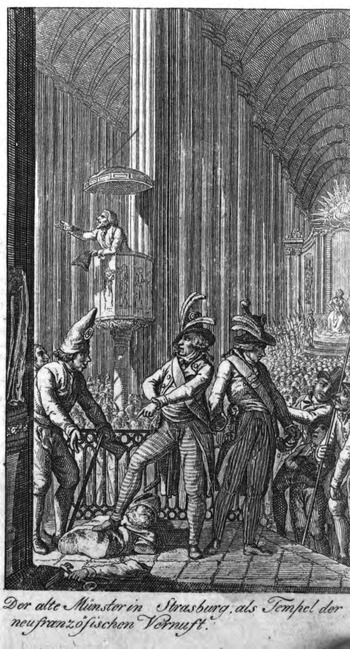
—Bertrand de Barère, Le Point du jour (1789)Between November 1793 and June 1794, French revolutionaries on orders from the représentants en mission Louis Saint-Just and Philippe Le Bas took over the twelfth-century Cathedral of Our Lady of Strasbourg (Münster), and, in the parlance of that time, vandalized the edifice.Footnote 1 Hundreds of statues adorning the Gothic basilica's nave were demolished as symbols of royalty and feudalism (see Figure 1); revolutionary slogans were carved above its side portals; and Antoine Téterel, an exceptionally zealous people's representative, proposed at a séance of the city council to demolish the cathedral's spire, the tallest man-made structure in the world at the time, so as to level this “pyramid erected by the people's superstition” in egalitarian fashion with the rest of the town.Footnote 2 As a compromise, a huge tin Phrygian cap was erected on the dome, covering its stone cross in order to accommodate the rites of the Cult of Reason, and later the Cult of the Supreme Being that succeeded Catholic liturgy at the basilica.Footnote 3 The triumph of Jacobinism over the Catholic Church was thus both visually and symbolically enshrined.
“The old cathedral in Strasbourg as temple of Neo-French Reason.” Etching in Heinrich August Ottokar Reichard, Revolutions-Almanach von 1795 (Göttingen: Dieterich, 1795), ad. p. 327.

Although this spurt of iconoclasm was, by some interpretations, a manifestation of revolutionary radicalism run amok to its logical Terroristic conclusion,Footnote 4 the Münster's polysemy in both an aesthetic and political key drew upon a much older tradition, extending back to the early Reformation. Couched in biblical and mythical imagery, the cathedral's spire was associated with the Tower of Babel and the Seven Wonders of the World of Antiquity (the Münster being popularly considered the eighth), fomenting a cultural identity that combined both local and cosmopolitan patriotism: in the former case manifesting Strasbourg's autonomous civitas status as an Imperial Free City, in the latter its importance on a grand European and global scale.Footnote 5 Yet the politics of iconoclasm during the Terror went beyond branding of the Revolution's symbolic discourse upon the Church's material “body,” as evidenced by deliberations in the Strasbourg city council and its correspondence with the National Convention through early 1794.Footnote 6 These exchanges suggest that local administrators, while adhering to the Convention's decree (of September 1793) to weed out symbols of royalty and feudalism from the French public sphere, were much more hesitant in carrying out similar directives to demolish religious symbols to make room for the successor revolutionary cults. The covering of the basilica's cross rather than its demolition (seven months after the Convention's decree to that effect was issued) manifests the presence of a silent local opposition in Strasbourg to the Convention's de-Christianization measures.Footnote 7
This saturation of meaning associated with the Münster, however, was not confined to French responses alone. Although political and religious undercurrents were compounded in Strasbourg with local civic identity as an antagonistic alternative to the symbolic discourse of central power in Paris (as also evidenced by the persistence of Catholic devotional practices in the French countryside), the cathedral's German heritage commanded a different layer of cultural meaning. Operating on a spectrum that ranged from veneration of the genius of one of its medieval builders, Erwin von Steinbach, to interpretations of its Gothic aesthetic as a quintessentially Germanic style, the cathedral's spoliation distilled the concerns of the German pro-revolutionary radicals residing in Strasbourg about the Revolution's veering off track to the betrayal of its erstwhile emancipatory promise, highlighting the emergent nexus between aesthetics and national identity. The debate on the significance of revolutionary vandalism thus took on decidedly national colors. In France, the post-Thermidor debate featured as part of a wider attempt, political as well as semiotic, to disarm the virulent political rhetoric that stoked the Jacobin Terror's physical violence and replace it with a more moderate style of politics.Footnote 8 Its German counterpart, in contrast, focused its criticism on the paradox posed by aesthetic violence, namely, that as an attack on the arts, it constricted the Revolution's aspiration to politically represent the moral autonomy and freedom of will of independent individuals. For these critics, arts rather than religion served as the guiding force for the education of mankind: because they express the truth in symbols, the arts were the first form of science and because they taught mankind taste and decorum—the need to restrain cruder feelings and desires—they became the basis for morality. These critics positioned themselves therefore not only as defenders of the Enlightenment ideal of man's capacity for perfectibility, but, more importantly, as advocates of the arts’ emancipatory role in fomenting aesthetic self-determination, thus prioritizing sensibility over reason.Footnote 9 This distinction ultimately resonated in their outlook on the prospects of German collective political emancipation as well; given their growing disillusionment with the change in the Revolution's course, it is little wonder that a hermeneutics of emotions became their vocabulary of choice.Footnote 10
This article situates such interpretations of the meaning of revolutionary vandalism within a history of emotions, thereby offering a new perspective on the contentious historiographic terrain of the French Revolution's reception and its dissemination in the German-speaking sphere.Footnote 11 It focuses mainly on the works and political career of Georg Christian Wedekind, a German radical who became a central player in the debate on vandalism and historical memory in Strasbourg. Wedekind's case study demonstrates that although the bulk of the German critique of revolutionary violence centered on the Terror regime's excesses, it was most unequivocal in its condemnation of revolutionary vandalism, going to the heart of revolutionary ethics. Drawing on the traditions of moral sentiment and German aesthetics, Wedekind and others came to view the continued support of the French revolutionary cause as anathema to protecting German historical and cultural heritage, and the Revolution as a decidedly French affair that defied cultural translation.Footnote 12 The critical vocabulary they produced, it is ultimately argued, although failing to sustain a full-fledged German revolution, nevertheless informed other projects of community building and brought about enduring political change in the German states. The article thus proceeds via discussion of three main elements in this debate: the critique of revolutionary vandalism and its implications for historical memory, artistic preservation, and reconstruction; the dialectics of moral sentiment, aesthetics, and national identity; and the Terror's interpretation as anathema to cultural autonomy and political freedom.
Who Is a Vandal?
The most comprehensive responses to revolutionary iconoclasm in the aftermath of the Jacobin Terror were the reports submitted to the Convention by the people's representative and constitutional bishop of Blois, the Abbé Henri Grégoire (1750–1831).Footnote 13 In his Third Report on Vandalism of December 1794, Grégoire singled the Strasbourg basilica for special mention:
In eighteenth-century Strasbourg, the Alani and Saracens have been surpassed; the immense and superb basilica of this city is unrecognizable: statues in their thousands have fallen under the ferocious destroyer. Added to this cost is the considerable sum paid to the attackers who degraded this monument, whose construction lasted 270 years, and that antiquity designated as the eighth wonder of the world. A friend of the arts (Wedekind) published a work in German that must transmit to our descendants this horrible image. He wishes to assemble some of the salvaged ornaments next to a pyramid, upon which the following inscription would be engraved: “Citizens of Strasbourg, may this heap of ruins serve you as a salutary lesson never to allow the system of terror to be reborn amongst you. Think of the verdict of posterity.”Footnote 14
Although Grégoire's description of the scale of destruction was conspicuously inflated for rhetorical effect, this emotionally charged excerpt is nevertheless instructive for making explicit the homology in Thermidorian thinking between vandalism as aesthetic violence on the one hand, and the Terror as political violence on the other.Footnote 15 Specifically targeting the image of “Robespierre the vandal,” the “antivandal” movement after Thermidor (inspired by Grégoire) exploited a key feature of Enlightenment ideology that identified tyranny with ignorance and populist anti-intellectualism.Footnote 16 But the inflated usage of “vandal” as a political slur both during and after the Terror (the Hébertists’ proscription as a “Vandal and Visigoth faction” and the uncovering of a supposed “vandal plot” against the arts are cases in point) established vandalism's paradigmatic political significance, which was carried over into Thermidorian discourse. The metaphorical implications of the historical allusion to the Germanic Vandals, who sacked Rome in the fifth century CE, was also not lost on contemporaries; the French Republic's self-image as a new Rome, a beacon of civilization on a quest to liberate the rest of the enslaved world, invariably cast other nations—and in this case, the Germans—as its uncivilized underlings.Footnote 17 Yet the fact that the majority of acts of spoliation came from within the revolutionary ranks and were committed in the name of the revolution challenged its self-image as both inheritor of the Enlightenment's legacy and as a representative of a new historical phase. The use of vandalism as a watershed demarcating the boundaries between universal absolutes of “civilization” and “barbarism” therefore served to establish a critical distance between the Thermidorians and what they deemed as the tainted legacies of both the old (royal) and new (Terroristic) barbarisms.Footnote 18
These fractious attitudes toward revolutionary iconoclasm resonated even louder in the course of the Revolution's multilayered exportation beyond French borders, particularly influencing its reception in the German-speaking sphere. The German cohort of revolutionary fellow travelers, political activists, and men of letters—the designated radical agents of the French Revolution's cultural transfer—mostly experienced a crisis of faith with the onslaught of the Jacobin Terror. Whereas the majority of the German liberal literati, initially enthusiastic about the Revolution, had reneged when France's 1792 defensive war transformed into an offensive war of conquest of German territories, the radical cohort exhibited a more complex range of responses. Although some were complicit in spreading the Terror regime's policies and mostly succumbed to its annihilating factional strife, a more substantial group, though distressed by the Revolution's reversal of its 1789 cosmopolitan promise in favor of self-serving French national interest, nevertheless remained loyal to France, in some cases until the demise of the Napoleonic empire. The Revolution's aesthetic violence, however, served to conclusively dissolve their idealism about its universally humanitarian prospects.Footnote 19
Following the Austro-Prussian retaking of parts of the previously French-occupied Rhineland in late 1793, the Alsatian city of Strasbourg attracted a host of German radicals seeking refuge from Prussian persecution. Taking advantage of the city's status as a cultural borderland between the French Republic and the German principalities of the Holy Roman Empire, with its mixed German and French population, these dyed-in-the-wool revolutionaries provided the backbone for the regeneration of the Strasbourg Society of the Friends of the Constitution as a Jacobin club and arguably contributed to its increasing political radicalization during the Terror, which capitalized on the rising social tensions since 1790 between Francophone Catholics and pro-German Lutherans.Footnote 20 Among these exiles was Georg Christian Gottlieb Wedekind (1761–1831), the eponymous “friend of the arts” of Grégoire's Third Report, previously employed as physician to the Prince Elector of Mainz, and the chief ideologue (along with the naturalist Georg Forster) of the short-lived Mainz Republic.Footnote 21 Having been a witness to the incidents of revolutionary vandalism in Strasbourg (which, apart from the cathedral's spoliation, included the imprisonment of some university professors and the relocation of the municipal pigsty next to the Strasbourg library),Footnote 22 Wedekind was impelled to write an open letter to Grégoire after the latter's Second Report on Vandalism was submitted to the Convention on 24 October 1794 (8 Brumaire, III).Footnote 23 Given his own shift to moderate politics in the aftermath of the Terror, Wedekind found Grégoire's restorative attempts—historical, political, and aesthetic—resonating with his own concerns about reforming French political culture. As a physician and man of letters, he also shared Grégoire's veneration for scientific knowledge and opposed the anti-intellectual stance that led to the Convention's abolishing the royal Academies of Science in August 1793. However, he was less keen than Grégoire, the constitutional bishop, about vetting republican sentiments through Christian moralism.Footnote 24 The more implicit feature in Wedekind's view was that revolutionary vandalism in Strasbourg entailed French aesthetic violence directed against German emblems of cultural identity. Aesthetic violence had thus ceased to operate as a universal weapon indiscriminately wielded against the remnants of the Old Regime (and therefore legitimate from a Jacobin point of view) and transformed into a premeditated policy of systematic destruction and plundering to consolidate France's cultural hegemony in the course of its continental expansion. Famously, the Apollo Belvedere and the Laocoön, along with other classical and Renaissance masterpieces, were taken from the Vatican following Napoleon's Italian campaigns and paraded in a triumphal procession in Paris in July 1798. Housed at the Louvre, they were repatriated only in 1816.Footnote 25 Wedekind's letter to Grégoire thus reiterates familiar tropes in the critique of revolutionary violence, pointing out vandalism as anathema to the Enlightenment and by extension to the Revolution as its ideological successor; historical preservation as a pedagogical tool for the education of future republican generations; and the multilayered effect of art on the senses as a cultivator of individual autonomy. Yet underscoring all of these arguments was a differentiation between French and German emotional experiences as conduits to the production of civic virtue, which accentuated their character as communities of sentiment.
Wedekind's motivation to report the vandalistic abuses in Strasbourg to Grégoire stemmed primarily, by his own admission, from civic probity and republican duty. He stressed his political neutrality in the debate on vandalism, lest his comments be ascribed to factionalism or personal hatred, “to which is sometimes attached the issue of national honor,” while clarifying, nonetheless, that he was not accusing the “wild, misguided rabble” for these excesses but rather their leaders because “one must distinguish between the instrument and the hand that wields it.”Footnote 26 The latter, he claimed, could not be oblivious to the fact that attacking the Enlightenment, “which had lifted from us the monarchical yoke,” must lead directly back to unbridled despotism, and though the counterrevolution had not reached these extremes yet, the leadership's betrayal had made the people hate the Revolution as a consequence.Footnote 27
With regard to Grégoire's quest for historical preservation, Wedekind raised both aesthetic and political considerations. Discussing the cultural artifacts of antiquity, “previously possessed by absolutist princes and their lackeys for their idle and childish pastime,” Wedekind argued that Grégoire's reports had shown his compatriots how such works of art would serve a free people. He conceded that a negligible minority of the cathedral's demolished statues did not possess exceptional artistic merit: some depicted scenes from Christian “mythology”; others were the equestrian statues of the Merovingian kings Clovis, Dagobert, and Rudolph of Habsburg, who were stripped of their stone scepters and crowns by municipal decree already in October 1792.Footnote 28 Nevertheless, Wedekind claimed, they deserved their place “in the history of the Fatherland.”Footnote 29 Could anyone be earnestly concerned, he asked, that these statues would provide more nourishment for fanaticism and royalism than images of Jupiter, Bacchus, or Minerva? Catholic iconography, when purified of its religious underpinnings, should likewise be deemed inoffensive, he claimed, albeit remaining silent about the Protestant iconoclasm that had swept sixteenth-century Strasbourg and also involved stripping the Münster of its prominent Catholic hallmarks.Footnote 30 In a rather transparent allusion to the ambiguities inherent in the French desacralizing mission, and to France's paradoxical role as both conqueror and liberator of German lands, Wedekind further claimed that during their conquest of the German provinces, the Roman proconsuls had not destroyed any old monuments or pagan temples on the banks of the Rhine, for “they knew that one does not instruct the people by embittering it.”Footnote 31 The instructive benefits of historical preservation, in contrast, could subsume even the “memento of nonsensical ideas, in order to warn our descendants, so that they do not become entangled in them again.”Footnote 32
The Revolution's historicity was nevertheless not an act of creatio ex nihilo: rather than accept Jacobin abstractions of universal reason, Wedekind advocated that “[i]ts own history, rather than Reason, secures the people against the moral and political maladies of the past.”Footnote 33 As he elaborated:
Fellow citizens! If you wish your descendants to remain free republicans, conserve for them the monuments of slavery. Understanding will grow stronger through the senses. Sensory perception of the images of the erstwhile tyrants, accompanied by good instruction, will win over your young against these monstrosities much better than theory alone. In comparison, while the destruction of the Bastille was necessary, had it not been demolished it ought to have become a site of pilgrimage for young republicans. … Should everything that reminds one of bygone times vanish, the next generation will be like children consuming poisoned berries, for not knowing that they are poisoned.Footnote 34
It is for this reason that aesthetic violence, in Wedekind's view, compromised most acutely the Revolution's capacity to emotionally mobilize its followers. The Münster featured not only as a sacred relic or historical monument, but primarily as a symbol and conveyor of communal identity. Its disfiguration, while abasing the local citizens to complicity in vandalistic acts, also detached them from their historical roots and sense of communal belonging: “In order not to become suspects themselves, these pitiable citizens felt that they had to participate in this abominable hypocrisy, as if they took part in a patriotic heroic deed, subscribing to the desecration of a monument that numbered among the first rank of artworks in the world, and whose sight inflamed the Strasbourg citizens with more patriotism than all the enforced propaganda processions could lend Catholicism.”Footnote 35
In no small measure, Wedekind's admonitions also signaled the unfolding crisis of the Revolution's appeal to its German acolytes as a system of symbolic meaning. By destroying all emotional attachment to a framework of historical reference other than its own originating myths, the Revolution created an emotional void that its republican credo and symbolic practices were hard put to fill. Most visibly, the revolutionary festivals, which orchestrated a “transfer of sacrality” from the Gregorian to the revolutionary calendar as part of the Revolution's reorganization of space and time, experienced a dramatic decline after 1794.Footnote 36 When the Directory attempted to import them en masse to the Rhenish departéments after their annexation to France in February 1798, the festivals, although acculturated to suit local German customs and given German names, were perceived as little more than the cultural arm of the French occupation and largely failed to engender revolutionary enthusiasm among an already hostile German populace.Footnote 37 In an attempt to keep them alive, the Directory issued several “republican manuals” authored by one of its members, Louis Marie de La Révellière-Lépeaux, as well as by François de Neufchâteau, Minister of the Interior.Footnote 38 Addressed to the departmental commissars and intended to codify republican law, customs, and public festivals, Neufchâteau's Le Manuel républicain (1799) also aimed to reintroduce pre-revolutionary history into public discourse by designating Gabriel Bonnot de Mably's magisterial Observations sur l'histoire de France (1765) as its second volume. Neufchâteau reasoned that, in order to change the nation's emotional economy, “acquaintance with the history of the monarchy is indispensable. It is the most suitable way to make one love the Republic.”Footnote 39 Although these historicist dialectics (which, as seen here, deployed emotional politics quite openly) arose from the caesura that the Revolution attempted to establish with absolutism, for German republicans, however, the discussion of historical heritage hearkened to a more veteran debate about the role of art in formulating moral sentiments.
Moral Sentiment and the Language of Monuments
The architecture and monuments of the French Revolution intrinsically entailed a visual language that intended to convey republican ideas through form and style. The continued presence of Old Regime cultural artifacts as symbols of oppression and despotism, however, presented a paradox that remained unresolved throughout the revolutionary and post-revolutionary period. While Old Regime monuments were widely considered offensive to republican sensibilities and hence condemned to erasure, even the outright obliteration of the past frequently entailed its metamorphosis, sometimes literally, into the present's pedestal, as was the case with the graves of the Capetian kings at the convent of St. Denis in Paris.Footnote 40 Emergent historicist sensibilities began supplanting merely antiquarian ones with regard to artifacts meriting preservation. From François-René de Chateaubriand to Alexis de Tocqueville, the Old Regime gradually transformed into an expanse of historical time worthy of commemoration due to its constitutive role in French national patrimony. Thus, François Volney's Les Ruines (1791), a secularist attack on the corrupting power of religion as a catalyst in the decline of ancient civilizations nevertheless opened with an invocation to the ruins of the past as educators of the future: “O Ruins! I will return to partake in your lessons! I shall place myself again in the peace of your solitude; and there, removed from the afflicting spectacle of the passions, I will cherish the love of men and dedicate myself to their happiness, and my own shall be composed from the idea of hastening theirs.”Footnote 41 But this cosmopolitan preoccupation with the abstract happiness of humanity diminished during successive revolutionary phases in favor of the concrete happiness of France. This shift manifested also in the prevailing regime of historicity following Thermidor that saw the Revolution's significance reframed within a narrative of French national history.Footnote 42 For instance, in the context of his efforts to eradicate patois and institute French as a unified national language, Grégoire's early reports to the Convention manifested this attitude toward national sentiment as inscribed in architecture: “For its public monuments, as for its currency, the French people should only allow the national idiom. The walls, marble, and brass speak to all sans-culottes, contemporary and future, in the language of liberty.”Footnote 43
Such sensibilities about architecture reflecting national identity echoed also among German commentators, where the language of monuments received literal manifestation in a pamphlet penned by the former Franciscan priest Eulogius Schneider. As the public prosecutor of the Strasbourg Revolutionary Tribunal, Schneider was complicit in the spread of political persecution in late 1793, for which he was later arrested and executed in Paris in 1794.Footnote 44 His German national sentiment, however, was belied in the pamphlet's imaginary conversation between the cathedrals of Strasbourg and Freiburg, on opposite banks of the Rhine. The Münster's alarum of la patrie en danger prompted the Freiburger to ask it why it had chimed its bells: “Has the Most Christian King come to visit you? Or is it our Holy Father, the Pope? Have your Jews and Protestants converted? Have the young girls of Strasbourg become religiously chaste all of a sudden, or have its women given up taking coffee in the afternoon?” The Münster's retort did not mince words:
Citizen Cathedral,
I chimed because I am a Republican, and you have not understood me because you are a slave. Here is my response to your silly questions: The Most Christian King no longer has a head, the Holy Father has no hands; not only Jews and Protestants, but the entire nation has converted to the Rights of Man. Our girls, thank God, have no penchant for monastic life … But I have also chimed for the burial of all despots; I announced our Revolution in Germany and when I speak again, all the earth shall tremble. For the sake of the ashes of the great Erwin [von Steinbach], the creator of us both, I summon you to awaken the people of Germany, to call upon them to claim their eternal rights. The time has come, why are they still tarrying?Footnote 45
This vacillation, ostensibly giving rise to later perceptions of Germany as a “lagging nation” possessing a “peculiar path” into modernity, could also be seen as one of the prime impediments to the Revolution's successful cultural translation in the German-speaking sphere.Footnote 46 Causes for stoking German disenchantment with the Revolution were legion—from abhorrence at the Revolution's excesses, to the physical realities of French military occupation in the Rhineland in the form of forced requisitions, compulsory conscription, and the censorious clamp on free press.Footnote 47 And yet, Wedekind's aesthetic advocacy for the preservation of the Old Regime's cultural artifacts hints at a more subtle causality underlying this German “flight from revolution”: one that was anchored in the Old Regime's status as a bulwark of historical heritage, cultural identity, and emotional attachment, which, moreover, symbolized an indigenous essence of communal identity posited against imported foreign models. Past cultural artifacts, cleansed of their meaning as emblems of despotism and feudalism, could be imbued with renewed republican and national significance. But whereas French revolutionaries perceived the Revolution's constructive role via its destructive annihilation of a supposedly barbarous past, Wedekind's restorative approach, strongly reliant on the interrelationship that developed in Aufklärung thinking between aesthetics and morality, reveals a more complex connection of emotional economies and their political significance.
The pre-Kantian philosophy of aesthetics, as developed since the mid-eighteenth century by Alexander Gottlieb Baumgarten and the Wolffian School, aligned toward the end of the eighteenth century with moral sentimentalism to counter the reigning zeitgeist of rationalism. Even Immanuel Kant's rejection of emotion as too subjective a faculty for grounding universal ethics—a stance dating back to his grappling with Scottish moral sense theory in the 1760s—had changed by the time of his Critique of the Power of Judgement (1790). Kant conceded that his previous definition of transcendental reason, which purposefully excluded the psychological and affective faculties of life, made the purely cognitive recognition of duty an insufficient inducement toward moral action.Footnote 48 Deeming aesthetic education as oriented toward art as well as conceived by it, the beautiful therefore emerged as a symbol of the morally good because aesthetic judgments were seen as analogous to moral judgements, and the autonomy of art reflected the autonomy of man to make aesthetic judgments.Footnote 49 Good taste, however, was no guarantee for good morals; in Kant's view, “virtuosi of taste, who are not only often but even usually vain, obstinate, and given to corrupting passions, could perhaps even less than others lay claim to the merit of devotion to moral principles.”Footnote 50 Evidently, the cultivation of taste, beyond its restrictive elitism, also posed the problem of providing guidelines to moral edification.
Friedrich Schiller's influential On the Aesthetic Education of Man in a Series of Letters (1793–1795) sought to reconcile the Kantian critique of taste with the moral sentimentalists’ attempt to identify feeling in the ethical domain, aiming to demonstrate how art might contribute to the realization of true human freedom.Footnote 51 Although claiming to uphold the main tenets of Kantian ethics, Schiller pushed further the connection between aesthetics and morality in an attempt to resolve the conundrum posed by the course of the French Revolution, namely, Why did an enlightened struggle for freedom and human rights descend eventually into terror and violence?Footnote 52 The whole French experiment, as Schiller saw it, was a coercive imposition of abstract moral virtue upon an underprepared populace set against a social background that negated the very principles of enlightenment and autonomy. This debacle of translating moral principle into political practice, however, revolved around the misuse of human feelings. Although the archetype of man as Idea (idealen Mensch) exists as a potential in every historical human being (Mensch in der Zeit), Schiller claimed, the manner of realization of this potential differs markedly. Either the state asserts itself in individuals by “suppressing empirical man, [thus] annulling individuals” or the individual himself becomes the state, “and man in time being ennobled to the stature of man as Idea.”Footnote 53 Although both these approaches fulfill the categorical imperative of adopting the moral law, a world of difference exists, however, from the perspective of feeling, between an authoritarian state's engineering ideological homogeneity as a surrogate for true virtue and its achievement, in contrast, by autonomous subjects operating in the light of ethical principles, thus fulfilling the unity between the “invisible realm of morals” and the “sensible realm of appearance.”Footnote 54 Moreover, a rational adoption of principles that are inimical to one's feelings would countermand the free act of an autonomous agent, which stems from an unfettered subjective will, making it instead the action of a “barbarian”: an uncivilized being who rejects nature (i.e., feeling) in favor of reason.Footnote 55 Individual receptivity to moral teachings, Schiller famously claimed, must not be a blind following of rational maxims, but rather be cultivated through sensibility: “[t]he way to the head must be opened through the heart. The development of man's capacity for feeling is, therefore, the more urgent need of our age, not merely because it can be a means of making better insights effective for living, but precisely because it provides the impulse for bettering our insights.”Footnote 56
But how could aesthetic appreciation cultivate moral sensibility and autonomy? Schiller, albeit inconsistently, tried to answer this question by positing two incompatible arguments. On the one hand, he saw aesthetic education serving the realization of morality and thus also the establishment of a free society, famously claiming that “if man is ever to solve the problem of politics in practice he will have to approach it through the problem of the aesthetic, because it is only through Beauty that man makes his way to Freedom.”Footnote 57 On the other hand, he conceived aesthetic experience within social and interpersonal relations as the realization of morality and human emancipation. In the first instance, aesthetic experience was devised as a means serving an external, heteronomous end. In the latter, it was seen as an end in itself, defining even morality and the creation of a free society in aesthetic terms. Morality thus does not present itself as an external imposition upon the individual in the form of “laws” or “duty,” but rather as a system of unmediated aesthetic interrelationships among the disparate members of society, operating autonomously.Footnote 58 The possibility for engendering a new social reality, therefore, is grounded in each individual's capacity to aspire to achieve the ideal of the individual, or, in other words, transcend his or her own historical individuality and assume the ideal characteristics of the species. Although Schiller maintained that aesthetic beauty by itself has no direct moral purpose, it nevertheless possesses the power to reconcile man with his alienated nature by endowing him with the freedom of self-determination.Footnote 59 In order to remain a vital human activity, he claimed, art must be capable of touching man's moral life through its restorative and integrating effect.
Georg Wedekind shared some of Schiller's insights in favoring precognitive intuition as a surer guide to moral sentiment, but went further in setting boundaries to reason as the basis for moral action—an element that insinuated itself in his writings both as a physician and as a political activist. In an article he published in 1785 in Gnōthi sauton (Know Thyself), Karl Philipp Moritz's journal of empirical psychology, Wedekind had already begun exploring the rudiments of a theory of emotions with regard to the influence of presentiment, which he labeled (following Leibniz's and Christian Wolff's epistemology) as “dark” or “opaque” ideas (dunkeln Ideen).Footnote 60 Narrating the case history of one of his patients, a pastor's wife from Diepholz, Wedekind recorded how after keeping vigil on the woman's health for six days he determined that her ailment—a case of mild fever and neuralgia—was negligible, and departed to attend to other business in Göttingen. Perturbed nonetheless by “anxious visions” (ängstliche Vorstellungen) and an “inner feeling” (innere Empfindung) that, against his reasoned medical judgment, the woman might be suffering from some undetected malady, Wedekind hastened back only to discover that his patient had succumbed to her illness and died.Footnote 61 What was the source of this precognitive intuition? While admitting to possess a fecund imagination, Wedekind assured his readers that he was not one of those “saccharine, sentimentally modish doctors, but rather one of rigorous seriousness.”Footnote 62 And yet this “dark,” intuitive feeling commanded his action spontaneously in a way that his reason failed to do.Footnote 63 Discerning between “dark” and “clear” perceptions was a similar stumbling block of defining willful action for thinkers in the moral sentiment tradition, such as the philosopher Karl Wilhelm Jerusalem, whose work Wedekind referenced in this essay.Footnote 64 For Jerusalem, control of one's passions by reason meant the ability to turn obscure perceptions into distinct ones. The obscure perceptions are linked with vice and moral weakness through their association with physical urges and involuntary conduct, whereas the clear, distinct, and rational ideas are connected with virtue and self-control. Wedekind, while perturbed by the involuntary influence of emotions on the will, was nevertheless more receptive to the intuited emotional response that is closely associated with aesthetic sensibility. Could not the same intuition, he asked, be applied to moral sensitivity (moralischen Reizbarkeit) as well?Footnote 65
Wedekind revisited this issue in an address to his comrades at the Mainz Jacobin club in late 1792.Footnote 66 The question before the plenary, at a time when the liberal core of the French Revolution was quickly eroding, was whether to grant the popular societies the power to censor their members’ free speech for the sake of maintaining ideological purity. Although such a censorious environment might be considered anathema to the principle of individual autonomy, it was a necessity, Wedekind argued, because public opinion guided by reason alone was insufficient for weeding out corrupt moral behavior. This is because, he claimed, “the motive for an action we perform is always in the emotional capacities, in the will. The principle of causation is always a feeling, or an affect, which reason, assisted by another affect may be able to suppress, or rather, depending on the circumstances, may modify, but which it cannot create.”Footnote 67 From a sociological point of view, he argued, the most beneficent of all the affects is love. Taken literally, it is the glue that draws the sexes together. More generally, however, it is the core of sociability, “an inner drive that draws us to companionship with our equals, towards moral assimilation … Wishing our peers’ approval impels us to want others to appreciate what we do, and to feel what we feel: the first impulse is called honor, the latter sympathy.”Footnote 68 Honor, however, as the Baron de Montesquieu pointed out, is by nature a form of egotistical conceit, a demand for preference and distinction that achieves its most developed manifestation in monarchical regimes.Footnote 69 Sympathy, in contrast, promotes egalitarian assimilation with one's peers and the investment in the correction of injustices done to them, based on fellow-feeling. By this logic, only a reliance on moral sentiment can allow one to exercise discerning judgment between egotistical motivations, on the one hand, and those that promote the public good and engender communal spirit (Gemeingeist), on the other. Wedekind therefore envisioned the popular societies as laboratories of social and psychological engineering, where emotions and ideas are refined via public deliberation toward the perfection of moral character.Footnote 70 Although such morally homogenizing attitudes may resemble the Rousseauist volonté générale, Wedekind maintained that consent could not be fabricated by external peer pressure; rather, the production of aesthetic nature had to evolve from every individual's moral deliberation rather than from rational maxims if political consensus is to emerge.
These attitudes, finally, also undergird Wedekind's feelings of awe and admiration elicited by the Münster, which, as a German Gothic masterpiece, he claimed, made one appreciate the fantastic, centuries-long industriousness of one's forefathers.Footnote 71 The revival of Gothicism was on the rise since the publication of Johann Wolfgang von Goethe's essay Von deutscher Baukunst (On German Architecture) in 1772 that appeared the following year in one of the founding manifestos of the Storm and Stress Movement, Von deutscher Art und Kunst (On German Culture and Art), edited by Johann Gottfried Herder.Footnote 72 Later appropriations saw neo-Gothicism as representative of a more populist and historical, and hence national, form of art, intended to replace the Classical and Palladian styles in vogue at the time.Footnote 73 Gothicism's reemergence as a German national style introduced an important shift in Wedekind's aesthetic disposition as well: while both Kant and Schiller attempted to keep separate the realm of the sublime from that of the beautiful in the appreciation of art, Wedekind's stance fused them by transforming the more detached experience of awe and admiration associated with the religious sublime into feelings of love associated with the aesthetically beautiful.Footnote 74 This move from the emotionally dissonant to the consonant and harmonious also enabled Wedekind to see in the Münster a conduit for translating individual sensual experience into communal feelings.Footnote 75 Emotional transfer operated here by mimesis: in the same way that imitation in the fine arts leads to propagation of the beautiful as a norm in society, the imitation of the good and noble qualities in other people enhances communal moral sentiment.Footnote 76
In his Third Report, Grégoire also emphasized the tie between the beautiful and the good as bound together by aesthetic instruction.Footnote 77 When he turned once more to discuss the effect of the Strasbourg cathedral, however, he distanced himself from universal idealism in favor of a more particularized, national outcome:
The same reflections [about artistic conservation] apply to the Strasbourg cathedral … When the connoisseur contemplates such basilicas, their features, [he is] suspended by such admiration before them that barely allows him to breathe: he is honored to be a man by thinking that men resembling him were capable of executing such feats, and experiences the satisfaction of being able to view them under the sun of liberty, which adds to his happiness of being French.Footnote 78
Contrary to the refined taste of the cultivated art connoisseur, whose aesthetic consumption is a part of the accumulation and dispensation of cultural capital, affirmation of national sentiment in Grégoire's reading did not require any cognitive predisposition. In fact, it is the immediacy of national aesthetics that is universally accessible, even if specific monuments speak different languages to different nations according to their particular heritage and history: “Public monuments should remind [the people] of its courage, its triumphs, its rights, its dignity; they should speak a language intelligible to everyone that should be the vehicle to patriotism and virtue, qualities which ought to penetrate the citizen through all the senses.”Footnote 79
Connoisseurship of national sentiment, it follows, does not require aesthetic refinement or particular powers of observation precisely because aesthetic experience is subjectively also a “common property”: it is an inalienable possession because it embodies the essence of the human, being the only relation in which the individual and the essential concept of the species are identical. The appeal of republican monuments is therefore inclusive because it is universally understood—its medium being the sentimentalized language of the patriotic heart.
The paradox of historical conservation in a national key can now be outlined more clearly. While the cultural artifacts of the Old Regime were gradually gaining recognition as part of a national heritage in post-revolutionary France, German relics were truncated from a pertinent connection to the German present and condemned, as in the case of the Cologne Cathedral, to become warehouses or stables under the French occupation.Footnote 80 Wedekind's approach to revolutionary vandalism therefore exhibits traces of what Peter Fritzsche called the “catastrophic” sense of the German predicament with regard to historical time and cultural memory—a sense of loss of historical subjectivity and homelessness in the world—albeit with an important caveat.Footnote 81 In contrast to the aristocratic émigrés of Chateaubriand's ilk, who pined for the Old Regime's rebirth from the ruins of the French Republic, Wedekind and many of his German comrades moved toward a more exclusivist nationalism only when revolutionary adherence became untenable in the face of intentional Francophone cultural erasure. The inscription that Wedekind proposed for the Münster's demolished statues, while harbingering the rise of the Romantic aesthetic of ruins, also represented the ravages dealt to German revolutionary aspirations, the Terror having severed the connection between aesthetics and moral sentiment:
Vandalization took place only a few months ago and already all republican sentiment has been banished from France due to trepidation and hypocrisy. Robespierre had apparently decided to turn France into a special kind of Jesuit order, and to pose himself as Grand Master of that order. I know full well that the evil anti-republican measures of the Robespierrist revolutionary regime made the promise of its beginning untenable, and this abuse led to dictatorship.Footnote 82
German aspirations for cultural autonomy, already in thrall to the evolving French project of national unification and territorial expansion, received a further decimating blow when aesthetic sensibilities were truncated from political significance. The Münster's spoliation, in the last account, signaled that the era of German pro-revolutionary cosmopolitanism was drawing to a melancholic closure.Footnote 83
Terror and Autonomy
In early November 1794, three months after the fall of Robespierre and in close proximity to the vandalism exchange with Grégoire, Wedekind published the treatise “Notes and Questions Concerning Jacobinism,” formulated as an indictment of the Terror regime.Footnote 84 Although Wedekind did not relinquish his adherence to Jacobin ideology, he did distance himself from its extremist interpretation and advocated political moderation, a position that was characterized by one historian, rather damningly, as the “conjectured opportunism of the chief ideologue of the Mainz Republic.”Footnote 85 It is true that the publication of Wedekind's treatise preceded by merely a week the Convention's decree of 22 Brumaire III (November 12, 1794) to dissolve the Parisian Jacobin Club, dovetailing its decision of 25 Vendémiaire (October 16, 1794) to ban association among popular societies, so as to impede their potential reemergence as terroristic cells.Footnote 86 Despite the prevailing anti-Jacobin mood, which soon gave rise to renewed political persecutions and an outbreak of a “White Terror,” Wedekind never relinquished his belief in Jacobin principles, as is evidenced in many of his publications in the post-Thermidor period.Footnote 87 Rather, he offered an apology for “true” Jacobins, among whom he counted himself, as well as for the irreplaceable merits of Jacobinism in the first phase of the Revolution: “I was a Jacobin, for I held it as a duty to place my dedication for freedom and equality solemnly before the people, and to associate myself with every warm and active friend of the people for the re-conquest of the oppressed rights of man and citizen.”Footnote 88 Nevertheless, this constructed homology between Jacobin partisanship and an advocacy of human rights did not collide, in Wedekind's mind, with his ostensible toleration of revolutionary violence.
Violence, by some interpretations, was inscribed in revolutionary agitation from its beginning: both as the lumières’ attack on the Old Regime's order of legal privilege, which fed into revolutionary ideology, as well as the spontaneous outbursts of popular aggression in the early revolutionary phases that were later subsumed under and institutionalized by the state-orchestrated violence of the Terror.Footnote 89 The oxymoronic legitimization of violence for the sake of enacting enlightened principles, others maintained, ought to be ascribed to the accelerated militarization of French society in the course of the 1790s, where revolutionary government represented “a logic of war transposed into politics.”Footnote 90 More recent interpretations, however, have focused on the meaning-producing aspects of revolutionary violence, distinguishing between “solipsistic” and “communicative” forms of violence. Whereas the former was largely an unmitigated venting of aggression and settling of personal vendettas (whose cruelty was often staged to mimic the gruesome spectacles of capital punishment under the Old Regime), the latter began to emerge as the manifestation of the people's justice in its quest to establish its sovereignty.Footnote 91 The emotional economy typifying both aspects of the exercise of violence also underwent a qualitative change: while the former was categorized in popular discourse as giving reign to unbridled passions and animalistic drives, the latter took the form of judiciary violence meted out via a supposedly impartial, emotionless, and calculated reason.Footnote 92
The Terror's uniqueness, however, emerges from the more elaborate change it instigated in the emotional economy of its perpetrators. By simultaneously expunging personal fears once the patrie en danger was proclaimed in June 1792, the unleashing of the Terror in 1793 emerged as a concerted manifestation of sovereign emotions, where French citizens demanded to be the first agents of public safety. Their active participation in acts of terror meant an assertion of their sovereignty over royal arbitrariness, while their demand for terrorizing the Revolution's enemies was translated into revolutionary law by their legislators. The recognition that popular violence had to be desensitized and recast into normative legal and symbolic structures ensured that violence meted out by the state in their name was represented as dispassionate and cleansed of any irrational motivations.Footnote 93
Wedekind indeed regarded the alchemy of emotions as the locomotive that hauls revolutionary change. Nevertheless, he recognized, and dreaded, the normalizing effect that persistent violent acts wield upon individual emotions, furthermore inuring the public to feelings of compassion. Although morally abhorrent to many, the Terror nonetheless became an established fact of everyday life—a routine whose tempo and sequences, although unsettling, paradoxically provided the ritualistic logic and emotional catharsis that the revolutionary festivals, for instance, failed to provide. But the need to reform Jacobinism arose from the dangerous offshoots of this very element, as Wedekind saw it—the constant incitement of the passions in the guise of reason enshrined in law, which fed the culture of obsessional fear of “grand conspiracies” under the Terror.Footnote 94 Albeit indispensable for unleashing revolution, he thought, such passions had to be rebottled for the Revolution's achievements to endure:
[i]n order to destroy the old state edifice, made durable by its longevity, such a high degree of energy is needed that can only be reached with the assistance of the passions, infused by party spirit. But for the construction of the new state edifice, in order for it to be lasting, cool reflection is necessary, and everything that inflames the passions and chases away harmony, so essential in this period, is extremely harmful.Footnote 95
Wedekind's critique of French Jacobinism therefore proceeded from two seminal propositions regarding individual autonomy. Firstly, he asked, do democratic freedoms not emanate from the capacity to enjoy anything that does not hurt either the state or its laws, or the right of any other individual to enjoy the same freedoms? And furthermore, is not the free election of representatives for the creation of legislation and the wielding of executive power the defining hallmark of popular sovereignty?Footnote 96 The drive, therefore, to consolidate power in the hands of a select few, owing no allegiance to the people as a whole, is inimical to the democratic principle and a breeding ground for partisanship and demagoguery.Footnote 97 Secondly, were the Jacobin clubs essential to the Revolution's inception, and had their actions been a beneficial tool for the spread of democracy? Not all “state transformations” amount to revolutions, Wedekind claimed: this is contingent upon the capacity of a revolutionary party to mobilize a critical mass of followers. Possessing an advanced revolutionary consciousness turns it into a political vanguard able to rally the politically inert populace.Footnote 98 The perennial conundrum of revolutionary movements, namely, the dialectic between popular spontaneity and pragmatic authority in charting political strategy faltered in the French case, where a supposedly dispassionate leadership resorted to increasingly coercive measures to generate consent through fear, while the masses, despite enjoying a brief stint of direct democracy through the sections, became complicit victims of the Revolution's self-purging measures. Revolutionary hope and optimism had turned into paranoia and terror.
The key to charting a different revolutionary course, Wedekind thought, was a political system attuned to the undulations of such emotional tides. In the first period of the revolution, the so-called “epoch of dismantlement and provisional measures,” the Jacobin clubs were indispensable as they comprised “the most enlightened, most unselfish, most courageous patriots, men full of enthusiasm for everything that is noble and great, assembled amongst themselves in order to instruct and lead the people.”Footnote 99 Their engagement was essential because “many honest and understanding people stood idly midway, either because their moral sentiment could not endure the many horrors and rigors, which, so it seems, were an inseparable evil from the revolutionary ferment, or because the current did not flow in the direction that they thought it should take.”Footnote 100 At this stage, then, moral qualms were subservient to emotional fervor, serving as a trigger to the “state of revolution.” This, Wedekind claimed, was:
[a] period in which the most enthusiastic part of the citizenry, equipped with the shield of truth and therefore more powerful … cast aside all obstacles hindering the State's wagon, until it eventually came to stand where it should. … It is unfortunately unavoidable that many good workers would have had their necks broken, and that some honest man, rushing in to help, would be taken for an antagonist … it also seems, that without the ultra-revolutionaries, without the bureaus of liberty, the better and more enlightened part of the patriots would not have been able to cope, on account of being too circumspect and slow.Footnote 101
In the second phase, that of the “reconstruction and the foundation of the appearance of the law,” “[t]he fortifications of aristocracy are stormed, the weapons of the old slaves of kings are broken, not a beam is left to be seen of the whole royalist edifice … yet only wisdom, quiet contemplation and promotion of all virtues can conclude the reconstruction and give the edifice itself permanence.”Footnote 102 Similar to the contemplation of the cathedral as a laboratory of architectonic ideas manifested in the trial and error of aesthetic beauty, geometrical harmony, and physical durability, so the Revolution emerges in Wedekind's interpretation as a political laboratory whose balancing act between emotional extremes produces its aesthetic merit and political stability.Footnote 103
At the point when the Convention and the constitution were secure, however, institutionalized Jacobinism could only be harmful. Having emerged from the Masonic lodges, the Jacobins’ secret society mentality was carried over to the public sphere and stoked a conspirative culture that corrupted public opinion; having lost sight of the public interest, they thus degenerated into a Dominican order of sorts.Footnote 104 Irrespective of the ensuing “misgovernment” of the Terror regime that constituted a veritable “state within a state,” Wedekind's condoning of violence as a sine qua non of political insurrection, and seeing its bloody consequences as a deplorable but necessary evil, manifest a pragmatism that was not uncommon among the Revolution's German fellow travelers.Footnote 105 One outcome of this disposition was a frequently self-victimizing and hagiographic representation of the German revolutionaries’ sacrifices as martyrs to the cause of freedom.Footnote 106 Another, perhaps more startling one, was that Wedekind approved of violent means as a hallmark of revolutionary robustness because he saw no incompatibility between the need to establish moral (and aesthetic) education as groundwork to opposing revolutionary vandalism, on the one hand, and the natural emanation of violence from revolutionary action, on the other.
Given that the lawlessness of the insurrectionary period could not be judged by the yardstick of the Old Regime's moral conventions, Wedekind in effect conceded to a Robespierrist interpretation of the Terror as both a necessary and virtuous action, although, importantly, not elevated to the status of metaphysical redemption, as pace Robespierre.Footnote 107 Breaking with the German natural law tradition that grudgingly conceded passive resistance to unjust government only in the extreme case of outright tyranny, Wedekind rather saw political violence as a morally justifiable action, at least during the initial stages of revolution.Footnote 108 With the end of the Terror regime, however, he deemed any continued attempt to incite public opinion through demagoguery, which verbally extolls freedom and equality but secretly yearns for tyranny, as anathema to the emergence of democratic culture.Footnote 109 His attempt to salvage the French republican experiment (as he outlined in a later treatise) focused therefore on a differentiation of ends and means—between moral disposition (“sansculotterie”) and political practice (“Jacobinism”).Footnote 110 Though far removed from the radical economic egalitarianism of such factions as the enragés or Hebértists, Wedekind saw in the ethical qualities of the sans-culotte, popularly represented as “energetic, industrious, frugal, yet the least egotistical person imaginable …, whose sentiment and love of justice defies all the moderés,” the same values that he wished to see informing German communal spirit as well.Footnote 111 Most importantly, the sans-culotte represented the emancipation of civic consciousness from the yoke of false belief: “It seems that liberty is a new sentiment [sens], even more subtle than those known so far, which gives to the citizens who are endowed with it the ability to discern truth from falsehood, the useful from that which is not.”Footnote 112 This new faculty was the essence of the spiritual progress ushered in by the Revolution, Wedekind believed, which was not contingent upon the downfall of the Jacobin party. Rather, the crimes perpetrated under the Terror, unlike Ixion's Wheel, did not catapult the Revolution back to its starting point, but instead endowed French citizens with an enduring capacity to love freedom and abhor tyranny.Footnote 113
Other German commentators, in contrast, were much less enthusiastic about the prospect of a seamless Franco-German cultural transfer. The poet Johann Schink considered such idealism adulterated when attached to the plebeian ways of “unwashed masses … who lack a heart as much as they lack knee breeches,” invariably accusing their German supporters as those who, “gladly planted the French tree of madness on German soil / as gallows, to dance around it the Carmagnole.”Footnote 114 Purified of its common vulgarity and thirst for aristocratic blood, he claimed, a refined German “sansculotterie” would nevertheless cater to the protection of equal rights and the sovereignty of the law, where virtue and noble deeds would become the distinguishing marks between estates rather than pompous mannerisms, and where the state would be governed by a benevolent, limited monarchy.Footnote 115 Thus, although no consensus existed regarding the desired political configuration for the German states, still under the reign of the Holy Roman Empire, the fear of “forced liberation” in a French vein moved many to consider aesthetic education as a requisite groundwork for civic education.Footnote 116 Indeed, this version of Enlightenment, one centered on practical philosophy rather than metaphysics and addressing the assumed common property of all mankind—aesthetic sensibility—seemed a surer guide to human progress than revolution. It is perhaps no coincidence that, following the Jacobin Terror, revolution receded from view in German political discourse as a viable practice for change until the Spring of Nations in 1848.Footnote 117 Nevertheless, against the grain of the apolitical stereotype of German national character in circulation since the early 1800s, one could instead see in this retraction from the idea of revolution a continuation of German republican sentiment by different means: the investment in the development of aesthetic sensibilities, enlightenment, and patriotism for promoting the emergence of a participatory political culture through communal spirit.Footnote 118
Conclusion
Revolutionary violence could be said to have assumed a twofold character in its German critics’ minds: both by its ability to impede the fomenting of aesthetic nature within an autonomously constituted individual, as well as by its negation of the social conditions necessary for the emergence of that free individual, it truncated the Revolution's capacity to produce moral citizens in a truly free society. With the escalation of the Terror, the Francophile sentiments of earlier Aufklärer such as Herder or Johann Christoph Gottsched were overshadowed by the popularized view that German enlightenment had already been established with the Reformation, hence making continued reliance on French ideas superfluous. The ensuing equivalence that was drawn between French political developments and German investment in projects of self-edification should nevertheless not obscure the contribution of the debate on revolutionary violence to the emergent discourse of German historicism and cultural memory, which directly shaped German post-revolutionary and anti-Napoleonic political ideologies, primarily liberalism, conservatism, and nationalism.Footnote 119
At the end of his Letters, Friedrich Schiller posed anew the question whether the State of Aesthetic Appearance (Staat des schönen Scheins), that is, the ideal manifestation of aesthetic and moral autonomy, could ever be realized in universal form.Footnote 120 Like the pure Church or the Rousseauist Republic, he thought, “it is to be found in every finely attuned soul, and in some few chosen circles, where conduct is governed not by some soulless imitation of the manners and morals of others, but by the aesthetic nature we have made our own.”Footnote 121 Could those “few chosen circles” sustain the project of restitution of human rights, the forging of political equality and moral regeneration that the French Revolution aspired, but ultimately failed, to materialize on a mass scale? The social-revolutionary role afforded to art in this vision was centered on its function as emancipator of the senses, an essential catalyst in the communicative action needed for community building and the formation of a free society.Footnote 122 Revolutionary violence, as seen in Wedekind's critique, produced only divisive identities that further disengaged the German public from community-forming aesthetic goals. But inasmuch as the beautiful was the essential experience of eighteenth-century aesthetics, it also became a prominent staple in the discourses of collective identity that began circulating by century's end. As a mediator between sensibility and reason, theory and practice, past and present, sentimental aesthetics required a more durable object of identification, and thus the notion of a “beautiful” revolution as its vehicle had to be abandoned. Among the multiple ways in which the French Revolution shaped German political and cultural experience at the turn of the nineteenth century, however, the introduction of this critical aesthetic and sentimental vocabulary, primarily in launching the idea of the German nation, is among its most significant legacies.