Introduction
Mass-casualty incidents (MCIs) in mountain areas occur as soon as the number of victims overwhelms or substantially constrains the technical and medical resources of mountain rescue services.Reference Blancher, Albasini and Elsensohn1 When in mountain areas, MCIs may present additional challenges to rescue teams, including geographical isolation, difficult terrain, exposure to weather extremes, communication difficulties, limited human resources and equipment, and specific injuries and illnesses. Data on MCIs caused by lightning strikes in mountain areas are limited. The available recommendations highlight the importance of “reverse triage.” Because of temporary paralysis of the respiratory center – lightning strike victims without signs of life should have excellent chances of survival if resuscitated early.Reference Blancher, Albasini and Elsensohn1,Reference Kitagawa, Ohashi and Ishikawa2
On August 22, 2019 at 13:09, a top of Giewont Mountain (1,894 meters above sea level [asl]) was hit by the ground discharge of 153.8 kA. Over the next 80 minutes, two more lightning bolts struck the summit area – at 13:37 and 14:22. Between 13:09 and 14:22, a total of 46 lightning discharges were recorded within a radius of five kilometers from the summit of Giewont (Supplementary Material 1; available online only). According to witnesses, more than 20 people were on the summit, near the metal cross located there, at the time of the lightning strike. Approximately 130 were on the ascent and descent routes along the steel chains, within a striking distance.
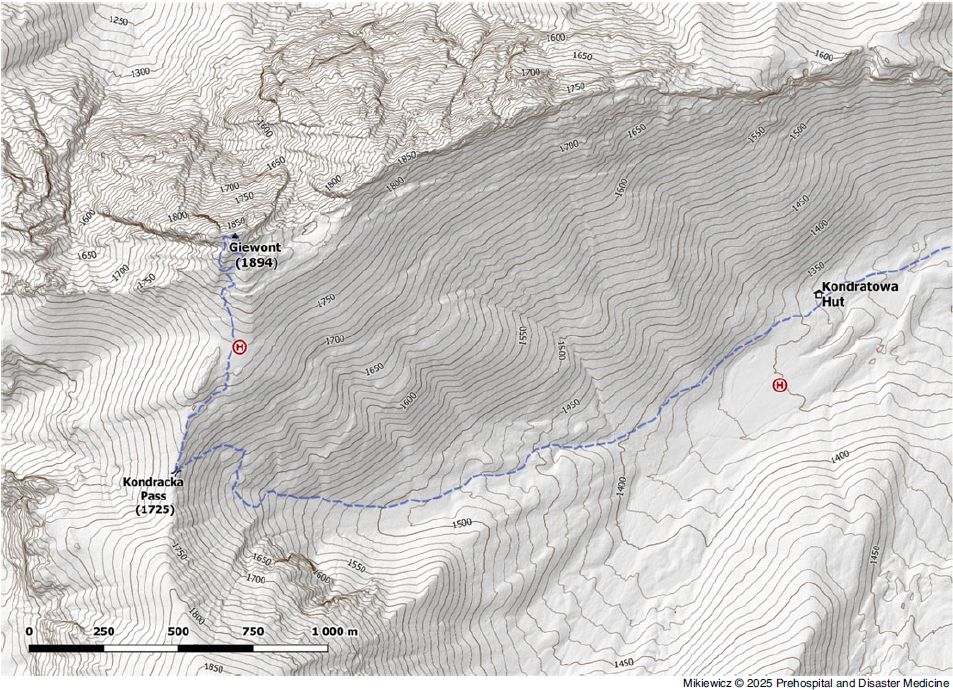
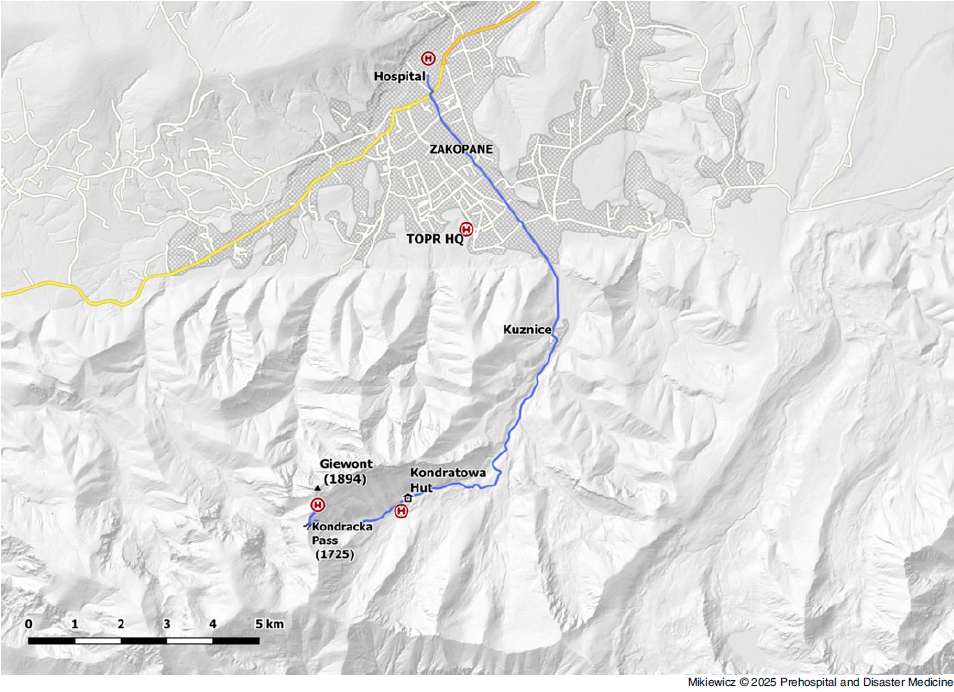
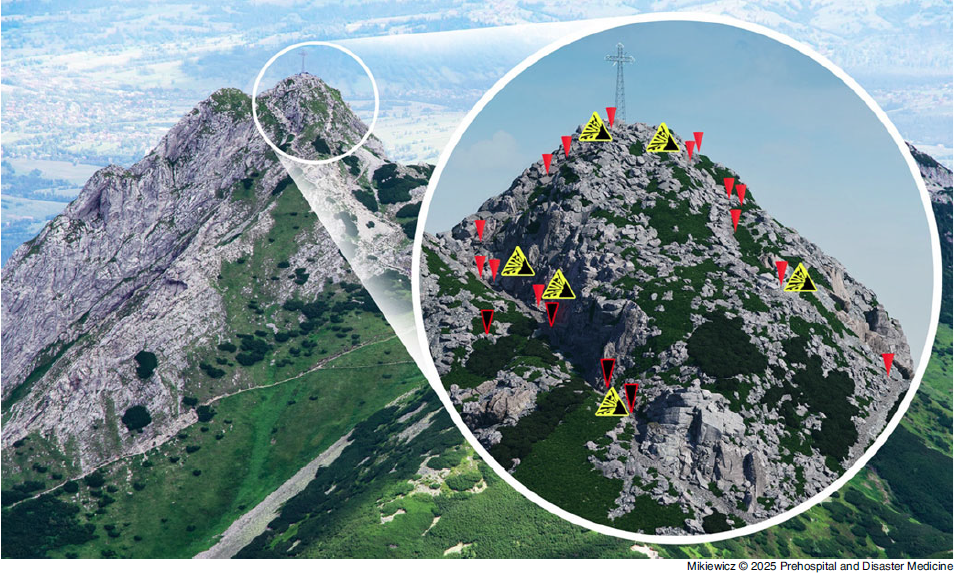
That day, a storm moving from the southwest came to the Tatra Mountains (Supplementary Material 1). In the MCI area, the storm was not preceded by intense rainfall, which caused hikers to remain on the trails. According to witnesses, five to ten minutes before the incident, a blockage had formed on the descent trail. When the first lightning strike occurred, quick descent along two narrow and difficult trails (one meant for ascent to the peak, the other for descent) proved impossible. Initially, panic became prevalent, and some victims who were able to move began to run down. The area where the victims were located was approximately five hectares. The average gradient of the trail was approximately 18%, and the usual walking time from Kondracka Pass to the summit was 15–20 minutes (Figure 1 and Figure 2). When the mechanisms of current flow are analyzed, it seems that the lightning struck the top of the metal cross and then split into several channels. Main lightning current most likely travelled as a surface arc down from the peak top and along the steel chains, mainly in the descent trail. This is supported by observations of the witnesses and analysis of the footage taken on the third strike (Supplementary Material 2; available online only). Several sites of rock and ground damage were identified on ascent and descent trails (Figure 3). Some of the victims were struck by rock fragments ejected from exploding rocks, and many were thrown back by the shock wave.Reference Pasieka, Polak and Pasieka3
Incident Location and Landing Sites.

Incident Location, Landing Sites, and Evacuation Route.
Abbreviation: TOPR, Tatra Mountain Rescue Service.

Presentation of the MCI Site.
Abbreviation: MCI, mass-casualty incident.

This report presents a retrospective analysis of the regional health system response that was developed through a collaborative effort of mountain rescue services, regional hospital Emergency Medical Services (EMS), and local services.
Source
The internal records of the mountain rescue service groups (Tatra Mountain Rescue Service [TOPR] and Mountain Emergency Rescue Service [GOPR]), Polish Medical Air Rescue (LPR), which acts as the sole Helicopter EMS (HEMS) provider in Poland, and State Fire Service—both professional and voluntary units, ground ambulances of the Polish Emergency Medical System (PRM), Regional Dispatch Center, district hospitals, and all hospitals taking the incident victims of Tatra National Park, and the District Prosecutor’s Office—were reviewed.
The entity authorized to conduct mountain rescue in the Tatra Mountains is the TOPR. It operates a single helicopter with capacity to perform winch operations in an alpine-type environment. The LPR is a national HEMS operator with over 20 helicopters on various bases in Poland; despite the advanced medical equipment, LPR helicopters are not capable of performing rescue missions with winch nor rope techniques. Meteorological data provided by the Lightning Detection System (NOWCAST) and Institute of Meteorology and Water Management (IMGW; Warsaw, Poland) were studied. Footage from cameras in the area and personal cameras of mountain rescuers were reviewed. Original recordings from TV broadcasts, hospital surveillance cameras, and complete TOPR radio transmission audio recordings were also analyzed. An on-site survey was conducted to address casualty count and flow. Surveys involving field trips, on-site interviews, in-person interviews, or telephone communication were conducted. Data concerning triage, the flow of information, communications, the organization of activities, and the decision-making process were collected.
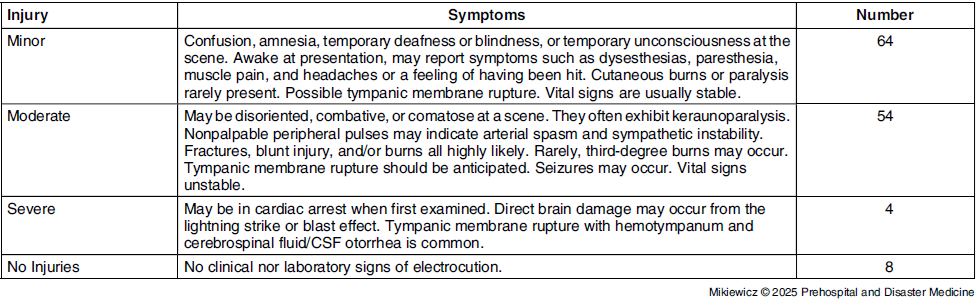
Compliance with local and national procedures in the MCI was verified. A review team included representatives from the services involved. Instances where the procedures were followed, deviated from, or were inadequate were identified and the extent of compliance with guidelines for each aspect of the response (command, control structure, safety, triage, treatment, evacuation, identification and tracking, communication, resource allocation, and management) was determined. The reasons behind any deviations or non-compliance were investigated. Factors such as environmental influence, lack of training or expertise, resource limitations, communication breakdowns, complexity of the incident, clarity and usability of procedures, and unexpected circumstances were considered. Nevertheless, national procedures for dealing with MCIs and reporting rules do not provide for events in mountainous regions.Reference Ładny, Michalak and Ziółkowski4 For this reason, the analysis of the activities was based on the Medical Commission of the International Commission for Alpine Rescue (ICAR-MEDCOM) guidelines.Reference Blancher, Albasini and Elsensohn1 The categorization of lightning injuries by severity was based on the initial presentation model (Table 1).Reference Cooper, Andrews and Holle5,Reference van Ruler, Eikendal and Kooij6 The referral criteria for the burn center were determined on the basis of the criteria of the American Burn Association (ABA; Chicago, Illinois USA).Reference Bettencourt, Romanowski and Joe7 However, for the analysis, the principle that in mass disasters, both adults and children with more than 20% total body surface area (TBSA) burn should be transferred to a burn center was adopted.Reference Bettencourt, Romanowski and Joe7,Reference Kosiński, Aleksandrowicz and Serafinowicz8
Severity of Injury, Based on the Initial Presentation ModelReference Kitagawa, Ohashi and Ishikawa2

This study was approved by the Institutional Review Board of Jagiellonian University Medical College (Krakow, Poland; No 118.6120.85.2023).
Observations
Field Disaster Medical Activity
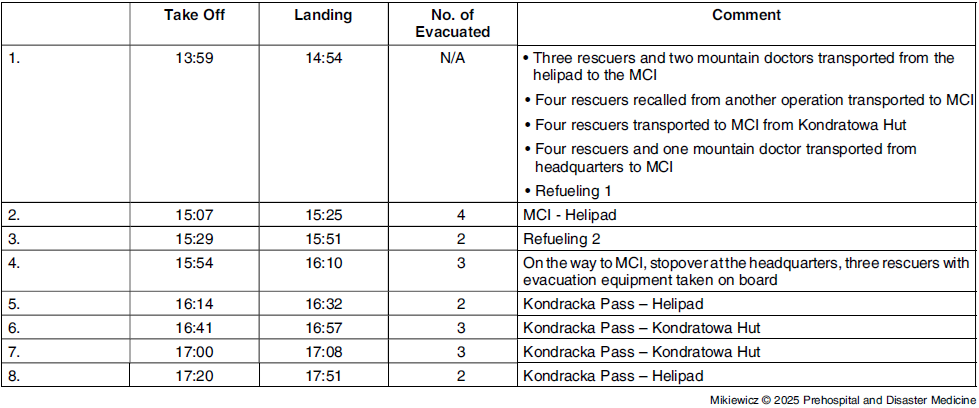
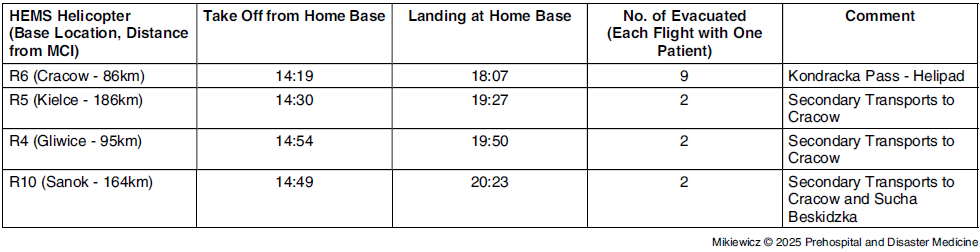
The immediate TOPR rescue helicopter activation was not possible because of an on-going storm. The first medical team reached the area of the MCI at 13:50. The temporary improvement in weather allowed the TOPR helicopter to take off at 14:00. The incident commander was a mountain rescuer with over 40 years of experience, and he was supported by a mountain doctor. At 14:14, TOPR medics took over the cardiopulmonary resuscitation (CPR) of two children on the descent trail (Figure 3). Five minutes later, a victim without signs of life was identified on the trail just below the summit, and another victim outside the trail was identified in a rocky gully, 100 meters below. All four CPR attempts were deemed futile and terminated by 15:11. The teams of mountain rescuers moved up simultaneously along the ascent and descent trails, reaching a summit at approximately 14:20. The entire area of the summit above the Kondracka Pass was secured by TOPR mountain rescuers and Tatra National Park rangers. A casualty collection point (CCP) and landing site for the LPR helicopter was established at the Kondracka Pass (1,725 meters asl; 49°14′46,4″N 19°55′56,5″E) and subsequently held by mountain rescuers under mountain doctor commands (Figure 1). A field emergency medical post (FEMP) was launched at a nearby mountain shelter (Kondratowa Valley: 1,333 meters asl; 49°14′55″N 19°57′07″E) at 13:55 and was held by mountain rescuers, firefighters, and volunteers. There were 20 victims requiring urgent evacuation in the summit area (Figure 3). In seven rescue flights, 19 victims were hoisted from difficult terrain and evacuated directly to the hospital (ten victims) and to the FEMP (nine victims) by helicopter operated by TOPR (Table 2). The LPR helicopter evacuated nine wounded victims unable to walk from the CCP directly to Zakopane General Hospital (Table 3). Initial triage was performed at the scene by paramedics and mountain doctors according to the Simple Triage and Rapid Treatment/START triage algorithm, with reverse triage modification.Reference Blancher, Albasini and Elsensohn1 The lightly wounded were brought or carried to the FEMP, re-triaged, and transported by off-road vehicles to the handover site where ground ambulances awaited (Kuźnice: 1,011 meters asl; 49°16′13″N 19°58′52″E). Overall, 51 victims were triaged and initially treated via the FEMP, 43 victims were transported by off-road vehicles in six convoys, and eight victims reached Kuźnice on foot, assisted by mountain rescuers, firefighters, or Tatra National Park Rangers. The activities of all services, rescuers, and firefighters, as well as rescue helicopter flights and off-road vehicle convoys, were coordinated from the TOPR headquarters.
TOPR Helicopter Flights

Abbreviations: TOPR, Tatra Mountain Rescue Service; MCI, mass-casualty incident.
Polish Air Medical Rescue (LPR) Helicopters Flights

Abbreviations: HEMS, helicopter Emergency Medical Services; MCI, mass-casualty incident.
In-Patient Hospital Care
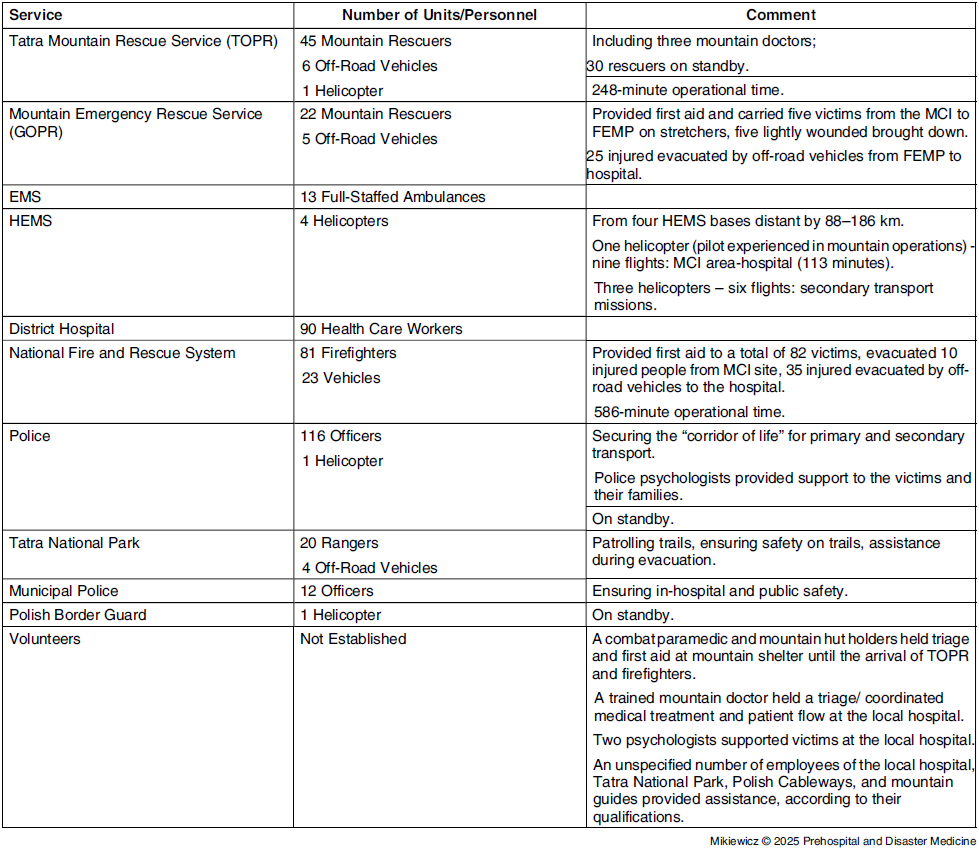
Zakopane General Hospital, located approximately ten kilometers from the MCI, was the only emergency medical center in the area (Figure 2). Activated immediately by TOPR headquarters, the hospital implemented a standard operation procedure and mobilized all available forces and resources. Fortunately, the hospital and heliport surroundings were not involved in the storm. Two medical coordinators at the emergency department (ED), one of whom was a mountain doctor, were appointed to the hospital. An experienced mountain rescuer was deployed to the helipad to coordinate take-offs and landings. At 14:30, the first victim was admitted to the ED. At the request of the medical coordinator, an emergency medical post (EMP) was installed at 16:27 and held by firefighters. Located between the helipad and the side entrance to the ED, it was intended to provide immediate care to lightly injured victims. The EMP provided initial medical assistance to nine lightly wounded victims. On the day of the incident, 121 patients were triaged and admitted, and six patients were admitted the next day. Overall, 29 triaged victims were relocated to other hospitals (seven by LPR helicopters, 22 by ground ambulances). Among the 17 victims with burns greater than 20% of the TBSA, eight were immediately transferred to burn centers. The Regional Dispatch Centre has deployed nine fully staffed ambulances to transport casualties. Forty patients were admitted to hospital wards (including 20 patients at Zakopane General Hospital). After diagnosis, necessary observation, and specialist consultations, 51 patients were discharged from the ED. The death toll on the day of the MCI was four, and there were no fatalities at a later date. The causes of death were analyzed in detail elsewhere.Reference Pasieka, Polak and Pasieka3 The resources used are listed in Table 4.
Resource List

Abbreviations: MCI, mass-casualty incident; FEMP, field emergency medical post; EMS, Emergency Medical Services; HEMS, helicopter Emergency Medical Services; TOPR, Tatra Mountain Rescue Service.
Analysis
There were 134 people involved in the incident: four died at the scene, four were severely injured, 118 were moderately and mildly injured, and eight had no signs of injury.Reference Cooper, Andrews and Holle5 Mountain emergency services managed to provide first aid and to evacuate all victims within less than four hours. Among the five available helicopters, two took part in the evacuation of victims from the MCI area because of the equipment and of the pilots’ mountain flight prior experience. The operation did include high risk for rescue personnel by exposure to on-going strikes (at least one rescuer suffered a strike requiring further treatment). Additionally, the risk of helicopter operations was considered very high (Supplementary Material 2). The analysis of the field rescue activity revealed satisfactory coordination of the operation by TOPR, ad hoc prioritization, quick activation of forces and resources, and efficient cooperation between services; nevertheless, because of the unique character of the incident, there were also elements of improvisation that left finer points that need to be addressed in future procedures. The horizontal radio-communication between rescuers, helicopters, and TOPR headquarters was satisfactory. Vertical communication with other services was possible only through TOPR headquarters. There are no adopted triage algorithms that are effective for MCI caused by a lightning strike. Priorities of evacuation were determined by local medical leaders in the MCI area with the authorization of TOPR headquarters. Initially, the order of evacuation was determined by both the severity of the injuries and the location of the victims. Only a few victims were marked with triage tags at the scene; upon arrival at the hospital, secondary triage was performed blindly, without information about the priority assigned during primary triage. Information about the time and dose of opioid analgesics administered was recorded with a marker on the victims’ forearms or on wound dressings for eight patients. The tracking of evacuated patients was unsatisfactory. The crew members of the helicopters and off-road vehicles kept medical records for only a few victims. The personal data of the evacuees were recorded in the form of handwritten notes on the FEMP for 46 victims. The FEMP staff had also introduced a system of commitments for adults taking temporary care of minors, which involved a written declaration of acceptance of care for a child whose guardian was absent (eg, injured or awaiting evacuation from the scene). Upon arrival at the hospital, children’s relatives were located among those previously admitted or with the assistance of police officers. The entire burden of triage, treatment, and relocation of victims rested with the local general hospital. Triage and tracking were carried out in the form of handwritten notes, which were entered into the hospital’s IT system. The actual time of admission and triage differed from the time recorded in the system during the periods of the highest load. Overall, the communication structure was satisfactory. However, vertical communication with rescuers at the MCI site was insufficient. As an algorithm for in-hospital triage and treatment of lightning strikes did not exist, the principles were implemented ad hoc. Patients were pre-triaged according to the Manchester Triage System.Reference Mackway-Jones, Marsden and Windle9 Those with burns, those with torn or burned clothing or shoes, or those with neurological symptoms were marked in Red (R). Patients without evident symptoms of electrocution, but reporting feeling electrocuted, were marked Yellow (Y). Both R and Y should have electrocardiogram and cardiac marker levels established. Overall, markers of muscle damage (troponin, creatine kinase) were determined in 77 victims, but there were no agreed-upon upper limits that would indicate the need for hospital admission. Among the 17 victims with burns greater than 20% of the TBSA, eight were immediately transferred to burn centers or trauma centers. Although some of the victims were diagnosed on-site with Stage 2 hypothermia (Swiss staging),Reference Musi, Sheets and Zafren10 only 21 (16%) had their temperature measured in the ED.
Supplementary Material
To view supplementary material for this article, please visit https://doi.org/10.1017/S1049023X2510143X
Conflicts of interest
The authors certify that they have NO affiliations with or involvement in any organization or entity with any financial interest (such as honoraria; educational grants; participation in speakers’ bureaus; membership, employment, consultancies, stock ownership, or other equity interest; and expert testimony or patent-licensing arrangements), or non-financial interest (such as personal or professional relationships, affiliations, knowledge, or beliefs) in the subject matter or materials discussed in this manuscript.
Author Contributions
Conception and Design: SK, MM, AG, AB, PG, WSz.
Analysis and Interpretation: MM, AG, SK.
Data Collection: SK, MM, AG, AB, PG.
Writing the Article: MM, SK, AG.
Critical Revision of the Article: MM, SK, AG, AB, PG, WSz.
Final Approval of the Article: MM, AG, AB, PG, WSz, SK.
AI Statement
The authors hereby declare that they have personally authored this academic research paper and did not use any artificial intelligence tools or automated assistance in the preparation or writing of this manuscript. All the work reflects their own efforts and intellectual contributions.