INTRODUCTION
The ‘bubble snails’, Cephalaspidea, are a major group of opisthobranch gastropods with an estimated 840 species worldwide (Wägele, Reference Wägele2004). Seven cephalaspideid Erythraean alien species have been recorded from the Levantine Basin of the Mediterranean. The earliest recorded Erythraean alien cephalaspideid was Chelidonura fulvipunctata Baba, 1938 (as Ch. mediterranea sp. nov.) collected in 1959 off the south-western Mediterranean coast of Turkey, and subsequently in Israel, Malta, Cyprus and Lebanon (Mienis & Gat, Reference Mienis and Gat1987; Perrone & Sammut, Reference Perrone and Sammut1997; Çevik & Ergüden, Reference Çevik, Ergüden, Çevik and Ergüden2008; Tsiakkiros & Zenetos, Reference Tsiakkiros and Zenetos2011; Bitlis et al., Reference Bitlis, Öztürk, Doğan and Önen2012). Retusa desgenettii (Audouin, Reference Audouin1826) was collected in 1969 in Bardawil lagoon, Egypt, and beginning in 1997 off the Israeli coastline (Bogi & Galil, Reference Bogi and Galil2002, Reference Bogi and Galil2006; Mienis, Reference Mienis2004a; Mienis & Zaslow, Reference Mienis and Zaslow2004). Cylichnina girardi (Audouin, Reference Audouin1826) was first recorded from Bardawil lagoon, Sinai, on the Mediterranean coast of Egypt in 1974 (Mienis, Reference Mienis1976, as Ventomnestia girardi); and is known to occur throughout the Levant (Barash & Danin, Reference Barash and Danin1986 as V. girardi, Bogi & Khairallah, Reference Bogi and Khairallah1987; Tringali & Villa, Reference Tringali and Villa1990; Barash & Danin, Reference Barash and Danin1992, as Retusa girardi; Engl, Reference Engl1995; Buzzurro & Greppi, Reference Buzzurro and Greppi1996; Cecalupo & Quadri, Reference Cecalupo and Quadri1996; Cosenza & Fasulo, Reference Cosenza and Fasulo1997; Bogi & Galil, Reference Bogi and Galil2006; Bitlis et al., Reference Bitlis, Öztürk, Doğan and Önen2012). Bulla arabica Malaquias & Reid, Reference Malaquias and Reid2008 was collected in 1978 off Israel, and subsequently recorded from Cyprus, Greece and Turkey (Barash & Danin, Reference Barash and Danin1982, Reference Barash and Danin1992; Vardala-Theodorou, Reference Vardala-Theodorou1999; Zenetos et al., Reference Zenetos, Gofas, Russo, Templaso and Briand2003; Mienis, Reference Mienis2004b; Yokeş & Rudman, Reference Yokes and Rudman2004; Delongueville & Scaillet, Reference Delongueville and Scaillet2007; Yokeş, Reference Yokeş2009; as Bulla ampulla). Pyrunculus fourierii (Audouin, Reference Audouin1826) was collected in 1986 from Jounieh Bay, Lebanon (Bogi & Khairallah, Reference Bogi and Khairallah1987), in 1989 from both Israel and southern Turkey, and in 1995 from Cyprus (van Aartsen et al., Reference Aartsen, Barash and Carrozza1989; Tringali & Villa, Reference Tringali and Villa1990; Engl, Reference Engl1995; Buzzurro & Greppi, Reference Buzzurro and Greppi1996; Giunchi et al., Reference Giunchi, Micali and Tisselli2001; Tringali & Oliverio, Reference Tringali and Oliverio2001; Mienis & Zaslow, Reference Mienis and Zaslow2004; Bogi & Galil, Reference Bogi and Galil2006; Delongueville & Scaillet, Reference Delongueville and Scaillet2006; Yokeş, Reference Yokeş2009; Bitlis et al., Reference Bitlis, Öztürk, Doğan and Önen2012). Acteocina mucronata (Philippi, 1849) was collected in 1986 from Israel, Lebanon and south-eastern Turkey, and subsequently from Tunisia, Naxos, Greece and Cyprus (van Aartsen et al., Reference Aartsen, Carrozza and Lindner1990; Bogi & Giannini, Reference Bogi and Giannini1990; Cecalupo & Quadri, Reference Cecalupo and Quadri1994; Engl, Reference Engl1995; Buzzurro & Greppi, Reference Buzzurro and Greppi1996; Storsberg, Reference Storsberg1997; Giunchi et al., Reference Giunchi, Micali and Tisselli2001; Bogi & Galil, Reference Bogi and Galil2006; Yokeş, Reference Yokeş2009; Delongueville & Scaillet, Reference Delongueville and Scaillet2010; Bitlis et al., Reference Bitlis, Öztürk, Doğan and Önen2012). In 2001 Haminoea cyanomarginata Heller & Thompson, 1983 was recorded from Porto Germeno, Korinthiakos, Greece, and the following year from Üç Adalar, Antalya, Turkey. It was subsequently recorded from Malta and Reggio di Calabria, Italy (Zenetos et al., Reference Zenetos, Gofas, Russo, Templaso and Briand2003; Yokeş & Rudman, Reference Yokes and Rudman2004; Mifsud, Reference Mifsud2005, Reference Mifsud2007; Anderson, Reference Anderson2007; Crocetta & Vazzana, Reference Crocetta and Vazzana2009; Crocetta et al., Reference Crocetta, Renda and Vazzana2009).
In the course of recent studies of the benthic biota off the Mediterranean coast of Israel, specimens of one more cephalaspideid species were collected. Upon examination, they were determined as Cylichna villersii (Audouin, Reference Audouin1826), a species endemic to the Red Sea (Dekker & Orlin, Reference Dekker and Orlin2000).
MATERIALS AND METHODS
The surveys of the shallow soft bottoms along the Mediterranean coast of Israel were made aboard the RV ‘Etziona', operated by Israel Oceanographic and Limnological Research. Surface sediments were collected by means of a Van Veen grab (KahlSico, WA265/SS214, 32 × 35 cm, volume 20 l). Three replicate samples were taken at each site. Upon collection the sediment samples were preserved in 4% formalin, and within days were sieved on a 250 µm mesh. The retained material was preserved in 70% alcohol, tinted with rose Bengal, and sorted. Five specimens are deposited in the Steinhardt National Collections of Natural History, Tel Aviv University, Israel (TAU MO 77954), and the balance retained in the private collection of C. Bogi, Livorno, Italy. Abbreviations used: Coll., collector; H, height of shell.
RESULTS
SYSTEMATICS
CEPHALASPIDEA Fischer P., Reference Fischer1883
CYLICHNIDAE Adams H. & A., Reference Adams and Adams1854
Cylichna Lovén, Reference Lovén1846
Cylichna villersii (Audouin, Reference Audouin1826)
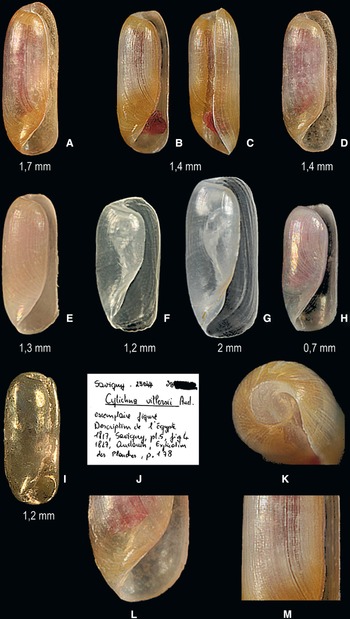
(Figure 1 A–E, H–M)
Cylichna villersii (Audouin, Reference Audouin1826). Mediterranean Sea, Israel: (A) Soreq, 10 May 2009, 1.7 mm, frontal view; (B, C, K–M) Soreq, 10 May 2009, 1.4 mm, frontal view, lateral view, apical view, basal view, detail of sculpture, respectively; (D) Ashdod, 10 October 2012, 1.4 mm, frontal view; (E) Ashdod, 10 October 2012, 1.3 mm frontal view; (H) Soreq, 10 May 2009, 0.7 mm, frontal view. Red Sea, Egypt: (I) Suez, Coll. J.C. Savigny, Syntypes of Bulla Villersii (MNHN 25044), 1.2 mm, frontal view; (J) original label of syntypes. Cylichna cylindracea (Pennant, Reference Pennant1777). Mediterranean Sea, Italy: (F) Capraia I., July 2009, 1.2 mm, frontal view; (G) Capraia I., July 2009, 2.0 mm, frontal view.

Bulla Villersii Savigny, Reference Savigny1817, pl. 5, figure 4, Audouin, Reference Audouin1826: 20, Reference Audouin1828: 178.
Cylichna Villiersii, Issel, Reference Issel1869: 170, 341, Pallary, Reference Pallary1926: 75, pl. 9 figure 4.
Cylichna villersii, Bouchet & Danrigal, Reference Bouchet and Danrigal1982, figure 53; Hoenselaar & Dekker, Reference Hoenselaar and Dekker1998: 202; Valdés & Héros, Reference Valdés and Héros1998: 702, figure 5D; Dekker & Orlin, Reference Dekker and Orlin2000: 34.
MATERIAL EXAMINED
Cylichna villersii (Audouin, Reference Audouin1826). Mediterranean Sea. Israel, Ashdod, 4 May 2008, 31°51.7100N 34°38.8840E, 18.8 m, 1 specimen. 10 October 2012, 31°51.5764N 34°39.1882E, 13.8 m, 1 specimen, H 1.4 mm (Figure 1D); 31°51.7100N 34°38.8840E, 18.8 m, 1 specimen, H 1.3 mm (Figure 1E). Soreq, 24 October 2008, 31°57.285N 34°40.850E, 28.4 m, 1 specimen; 31°57.198N 34°41.198E, 23.5 m, 2 specimens; 31°57.113N 34°41.382E, 20.3 m, 4 specimens; 31°55.817N 34°40.193E, 29.3 m, 1 specimen; 31° 55.826N 34°40.494E, 25.8 m, 4 specimens; 31°56.796N 34°42.008E, 10.3 m, 1 specimen; 31°56.514N 34°41.174E, 20.6 m, 2 specimens; 31°55.869N 34°41.461E, 10.5 m, 1 specimen; 31°56.655N 34°40.889E, 25.3 m, 1 specimen; 31°56.473N 34°41.508E, 15 m, 1 specimen; 31°56.974N 34°41.741E, 15.5 m, 2 specimens. 10 May 2009, 31°45.479N 34°34.821E, 26.4 m, 1 specimen, H 1.7 mm (Figure 1A); 31°44.823N 34°33.055E, 33.7 m, 1 specimen, H 1.4 mm (Figure 1B, C, K–M); 31°51.7100N 34°38.8840E, 18.8 m, 1 specimen, H 0.7 mm (Figure 1H). 11 October 2012, 31°57.2017N 34°41.5845E, 19.9 m, 1 specimen; 31°56.7614N 34°41.3788E, 20.0 m, 1 specimen; 31°56.7340N 34°41.0700E, 24.7 m, 2 specimens; 31°56.2337N 34°40.9883E, 22.0 m, 25 specimens; 31°56.2896N 34°40.8044E, 25.4 m, 25 specimens; 31°56.1846N 34°40.7771E, 24.8 m, 10 specimens; 31°56.1772N 34°40.9465E, 22.2 m, 37 specimens; 31°56.1841N 34°41.0736E, 20.2 m, 34 specimens; 31°56.1779N 34°41.0269E, 20.9 m, 28 specimens; 31°56.2025N 34°41.1856E, 18.6 m, 4 specimens. Hadera, October 1999, 15–20 m, 2 specimens. Haifa Bay, August 2007, 32°49.266N 035°01.176E, 11.0 m, 2 specimens; 4 May 2008, 32°49.154N 35°01.316E, 7.5 m, 3 specimens. All specimens complete with soft parts.
Red Sea. Egypt. Suez, Coll. J.C. Savigny, syntypes of Bulla villersii, 2 specimens (1 eroded), H 1.2 mm (MNHN 25044) (Figure 1 I, J).
Cylichna cylindracea (Pennant, Reference Pennant1777). Mediterranean Sea. Italy, Capraia Island, July 2009, 80–100 m, sandy bottom, 1 specimen, H 2.0 mm, 2 juveniles (collection C. Bogi) (Figure 1 F, G).
DIAGNOSIS
Shell small, fragile, transparent, perfectly cylindrical in profile, height/width ratio about 2.5. Aperture narrow and elongate, wider and rounded at the bottom. Outer lip simple, straight, slightly exceeding apice, separated from coil by distinct sinus. Umbilicus invisible (Figure 1K). Columella short, oblique, slightly sinuous bearing a fold basally (Figure 1L). Shell surface with closely spaced fine striae, at high magnification spiral sculpture is visible (Figure 1M). Freshly collected shells are covered with a fine, glossy pinkish-brown periostracum.
REMARKS
Examination of Savigny's syntypes of Bulla villersii, preserved at the Muséum National d'Histoire Naturelle, Paris, revealed that one was badly eroded, the other, gold plated (Figure 1I), was depicted by Bouchet & Danrigal (Reference Bouchet and Danrigal1982, figure 53) and Valdés & Héros (Reference Valdés and Héros1998, figure 5D). That specimen corresponds well with the Mediterranean specimens, with only a slight variance in height/width ratio, which, in our opinion, falls within the range of variability for this species. Cylichna villersii differs from its cogener C. cylindracea (Pennant, Reference Pennant1777) in its height/width ratio, wider aperture, truncate or slightly rounded base, and formation of the columella (Figure 1 F, G). The Mediterranean endemic C. parvula Jeffreys, Reference Jeffreys1883 differs in its more rounded profile, lower height/width ratio, straight columella, perforated apex and lack of spiral sculpture.
Cylichna villersii is endemic to the Red Sea (Dekker & Orlin, Reference Dekker and Orlin2000). The type specimens have been collected in Suez (Pallary, Reference Pallary1926), and subsequently in the Great Bitter Lake, Suez Canal (Hoenselaar & Dekker, Reference Hoenselaar and Dekker1998). In the Mediterranean it is found on sandy bottoms.
The earliest specimens of C. villersii collected in the Mediterranean date back to 1999. These were initially mistaken for juvenile C. cylindracea. Recent benthic samples from Soreq have a much increased number of specimens, from 1–4 per 0.11 m2 in October 2008, to as many as 37 per 0.11 m2 four years later.
ACKNOWLEDGEMENTS
Thanks to Stefano Bartolini for the photographs, to Riccardo Giannuzzi-Savelli for his valuable comments and to Jacobus J. van Aartsen, Museum of Natural History Naturalis, Leiden, for bibliographic material. We are grateful to Dr Virginie Héros, curator of Molluscs at the Muséum National d'Histoire Naturelle, Paris, for permission to examine the syntypes of Cylichna villersii. We thank the referees for their comments on an earlier version of the manuscript.
FINANCIAL SUPPORT
Partial support for this research was provided by the European Community's Seventh Framework Programme (FP7/2007-2013) for the project ‘Vectors of Change in Oceans and Seas Marine Life, Impact on Economic Sectors' (VECTORS) (B.S.G.).