Introduction
Nebraska is the third largest corn-producing state in the United States (after Iowa and Illinois), with approximately 3.8 to 3.9 million ha of hybrid corn planted each year (Nebraska Corn Board 2017). With commercialization of glyphosate-resistant (GR) corn in 1998 and soybean [Glycine max (L.) Merr.] in 1996, GR crops have been widely adopted across the United States and in many other countries as well (Dill et al. Reference Dill, CaJacob and Padgette2008). Further advancements in genetic engineering have led to the commercialization of crops with multiple herbicide–resistant (HR) traits, such as glufosinate- and glyphosate-resistant corn (Green et al. Reference Green, Hazel, Forney and Pugh2008) and soybean (Beckie et al. Reference Beckie, Ashworth and Flower2019). In 2018, HR corn and soybean composed 90% and 94% of total corn and soybean production in the United States, respectively (USDA-ERS 2018). Herbicide-resistant crops have provided flexibility in weed management to producers; however, over-reliance on a single herbicide or herbicide(s) with the same site of action has led to shifts in weed species composition (Owen Reference Owen2008) and the evolution of HR weed biotypes (Heap Reference Heap2014, Reference Heap2020; Johnson et al. Reference Johnson, Davis, Kruger and Weller2009).
With widespread adoption of GR corn in the United States, correlative increases in the presence of GR volunteer corn in rotated crops have been identified (Davis et al. Reference Davis, Marquardt and Johnson2008), creating management concerns (Marquardt et al. Reference Marquardt, Krupke and Johnson2012a) as well as new challenges for management of insect resistance (Krupke et al. Reference Krupke, Marquardt, Johnson, Weller and Conley2009). Derived from dropped ears or kernels and lodged plants in the field, volunteer corn overwinters in the field and emerges the following year (Chahal and Jhala Reference Chahal and Jhala2015). Although grain loss due to mechanized harvest can be reduced to below 5% (Shauck Reference Shauck2011; Shay et al. Reference Shay, Ellis and Hires1983), adverse weather conditions (hail and windstorms) prior to harvest can increase plant lodging and dropped corn ears, resulting in additional loss and management problems with volunteer corn the following year (Rees and Jhala Reference Rees and Jhala2018). Managing volunteer corn requires additional selective herbicides when tillage is not an option because of the retention of the HR traits from the initially planted hybrid parent (Steckel et al. Reference Steckel, Thompson and Hayes2009). Acting as a very competitive weed, volunteer corn (depending on density) can cause yield reductions in rotated crops. Kniss et al. (Reference Kniss, Sbatella and Wilson2012) reported that volunteer corn densities of 1 to 1.7 plants m−2 reduced sugar beet (Beta vulgaris L.) sucrose yield by 19%. Likewise, Clewis et al. (Reference Clewis, Thomas, Everman and Wilcut2008) reported that cotton (Gossypium hirsutum L.) lint yield was reduced by 4% to 8% for each 500 g of volunteer corn biomass per meter of crop row. In soybean, Beckett and Stoller (Reference Beckett and Stoller1988) reported that a single clump of 5 to 10 plants m−2 resulted in a 6% yield reduction. Similarly, Andersen et al. (Reference Andersen, Ford and Lueschen1982) reported that uncontrolled volunteer corn densities of one clump per 2.4 m of row resulted in 31% soybean yield reduction. Research conducted in Nebraska has shown similar results, with volunteer corn densities of 8,750, 17,500, and 35,000 plants ha−1 reducing soybean yields by 10%, 27%, and 97%, respectively (Chahal and Jhala Reference Chahal and Jhala2016; Wilson et al. Reference Wilson, Sandell, Robert and Mark2010).
In addition to research focused on the effects of volunteer corn in rotated agronomic crops, studies examining yield effects of volunteer corn on hybrid corn and the control of failed hybrid corn stands in replant situations have also been conducted. For example, Shauck and Smeda (Reference Shauck and Smeda2014) reported that 0.5 to 8 hybrid corn plants m−2 resulted in 7% to 81% corn yield reductions under a replant situation. Likewise, Steckel et al. (Reference Steckel, Thompson and Hayes2009) reported that 27,000 hybrid corn plants ha−1 reduced corn yield by 1,000 kg ha−1, with a yield loss threshold of two plants m–2. Yield effects of high volunteer corn densities were studied by Alms et al. (Reference Alms, Moechnig, Vos and Clay2016) and Marquardt et al. (Reference Marquardt, Terry, Krupke and Johnson2012b), who reported that 8 and 9 volunteer corn plants m−2 resulted in 0 to 41% and 22% to 23% corn yield reductions, respectively.
In Nebraska, 1.5 to 1.6 million ha more of corn is produced annually than soybean (2.3 million ha) (USDA-NASS 2017). This discrepancy indicates that many producers are rotating corn into a non-soybean crop, or more commonly, utilizing a corn-on-corn production system. In South Central Nebraska especially, highly productive soils and easy access to irrigation have promoted adoption of corn-on-corn cropping systems. With a majority of Nebraska producers implementing no-till or reduced-tillage cropping systems (Sarangi and Jhala Reference Sarangi and Jhala2019), management of volunteer corn has relied on POST herbicides in soybean production (Chahal and Jhala Reference Chahal and Jhala2015). Prior to the commercialization of GR crops, glyphosate was commonly used with rope-wick applicator to selectively control volunteer corn in soybean fields (Andersen et al. Reference Andersen, Ford and Lueschen1982; Beckett and Stoller Reference Beckett and Stoller1988; Dale Reference Dale1981); however, widespread adoption of GR corn has made this control practice ineffective. With commercialization of stacked glyphosate- and glufosinate-resistant corn in 2012, planned rotations between GR and glufosinate-resistant hybrids have also become challenging for producers to implement successfully as a result of the prevalence of stacked glyphosate- and glufosinate-resistance traits in many elite hybrids. With widespread adoption in the United States, glyphosate/glufosinate-resistant hybrids make both glyphosate and glufosinate ineffective for controlling volunteer corn in the following year (Chahal and Jhala Reference Chahal and Jhala2015).
In rotated fields, the need for selective POST herbicides to control volunteer corn and grass weed species has led to the use of acetyl-coenzyme A carboxylase (ACCase)–inhibiting herbicides. Comprised of the aryloxyphenoxypropionate (FOPs), cyclohexanediones (DIMs), and phenylpyrazolin chemical families, diclofop, clethodim, fluazifop, quizalofop, and sethoxydim have been reported by previous researchers to be effective for controlling volunteer corn in soybean (Andersen et al. Reference Andersen, Ford and Lueschen1982; Beckett et al. Reference Beckett, Stoller and Bode1992; Beckett and Stoller Reference Beckett and Stoller1988; Marquardt and Johnson Reference Marquardt and Johnson2013; Soltani et al. Reference Soltani, Shropshire and Sikkema2006; Young and Hart Reference Young and Hart1997), and in sethoxydim-resistant corn (Vangessel et al. Reference Vangessel, Johnson and Isaacs1997). However, control of glyphosate/glufosinate-resistant volunteer corn in corn has not been previously studied because of a lack of selective herbicides (Shauck Reference Shauck2011).
Enlist is a new multiple HR corn trait developed by Corteva Agriscience conferring resistance to 2,4-D, glyphosate, and FOP herbicides. Commonly integrated in glufosinate-resistant germplasm, Enlist is the first commercialized HR trait providing resistance to FOPs herbicides in corn; as such, it provides an opportunity for selective in-season management of glyphosate/glufosinate-resistant volunteer corn through the use of FOP herbicides. Before recommending this technology to growers, Enlist corn must be assessed for volunteer corn control and Enlist corn safety. The objectives of this project were (1) to evaluate ACCase-inhibiting herbicides for glyphosate/glufosinate-resistant volunteer corn control in Enlist corn and (2) to evaluate the effect of timing of applying ACCase-inhibiting herbicides (early POST vs. late POST) on volunteer corn control, Enlist corn injury, and yield.
Materials and Methods
Site Description
Field experiments were conducted at the South Central Agricultural Laboratory, University of Nebraska–Lincoln, near Clay Center, NE. Fields were irrigated by center pivot and followed a corn–soybean crop rotation, with soybean preceding the field experiment in both years. The soil texture at the research site consisted of a Hastings silt loam (montmorillonitic, mesic, Pachic Argiustolls) with a pH of 6.5, 17% sand, 58% silt, 25% clay, and 3.0% organic matter.
Treatments were arranged in a randomized complete block design with four replications. Plot size was 3 m wide (four corn rows spaced 0.75 m wide) by 9 m long. Herbicide treatments comprised six ACCase inhibitors (fluazifop, quizalofop, fluazifop/fenoxaprop, clethodim, sethoxydim, and pinoxaden) applied at two application timings based on the height of volunteer corn. For comparison, a no-POST herbicide control and weed-free control treatment were included. Due to recent commercialization of Enlist corn, supplementary labels for ACCase-inhibiting herbicides were not available; thus, application rates were selected based on labeled rates for control of volunteer corn in soybean and included all label-recommended adjuvants, excluding pinoxaden, which was applied at labeled rates for grass weed control in wheat (Triticum aestivum L.) (Table 1). Labeled rates for volunteer corn control in soybean were selected for all other treatments because of the prevalence of corn/soybean cropping rotations in the Midwest, as well as local use of many of these herbicides in soybean production fields.
Acetyl CoA carboxylase (ACCase)–inhibiting herbicides, their application timings, rates, and products used for control of volunteer corn in aryloxyphenoxypropionate-resistant corn in field experiments conducted at South Central Agricultural Lab near Clay Center, NE, in 2018 and 2019.a

a Abbreviations: AMS, Ammonium sulfate (N-Pak AMS Liquid; Winfield United, LLC, St. Paul, MN); COC, crop oil concentrate (Agri-Dex; Helena Chemical Co., Collierville, TN); EPOST, early POST; LPOST, late POST; NIS, nonionic surfactant (Induce; Helena Chemical Co.).
b A pre-mix of S-metolachlor, atrazine, mesotrione, bicyclopyrone (Acuron; Syngenta Crop Protection, LLC, Greensboro, NC) was applied PRE at 2,410 g ai ha–1 to the entire experimental area on May 10, 2018 and May 3, 2019.
c AMS1 at 4% v/v, AMS2 at 3% v/v, AMS3 at 5% v/v, COC at 1% v/v, and NIS at 0.25% v/v were mixed with POST herbicide treatments based on label recommendations.
Treatments were applied with a CO2-pressurized backpack sprayer consisting of a five-nozzle boom fitted with AIXR 110015 flat-fan nozzles (TeeJet Spraying Systems Co., Wheaton, IL) calibrated to deliver 140 L ha−1 at 276 kPa. Early-POST (EPOST) herbicides were applied on June 12, 2018 and June 13, 2019, when volunteer corn was 30 cm (V5) and 28 cm (V5) in height, respectively, with Enlist corn at 36 cm (V7). Late-POST (LPOST) herbicides were applied June 18, 2018 and June 24, 2019, when volunteer corn was 50 cm (V7) in height with Enlist corn at 70 and 73 cm (V8), respectively.
To simulate uniform infestations of volunteer corn, glyphosate/glufosinate-resistant corn harvested from the field (F2 populations) in 2017 (Pioneer P1197 AM) and 2018 (Channel 210-26 STX) were planted in no-tillage conditions at a population of 49,000 seeds ha–1 at a depth of 4.5 cm on April 26, 2018 and April 23, 2019 across the entire plot, for a total of 12 rows per plot spaced 0.75 m apart. Enlist corn hybrids were planted perpendicular to the volunteer corn rows at a density of 91,000 seeds ha−1 in rows spaced 0.75 m apart at a depth of 4.5 cm on May 7, 2018 and May 1, 2019, respectively. Enlist corn hybrid Mycogen MY10V09 was used in 2018, but because of end-of-season stalk strength concerns, was replaced with Enlist corn hybrid Mycogen MY11V17 in 2019.
To control broadleaf and grass weed species without affecting cross-planted volunteer corn in all experimental plots, a pre-mix of S-metolachlor, atrazine, mesotrione, bicyclopyrone (Acuron; Syngenta Crop Protection, LLC, Greensboro, NC) was applied PRE at 2,410 g ai ha–1 to the entire experimental area on May 10, 2018 and May 3, 2019. A general maintenance application of glyphosate (Roundup PowerMAX; Monsanto Co., St. Louis, MO) at 1.50 kg ae ha−1 was applied on June 20, 2018 to the entire experimental area excluding the no-POST herbicide control plots, to provide POST control of all other broadleaf and grass weeds. Because of the presence of glyphosate-resistant Palmer amaranth (Amaranthus palmeri S. Wats.) at the experimental location in 2019, general maintenance application of glyphosate was replaced with glufosinate (Liberty 280 SL; Bayer Crop Science, Research Triangle Park, NC) at 0.90 kg ai ha−1 plus acetochlor (Warrant; Monsanto Co., St. Louis, MO) at 1.26 kg ai ha−1, which were applied on June 17, 2019 to the experimental area, excluding the No-POST herbicide control plots.
Data Collection
Crop and volunteer corn stands were assessed at 28 d after PRE (DAPRE) herbicide applications by counting the number of crop and volunteer corn plants in a 1-m2 quadrat placed across the middle two Enlist corn rows. Visual estimates of volunteer corn control were recorded at 14 and 28 d after early-POST (DAEPOST) and late-POST (DALPOST) herbicide applications based on a scale of 0 to 100%, where 0 equals no control and 100% equals volunteer corn plant death. A similar scale was utilized to assess crop injury at 14 and 28 DAEPOST/LPOST. At 21 DAEPOST/LPOST, a 1-m2 quadrat was placed over the middle two rows in each plot, and volunteer corn density and total volunteer corn biomass (living and dead) were recorded. Within each quadrat, a representative sample of total crop biomass (living and dead) was collected from 0.5 m from either the left or right row. Collected aboveground biomass was oven-dried at 70 C for 10 d, and dry weight was recorded. Corn was harvested from the center two rows in each plot at maturity using a small-plot combine with grain weight and moisture content recorded and adjusted to 15.5%. Percent biomass reduction and percent yield loss (Y) were calculated using Equation 1 (Wortman Reference Wortman2014).
 $$Y = [(C - B)/C] \times 100$$
where C represents the volunteer corn biomass from the no-POST herbicide plots or yield from the weed-free control, or crop biomass from weed-free control, and B represents the volunteer corn biomass or crop biomass, or grain yield from the treated plots.
Statistical Analysis
Data were subjected to ANOVA using R 3.6.1, utilizing the base packages in the Stats Package “stats” version 3.6.1 (R Core Team 2018), the Statistical Procedures for Agricultural Research Package “agricolae” version 1.3-1 (Mendiburu Reference Mendiburu2019), and Various R Programming Tools for Model Fitting Package “gmodels” version 2.18.1 (Warnes et al. Reference Warnes, Bolker and Lumley2018). One-way ANOVA was performed using the aov function, with treatment and year as fixed effect. Replication nested within years were considered as a random effect in the model. If year-by-treatment interactions were significant, data were analyzed separately among years.
ANOVA assumptions of normality was tested using Shapiro-Wilk tests with the shapiro.test function, and homogeneity of variance was tested using Bartlett, Fligner-Killen, and Levene’s tests (Wang et al. Reference Wang, Rodríguez de Gil, Chen, Kromrey, Kim, Pham, Nguyen and Romano2017) with the bartlett.test, fligner.test (Kniss and Streibig Reference Kniss and Streibig2018) and leveneTest functions, respectively. Square root and logit transformation of data did not improve normality; therefore, data that failed ANOVA assumptions of normality and homogeneity of variance (crop and volunteer corn biomass reductions, ratings for volunteer corn control, crop injury) were subjected to nonparametric Kruskal-Wallis tests (McDonald Reference McDonald2014; Ostertagová et al. Reference Ostertagová, Ostertag and Kováč2014) using the kruskal function. Treatment means were separated at P ≤ 0.05 using Fisher’s protected LSD tests with the LSD.test function and the kruskal function with Bejamini-Hochberg and Bonferroni P-value adjustments, respectively, to correct for multiple comparisons (Mendiburu Reference Mendiburu2019). Following treatment means separation, a priori orthogonal contrasts were performed with the fit.contrast function (Warnes et al. Reference Warnes, Bolker and Lumley2018).
Results and Discussion
Average daily temperature in 2018 (14.5 C) was lower than the 30-yr average (19.0 C) for the experiment location, but similar in 2019 (Figure 1). Cumulative precipitation received in both years exceeded the 30-yr average, with 714 mm in 2018 and 756 mm in 2019 from May to November (Figure 1). Year-by-treatment interactions were not significant for most experimental variables, excluding crop yield, yield reduction, and 28 DAPOST crop injury; therefore, data from 2018 and 2019 were separated on a per-variable basis. Data from pinoxaden applied EPOST in 2019 were removed from analysis of the current study because of the mistaken substitution of pinoxaden with an unknown FOP herbicide.
Average daily air temperature (C) and total cumulative precipitation (mm) received during the 2018 and 2019 growing seasons compared to the 30-yr average at the University of Nebraska–Lincoln, South Central Agricultural Laboratory near Clay Center, NE.

Crop and Volunteer Corn Stand
Enlist corn and volunteer corn stands did not differ from 2018 or 2019 at 28 DAPRE, nor across treatments (P = 0.83, P = 0.70), with overall study means of 79,000 Enlist corn plants ha−1, and 41,000 volunteer corn plants ha−1 (Table 2).
Effects of acetyl CoA carboxylase (ACCase)–inhibiting herbicides on control of glyphosate/glufosinate-resistant volunteer corn at 14 DAPOST, 28 DAPOST, and pre-harvest, with 21-DAPOST biomass reduction and 28-DAPRE stand for field experiments conducted at South Central Agricultural Lab near Clay Center, NE, in 2018 and 2019.a

a Abbreviations: DAPRE, days after PRE herbicide application; DAPOST, days after POST; DIM, herbicides in the cyclohexanedione family; EPOST, early POST; FOP, herbicides in the aryloxyphenoxypropionate family; LPOST, late POST.
b Means presented within this table with no common letters are significantly different according to Fisher’s protected LSD with Bonferroni correction for multiple comparison, where α = 0.05.
c a priori orthogonal contrasts: * significant (P < 0.05); ** significant (P < 0.01); *** significant (P < 0.001); NS, nonsignificant (P ≥ 0.05).
Volunteer Corn Control
ACCase-inhibiting herbicides evaluated in this study provided 94% to 99% control of volunteer corn at 14 DAEPOST and LPOST, except for pinoxaden applied LPOST (85%) (Table 2). Similarly, at 28 DAEPOST and LPOST, fluazifop, quizalofop, and fluazifop/fenoxaprop provided 97% to 99% control of volunteer corn, whereas clethodim and sethoxydim provided 90% and 84% control 28 DAEPOST and 98% and 94% control at 28 DALPOST, respectively. Pinoxaden provided 65% control of volunteer corn 28 DAEPOST in 2018, and 71% control 28 DALPOST in 2018 and 2019 (Table 2). Orthogonal contrasts for application timing was significant for DIM herbicides, with 87% and 97% control of volunteer corn at 28 DAEPOST and LPOST, respectively. Previous studies have demonstrated that ACCase-inhibiting herbicides provide effective control of volunteer corn. In a 2-yr study in Nebraska, Chahal and Jhala (Reference Chahal and Jhala2015) reported 76% to 93% volunteer corn control at 15 d after application of ACCase-inhibiting herbicides in soybean. Similarly, Underwood et al. (Reference Underwood, Soltani, Hooker, Robinson, Vink, Swanton and Sikkema2016) reported that quizalofop and clethodim provided 95% control of glyphosate-resistant volunteer corn at 4 wk after application in dicamba-resistant soybean. Although application time was significant (P < 0.001) for DIM herbicides in this study at 28 DAPOST, overall efficacy of clethodim was comparable to a 2-yr, two-location study conducted in Indiana in which early (30 cm) and late (90 cm) applications of clethodim provided 95% to 99% control of volunteer corn at 28 d after application in soybean (Marquardt and Johnson Reference Marquardt and Johnson2013).
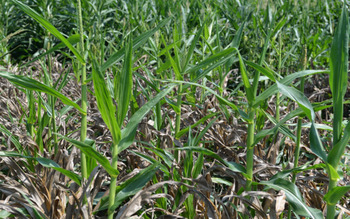
Prior to harvest near the end of the growing season, fluazifop, quizalofop, and fluazifop/fenoxaprop provided 94% to 99% control of volunteer corn in both years regardless of volunteer corn height at the time of application. Orthogonal contrasts comparing volunteer corn control by application time in clethodim and sethoxydim were significant (P < 0.001), with 89% and 96% control of volunteer corn for EPOST and LPOST applications, respectively. Reduced volunteer corn control for EPOST (28 to 30 cm, V5) applications of clethodim and sethoxydim was primarily due to the production of axillary tillers by volunteer corn in response to herbicide applications that persisted throughout the growing season (Figure 2). This physiological response was not observed in plots that received FOPs but was also present to a lesser extent for EPOST application of pinoxaden.
Axillary tiller production depicted 28 d after early-POST application of sethoxydim at 158 g ai ha−1 for control of glyphosate/glufosinate-resistant volunteer corn in Enlist corn in experiments conducted at the University of Nebraska–Lincoln, South Central Agricultural Laboratory near Clay Center, NE.

At the end of the season, pinoxaden provided 60% and 85% control of volunteer corn for EPOST and LPOST applications, respectively, with volunteer corn and Enlist corn growing out of the injury symptoms and persisting to the end of the growing season. This could be attributed to the rate of pinoxaden applied in the current study (44 and 60 g ai ha–1) but is unsurprising, as pinoxaden is labeled in wheat and barley (Hordeum vulgare L.) for POST control of grass weeds and has not previously been studied for volunteer corn control as it is not labeled for volunteer corn control (Anonymous 2014).
Volunteer Corn Biomass Reduction
Compared to the no-POST herbicide control at EPOST (129 g m2) and LPOST (211 g m2), ACCase-inhibiting herbicides evaluated in this study provided 43% to 74% reduction of volunteer corn biomass except pinoxaden (25%) at 21 DALPOST. EPOST applications resulted in high biomass reductions compared to LPOST applications (Table 2). In contrast, Soltani et al. (Reference Soltani, Shropshire and Sikkema2006) reported 89% to 99% GR volunteer corn biomass reduction at 70 d after application of clethodim, fluazifop, and quizalofop in GR soybean. Similarly, Underwood et al. (Reference Underwood, Soltani, Hooker, Robinson, Vink, Swanton and Sikkema2016) reported 90% to 99% volunteer corn biomass reduction at 42 d after application of quizalofop and clethodim. The relatively lower biomass reduction observed in the current study could be due to the timing of volunteer biomass collection at 21 d after applying ACCase-inhibiting herbicides compared with more than 40 d after application in previous studies (Chahal and Jhala Reference Chahal and Jhala2015; Soltani et al. Reference Soltani, Shropshire and Sikkema2006; Underwood et al. Reference Underwood, Soltani, Hooker, Robinson, Vink, Swanton and Sikkema2016).
Crop Biomass Reduction
Reduction in Enlist corn biomass was not different from the weed-free control at EPOST (316 g m−2) or LPOST (407 g m−2) applications of fluazifop, quizalofop, and fluazifop/fenoxaprop. In contrast, clethodim and sethoxydim reduced crop biomass by 64% to 69% regardless of application time, whereas pinoxaden resulted in 28% and 37% crop biomass reduction at 21 DAEPOST and LPOST, respectively. A 17% reduction to Enlist corn biomass in the no-POST herbicide control was also observed. Results from the current study are similar to reductions in Enlist corn biomass by clethodim and sethoxydim reported by Soltani et al. (Reference Soltani, Shropshire and Sikkema2015), with 97% and 99% reduction for sethoxydim and clethodim at 42 DAT, respectively. Likewise, crop biomass reduction in the no-POST herbicide control is consistent with the findings of Marquardt et al. (Reference Marquardt, Terry, Krupke and Johnson2012b), in which volunteer corn competition reduced hybrid corn leaf area and biomass.
Crop Injury
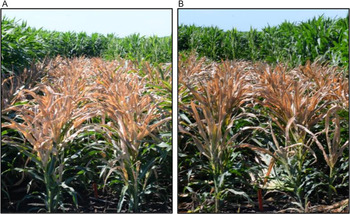
Enlist corn injury was not observed for fluazifop, quizalofop, or fluazifop/fenoxaprop applied EPOST or LPOST at any observation time (Table 3). In contrast, high levels of crop injury were observed with clethodim and sethoxydim (Figure 3), with 66% to 88% injury at 28 DAEPOST, and 88% to 89% injury at 28 DALPOST in 2018 and 2019 (Table 3). Similarly, pinoxaden resulted in 25% and 59% to 61% crop injury at 28 DAEPOST and LPOST, respectively. Clethodim and sethoxydim have been previously shown to injure Enlist corn by Soltani et al. (Reference Soltani, Shropshire and Sikkema2015), reporting 92% to 97% and 84% to 96% control of volunteer Enlist corn in soybean, respectively. The same study also demonstrated volunteer Enlist corn tolerance of fluazifop, fenoxaprop, and quizalofop. Prior to harvest, clethodim and sethoxydim applied LPOST resulted in higher crop injury (97%) compared to EPOST applications (77%) (Table 3). Lower crop injury ratings of EPOST applications of clethodim and sethoxydim were due in part to axillary tillers produced by the Enlist corn, which was 36 cm tall (V7) at the time of application. Enlist corn tillers persisted through the growing season and produced harvestable grain (Table 4).
Effects of acetyl CoA carboxylase (ACCase)–inhibiting herbicides on Enlist corn injury at 14 DAPOST, 28 DAPOST, and pre-harvest, with 21 DAPOST aboveground crop biomass reduction for field experiments conducted at South Central Agricultural Lab near Clay Center, NE in 2018 and 2019.a

a Abbreviations: DAPOST, days after POST; DIM, herbicides in the cyclohexanedione family; EPOST, early POST; FOP, herbicides in the aryloxyphenoxypropionate family; LPOST, late POST.
b Means presented within this table with no common letters are significantly different according to Fisher’s protected LSD with Bonferroni correction for multiple comparison, where α = 0.05.
c Data presented in these columns were pooled across both years (2018 and 2019) unless otherwise indicated.
d a priori orthogonal contrasts; * significant (P < 0.05); ** significant (P < 0.01); *** significant (P < 0.001); NS, nonsignificant (P ≥ 0.05).
Enlist corn injury shown after (A) sethoxydim applied at 210 g ai ha−1 and 14 d after late-POST application; (B) clethodim applied at 119 g ai ha−1, for control of glyphosate/glufosinate-resistant volunteer corn in Enlist corn in experiments conducted at the University of Nebraska–Lincoln, South Central Agricultural Laboratory near Clay Center, NE.

Effect of acetyl CoA carboxylase (ACCase)–inhibiting herbicides on Enlist corn yield and percent yield reduction in field experiments conducted in 2018 and 2019 at the South Central Agricultural Lab near Clay Center, NE.a–c

a Abbreviations: DIM, herbicides in the cyclohexanedione family; EPOST, early POST; FOP, herbicides in the aryloxyphenoxypropionate family; LPOST, late POST.
b Means presented within this table with no common letters are significantly different according to Fisher’s protected LSD with Bejamini-Hochberg correction for multiple comparison, where α = 0.05.
c Data presented in this table were separated by year (2018 vs. 2019) because of significant yield reduction from hail and windstorms in August.
d a priori orthogonal contrasts; * significant (P < 0.05); **significant (P < 0.01); ***significant (P < 0.001); NS, nonsignificant (P ≥ 0.05).
Crop Yield
Wind and hail storms in 2019 reduced end-of-season crop stand compared to 2018; therefore, Enlist corn yield was analyzed separately by year. Plots receiving EPOST and LPOST applications of fluazifop, quizalofop, and fluazifop/fenoxaprop resulted in Enlist corn yield comparable to the weed-free control in 2018 (13,601 kg ha–1) and in 2019 (8,150 kg ha–1). Likewise, percent yield reduction calculated in comparison to the weed-free control ranged from 0 to 7% without statistical difference among FOPs (Table 4). In contrast, clethodim and sethoxydim with EPOST applications resulted in 57% to 88% Enlist corn yield reduction in both years, whereas LPOST applications resulted in 93% to 98% yield reduction in the same period (Table 4). Pinoxaden yield loss varied from 21% to 69% in 2018 for EPOST and LPOST application, respectively, with comparable yield losses to clethodim and sethoxydim in 2019 (86%) for LPOST application. Absence of Enlist corn yield reductions from FOP chemistries and subsequent Enlist corn yield reductions from DIM (i.e., clethodim and sethoxydim) and DEN (i.e., pinoxaden) chemistries presented in this study are comparable to results reported by Soltani et al. (Reference Soltani, Shropshire and Sikkema2015). Despite volunteer corn densities of 41,000 plants ha–1 in 2018 and 2019, no significant reduction in crop yield was observed in the no-POST herbicide control compared to the weed-free control (Table 4). In both years, the entire experimental area including no-POST herbicide control received a premix of atrazine, bicyclopyrone, mesotrione, S-metolachlor applied PRE at labeled rate, which provided excellent early-season weed control. As such, no-POST herbicide control plots were essentially weed-free for most of the growing season, excluding competition from cross-planted volunteer corn. Lack of Enlist corn yield loss from volunteer corn competition in the current study is consistent with Marquardt et al. (Reference Marquardt, Terry, Krupke and Johnson2012b), in which 22% to 23% hybrid corn yield loss associated with spike-planted volunteer corn at 8 plants m–2 were removed when volunteer corn grain was included with hybrid corn grain yield. Likewise, in a 2-yr study conducted in South Dakota by Alms et al. (Reference Alms, Moechnig, Vos and Clay2016), season-long competition from scattered volunteer corn kernels incorporated by cultipacker at densities ranging from 0.2 to 8.5 plants m–2 resulted in hybrid corn yield losses ranging from 0 to 41% when volunteer corn was hand-removed prior to harvest. Further analysis of hand-harvested volunteer corn grain from the study indicates that even at low densities volunteer corn can contribute to grain production, with 5,700 kg ha–1 at 1.6 plants m–2 and 4,800 kg ha–1 at 3.4 plants m–2 (Alms et al. Reference Alms, Moechnig, Vos and Clay2016). All referenced studies examining the competitive effects of volunteer corn on hybrid corn established volunteer corn populations via planting individual corn kernels, which were similar to the cross-planting method used in the current study and by Chahal and Jhala (Reference Chahal and Jhala2015) in glufosinate-resistant soybean. Although the literature indicates that yield loss associated with volunteer corn competition in hybrid corn can be compensated by the grain produced by volunteer corn, the unpredictable nature of volunteer corn distribution (dropped ears vs. loose kernels), density, and location within the field and crop rows warrants additional study.
Practical Implications
Control of glyphosate/glufosinate-resistant volunteer corn has been achieved primarily through the use of ACCase-inhibiting herbicides applied POST in soybean, but no selective herbicide providing effective control of glyphosate/glufosinate-resistant volunteer corn in non-Enlist corn is available. Integration of FOP-resistant
Enlist corn into corn-on-corn production systems will enable control of glyphosate/glufosinate-resistant volunteer corn in a corn-on-corn production system. Results of this study indicate that fluazifop, quizalofop, and fluazifop/fenoxaprop provided 94% to 99% control of glyphosate/glufosinate-resistant volunteer corn with no associated Enlist corn injury or yield loss. Although Enlist corn is resistant to all FOP herbicides, quizalofop is the only product currently labeled for control of volunteer corn in Enlist corn; therefore, other FOPs cannot be applied. Results also indicate sensitivity of Enlist corn to cyclohexanediones (clethodim and sethoxydim) and phenylpyrazolin (pinoxaden); therefore, these cannot be applied. It must be noted that FOP herbicides will not be effective for control of volunteer Enlist corn, because Enlist corn is resistant to FOPs; therefore, rotation of Enlist corn with soybean or other broadleaf crops where DIMs are labeled is required (Soltani et al. Reference Soltani, Shropshire and Sikkema2015). If corn is planted the year following Enlist corn, no selective herbicide is available to control volunteer Enlist corn in corn.
Acknowledgments
The authors would like to acknowledge the contributions of Ethann Barnes in the statistical analysis of this project, Irvin Schleufer and Mike Schlick for field experiment assistance, as well as Amy Hauver, Shawn McDonald, Jasmine Mausbach, Will Neels, Adam Leise, and Jared Stander for assistance with data collection. This project was partially supported by the Nebraska Agricultural Experiment Station with funding from the Hatch Act through the U.S. Department of Agriculture (USDA) National Institute of Food and Agriculture Project # NEB-22-396. This project was also supported by the USDA National Institute of Food and Agriculture’s Nebraska Extension Implementation Program. No conflicts of interest on this project have been declared.