INTRODUCTION
Certain parasites can alter host behaviour to enhance their transmission (Barnard, Reference Barnard, Barnard and Behnke1990) and the ubiquitous protozoan Toxoplasma gondii provides a convincing example of such manipulation. T. gondii has an indirect life cycle, in which members of the cat family are the definitive hosts (Hutchison et al. Reference Hutchison, Dunachie, Siim and Work1969). If oocysts, shed with the faeces of an infected cat, are ingested by a rodent intermediate host, or another secondary host such as domestic livestock or a human, schizogony occurs and small thin-walled cysts are formed. These are found in various tissues and organs, most commonly the brain, where they remain potentially for the host's life-time (Remington and Krahenbuhl, Reference Remington, Krahenbuhl, Nahmias and O'Reilly1982). The parasite completes its life cycle when a cat consumes an infected intermediate host (Hutchison et al. Reference Hutchison, Dunachie, Siim and Work1969). Since sexual reproduction can be accomplished only in the feline, there are likely to be particularly strong selective pressures on T. gondii to evolve mechanisms to enhance the transmission rate from the intermediate to the definitive host. The predilection of the parasite for the brain of its intermediate host places T. gondii in a privileged position to cause such a manipulation (Werner et al. Reference Werner, Masihi and Senk1981).
Previous studies have shown that T. gondii infection appears to manipulate a range of ‘predation risk’ behavioural traits in its Rattus norvegicus intermediate host, including increased activity and conspicuousness, and decreased neophobia and attention (Berdoy et al. Reference Berdoy, Webster and Macdonald1995, Reference Berdoy, Webster and Macdonald2000; Webster, Reference Webster1994, Reference Webster2001, Reference Webster2007; Webster et al. Reference Webster, Brunton and Macdonald1994, Reference Webster, Lamberton, Donnelly and Torrey2006). These alterations appeared specific to only those behavioural traits likely to enhance predation, leaving other important behavioural traits, such as a rat's social status or mating success, intact and unaffected by the parasite (Berdoy et al. Reference Berdoy, Webster and Macdonald1995). In some cases infection even appeared to reverse a rat's innate aversion of cat-odour into a potentially suicidal preference for feline predation-risk areas (Berdoy et al. Reference Berdoy, Webster and Macdonald2000; Webster et al. Reference Webster, Lamberton, Donnelly and Torrey2006). Moreover, such manipulation appeared specific to that influencing predation rate of the intermediate host, as there were no significant differences between T. gondii-infected and uninfected rats in their response to either their own odours or moreover that of rabbit urine odours, and hence that of a non-predatory mammal (Berdoy et al. Reference Berdoy, Webster and Macdonald2000; Webster et al. Reference Webster, Lamberton, Donnelly and Torrey2006). Several of these studies have recently been replicated and expanded using laboratory mice and rats under laboratory conditions (Vyas et al. Reference Vyas, Seon-Kyeong, Giacomini, Boothroyd and Sapolsky2007a). These authors confirmed that T. gondii reduced the fear of cat odour in infected rodents, but infection did not diminish learned fear, anxiety-like behaviour, olfaction, or non-aversive learning. Such results indicted that, despite the shared neural and behavioural substrates potentially involved across the range of these behavioural traits (Hendrie et al. Reference Hendrie, Weiss and Eilam1996; Kemble, Reference Kemble, Cooper and Hendrie1994; LeDoux, Reference LeDoux2003), the impact of T. gondii on rodent behaviour was not due to any generalized compromise in learned fear or anxiety in general (Vyas et al. Reference Vyas, Seon-Kyeong, Giacomini, Boothroyd and Sapolsky2007a).
The aim of the current study was to further elucidate the potential species-specificity of T. gondii's behavioural manipulation towards predator odour, using, for the first time, a comparison between cat (definitive host) and mink (dead-end host) predation risk. Using a novel Y-shaped maze design where rats could only explore in a potentially aversive-odour-treated arm or box, it was predicted that T. gondii-infected rats, if a definitive host-specific response was induced by infection, would demonstrate a significantly higher proportion of time spent in the definitive host cat predator-risk areas rather that the non-definitive host mink predator-risk areas, relative to their uninfected counterparts.
The current study also expands on the Webster et al. (Reference Webster, Lamberton, Donnelly and Torrey2006) study which tested the hypothesis that the anti-psychotic and mood stabilizing activity of some medications may be achieved, or at least augmented, through their in vivo inhibition of T. gondii replication and invasion in infected individuals. In particular, the previous work demonstrated that haloperidol (an anti-psychotic used in the treatment of mental illnesses) and, to a lesser extent, valproic acid (a mood stabilizer), proved as efficient in preventing the development of T. gondii-associated behavioural alterations as the standard anti-T. gondii chemotherapeutics pyrimethamine with dapsone (PD). However, a potential non-specific generalized anxiolytic (anxiety reducing) impact of the drugs was also observed which caused both infected and uninfected, treated rats to reduce their innate fear of cat-treated predator-risk areas. We thus predicted that drug treatment in the current study, through its additional generalized anxiolytic action, may act to reduce any specific discrimination between cat and mink predator avoidance in infected rats.
MATERIALS AND METHODS
Observations were carried out using adult Lister-hooded laboratory rats. The rat provides a useful model here as the chronic impact of T. gondii within the central nervous system (CNS) of rats has been demonstrated to be more applicable to human latent toxoplasmosis, relative to that of the more acute infections in animals such as mice (Hrda et al. Reference Hrda, Votypka and Kodym2000; Webster, Reference Webster2001). Experimental rats (n=47) were orally exposed with 20 cysts of the low virulence cyst-forming ME-49 T. gondii strain. This strain had been maintained by continuous passage of infective brain homogenate in mice from the University of Leeds. Since it has been demonstrated that the route of infection (horizontal versus congenital) has no significant effect on the characteristics of T. gondii-altered behaviour in rats (Webster, Reference Webster1994) and adult-acquired infection may be more applicable to human latent infection (because human congenital infections often result in death or severe symptoms), adult-acquired infection was used throughout this study. Uninfected rats (n=39) were sham orally exposed with an equal quantity of isotonic saline. Rats were divided into 8 groups, each containing 9–12 rats (4 drug treatment groups, each subdivided into an infected and uninfected control group).
The drug treatments were either: (1) water control; (2) pyrimethamine (3 mg/kg/day) with dapsone (5 mg/kg/day) (PD), an anti-T. gondii treatment which has previously been shown to prevent latent toxoplasmosis both in rodents (Brun-Pascaud et al. Reference Brun-Pascaud, Chau, Garry, Jacobus, Derouin and Girard1996; Derouin et al. Reference Derouin, Piketty, Chastang, Chau, Rouviex and Pocidalo1991) and humans (Girard et al. Reference Girard, Landman, Gaudebout, Olivares, Saimot, Jelazko, Gaudebout, Certain, Boue, Bouvet, Lecompte and Jean-Coulaud1993); (3) haloperidol (1·5 mg/kg/day) (HAL); or (4) valproic acid (40 mg/kg/day) (VAL). HAL and VAL were dissolved in distilled water while PD was dissolved in ethanol. Despite the highly variable doses which are administered to human patients, and because of the half-life differences of these anti-psychotics between humans and rodents, the doses of each drug administered here were those specifically recommended for rodent models (Kapur et al. Reference Kapur, VanderSpek, Brownlee and Nobrega2003). Daily oral drug (or water placebo) administration commenced 14 days after T. gondii exposure, and continued for a further 14 days in all groups (i.e. during the T. gondii tachyzoite replication stage).
Drugs were administered via the oral route as this most accurately mimics the most common method by which humans receive the equivalent drug treatments and also minimizes the stress which drug administration can cause. It was deemed especially important in the current investigation to minimize any stress effects on the rats' natural behaviour. Likewise, for ethical reasons, all drugs (or placebos) were administered within fruit-flavoured jelly cubes (Flecknell et al. Reference Flecknell, Roughan and Stewart1999), to which all rats had been previously trained (habituated) to eat daily. All rats were housed in groups of 2–4 individuals per large (60 (L)×60 (W)×30 (H) cm) (4–9 times larger that the required Home Office minimum specifications for grouped rats (HMSO, 1989)), extensively environmentally enriched cage. Individual rats were randomly mixed between experimental groups within each cage, with food and water available ad libitum. All rats were monitored closely and none displayed any symptoms of illness or experimentally-induced stress at any point during the study.
At the end of the study all experimental rats were euthanased by a rising concentration of carbon dioxide and cervical dislocation. T. gondii antibodies were determined by the IgG indirect latex agglutination test (ILAT: Toxoreagent; Eiken) and IgM direct agglutination test (BioMerieux, UK). Titres >1:16 were considered positive (Webster, Reference Webster1994; Webster et al. Reference Webster, Brunton and Macdonald1994), and data from any exposed rat found to be serologically negative in both tests (n=2) were excluded from the analysis. Thus the final sample size (and median IgG titre amongst the T. gondii exposed/+ve groups) per group was: +ve undrugged control n=12 (1:32); +ve HAL n=11 (1:16); +ve PD n=11 (1:32); +ve VAL n=11 (1:32); −ve undrugged control n=9; −ve HAL n=11; −ve PD n=9; −ve VAL n=10. Notably those rats within the +ve HAL group which failed to seroconvert on the IgG ILAT were, however, IgM seropositive on the direct agglutination test. Those rats unexposed to T. gondii remained seronegative. The work was performed under Home Office project licenses PPL 30/2032 and PPL 30/1805, and all procedures were classed as ‘mild’.
‘Choice-chamber’ experimental design
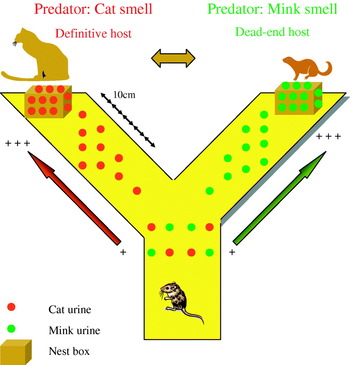
To test the specificity of the decreased fear of cat definitive host predator odours amongst T. gondii-infected rats and uninfected rats, relative to that of non-definitive host predator odours, a novel Y-shaped maze was used in the current study (Fig. 1: where the lower neutral area was 50 (W)×24 (D) cm, and each arm was 28 (W)×70 (L) cm). The floor was covered with a layer of woodchips to provide a neutral surface that could be cleaned between each rat tested. Each arm of the maze contained a nest box. Fifteen drops of cat urine were placed onto the woodchips inside one nest box and the concentration of cat odour was increased up the arm outside the box by placing 1 drop then 2, 3 and 4 drops each 10 cm further up the arm to the entry of the nest box. The same was repeated in the other arm of the maze using mink urine. Mink urine was chosen as a valid non-feline predator odour here since rats are a key component of mink diets (Linscombe et al. Reference Linscombe, Kinler, Aukrich, Chapman and Feldhamer1982). Likewise, although mink may be a relatively new predator to rats in the UK, for example, rats are universal and ubiquitous and hence mink may plausibly represent a sufficiently long co-evolutionary predator to rats overall. Furthermore, our aim here was to test for any differential response between feline and non-feline predator odour, rather than absolute responses to either. The base of the Y-shaped maze had 4 drops of urine, 2 cat and 2 mink in each bottom corner and the centre, to create a neutral area, but not a refuge. A randomly selected half of each experimental group was presented with cat urine in the left arm and half in the right. Statistical tests showed that there was no positional effect and this variable was ignored in data analysis. As variation may exist between different batches of cat odour and between odours collected from different cats in terms of aversion induced and potentially in terms of aversive odour present, we used the same batches of cat urine and mink urine throughout all the experimental trials.
Y-shaped maze presenting cat-odour treated arm and nest-box (Toxoplasma gondii definitive host predator risk) and a mink-odour treated arm and nest box (dead-end host predator risk).

Each rat was placed in the test apparatus for 10 min to become habituated to the maze and conditioned to the presence of the predator odours. The rats were then removed from the maze for 2 min before beginning the test phase when they were placed into the neutral base and observed until they entered one of the nest boxes for ⩾1 min. They were then removed for a further 2-min interval and the test was repeated twice more (runs 1–3). The wood chips were removed and the maze sterilized using 70% ethanol between each rat (as the current study aimed to test between group responses to definitive host predator vs dead-end host predator odour and, since in previous studies it was demonstrated that no difference existed between T. gondii-infected and uninfected rats in responses to their own odour (Berdoy et al. Reference Berdoy, Webster and Macdonald2000; Webster et al. Reference Webster, Lamberton, Donnelly and Torrey2006), it was deemed appropriate to restrict cleaning to between individual rat trials only). Three runs were used rather than a single run in an effort to maximize data reflecting choice rather than chance, particularly relating to any highly nervous individuals (as may be expected within the uninfected undrugged group in particular), which may be inclined to initially hide and stay hidden irrespective of predator-species odour. Likewise, 3 short runs rather than a single run of longer duration was deemed more appropriate since the Y-shaped maze design allowed no non-predator-odour risk refuge and therefore may have resulted in unnecessary stress to the individual rats. All runs were performed during daylight hours and randomized between experimental groups.
Statistical analyses
Means and variances were calculated for the proportion of time spent in the feline-associated maze arm, or nest-box, out of the total time spent in either the feline- or mink-associated maze arms, or nest-boxes (binary data of the sum of the time units spent in cat (the numerator) out of the time units spent in cat or mink (the denominator), where 1 if cat and 0 if mink). Thus, in the maze arm analyses, time spent outside both maze arms was not considered; similarly in the nest-box analyses, time spent outside both nest-boxes was not considered. Further analyses on the ‘proportion of total time spent in arms but not spent in boxes was cat’ was also performed – on the premise that, despite predator-risk odours being present in all areas, a rat may be expected to feel more ‘safe’ in a nest-box, whilst the more time a rat may spend in the cat arm but not box, the more at risk it may be from being predated. Analyses were performed and presented separately for each of the 3 runs of the experiment, and examined firstly the impact of infection amongst non-drug-treated rats and secondly the impact of drug effects amongst infected rats with respect to reactions to mink vs cat predator odour. In contrast to the Webster et al. (Reference Webster, Lamberton, Donnelly and Torrey2006) study, we did not focus on the impact of the drugs in reversing effects of infection.
RESULTS
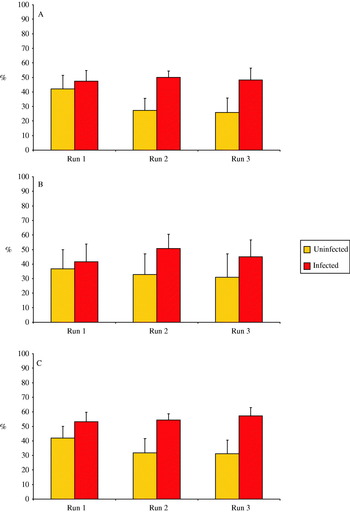
T. gondii-infected, but untreated, rats spent a consistently longer proportion of their total time in the cat-odour-treated arm (Fig. 2A), cat-odour-treated nest-box (Fig. 2B), and ‘cat-odour-treated arms but not in boxes’ (Fig. 2C) than that spent in the mink-odour-treated alternatives relative to their uninfected, untreated, counterparts across all 3 ‘runs’. This difference reached/neared significance by the second ‘run’ for both the proportion of time spent in cat-odour arm (run 2 P=0·015; run 3 P=0·093) and arm but not box (run 2 P=0·032; run 3 P=0·021). Furthermore, whilst uninfected rats showed a non-significantly linearly increasing aversion to cat-treated areas over time/runs 1–3 (Fig. 2A–C), infected rats showed a non-significantly linearly decreasing aversion to cat-treated areas over time/runs 1–3 (Fig. 2A–C). However, these trends were not significantly different from each other.
(A–C) Impact of Toxoplamsma gondii infection on the mean (s.e.m.) proportion (%) of total time T. gondii-infected untreated and uninfected untreated rats spent in (A) cat-odour-treated arm as opposed to mink-odour-treated arm; (B) cat-odour-treated nest-box as opposed to mink-odour-treated nest-box; (C) in cat-odour-treated arms but not boxes, over 3 trial runs. Means and variances were calculated for the proportion of time spent in each area (binary data of the sum of the time units in cat out of the time units in cat or mink).

As predicted, all 3 drug treatments in infected rats resulted in a loss of the predator odour species-specificity observed in the untreated infected rats, with no significant differences in the relative proportion of time rats spent in either cat- or mink-treated areas (Table 1).
Impact of drug treatment on the proportion of total time Toxoplasma gondii-infected rats spent in cat-treated areas over 3 trial runs
(Reference group=untreated infected rats.)

DISCUSSION
Wide interest in the evolutionary ecological literature on parasite–host interactions has focused on parasite-induced host manipulation. Since completion of parasite life-cycles through successful transmission between hosts is thought to be an unlikely event, the ability of trophically-transmitted parasites to manipulate the phenotype of infected hosts to increase their susceptibility to predation by definitive hosts may be favoured by selection (Holmes and Bethel, Reference Holmes, Bethel, Canning and Wright1972). However, there may also be costs associated with manipulation, one of which is that infected individuals may also be predisposed to being caught by predators that are unsuitable hosts for the parasite. Barnard (Reference Barnard, Barnard and Behnke1990) said that predation by non-definitive hosts is an unavoidable consequence of parasite-altered behaviour, even though this almost always also leads to death of the parasite. In extreme cases, non-host predation may even override the benefits of manipulation and reduce parasite fitness (Mouritsen and Poulin, Reference Mouritsen and Poulin2003). Separating host susceptibility to different types of predators is thereby essential when evaluating the effect of manipulation on parasite transmission probability. The specificity and intensity of prey responses to different types of predator remains, however, little studied (Grostal and Dicke, Reference Grostal and Dicke1999), even without considering the additional complexities of potential parasitic effects on such behaviour. Our previous findings have suggested that T. gondii may enhance transmission to a feline definitive host by causing infected rat intermediate hosts to lose their innate avoidance and, in some cases, even become attracted to cat-odour-treated areas, whilst having no impact upon a rat's response to that of non-predatory rabbit-odour-treated areas (Berdoy et al. Reference Berdoy, Webster and Macdonald2000; Webster et al. Reference Webster, Lamberton, Donnelly and Torrey2006). The results of the current study augment this by demonstrating that such a response may be feline definitive-host predator species-specific, rather than a generalized lack of fear of any potential predator. These results thus provide further support to suggest that the ability of T. gondii to manipulate intermediate host behaviour can be considered as a potential adaptation to increase the probability of successful parasite transmission. Indeed, even though the differences may be subtle, mathematical models describing a similar prey–predator–parasite system demonstrate that even a small selective increase in susceptibility of an infected prey population would be sufficient to cause a significant increase of parasitic load in predator populations (Vervaeke et al. Reference Vervaeke, Davis, Leirs and Verhagen2006). Hence an absolute behavioural manipulation might not be a pre-condition to obtaining substantial fitness benefits.
In terms of potential mechanistic explanations for the observed effects, these as ever remain to be fully elucidated. Exposure to cat and cat odour has been demonstrated to cause long-term changes in rodent behaviour, such as increased anxiety levels observed in the absence of subsequent exposures (Blanchard et al. Reference Blanchard, Yang, Li, Gervacio and Blanchard2001; Adamec et al. Reference Adamec, Blundell and Burton2005; Staples et al. Reference Staples, Hunt, Cornish and McGregor2005). This increase in unconditioned fear is associated with lasting changes in amygdalar neurotransmission, in stress hormone secretion and in pCREB content in brain regions related to regulation of stress (Adamec et al. Reference Adamec, Blundell and Burton2006). However, the apparently subtle ability of T. gondii-infected (but non-drug-treated) rats to distinguish between the two potential predator host species odours observed in the current study, as well as the rat's ability to distinguish between the predatory cat from the non-predatory mammal rabbit odours observed in our previous studies (Berdoy et al. Reference Berdoy, Webster and Macdonald2000; Webster et al. Reference Webster, Lamberton, Donnelly and Torrey2006), suggests this is not a simple disruption or reduction of olfaction in general, nor likely to indicate any sweeping changes in the neural substrates involved in bringing about these effects. One could suspect preferential localization of T. gondii to brain areas such as the septohippocampal or amygdalar regions. Indeed, it has been previously observed that while T. gondii cysts are observed in a variety of brain regions within rats, the density of cysts can be significantly higher in the amygdala, a brain region known to be important for both defensive behaviours and conditioning of fear (Webster et al. Reference Webster, Lamberton, Donnelly and Torrey2006; Vyas et al. Reference Vyas, Seon-Kyeong, Giacomini, Boothroyd and Sapolsky2007a, Reference Vyas, Kim and Sapolskyb). Likewise, one could suspect inactivation of a few olfactory receptors important specifically for cat, but not other species, odour detection, or a potential alteration in emotional valence (how negative or positive an emotional response evokes) of cat odour by brain rewiring. Indeed, it is known that each glomerulus in the olfactory bulb represents a single species of odorant receptor (Buck and Axel, Reference Buck and Axel1991). Recent studies, aimed to elucidate how odour maps are interpreted in the brain, generated mutant mice in which their olfactory sensory neurons in a specific area of the olfactory epithelium were ablated. They demonstrated that mutant dorsal-zone-depleted mice, where only second-order neurons were present, lacked innate responses to feline snow leopard urine-treated stimuli, even though they were capable of detecting them. Furthermore, these mutant mice could be conditioned for aversion to the feline urine with their remaining glomeruli, indicating that aversive information may be received by the olfactory bulb through separate sets of glomeruli, those dedicated for innate and those for learned responses (Kobayakawa et al. Reference Kobayakawa, Kobayakawa, Matsumoto, Oka, Imai, Ikawa, Okabe, Ikeda, Itohara, Kikusui, Mori and Sakano2007). Another, not mutually exclusive, mechanistic explanation may relate to the potential neuromodulatory impact of T. gondii, either directly or indirectly (Blanchard et al. Reference Blanchard, Blanchard, Rodgers and Weiss1990; Berdoy et al. Reference Berdoy, Webster and Macdonald2000; Torrey and Yolken, Reference Torrey and Yolken2003; Webster et al. Reference Webster, Lamberton, Donnelly and Torrey2006). The reaction by potential prey to cat stimuli is used to study the neurological basis of anxiety and the mechanisms of anxiolytic (anxiety relieving) drugs, and such studies have found, for example, that blocking the normally anxiogenic NMDA receptors in the amygdala also causes laboratory rats to ‘fearlessly’ approach areas treated with cat urine (Adamec et al. Reference Adamec, Burton, Shallow and Budgell1999). Likewise, infected rats here, following treatment with the drugs, appeared to lose their aversion and/or ability to distinguish between potential predator species (Table 1). This could perhaps suggest an additional generalized response of drugs in reducing ‘anxiety’ per se in these rats.
Of course, actual predation rates are the real (if not necessarily ethical) yardstick of measuring parasite manipulation to enhance transmission to the definitive host. The current study nevertheless provides an important first step in elucidating the predator-specificity of such a response. Further studies should now be performed across a range of potential predators, both suitable definitive host species (i.e. other members of the Felidae) and dead-end host species (ideally of differential potential co-evolutionary histories), combined with research aimed to identify the active compound(s) within these various predator odours involved, in order to further elucidate the specificity of this parasite-altered behavioural trait.
This work was funded by the Stanley Medical Research Foundation and The Royal Society. C. A. D. also acknowledges the MRC for Centre funding support. We are extremely grateful to V. Clarke, A. Hill, M. Berdoy, P. Harrison and D. Plimmer for practical assistance or advice, S. Wolfensohn for supplying the cat urine and G. Mason for supplying the mink urine, J. Smith for supplying the T. gondii cysts, and to J. Rudge and C. Gower for valuable comments on the manuscript.