Introduction
In the past, the European mink, Mustela lutreola (L., 1761), was widely distributed in Europe. Nowadays, some populations have declined or disappeared from several countries, and currently it is one of the most endangered small carnivores in the world (Schreiber et al., Reference Schreiber, Wirth, Riffel and Rompaey1989; Maran & Henttonen, Reference Maran and Henttonen1995). French and Spanish populations are currently continuous, but there is no connection to other important populations in Eastern Europe (Palazón & Ruíz-Olmo, Reference Palazón and Ruíz-Olmo1997; Michaux et al., Reference Michaux, Hardy, Justy, Fournier, Kranz, Cabria, Davison, Rosoux and Libois2005). Presently, the European mink is still declining in all countries (Maran et al., Reference Maran, Macdonald, Kruuk, Sidorovich, Rozhnov, Dunstone and Gorman1998a; Tumanov, Reference Tumanov1999; Gotea & Kranz, Reference Gotea and Kranz1999; Sidorovich, Reference Sidorovich and Griffiths2000a; Palazón et al., Reference Palazón, Ceña, Mañas, Ceña and Ruíz-Olmo2002). In France, it lost nearly half of its range between 1980 and 2000 (Maizeret et al., Reference Maizeret, Migot, Rosoux, Chusseau, Gatelier, Maurin and Fournier-Chambrillon2002) being presently restricted to seven departments of south-western France (Charente, Charente-Maritime, Dordogne, Gironde, Landes, Lot-et-Garonne and Pyrénées-Atlantiques) where population density seems to be low (unpublished data). The polecat, Mustela putorius (L., 1758), once present throughout most of continental Europe, is now restricted to the south of Europe and some parts of northern Europe (Roger et al., Reference Roger, Delattre and Herrenschmidt1988). A recent study has shown that M. putorius is present in most of the French departments but there are no available data on its population densities (Ruette et al., Reference Ruette, Léger, Albaret, Stahl, Migot and Landry2004). Also, in south-western France M. putorius is less tightly linked to wetlands than M. lutreola (Fournier et al., Reference Fournier, Maizeret, Jimenez, Chusseau, Aulagnier and Spitz2007). The American mink, Mustela vison Schreber, 1777 is a species of Nearctic distribution. However, due to the economical importance of their fur, minks were brought to breeding farms in Europe about a century ago. Wild populations of M. vison soon became invasive all over Europe. In France, the first observations of free individuals of M. vison occurred in 1960 but the colonization in nature was observed 10 years later (Léger & Ruette, Reference Léger and Ruette2005). In Spain, free individuals were first reported in 1978 (Ruíz-Olmo et al., Reference Ruíz-Olmo, Palazón, Bueno, Bravo, Munilla and Romero1997) and currently both countries present some high-density populations. Presently, M. vison is widely spread, with distribution areas partially overlapping those of M. lutreola (Barrault et al., Reference Barrault, Arlot, Crabos, Ducournau, Girard, Joubert, Laborde, Mozzi, Lalanne, Sabathé, Trichet and Fournier2003; Mission Vison d'Europe, 2003), which can be locally displaced by the more aggressive introduced mink (Ruíz-Olmo et al., Reference Ruíz-Olmo, Palazón, Bueno, Bravo, Munilla and Romero1997; Palazón et al., Reference Palazón, Ceña, Mañas, Ceña and Ruíz-Olmo2002).
In south-western France, all three mustelids are sympatric but several authors have shown that differences in their diets or habitat use are sufficiently large to prevent intense competition, which may only occur during periods of poor feeding conditions (Sidorovich, Reference Sidorovich1992; Lodé, Reference Lodé1993; Maran et al., Reference Maran, Kruuk, Macdonald and Polma1998b; Fournier et al., Reference Fournier, Maizeret, Jimenez, Chusseau, Aulagnier and Spitz2007). Nevertheless, M. vison represents a major source of Aleutian mink disease parvovirus and is a more opportunistic and competitive predator than M. lutreola (Sidorovich, Reference Sidorovich2000b; Fournier-Chambrillon et al., Reference Fournier-Chambrillon, Aasted, Perrot, Pontier, Sauvage, Artois, Cassiede, Chauby, Dal Molin, Simon and Fournier2004). Furthermore, the cross-transmission of pathogenic helminths between neighbouring populations of both European and American minks may occur, as previously assessed in Spain (Torres et al., Reference Torres, Mañas, Palazón, Ceña, Miquel and Feliu2003, Reference Torres, Miquel, Mañas, Asensio, Eira and Palazón2006). However, global helminthological knowledge on M. lutreola, M. putorius and M. vison in south-western Europe is scarce, compared to Eastern countries where a great deal of information has been compiled in the past decade (Sidorovich & Bychkova, Reference Sidorovich and Bychkova1993; Sidorovich & Anisimova, Reference Sidorovich and Anisimova1997; Shimalov & Shimalov, Reference Shimalov and Shimalov2001; Anisimova, Reference Anisimova2002). In this context, the present study aims to provide the first comprehensive helminthological data on these three riparian mustelids in France. Considering the importance of the continuity of both French and Spanish populations of the endangered M. lutreola, this information will complement the available data on these carnivores in Spain (Torres et al., Reference Torres, Feliu, Miquel, Casanova, García-Perea and Gisbert1996, Reference Torres, Mañas, Palazón, Ceña, Miquel and Feliu2003, Reference Torres, Miquel, Mañas, Asensio, Eira and Palazón2006). In addition, the survey will also allow the comparison of the helminth communities of both native (M. lutreola and M. putorius) and introduced (M. vison) mustelids in areas of France, while analysing the possible cross-transmission of some pathogenic helminths, which may produce a negative effect on the French population of M. lutreola.
Materials and methods
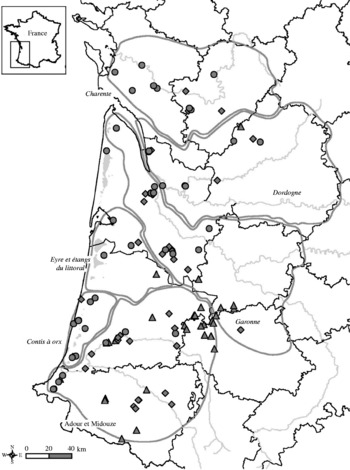
Carcasses of 45 M. lutreola, 37 M. putorius and 42 M. vison were collected by the European Mink Network between 1992 and 2005 in six river basins of south-western France (fig. 1). This large network of trained trappers has been organized for the standardized study of the European mink's distribution (Maizeret et al., Reference Maizeret, Migot, Rosoux, Chusseau, Gatelier, Maurin and Fournier-Chambrillon2002) and for the control of the feral population of the American mink (Barrault et al., Reference Barrault, Arlot, Crabos, Ducournau, Girard, Joubert, Laborde, Mozzi, Lalanne, Sabathé, Trichet and Fournier2003). Members of the network were also asked to collect all dead mustelids found fortuitously in the wild.
Origin of the hosts examined from the six prospected river basins of south-western France. The thick lines delimit the prospected river basins.  = M. lutreola,
 = M. putorius,
 = M. vison.

The river basins that provided the majority of specimens were: Adour et Midouze (8 M. lutreola, 15 M. putorius and 34 M. vison) and Garonne (10 M. lutreola, 12 M. putorius and 6 M. vison). Most of the M. lutreola specimens came from the remaining river basins prospected: Eyre (3 M. lutreola, 1 M. putorius and 1 M. vison), Contis (9 M. lutreola and 2 M. putorius), Dordogne (7 M. lutreola, 3 M. putorius and 1 M. vison) and Charente (8 M. lutreola and 4 M. putorius). Each animal was necropsied by trained veterinarians within 48 h when possible, or carcasses were stored frozen until necropsy. All skulls and viscera were frozen until parasitological analysis. Skulls were scanned for cranial helminths, especially in the nasolacrimal sinuses. All viscera were systematically checked under stereoscopic microscope and all helminths found were removed and preserved with fixative agents. Helminths were processed according to classical helminthological methods, identified, and counted. Ecological terminology follows Bush et al. (Reference Bush, Lafferty, Lotz and Shostak1997). Prevalences and intensities were compared using a chi-square analysis of contingency tables and the Mann–Whitney U-test, respectively.
Results
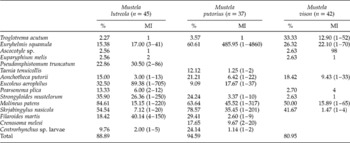
The helminthological study of all 124 mustelids revealed a total of 15 helminth species. Table 1 shows the qualitative and quantitative data of all three helminth communities. The highest global prevalence was evidenced in M. putorius (94.6%) and the lowest in M. vison (80.9%). The European mink harboured the richest community (13 species), which contrasts with the most depauperate community (nine species) found in the introduced American mink. Only six helminths were shared by all three mustelids, including two pathogenic cranial species (the fluke Troglotrema acutum and the nematode Skrjabingylus nasicola). Contrarily, helminths such as Euparyphium melis, Ascocotyle sp. and Pearsonema plica were only scarcely evidenced in both European and American minks. There were no significant differences among Aonchotheca putorii prevalences in all three mustelids. The prevalence of Euryhelmis squamula in M. putorius was significantly higher than in M. lutreola (χ2 = 17.12, P < 0.001) and M. vison (χ2 = 8.95, P = 0.003). The mean intensity of this fluke in M. putorius was also significantly higher than that of M. vison (U = 44.5, P = 0.15). Similarly, the prevalence and mean intensity of S. nasicola in M. putorius were significantly higher than in M. vison (χ2 = 10.29, P = 0.002; U = 12.5, P < 0.001) and M. lutreola (χ2 = 4.71, P = 0.037; U = 67.0, P < 0.001). In addition, the mean intensity of S. nasicola in M. lutreola was also statistically higher than in M. vison. Strongyloides mustelorum was evidenced in M. vison with statistically lower prevalence than those found in M. lutreola (χ2 = 15.21, P < 0.001) and M. putorius (χ2 = 8.57, P = 0.005). On the other hand, M. vison harboured a higher prevalence of T. acutum compared to M. lutreola (χ2 = 14.73, P < 0.001) and M. putorius (χ2 = 11.99, P < 0.001). The prevalence of Molineus patens was statistically higher in M. lutreola than in M. vison (χ2 = 11.81, P = 0.001) and M. putorius (χ2 = 4.22, P = 0.04).
The prevalence (%) and mean intensity (MI) of helminth parasites of M. lutreola, M. putorius and M. vison in south-western France. n=number of hosts examined and worm ranges are in brackets.

Discussion
Despite the fact that samples of all three mustelids were quite homogeneous, the helminth fauna of M. lutreola was qualitatively richer (13 helminths) than that of M. putorius (11 helminths) and M. vison (9 helminths). However, they shared the most abundant species (T. acutum, E. squamula, A. putorii, S. mustelorum, M. patens and S. nasicola).
All digeneans observed in the present study are transmitted by fish (Ascocotyle sp., E. melis and P. truncatum) or by amphibians (T. acutum and E. squamula). Therefore, particular data on digeneans in each mustelid surveyed may be related to their respective diet. In the study area, there are data on the feeding ecology of M. lutreola and M. putorius at the Eyre and Ciron rivers, the latter belonging to the Garonne river basin (Libois, Reference Libois2001). Unfortunately, there are no data on the diet of the American mink. No digeneans transmitted by fish were detected in M. putorius, although both of the above-mentioned amphibian-transmitted flukes were detected with different prevalence and abundance values (table 1). These data may be explained by considering the polecat's diet in most countries, including south-western France (Weber, Reference Weber1989; Sidorovich, Reference Sidorovich1992; Lodé, Reference Lodé1993; Sidorovich et al., Reference Sidorovich, Kruuk, Macdonald and Maran1998; Hammershøj et al., Reference Hammershøj, Thomsen and Madsen2004): fish is rarely taken ( < 1% of occurrence) whereas amphibians are common (>60% of the occurrence of anurans). On the contrary, the European mink (the other autochthonous mustelid) is mainly parasitized by species transmitted by fish (P. truncatum, particularly) but also by those transmitted by amphibians (especially by E. squamula). This feature reflects the generalist diet of the European mink in the study area (c. 19% occurrence of fish and c. 30% of anurans in the diet). The fact that the introduced M. vison species is scarcely parasitized by species transmitted by fish but regularly infected by those transmitted by amphibians could be related to this mustelid's diet. In fact, the diet of M. vison seems to be highly variable, either presenting high (Sidorovich, Reference Sidorovich1992; Maran et al., Reference Maran, Kruuk, Macdonald and Polma1998b; Sidorovich et al., Reference Sidorovich, Kruuk, Macdonald and Maran1998; Hammershøj et al., Reference Hammershøj, Thomsen and Madsen2004) or low amphibian occurrences (Chanin & Linn, Reference Chanin and Linn1980; Lodé, Reference Lodé1993).
Generally, riparian mustelids are scarcely infected by cestodes and acanthocephalans. In fact, in the present study only some Taenia tenuicollis adult specimens were found exclusively in four M. putorius and some larval stages of Centrorhynchus were evidenced in a few M. lutreola and M. putorius specimens.
Eight species of nematodes were identified in all analysed mustelids (seven in both autochthonous M. lutreola and M. putorius species and five in M. vison). In agreement with data from Spain (Torres et al., Reference Torres, Feliu, Miquel, Casanova, García-Perea and Gisbert1996, Reference Torres, Mañas, Palazón, Ceña, Miquel and Feliu2003), M. patens is one of the best-adapted nematodes to French riparian mustelids, probably due to their long-lasting host–parasite associations. The present prevalence of M. patens in M. lutreola (84.6%) is much higher than that reported in this mustelid from Belarus and Spain (18.0% and 53.6%, respectively) (Sidorovich & Bychkova, Reference Sidorovich and Bychkova1993; Torres et al., Reference Torres, Mañas, Palazón, Ceña, Miquel and Feliu2003). It is also higher in M. vison (50.0%) in comparison to that in Belarus (8.0%) and Spain (24.1%) (Shimalov & Shimalov, Reference Shimalov and Shimalov2001; Torres et al., Reference Torres, Mañas, Palazón, Ceña, Miquel and Feliu2003). Furthermore, the prevalence of M. patens in M. putorius is also higher (63.6%) in respect to that found in Spain (44.1%) (Torres et al., Reference Torres, Feliu, Miquel, Casanova, García-Perea and Gisbert1996). French data concerning S. mustelorum in riparian mustelids are very similar to those obtained in Spain. In fact, the present prevalence in M. lutreola, M. putorius and M. vison (35.9%, 24.2% and 2.6%, respectively) are very close to those from Spain (respectively 46.4%, 23.5% and absence of parasitization; Torres et al., Reference Torres, Feliu, Miquel, Casanova, García-Perea and Gisbert1996, Reference Torres, Mañas, Palazón, Ceña, Miquel and Feliu2003). Among Capillariinae, the most adapted species to riparian mustelids seems to be A. putorii, with a prevalence of around 15–20% in all three mustelids (table 1). These values are relatively similar to that reported in M. lutreola from Spain (18.7%; Torres et al., Reference Torres, Mañas, Palazón, Ceña, Miquel and Feliu2003). Surprisingly, E. aerophilus and P. plica were frequently found not only in M. lutreola (table 1) but also in M. putorius (9.1% of E. aerophilus) and M. vison (2.7% of P. plica). These findings are in disagreement with the Spanish data, considering that E. aerophilus and P. plica have never been found in any riparian mustelid in Spain (Cordero del Campillo et al., Reference Cordero del Campillo, Castañón-Ordóñez and Reguera-Feo1994; Torres et al., Reference Torres, Feliu, Miquel, Casanova, García-Perea and Gisbert1996, Reference Torres, Mañas, Palazón, Ceña, Miquel and Feliu2003). In order to complete their life cycle, fully embryonated eggs of both Capillariinae need to hatch in earthworms, developing into the infective stage within a month, which must be incorporated by the definitive host (Anderson, Reference Anderson2000). Although several authors mentioned the presence of earthworm remains in the scats of several mustelids, including the polecat and the American mink (Bradbury, Reference Bradbury1977; Chanin & Linn, Reference Chanin and Linn1980; Wroot, Reference Wroot1985; Weber, Reference Weber1989; Lodé, Reference Lodé1990, Reference Lodé1991), this item is rarely specifically searched for in diet studies. In south-western France, earthworms were not found in scats of M. lutreola and they were detected once in M. putorius scats. However, the specific search for earthworms was performed on a small sample (20 scats) of each species (Libois, Reference Libois2001), precluding a reliable inference about the frequency of ingestion of earthworms by these mustelids. Apart from the results concerning S. nasicola, which will be discussed later, two metastrongylid species (Filaroides martis and Crenosoma melesi) have been detected in these riparian mustelids in France (table 1). Both species seem to be well adapted to the polecat but they are absent from the introduced M. vison and only F. martis was found in M. lutreola. All metastrongylids have a similar life cycle, including a gastropod (snails or slugs) obligatory intermediate host (Anderson, Reference Anderson2000).
The pathogenic helminths T. acutum and S. nasicola were found in the nasolacrimal sinuses of all three mustelids (table 1). Both helminths had previously been reported in free-living M. lutreola, M. vison and M. putorius specimens in Spain (Aymerich et al., Reference Aymerich, Márquez and López-Neyra1983; Torres et al., Reference Torres, Feliu, Miquel, Casanova, García-Perea and Gisbert1996, Reference Torres, Miquel, Mañas, Asensio, Eira and Palazón2006), but to our knowledge, they had never been found before in these mustelids in France. The distribution of T. acutum mainly encompasses central European countries, usually parasitizing the polecat and other carnivores considered as accidental hosts (Koubek et al., Reference Koubek, Barus and Koubkova2004). Nevertheless, a relatively important focus involving M. vison specimens was recently pointed out by Torres et al. (Reference Torres, Miquel, Mañas, Asensio, Eira and Palazón2006) in Spain after studying the skulls of 46 American minks from a population located quite close to that of the present study area (30.4% in Álava). This value is very similar to that obtained in the present study (34.5% in Adour et Midouze) where sympatric M. lutreola and M. putorius specimens were not found to be affected. Therefore, in accordance with Torres et al. (Reference Torres, Miquel, Mañas, Asensio, Eira and Palazón2006), further attention should be devoted to evaluating the role of the introduced M. vison in the maintenance of the life cycle of T. acutum in south-western Europe by potentially favouring its transmission on to other mustelids, including M. lutreola, in which it can inflict serious cranial lesions. As in other European countries, the distribution of T. acutum in France seems to be discontinuous and its presence depends on the suitability of biocoenoses for the completion of its life cycle. Although no precise information is available about the life cycle of T. acutum in the prospected area, the present results imply that, at least in Adour et Midouze, M. vison must frequently feed on infested amphibians. The cosmopolitan nematode S. nasicola affects several representatives of the genus Mustela, having the capacity to produce severe damage. Its high prevalence in all of the analysed mustelids and mean intensity in both autochthonous species (table 1) contrasts with the currently available data from Spain (Torres et al., Reference Torres, Miquel, Mañas, Asensio, Eira and Palazón2006), where both European and American minks are very poorly affected by skrjabingylosis. The infective stage of S. nasicola is mainly developed in several snails and slugs (Anderson, Reference Anderson2000). Given that conditions are relatively similar in the French prospected areas where all three mustelids are sympatric, it is likely that M. vison consumes fewer snails and/or slugs than M. lutreola and M. putorius. However, gastropods may be taken more frequently in France than in Spain, considering the present results and all the available data in south-western Europe. It is possible to conclude that, at least in some French areas, the introduced American mink is a usual host of S. nasicola and mainly of T. acutum. Therefore, M. vison plays a considerable role in the maintenance of the life cycle of both pathogenic helminths by favouring its transmission on to other mustelids, including the autochthonous and severely endangered European mink.
Acknowledgements
This study was partially supported by the Spanish project 2005-SGR-00 576 from the DURSI and by the Conseil Régional d'Aquitaine, the Ministère de l'Ecologie et du Développement Durable/Direction Régional de l'Environnement Aquitaine and the European Union. We would like to thank the European and American Mink Trapping Networks, which collected the dead animals. It is composed of: Association Curuma; Associations des Piégeurs Agréés de Charente, de Charente-Maritime, de Dordogne, du Gers, de Lot-et-Garonne, de Gironde, et des pays de l'Adour; AI 17; Association pour la Défense de l'Environnement en Vendée; Centre de découverte de la Trave; Centre de Formation Permanent pour Adultes de Coulounieix-Chamiers; Centres Permanents d'Initiative à l'Environnement du Périgord et des Pays de Seignanx; Charente Nature; Cistude Nature; Conseils Généraux de la Dordogne, du Gers, de la Gironde, des Landes et des Pyrénées-Atlantiques; Direction Départementale de l'Agriculture et de la Forêt des Pyrénées-Atlantiques; Espaces Naturels d'Aquitaine; Fédérations Départementales des Chasseurs de Charente, de Charente-Maritime, de Dordogne, du Gers, de Gironde, des Landes, de Lot-et-Garonne, et des Pyrénées-Atlantiques; Fédérations Départementales des Groupements de Défense contre les Organismes Nuisibles de Charente, de Dordogne, de Gironde, des Landes et de Lot-et-Garonne; Jalle Rivière Propre; Ligue pour la Protection des Oiseaux; Lycée Agricole et Forestier de Bazas; Maison d'Initiation à la Faune et aux Espaces Naturels; Muséum d'Histoire Naturelle de la Rochelle; Nature Environnement 17; Piégeurs agrées des Landes; Parc National des Pyrénées; Parcs Naturels Régionaux des Landes de Gascogne et du Périgord-Limousin; Réserves Naturelles de Bruges, du Courant d'Huchet, de l'Etang Noir, de la Mazière et des Marais d'Orx; Services départementaux de l'Office National de la Chasse et de la Faune Sauvage de Charente, de Charente-Maririme, de Dordogne, du Gers, de Gironde, des Landes, de Lot-et-Garonne et des Pyrénées-Atlantiques; Société Française pour l'Etude et la Protection des Mammifères; Société pour l'Etude, la Protection et l'Aménagement de la Nature dans le Sud Ouest; Syndicat Mixte d'Etude et d'Aménagement du Pays des cantons de Ribérac-Verteillac-Montagrier; Syndicat Mixte d'Etudes et Travaux pour l'Aménagement et l'Entretien du Bassin de l'Isle; Syndicat Intercommunal d'Aménagement Hydraulique de la Tude.