Introduction
Effective human resource management (HRM) is a crucial and elementary construct of successful organizations. Most research studying the HRM–innovation relationship tended to borrow general high-performance work practices as predictors. However, little research has been done to understand the effects of specific HRM systems in predicting innovation (Zhou, Hong, & Liu, Reference Zhang, Zyphur and Preacher2013). Although the creativity literature has started to pay attention to the importance of individual contextual interactions and explored how team context influences the expression of individual differences related to creativity (e.g., Hirst, Van Knippenberg, & Zhou, Reference Hirst, Van Knippenberg and Zhou2009; Hirst, Van Knippenberg, Chen, & Sacramento, Reference Hirst, Van Knippenberg, Chen and Sacramento2011; Yang, Qian, Tang, & Zhang, Reference Yang, Qian, Tang and Zhang2016), evidence regarding the research on the relationship between HRM and individual creative contribution in research teams remains largely untested.
Indeed, researchers have identified culture as an important variable influencing creativity at the individual, team and organizational levels (Erez & Nouri, Reference Erez and Nouri2010; Zhou & Su, Reference Zhou and Su2010). In line with this research, a culture specific HRM system, namely collectivism-oriented HRM (hereafter CHRM) has been identified as compared with an individualistic HRM system (e.g., Li, Tang, Wang, Yan, & Liu, Reference Li, Tang, Wang, Yan and Liu2012). Given the existence of this kind of HRM system, it would be of interests to study how it may influence different levels of creativity, such as creativity at the individual level or individual creative contribution.
To address the above gap, our current paper tries to test the relationship between CHRM and individual creative contribution to their teams. This study contributes by extending the current HRM literature with a new conceptual model on the relationship between CHRM and individual creative contribution: First, it considers the influence of culture by selecting CHRM as an antecedent when explaining the development or improvement of individual creative contribution to their teams, whereas both CHRM and individual creative contribution are relative new constructs and their relationship has not been tested. Second, it links CHRM and individual creative contribution using the construct of person–organization value congruence as a mediator. This mediator can help understand the path through which how CHRM may influence individual creative contribution, which should have some significant implications for HRM research and practice in creativity-oriented teams and organizations. Third, it explores the extent to which task interdependence may enhance the association between value congruence and individual creative contribution. While authors have pointed out that task interdependence is likely to moderate the relationship between team goal commitment and team performance, this study adds value to the task design literature by introducing task interdependence as a moderator when studying the relationship between CHRM and individual creative contributions.
This paper is organized as follows: It first reviews the literature, based on which relevant hypotheses for empirical testing are proposed. After that, it reports and discusses the methodology used to test the hypotheses. Then the paper presents the results of the study. Finally, the paper concludes with a discussion of the implications of the findings for future HRM research and practice.
Literature Review and Hypotheses
Collectivism-oriented HRM
According to the research, collectivism-oriented HRM (CHRM) can be regarded as a set of HRM policy/practice cultivating collectivistic cultural value in organizations, which can be observed in East Asian societies where many organizations stress collectivism in every dimension of HRM, including recruitment, training, evaluation, reward, compensation, and promotion (e.g., Li, Zhang, Yang, & Li, Reference Li, Zhang, Yang and Li2014). For instance, with CHRM, rewards are given mainly to teams of individuals rather than single individuals, employee training and development stress teamwork rather than individual performance and promotion priority goes to those who can work well with other people (Chen, Zhang, Zhang, & Xu, Reference Chen, Zhang, Zhang and Xu2016). It generally includes team/group-related ability, which enables team members to communicate and coordinate with others. In fact, teamwork and collaboration are often the foundation for organization creativity because it can lead to internal constructive conflict with regard to attention and use of creative energy (Andreassi, Lawter, Brockerhoff, & Rutigliano, Reference Andreassi, Lawter, Brockerhoff and Rutigliano2014). By improving teamwork, CHRM not only increases employees’ sense of collective belongings to their team, but also improves collective creativity in their team.
Individual creative contributions to research teams/organizations
Creativity is a core competency among human resources in many teams and organizations today, and this is especially true for those research-oriented teams or organizations, such as those in research universities. Based on Shalley, Zhou, and Oldham (Reference Shalley, Zhou and Oldham2004), creativity can be defined as the ability to develop new ideas, new products, new practices, new services or new procedures that are novel and potentially useful to its organization. Although creativity can be observed at various levels of analysis, including the individual, group, and organizational levels, the ultimate source of creativity lies in individual one (Choi, Reference Choi2004). For a research team/organization, individual creative contributions to their team/organization should have a positive relationship with the creativity at team and organization levels. In other words, individual creativity will eventually influence team-level or organization-level creativities, which should contribute to the overall performance of the team/organization (Baron & Tang, Reference Baron and Tang2011). As such, our current study focuses on individual creative contributions to their teams in research-oriented organizations.
Scholars have identified many factors that may either stimulate or suppress creativity. At the organizational level, these include top level leadership (e.g., Zhang & Bartol, Reference Zhang and Bartol2010), organizational culture (e.g., Rice, Reference Rice2006), investment in R&D activities (e.g., Petroni, Venturini, & Verbano, Reference Petroni, Venturini and Verbano2012), and organizational structure and design (e.g., Wei, Liu, & Herndon, Reference Wei, Liu and Herndon2011). Besides, it has been agreed that prominent businesses (e.g., Hewlett Packard, IBM, and 3M) are known for both their collectivistic cultures and for creativity. Another example is, although Americans ranked higher on individual creativity, Japanese companies with a collectivistic culture ranked the highest in terms of absolute number of organizational patents, and the same was true for Israel (e.g., Erez & Nouri, Reference Erez and Nouri2010). All of these suggest that there can be a positive relationship between CHRM and creativity. Specifically, individual creative contribution to a team/organization is likely to be positively influenced by a collectivistic culture or a HRM system reflecting this culture.
The relationship between CHRM and individual creative contributions
Before discussing the relationship between CHRM and individual creative contributions, we first define individual creative contributions as an individual-level construct showing the degree to which a member contributes to her/his team/organization. As mentioned above, CHRM is characterized by valuing work together as a team and therefore, teamwork is an important driver of individual behaviors, which may have positive effects on individual creative contributions. Moreover, organizations with high level of collectivism are likely to run with an ‘integrative’ structure that makes great use of coordinative devices and involves substantial joint decision making (Ling & Zhao, Reference Ling and Zhao2007). Evidence indicates that group members collaborating closely to achieve common goals are more creative than groups that do not (e.g., Taggar, Reference Taggar2002; Bechtoldt, De Dreu, Nijstad, & Choi, Reference Bechtoldt, De Dreu, Nijstad and Choi2010).
Take a research-oriented team/organization as an example, teamwork and collaboration between an individual and other team members can be the foundation of individual creative contributions and team-level creativity (Barczak, Lassk, & Mulki, Reference Barczak, Lassk and Mulki2010). It can be observed that many large-scale research projects today require researchers to work as a team. In the processes of team work, CHRM helps to develop a sense of collective identification among team members, which in turn motivates members to work harder for the common goal of their team (House, Hanges, Javidan, Dorfman, & Gupta, Reference House, Hanges, Javidan, Dorfman and Gupta2004). Given the motivation, team members should have more creative contribution to the research of their team. In addition, HR practices with a longer term focus tend to do well in promoting creativity among employees (Ngo, Jiang, & Loi, Reference Ngo, Jiang and Loi2014). As CHRM is characterized by stressing long-term relationship between employees and organizations, CHRM should also encourage creative behaviors or contribution of team members. Therefore, we propose the following hypothesis:
Hypothesis 1: CHRM system has a positive relationship with individual creative contributions.
Person–organization value congruence as a mediator
Researchers (e.g., Kristof-Brown, Zimmerman, & Johnson, Reference Kristof-Brown, Zimmerman and Johnson2005) have defined person–organization value congruence as the degree to which the value of given member and that of her/his team/organization match each other. It also reflects individual aspirations and expectations on such issues as coworkers, supervisors, rewards, norms, or social relations (Vigoda & Cohen, Reference Vigoda and Cohen2003). Some findings suggested that good HR practices can help team members to understand the values or norms of their organization through such mechanism as effective communication and leader–member interactions (e.g., Bretz & Judge, Reference Bretz and Judge1994; Kristof, Reference Kristof1996). Furthermore, other effective HR practices such as selection, training and development can also help improve person–organization value congruence. For example, effective HR practices can create some degree of homogeneity with individual skills knowledge and abilities according to the needs of their organizations (e.g., Werbel & DeMarie, Reference Werbel and DeMarie2005). Also, effective HR practices may increase the level of the value congruence by consistently satisfying the expectations of employees (e.g., Boon, DenHartog, Boselie, & Paauwe, Reference Boon, DenHartog, Boselie and Paauwe2011).
In terms of its effects on person–organization value congruence, CHRM can be considered as a set of effective HR practices. Through practicing CHRM, teams/organizations can signal their willingness to invest in and support their members and employees. CHRM can also help cultivate a set of organizational norms or values that stress the subordination of personal interests to the interests of team/organization. In addition, with CHRM, individuals with collectivistic cultural values are more likely to be recruited and selected, while those who ultimately do not fit are more likely to leave. According to all these, CHRM should result in a high level of person–organization value congruence.
On the other hand, the value congruence may also have a positive relationship with individual creative contributions, and this should be especially true in organizations with values of collectivism (e.g., Kristof, Reference Kristof1996). Specifically, when employees hold values that match the values of their employing organization, they are more likely to be satisfied with their jobs, to identify with the goal of their team/organization (such as the goal of research for creativity), and to seek to maintain good relationship with leaders and other members (Kristof-Brown, Zimmerman, & Johnson, Reference Kristof-Brown, Zimmerman and Johnson2005). In light of this, value congruence mainly increases the motivation of individuals to contribute to the team, and a good match between the person and organizations should result in better individual performance.
In terms of creative performance, studies have shown explicitly that value congruence may have a positive effect on creativity (e.g., Oldham & Cummings, Reference Oldham and Cummings1996; Tierney, Farmer, & Graen, Reference Tierney, Farmer and Graen1999; Choi, 2004). These studies, however, have not linked HRM directly or indirectly to individual creative contributions. Considering the positive effects of person–organization value congruence on employee performance, especially those performance contributing to their organizations, we predict a positive relationship between person–organization value congruence and individual creative contributions. That is, the relationship between CHRM and individual creative contributions can be mediated by person–organization value congruence. The reason is that, with a CHRM system, teams/organizations are more likely to accept or adapt to their team/organizational values, which in turn can result in a high level of motivation contributing to the goal of their team/organization. Assuming that the goal is creativity-related, individual creative contributions should increase as a result of CHRM.
Taken together, there can be an important mediating role of person–organization value congruence in the relationship between CHRM and individual creative contributions. We therefore propose the following hypothesis:
Hypothesis 2: Person–organization value congruence is mediating the relationship between CHRM and individual creative contributions.
Task interdependence as a moderator
Here task interdependence can be defined as the degree to which group members rely on each other to perform their task effectively given the design of their jobs or the interconnections among the group members in doing the task (Sargent & Sue-Chan, Reference Sargent and Sue-Chan2001). Task interdependence is often considered as the extent to which an individual’s task performance depends on the efforts and skills of others (Wageman & Baker, Reference Wageman and Baker1997; Langfred, Reference Langfred2007). If the team values results of research or creativeness, the team members should be more likely to work harder for creativity given the condition of high-level task interdependence. Also, organizations with more interdependent tasks are likely to take a collective approach on their HRM practices.
Research has shown that the positive effects of task interdependence were particularly present during the first year of virtual teamwork, and the use of team-based rewards as operationalization of outcome interdependence was also positively related with team effectiveness (Hertel, Konradt, & Orlikowski, Reference Hertel, Konradt and Orlikowski2004). With a high-level of task interdependence, individuals perform tasks where they rely on each other, which may help increase individual creative contribution if the goal of their team/organization is creative research results (Staples & Webster, Reference Staples and Webster2008). Besides, perceptions of interdependence in a given team/organization may result in its members believing that the outcomes of team/organization depend on every individual’s contributions or efforts (Ramamoorthy & Flood, Reference Ramamoorthy and Flood2004). Given the condition, the members’ expectation of reciprocal actions should be enhanced, and they are more likely to work harder to fulfill their obligation. Accordingly, we predict a moderating effect of task interdependence on the relationship between person–organization value congruence and individual creative contributions.
Hypothesis 3: Task interdependence moderates the relationship between person–organization value congruence and individual creative contributions. Other conditions being equal, the higher the task interdependence, the greater the positive relationship between person–organization value congruence and creativity.
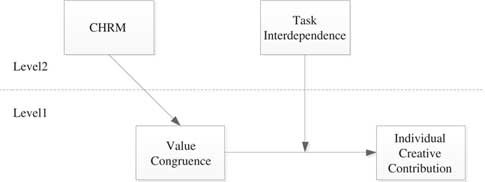
Figure 1 summarizes the hypotheses and graphically proposes the conceptual model.
Conceptual model

Methods
Participants and procedure
To test our hypotheses, we surveyed research teams that consist of full-time university employees in China. The reasons for selecting this sample are: First, these academy faculties are directly responsible for developing and implementing research projects that demand creativity so that they understand what may influence creativity in their research. Second, selecting only these academy faculties eliminates the potential confounding effects from surveying different types of human resource for different functions. All sample teams consisted of a supervisor and two or more team members.
We conducted two-wave, multiple-source survey at an average 3-month interval. This time lag was set so that the supervisor’s rating of individual creativity would not be affected by how they responded to CHRM measure. Specifically, at time 1, supervisors rated the CHRM used in the teams and their demographic information such as age, gender, education, and tenure. Members reported their perception on value congruence and task interdependence. They also filled their demographic information such as age, gender, education, and tenure. At time 2 (around 3 months later), supervisors rated individual creative contributions.
We assigned each team a unique team code, enabling us to match supervisor and member responses. To be included in the study, a team had to satisfy two conditions. One is the team’s supervisor had to complete the measures assessed in the supervisor survey, and the other is at least two team members had to complete the measures assessed in the member survey (Chen, Kirkman, Kanfer, Allen, & Rosen, Reference Chen, Kirkman, Kanfer, Allen and Rosen2007). A total of 113 teams were invited to participate in this study, and only 40 teams met above requirements, reflecting the usable rate of 35.40%.
The final sample consisted of 168 members nested in 40 teams, and the number of member responses per team ranged from 3 to 5 (not including the supervisor). In addition, the supervisor sample comprised 42.5% women, 57.5% of them held doctor degree, their average age was from 31 to 40 years (SD=1.057), and the average tenure was from 8 to 10 years (SD=1.128). The team member sample comprised 32.1% women, 63.7% of the member held doctor degree, their average age was from 31 to 50 years (SD=1.196), and their average tenure was from 2 to 4 years (SD=1.023).
Measures
The four core constructs were measured at two levels: First, both CHRM and task interdependence were measured as team-level constructs, the former was assessed by supervisor of each team at time 1 survey, whereas the later was assessed by member of each team at time 1 survey and aggregated to team-level variable. Both value congruence and creativity were tested as individual-level constructs, the former was assessed by member of each team at time 1 survey, while the later was assessed by supervisor of each team at time 2 survey. For all measurement instruments, we used 7-point Likert scales ranging from 1 (strongly disagree) to 7 (strongly agree). Given that the Chinese respondents varied in their ability to comprehend English, a professional translation service was in charge of translating all study measures into Chinese following a double-blind, back-translation strategy. Below we discuss specifically how we measured each of the constructs.
CHRM was measured with a 6-item scale developed by House et al. (Reference House, Hanges, Javidan, Dorfman and Gupta2004). Sample items from this scale are ‘The pay and bonus system in this organization is designed to maximize collectivism’; ‘In this organization, the majority of employees have a long-term employment contact’; ‘In this organization, personal influence depends on contributions to the organization.’ Reliability for this scale was 0.851.
Value congruence was measured with three items developed from previous investigation of person–organization fit (Cable & DeRue, Reference Cable and DeRue2002). Sample items like ‘The things that I value in life are very similar to the things that my organization values’; ‘My personal values match my organization’s values and culture.’ The reliability of the scale was 0.892.
Task interdependence was tested with a 5-item scale that was based on VanDer Vegt, Emans, and VanDe Vliert (Reference VanDer Vegt, Emans and VanDe Vliert2001). Sample items such as ‘I have to obtain information and advice from my colleagues in order to complete my work’; ‘I depend on my colleagues for the completion of my work.’ The reliability of the scale was 0.797. The within-group agreement index (rwg) was 0.872 (SD=0.069), and inter-member reliability (ICC1, ICC2) were 0.559 and 0.835, respectively, which were above the common rule of thumb. Also, the ANOVA result showed a significant between-group variance, F(39, 128)=6.066 (p<.001). Taken together, we obtained support for aggregating this variable to the team level.
Individual creative contribution was tested by a 4-item survey adapted from Farmer, Tierney, and Kung-McIntyre (Reference Farmer, Tierney and Kung-McIntyre2003). Sample items are ‘This member tries new ideas or methods first’; ‘This member seeks new ideas and ways to solve problems.’ Reliability for this scale was 0.841. Here our assumption is that team leaders’ scores here should be influenced mainly by the creative contribution of each of the team members. If a team member is making greater contribution to her/his research team, this person’s score should be higher than those of other members who make less contributions.
Control variables in our research were employee age, gender, education level, and tenure to rule out alternative explanations that may affect individual creativity. Specifically, age was measured on a scale from 1 (30 years or below) to 5 (61 years or above) with 10-year intervals. Gender was coded as 1=male and 2=female. Education level as measured by the last education received (1=bachelor degree, 2=master degree, 3=doctor degree). Tenure was measured on a scale from 1 (less than 1 year) to 5 (11 years or above) with 3-year intervals.
Results
Descriptive statistics
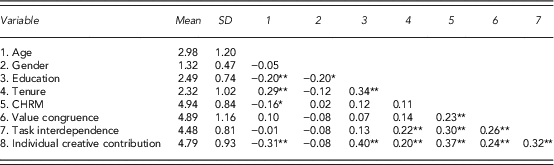
Table 1 displays the means, standard deviations, and correlations for each scale. It is obvious that both individuals’ education level and tenure were positively related to creativity, whereas individuals’ age was negatively related to creativity. Besides, CHRM was positively related to value congruence and creativity. Furthermore, task interdependence was positively related to value congruence and creativity.
Individual-level descriptive statistics

Notes. N=168. Team-level variable (CHRM) was assigned to the individual level.
*p<.05; **p<.01.
Measurement models
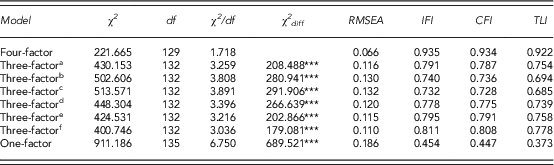
To detect and control for the threat of common method bias through statistical remedies, we carried out confirmatory factor analyses on the data set. First, we tested the full measurement model, in which all items loaded into their latent factors as intended. In Table 2, the four-factor model exhibited good psychometric properties when comparing with three-factor models. To further investigate common method variance, we conducted Harman’s single-factor test with all variables were load onto one general factor (Podsakoff, Mackenzie, Lee, & Podsakoff, Reference Podsakoff, Mackenzie, Lee and Podsakoff2003). This one-factor model exhibited very poor fit, which provided a good indication that a single factor did not account for the majority of variance in our data.
Measurement model comparisons

Notes. N=168.
a Value congruence and task interdependence combined into a single factor.
b Value congruence and individual creative contribution combined into a single factor.
c Value congruence and CHRM combined into a single factor.
d CHRM and individual creative contribution combined into a single factor.
e CHRM and task interdependence combined into a single factor.
f Task interdependence and individual creative contribution combined into a single factor.
CFI=comparative fit index; IFI=incremental fit index; RMSEA=root mean square error of approximation; TLI=Tacker-Lewis index.
***p<.001.
In addition, a series of nested model comparisons were conducted, and the results of sequential χ2 revealed that the model fit with four-factor was significantly better than all other models (all at p<.001). It is suggested that all variables were distinct and, therefore, appropriate for inclusion in the analyses.
Hypothesis testing
Because our data set were multilevel, we tested the hypotheses using hierarchical linear model. For these hypotheses to be supported there must be significant between-groups variance in the outcome variables (Liao & Rupp, Reference Liao and Rupp2005). As such, we estimated null models with only value congruence and individual creative contribution as outcome variables. Results demonstrated significant between-group variance for value congruence, χ2(40,168)=485.55, p<.001, ICC(1)=0.728, and individual creative contribution χ2(40,168)=218.83, p<.001, ICC(1)=0.522, justifying the application of cross-level hierarchical linear model testing.
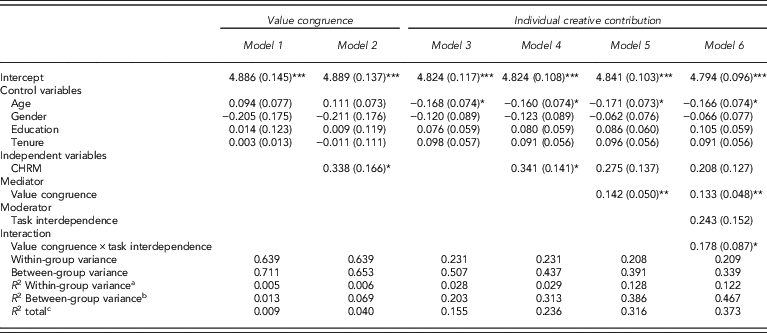
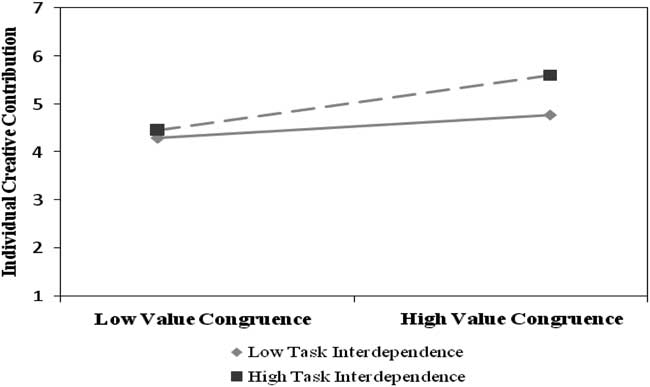
In the hierarchical linear model analysis, the individual variables were set at level 1, and the intercept was permitted to vary randomly across groups at level 2. We first tested Hypothesis 1 and Hypothesis 2, following Zhang, Zyphur, and Preacher’s (Reference Zhou, Hong and Liu2009) multilevel mediation procedures, and then tested Hypothesis 3 following Hofmann and Gavin’s (Reference Hofmann and Gavin1998) cross-level interaction procedures. Table 3 summarized the results of hypotheses. We first tested whether CHRM was positively related to individual creative contribution (Hypothesis 1) and whether CHRM was positively related to value congruence. As shown in model 4, CHRM was positively related to creativity or individual creative contribution (β=0.341, p<.05), which supports Hypothesis 1. Also, as shown model 2, CHRM was positively related to value congruence (β=0.338, p<.05). After adding value congruence to the model 5 at level 1, the effect of CHRM on creativity was not significant, whereas that of value congruence was still statistically significant on individual creative contribution (β=0.142, p<.01). This result indicates a full mediation effect of value congruence in the relationship between CHRM and individual creative contribution, which supports Hypothesis 2. Moreover, as shown in model 6, the cross-level interaction between task interdependence and value congruence on creativity was significant (β=0.178, p<.05). Therefore, this result supports Hypothesis 3.
Results of hierarchical linear modeling

Notes. N=168 at individual level, N=40 at team level. Entries corresponding to the predicting variables are estimations of the fixed effects, with robust standard errors appearing in parentheses.
a R 2 within-group variance=the proportion of within-group variance explained by the model specification as compared with the null model.
b R 2 between-group variance=the proportion of between-groups variance explained by the model specification as compared with the null model.
c R 2 total=R 2 within-group variance×(1-ICC1) +R 2 between-group variance×ICC1.
CHRM=collectivism-oriented human resource management.
*p<.05; **p<.01
To further explore the cross-level moderating effect, we plotted the simple slopes of the significant moderating effect followed by Aiken and West (Reference Aiken and West1991). As shown in Figure 2, there was a significant positive relationship (β=0.287, p<.05) between value congruence and individual creative contribution when task interdependence was high (i.e., +1 SD), but an insignificant relationship (β=0.119, p>.05) when task interdependence was low (i.e., −1 SD).
Moderating effect of task interdependence

Conclusion and Limitations
The relationship between CHRM and individual creative contribution is a type of relationship between HRM and creativity. Prior research has obtained competing evidence of this relationship. Our current study contributes by showing that, there can be a positive relationship between CHRM and individual creative contribution. Our paper also shows the boundary condition for this relationship. Specifically, the relationship between CHRM and individual creative contribution was fully mediated by value congruence, which suggests a new and important mechanism through which CHRM enhances creativity. As CHRM provides a strong link between organizational goals and individual goal, team members are likely to perceive an alignment with the values of their teams/organizations. Consequently, there can be more individual creative contribution. Finally, task interdependence functions as a moderator which should foster the relationship between value congruence and individual creative contribution. In other words, high task interdependence implies the need for intensive interactions among members, which offers more opportunities for collaboration and provides more incentive for individual creative contribution.
Studying the relationship between CHRM and individual creative contribution can help understand the relationship between organizational cultural values on the one hand, and individual/organizational creativity on the other. As mentioned above, this relationship has been studied by many researchers, but there has been no empirical evidence showing whether CHRM should influence creativity positively or negatively. By showing how CHRM, a system based on collectivistic cultural values, may improve individual creative contribution to a team through increasing person–organization value congruence, our current study provides new knowledge on the effects of culture on creativity.
Theoretical implications
It is of interests that our current study found a significant and positive effect of CHRM on creativity. This finding implies the need to further study the effects of environmental factors on the relationship between a given HR system and its usefulness for creativity. Creativity is a complicated process and creative outcomes can be relevant to both individuals and team/organizations. How HRM system should help improve creativity can be an important issue for future studies.
In addition, our finding suggests the need to further study the relationships among HRM, job design and organization design. In other words, future study should further consider the issue how HRM, job design and organization design could be conducted in a consistent and comprehensive way. In particular, how should manager use appropriate HR system to motivate employees, and to conduct reasonable job design to allow the allocation of job tasks and responsibilities so that they can be consistent with the goals of group/organization?
Finally, as our data suggest, different HRM systems may work well in different cultural environments. Therefore, greater efforts should be made in the future to conduct cross-cultural research to understand the consequences of culture on HRM system. More information on this issue should allow HR managers to effectively stimulate employees’ motivation and achieve synergy in their teams/organizations.
The information can also help understand the external validity of the findings from our current study. In other words, although our current study documented some interesting evidence on the relationship between CHRM and individual creative contribution, it remains unclear whether the same is true in other cultures, including other collectivistic cultures.
Practical implications
Considering the findings from our current study, one can see that a major practical implication is that CHRM can improve individual creative contribution, which helps her/his team/organization to gain competitive advantages. As our findings suggest that, as a culturally specific HRM, CHRM improves individual creative contribution to team/organization through the role of value congruence, which in turn improves individual creative contribution. This finding should be useful for managers who want to improve the performance of their research teams. By creating a feeling of belongings and encouraging high performance norms, team members may view the team as an in-group and make contribution to the team.
In addition, our current study shows that the impact of value congruence on individual creative contribution is significant with high level of task interdependence. Therefore, in order to encourage employees to act as ‘closed systems’ and make more individual creative contribution to their team/organization, managers may need to do more to encourage person–organization value congruence as well as to create a high task interdependence environment through job design. For instance, it is necessary to identify, recruit, and retain the most goal-congruent individuals for a particular job or task, which should lead to a better person–organization fit, enhance creativity-related motivation, and significantly improve his/her performance in the workplace.
Limitations
The current study also has several limitations that should be addressed in future research. First, we limited the testing of our hypotheses to the Chinese setting, and some caution is warranted in extending these results to other countries. Future work is needed to explore the cross-cultural applicability of CHRM and the particular relationships we detected. Second, the measure of individual creative contributions is based on supervisors’ perceptions on their employees. It is desirable to have employees’ mutual ratings on their creative performance, and then to consider both parties’ ratings to avoid supervisors’ personal bias. Third, it is very likely that employees may shift his/her values according to the work environment. This issue can be better understood over time using a longitudinal research design to examine this time-dependent fluctuation factors.
Acknowledgment
Part of this research was supported by the Chongqing Philosophy and Social Science Fund of China (2014 YBJJ030). The authors are grateful to anonymous reviewers for their constructive and very helpful comments.
Supplementary material
To view supplementary material for this article, please visit https://doi.org/10.1017/jmo.2016.68