


INTRODUCTION
Despite recent increases in the use of online communications and in-person contact, television advertising remains the primary mode of communication between campaigns and voters. Because of their relatively high cost, television advertisements are the largest single use of campaign contribution dollars: in 2010–2014, direct television advertising costs—the amounts charged by broadcasters and cable operators to run ads—accounted for just over a quarter of all expenditures in congressional campaigns. But campaigns do not pay these costs directly. Almost without exception, the tasks of production and placement of TV ads are outsourced to privately owned, for-profit intermediary firms: political media consultants.Footnote 1 When the cost of this intermediation is included, the share of total 2010–2014 campaign expenditures accounted for rises to 47%.Footnote 2
It is only a slight exaggeration, then, to say that to the extent that fundraising ability is an essential skill of high-quality candidates in modern congressional campaigns, it is essential to be able to pay media consultants. While there are voluminous literatures in political science on campaign fundraising and campaign advertising, political scientists have paid relatively little attention to the firms that actually produce nearly all campaign advertisements, and that handle a sizable share of all campaign funds raised. This omission is important because, as with any principal-agent relationship, the interests of the firms and those of their clients may not always align. Given the ubiquity of media consultants in modern campaigns and the large shares of campaign budgets they command, conflicts of interest between firm and client have the potential to generate real consequences for the conduct of electoral campaigns.
As Enos and Hersh (Reference Enos and Hersh2015) note in a different but related context, it is not necessary that the agents (media consultants) be intentionally undermining the goals of their principals (candidates) for a principal-agent problem to exist and to influence the strategy of principals. All that is required is that there be some strategic dimension on which candidate interests and firm interests diverge. For example, media consultants who earn a markup over costs on television advertising purchasesFootnote 3 have an obvious incentive to recommend allocating more campaign resources to these purchases, regardless of whether there might be more cost-effective uses for the funds, such as door-to-door canvassing or get-out-the-vote efforts. Another important example of divergence of interest is in candidate recruitment, an area where consultants have some influence thanks to their frequently close connections to party organizations (Kolodny and Logan Reference Kolodny and Logan1998; Kolodny and Dulio Reference Kolodny and Dulio2003). Profit-driven consulting firms may have an incentive to value candidates with strong fundraising ability—for example, candidates who are themselves wealthy or have networks of wealthy friends (Carnes Reference Carnes2013)—highly relative to candidates with other kinds of political skills.Footnote 4
These divergences of interest might not matter if candidates and media consultants interacted on a level informational playing field, where candidates could fully discount any profit-driven biases in consultants’ advice. But most consulting firms work on multiple campaigns per election cycle (Nyhan and Montgomery Reference Nyhan and Montgomery2015; Martin and Peskowitz Reference Martin and Peskowitz2015), meaning that firms benefit from economies of scale that allow them to develop expertise in functions—such as advertising production—that a single campaign usually does not have the capacity to carry out in-house. They can also accumulate campaign experience much faster than any individual candidate. As a result, principals at experienced firms are, relative to candidates, campaign experts. As in other situations where decision makers consult with more-informed experts (Krishna and Morgan Reference Krishna and Morgan2001), it may be very difficult for candidates to separate consultants’ bias from their expertise.
Because the potential for conflict of interest depends on the existence and magnitude of rents accruing to consulting firms, we first measure media consultants’ profits systematically. We document that profitability varies with candidates’ ability and incentive to closely monitor firm performance, consistent with the agency perspective. Finally, we show that the internal organization of media consulting firms—involving ideologically homogeneous firms who work for ideologically aligned clients—reflects an awareness of and an attempt to mitigate this potential for conflict of interest.
Summary of Results
We quantify the magnitude of the agency problem by examining variation in candidates’ disbursements to media consulting firms, conditional on total advertising expenditures. We are able to measure both the inputs and the outputs of media firms, and focus our attention on variation in the losses (from the candidates’ perspective) that occur in between. Using a new dataset from Nielsen Media Research (Nielsen), we estimate the cost of the total television advertising expenditures for each political campaign in our sample. We then regress total campaign expenditures to media consultants, derived from Federal Elections Commission (FEC) expenditure reports, on the Nielsen advertising expenditures. The resulting coefficient estimate can be interpreted as one plus the average markup among the set of firms in the sample. We then allow the estimated markup to vary along several dimensions: the level of district ex ante electoral competitiveness, the partisanship of candidates, and the incumbency status and previous campaign experience of candidates. We also compare the markups paid by candidate committees to those paid by noncandidate PACs and “super PACs.”
We first show that media consultants representing candidates in uncompetitive races are able to extract more financial surplus from the campaign by charging higher markups than consultants in competitive races. This finding is consistent with the fact that in a safe seat election, there is more financial slack and the candidate’s incentives to monitor are weaker. Second, there is no statistical difference in the markups that media consultants charge incumbents and challengers. This pattern results from the combination of countervailing supply- and demand-side forces. While incumbents have larger budgets and greater electoral security, and hence reduced incentives to carefully monitor expenditures, for the same reasons they are also more attractive as clients, leading to greater competition for their business from consulting firms. We do find that for a given candidate, markups decline from the candidate’s first to her second and subsequent campaigns, suggesting a role of campaign experience in candidates’ ability to monitor their consultants’ activities.
Third, we find that Republican media consultants are able to extract larger rents than their Democratic counterparts. This finding holds not just at the level of the campaign, but also at the level of the individual ad spot: Republican candidates pay higher effective prices to advertise on the same program in the same market on the same date than their Democratic counterparts. Republican media consultants appear to be working less hard on their clients’ behalf to negotiate the best prices for media time: they spread advertising purchases over significantly fewer ad spots and programs. As we discuss and document below, these findings are consistent with the relative scarcity of conservatives in the political consulting marketplace.
Finally, we show that PACs pay substantially higher markups on television advertising than do candidate committees.Footnote 5 This difference is consistent with the agency perspective, in that PAC leadership is more diffuse, and monitoring ability weakened, compared to that of a traditional campaign organization. In the context of a super PAC, where the candidate cannot communicate with super PAC leadership or remove them from their positions, the candidate’s monitoring ability is weakened still further.
After documenting the patterns in consultant rents present in the data, we investigate whether the industry has evolved organizational or contractual mechanisms to mitigate the potential for divergence of interests between firm and client. One partial solution to these agency problems lies in the possibility that political consulting firms are mission-oriented organizations. Besley and Ghatak (Reference Besley and Ghatak2005) demonstrate that aligning the mission of an organization with the motivations of agents improves organizational performance and reduces the need for strong monetary incentives. As a result, employees and organizations will exhibit assortative matching where individuals work in organizations with an aligned mission. Consistent with this perspective, consulting firms are relatively homogenous ideologically. While previous research has documented that consulting firms tend to work exclusively with candidates from one of the major political parties (Kolodny and Logan Reference Kolodny and Logan1998; Nyhan and Montgomery Reference Nyhan and Montgomery2015), we are the first to examine directly the ideologies of consulting firm employees and to contrast this distribution with other professional service firms. We demonstrate that consulting firms are ideologically specialized within the parties: there are relatively liberal and relatively conservative Democratic firms, for instance, who tend to work for relatively liberal or relatively conservative Democratic candidates.
When analyzing the ideological composition of consulting firms, we make explicit comparisons between consulting and law and lobbying firms. To the extent that ideological homophily is an important component of the formation of social and professional networks (McPherson, Smith-Lovin, and Cook Reference McPherson, Smith-Lovin and Cook2001), the structure of ideologically homogenous political consulting firms may be simply due to homophily rather than an attempt to ameliorate agency problems in the political consulting marketplace. To isolate the effect of agency issues specific to political consulting, we contrast the ideological structure of political consulting firms with law firms, an industry that is not directly engaged in political work, and lobbying firms, an industry where firms are directly engaged in political work, but of a different form than political consulting. In the context of lobbying, financial motivations as opposed to intrinsic motivations are likely to be more prevalent among employees. In striking contrast to lobbying firms, the density of the average firm employee ideology is bimodal in the consulting industry.Footnote 6 The difference between the ideological composition of lobbying and consulting firms is surprising given the role of personal connections and certification in serving as intermediaries between special interest groups and policymakers (Hirsch and Montagnes Reference Hirsch and Montagnes2015) but is explained by the differences in agent motivation across the industries.
RELATED LITERATURE
Our article contributes most centrally to an emerging literature on agency problems in contemporary political campaigns. As the complexity of electoral campaigns has increased, candidates increasingly delegate and share authority with intermediaries whose objectives may not align with the candidates’ goals. Enos and Hersh (Reference Enos and Hersh2015) analyze how the differences in the interests of volunteer campaign activists and the candidate manifest themselves in Barack Obama’s 2012 ground campaign. They show that Obama campaign volunteers are systematically more liberal and have different issue priorities than both the average Democratic and undecided voter. Enos and Hersh (Reference Enos and Hersh2015) argue that these extreme volunteers are likely to be less successful at persuading uncommitted voters than more moderate voters, and that the Obama campaign was unable to allocate these volunteers or control the content of their canvassing activity to ameliorate these agency problems. Their theoretical approach is complementary to ours, but we focus on the difference in objectives between a candidate, who is primarily concerned with maximizing the probability of electoral victory, and media consulting firms, which are concerned with winning but also have financial objectives that can be unaligned with those of the candidate. Franz, Fowler and Ridout (Reference Franz, Fowler and Ridout2016) examine another type of agency problem concerning the difference in incentives between candidate and outside group campaigns, asking whether outside group advertising campaigns faithfully reflect the issues emphasized by the candidate. They find that multi-issue nonmembership groups employ similar issue content to the candidates that they support, while there is less congruence for single-issue membership groups. In some of our analyses, we examine potential differences in advertising strategy across candidate and PAC campaigns that emanate from agency problems, but our focus is on how the effective cost of advertising varies across candidates and PACs.
While the data we use are from very recent election cycles, the importance of agency problems in the candidate-consultant relationship is not limited to recent political history. In fact, these issues were central during the creation and evolution of the political consulting industry. As Sheingate (Reference Sheingate2016) shows in his definitive history of the American political consulting industry, since the earliest days of the industry, consultants were ideologically homogenous and worked almost exclusively with ideologically aligned clients. “The financial rewards notwithstanding, early consultants were not simply political mercenaries lacking in partisan commitment” (p. 131). Early consultants were cognizant of the potential agency problems between campaigns and consultants. In fact, this feature of the contemporary organization of the consulting industry was in part a response to the presence of ideological diversity within advertising firms. In the 1950s, much political work was performed by conventional advertising firms. However, concerns about moral hazard and electoral sabotage were so severe that in 1960 the Republican National Committee created its own internal advertising firm, Campaign Associates, by handpicking ideologically sympathetic advertising executives from the nation’s leading advertising companies (p. 148).
Our analysis also contributes to the literature on the consequences of political consultants for campaign strategy, the allocation of campaign resources, and electoral outcomes. There is a large literature on the evolution of the political consulting industry, its business practices, and the effects of consultants on campaign strategy. One of the central themes in this literature is whether political consultants make campaigns more effective. Herrnson (Reference Herrnson1992) shows that congressional candidates enjoy increased fundraising success when candidates outsource fundraising tasks to political consultants. Medvic and Lenart (Reference Medvic and Lenart1997) find that congressional candidates who hire political consultants enjoy higher general election vote shares than candidates who do not. Medvic (Reference Medvic2001) argues that political consultants are campaign resources that help advance candidates’ electoral goals. Dulio (Reference Dulio2004) studies the attitudes of consultants and examines how variation in consultant professionalization is related to electoral performance. Cain (Reference Cain2011) shows that hiring experienced political consultants is positively associated with elite perceptions of the electoral viability of a candidate. There is also more direct evidence that campaign intermediaries who are experienced at performing a political task are more effective. For example, Mann and Klofstad (Reference Mann and Klofstad2015) show that get-out-the-vote phone calls are systematically more effective in turning out contacted voters when these calls are conducted by firms that specialize in politics as opposed to generic call centers. Our results document the incentives of media political consultants to direct a large portion of campaign resources to advertising expenditures and how agency slack may account for differences in the effectiveness of consultants across campaigns.
Political consultants have an important role in shaping the content of political advertising and advertising strategies across campaigns. Medvic (Reference Medvic2006) argues that one of the primary functions of political consultants is to craft messages that emphasize issues where voters will positively evaluate the candidate and negatively evaluate the opposition. Nyhan and Montgomery (Reference Nyhan and Montgomery2015) demonstrate that political consultants exert measurable influence on the content of their clients’ political communication. The issues that candidates highlight in their campaign communication do not only affect election outcomes, but can also reverberate to the legislative behavior of candidates once they are in office (Sulkin Reference Sulkin2011). Scholars have recently turned attention to the role of extended party networks in the recruitment of candidates, advancing policy goals, and serving members’ self-interest (Koger, Masket, and Noel Reference Koger, Masket and Noel2009; Bawn et al. Reference Bawn, Cohen, Karol, Masket, Noel and Zaller2012; Skinner, Masket, and Dulio Reference Skinner, Masket and Dulio2013). Political consultants are an important component of the broader party network serving candidates, 527s, PACs, and interest groups, and our work highlights how their incentives affect campaign communication and strategy.
Our findings also reveal important asymmetries in how campaigns are contested and how the intensity of advertising can differ across candidates due to variation in consultant markups. Most perspectives on campaign finance implicitly assume that the transformation function from a dollar of campaign funds to campaign spending is symmetric across candidates. By examining how markups vary across candidate types, we are able to quantify the cost in excess markups that inexperienced candidates pay relative to experienced candidates and Republicans relative to Democrats. If campaign advertising influences election outcomes, variation in markups across candidates exert a previously hidden drag on candidates’ campaign efforts. These findings have important implications for the literature on the influence of campaign spending on election outcomes (Jacobson Reference Jacobson1978; Green and Krasno Reference Green and Krasno1988).
DATA
We utilize three primary sources of data, each of which is described in detail below. First, we collected data on candidates’ expenditures on consulting firms from the database of FEC expenditure reports maintained by the Center for Responsive Politics (2016). Second, we use data from Nielsen covering the universe of advertising spots aired by political campaigns in the 2010, 2012, and 2014 election cycles. Finally, we use Adam Bonica’s Database on Ideology, Money in Politics, and Elections (DIME) (Bonica Reference Bonica2013) for information on the individual ideology of political consultants, lobbyists, and lawyers.
FEC Expenditures
To construct our dataset of expenditures to media consulting firms, we searched the FEC expenditure data collected by the Center for Responsive Politics for expenditures whose descriptions contained variants of the keywords “advertising,” “media,” “production,” or “television,” and did not contain keywords indicating that the expense related to some nontelevision (for example, outdoor or online) form of advertising. We next excluded payments made directly to vendors such as local television affiliates or cable providers.Footnote 7 We then applied a name regularization process used by Martin and Peskowitz (Reference Martin and Peskowitz2015) to consolidate trivial variations in firm names, and identified firms whose names appeared in the “recipient” field in at least five expenditure records identified in the previous step. After manual cleaning to remove nonconsulting firms, this left us with a sample of 234 firms. We then added to the list additional firms that were uncovered by manual inspection of expenditure reports for candidates who, according to our initial screen, had very low consultant expenditure relative to their advertising spending, yielding an additional 63 firms.Footnote 8 Finally, we went back and searched for any expenditure made to any of these 297 firms by a federal candidate, regardless of description.
We aggregated the resulting set of expenditures to the level of firm-candidate-election cycle. Because the advertising data only identify the sponsoring candidate and not the intermediary firm, some of our analyses use a coarser aggregation of total spending on all firms by candidate-election cycle. We exclude presidential candidates from the sample, focusing on expenditures in congressional campaigns. Tables A.1– A.3 in the Online Appendix give descriptive statistics on the number of firms operating, the revenues they earn, and the concentration of the market measured by Herfindahl-Hirschman index, by party, and election cycle. These calculations show that the consulting market is somewhat more concentrated on the Democratic side than the Republican.
Advertising Expenditures
Our advertising data come from a proprietary database maintained by Nielsen. The data contain every broadcast network television advertisement,Footnote 9 aired by a political campaign or interest group in the 2010, 2012, and 2014 election cycles, covering all 210 Designated Market Areas (DMAs) in the United States. Each observation is an individual advertising purchase, corresponding to a single date on a single program and station. The data contain information on the media market, date, time, program, and station on which the ad ran; the number of impressions;Footnote 10 gross ratings points (GRPs);Footnote 11 cost in dollars; and price per 1000 impressions (CPM).Footnote 12 We matched the advertising data to candidates by the ‘advertiser” field provided by Nielsen. In some analyses, a candidate’s total spending on advertising, total quantity of ads purchased in units of impressions, or total number of spots purchased are aggregated to the level of candidate-election cycle.
Individual Consultant and Candidate Ideology Scores
Bonica (Reference Bonica2014) develops a correspondence analysis approach to estimate the ideologies of private citizens from their campaign contributions, in a common space with candidates for office. These scores are useful for our analysis because they cover challengers as well as incumbent candidates, and because, by putting consultants on the same scale as candidates, we can easily compute measures of ideological distance or similarity. We use these estimated “CF scores” as our measure of individuals’ ideology.Footnote 13 The DIME data includes fields for the occupation and employer of individual contributors. We first flagged potential matches using both the political consultant occupation code and fuzzy string matching of the employer field to our set of firm names, and then hand matched the resulting potential matches to consulting firms. We also gathered a parallel set of lobbyists and lawyers for comparison purposes; these were extracted by matching the corresponding occupational category from FEC records to the DIME database.
ANALYSIS
Our first results compare congressional candidates’ advertising costs, measured from the Nielsen sample, to their expenditures to media consulting firms, measured by the FEC expenditures data. In our sample period, only 0.8% of total expenditures by federal candidates for the purpose of purchasing television advertising are paid directly from the campaign committee to a provider (either a local network affiliate or a cable system operator). Almost all such expenditures are paid indirectly through the third-party media consulting firms that are the focus of this article.
Of course, there are obvious efficiency reasons for campaigns to delegate this task. Specialist firms are often vertically integrated, bundling together ad production services with spot purchasing, and they may have expertise in negotiating with TV affiliates or understanding the demographics of different programs and media markets that in-house campaign staff lack. Given the nearly uniform choice of campaigns to delegate, it appears that these efficiencies are significant. Nonetheless, delegation has the potential to come with a trade-off in that the agent’s interests may not coincide perfectly with the principal’s: the advertising strategy that would be chosen by a profit-maximizing middleman ad buyer may not match the preferred strategy of a vote-share- or victory-probability-maximizing congressional candidate.
We begin by quantifying the average markup in our sample of campaigns. Table 1 reports coefficient estimates and standard errors from the regression of total expenditures by a single candidate in a single election cycle to any of the 297 media consulting firms (the left-hand side variable) on the total amount spent on TV advertising by the same candidate in the same election cycle (the right-hand side variable). The leftmost column of the table is a bivariate regression with no additional regressors other than a constant; the following columns allow the intercept to vary at various levels of aggregation. The overall fit of the regression is quite good, with R 2 exceeding 0.8 even in the bivariate regression, suggesting that purchasing TV advertising is in fact the major activity of the firms in the sample.Footnote 14
Regression of FEC Expenditures to Media Consulting Firms on Nielsen TV Ad Expenditure

*p < .1; **p < .05; ***p < .01
Cluster-robust standard errors in parentheses (clustered by candidate).
The coefficient estimates in Table 1 can be interpreted as one plus an average markup; for example, depending on the set of fixed effects used, a campaign must pay a consulting firm between $1.41 and $1.44 to produce $1 worth of advertising. The remaining 41 to 44 cents are presumably used by the consulting firm to pay staff and overhead costs or retained as profit. With standard errors clustered at the level of the candidate, we can reject the null of zero average markup in all specifications at the 5% significance level except for the candidate fixed effects model. The constant terms in the regression are all positive, indicating that firms still earn gross profits even if the variable cost of advertising is passed through to clients with no markup.Footnote 15
The estimates in Table 1, of course, pool across many kinds of candidates in different electoral circumstances. Our next set of results examines how the the effective markup over advertising costs varies across various candidate- and election-level dimensions. Because markups are a clear instance where the interests of firms and candidates diverge, variation in markups corresponds to variation in the balance of bargaining power between firms and candidates.
Variation in Advertising Markups
We first investigate how markups vary according to the ex-ante competitiveness of the race in which expenditures take place. We measure ex-ante competitiveness using the widely used Cook Political Report race ratings published in February of each election year.Footnote 16 Cook rates races on a seven-point scale. The most competitive races are rated “toss-up;” this category forms the excluded baseline category in our regression results. Races that favor Democrats are rated, in increasing order of favorability, ‘lean Democrat” (D1), ‘likely Democrat” (D2), and ‘solid Democrat” (D3); there are three symmetric categories for races that favor Republicans. To ease comparison of the coefficient estimates across the specifications, we report the regression results graphically. We include the full set of results for the underlying regressions in tabular form in the Online Appendix.
Before moving to our main focus of variation in markups, it is worth noting how the levels of media consultant expenditures vary with competitiveness. The coefficient estimates in Table A.4 in the Online Appendix show that, as expected, the mean levels of expenditure to media consulting firms decline as the race is expected to be less competitive.Footnote 17 The typical candidate in a D3-rated race spends nearly $500,000 less on media consultants than does the typical candidate in a toss-up race. This pattern naturally emerges from the strategic calculus of office-motivated candidates: if advertising effects (in terms of votes converted per dollar spent) are roughly constant, then the marginal effect on the probability of victory of an additional advertising dollar in an ex-ante competitive race is much greater than that in an ex-ante uncompetitive one. Consequently, candidates in competitive races allocate more effort to fundraising and spend more on advertising.
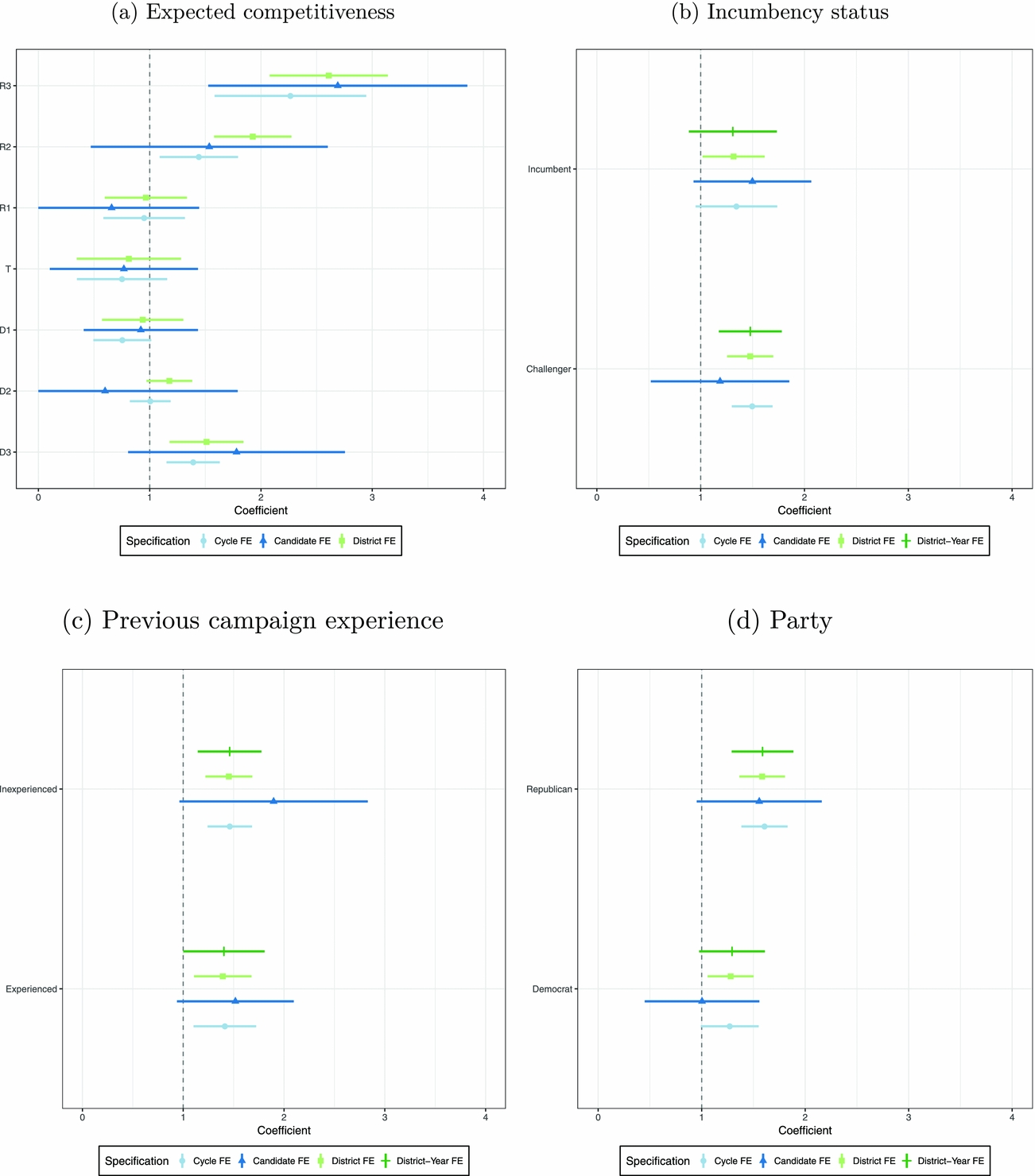
Comparison of the estimates on the interaction terms with advertising expenditures, shown in Figure 1(a), indicates that the effective markups earned by consulting firms are higher in less competitive races as compared to more competitive races. That is, although consultant revenues decline, variable profits increase in less competitive races. Once district fixed effects are included in the specification, all rating interactions are positive, indicating that markups are lowest in the most competitive races.Footnote 18 In fact, the point estimates on the advertising effects in toss-up- and lean-rated races are less than one; the point estimates for all likely and solid races exceed one. We generally cannot reject the null of zero average markup in the more competitive group, and can for the less competitive group. The exception is the candidate-fixed-effects specification, where the estimates are much less precise due to the relatively small amount of within-candidate variation in electoral circumstances present in this short, three-election-cycle panel. Nonetheless, the pattern of point estimates is the same as in the other specifications.Footnote 19
Estimates of coefficients on advertising expenditures on media consultant payments, interacted with candidate or election characteristics. Each panel presents point estimates and 95% confidence intervals from a set of regression specifications that include fixed effects at varying levels. Output from the same regressions is also presented in tabular form in the Appendix.

Another factor that might be expected to alter candidates’ incentives to monitor their agents is incumbency status. Incumbents tend to have much larger “war chests” of campaign cash available, reducing the need to carefully control campaign expenses. And the incumbency advantage means that incumbents will typically face less competitive elections than challengers. Figure 1(b) shows, however, that this pattern is not evident in the data. While incumbents’ total expenditures on media consulting firms are higher (as evidenced by the main incumbency effect reported in Table A.5 in the Online Appendix), consistent with their larger average budgets, the marginal advertising costs do not differ significantly between incumbents and challengers on average.
It is possible that the null finding here reflects opposing pressures from each side of the market: on the demand side, incumbents have larger budgets and hence less need for careful monitoring, which may allow more slack for high consultant fees. On the supply side, for reputational reasons discussed in Martin and Peskowitz (Reference Martin and Peskowitz2015), incumbents are more attractive clients for consulting firms. Incumbents are likely to have more firms competing for their business, increasing their bargaining power and driving down prices.
An alternative way of operationalizing differences in candidate experience across candidates is to employ an indicator for whether the candidate has previously run a federal campaign. Non-incumbents who have previously run unsuccessful campaigns for congress are characterized as having previously run a campaign.Footnote 20 Once again, we estimate the same set of regressions as in our incumbent results but now we interact Nielsen advertising expenditures with the previous campaign experience indicator. The point estimates, shown in Figure 1 (c), indicate lower margins for experienced candidates in all four specifications. In the specification that includes candidate fixed effects, the magnitude of the point estimate is fairly large, representing a 37.9% decrease in markups for experienced candidates, and this difference is significant at the 5% level. The results from this candidate fixed effects specification suggest that candidates learn from previous campaigns and are more effective at monitoring media consulting firms as they become more experienced.
We next examine whether markups systematically differ across candidate and PAC advertising purchases. Our perspective suggests that the scope for media intermediaries to extract rents will be larger in PAC than candidate campaigns. In a candidate-run campaign, the candidate maintains ultimate responsibility for how money is spent and will typically have stronger incentives to monitor than a PAC campaign.Footnote 21 Furthermore, in some instances PACs are operated by strategists who also have financial interests in the media intermediary firms that the PAC uses to purchase advertising (Ball Reference Ball2016). For example, in our data we find that the American Crossroads PAC and Crossroads GPS super PAC—two of the heaviest PAC advertisers in the sample—frequently engaged the Crossroads Media Group to purchase advertising on their behalf, directing a total of more than $200 million to the firm in 2010-2014. In these cases, the strategist may have strong personal financial incentives to direct PAC funds to the media consulting firms they own and to permit relatively high markups. Table 2 shows that, indeed, the average markup is dramatically higher for PACs as compared to candidate committees: PACs pay an average of $2.51-$2.69 to generate $1 worth of advertising.Footnote 22
Regression of FEC Expenditures to Media Consulting Firms on Nielsen TV ad Expenditure: PACs.

*p < .1; **p < .05; ***p < .01
Cluster-robust standard errors in parentheses (clustered by PAC).
Finally, Figure 1 (d) shows the variation in margins across candidates from the two major parties. The marginal advertising cost paid by Republican candidates is consistently estimated to be larger than that paid by Democrats, by about 30 cents on the dollar. We can typically reject that the two slope coefficients are equal at standard levels of significance.Footnote 23 This difference is substantively large, as it implies that marginal contributions to Democratic candidates can be converted into roughly 30% more advertising impressions seen by voters compared to marginal contributions to Republican candidates. If TV advertising has nonzero impact on election outcomes (Huber and Arceneaux Reference Huber and Arceneaux2007; Gerber et al. Reference Gerber, Gimpel, Green and Shaw2011), then, the per-dollar effectiveness of Democratic contributions is much higher. A substantially larger share of Republican contribution dollars are being captured by consulting firms compared to their Democratic counterparts.Footnote 24 Noting that the consulting firm market is split along partisan lines, with Democratic firms and Republican firms serving exclusively Democratic and Republican candidates, respectively (Nyhan and Montgomery Reference Nyhan and Montgomery2015), we next examine whether there are measurable differences between the two sets of firms on other measures of behavior.
Additional Evidence on Partisan Differences
One major function of media consultants is advising candidates on media strategy: how much, where, and when they should advertise. As noted earlier, candidates’ interests dictate that ad spending should vary with anticipated race competitiveness: all else being equal, ad spending is more valuable in close races than in uncompetitive contests. On the other hand, consultants who are compensated on the basis of the client’s total media expenditures have an interest in keeping those expenditures as high as possible, regardless of the electoral environment.
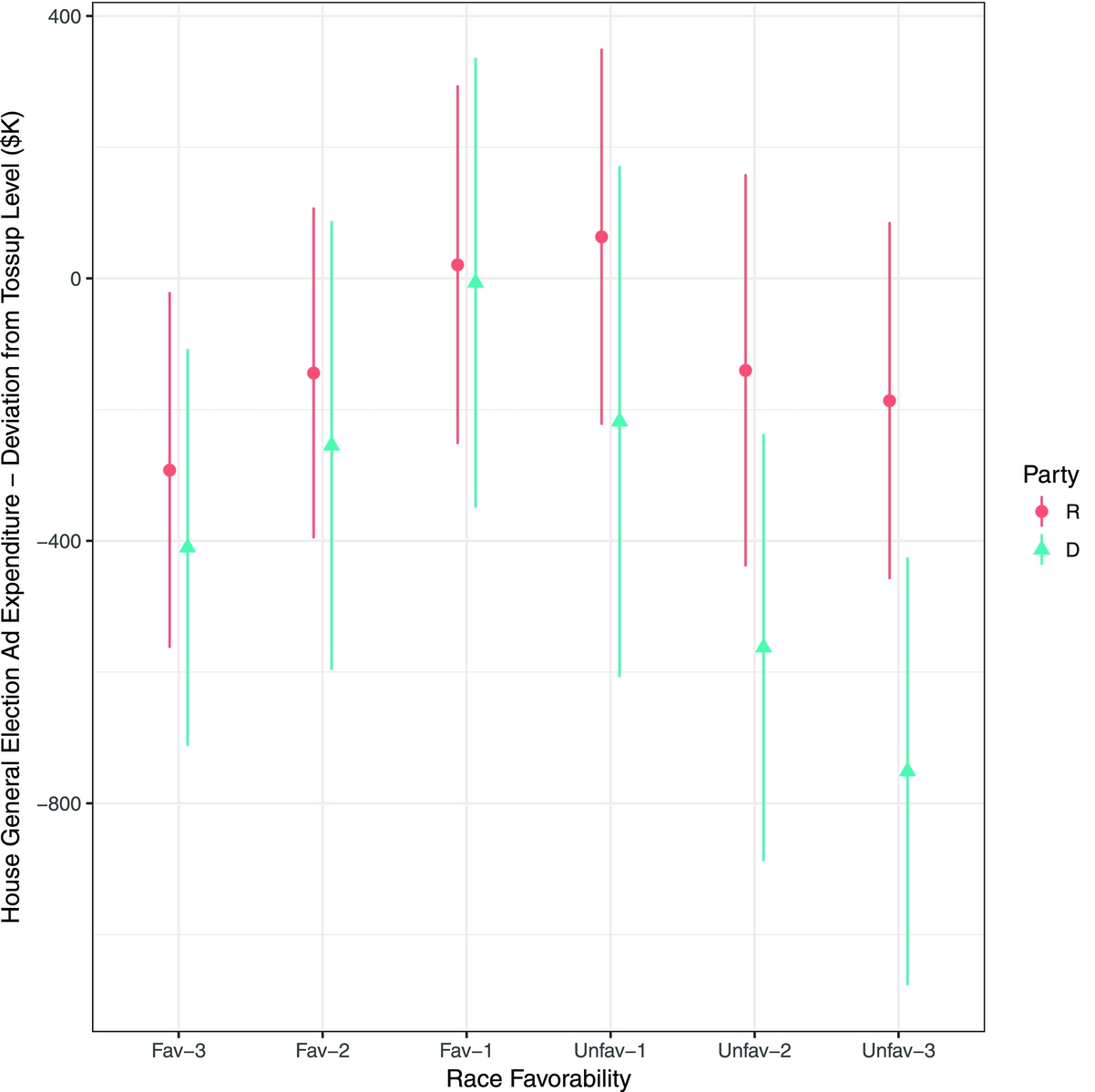
Figure 2 examines which of these patterns is evident in the data across the two parties. The results show partisan differences in total television advertising spending with competitiveness (again measured by the Cook forecasts). Each row interacts an indicator for the party of the sponsoring candidate with dummies for each of the Cook categories.Footnote 25 The twelve possible combinations are reordered so that symmetric effects (for example, being a Democrat in an R3 race versus being a Republican in a D3 race, the least favorable situation) are adjacent. Results from this regression are also presented in the Appendix in Table A.8.
Estimated differences from toss-up level in total TV ad expenditure, by party. Cook February forecasts are reordered for comparability across parties: The Democratic candidate in a D3 race is coded as Fav-3, whereas the Republican candidate in a D3 race is coded as Unfav-3, and so on. The unit of the y axis is thousands of dollars.

The consistent pattern that appears is that Democratic ad spending is more responsive to changes in race competitiveness than is Republican spending. For instance, Democratic candidates in R3 races (races they are very likely to lose) spend on average nearly $800,000 less on TV ads than Democratic candidates in toss-up races. Republican candidates in the symmetric situation, running in a D3 rated race where they are heavy underdogs, spend a not-statistically-significant $200,000 less on average than in races they have a chance to win. Republican firms that earn a percentage of the client’s expenditures thus do better on two dimensions than their Democratic counterparts: their margins are higher, and the base level of spending is less variable.
While the evidence in Figure 2 is suggestive that the distribution of rents between candidate and consultant favors consultants more on the Republican side than the Democratic, it is not conclusive. It is possible that the true optimal response curve of ad spending to competitiveness is flatter for Republicans than Democrats, and this pattern would appear even in the absence of intermediary firms. For example, differences in the structure of media markets across districts where Democrats and Republicans are favored may be explaining some of the variation across the parties.Footnote 26
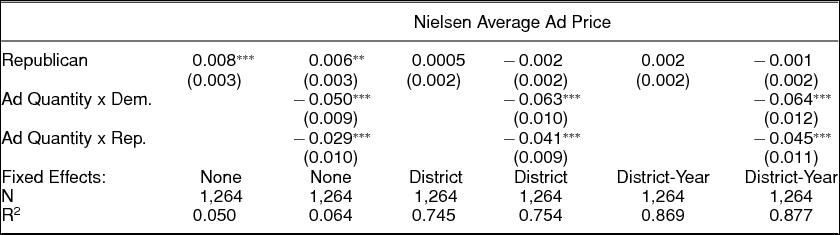
In contrast, our next result examines variation in a measure that candidates have a clear interest in keeping low: the per-impression price paid for advertising.Footnote 27 The higher the price paid, the fewer voters who can be reached given any budget for advertising. One major function of media consultants is selecting the most cost-effective programs and times on which to advertise, a task with which in-house campaign staff are unlikely to be familiar and for which the consultant’s expertise is potentially valuable. Table 3 shows that Republican consultants do a worse job for their clients on this dimension. The average price per impression paid by Republican advertisers is higher (columns 1, 3, and 5 of the table), and they get smaller quantity discounts (columns 2, 4, and 6). The median per-impression price in the data is 10 cents, meaning that the Democratic cost advantage is estimated to be between 0.5% and 8% of the median. Again, this is a substantively large penalty that reduces the per-dollar effectiveness of Republican contributions.
Regressions of Average Ad Price on Party and Ad Quantity.

*p < .1; **p < .05; ***p < .01
Cluster-robust standard errors in parentheses (clustered by candidate).
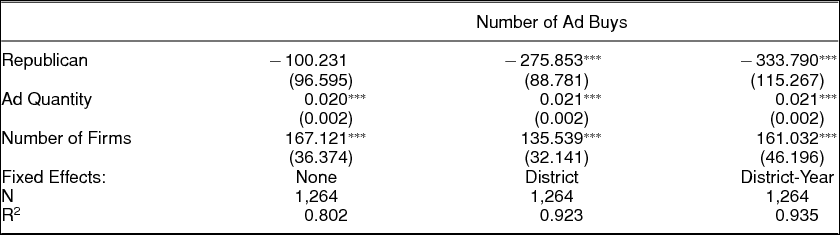
Consistent with the hypothesis that Republican consultants are exerting less effort to obtain the best prices for their clients, Table 4 shows the average number of ad spot purchases (“buys”) that a candidate’s agent makes by party. The two control variables included are the total advertising quantity purchased, and the number of firms hired by the candidate (a single candidate can potentially, and in the data often does, hire more than one media consulting firm). For a given level of advertising purchased, Republican firms break it into several hundred fewer individual spot purchases. The median number of spot purchases in the data is 755, so the party effect estimated here is large relative to the typical advertising purchasing strategy.
Regressions of Number of Ad Buys on Party and Ad Quantity.

*p < .1; **p < .05; ***p < .01
Cluster-robust standard errors in parentheses (clustered by candidate).
Of course, advertising prices vary with audience demographics as well as size, and it is conceivable that a candidate would prefer to pay a higher per-impression price if that meant reaching a more desirable audience (for example, one more likely to turn out to vote or more persuadable). Advertising prices are especially sensitive to audience income, and given that higher income households are more likely to be Republican voters, an alternative explanation for the Table 3 results is that Republican candidates simply need to target a more upscale (and more costly) audience. A related concern is that if Republicans are more concentrated in particular programs or time slots than Democratic audiences, then it may be in the interest of Republican candidates to purchase fewer spots.Footnote 28 Additionally, campaign strategists have found that Democrats watch more television than Republicans (Seelye Reference Seelye2004) so these partisan differences may in part reflect differences in how core supporters consume media.
We address these possible differences in the advertising environment across parties by disaggregating the data to the spot level. Table 5 shows the variation in price per 1000 impressions (CPM) paid across parties, using increasingly fine-grained fixed effects to hold audience attributes constant.Footnote 29 Column 1 compares spots within the same media market, the same channel, and the same year. The difference is a statistically significant 38 cents. Column 2 uses variation only within the same program, channel, market, and year. Audience attributes such as demographic composition are measured and reported to advertisers at the program level, so this comparison holds such demographic variation fixed. There is still a positive and significant difference in the price paid by Republican advertisers.
Regressions of Ad Price (CPM) on Party.

*p < .1; **p < .05; ***p < .01
Cluster-robust standard errors in parentheses (clustered by Designated Market Area). An observation is an individual ad buy. The dependent variable is the price of the ad spot, measured in dollars per 1000 impressions.
Finally, while audience demographics (at least as observed by advertisers) do not vary within the program-year, in the context of elections it is possible that some days may be more desirable than others: two days before an election is a much more desirable spot than five months due to the short-lived persuasive effects of advertising (Gerber et al. Reference Gerber, Gimpel, Green and Shaw2011). Candidates may be willing to pay more for the same number of impressions on these more desirable days.Footnote 30 Column 3 uses variation only within the same market, the same channel, the same program, and the same air date. Including this many fixed effects reduces the power, but the point estimate of the Republican effect is still positive even within this highly restricted comparison. These results illustrate that the differences across parties in the cost of advertising are not due to cross-party variation in the types of advertisements that candidates optimally purchase, but instead appear to be the result of differences in behavior on the part of media purchasing consultants.
CONSULTANT IDEOLOGY AND FIRMS’ INTERNAL ORGANIZATION
The results of the previous section provide evidence that, at least in certain situations, media consulting firms are able to exploit their intermediary position to extract rents from candidates. This observation raises the question of whether the market has evolved organizational forms to guard against this possibility. One potential solution, which Sheingate (Reference Sheingate2016) demonstrates has been a part of the industry since its early days, is to organize consulting firms such that they are made up of individuals who are intrinsically motivated to act in the interest of the client (that is, getting a particular type of representative elected to Congress). Consulting firms might be able to signal their trustworthiness and lack of incentive to exploit the client by selecting employees who are ideologically homogenous and aligned with the client’s ideology; a firm made up of such individuals would face intrinsic costs that could restrain the profit-maximizing desire to enrich itself at the cost of the client’s electoral prospects.
We examine this possibility using the data on individual consultant ideology scores from Bonica’s DIME described in the data section. Table 6 shows regressions of several summary measures of within-firm ideology variation. We compare the average intrafirm ideological heterogeneity of political consulting firms to two other kinds of professional-services firms made up of individuals with comparable skills: law firms and lobbying firms. We limit the sample to firms that are of similar size to the typical consulting firm in the sample (less than 25 employees in the DIME data) and include flexible controls for firm size in that rangeFootnote 31 to remove mechanical variation due purely to the number of individuals included in the firm-level summary statistics. The results show that regardless of the measure used, consulting firms are more homogeneous than their counterparts in the two comparison industries.
Comparison of Within-Firm Ideological Heterogeneity Measures by Industry.

*p < .1; **p < .05; ***p < .01
Standard errors in parentheses. The sample is all firms with at least 2 and no more than 25 employees identified in the contribution records. All regressions include a full set of dummies for year and firm size. The outcome measures are four summary statistics of the set of individual ideology scores within each firm: the minimum to maximum range, the interquartile range, the median absolute deviation, and the variance.
Figures 3(a) and 3(b) provide a visualization of the forces generating this difference. Figure 3(a) shows that the distribution of individual consultants looks similarly bimodal, as compared to the distributions of individual lobbyists and lawyers. Lawyers and especially lobbyists are more conservative than consultants, but there are very few “centrists” who give equally to candidates on both ends of the spectrum in either group.
Comparison of the individual- and firm-level distributions of ideology, as measured by Bonica CF score, in the political consulting, lobbying, and law industries.

Figure 3(b), however, shows that while the distribution of consulting firms—constructed by averaging CF scores across all employees within each firm—is still quite bimodal, the distribution of lobbying and law firms looks nearly unimodal, with a large mass close to the zero point of the scale. While the pools of individual consultants, lobbyists and lawyers are similarly polarized, law firms and lobbying firms mix individuals with different ideological preferences, leading to firms with average values close to zero. Employees of consulting firms, on the other hand, appear to be selected to fit an ideological profile.
Finally, we test the second part of the hypothesis—that firms work for ideologically aligned candidates to align principal and agent incentives—in three ways. First, Table 7 regresses a binary indicator for the existence of a hiring relationship between a firm and a candidate in a particular cycle on the ideological distance between firm and candidate, measured as the absolute difference between the candidate’s CF score and the median CF score of the firm’s employees in that cycle. We consider the universe of possible matches to be all firm-candidate pairs where the candidate hired at least one media consulting firm in that cycle, and the firm worked for at least one candidate from the same party in that cycle. The resulting estimates show that ideological distance is a strong predictor of the likelihood of a match between firm and candidate. In terms of magnitude, the range of the CF score measure is –5 to 5, with most of the mass between –2 and 2. A one-point increase in ideological distance—roughly equivalent to half the within-party range—leads to half a percentage point decrease in the probability of a match, a sizeable drop given that the base probability is about 3%.
Regressions of Probability of Match between Candidate and Firm as a Function of Ideological Distance.

*p < .1; **p < .05; ***p < .01
Cluster-robust standard errors in parentheses (clustered by candidate). All three columns are linear probability models where the outcome is the existence of nonzero expenditures from candidate to firm in a given cycle. Ideological distance is computed as the absolute difference between a candidate’s CF score and the median CF score of the firm’s employees.
Second, we compare the ideological heterogeneity of firms’ 2012 client lists (measured by the median absolute deviation of clients’ CF scores in 2012) to the heterogeneity that would result if the firm worked for a random sample of the same size as the actual client list of candidates from the same party. For every firm in the sample, we first compute the median absolute deviation among the firm’s actual observed clients. We then construct a new simulated client list for the firm by sampling candidates at random from within the set of same-party candidates running in 2012. Figure 4 plots the distribution of the real and simulated heterogeneity measures. The figure shows that actual client lists are more ideologically homogeneous than would be expected if firms had no particular ideological niche within the party and simply drew clients uniformly from the party’s set of candidates.
The density of ideological heterogeneity of firms’ client lists, compared to a baseline where firms work for clients selected at random from the same party.

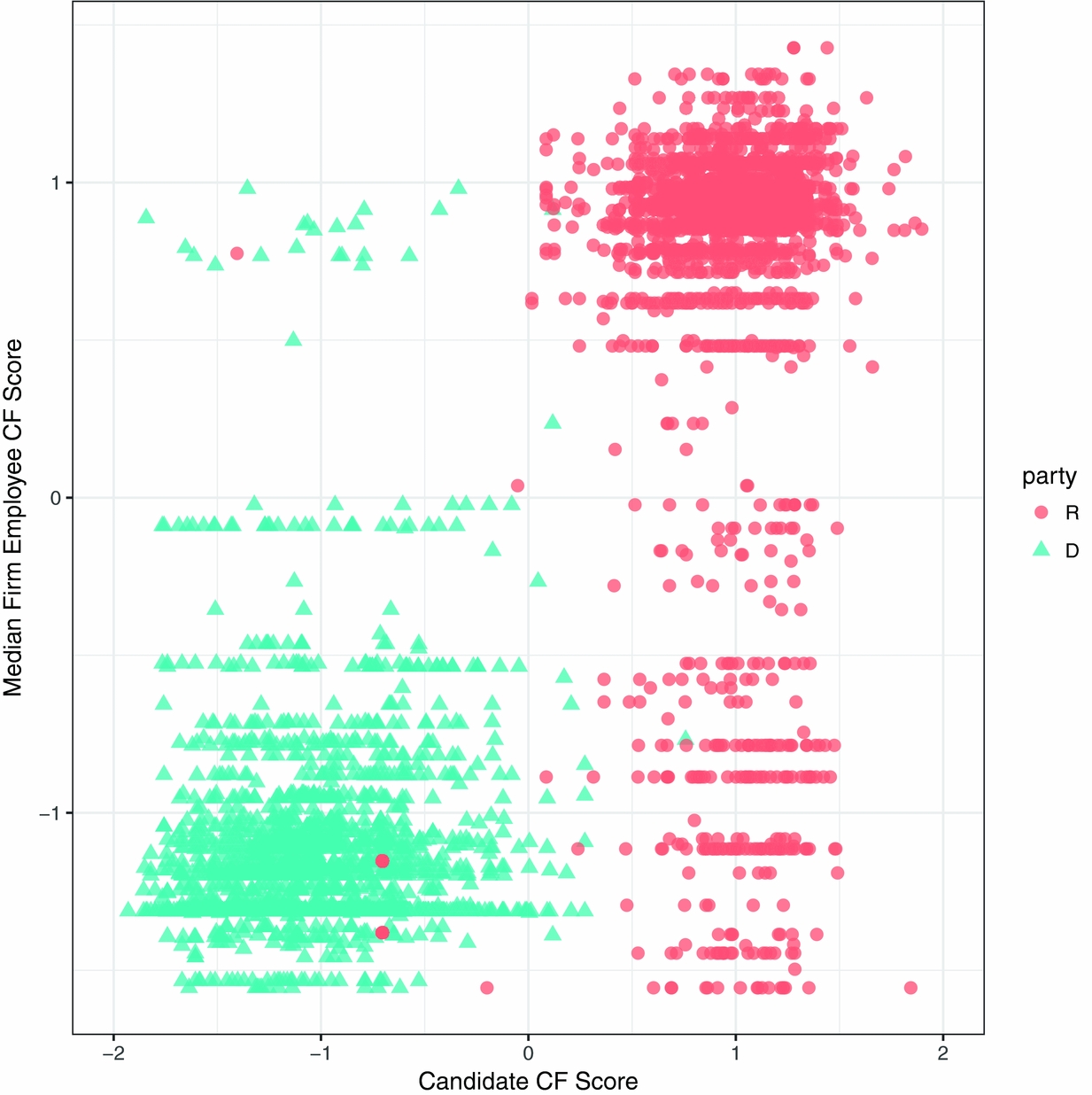
Third, in Figure 5, we plot median firm ideology against candidate ideology, for the set of firm-candidate matches that we observe in the data. There is clearly a positive relationship, but there is also a striking partisan asymmetry: Democratic candidates almost never hire a firm whose median employee has a conservative CF score, but the inverse situation is fairly common.Footnote 32 This result connects to the distribution of individual consultant and firm-average ideology scores in Figures 3(a) and 3(b). There simply are far more Democratic- than Republican-leaning consultants, a fact that is perhaps unsurprising given the typical ideological leanings of individuals with experience in the media and television industries. This relative scarcity of individual Republican-aligned consultants leads to a much higher likelihood of ideological misalignment between firm and candidate on the Republican side, which may be driving the greater profitability of firms working for Republican candidates documented in the previous section.
Firm ideology vs. candidate ideology, for firm-candidate pairs observed in the data.

DISCUSSION OF RESULTS
The profitability of the “business of politics” (Sheingate Reference Sheingate2016) has important consequences for the functioning of the electoral system. For one, the margins earned by media consultants over and above the direct cost of advertising influence the potential effectiveness of campaign contributions: the larger the margins, the more costly it is for a candidate to reach any particular quantity of advertising. While these markups are substantial and vary across types of candidates, they do not always bias electoral competition in a normatively troubling way. For example, we do not find differences in markups across incumbents and challengers. However, there are other differences which may tilt the playing field toward one group of candidates. Our results have demonstrated robust and substantial differences across the parties in the size of consultants’ markups, a fact that implies that in a race between two equally well-funded candidates, the Republican candidate is actually at a sizable disadvantage in terms of the quantity of advertising she can expect to obtain.
Second, media consultants play an important strategic and advisory role in campaigns (Nyhan and Montgomery Reference Nyhan and Montgomery2015). To the extent that consultants earn positive markups on their clients’ advertising expenditures, their financial incentives provide a clear bias towards recommending higher levels of advertising expenditures, regardless of the client’s particular circumstances. The larger the equilibrium markups, the greater the temptation will be to make this recommendation even if additional expenditures—coming, as they must, at the cost of additional candidate effort diverted to fundraising and away from other activities—might not yield positive returns for the client on the margin. These results provide additional evidence of the potential for principal-agent conflict in contemporary political campaigns (Enos and Hersh Reference Enos and Hersh2015).
Given the reputation for campaign expertise cultivated by established media consulting firms and their central role in modern campaign strategy, candidates are unlikely to be able to completely discount this profit-driven bias in consultant advice. This problem may be especially acute for novice challenger candidates with little campaign experience of their own. We show that the higher rents available to Republican candidates are mirrored in advertising strategies pursued by Republican campaigns that favor consultant interests.
Nonetheless, candidates do not appear to be entirely unaware of the potential for agency problems in the market for media consultants. Over time, the market has evolved several organizational features that provide some defense against conflicts of interest. Firms are ideologically segmented, a fact that they signal through ideological selection in both employee hiring and in the development of their client lists. In turn, candidates are much more likely to hire firms they perceive to be ideologically close. By demonstrating the ideological commitment of their employees, firms are able to signal that they are intrinsically motivated to achieve the client’s goals—getting an ideologically friendly member elected to congress—and hence mitigate potential profit-driven interest conflicts. These mechanisms appear to be better established among Democratic firms, an observation driven by the relative scarcity of individual ideologically compatible Republican consultants.
CONCLUSION
In large elections, communication between campaigns and voters is rarely direct. Rather, intermediaries of various kinds—media outlets, volunteers, organized interest groups, and so on—stand in between candidates and the electorate, selecting and shaping the campaign messages that manage to reach voters. Such frictions inherent in mass communication are a universal, defining feature of democratic politics. They are also likely to become more important as modern campaigns consist of an increasingly broad set of functional responsibilities, such as get-out-the vote operations, fundraising solicitations, and advertising across a proliferating number of media channels.
The dominance of television advertising as an information source in many campaigns means that the intermediaries involved in this communication channel are of particular importance. Not only does the content of televised appeals affect voter information and participation, but there are also potential policy consequences when candidates choose to emphasize one set of issues over another. Indeed, the issues that congressional candidates highlight in their advertisements are those on which they introduce and cosponsor legislation once in office (Sulkin Reference Sulkin2011). A structural feature of the production process for television content is that politicians, lacking the necessary capacity in-house to design, produce, and purchase advertising spots, delegate these tasks to outside firms.
These firms, in turn, develop specialized expertise that is proprietary to the firm. Both their functional specialization and their work for multiple campaigns in each election cycle allows them to accumulate knowledge at a much faster rate than is available to candidates. The relative expertise advantage that experienced intermediaries possess, then, gives them leverage over candidates in shaping campaign strategy. Far from being subordinates mechanically implementing the directives of the candidate, intermediaries can exploit this leverage to pursue their own objectives, which may not always align with those of the candidate.
An important question is whether this phenomenon is generalizable outside of the specific, and somewhat atypical, U.S. electoral context. In democracies outside the United States, the media environment is generally more structured and constrained by legal restrictions than in the more freewheeling U.S. setting. In many democracies, television advertising is not permitted, or television access is mechanically allocated on a proportionate or equal basis across parties. If permitted, advertising is often restricted to occur in a short time period before the campaign. In some instances, there are also restrictions on other consultant-provided services, such as polling (Farrell Reference Farrell1998). Despite these regulatory differences, the use of intermediaries to assist in electoral campaigns is widespread. In fact, many of the consultants prominent in U.S. politics also participate in electoral campaigns in other democracies. In a survey of party and campaign managers in non-U.S. democracies, Plasser (Reference Plasser2000) finds that 43% of survey respondents had previously worked with U.S. political consultants in Latin America, 58% in South Africa, 40% in East Central Europe, 34% in Russia and Ukraine, and 21% in Australia. While intermediaries may be less important in the specific task of purchasing advertising in other electoral contexts—where advertising is often allocated by means other than market transactions—the presence of political consultants and particularly U.S.-based firms suggests that differences in the objectives of intermediaries and candidates may play an important role in candidate strategy for these contests as well.
Furthermore, the particular quirks of the U.S. system of regulation are actually useful for understanding the effects of the delegation of campaign communication tasks to intermediaries. The very ubiquity of such delegation makes it difficult, in general, for researchers to draw inferences about its implications for the content and conduct of campaigns. However, the American system of decentralized, privately funded campaign advertising offers substantial cross-candidate variation that sheds light on the influence of communication intermediaries. Specifically, we show that profit-seeking motivations generate a divergence of interest between candidate principals and their media consultant agents. This divergence can be mitigated by credible signaling of ideological alignment between firm and candidate, a principle that shapes the organization of the market for media consultants. Ideological asymmetry in the supply of individual consultants, however, means that this mechanism works better for left-wing compared to right-wing candidates: Democratic candidates pay lower effective costs to reach voters through TV ads than do Republican candidates. This difference in agent motivation leads to corresponding differences in strategic campaign choices: Republican candidates’ TV advertising levels are much less responsive to electoral circumstances than are Democrats’.
The centrality of intermediaries and the nature of the agency problems in their relationships with candidates have important implications for the strategies that campaigns employ, the types of candidates who run for and win office, and the policies they pursue once in office. Intermediaries have strong incentives to increase the share of campaign resources devoted to their functional area. Because the intensity and content of campaign advertising affects citizen knowledge of (Coleman and Manna Reference Coleman and Manna2000) and participation in (Ansolabehere et al. Reference Ansolabehere, Iyengar, Simon and Valentino1994) the democratic process, these decisions not only affect how candidates allocate their resources between television advertising and other campaign activities, such as get-out-the-vote efforts, but also influence the aggregate functioning of American democracy. As we show, the implicit markups that media consultants charge candidates vary systematically with candidate characteristics, such as the competitiveness of the race and candidate partisanship. The marginal effectiveness of spending on campaign advertising spending will, correspondingly, vary systematically with the same candidate characteristics.
Profit-driven consulting firms also have a clear incentive to recruit and work on behalf of candidates with high fundraising capacity over candidates who are weaker on this dimension. Given our finding that variable costs of TV advertising are passed through to campaigns with strictly positive markup, the more funds a candidate can raise to spend on advertising, the larger will be the consultant’s profits. Individual consultants often have close professional connections to the party organization, and their reputation for campaign expertise may allow them to exert influence on party officials’ candidate recruitment decisions as well. These dynamics may contribute to the overrepresentation of wealthy individuals in office (Carnes Reference Carnes2013) and, in turn, the shifting of policy outcomes toward the interests of the wealthy.
SUPPLEMENTARY MATERIAL
To view supplementary material for this article, please visit https://doi.org/10.1017/S0003055417000594. Replication material can be found on Dataverse at https://doi.org/10.7910/DVN/XEXISR.











Comments
No Comments have been published for this article.