The reading of literary texts has been an integral part of the first and second language learning curriculum in the majority of classrooms for centuries. However, until the present day, it has not been clarified whether or not, how, and to what extent the specific characteristics of literary texts affect language acquisition. It is primarily the lack of empirical evidence that has led to the direct questioning of the relevance of literature for language learning (Edmondson, Reference Edmondson1997).
One of the central issues in the field of literary research has been the effort to define “literariness,” that is, the distinctive quality or circumstance that turns a text into a piece of literature. Jakobson (Reference Jakobson1960) and Mukařovský (Reference Mukařovský1964) put forth their groundbreaking argument that literary texts differ from other genres because the so-called poetic or aesthetic function plays a dominant role in them. According to their formalist view, “the poetic function comprises the focus within the verbal message on the verbal message itself” (Waugh, Reference Waugh1980, p. 58; cf. Winko, Reference Winko2009) and therefore makes the reader of a literary text aware of its textual and linguistic properties and patterns. In a different field, namely, second language vocabulary acquisition, similar claims have been made, for example, through the noticing hypothesis (Schmidt, Reference Schmidt1990, Reference Schmidt2012) with respect to incidental acquisition. According to Schmidt (Reference Schmidt1990, Reference Schmidt2012) and Ellis (Reference Ellis2006, Reference Ellis2007), attention to the linguistic properties of the input (cf. focus on form) is a prerequisite for incidental acquisition to take place and “input does not become intake unless it is noticed, that is, consciously registered” (Schmidt, Reference Schmidt2012, p. 27).
In this study, we combine these two areas to make the first attempt to specify the role of literariness in the initial stages of incidental acquisition.Footnote 1 On the one hand (Hypothesis A), it could be stipulated that through directing the reader’s attention toward the message itself, reading of literary texts could promote noticing and thus contribute to incidental vocabulary acquisition (IVA). On the other hand (Hypothesis B), the processing of literary texts might overstretch the learner/reader’s cognitive capacity and limit his resources for vocabulary acquisition. The second view is backed up by the common classroom practice in which new vocabulary is introduced within a “familiar” context. “Familiar” typically refers to grammatical properties, but also implies the leveling of other text properties as witnessed by modifications of original literary texts for graded readers.
To test the above hypotheses, we employed a psycholinguistic method of adjusted self-paced reading (SPR) in a task that followed texts that participants read in a usual way on a computer screen. Our study is thus novel not only with respect to its research question but also methodologically as it introduces experimental approaches to areas that typically do not work experimentally. The novel methodological approach opens possibilities for addressing research questions that were not accessible to the traditional methods so far, as it is the case of the initial stages of IVA when the acquired word knowledge may not be strong enough to manifest itself in, for example, tasks relying on explicit recall.
BACKGROUND AND SIGNIFICANCE
Literariness and the aesthetic function
What distinguishes literary texts from other genres? The ongoing debate on this topic began in 1960 with discussions initiated by formalists related to the Prague School. The school represented a center of European structuralism, which continued the tradition of de Saussure (e.g., Roman Jakobson, Nikolai Trubetzkoy, and Jan Mukařovský). Jakobson (Reference Jakobson1960) introduced the term poetic (aesthetic) function and defined it as the factor that “makes a verbal message a work of art” (Jakobson, Reference Jakobson1960, p. 350). Formalists associate the aesthetic function with specific literary devices, that is, surface phenomena such as alliteration, rhyme, repetitions, parallelisms, and so on, which draw the reader’s attention to language and language structure. In the formalist view, literariness is thus text inherent and language driven. Mukařovský (Reference Mukařovský1964), another formalist from the Prague School, introduced the term foregrounding in this context. Through foregrounding, that is, the systematic employment of a range of stylistic devices, the poetic language becomes more conscious to the reader compared to language of standard spoken discourse or informative text (cf., e.g., Miall & Kuiken, Reference Miall and Kuiken1998). Foregrounding has become “a core concept of stylistics” (Yaping & Yuying, Reference Yaping and Yuying2017, p. 28) and has been vividly discussed by both linguists and literary theoreticians throughout the 20th century up until the present years (e.g., Hakemulder, Reference Hakemulder2004; Halliday, Reference Halliday1973; Jeffries & McIntyre, Reference Jeffries and McIntyre2010; Leech, Reference Leech1970, Leech & Short, Reference Leech and Short2001, Levin, Reference Levin1965; Van Peer, Zyngier, & Hakemulder, Reference Van Peer, Zyngier and Hakemulder2007; Zhang, Reference Zhang1994, Reference Zhang2017). It is understood as the opposite of automatization, which schematizes an event and makes the reader perceive it as he already knows it, instead of perceiving it with full attention as something refreshing and new: “the more the act is automatized, the less it is consciously executed; the more it is foregrounded, the more completely conscious it becomes” (Mukařovský, Reference Mukařovský1964, p. 19). Experimental results by Hakemulder (Reference Hakemulder2004) suggest that foregrounding enhances aesthetic perception and appreciation of readers. The results are in accordance with a recent eye-tracking study by van den Hoven, Hartung, Burke, and Willems (Reference van den Hoven, Hartung, Burke and Willems2016), which delivered evidence (modulated by individual differences) in support of the tested formalist hypothesis that foregrounding increases processing demands and causes slower reading. In general, however, there are only very few studies that would empirically support the claims of the foregrounding theory regarding the aesthetic effects of foregrounding on the reader, as discussed, for example, by Van Peer and Hakemulder (Reference Van Peer and Hakemulder2006).
In contrast to the formalist approach, subsequent poststructuralist literary theories such as reader response theory, psychoanalytic criticism, and reception theory (Bredella & Burwitz-Melzer, Reference Bredella and Burwitz-Melzer2004; Fish, Reference Fish1980; Hallet & Nünning, Reference Hallet and Nünning2007; Iser, Reference Iser1994; Stockwell, Reference Stockwell2002; Van Dijk, Reference Van Dijk1979) claim that poetic or stylistic means do not constitute a distinctive feature of literary texts. They are present also in other genres and therefore cannot be viewed as “carrier” of the aesthetic function or literariness. In their view, it is the readers’ reception of the text and the conventions for reading literature that determine how readers process the text and direct their attention toward the use of textual features (e.g., for interpretation). Literariness is thus not text driven, but reader driven. It is not a property of a text itself, but a mode of text processing that is set in the head of a reader. An iconic example to support this notion is Fish’s (Reference Fish1980) pseudo-experiment with students who mistook a random list of names left on a blackboard for a piece of modern poetry and proceeded to interpret it: it was not any inherent property of the list, but the mode in which the names were perceived that was turning it into a work of art. The reader- or processing mode-centered view of literary reading is characteristic also of the current “cognitive literary science” approaches (Burke & Troscianko, Reference Burke and Troscianko2013).
Despite the strong claims of the poststructuralistic approaches, there has not been, to our knowledge, an empirical study that has convincingly backed up the reader-oriented, receptionist claims (cf. Miall & Kuiken, Reference Miall and Kuiken1998). There are studies demonstrating that expectations about the text genre (Zwaan, Reference Zwaan1991, Reference Zwaan1994) or reading goals in general (Schmalhofer & Glavanov, Reference Schmalhofer and Glavanov1986; van den Broek, Lorch, Lindernholm, & Gustafson, Reference van den Broek, Lorch, Linderholm and Gustafson2001) influence how readers process and mentally represent texts and that the observed effects are not due to, for example, bare differences between, for example, fictional versus true stories (Hartung, Withers, Hagoort, & Willems, Reference Hartung, Withers, Hagoort and Willems2017). However, only very few empirical studies (Hanauer, Reference Hanauer1996, Reference Hanauer1998a; Hoffstaedter, Reference Hoffstaedter1987; Miall & Kuiken, Reference Miall and Kuiken1998) have attempted to differentiate explicitly whether linguistic features, on the one hand, or the readers’ reception, on the other hand, were influential in shaping the readers’ behavior. Hoffstaedter (Reference Hoffstaedter1987) explored literary (in his terminology “poetic”) text processing and the conditions of its occurrence. The study revealed that certain text properties (e.g., parallelisms and elliptic constructions) as well as specific dispositions of the reader (e.g., literary experience) may contribute to the occurrence of literary text processing. Hoffstaedter further noted that language competence (native language [L1] German vs. second language [L2] German) was more influential than literary experience (engineers vs. literature students) on literariness judgments. Nevertheless, contextual information about genre had hardly any effect on the mode of text processing. Hanauer’s (Reference Hanauer1998a) study also indicates that the external categorization of genre does not induce literary reading mode: the verbatim recall of a text that reflects how closely readers attended to it was not influenced by this type of information (but see Zwaan, Reference Zwaan1994, for different results). Graphic features of a poem, however, did affect the reading mode (Hanauer, Reference Hanauer1998a). In a qualitative study with L2 learners, Hanauer (Reference Hanauer2001a) showed that advanced L2 learners focused on form while reading poetry and exhibited instances of noticing specific textual features in 32.6% of all utterances during the think-aloud protocols. However, his study did not “provide evidence for L2 acquisition in the strict sense” (Hanauer, Reference Hanauer2001a, p. 318), because it focused on the reading and meaning-making processes rather than on quantifiable instances of learning. Nevertheless, the results of his study support the hypothesis that the presence of literary devices that formalists associate with the aesthetic function of language invites closer reading and therefore more opportunities for noticing.
Incidental vocabulary acquisition during reading
A large proportion of vocabulary is acquired incidentally, that is, without the explicit intent to commit new words to memory and as a secondary result from another main activity such as listening or reading for comprehension (e.g., Laufer, Reference Laufer2003). In the L1, incidental acquisition through interaction and listening in the early years and later on through reading (cf. Nagy, Anderson, & Hermann, Reference Nagy, Anderson and Herman1987; Nagy, Hermann, & Anderson, Reference Nagy, Herman and Anderson1985; Sternberg, Reference Sternberg1987) is regarded as the main route of vocabulary acquisition from childhood up to the old age, while intentional vocabulary learning is more commonly associated with the learning of a second language in a classroom setting. Nevertheless, incidental acquisition is a crucial vehicle for expanding a learner’s L2 mental lexicon, and extensive reading is recommended for all L2 learners and particularly for advanced L2 speakers (Coady, Reference Coady1997). The efficiency of IVA during reading, however, has been the focus of much debate. Studies have shown a large variance in acquisition rates ranging from 4% to 25% of new words (Waring & Nation, Reference Waring and Nation2004, p. 101). The process of “picking up” a new word has been shown to be frail and dependent on a large number of factors, for instance, various context properties (Bordag, Kirschenbaum, Opitz, & Tschirner, Reference Bordag, Kirschenbaum, Opitz and Tschirner2015; Webb, Reference Webb2008), topic familiarity (Pulido, Reference Pulido2003), exposure frequency (Godfroid et al., Reference Godfroid, Ahn, Choi, Ballard, Cui, Johnston and Yoon2017; Pellicer-Sánchez, Reference Pellicer-Sanchez2016; Rott, Reference Rott1999), or salience of the word form (Rieder, Reference Rieder2002a, Reference Rieder2002b). Text genre has been identified as one such factor (Shokouhi & Maniati, Reference Shokouhi and Maniati2009; Taylor & Beach, Reference Taylor and Beach1984; Moore & Zabrucky, Reference Moore and Zabrucky1999). Shokouhi and Maniati report evidence that expository texts resulted in superior gains than narrative texts in the early stages of vocabulary acquisition. By contrast, Hanauer (Reference Hanauer1998b) used a cloze test to show that reading poetry led to better recall of surface information than reading encyclopedia texts, suggesting at least acquisition of some aspects of word knowledge might profit from presentation in literary contexts (cf. Zwaan, Reference Zwaan1994).
During reading, one of the primary goals of the reader (in general and in our study) is text comprehension, that is, building a mental model of the text-meaning based on information contained in the text and in the reader’s world knowledge (Johnson-Laird, Reference Johnson-Laird1983; Van Dijk & Kintsch, Reference Van Dijk and Kintsch1983). An unknown word represents a discontinuity in the textual basis that the reader might attempt to bridge to achieve textual coherence. Rieder (Reference Rieder2002a, Reference Rieder2002b) emphasizes the distinction between building a mental model of the text-meaning, during which readers usually attempt to specify unknown word-meaning solely in order to complete the mental model, and “true vocabulary learning,” which is induced by a learner’s active shift of attention from the text level to the word level.Footnote 2 Current studies employing behavioral online measures such as eye movements show that longer engagement with unknown words supports their incidental acquisition (Elgort, Brysbaert, Steven, & Van Assche, Reference Elgort, Brysbaert, Steven and Van Assche2017; Godfroid et al., Reference Godfroid, Ahn, Choi, Ballard, Cui, Johnston and Yoon2017; Godfroid, Boers, & Housen, Reference Godfroid, Boers and Housen2013; Pellicer-Sánchez, Reference Pellicer-Sanchez2016).
It can be hypothesized that the shift to the word level may also be triggered by the foregrounding exhibited in literary texts (cf. Miall & Kuiken, Reference Miall and Kuiken1998). As discussed in the previous section, according to the formalist view, the use of language devices associated with literature contributes to deautomatized processing of a text. It could thus induce “noticing” as the impetus to initiate the incidental acquisition process (Ellis, Reference Ellis2006, Reference Ellis2007; Schmidt, Reference Schmidt1990, Reference Schmidt2012) that takes place when a subset of newly registered information becomes the focus of attention, passes into short-term memory, and is then linked with long-term memory (Robinson, Reference Robinson2003, p. 654).
The cognition hypothesis formulated by (Robinson, Reference Robinson2001; Robinson & Gilabert, Reference Robinson and Gilabert2007) for language teaching based on the cognitive load theory (Pass & Van Merriënboer, Reference Paas and Van Marienboer1993; Sweller, Reference Sweller1988) goes along similar lines. According to Robinson, the more complex and demanding a task is, the more attention will be directed toward the respective input necessary to complete it. If the goal is to understand a complex, for example, literary text, the increased attentiveness with which it is read can benefit the acquisition of new and salient linguistic features.
That being said, Pulido (Reference Pulido2004) argues that reading simpler texts requires less cognitive resources, which are then freed up for processes such as the inference and acquisition of new words and their features. This point of view is closer to the approaches of communication-oriented language teaching and learning that have dominated the L2 classrooms since the 1980s. Its advocates argue that the primary target model of language to be taught and learned in L2 education should be the daily language of communication. This view is also reflected in the choice of texts that typically appear in text books, assuming that nonliterary texts both mirror daily communication more successfully and ease L2 text comprehension (cf. Lu, Reference Lu2008). Specially adapted texts with simple, short sentences and controlled vocabulary are widely used in the language classroom and are an integral segment in educational publishing (Urano, Reference Urano2000).
In this study, we examine whether IVA through reading is promoted or hindered by the literariness of the texts as defined in both the language- and reader-driven approaches.
RESEARCH METHODOLOGY
Literary research has commonly been conducted through literary analysis and has often revolved around seemingly dichotomous positions, for example, the language-driven versus reader-driven view on literariness/aesthetic function. Hanauer (Reference Hanauer2001b, p. 155) argues that an empirical (i.e., based on data actually obtained from readers) rather than theoretical (i.e., based on the analyses of literary texts) approach in literary research might be more suitable, as it could overcome simplifications and extrapolations resulting from efforts to clarify and contrast theoretical positions. Empirical investigation of literature reading and the accompanying processes might enable an integration of seemingly opposite perspectives and allow deeper insights into cognitive processes underlying reading of literary texts (see Miall, Reference Miall2006). This approach is argued for also in the emerging field of “cognitive literary science” (Burke & Troscianko, Reference Burke and Troscianko2013).
Previous methods employed in empirical literary research have mainly been cued recall (e.g., Hanauer, Reference Hanauer1998b), rating studies and questionnaires (e.g., Burke, Reference Burke2011; Miall & Kuiken, Reference Miall and Kuiken1994), which rely on the conscious recall of textual information or reader’s introspection. In IVA, the research has also typically employed introspection-based methods and/or pencil-and-paper tasks such as the Vocabulary Knowledge Scale (Paribakht & Wesche, Reference Parikbakht and Wesche1993; Wesche & Paribakht, Reference Wesche and Paribakht1996), multiple choice tests requiring identification of the target word’s meaning (e.g., Vocabulary Levels Test; Nation, Reference Nation1983, Reference Nation2001), or generating a definition. According to Borovsky, Elman, and Kutas (Reference Borovsky, Elman and Kutas2012, p. 280) and other authors “these are useful measures of word learning in its final stages but are relatively reticent about earlier stages of learning, when the learner’s knowledge is not stable and/or robust enough to drive such overt behaviours. Online methods, in contrast, are considered more sensitive to subtle effects as they provide fine-grained information about moment-by-moment sentence comprehension. As they measure interpretation in real time, they also better tap the knowledge which the reader/learner may not be able to report explicitly (Keating & Jagerski, Reference Keating and Jagerski2015), because, for example, it is constituted by weak memory traces of a newly emerged semantic representation (Bordag et al., Reference Bordag, Kirschenbaum, Opitz and Tschirner2015, Bordag, Kirschenbaum, Rogahn, & Tschirner, Reference Bordag, Kirschenbaum, Rogahn and Tschirner2017).
In the area of empirical literary research, examples of online approaches include an online underlining task (Van Peer, Reference Van Peer1986), event related potentials (Hoorn, Reference Hoorn1996), and SPR (Carminati, Stabler, Roberts, & Fischer, Reference Carminati, Stabler, Roberts and Fischer2006). A study employing a measure of pupil dilation was carried out by Scheepers, Mohr, Fischer, and Roberts (Reference Scheepers, Mohr, Fischer and Roberts2013) to explore what makes poetry so captivating. Similarly oriented studies by Thierry et al. (Reference Thierry, Martin, Gonzalez-Diaz, Rezaie, Roberts and Davis2008) and Keidel, Davis, Gonzalez-Diaz, Martin, and Thierry (Reference Keidel, Davis, Gonzalez-Diaz, Martin and Thierry2013) used event-related potentials and functional magnetic resonance imaging, respectively, to explore how listeners process specific rhetoric devices (functional shifts) from Shakespeare’s plays. The studies revealed that the devices boost readers’ interest and cause a “neurological tempest” along with activating the standard areas of language processing.
In the area of IVA, studies employing experimental online methods started to appear only recently (Bordag, Kirschenbaum, Opitz, & Tschirner, Reference Bordag, Kirschenbaum, Opitz and Tschirner2014; Bordag et al., Reference Bordag, Kirschenbaum, Opitz and Tschirner2015; Bordag, Kirschenbaum, Opitz, & Tschirner, Reference Bordag, Kirschenbaum, Opitz and Tschirner2016; Bordag, Kirschenbaum, Rogahn, & Tschirner, Reference Bordag, Kirschenbaum, Rogahn and Tschirner2016; Godfroid et al., Reference Godfroid, Boers and Housen2013; Mestres-Missé, Rodriguez-Fornells, & Münte, Reference Mestres-Missé, Rodriguez-Fornells and Münte2007; Pellicer-Sanchez, Reference Pellicer-Sanchez2016). However, there is already a large body of L2 vocabulary research that uses online methods or combinations of those and offline methods to explore explicit learning or relations between established lexical units in the L1 and L2 mental lexicons (e.g., Altarriba & Canary, Reference Altarriba and Canary2004; Elgort, Reference Elgort2011; Elgort & Warren, Reference Elgort and Warren2014; Favreau & Segalowitz, Reference Favreau and Segalowitz1983; Frenck-Mestre & Prince, Reference Frenck-Mestre and Prince1997; Kotz & Elston-Güttler, Reference Kotz and Elston-Güttler2004; see Altarriba & Basnight-Brown, Reference Altarriba and Basnight-Brown2007; McDonough & Trofimovich, Reference McDonough and Trofimovich2008; Williams & Cheung, Reference Williams and Cheung2011, for reviews of cross-language priming research).
We understand vocabulary acquisition as an accumulative process of adding various types of lexical information (phonological, orthographic, semantic, grammatical, pragmatic, etc.) about individual words into the mental lexicon. In this particular study, we explore the very initial stages of the acquisition process, in which meaning is inferred and new semantic information is added to the memory for the first time (see, e.g., Bordag et al., Reference Bordag, Kirschenbaum, Opitz and Tschirner2015). During these stages, the memory traces of the emerging representation are unlikely to be strong enough for the explicit recall on which earlier research methods into vocabulary acquisition were typically based (e.g., Vocabulary Knowledge Scale; Parikbakht & Wesche, Reference Parikbakht and Wesche1993; Wesche & Parikbakht, Reference Wesche and Paribakht1996). Therefore we use SPR (with moving window), a well-established psycholinguistic method (see, e.g., Jegerski & Van Patten, Reference Jegerski and Van Patten2013; Marinis, Reference Marinis2003) that allows for the detection of mismatches between the information stored in the memory and the information presented in the text (e.g., semantic or syntactic violations) and thus enables insights also into readers’ unconscious knowledge without requiring explicit reports (Bordag et al., Reference Bordag, Kirschenbaum, Opitz and Tschirner2015). During the task, participants read one word at a time, which allows the measurement of the reading time of individual words. Longer reading times indicate processing difficulties when incongruent semantic (or syntactic) information is encountered (see Procedure for more details).
THE PRESENT STUDY
The present study extends previous research on incidental acquisition of lexical knowledge during reading in a new direction by exploring the role of literariness in L2 IVA. In particular, it addresses the following three research questions:
1. What is the role of the literary language in IVA during reading? There are two conceivable, yet contradictory, scenarios: (a) literariness (as a manifestation of the aesthetic function from the language-driven point of view) contributes to IVA, because it “directs the reader to focus on form and thus has the potential of raising the reader’s ability to notice input and notice the gap between input and output and thus enhance the language learning process” (Hanauer, Reference Hanauer2001a, p. 299); or (b) the presence of literary devices in literary texts hinders IVA because the reader’s capacity is overloaded by the complexity of the comprehension processes (Pulido, Reference Pulido2004), so that only limited cognitive resources remain available for lexical acquisition.
2. Does the role of literariness in IVA differ when it is operationalized more along the language-driven, or the reader-driven view? In order to assess both approaches, two experiments, A and B, were designed. Experiment A operationalized literariness along the language-driven view by employing various literary devices (cf. the aesthetic function of literary works). In Experiment B, contextual information (book title, author, etc.) was added that externally classified the text as literary to operationalize literariness more along the reader-driven reception theory. A possible outcome could be that because it is the reader’s approach to the text as a piece of literature in general rather than the employment of literary devices that induces the specific way literary texts are read and perceived, the effect of literariness on IVA might be observed in Experiment B, but not A. The experiments were analyzed together, their participants were from the same pool, and the materials used were closely comparable.
3. How do literary devices (which are the carriers of literariness in the language-driven view) affect IVA? In particular, we explored whether their effect is global in the sense that their presence in the text affects IVA irrespective of the location of the novel word relative to the location of the literary device, or whether their effect is local, affecting IVA only of the novel words that directly participate in the literary device, for example, as a part of alliteration (see online-only Supplementary Material).
Participants
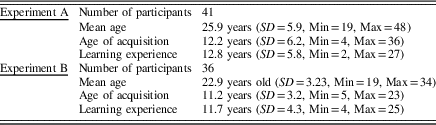
The participants were 77 Czech students of German Studies at the Charles University in Prague (Czech Republic) who were advanced learners of German at the B2/C1 level of the Common European Framework of Reference for Languages (CEFR).Footnote 3 Their competence level was determined based on self-evaluation that has been shown to correspond well with participants’ actual competence (e.g., Bobb, Kroll, & Jackson, Reference Bobb, Kroll and Jackson2014). Participants gave informed consent to participating in the experiments. They were paid for their participation. Details about participants are listed in Table 1.
Participants in Experiments A and B

Materials
Pseudowords
The targeted novel words were 18 low-frequent concrete German nouns (e.g., Stoßzahn / tusk or Hydrant / hydrant). Their average frequency was 16.9 (Min=14, Max=22; according to the frequency classification in the database of the Wortschatz Projekt Leipzig (the most common German word “der” occurs 2^16.9 as often, the corpus contains over 4 million tokens).Footnote 4 Each noun was matched with a phonologically unrelated pseudoword, which functioned as the novel word in the texts (e.g., “Driep”, “Mekolt”; see Appendix A). The novel words were easy to pronounce and conformed to German phonotactics. They either were generated with the Wuggy pseudoword generator (Keuleers & Brysbaert, Reference Keuleers and Brysbaert2010) or were slightly changed forms of Wuggy generated pseudowords. They were used to ensure that no learner had prior knowledge of the new words. It should be, however, stressed that though we employed pseudowords, from the participants’ perspective they were real German words. Therefore we can assume that their acquisition proceeded in the same way as if they were existing, low-frequent words.
Texts
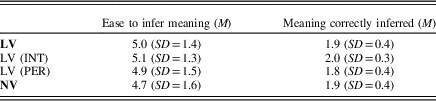
For each of the 18 novel words, two versions of short texts were written (201 words on average). The literary version (LV) contained a number of literary devices and resembled excerpts from literary texts. The nonliterary version (NV) differed in that it did not contain any literary devices. The texts in this version resembled explanatory texts, but specific genre marking was avoided. In other respects (e.g., syntactic complexity, vocabulary used, etc.) the two versions were kept as closely parallel as possible (see Appendix B for example texts and online-only Supplementary Material for all texts). The texts were written with the support of a professional writer with the relevant education and experience. The novel word appeared three times in each text in a context that made inferring its meaning reliable (see Table 2) as confirmed by a pretest. In this pretest, which is described in more detail below, the novel words were replaced by a dummy word BING in the texts. Participants were asked to guess the meaning of the dummy word and to rate on a scale ranging from 1 (not at all) to 6 (very well) how well they were able to derive the meaning.
Pretest ratings for the ease with which pretest participants were able to infer the novel words’ meanings and average correctness in inference

Note: “Ease to infer” was rated by pretest participants on a 6-point scale (Min=1, Max=6); “Meaning correctly inferred” was assessed as 0=false, 1=almost correct, 2=correct (Min=0, Max=2). (A meaning was guessed wrongly only twice, and “almost correct” guesses were usually synonyms or near-synonyms.) LV, literary version. NV, nonliterary version. INT, integrated condition. PER, peripheral condition.
In half of the LV texts that each participant read, the novel word was part of a literary device (“integrated” condition, abbreviated as INT). As an example, in the INT condition in a text including the target word hydrant (see Appendix B), the novel word Mekolt was part of a literary device called parallelism: Ohne Mekolt kein Wasser, ohne Wasser kein Kampf gegen das Feuer, keine Hilfe für hilflose Bewohner. (Without mekolt, no water, without water, no fight against fire, no help for the helpless inhabitants.) In the other half of the literary marked texts, the immediate context of the novel word did not contain any literary devices; instead, the literary devices appeared in its periphery (peripheral condition, abbreviated as PER). The purpose of this additional manipulation was to determine whether the literary devices have only a local effect on IVA (inference and acquisition are improved/hindered only in INT), or if their effect is more general (inference and acquisition are improved/hindered both in INT and PER). While the general effect would support the assumption that literary devices change the general reading mode of the text and thus affect the IVA more globally, the local effect would indicate that literary devices only affect IVA of the words that they directly subsume. Literary devices that were employed included alliteration, metaphors, similes, personifications, and rhyme assonance.
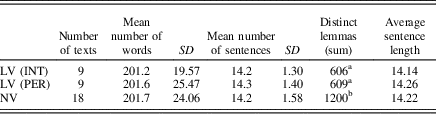
Each INT text had a corresponding PER text with similar characteristics. The texts’ characteristics are summarized in Table 3, which shows that texts in all conditions were comparable with respect to their length, length of their sentences, and number of different lemmas they involved.
Text characteristics: LV versus NV and INT versus PER

Note: aSum from 9 texts. bSum from 18 texts. LV, literary version. NV, nonliterary version. INT, integrated condition. PER, peripheral condition.
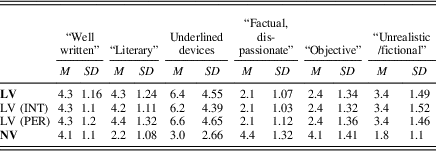
Further text properties that were matched across the text versions and their adequacy for the purposes of the present study were assessed in a pretest. The pretest participants were 28 students of the Philological Faculty at the University of Leipzig with L1 German, who were paid for their participation. The participants rated the texts with respect to the properties listed in Table 4 on a scale ranging from 1 (not at all) to 6 (very much so). The results show that the texts in all conditions were considered equally well written and that the genre manipulations were successful. Pretest participants were also asked to circle any literary devices they could find. The nature of the task led the participants to mark as literary devices also word combinations in the NV texts that the experimenters could not identify as such (cf. Fish, Reference Fish1980). Overall, participants omitted about 23% of literary devices that were recognized as such by the authors. The omitted devices were usually form based (e.g., alliteration, rhyme, and assonance), while meaning-based devices (e.g., metaphor, personification, etc.) were noticed quite reliably.
Ratings of perceived text characteristics in the pretest and underlined literary devices in the LV (and INT vs. PER) and LN conditions

Note: LV, literary version. NV, nonliterary version. INT, integrated condition. PER, peripheral condition.
There were eight filler texts with existing words used as target words that appeared three times. Half of the filler texts were literary texts from widely known pieces of literature (e.g., an excerpt from Hesse’s “Siddhartha”), the other half were neutral texts with an explanatory style.
SPR sentences
Each novel word was combined with two adjectives that had not appeared in any of the preceding texts. One of the adjectives was semantically compatible (plausible condition) and the other one incompatible (implausible condition) with the meaning of the low-frequency word that the novel word was replacing. The linguistic properties of the adjective pairs (plausible–implausible) were pairwise matched as closely as possible with respect to their morphological structure, frequency (the average frequency class of the adjectives according to Deutscher Wortschatz was 10.18 and 10.36 for the plausible and implausible adjectives, respectively), length in letters (average plausible: 5.89, implausible: 6.05), and phonemes (average plausible: 5.53, implausible: 5.37).
For each pair of novel words, two sentences were constructed containing a noun phrase consisting of a definite article, the semantically compatible/incompatible adjective, and the novel word (see Appendix A).
(1) Plausible sentence
Ich bewunderte den riesigen Driep und wünschte, ich wäre in Afrika. / I admired the enormous Driep [i.e., tusk] and wished I were in Africa.
(2) Implausible sentence
Ich bewunderte den langsamen Driep und wünschte, ich wäre in Afrika. / I admired the slow Driep [i.e., tusk] and wished I were in Africa.
To ensure that any effect found was due to the semantic incompatibility between the previously inferred meaning of the novel word and the adjective and not due to some other properties of the sentences, the implausible sentences were constructed in a way that the novel word could hypothetically be replaced by another noun with a different meaning that would be compatible with the chosen implausible adjective. For example, in the implausible sentence (2) above, “Driep” could, in theory, stand for “river” or “rhinoceros” instead of “tusk” and the sentence would remain meaningful. In addition, a Mann–Whitney U test was performed based on the occurrences of the adjectives in a 3-million-sentence corpus that is part of the Leipzig Wortschatz collection (Quasthoff, Richter, & Biemann, Reference Quasthoff, Richter and Biemann2006). It revealed that there were no significant differences between the number of word types immediately following the adjectives in plausible and implausible conditions (U=155, p>.05), so that the expected effects are unlikely to be caused by different degree of uncertainty about the upcoming words in the two conditions. For each text, up to two additional filler sentences were constructed that were related in topic, but consisted only of known words. SPR sentences were also created for the filler texts. One of these contained a compatible or incompatible adjective combined with a central word from the filler text.
Statements
A statement for each of the 24 texts (16 experimental, 8 fillers) referring to their content was constructed that could be responded to with a simple “yes” or “no” answer. It directly followed the SPR sentences. None of the statements was related to information relevant for the meaning of the novel word. The intention of the statements was to keep participants attentive to the texts.
Procedure
Participants first read instructions and were then tested in small groups (2–4) in a laboratory setting using the E-prime software (Psychology Software Tools, Pittsburgh, PA) to record reading times. They were asked to try to comprehend the texts in order to be able to respond to statements focusing on the content. They were also instructed to read the SPR sentences for comprehension and at an expeditious pace.
The experimental task was integrated into the learning phase. Each text was followed by a number of SPR sentences (between one and three), one of which was the critical sentence with the novel word in the plausible or implausible condition. The session started with two practice trials, followed by the experimental and the filler trials. Each trial started with a text that participants read silently while their reading duration was measured. When they finished, the SPR phase began. Participants pressed the space bar and a plausible, implausible, or filler sentence appeared, with each letter masked with an “X.” Each time the space bar was pressed, the next word was revealed and the previous one covered with a string of “Xs” again (moving window). The reading times of each word were recorded.
Reading times on the target words were expected to be longer in the implausible condition due to difficulties in integrating the newly acquired meaning with the semantic context. However, this effect should be observable only if participants correctly inferred the meaning of the novel word; otherwise, they would not be able to recognize the semantic (in)compatibility between the adjective and the novel noun, and the reading times would be the same in both the plausible and the implausible conditions. Previous studies have shown that stronger semantic representation of the novel words leads to stronger implausibility effects (Bordag et al., Reference Bordag, Kirschenbaum, Opitz and Tschirner2015).
Each participant read each text just once, either in its LV or NV version, followed either by the semantically plausible or the implausible SPR sentence. Thus in order to create a complete experimental design with the four conditions for each item (by crossing the two two-leveled factors literariness and plausibility), there were four experimental lists, and each participant was assigned to one of them.
Experiment A
In Experiment A, LV and NV texts as well as literary and nonliterary filler texts with their respective SPR sentences and statements were presented in a pseudo-randomized order. There were never more than three texts in each condition following each other. The pseudo-randomization was also determined by the yes-or-no answers to the statements and INT/ PER condition so that no more than three of the same category occurred in a row.
Experiment B
The purpose of Experiment B was to enhance the possible effect of the literariness as defined in the reader-driven approaches, that is, to use additional means and arrangements to set the reader in the “literary mode” of reading.
If the reading mode rather than the literary devices was constitutive for literariness, the random presentation of LV and NV texts in Experiment A could work against the reader’s perception of the individual texts as either literary or not: the literary mode could transfer from the literary texts to the neutral texts, or the switches between the two text versions could disturb the literary mode, so that either way, both types of texts would be read in the same mode. Therefore, in Experiment B, we presented all NV texts first and all LV texts second to avoid carryover effects. Participants thus had no reason to relate the NV texts to LV texts and could stay in a continuous “literary mode” during the entire second part of the experiment.
In the first experimental phase, the same NV texts and filler texts as in Experiment A were employed without change. The second experimental phase began with the announcement that pieces of literary texts would follow. The same LV texts as in Experiment A followed, each introduced with a title, year, and author to give the impression that participants were reading original/authentic literature. Four of the 18 given author names were invented, a further 4 authors were considered as not commonly known, and six of the titles were also fabricated. Special care was taken to ensure that the choice of “alleged author” was plausible in light of the text content and style. In order to draw participants’ attention to the literary status of each text, they were asked to press a YES or NO button twice after the author and title presentation to indicate whether they knew the author and whether they had read the book from which the text allegedly came (the author, title, and year of publication appeared on the screen, then the two questions were presented, and then the text followed by the SPR sentences as in Experiment A). The block of LV texts started with a filler text from Hesse’s “Siddharta” to add credibility to the literary origin of the texts. The order of texts was pseudorandomized within each block for each participant.
RESULTS
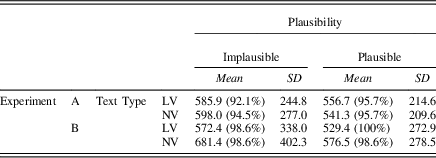
Reading times on the novel word preceded either by the plausible or the implausible adjective were measured.Footnote 5 Experiments A and B were analyzed in a joint analyses to allow for direct comparisons. Out of 1,232 observations, 42 (3.4%) were discarded because they deviated from the participants’ mean by more than 2 SD. The reading times of the individual words in the critical SPR sentences were analyzed through 2×2×2 analyses of variance with factors experiment (A vs. B), text type (LV vs. NV), and plausibility (plausible vs. implausible). The results are presented in Table 5.
Mean reading times in milliseconds for plausible and implausible sentences in both conditions

Note: LV, literary version. NV, nonliterary version.
The factor plausibility was significant, F 1 (1, 74)=14.565, p<.001, η2=159; F 2 (1, 16)=26.676, p>.001, η2=.641, confirming statistically that participants were slower in the implausible condition than in the plausible condition by 58 ms. This result indicates that participants successfully derived the meaning from both types of texts in both experiments. The factor text type was also significant in indicating that participants read the novel word slower when it had appeared in the neutral than in the literary text version, F 1 (1, 74)=11.42, p=.001, η2=.128; F 2 (1, 16)=6.888, p=.019, η2=.314. The factor experiment was not significant, showing that the order of the text presentation (LV and NV texts randomized vs. blocked) did not have any effect. The interaction between factors experiment and text type was also significant, F 1 (1, 74)=13.452, p=.000, η2=.154; F 2 (1, 16)=11.290, p=.005, η2=.439. However, this seems to be an order effect: in Experiment B, participants read the items presented in the first half slower (629.0 ms, NV) and the items in the second half faster (550.7 ms, LV). In Experiment A, where NV and LV texts were presented randomly, there was no difference in the speed in which the novel words presented in the neutral text versions were read compared to those presented in the literary text version in the SPR sentences (569.5 ms, NV vs. 571.0 ms, LV). The crucial interaction between text type and plausibility that would reveal differences in IVA between literary and nonliterary texts was not significant and neither was the triple interaction.
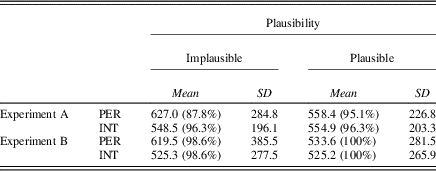
In the next stage, only the literary texts in both experiments were analyzed with the focus on the INT versus PER condition, that is, whether the novel words were parts of the literary devices employed, or not. The results are presented in Table 6 and Figure 1.
Mean reading times in milliseconds for plausible and implausible sentences in both PER and INT conditions for the literary version novel words in the two experiments

Note: INT, integrated condition. PER, peripheral condition.
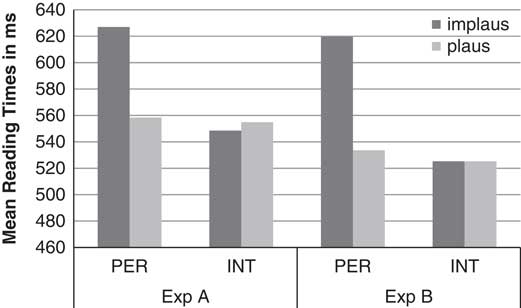
Mean reading times of novel words during self-paced reading in the literary version condition occurring in an integrated or peripheral setting.

The 2×2×2 analyses of variance with the factors experiment, plausibility, and literary device (INT vs. PER) revealed a significant interaction between the factors plausibility and literary device, F 1 (1, 74)=5.579, p=.021, η2=.073; F 2 (1, 16)=4.78, p=.042, η2=.249. Other factors were not significant.
This finding reveals that the plausibility effect observed for the literary texts was driven by the PER condition (77 ms), whereas it was virtually absent in the INT condition (3 ms) in both experiments. This result indicates that participants did not acquire the meaning of the novel word when it was presented as a part of a literary device, as they did not react to the semantic violation in the SPR sentence in this condition.
DISCUSSION
In this study, we brought together two areas, literary theory and L2 acquisition, to explore a novel research question with both theoretical and practical (L2 teaching) implications. To our knowledge, the study presented here is the first one of its nature. The previous empirical studies from the literary theory background (Hanauer, Reference Hanauer2001b; Hoffstaedter, Reference Hoffstaedter1987; Miall & Kuiken, Reference Miall and Kuiken1994, Reference Miall and Kuiken1998) that explored the special characteristics of reading literary texts did not link their research directly to language learning and typically focused on the reading process. This is true also for Hanauer (Reference Hanauer2001a), who focused on L2 readers. Furthermore, studies on IVA during reading that considered genre in their study did not take into account findings from literary theory when designing and evaluating their studies (e.g., Shokouhi & Maniati, Reference Shokouhi and Maniati2009).
In our first two research questions, we asked whether literariness contributes to or hinders IVA, and whether the role of literariness in IVA differs depending on its operationalization along the language-driven and reader-driven view. We conducted two experiments in which we explored the initial stages of IVA from reading short texts, which were manipulated with respect to the language-driven (formalist) and reader-driven (reception theory) definition of literariness. In Experiment A, participants read randomly ordered literary and nonliterary texts. The literary texts contained a relatively large number of literary devices that, according to the formalist, language-driven view, are the main carrier of literariness. In Experiment B, the reader-driven view of literariness was put to the test in that literary and nonliterary texts were presented in blocks with literary texts explicitly marked as such. The intention was to encourage a literary mode of reading by the participants through the conventions that are typically associated with literary texts (author, title, and year of publishing). The results revealed no differences in the incidental acquisition of novel words presented in the nonliterary and literary texts in Experiment A or B: participants successfully inferred and at least temporarily stored the meaning of the novel words under both testing conditions. After having encountered the novel words just three times in highly constrained contexts in both types of texts, participants were able to establish the first memory traces of the meanings of those nouns. When this newly established meaning was in conflict with the meaning of the preceding adjective in the SPR sentence, participants had difficulties with the semantic integration of the novel word in the noun phrase context. This was proven by their longer reading times in the implausible condition in the SPR sentences compared to the plausible ones. As the answer to our first two research questions research questions we can thus conclude that the literary status of the texts, be it more along the text-driven or the reader-driven view, neither hindered nor facilitated IVA.
The study did however provide evidence that the L2 advanced learners noticed and processed the literary devices employed in the literary texts in both Experiment A and B. In an additional manipulation of the literary texts in both experiments, the novel words were either presented within literary devices (INT condition, e.g., within an alliteration “… drei starke Stroge [=ship masts], die standen auch im schwersten Sturm …”) or they appeared in immediate contexts that did not involve a literary device (PER condition, i.e., the literary devices in the texts appeared in sentences that did not involve the novel words). This manipulation aimed at our third research question, namely, whether the effect of the literary devices is global, or whether it is local and affects IVA only if the novel words directly participate in a literary device. The analysis of the literary texts along this dimension revealed that the plausibility effect (i.e., the longer reading times in the implausible condition) was driven by the condition in which the novel words appeared outside of the literary devices. When the novel word participated in the literary device, the reading times in the plausible and implausible condition were the same. This finding indicates that in such a case, participants did not infer and/or store the meaning of the novel word, because they did not react to the semantic violation due to the incompatible adjective in the implausible condition in the SPR sentence. Several implications can be drawn from this result.
It can be concluded that participants were sensitive to the literary text manipulation through the stylistic devices. Once there is evidence that the L2 participants processed the literary devices in which the novel words participated, we can assume that other literary devices that appeared in the texts were also processed. Consequently, if we follow the language-driven view that these formal means are the carriers of literariness or aesthetic function and thus turn texts into pieces of literature, we can assume that the experimental manipulation created conditions in which the aesthetic function could become dominant at least during parts of the texts. Thus, the lack of the difference in IVA between the literary and nonliterary texts is unlikely to be attributable to the failure to create such conditions in which the aesthetic function (in the formalist sense) could become dominant, but rather to the absence of the effect of literariness as defined in language-driven terms on IVA. With regard to the reader-driven approach to literariness, we found no evidence to suggest that adding unambiguous conventions marking literary texts (like known authors’ names, titles, etc.) would lead to any change with respect to the mode of how the literary texts were read and processed. Specifically, as no difference was observed between the literary and nonliterary texts in either Experiment A or B (despite the evidence that the literary devices were processed), we cannot claim that we found evidence that would support the concept of literariness according to either the language- or the reader-driven view. It must, however, be stressed that the difference between the text types was assessed via IVA. It is equally plausible that participants read the literary texts as literary (in both experiments), but the literariness status of the texts did not affect IVA. Further experimental research is clearly necessary both to assess the validity of the concept of literariness according to its various definitions and to explore whether and in which way incidental acquisition might be affected by it.
The crucial finding of this study with respect to IVA is that while the presence of literary devices in the context of novel words does not negatively affect their acquisition, the participation of these words directly in the literary devices hinders IVA. This finding disputes the assumption that literary devices might trigger noticing and thus improve IVA (Ellis, Reference Ellis2006, Reference Ellis2007; Hanauer, Reference Hanauer2001a; Schmidt Reference Schmidt1990, Reference Schmidt2012). The results speak in favor of the hypothesis that the processing of the literary device itself consumes the cognitive recourses that would otherwise be used for meaning inference/storage and therefore they impede IVA (Barcroft, Reference Barcroft2004; Pulido, Reference Pulido2004). The “neurological tempest” in a reader’s brain that literary devices can induce, as observed by Keidel et al. (Reference Keidel, Davis, Gonzalez-Diaz, Martin and Thierry2013) in their brain imaging study, might illuminate the challenges the learner faces under such circumstances in more detail.
The present study shows no indication that reading literary versus nonliterary texts per se would lead to different incidental acquisition outcomes. However, when composing textbook texts or adapting original literature into graded readers, due care should be taken to ensure that newly introduced vocabulary is not a part of a literary device. The results of our study have shown that under such circumstances, the inference and/or storage of the new word meaning is less efficient.
This being said, the limitations of the present study need to be mentioned as well. Because we were interested in the possible immediate effects of literariness on IVA, we focused on the initial stage of vocabulary acquisition. It is thus only this stage about which we can make claims based on our data. Furthermore, vocabulary acquisition entails various types of knowledge; in the present study, we focused on just one of them, the acquisition of meaning. It could be the case that literariness affects differently IVA of semantic, phonological, and grammatical information. Clearly, further research is necessary to reveal both (a) whether literariness may affect the later stages of IVA and (b) whether it may affect differently the IVA of the different types of lexical knowledge.
Moreover, various literary devices had been employed in the literary texts in the present study. Though such an approach has the advantage of being more natural, it does not allow us to distinguish how each type of literary device contributes to the overall effect. Recent studies by Lindstomberg and Boers (Reference Lindstromberg and Boers2005, Reference Lindstromberg and Boers2008a, Reference Lindstromberg and Boers2008b) show that, for example, alliteration has a positive mnemonic effect on recalling two word chunks; however, this study involved only well-known words. It remains to be explored whether alliteration affects differently the recall of known versus new words and to what degree the results for alliteration can be generalized to other literary devices.
The aim of our study was twofold: on the one hand, we explored the effects of literariness on IVA, and on the other hand, we addressed (via IVA) a question from the literary theory concerning the nature of the literariness. Our materials were primarily designed and controlled along two approaches in the literary theory to literariness, the language driven versus the reader driven. However, the differences between genres relevant for IVA may go beyond such distinction. For example, in his comparative analysis of children literary and expository texts, Gardner (Reference Gardner2004) notes that vocabulary in expository nonfiction is informationally oriented and tends to be recycled more often than the culturally and socially oriented vocabulary of narrative fiction. Similarly, reading of literary texts can be a very complex and powerful process (Burke, Reference Burke2011, uses the term “oceanic”), that can involve construction of extensive mental imaginary and emotional and affective states. These states (can be determined by various factors, e.g., length of the text, situation in which one reads, and anticipations the reader has) that could not be addressed in the present study. Such differences between genres may influence also the effectiveness of IVA, but they lay outside the scope of the present study. The highly constrained contexts in which the target words appeared in our texts enabled us to focus on the role of literariness and literary devices in IVA and answer the questions concerning precisely this topic. Based on our results, we cannot conclude that the effectiveness of IVA in literary and nonliterary texts does not differ. However, we can say that if it does, it is most likely due to other aspects than literariness as operationalized based on the two literary theory approaches discussed in the present study.
Appendix A
A list of novel words and their corresponding base words with translations used in the experiments, followed by the adjectives (and their translations) with which they were combined in the plausible vs. implausible sentences.

Appendix B
EXAMPLE TEXTS
Example Texts for novel word “Mekolt” (i.e. hydrant)
Literary Version (literary devices are bold)
Ein parkender Lastwagen hat mein Leben für immer verändert. Es war ein Mittwoch mitten in der Nacht und in der Müllerstraße im Mehrfamilienhaus [alliteration], wo ich wohnte, schlief und träumte [ennumeratio, climax], brannte es. Die Feuerwehr war innerhalb von wenigen Minuten vor Ort, das Gebiet abgesperrt. Es sollte alles besonders schnell gehen, die Wasserversorgung musste gesichert werden, doch der Weg zum roten Mekolt, der das weit verzweigte Wassernetz der Stadt bewachte [personification], war versperrt. Nichts war möglich, denn zwei Minuten lang konnten die Schläuche nicht daran angeschlossen werden. Ohne Mekolt kein Wasser, ohne Wasser kein Kampf gegen das Feuer, keine Hilfe für hilflose Bewohner [parallelism]. Ich schlief. Da kroch ein Feuerwehrmann namens Steffen K. mühsam wie ein Wurm [simile] in seinem schweren Anzug unter dem Lastwagen hindurch zu dem Mekolt, der nun durch seine Arme aus Schläuchen endlich Rettung bringen konnte[metaphor, personification]. Alle acht Bewohner kamen lebendig aus dem Haus. Zu mir kam die Feuerwehr exakt zwei Minuten zu spät. Länger braucht das Feuer nicht, um aus einem Gesicht eine Narbenfläche zu machen. So viele Wochen lag ich im Krankenhaus und immer wieder wurden mein Gesicht und meine Arme operiert. Bis ich mich wieder ein wenig erholt habe, wird es wohl noch Monate dauern.
Approximate translation of the literary version (literary devices were not systematically translated)
A parked truck has changed my life forever. It was a Wednesday in the middle of the night and the multi-family house [alliteration] in the Müllerstrasse, where I lived, slept and dreamed [ennumeratio, climax], was on fire. The fire department was on site within a few minutes, the area was cordoned off. Everything was supposed to happen very fast, the water supply had to be secured, but the road to the red Mekolt guarding the city’s extensive water network was blocked. Nothing was possible, because for two minutes the hoses could not be connected to it. Without Mekolt no water, without water no fight against the fire, no help for helpless inhabitants [parallelism]. I was sleeping. Then a firefighter named Steffen K. laboriously crawled like a worm [simile] in his heavy suit under the truck to the Mekolt, which was finally able to bring salvation through his arms of hoses [metaphor, personification]. All eight residents came alive from the house. The fire department came to me exactly two minutes too late. The fire does not take longer to turn a face into a scare surface. I was in the hospital for so many weeks, and my face and arms were repeatedly operated. It will take months until I recover at least partially.
Neutral Version
Am vergangenen Mittwoch brannte es in der Müllerstraße in einem Mehrfamilienhaus. In so einem Fall muss es besonders schnell gehen. Die Feuerwehr muss selbst mitten in der Nacht innerhalb von wenigen Minuten vor Ort sein. Dann müssen sie das Gebiet absperren und zunächst die Wasserversorgung sichern. Denn erst danach kann auch das Feuer bekämpft werden. In der Müllerstraße war das aber zuerst nicht möglich. Die Feuerwehr konnte ihre Schläuche minutenlang nicht anschließen, weil der Weg zum Mekolt von einem parkenden Lastwagen versperrt war. Deshalb konnte niemand den hilflosen Bewohnern zu Hilfe kommen. Der rote Mekolt ist der Zugang der Feuerwehr zum weit verzweigten Wassernetz, das unter der Stadt verläuft. Die Feuerwehr musste rasch handeln und Feuerwehrmann Steffen K. kroch mit den Schläuchen mühsam in seinem schweren Anzug unter dem Lastwagen durch. In exakt zwei Minuten schloss er die Schläuche endlich an den Mekolt an. Alle Bewohner konnten glücklicherweise lebendig aus dem Haus gerettet werden. Allerdings gab es bei zwei der acht Bewohner an Armen und Gesichtern Verbrennungen, die Narbenflächen zurücklassen und ihr Leben verändern werden. Im Moment befinden sie sich im Krankenhaus und werden operiert. Bis sie sich alle wieder komplett erholt haben, wird es noch circa 6 Monate dauern.
Approximate translation of the neutral version
A multi-family house in the Müllerstraße was on fire last Wednesday. In such a case, everything must be arranged very fast. The fire brigade has to be there within a few minutes even in the middle of the night. The area must be shut off and the water supply must be secured. Only then the fire can be fought. But that was not possible in Müllerstrasse at first. The fire department could not connect their hoses for long minutes, because the way to Mekolt was blocked by a parked truck. Therefore no one could come to the help to the helpless residents. The red Mekolt is the fire brigade's access to the extensive water network which is under the city. The fire department had to act quickly and firefighter Steffen K. laboriously crawled in his heavy suit with the hoses under the truck. In exactly two minutes, he finally connected the hoses to the Mekolt. Fortunately, all residents were rescued alive from the house. However, two of the eight residents were burnt on the arms and faces they will be left with scars and might change their lives. At the moment, they are in the hospital undergoing surgery. It will take about 6 months until they be completely recovered.
ACKNOWLEDGMENTS
We would like to thank Thomas Pechmann, Andreas Opitz, Renate Riedner, and Michael Dobstadt for their invaluable comments in the interim stages of this project, Amit Kirschenbaum for his help in preparing the data for analyses, and Rike Scheffler, the author of “Der Rest ist Resonanz,” for her support in the preparation of the text materials. We would further like to thank Ricarda Theobald and Benjamin Krasselt for conducting the experiments. This research was funded by the Language Learning Small Grants Program.
SUPPLEMENTARY MATERIAL
To view supplementary material for this article, please visit https://doi.org/10.1017/S0142716418000620