


1. Introduction
Easy language (EL) and plain language (PL) are used on all continents to make the communication of authorities, businesses, and organisations more accessible. These special forms of language have many similarities and they are, therefore, often confused with each other especially among the general public. In turn, specialists, authors and researchers working on EL and PL mainly have had limited contact and only few studies have examined the relationship between these two language varieties. In addition, these studies analysing EL and PL as special cases of simplified language (e.g. Maaß Reference Maaß2020, Perego Reference Perego2020) have mostly focused on their different textual practices and concrete use in publications and less on their theoretical foundation.
Previously, both EL and PL have been criticised for a lack of analysis, which has led to their weak or incomplete scientific basis and research evidence, especially in terms of their linguistic aspects (e.g. Bock Reference Bock2015, Bock & Lange Reference Bock, Lange, Bock, Fix and Lange2017, Zurstrassen Reference Zurstrassen, Bock, Fix and Lange2017, Nord Reference Nord2018:25–28). EL is currently emerging as a new important field of study, particularly in Germany where linguists have carried out a number of EL research projects (e.g. Bock Reference Bock2019, Bredel & Maaß Reference Bredel, Maaß, Maaß and Rink2019:257–259, Hansen-Schirra & Maaß Reference Hansen-Schirra, Maaß, Hansen-Schirra and Maaß2020:19). Specialists of PL have generally had to rely on the linguistic or sociological phenomena studies that are relevant for PL practices (Schriver & Gordon Reference Schriver and Gordon2010:33). In addition, reform projects administered by public authorities around the world have gathered practical evidence that has measured changes in customer satisfaction and the number of complaints and enquiries before and after textual modifications (Dahle & Ryssevik Reference Dahle and Ryssevik2013:96). As a whole, discussion around these linguistic varieties has suffered from isolation: they have been examined separately from each other and without attention to their connections to other linguistic and social phenomena.
The aim of this article is to bring new insights into the discussion of the nature of EL and PL by putting them into a larger context of tailoring and linguistic varieties. Such an approach enables us to clarify their differences, on the one hand, and to highlight their specificity as important communicative tools in a modern society, on the other. We start with general observations on the definitions and rules or guidelines given to EL and PL (Section 2) to discuss how promoters and practitioners of those varieties regard them. Then we focus on three questions which, in our opinion, have received too little attention in research on EL and PL but which are relevant in comprehending the essence of these linguistic varieties. The first of them is linguistic tailoring. In Section 3 we want to show that EL and PL are not exceptional phenomena but represent an aspiration typical of all communication situations: to ensure that the recipient comprehends the message appropriately. We also discuss why tailoring into EL and PL can still be more challenging than in many other situations.
The second question concerns the comparison of EL and PL with other language varieties (Section 4). This is important for the discussion of their relation to linguistic norms and standards. Here again we try to show that EL and PL are not isolated islands but have close connections to other language varieties. In Section 5 we focus on the third question, considering the special societal role of EL and PL as simplified language varieties. The societal status and stigmatising potential of these varieties will be considered from the point of view of both users and text producers. Finally, in conclusion, we sum up our findings and try to give a coherent picture of the characteristics of EL and PL. To make our views on EL and PL clear, we use tables and figures.
Before moving on to our analysis, some general notes are needed to explain the orientation and terminology of the article. The article is theoretical in the sense that we will not provide any new empirical data. This does not mean that we do not have connections to practice. In our analysis, we will use previous research, mainly concerning Finnish, Swedish, German, English, and Russian, as well as our own experience as EL and PL researchers, consultants, and international co-operators.
In order to offer new insights, we combine diverse perspectives without committing to any particular theory. Nevertheless, our views mainly derive from communication theories (see e.g. Watson & Soliz Reference Watson, Soliz and Harwood2019, Weigand Reference Weigand2021) and sociolinguistics, especially theories on language planning (e.g. Bartsch Reference Bartsch1987, Jernudd & Neustupný Reference Jernudd, Neustupný and Marshall1991, Trudgill Reference Trudgill2000, Milroy & Milroy Reference Milroy and Milroy2012, Bruggink et al. Reference Bruggink, Swart, van der Lee and Segers2022).
We have chosen to refer to both EL and PL as language varieties; however, there is debate as to whether EL and PL should be called registers (see Hennig’s article in this volume). The distinction between the concepts is not entirely clear-cut, and neither is the usage of the terms (Lappalainen Reference Lappalainen and Heikkinen2012); for example, standard language has been placed in both categories. A variety is a form of language use that can be distinguished from other varieties. Corpus studies of Finnish have shown that EL and PL differ from varieties that are not tailored to be easy to understand, and they also differ from each other in terms of the frequency of several linguistic features, such as vocabulary structure, sentence length, and sentence structure (see e.g. Heikkinen et al. Reference Heikkinen, Lehtinen and Lounela2005, Kankaanpää Reference Kankaanpää2006:160–166, Piehl Reference Piehl, Gotti and Giannoni2006 and Reference Piehl, Mattila, Piehl and Pajula2010:165–170, Kulkki-Nieminen Reference Kulkki-Nieminen2010). Registers are categories of situational variation (e.g. Halliday Reference Halliday1978), and neither EL nor PL are limited to special situations or subjects like, for example, the language of law or sports. For this reason, we prefer the term ‘variety’.
We also point out that EL is a language variety that is also applied to oral interactions (see e.g. Leskelä Reference Leskelä2019). However, in this article we focus on written language, i.e. compiling and reading a text. Therefore, in this context, the speaker is an author and the recipient a reader of a text.
2. Characterising and defining easy and plain languages
Despite their long and established use in many countries, EL and PL are often confused, and clear differentiation is required to ensure that they are kept distinct (e.g. László & Ladányi Reference László, Ladányi, Lindholm and Vanhatalo2021).Footnote 1 In this section we aim to clarify the borderlines between EL and PL by taking a closer look at their characterisations and definitions.
The general idea of tailoring is included in the widely used definition of PL that was developed by the International Plain Language Federation in 2010:
A communication is in plain language if its wording, structure, and design are so clear that the intended readers can easily find what they need, understand what they find, and use that information. (International Plain Language Federation)
This definition is intended to be applicable regardless of language and medium, and it is being used as a base for the ISO standard for plain language that is currently being developed (ISO standard 24995 Plain language – Part 1: Governing principles and guidelines).Footnote 2 The definition of PL focuses on the reader’s experience and identifies the wording, structure, and design of a text as features that need to be tailored to the intended readers to ensure that they can find, understand, and use the information. It does not define the exact parameters for comprehensibility: the extent of the tailoring depends on who is identified as the intended reader, and this is separately assessed for each communication; hence, there are loose recommendations for PL tailoring rather than strict rules. The definition does not mention specific target groups for PL, but PL is typically used in communications between a smaller group of expert writers and a wide audience of lay readers, for example between authorities and citizens (see e.g. Schriver Reference Schriver2017, Nord Reference Nord2018). However, PL is also recommended for specialists’ internal communication; for example, civil servants can find it difficult to understand the sublanguages used by other agencies or in other legal systems (Piehl Reference Piehl, Foley, Salmi-Tolonen, Tukiainen and Vehmas2008:275, Viertiö Reference Viertiö2011, Piehl Reference Piehl2019).
The definition of PL is very broad, and, in principle, it could also cover EL or any tailored language variety that supports comprehensible communication. However, including EL in the PL definition would obscure the key differences of these two language varieties behind a high level of abstraction, and thus a more specific definition of EL is required in order to adequately address the needs of readers with language barriers.Footnote 3 The tailoring of texts for these special reader groups requires the implementation of EL processes that are often beyond the scope of PL, as generally PL does not produce texts that are linguistically simple enough for readers with language barriers. In contrast to PL, however, EL lacks a commonly accepted international definition.Footnote 4 In Finland, EL is defined by Selkokeskus (the Finnish Centre for Easy Language) as a language variety in which vocabulary, language structures, and content are modified to be more readable and understandable than in PL, and it is intended for people who have difficulties in reading or understanding standard language (Selkokeskus 2021).Footnote 5 The Finnish definition identifies the features that need to be simplified through tailoring, and it indicates that EL is targeted at people with restricted linguistic skills.
In general, EL and PL seem to be closely aligned and share several overlapping characteristics, but, at the same time, they differ in some crucial, yet not always clearly expressed aspects. For instance, their definitions both identify features of language and text that need to be tailored, but they differ in their approach to content modification, which is not mentioned in the PL definition but is central to EL. Content modifications are usually carried out in EL texts using two basic strategies: additions and reductions (e.g. Bredel & Maaß Reference Bredel and Maaß2016:489–491). The reader may possess incomplete knowledge of many common topics, and therefore they may need additions to the text in the form of explanations or clarifications. However, as they find reading laborious, they also require a reduced information burden and a shortened text. As a result, an EL text is often, but not always, significantly shorter than the untailored original text (Leskelä Reference Leskelä2019:95–96).
Although the definition of PL does not address content modifications, an important PL recommendation is that an author should leave out information that is unnecessary from the reader’s perspective (e.g. Be concise, Kankaanpää & Piehl Reference Kankaanpää and Piehl2011:85–88, Isof 2022). Additionally, content can also be added to a PL text to increase the comprehensibility in comparison to a professional sublanguage text. In fact, these two types of texts may differ significantly in terms of their linguistic features and the level of background knowledge required to understand the topic. However, the radical content modifications typical in an EL text may be rejected in PL by the author of an untailored original text: the changes required when using EL are not regarded as self-evident PL modifications. Instead, they tend to raise questions about the limits of a PL specialist’s domain of expertise (Kankaanpää et al. Reference Kankaanpää, Piehl, Räsänen, Kristinsson and Sigtryggsson2012, Nord Reference Nord2018).
The definitions of EL and PL do not include clear-cut guidance as to how the tailoring should be actualised, but they are accompanied by linguistic recommendations, guidelines, or rules that aim to instruct the authors.Footnote 6 Concerning the nature of these instructions, there is a long-standing debate about whether they are too strict or too loose. The first international EL guidelines (IFLA 1997, ILSMH 1998) were approximate recommendations (Bohman Reference Bohman, Lindholm and Vanhatalo2021, Bugge et al. Reference Bugge, Berget, Vindenes, Lindholm and Vanhatalo2021, Leskelä Reference Leskelä, Lindholm and Vanhatalo2021), but because it was anticipated that these guidelines would lead to extensive qualitative variation between EL texts, more strict rules for EL were demanded. As a result, rule-based standards for easy language were developed by Inclusion Europe, an association for people with intellectual disabilities and their families (European standards for making information easy to read and understand, IE 2009). The EL rules and standards, however, generated criticism for being excessively absolute, overly general, contradictory, and based only on a layman’s understanding of language (see e.g. Bock Reference Bock2015, Bredel & Maaß Reference Bredel and Maaß2016:108–109).
PL guidelines, in turn, have in our experience been criticised for being too loose and broad, which leaves them open to different interpretations and lays the burden of deciding the best course on the writer. On the other hand, we have seen checklists that summarise recommendations for using PL having been misunderstood as absolute rules that are applicable in every situation, which has led to claims that PL is excessively simple. A case in point is the belief that the passive voice is never to be used in PL texts (see e.g. Tiililä Reference Tiililä1993).
Both EL and PL can be further divided into various levels of difficulty. In PL there is no precise systematic levelling; however, authors are expected to modify the level of difficulty by appropriately tailoring the text to the reader. In some languages, there are attempts towards a levelling for EL. In Finnish, for example, EL is divided into three levels of difficulty:Footnote 7 the easiest level is designed for the most challenged readers, the middle level for readers facing average challenges in reading, and the advanced level for those experiencing minor reading difficulties (Leskelä Reference Leskelä2019, Reference Leskelä2020). This levelling, however, is neither official nor widely used in Finland yet. Recent research has also discussed the character and position of the advanced level because it appears to be analogous to PL; thus the advanced level of EL could be included in the scope of PL (Leskelä Reference Leskelä, Lindholm and Vanhatalo2021).
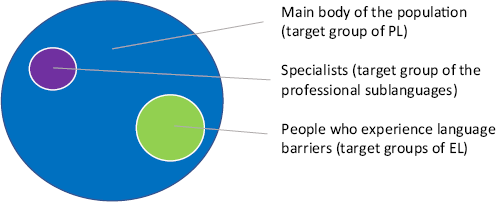
We have in this section described how both EL and PL are characterised by a strong audience orientation. Employing this perspective, Figure 1 shows the main reference groups of EL and PL in informative communication. In addition to the audiences for EL and PL, we also differentiate specialists as a key group of language users.
The main reference groups in informative communication.

The figure shows how we see the relations between these three language user groups. The target group of PL is the main body of the population, the general audience, that is expected to understand a text written in the level of difficulty used by the ordinary news media which omits features of specialist sublanguages (or explains the necessary ones). Those are typically employed by the specialists in their internal communication, but they need to employ PL or EL to inform other audiences. The third group consists of people experiencing language barriers who find the information of a PL text too difficult to be of use. The latter groups, specialists and people with language barriers, are smaller compared to the general audience, although it can be questioned where the borders lie. We want to point out that specialists only represent a distinct group when they operate within their own field of expertise; otherwise they can be regarded as members of the general population, for example when a doctor reads a juridical text or when a lawyer reads a medical text. This perspective means that anyone can be a potential reader of PL in certain circumstances. Generally, it is also possible to claim that anyone can potentially experience language barriers and thus need EL, for instance when encountering a health crisis or a catastrophe. This, however, requires specific events that people do not commonly experience in their everyday lives.
3. EL and PL as products of linguistic tailoring
In order to use PL to reach the main body of the population or EL to communicate with people who experience language barriers, the author must adapt their language to the audience, a process that we call tailoring (see e.g. Pierce-Grove Reference Pierce-Grove, Greenhow, Sonnevend and Agur2016).Footnote 8 A fundamental characteristic of communicative or pragmatic competence is the ability to adjust one’s speech to the current situation and involve the communicants (Bremer & Simonot Reference Bremer, Simonot and Bremer1996). In this process the key aim is to ensure that the intended recipients can achieve complete comprehension, or as close to complete as possible. Ensuring that improves the recipients’ chances to participate in both private and public communications, which is in line with the basic objective of accessibility (e.g. Rink Reference Rink, Maaß and Rink2019, Hirvonen et al. Reference Hirvonen, Kinnunen, Tiittula, Hirvonen and Kinnunen2021). Symmetric communicative settings create a productive foundation for mutual understanding, although communication failures due to common ground fallacy are also frequent (see Mustajoki & Baikulova Reference Mustajoki and Baikulova2020, Mustajoki Reference Mustajoki2021). In asymmetric communicative settings, where participants do not share the same linguistic resources, communication failure for various reasons is even more typical (Leskelä Reference Leskelä2019:45–82). In this section we bring up a few general notions on linguistic tailoring processes and consider how they differ in relation to EL and PL.
In spoken contexts, a clear asymmetry between communicants is not unusual. When the need for tailoring arises, a person will consciously or unconsciously analyse the source of the asymmetry and try to choose the most appropriate linguistic means to achieve a balance. Common forms of asymmetric communication are generally well managed. For example, adults regularly simplify their speech when they speak to children (Freed Reference Freed1981). This speech is usually delivered fluently and without a conscious effort, because the need for tailoring is obvious, and it is a form of communication that adults have frequently practised. Another typical situation involves a conversation with a foreigner, although this form of communication can be more difficult than interactions with children.
Children’s books, school textbooks and popularised scientific texts are examples of the use of linguistic tailoring in written contexts (Mustajoki et al. Reference Mustajoki, Mihienko, Nechaeva, Kairova, Dmitrieva, Lindholm and Vanhatalo2021). In the first two cases mentioned above, the tailoring process requires the author to adapt the language typically aimed at adults to expressions considered comprehensible to young readers – a process which at least in communication situations is usually quite familiar to most people.Footnote 9 The last case, popularising scientific texts, requires tailoring from a scientific sublanguage to a language that can be understood by a wider audience. This can be more challenging for the authors, particularly if they are used to readers who share the same level of knowledge and linguistic capabilities as themselves (e.g. Alvim da Silva et al. Reference Alvim da Silva, Pereira and Felizardo2022, Roedema et al. Reference Roedema, Rerimassie, Broerse and Kupper2022).
The production of EL or PL texts can be seen as a specific case of tailoring (see e.g. Kleinschmidt & Pohl Reference Kleinschmidt, Pohl, Bock, Fix and Lange2017). Their simplification process resembles the cases described above, but EL and PL represent more systematised language varieties in comparison to the language tailoring in literature for young readers or in popularised scientific texts. In the context of implementing PL, tailoring means a change of attitude as it requires renouncing the established professional or ‘proper’ forms of language use and familiarising oneself with the aims and guidelines of PL. For EL, the tailoring process is even more challenging because the implementation of EL requires the use of specific linguistic methods to enhance comprehensibility, and these are not necessarily known by the author. It is possible to overcome the lack of necessary skills by training, and authorities in many countries have invested in training by PL and EL experts and diverse support (e.g. guidebooks, self-learning courses, and tests) for civil servants, especially in the case of PL (see e.g. Kimble Reference Kimble2012, Dahle & Ryssevik Reference Dahle and Ryssevik2013, Ehrenberg-Sundin & Sundin Reference Ehrenberg-Sundin and Sundin2015, Kirchmeier et al. Reference Kirchmeier, Piehl, Van Hoorde, Choleva, Hallik and Robustelli2022). Another solution is to rely on the services of a third party, such as a mediator or a ‘translator’, who has professional skills in EL or PL. As a result, there is a demand and supply for EL and PL experts in many countries (Lindholm & Vanhatalo Reference Lindholm and Vanhatalo2021).
Consequently, tailoring is the key concept for the successful production of EL and PL. However, awareness of the significance of this procedure is not enough, as there are several obstacles related to tailoring in the EL and PL environments (for more details see Mustajoki Reference Mustajoki2021). First, a person’s egocentric worldview is a general background factor (Keysar Reference Keysar, Kecskes and Mey2008, Kecskes & Zhang Reference Kecskes and Zhang2009, Mustajoki Reference Mustajoki2012): the author may believe that they share adequate common ground with the audience and thus do not need to implement tailoring. The context of using EL and PL is favourable for such a common ground fallacy because an expert author may not be fully aware of the lay recipient’s actual level of language and knowledge.Footnote 10 Furthermore, professionals may sincerely regard their sublanguage (e.g. medical or juridical language) as the only suitable option to express information about their field of expertise; they may believe that other language varieties would distort the original meaning (see e.g. Mazur Reference Mazur2000, Kimble Reference Kimble2016).
Second, although the author may recognise the need for simplification, they may lack the necessary skills to carry out the process. In EL and in PL, the author should, for example, be able to choose and arrange contents from the reader’s perspective, but that is not easy if the author is unable to recognise their reader’s perspective on the subject. Overall, the skills required for producing EL and PL are not automatic and, as a rule, demand conscious attention.
Third, common reasons for insufficient attention to tailoring are time pressure and the desire to avoid additional effort (see Bargh & Chartrand Reference Bargh and Chartrand1999, Inzlicht et al. Reference Inzlicht, Shenhav and Olivola2018, Mustajoki Reference Mustajoki2021). These concerns are present in many human activities, and therefore it is not surprising that the consequences of these factors are also seen in EL and PL contexts. The level of effort required when switching to EL is greater than for PL, because even PL expressions can be too complex for an EL reader (Leskelä & Lindholm Reference Leskelä, Lindholm, Leskelä and Lindholm2012).
Fourth, a serious barrier to the effective use of tailoring can be caused by the author’s attitude towards their role, as they may not be concerned about whether or not they are understood. They may think that their primary obligation is to distribute information – and it is the recipient’s duty to try to understand what they have produced. This attitude has sometimes been associated with characterising communication produced by public authorities (see e.g. Ehrenberg-Sundin & Sundin Reference Ehrenberg-Sundin and Sundin2015, Schriver Reference Schriver2017).
As previously described, EL and PL both require special effort from the author in order to tailor the text to meet the needs of the audience. However, this process highlights a significant difference between EL and PL that relates to the direction of the tailoring. An author of a PL text modifies a specialist’s sublanguage and produces a more widely understood language that can reach the general public. The use of EL requires effort in the opposite direction: a translationFootnote 11 from a language that is understood by the general public into a variety that is more comprehensible for a smaller audience who experience language barriers.
4. Easy and plain languages in the context of other language varieties
In order to understand the tailoring processes of EL and PL, we need to place them in a context with other linguistic varieties. EL has been most examined in relation to the standard language considered common to all language users in a given linguistic community (e.g. Bredel & Maaß Reference Bredel and Maaß2016:523–525, Hansen-Schirra & Maaß Reference Hansen-Schirra, Maaß, Hansen-Schirra and Maaß2020). In the case of PL, the interest has often been focused on its relation to diverse sublanguages used by specialists (Schriver Reference Schriver2017). In this section we will expand this perspective by considering their relation to other language varieties as well and exploring in more detail the concept of standard language.
The very essence of a human language lies in dialogical forms of speech, as pointed out by many linguists (e.g. Marková Reference Marková1982, Liddicoat Reference Liddicoat2007, Linell Reference Linell and Kravchenko2012). The famous Russian language philosopher Mikhail Bakhtin claimed that this ‘home language’ is the primary variety of a language, while other genres learnt later are secondary ones (Bakhtin Reference Bakhtin1986). A person’s concept of a language, however, is often connected with its codified and officially recognised variant (see e.g. Kachru Reference Kachru, Quirk and Widdowson1985, Ammon Reference Ammon, Holtus and Radtke1986). This codified standard language (CSL) is manifested, for example, in school grammar lessons. The need for codification of languages derives from the idea of a nation state. A common language enables us to rule and educate citizens by distributing information to them in an understandable way (Taylor Reference Taylor, Joseph and Taylor1990). Although CSL originates from actual usage, it is rarely spoken or written in full compliance with the codified norms by individual language users. Instead CSL is more of a top-down artificial model or ideal used by education authorities.Footnote 12 Years of intensive learning of the CSL grammar rules often leaves a lasting impact on a person’s linguistic mind. In their subconscious, they retain an awareness that certain kinds of language usage are acceptable while others are not, even if they do not master or apply all the rules themselves (Milroy & Milroy Reference Milroy and Milroy2012).
We call the manifestation of CSL in actual usage commonly used standard language (CUSL). It is employed, for example, in education, public service encounters, many workplaces, and in mass media. CUSL is affected by CSL standards; however, the opposite is also true: if CUSL ceases to follow a CSL norm, the change to CUSL must be taken into consideration when examining the norm-setting of CSL in order to maintain its acceptability (Bartsch Reference Bartsch1987, Ammon Reference Ammon2003). We do not regard the norms of CUSL as communication-oriented: unlike EL and PL, they do not require conscious tailoring for comprehensibility. However, CUSL has the potential to be widely understood because of its phonology, morphology, and syntax which have become familiar to most members of the linguistic community on account of its extensive use in public contexts. The actual comprehensibility of CUSL depends on how well the vocabulary, sentence structures, and textual features used in a communication suit the audience in question. We would describe CUSL as an untailored standard variety which is widely used throughout society.
Another important type of linguistic variety is sublanguage (Gunnarsson Reference Gunnarsson, Richard Tucker and Corson1997, Humbley et al. Reference Humbley, Budin and Laurén2018).Footnote 13 Similar to CUSL, sublanguages in written form generally follow CSL grammatical norms; however, in comparison to CUSL, they are a linguistic variety that is intended for limited user groups, and they are distinguished from other varieties especially by their vocabulary. Sublanguages emerge within specific professions, and they are mainly used by the particular reference group, such as doctors, IT-specialists, or lawyers. Learning the sublanguage of their field is an essential part of a specialist’s education. While they may consciously adopt the required terminology, their familiarisation with a sublanguage generally happens by following the behaviour of other people within the collective. The use of a sublanguage is interwoven with the specialist’s professional competence and identity as a full member of their professional community (e.g. Blückert Reference Blückert2010:294). An essential component of speaking a sublanguage is a common understanding of the content of the communication and the way the interaction is conducted. The situation is different when the aim is to reach users of other varieties simultaneously. CUSL is a necessary condition in order to offer a common foundation for grammar; however, tailoring is also required to achieve effective communication. Conscious tailoring is essential for both EL and PL, and this places most professionals in an unfamiliar situation because the process of simplifying communication to easy or plain language is to our knowledge rarely taught in standard basic or higher education (see also Nord Reference Nord2018:15, 54). Instead, the professionals interested in these matters will usually undertake special training in order to learn the skills required to compile (mostly) PL texts (see Ehrenberg-Sundin & Sundin Reference Ehrenberg-Sundin and Sundin2015, Nord Reference Nord2018).
We have in this section described how wide a range of linguistic varieties people use in communication in day-to-day life. The basis of their communication skills, the first linguistic variety, is obtained at home by children learning their mother tongue from other family members. As they grow, children gradually learn other non-standard linguistic norms through interactions with friends and acquaintances and by following and participating in social media discussions. In contrast to the CSL-based varieties, the norms that regulate the way people speak in these circumstances are collective norms which mainly emerge spontaneously without conscious planning (Mustajoki Reference Mustajoki and Weigand2017). We refer to these varieties as everyday linguistic varieties, as they are used in many groups in people’s private lives.
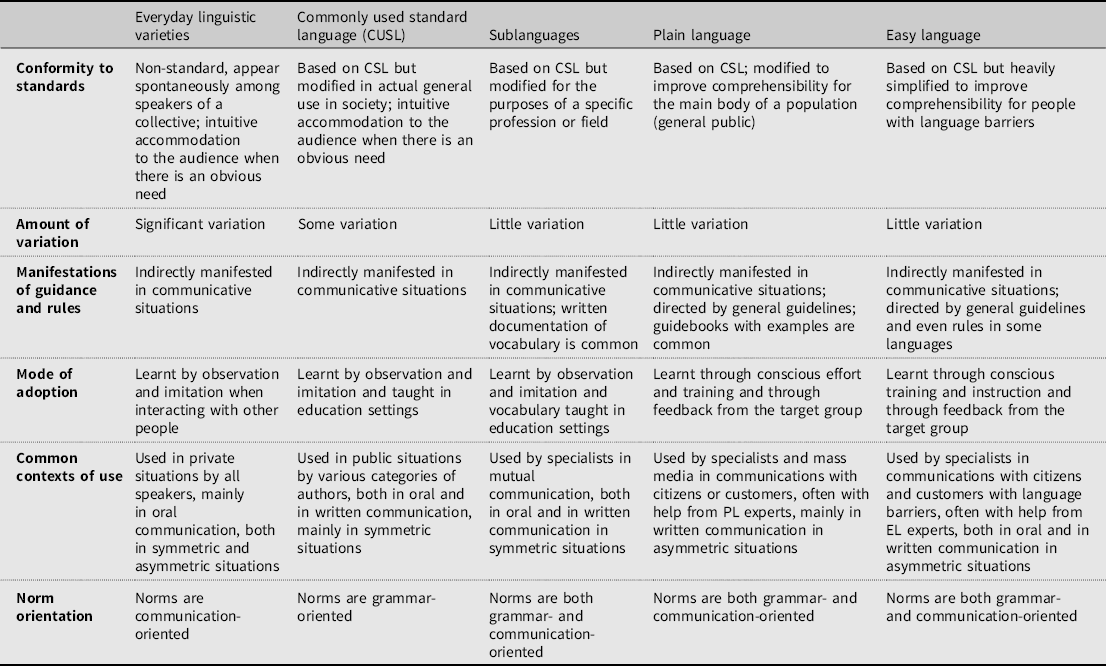
Table 1 (see next page) summarises our standpoint to the relevant features of selected language varieties.
Features of five natural linguistic varieties

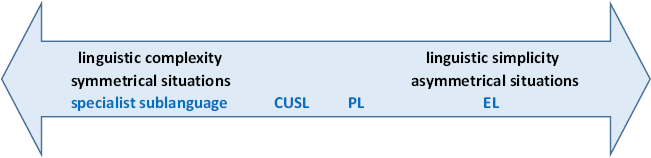
Considering the different (written) language varieties presented in this table, we can place EL and PL in a continuum that moves from complex to simple language usage. EL and PL, thus, form a path that simplifies untailored standard language (sublanguages and CUSL) and generates tailored accessible communication (e.g. Bredel & Maaß Reference Bredel and Maaß2016:526–542, Hansen-Schirra & Maaß Reference Hansen-Schirra, Maaß, Hansen-Schirra and Maaß2020:17–18, Lindholm & Vanhatalo Reference Lindholm and Vanhatalo2021:19–20), although the path from one language variety to another is gradual and difficult to present as definitive categories. This continuum is illustrated in Figure 2.
The linguistic tailoring required in linguistically symmetric and asymmetric written contexts (modified from Leskelä, forthcoming).

5. The stigmatising potential of easy and plain languages
In this section we discuss stigmatisation as a significant point of view that can potentially harm the implementation of EL and PL in a society. The influence of stigmatisation on the perception of simplified language varieties has been discussed by the German EL researchers Ursula Bredel and Christiane Maaß.Footnote 14 Using the German EL context, they have focused on the dimensions of stigma (originally identified by Jones et al. Reference Jones, Farina, Hastrof, Markus, Miller and Scott1984) and argued that EL is not as widely accepted as PL because it has been linked to issues of stigmatisation (Bredel & Maaß Reference Bredel, Maaß, Maaß and Rink2019:262–265, Maaß Reference Maaß2020:12–13). We propose that this topic requires further examination, as similar attitudes may occur in other countries as well.
The need for EL is related to stigmatisation in a variety of ways and to varying degrees. Maaß (Reference Maaß2020:206) has shown that in general, people who need EL often have to manage other issues related to stigma, particularly as disability and communication impairment can have a strong stigmatising potential. The special arrangements and tools required by people with disabilities can provoke contempt and even aversion in individuals who do not identify with the group, and this may result in imaginary infective influence. On the other hand, there are also counter-effects that celebrate disability with pride, such as the empowerment movement of people with disabilities. If we consider how the disability movement has recently actively influenced the rapid progress of EL in Europe (e.g. Bredel & Maaß Reference Bredel and Maaß2016:108), we can conclude that despite the general stigma related to disability, the need for EL is often approached with pride rather than shame. PL does not generate a corresponding stigma, as its audience consists of the majority of the population, and thus they do not share distinct or common features.
Duration also affects stigma: it is assumed that a long-term stigma is stronger than a temporary one. In addition, the more dependent a person is on EL for their social interactions, the higher the potential for stigma (Bredel & Maaß Reference Bredel, Maaß, Maaß and Rink2019:263, Maaß Reference Maaß2020:212–213). EL is more stigmatising when it is a permanent means of communication and less stigmatising when it is offered as an intermediate aid for achieving better reading capabilities (scaffolding function of EL, Bredel & Maaß Reference Bredel and Maaß2016:43). Thus learners of a second language would be less stigmatised by EL than people with intellectual disabilities; the former may eventually shift to PL or even to sublanguages, while the latter may need EL permanently. However, as our Finnish experience indicates, second language learners are less inclined to use EL materials than people with intellectual disabilities.
From the point of view of stigmatisation, the PL context is different to EL because, in most cases, the need for PL is situational. In many specialist fields, a layperson may always require a PL version of a text; however, in other situations and with other texts, they will not be dependent on PL. This, in turn, decreases the stigma associated with the reader’s use of PL. In contrast, the author of a PL text may experience a stigma if they fear their professional status will be threatened by communicating in their own expert field in PL (see Mazur Reference Mazur2000, Kimble Reference Kimble2016).Footnote 15 In fact, the author of an EL text may be less stigmatised because they are not presenting their EL text in a professional context.
Once again, the use of PL produces a different context because the need of PL is generally regarded as a normal situation and not a deficiency in the reader. The digitisation of services has further highlighted the nature of unnecessarily difficult expert language as a barrier to communication, as clients frequently have to rely on written instructions when interacting with authorities (Schriver Reference Schriver2017, Nord Reference Nord2018, Kirchmeier et al. Reference Kirchmeier, Piehl, Van Hoorde, Choleva, Hallik and Robustelli2022). This partly explains in our view why the PL movement is becoming more successful worldwide.
Bredel and Maaß (Reference Bredel, Maaß, Maaß and Rink2019:236) have also argued that the object of stigmatisation can be the language variety itself when EL is viewed as a ‘peril’ that threatens the existence of standard language (CSL), particularly in the context of education and culture (see also Schiewe Reference Schiewe, Bock, Fix and Lange2017:71–72). This risk is particularly evident in countries where EL deviates from the CSL norms, for example by allowing non-grammatical solutions or incorrect orthography, such as hyphenation of compounds (see Maaß et al. Reference Maaß, Rink, Zehrer and Jeka2014:69, 81). EL can therefore be seen as a language form that is competing with CSL (Maaß Reference Maaß2020:214). This perspective has significant stigmatising potential, which can lead to a rejection of EL. However, in this respect the situation may be different in other countries. In Finland, for example, the deviations from CSL have been counteracted, and the principles of EL include an adherence to CSL, both grammatically and orthographically (e.g. Leskelä & Kulkki-Nieminen Reference Leskelä and Kulkki-Nieminen2015:135–136).
In general, PL is not considered a threat to CSL because PL follows standard norms. However, PL could be perceived as perilous by specialist writers who are instructed to avoid some characteristic features of their sublanguages when their text is in PL if they feel that it jeopardises their professional credibility or impairs the precision of communication (see e.g. Mazur Reference Mazur2000, Kimble Reference Kimble2016).
In light of these considerations, while EL is more broadly and diversely surrounded by the potential for stigmatisation, PL is not free from the effects of stigma. The main difference relates to whom the stigma is directed. The potential stigma associated with EL is focused primarily on the reader (user), while concerns relating to the use of PL are primarily felt by the author (or the organisation producing the text).
6. Conclusion
The aim of this article was to introduce new insights to further the understanding of EL and PL as simplified languages and place them within a broader context of linguistic varieties. We conclude that the differences between EL and PL are gradual rather than categorical. The fundamental concept of both EL and PL is to empower the intended audience by modifying the message in order to meet the communicative needs of that audience. Tailoring is, in fact, a key aspect of any successful communication, and people, in general, are capable of adjusting their language use when faced with different situations in their everyday life. However, EL and PL represent a specific asymmetric communication, and when they are produced, the authors or speakers do not rely on intuition. Therefore, successful tailoring for EL and PL demands special effort and conscious training. While both of these simplified language varieties are based on CSL, PL authors require knowledge about general comprehensibility, whereas to produce an EL text, authors must understand the process of more radical linguistic simplification. Both varieties can also include varying levels of difficulty, and these reflect the changes that mark the shift from untailored to tailored texts.
Although the same argument of empowerment motivates the use of EL and PL, there is a difference in the level of dependence exhibited by the two reader groups, and this can have a bearing on potential stigma. Stigma affects both EL and PL, but in somewhat varying ways and to different degrees: EL appears to stigmatise the individuals who require this form of language support, and the effects are broader, whereas PL has the potential to stigmatise the author. This demonstrates an important difference between these two language varieties: PL is regarded as a potential instrument for all professional communication, especially but not solely involving lay people, while EL is only used for communication that is specifically created for limited target groups. In both cases, however, negative stigma may prevent extending their use to new situations and target groups.
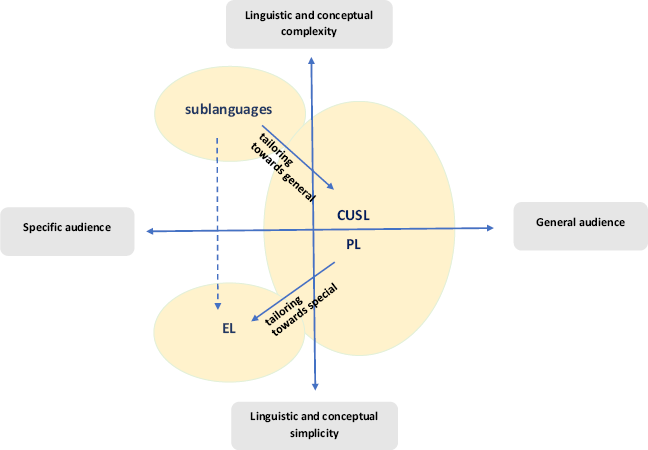
In the light of the perspectives we have presented in this article, it is worth paying attention to one particularly significant key difference between EL and PL, the direction of tailoring. The PL tailoring process modifies the sublanguage of a special(ist) audience to serve a general audience while the EL tailoring process moves in the opposite direction by accommodating the special needs of a special audience with language barriers (see Figure 3).
The directions of the tailoring processes in EL and PL.

Figure 3 summarises our understanding of the positions of EL, PL, CUSL, and sublanguages in relation to the two dimensions ‘linguistic and conceptual complexity vs. linguistic and conceptual simplicity’ and ‘specific audience vs. general audience’. The arrows show the connections between the different factors. As tailoring from sublanguages directly to EL is rare in Finland, but possible, this direction is shown with a dashed arrow.
Understanding the direction of tailoring is important, as it guides the author when selecting either PL or EL. In the case of PL, the author must combine the general linguistic features of CUSL that enhance comprehensibility with appropriateness of language and content to accommodate a professional sublanguage in a form that will be understood by a reader with standard linguistic capabilities. In the case of EL, the direction of the process is the opposite as the author must identify the specific needs of a reader with language barriers in order to tailor the text from PL to a special form that is easily accessible to this readership. This tailoring may include, at least occasionally, radical changes to language that is generally regarded as commonly comprehensible. The tailoring processes of both EL and PL require linguistic training, but a sensitivity towards the intended audience, whether specific or general, is also essential, as is a willingness to acknowledge the necessity of tailoring the language one habitually uses. This attitude is reflected in the definition of PL and contributes to a broad interpretation that could in principle also cover EL. However, additional research that is ideally directed by both EL and PL specialists is required to precisely specify the differences and examine the borderlines between these language varieties.
Acknowledgement
We thank the anonymous referees and editors of the volume for constructive and fruitful comments which helped us to crystallise our thoughts and wordings. Needless to say, we are solely responsible for all the remaining errors and shortcomings.
Competing interests
The authors declare none.