1. INTRODUCTION
Freehand sketching is not a common skill practiced by today's engineering students. Very few of today's engineering students create freehand sketches during their design tasks. Though sketching is a topic that may have been taught at the introduction of a computer-aided design (CAD) course to help students improve their spatial visualization skills (Carr, Reference Carr2011), engineering students are rarely taught to sketch or required to make freehand sketches in their courses. This is true even in mechanical design, an engineering field devoted to the process of creating a physical artifact that may be beyond what the designer can perceive with their senses. Sketching is a critical tool to give physical representation to and provide an external recording of ideas that exist only in the mind of a designer or design team.
As we conduct research at the University of Maryland on design methods and strive to develop tools that can implement our findings, we discover and rediscover new ideas. The renewed attention to sketching comes after the engineering profession has embraced the use of computer aided designing and drawing tools (CAD tools) and computational power has improved to the point that students and professionals frequently use these tools first in their visualization process. This has resulted, in part, because student versions of CAD packages are easily accessible on laptops so that today's engineers and students have CAD tools at their fingertips.
For the purposes of our discussion, a sketch is defined as “a simply or hastily executed drawing or painting, especially a preliminary one, giving the essential features without the details.”Footnote 1 Freehand sketching is, literally, a sketch done with only the hand and a pencil or pen; drawing tools (e.g., straightedge, curve, or tracing materials) are not used in a freehand sketch. Some sketchers may use a straightedge occasionally but a freehand sketch is always distinguishable from a more formal and painstakingly made line drawing with a pen or pencil. A sketch is a work-in-progress; it can include crossed-out lines, multiple strokes to indicate a single line, or uncertain placement of lines or marks. Figures in a sketch can have some ambiguity as to their exact shapes. It is in this characteristic that the sketch differs from a CAD drawing.
Professional engineering practice has also moved in the direction of current technological advances in graphical communication such as digital visualization, animation, and CAD. Advances in creating visual representations of objects are coupled with ease of access to technological tools. This synergy creates the opportunity and motivation for students to build competence in the use of CAD tools through their engineering programs. Unfortunately, there were also unintended consequences for engineering education.
Robertson et al. (Reference Robertson, Walther and Radcliffe2007) studied the impact of CAD education on engineering students working in industry and reported many benefits, some unexpected. One of the accidental competencies associated with CAD is an improvement in communication with colleagues happening when students share the results of CAD visualization tools. Robertson et al. (Reference Robertson, Walther and Radcliffe2007) also reported an accidental incompetency in sketching skills: “It was shown that as well as impacting negatively on the students’ conceptual understanding of creative design, the combination of CAD usage and other factors in education had impeding effects on key abilities that support creative problem solving such as sketching.”
This paper proposes a need to reemphasize the value of sketching during the design process, particularly for engineering students. Results of three, separate studies have sought to demonstrate this value through empirical research on engineering students. Section 2 introduces representative literature from specialists in a variety of fields on the value of sketching and trends in the most recent research on sketching by engineering students. The next three sections each describe the results of different studies on sketching conducted by the authors. Section 3 presents the results of a sketching homework assignment in a capstone design course. Section 4 describes the influence of a class module titled “Sketching Importance” on the content of sketches in later capstone design courses. Section 5 reviews a study on the impact of using a Livescribe Smartpen in which sketching with a Smartpen was one of the interventions being assessed. Section 6 discusses the impact of the results of these studies and Section 7 presents the conclusion and future work.
2. BACKGROUND: SKETCHING RESEARCH FOR ENGINEERING
Sketching is a representation tool used in all walks of life for a myriad of purposes, but has a particular significance to designers. In our discussions, sketching is studied from the perspective of design practitioners who hope to improve their craft. Sketching practitioners include working artists and engineers, architects, and industrial designers; graphics designers and fashion setters; and students of these fields. Sketching is studied by those interested in the workings of the human mind to better understand cognition and human perception. Architects use sketches to communicate and perform functional reasoning. Sketching is also studied by computational researchers who wish to model both the process of sketching for implementation in software and the benefits it provides to the designer.
Conclusions from studies on sketching must be interpreted with an idea of each study's context. For example, Bilda et al. (Reference Bilda, Gero and Purcell2006) conducted a protocol study with subjects doing design. Some were allowed to sketch while others were not. Their results indicate that there is no significant difference between sketching and not sketching when assessing the design outcome, cognitive activity, and idea links. This result appears contrary to the major assumption of this work that sketching is beneficial to design. The details of the study reveal that the subjects were expert architects who have highly refined mental imagery and visualization skills. The authors believe that results for engineering students will be different.
This section on background research will include representative literature citations that present specific findings relevant to establishing the value of sketching and in particular in engineering design.
2.1. Value of sketching in engineering design: Representative literature
Sketching is a means to communicate and the ability to communicate technical information about potential design concepts is critically important to engineering practitioners and design students. Settings where technical information is communicated include technical audiences, lay audiences, groups in public forums, workshops, brainstorming sessions, and so forth. The traditional and quickest way to communicate technical information is through hand-drawn sketches (Kivett, Reference Kivett1998; Van der Lugt, Reference Van der Lugt2005).
Ferguson's position on sketching is direct; creating and using drawings and sketches is the engineer's way to work (Ferguson, Reference Ferguson1992). He identifies three types of sketches: thinking sketches, prescriptive sketches, and talking sketches, which can be used to guide nonverbal thinking. Thinking sketches aid in the building of an object in the mind, nonverbally. Prescriptive sketches are produced to create a form of communication with another person. Finally, talking sketches are created during the exchange of information between people and enable discussion.
Creating any type of sketch at any stage of the design process provides a quick way to visualize the problem, consider design options, and identify questions and uncertainties where more information is needed (Rose, Reference Rose2005). Current instructional methods tend to encourage students to present graphical information formally on handouts, overheads, CAD drawings (Rose, Reference Rose2005), and digital slide shows. Sketching during the design process is believed to have a positive effect on the solution quality of design outcomes however this is at the expense of time (Schütze et al., Reference Schütze, Sachse and Römer2003).
Sketches are a means for the designer to perform specific mental processes used during design. Sketches are physical, external representations of ideas that relieve the designer of the need to hold them in memory and provide a means of recalling the ideas (Tversky et al., Reference Tversky, Suwa, Agrawala, Heiser, Chris Stolte, Hanrahan, Phan, Klingner, Daniel, Lee, Haymaker and Lindemann2003). Sketches become part of the process of reviewing and revising ideas by providing a means to store the external representations until they can be reviewed (literally, viewed again) with a fresh perspective or a new frame of reference. Tversky and Suwa (Reference Tversky, Suwa and Markman2009) call this reinterpretation a construction perspective. Bilda and Gero (Reference Bilda, Gero, Gero and Goel2008) call this sketch reviewing process one way to create an interaction between the mind's cognitive process and the external representation. Schon (Reference Schon1983) defines this process in an activity-based fashion and calls it the way a designer has a conversation with himself.
Ullman, a well-known mechanical engineer and educator, discusses the importance of the pre-CAD skills of drafting and sketching. He recommends that the integration of CAD into engineering education must take into account different mediums, specifically sketching (Ullman et al., Reference Ullman, Wood and Craig1990). Sketching activities lead to important questions from designers about problem particulars and motivate in-depth thinking.
Unfortunately, engineering students do not believe that sketching is an important skill for professional practice. A study published in 2011 surveyed fifty-one students in an upper-level, mechanical engineering design course at the University of California in Berkeley (Oehlberg & Agogino, Reference Oehlberg and Agogino2011). Students were presented a set of 24 design skills and asked to select the 6 most important and least important skills. Sketching was the only mode of drawing included in the set; related activities were visualizing, modeling and prototyping. Student opinions were compared to those of practicing engineers as reported in a study by Mosborg et al. (Reference Mosborg, Adams, Kim, Atman, Turns and Cardella2005). Two percent of the students included sketching as a most important skill compared to 53% of the practicing engineers.
2.2. Trends in recent studies on sketching in engineering design
Research into the generation of design concepts, often referred to as ideation, has increased in recent years as the interest in engineering entrepreneurship has risen. For the purposes of this paper, the term ideation refers to the process of idea creation. The increased interest in engineering entrepreneurship has resulted in more research on design innovation and designer creativity. Accordingly, more investigations have been performed on the cognitive aspects of design methods and tools to improve design process outcomes. In this context, the use of sketching in design is a frequent topic of experimental research.
Yang conducted research specifically on sketching activities of student design teams during concept generation (Yang, Reference Yang2003; Yang & Cham, Reference Yang and Cham2007). Students’ cognitive abilities and sketching abilities are key factors that influence the different types of sketches that will be produced in a project or report. Yang concludes that students who may be less skilled drawers or who do not require the visual aid to their mental imagination were less likely to keep a sketching journal. Yang and Cham (Reference Yang and Cham2007) also report that the likelihood that a student will sketch is influenced by their artistic skill level and the perceived value they find in sketching activities. In a third study, Yang (Reference Yang2009) conducted an experiment on the relationship between quantity of ideas generated and the design outcome for brainstorming, morphology charts and sketching. Yang concluded project length and difficulty in design affect sketching activity. Yang also indicates that the importance of concrete sketching (i.e., more details), timing and milestones in the design process have an effect on the design outcome. The impact of sketching on improving outcomes in the design process was stronger than the other factors studied including: brainstorming and morphology.
Oehlberg et al. (Reference Oehlberg, Lau and Agogino2009) reported on a study of sketchesFootnote 2 made from 2004 through 2007 in a multidisciplinary, graduate-level design course on new product development. Their work reviewed design journals containing two-dimensional paper visualizations with those that included three-dimensional digital visualizations. These were called hybrid journals. The study noted the trend to decreasing use of two-dimensional media in favor of digital media that create three-dimensional models of ideas (e.g., CAD, photographs). Oehlberg et al. (Reference Oehlberg, Lau and Agogino2009) used a very broad definition of “sketch” in this study. The main conclusion of the work is that the increase in technological fluency is changing how students work with visual representations, which confirms the shifts seen in other studies.
An intriguing study by Do (Reference Do2002) proposed a relationship between reasoning and sketches where not only sketching marks but also the acts and reactions to them can be related to the reasoning process. This potential capturing of a significant portion of the design engineer's reasoning process may provide the necessary inputs to the next generation of CAD capabilities, automated engineering software, or customized engineering design applications. Researchers studying design space exploration are also interested in understanding the sketching process. For example, Prats et al. (Reference Prats, Earl, Garner and Jowers2006) proposed a model of exploration with four types of shape descriptions (contour, decomposition, structure, and design) and, with this, proposed to define styles of exploration. Woodbury and Burrow (Reference Woodbury and Burrow2006) studied the structure of the design space as a “network structure of related designs” and the implications of designers acting as explorers. Perhaps, one of the most important technological expectations with respect to sketching is the development of computer-aided sketching interfaces. The goal, as explained by LeClerq and Juchmes (Reference Leclerq and Juchmes2002), is to achieve the “absent interface” in design engineering. This means having an interface that is compatible with the cognitive process and has the following characteristics: natural, transparent, adaptive, and intelligent. This applies to sketching interfaces as well as other interfaces in the human–computer interaction domain.
2.3. Assessing sketching during design
Shah conducted a study combining engineering design and cognitive psychology perspectives to analyze ideation effectiveness through sketching (Shah et al., Reference Shah, Vargas Hernandez and Smith2003). Sketched solutions were objectively measured by quantity, quality, novelty, and variety. A genealogy tree based on functions and forms suggested by the sketches' categorization was created to better understand the different levels of sketches and differentiate physical principles. This categorization assists in models of ideation and sketching, as well as in predicting performance in design projects. These metrics for ideation are useful in quantitatively assessing the concepts presented in sketches during the design process. McGown et al. (Reference McGown, Green and Rodgers1998) and Yang and Cham (Reference Yang and Cham2007) introduced two sketch coding schemes that differentiate sketches based on the drawing skill of the sketcher. In each case, the highest levels of the coding schemes involved the most realistic looking sketches. Ruocco (formerly Grenier) developed and piloted a content-based coding scheme for sketches in design journals (Grenier, Reference Grenier2008). The uniqueness of Ruocco's coding scheme is that it does not differentiate sketches on the basis of the sketching or drawing skill of the creator. This is in contrast to sketch coding schemes previously mentioned (McGown et al., Reference McGown, Green and Rodgers1998; Yang & Cham, Reference Yang and Cham2007).
The Ruocco sketch coding scheme consists of attribute codes describing the subject matter of the sketch (the subject matter: entire artifact or just a feature) and the types of detail included in the sketch. Examples of details coded in sketches are motion arrows, dimensions, free body diagrams or force vectors. Sketch subject matter and sketch detail coding provides more cues by which to infer cognitive activity. The sketch coding scheme is a useful tool for conducting formal, quantitative, analysis of sketching data. Ruocco's coding scheme is simpler to apply to a sketch as much of the subjectivity is removed. The codes describe what the sketch includes, not the sketch ability of the designer.
Ruocco and colleagues expanded the sketching content coding scheme to apply to any visual representation of physical artifact (Westmoreland et al., Reference Westmoreland, Ruocco and Schmidt2011). The expanded content-based coding scheme was applied to study the visuals included in sets of mechanical engineering capstone design course reports for a study of 1497 visuals appearing in 48 different capstone design reports created by 262 students in total. The reports were submitted during five different semesters from spring of 2005 through fall of 2007. Relevant findings on sketches appearing in capstone design reports from this study included (1) the number of sketches included in final reports increased in response to the instructor's requirements (not voluntarily), (2) students appear to have replaced line drawings created by MS Word drawing tools with scans of hand-drawn sketches,Footnote 3 (3) sketches selected for inclusion in the capstone design reports are of low quality when assessed by McGown and Yang sketch coding schemes (i.e., 75% of sketches fell into the lowest two McGown sketch quality categories), and (4) sketches are most frequently used to represent the concept generation results of the design process. Sketches were coded using the Yang and McGown scales by two graduate students working independently. An inter-rater reliability coding comparison study was done for the coders on a set of sketches used to train for coding. The details are provided in Grenier (Reference Grenier2008).
3. EXPERIMENTAL STUDY 1: SKETCHING HOMEWORK ASSIGNMENTS IN CAPSTONE DESIGN COURSE
Grenier (Reference Grenier2008) researched student understanding of the use of sketching and CAD drawing in design in mechanical engineering students at the University of Maryland. The results of the survey indicated that students did not choose sketching as the medium of choice during the early stages of design. This finding agrees with the results of the study on the types of visualizations found in capstone design final reports (Westmoreland et al., Reference Westmoreland, Ruocco and Schmidt2011) that students were not voluntarily using sketches to communicate design concepts. In the wake of the findings, Schmidt, manager of the Mechanical Engineering Department's capstone design course, implemented an individual sketching homework assignment in the course to encourage sketching. This section reports on Grenier's findings and the results from adding a sketching assignment to the capstone design course.
3.1. Engineering student attitudes on sketching
Greiner (2008) developed the Mechanical Engineering Visual Design Mediums Concept Inventory to investigate students’ conceptual understanding of the role of sketching and CAD within the design process. The concept inventory is composed of 2 short answer and 20 multiple choice questions. The questions were created from previous literature on sketching and CAD. A concept inventory is typically used to assess learning of a set of concepts and can be administered before and after a teaching intervention. A concept inventory is created with answers that support correct concepts and those that support common misunderstandings of concepts.
During fall 2007, the concept inventory was administered to 58 first-year students (100 level courses), 27 second-year students (200 level courses), 33 third-year students (300 level courses), and 105 fourth-year students (400 level courses), for a total of 223 students. The concept inventory was designed to test the students' understanding of key concepts about sketching and CAD drawings. This concept inventory has not been systematically validated. However, the results leave little question that students misunderstand key concepts about sketching. Grenier found that the average score on the inventory was between 45% and 50% for respondents at all grade levels. First-year students had an average score of 45.7%, which is statistically significant in its deviation from that of students with more time in the curriculum. There is evidence that students in fourth-year courses had a better average understanding of the concepts than those first-year courses. For students in the capstone design course the word most commonly used to describe a sketch was “idea”; the word “drawing” was the dominant word used to describe a sketch for all other groups of students. This finding shows that there is some shift in student attitudes toward sketching as they move through the curriculum.
Students did not understand which drawing method was most appropriate for each phase of design. Eighty-two percent of respondents recognized that sketching is more appropriately used in the concept generation portion of the design process where a variety of ideas should be considered. However, a majority of students in all grade levels also answered that CAD should be used in all stages of design. In a third question, a majority of students in all grade levels also answered that sketching should be used in all stages of design. To demonstrate understanding of the concept that sketching is best suited for concept generation, a student would need to answer all three questions correctly: (1) sketching is best for conceptual design, (2) CAD is best for detailed design, and (3) neither should be used exclusively.
A survey was given with the concept inventory to obtain demographic and preference information. From data input, many students state that they prefer using CAD because they are not good at sketching and/or they know how to use CAD and are good at it. Conversely, students that do not know CAD and/or are not confident in their use of CAD tend to prefer sketching because it is easier and quick. Other students stated that they did not like sketching or using CAD. Much more detail on the concept inventory can be found in Grenier's MS thesis (Grenier, Reference Grenier2008).
3.2. Capstone design sketching assignment
Grenier's findings indicate that mechanical engineering students at the University of Maryland are not motivated to use sketching in their design process. Convinced of the benefits of encouraging sketching in engineering design, Schmidt includes a sketching task as an individual homework assignment during the University of Maryland's mechanical engineering capstone design course.
3.2.1. Experiment methodology
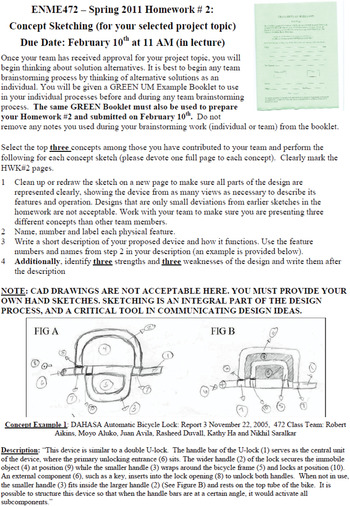
The sketching assignment is given during the first few weeks of the one semester course. Figure 1 displays the concept sketching assignment posted on the course website for the spring 2011 capstone design course. The assignment is due prior to team brainstorming sessions for their design project; the sketching work provides team members with ideas to bring to the team session. The value of the homework assignment in a given semester ranges from 5% to 8% of a student's final course grade.
An example of a concept sketch and description given in the sketching assignment for the capstone design course. [A color version of this figure can be viewed online at http://journals.cambridge.org/aie]

Key requirements for the assignment are as follows:
• Each member of the team is required to generate sketches of different concepts that fulfill the design task undertaken by the team.
• The homework concept sketches must be drawn by hand.
• Sketches must include labels naming the component parts.
• Each sketch must be accompanied by a description of the operation of the concept represented by the sketch.
The homework assignment sheet includes a sample of a sketch submitted in a prior offering of the course. These sketched descriptions of their concepts will also be required in the course's final report. This supports the value of the sketching assignment to the course project overall.
3.2.2. Assessment
Many students are skeptical about their ability to perform the sketching assignment because of the requirement of sketching, or freehand drawing, of the concepts. Inevitably as the assignment is announced a student will ask if they may use a CAD program. To allay the anxiety of the students the criteria for assessment of the assignment are based on the usefulness of the concept sketches for their project.
The sketch assignment is graded on three criteria described below.
• The clarity of the sketch and description.
• The variety of the submitted concepts. The variety criterion prevents good scores for one good idea followed by concepts with only minor variations.
• The novelty of the concepts. Students do not receive full credit for ideas that are common among team members. It is not unusual for two students to generate a similar concept as a team member. However, there is a need emphasize the expectation of individual effort on the assignment.
Absent from the assessment criteria is the artistry of the sketch. Instead, clarity in expressing the idea is emphasized.
3.2.3. Experimental results and analysis
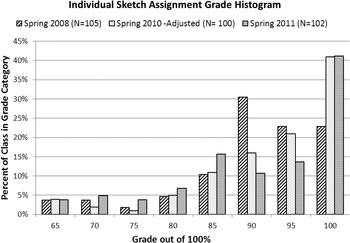
Figure 2 displays a histogram of three semester's worth of grades on the sketching assignment. The grades for 2010 are adjusted by eliminating a 10 point bonus for electronic submission from the top two categories of grades. The grades shown also include penalties for late assignments or those that failed to include the appropriate number of concepts.
The grades on the sketching assignment for the capstone design course.

In each year the majority of the students receive excellent grades. It is believed that the high grades are influenced by a number of factors: (1) motivation for a good course grade, (2) interest in developing good concepts for the design project, and (3) willingness to attempt sketching because they are assessed on the content of the sketches and not their sketching skills. Although we cannot say that the assignment assessment process is the most influential factor in this sketching performance, the outcome is notable. The conclusion from this study is simple: students who would not normally sketch in the design process will sketch for an assignment that is designed to align with the course goals.
4. EXPERIMENTAL STUDY 2: IMPACT OF SKETCHING IMPORTANCE LESSON
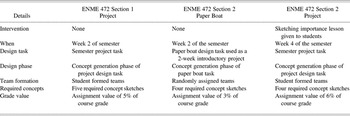
Ruocco et al. (Reference Ruocco, Westmoreland and Schmidt2009) conducted a study on the impact of increasing students’ awareness of the importance of sketching to the design process. Two sections of University of Maryland mechanical engineering capstone design courses were used. One section of students, ENME 472 section 2, worked on a short introductory project before tackling their capstone design topic. The introductory project was a paper boat design task. This short project assignment was not an intervention on sketching, but sketches were required. This allowed comparison of sketching behavior between the two sketching assignments in section 2 and between the sections 1 and 2. The context for each of the sketching assignments is given in Table 1.
Context for sketching homework assignments for fall 2007 semester study

4.1. Experiment methodology
The study examined student sketching homework assignments for two sections of a mechanical engineering senior capstone (named ENME 472) course at the University of Maryland in the fall semester of 2007. All students (N = 72) were required to produce sketches of design concepts on their team's course project as a graded homework assignment, like that described in Section 3.2 of this paper.
This experimental design allows the comparison of the sketching assignment submissions for three different sets of assignments.
• Section 1 students prepared concept sketches on their capstone course projects with no special intervention on sketching.
• Section 2 students prepared concept sketches on their paper boat assignment with no special intervention on sketching.
• Section 2 students prepared concept sketches on their capstone course projects after a special intervention on the importance of sketching. (Note that this intervention did not teach any sketching skills.)
The intervention given to students of section 2 consisted of a 45-minute course module on the importance of sketching. The module was given in a PowerPoint lecture and discussion format. In included the following four elements.
1. The Schütze study is presented to the students (Schütze et al., Reference Schütze, Sachse and Römer2003). In the Schütze study 45 mechanical engineering students were given a design problem (design a simple garden tool). There was no time limit. The students were divided into three groups: (1) unlimited use of self-made sketches throughout the process, (2) use of self-made sketches part way through the design process, and (3) no sketching allowed. The results were that groups 2 and 3 performed more quickly than group 1. Group 1 (unlimited sketchers) found the problem to be significantly less difficult than group 3 (no sketching allowed). There was no significant difference in certainty of the correctness of the solution. Participants stated that sketching was an aid for analysis, short-term memory, communication, and documentation. Sketching helped students develop, test, and improve their solutions.
2. The benefits of sketching as a communication tool and an aid to the cognitive process used in design are presented to the students.
3. Students are engaged in a discussion of the uses of sketching versus CAD drawings.
4. Students were given the short article by McCormick (2007) on the benefits of sketching and asked to read it after the initial discussion of sketching and CAD. The article is titled “Seeing Mechanical.” A key quote in the article is the following: “Sketching is the tool for innovation, and is so vital to the engineering process that it should be taught and used as an essential part of engineering education and professional practice.” (McCormick, Reference McCormick2007).
The most important feature of the intervention is that it did not teach students to sketch. The intervention was designed only to communicate that there is an appropriate role for sketching in the modern engineering design process.
4.2. Experimental results and analysis
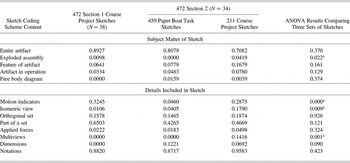
The sketching assignments from all the participants were collected and coded by Ruocco using the Ruocco content-based sketch-coding scheme. Application of the Ruocco content-based coding scheme is objective. The coding scheme assesses the presence of different features in the sketch. For example, the type of views used (isometric, standard engineering drawing), the presence of force arrows, the presence of extra views, and the presence of annotations or dimensions.
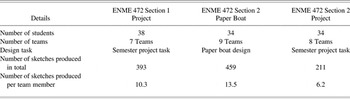
Table 2 displays the number of sketches produced for the sketch assignments done during the study period. The statistics are displayed separately by each assignment. The number of sketches is further converted into the number per student on each team. We find differences in the number of sketches produced by student on average for the sketching assignments. The first difference is that students in section 2 changed the number of sketches provided in their sketch assignment after the sketching importance lesson (13.5 on average for the paper boat designs and 6.2 on average for the semester project). This is interesting because in each assignment the students were asked to describe four concepts. It is likely that the capstone design projects were more complex than the paper boat project as well. An explanation may be found in reviewing differences in the sketch content.
Context for sketching homework assignments for fall 2007 semester study

The data on the sketch contents were analyzed and results are presented in Table 3. Table 3 analysis of variance results highlight several significant differences in the sketching assignment after the sketching importance lesson. Significant changes in sketch content for capstone design project sketching assignment for section 2:
• Increase in the number of exploded assembly sketches
• Increase in the number of motion indicators in sketches over those used to describe paper boat concepts. (This result is not too surprising because parts of a paper boat are not likely to move relative to one another.)
• Increase in the number of multiple views of concepts beyond those done for paper boat concepts and those done by students in section 1.
• Increase in the number of isometric views of concepts beyond those done for paper boat concepts and those done by students in section 1.
Percentages of sketches with content codes by section for University of Maryland's fall 2007 capstone design course sketching study

Note: The p values are the probability of finding three samples with these attributes if they were from the same population. Adapted from Ruocco et al. (Reference Ruocco, Westmoreland and Schmidt2009). ANOVA, analysis of variance.
aThese results are statistically significant at the α = 0.05 level.
The sketching importance lesson changed the type of sketches produced; the number of sketches produced by the students (a reduction), and increased the number of details within sketches. This may also explain why the absolute number of sketches is down for section 2 students’ capstone projects. The sketches they did produce include more content so fewer were needed.
5. EXPERIMENTAL STUDY 3: USE OF TECHNOLOGY—SMARTPEN
Although ink and paper sketching is the most traditional approach, various technological alternatives exist. Using a traditional computer mouse to sketch remains a difficult task, whereas an electronic sketchpad (Wacom, http://wacom.com) allows designers to translate freehand movements using an electronic pen on the surface of a tablet to mimic pen or brush strokes to create a computer sketch. Because of the multiple functions provided by the software and the interface, this approach is preferred by artists, CGI industry, architects, and industrial designers. An evident disadvantage is that the user must make a connection between the hand and pen movements on the tablet and what is represented on the screen. Computers with touch screen technology have the advantage that users can “sketch” directly on the screen either with a pen or fingers. However, high quality resolution of strokes to mimic lines on the page of a sketch notebook comes at a price.
5.1. Experimental studies on sketching technology
Leake and Weightman (Reference Leake and Weightman2011) report on a first-year engineering graphics and design at University of Illinois at Urbana–Champaign. The course added tablet PCs and a Wacom Cintiq pen display. The researchers report that industrial design students are enrolling in the course as an elective. A digital sketching (these authors call sketching an industrial design tool) assignment was given to students to convert an architectural photograph into SketchBook Pro, an Autodesk sketching tool. The conversion requires determining layers for different types of information (e.g., lines, shading, colors). A fourth year course of teams of industrial design and engineering students called computer-aided product realization is offered bringing a multidisciplinary view to their projects. The course focuses on the research and design of a digital prototype. The researchers did not report on any hand sketching done in these courses.
On the lower end of the technological spectrum, a typical student may afford a digitizing pen to take notes and sketch. An example is the Smartpen from Livescribe Co. (http://livescribe.com/en-us), an electronic pen that has the ability to digitize what is written/sketched and also record audio. Currently, this product is geared toward middle and high school and increasingly to college students. The Echo Smartpen can be bought for approximately $150 to $200, depending on the memory size (4–8 GB); previous models can be bought for as low as $50 (Pulse 1 GB, which may be enough for one semester course's worth of notes and audio without downloading).
The Smartpen works only when special microscopic dot-paper is used; an infrared camera at the tip of the pen recognizes the microdots in a grid array that, through slight offsets, identifies the coordinates on the page as well as the page and notebook product being used. Users turn the pen on and start writing in the notebook. The pen also has a built-in microphone to record audio. It can record graphics or audio or both simultaneously.
5.2. Use of Smartpen experimental study
What is the effect of the use of technology for design sketching? An ongoing study by Vargas et al. (Reference Vargas, Kremer, Linsey and Schmidt2010) hypothesizes that the use of a Smartpen improves creativity effectiveness metrics such as quantity, novelty, and variety (Shah et al., Reference Shah, Vargas Hernandez and Smith2003). The experiment was conducted at the University of Texas at El Paso on a group of students generating ideas using a Smartpen versus traditional paper and pen as a control group.
5.3. Experimental methodology
The control group consisted of 21 students while the Smartpen group had 14 students; all participating students belong to the fall 2010 mechanical engineering senior design course and received 5% of their overall grade for their completed participation. The design task used is the redesign of a LED Traffic Light where designers have to generate ideas on how to avoid accumulation of snow because of reduced heat output by the LED bulb.
5.4. Experimentation sequence
Working in separate classrooms, both groups started with a warm-up ideation activity; students worked individually for 20 min on an unrelated ideation task. The ideation task (LED Traffic Light redesign) was then introduced and clarified; this took 10 min. Both groups then generated ideas individually for 20 min; students sketched their ideas on blank paper and no formal ideation method or recording technique was indicated to them. The Smartpen group received the Smartpen equipment (pen, notebook, headphones, docking station, and getting started guide) and 1-h hands-on training on the basic functionality (setup, recording audio, manager software, etc.). Both groups were asked to generate ideas for 50 min (ideation session 1), the Smartpen group now using the training and equipment and the control group without formal ideation method or recording technique other than paper and pen; ideas were then collected. Students were asked to continue generating ideas as homework with a time limit of 2 h in the next week (ideation session 2).
5.5. Assessment
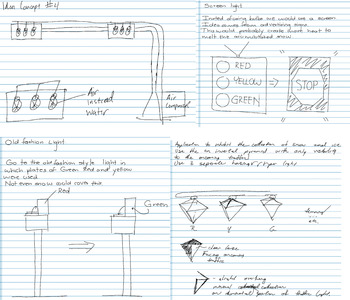
The ideas assessed were those from ideation session 1 (for 50 min, after the Smartpen treatment). Figure 3 presents sample ideas generated using the Smartpen. The ideas were assessed using a set of metrics based on Shah et al. (Reference Shah, Vargas Hernandez and Smith2003). The ideas were first characterized using a genealogy tree (GT). The GT allows this by defining a common origin for all ideas addressing functions of the design process. The branches follow the concretization of the ideas from physical principles and working principles. This GT allows two objectives: (1) to have a common structure to categorize each idea and (2) the GT is used to calculate quantity, novelty, and variety (see Vargas et al., Reference Vargas, Kremer, Linsey and Schmidt2010, for more details).
A sample of improved traffic light design solution sketches using the Smartpen. [A color version of this figure can be viewed online at http://journals.cambridge.org/aie]

5.6. Experimental results and analysis
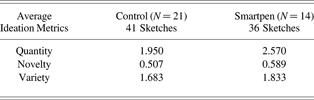
Table 4 presents the results on the ideation metrics for the Traffic Light redesign problem. The hypothesis was that the group of students using the Smartpen would display improvements over the control group because of the impact of using the Smartpen for the design task. The results indicate that the use of the Smartpen increases the quantity, novelty, and variety of ideas generated when compared to a control group not required to use a formal ideation method or recording technique other than paper and pen.
University of Texas at EI Paso Smartpen versus paper and ink results in fall 2010 study
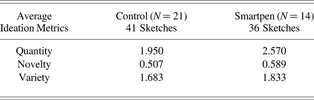
Based on these results, it can be concluded that the introduction of a new technology enhances the students’ performance when generating ideas to solve a design problem. Additional research on the sketches generated in the study must be done to provide more insight.
Researchers made the following observations from the experiment with the Smartpen.
• Students showed great enthusiasm on using the Smartpen and found it easy to use for basic operations; these may explain some of the improved ideation metrics.
• A key advantage of the Smartpen is the ability to revisit previous ideas or sketches and replay its corresponding audio; this may have the effect of improving the quality of ideas while decreasing variety since the designer brings the best features of previous ideas.
• Students liked the ease of sharing sketches as PDFs or publishing them by uploading to a website. This finding aligns with Robertson's observation about the accidental competency of improved communication as a result of developing CAD skills. The Smartpen is also a tool with a built-in communication advantage.
Researchers concluded that the students make the most of the pen on the long run such as in a one or two semester capstone design course. Qualitatively, we observed that students really liked the Smartpen because its use can be naturally extended to course note taking. When given the option, almost all participants decided to keep their Smartpen and use if it for the rest of the semester. We can also conclude that the Smartpen technology can be tailored and reprogrammed to become a more supportive tool for design (e.g., what if the pen has a catalog of functions or it recognizes functional diagrams).
6. DISCUSSION
The value of sketching to improve design outcomes has been reported in many studies, and a representative sample of those is included in section 2. The cumulative impact of the literature implies that sketching is a valuable skill for the engineering professional. Unfortunately, engineering students are not sketching as a regular part of their design process. This development is concurrent with the increased ease and availability of the computer-aided drawing software. A study at one large engineering university indicates that students do not understand the role of sketching in the design process. Furthermore, these students do not wish to engage in sketching when they do not have good sketching skills. With that understanding, the intention of this paper is to make a case that the use of sketching in the engineering curriculum can be encouraged by relatively simple tactics.
This paper provides empirical evidence matching research on student attitudes and behaviors toward sketching. The concept inventory results clearly indicate a lack of understanding of sketching and the value it provides to designers. Three interventions to increase the use of sketching in design courses were described. It was demonstrated that students will sketch when required to in an assignment. It was also demonstrated that students changed the type of sketches they created after a sketching importance lecture. The students included more detail in the sketches after discussing the value of sketching to design. Finally, we reported the use of Smartpens in a design ideation study. The pens did not conclusively change the nature of the solutions prepared by the students but students did respond favorably to using the new technology in sketching.
Teaching sketching to engineering students would be a natural way to impart this skill to the students. Lane and Seery (Reference Lane and Seery2010) used Pareto's Law (based on the paradigm of diminished return): the most effective way to teach was to find out what would be most useful to students new to a subject area. This law was coupled with deBono's (Reference deBono1983) concept of “operacy” reducing the time spent on teaching information and increasing the teaching of higher-order thinking. This combination resulted in an approach to teach sketching where 20% of classroom time is spent on the core principles (critical to learn freehand sketching) while the remaining 80% is spent on critical engagement (i.e. the ability to think independently and from hypotheses). This indicates that sketching can be taught without the need to add new courses to the curricula, but as part of other courses and by teaching sketching techniques and by providing the proper encouragement, for example, through assignments that require sketching.
The interventions shown in this paper indicate that instructors can encourage sketching without directly teaching sketching techniques. Communicating the appropriateness of sketching in early stages of the design process can increase the use of sketching by students. Students may be under the mistaken impression that only CAD drawings are acceptable in design assignments. This may be true for detailed design tasks. However, assignments that accept sketches scanned into reports on design projects will reinforce acceptance of sketching at early stages of design.
Another tactic for influencing student use of hand sketching is to adopt sketch supportive technology in the classroom during lectures or lab sessions. Supportive technology like the Smartpen may capture the imagination of students who are early adopters. Instructors should also be aware of the technology that students are already using in the classroom. For example, students may already be using tablets or iPads with stylus-type applications for sketching.
7. CONCLUSIONS
The evidence presented in the literature review clearly demonstrated the value of sketching in engineering design. Various points of view and different approaches on how to teach the sketching process were analyzed in this paper. Consequently, this paper focused on ways to encourage sketching in engineering designers. From these efforts, the authors conclude the following:
1. Sketching allows designers to form, visualize and externalize ideas and provides the opportunity to communicate and discuss them during the design and development process.
2. Through the concept inventory analysis it was shown that engineering students lack understanding of sketching and its value.
3. There are three available encouragement approaches: assignments that include sketching, lectures on the importance of sketching, and the use of the Smartpen as a supportive technology for sketching. Experimental results indicate that these three approaches encourage sketching; hence, it is possible to influence sketching behavior in engineering design. In particular, the Smartpen study results indicate a promising future for the use of technology in sketching.
Current technology must improve to deliver freehand sketching availability directly to students in their design work environments. This means that sketching interfaces must be at the designer's fingertips, embedded in typical designer activities, for example journaling and design team meetings. As explained by LeClerq and Juchmes (Reference Leclerq and Juchmes2002), the sketching interface must be natural, transparent, adaptive, and intelligent. The combination of effective strategies for encouraging student sketching and new technologies could create a future in which an intelligent sketch pad that makes anyone able to communicate about ideas like a professional design engineer.
Linda Schmidt is an Associate Professor in the Department of Mechanical Engineering at the University of Maryland. Her interests are in understanding the process by which early stage, engineering design tasks are successfully completed so that we can devise effective methods for learning design and preserving knowledge that arises in the process. Dr. Schmidt was the 2008 recipient of the American Society of Engineering Education's prestigious Fred Merryfield Design Award and is the coauthor with George Dieter of the text Engineering Design (5th ed.) published by McGraw Hill in 2012.
Noe Vargas Hernandez is an Assistant Professor at the University of Texas at El Paso Mechanical Engineering Department where he teaches design related courses such as senior design, mechanical design, and creativity and innovation. His research interests include ideation methods, creativity metrics, expert design systems, innovation process, biomechatronic rehabilitation devices, sustainability engineering, and design education.
Ashley Ruocco is an Engineer at the Department of Energy in Germantown, Maryland. She is the Occurrence Reporting and Processing System Program Coordinator and Operational Experience Program Coordinator at the Department of Energy. Her research interests in engineering design stem from her graduate work at the University of Maryland where she earned her MS in 2008. Ruocco's interests also include nuclear safety, systems, and policies; nuclear engineering; mechanical design; engineering education; sketching; and CAD tools.