INTRODUCTION
Nitrogen (N) is considered a major limiting nutrient for maize production in the savannah soils of West and Central Africa (Carsky & Iwuafor Reference Carsky, Iwuafor, Badu-Apraku, Fakorede, Ouedraogo and Quin1995). In most agricultural communities in the region, low-N (LN) availability and N use efficiency (NUE) almost always limit crop growth, more than deficiencies in any other minerals. This is because N is of great importance to the maize crop. It plays a key role in metabolism, notably in protein synthesis, and thus strongly influences both grain production and grain protein content (Machado & Fernandes Reference Machado and Fernandes2001). Farmers understand the importance of N for maize production and employ different strategies to minimize the adverse effect of low soil fertility, such as planting at low population densities, applying mineral fertilizer or animal manure, leaving the land fallow, or switching to less demanding crops (Carsky et al. Reference Carsky, Nokoe, Lagoke and Kim1998). However, the low maize grain yield (1–2 t/ha) recorded in the West African savannahs (Fakorede et al. Reference Fakorede, Badu-Apraku, Kamara, Menkir, Ajala, Badu-Apraku, Fakorede, Ouedraogo, Carsky and Menkir2003) indicates the limited use of fertilizer and the inadequacy of the other coping strategies. Farmers often apply an amount of fertilizer suboptimal for yield to their farms because of its high cost and limited availability as well as their low purchasing power (Kling et al. Reference Kling, Heuberger, Oikeh, Akintoye, Horst, Edmeades, Bänziger, Mickelson and Pena-Valdivia1997; Bänziger et al. Reference Bänziger, Edmeades and Lafitte1999).
The savannah soils are mainly kaolinite Alfisols that are low in organic matter (Jones & Wild Reference Jones and Wild1975; Tian et al. Reference Tian, Kang and Brussaard1993), resulting in LN availability. Cell and tissue growth are affected by N stress, thereby influencing leaf area and photosynthetic capacity (Brown Reference Brown1978; Novoa & Loomis Reference Novoa and Loomis1981; Pan et al. Reference Pan, Jackson and Moll1985; Wong et al. Reference Wong, Cowan and Farguhar1985; Muchow & Sinclair Reference Muchow and Sinclair1994), hence reducing maize yields by as much as 40% (Bänziger & Lafitte Reference Bänziger, Lafitte, Edmeades, Bänziger, Mickelson and Pena-Valdivia1997). Thus, a successful maize production scheme would depend on high investment in inorganic fertilizer, but the N fertilizer is expensive for the resource-poor farmer.
Breeding maize for adaptation to suboptimal soil N may enhance the capacity of maize cultivars to absorb and use the available N more efficiently for grain production at farm-level in soils with LN availability and areas with poor access to fertilizer. Research on the genetic improvement of maize has traditionally laid emphasis on breeding under conditions of high fertility, but such improved varieties fail to produce high yields under N-stressed conditions. Until recently, researchers have largely ignored breeding for N efficient maize at conditions of LN fertility. Several studies have demonstrated the presence of considerable genetic variation and genotype by level of N fertilizer interaction for N uptake and N utilization efficiency in maize (Balko & Russel Reference Balko and Russel1980; Moll et al. Reference Moll, Kamprath and Jackson1987; Lafitte & Edmeades Reference Lafitte and Edmeades1995a, Reference Lafitte and Edmeadesb; Medici et al. Reference Medici, Pereira, Lea and Azevedo2005). Also, the correlation between yield and the components of NUE varied, depending on the levels of N application (Bertin & Gallais Reference Bertin and Gallais2000). Such different responses of genotypes were further confirmed by the direction of quantitative trait loci (QTL) that are specific to a given level of N application (Bertin & Gallais Reference Bertin and Gallais2001). Those results suggest that physiological mechanisms, as well as the alternative pair of alleles required for good performance are, to some extent, different for varying levels of N application. A fairly limited number of inheritance studies have been conducted to evaluate parameters related to NUE and its components. These parameters include total N accumulation, N harvest index, N translocation and nitrate reductase activity, N uptake efficiency, N utilization efficiency and harvest index. Katsantonis et al. (Reference Katsantonis, Gagianas and Fotiadis1988) studied genetic differences in the N uptake and N harvest index in maize inbred lines from diallel single cross. The diallel analysis indicated that an additive gene action could explain the genetic differences among those inbred lines for N uptake and N harvest index. The inheritance studies conducted by Rizzi et al. (Reference Rizzi, Balconi, Nembrini, Stefanini, Coppolino and Motto1993) and Below et al. (Reference Below, Brandau, Lambert, Teyker, Edmeades, Bänziger, Mickelson and Pena-Valdivia1997), in single cross maize hybrids derived from a diallel cross among six inbred lines, revealed a high magnitude of general combining ability (GCA) effects relative to specific combining ability (SCA); this also shows a greater importance of additive gene action. In a study that evaluated progress from recurrent selection under LN in two landrace pools, grain yield under LN increased by 118–160 kg/ha/cycle. Bänziger et al. (Reference Bänziger, Edmeades and Lafitte1999) also reported a yield gain of 84 kg/ha/cycle at LN and 120 kg/ha/cycle at high-N (HN) in a tropical maize population after five cycles of selection under LN conditions.
Genetic improvement of maize for low soil N tolerance was initiated by the International Centre for the Improvement of Maize and Wheat (CIMMYT) in 1986, using a full-sib population improvement approach. A recurrent selection method has been successfully utilized in improving yield of maize populations for tolerance to low soil N at CIMMYT. However, results obtained have not been spectacular because of high environmental variation and genotype by environment interaction in nutrient-stressed environments.
In 1998, the International Institute of Tropical Agriculture (IITA), in collaboration with the Institute for Agricultural Research (IAR), began a selection programme for the improvement of NUE in a tropical lowland maize population. The aim was to develop maize populations tolerant to N stress with improved NUE and identify mechanisms of tolerance to suboptimal soil N in the savannahs of West and Central Africa using the full-sib recurrent selection method. Three selection cycles have been completed in the maize population that is being improved to tolerate suboptimal soil N.
Therefore, the objectives of the present study were to select and classify the three cycles in relation to their response to N levels in N depleted soil, and determine if the selection cycles were successful at improving the performance of the maize population in relation to N uptake efficiency and N utilization efficiency.
MATERIALS AND METHODS
Genetic background
The LN pool (LNP) maize populations were developed through recurrent selection using a full-sib family selection method under controlled stress condition at LN screening sites of IITA and IAR. In the selection cycle, the best families were selected using an index that combined high yield under LN with low leaf death scores (stay-green), short anthesis-silking interval (ASI), high number of ears/plant, and an acceptable yield under HN to form the next cycle of selection.
Population development and selection procedure
A cycle of full-sib selection usually requires 3 years: (1) development of families, (2) evaluation of families and (3) recombination of selected families. However, in an abridged full-sib selection where facilities are available, steps 1 and 3 are done simultaneously by making plant-to-plant crosses between selected families (Johnson et al. Reference Johnson, Fischer, Edmeades and Palmer1986). The procedure in the present study was further modified to complete a cycle of selection in 1 year. To accomplish this goal, the evaluation experiments were sown during the rainy season at the IAR Farm, Samaru. Breeding nurseries were planted with irrigation at the IITA, Ibadan, during the off-season where selected families were recombined and new families were generated in the same year in which evaluation experiments were conducted.
The initial families were developed at IITA, Ibadan, in 1995 from several germplasm collections from CIMMYT, Mexico, which had undergone screening for good performance under N-stressed conditions. The germplasm materials were random-mated to form a genetically broad-based population. Full-sib families were generated by producing reciprocal crosses between the same pair of So plants. At harvest, seeds from each pair were bulked to form a particular full-sib family applying 0·01 selection intensity. The source population is a ‘La Posta Sequia’ tropical maize accession from CIMMYT, a flint yellow endosperm population, and medium maturing (100–110 days).
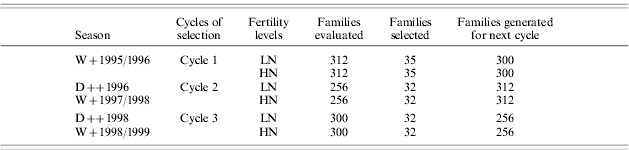
The method of rank summation selection index described by Edmeades et al. (Reference Edmeades, Bolanos, Chapman, Lafitte and Bänziger1999) was used in the selection process to facilitate the identification of the superior families for recombination for the next cycle as well as to maximize gain from selection. Three cycles of full-sib recurrent selection were completed in this population. The experimental details during cycles of selection are summarized in Table 1.
Evaluation and selection process during each cycle of selection
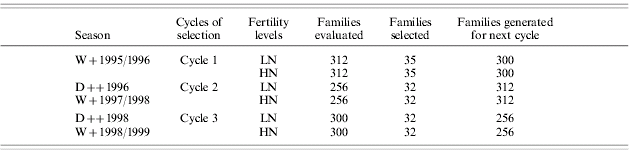
W+, field evaluation at Samaru cropping season: D++, dry season planting at Ibadan to recombine selected families and generation of new families.
Site and experimental design
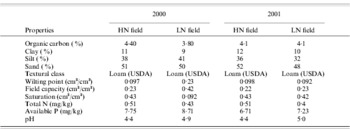
The study was conducted in 2000 and 2001 at the LN screening site of the IAR Research farm, Samaru (11°11′N; 07°38′E; 686 m asl) in the northern Guinea savannah agro-ecological zone of Nigeria. The soil at the experimental site is a fine loamy, isohyperthemic Plinthustalf; United States Department of Agriculture (USDA) taxonomy. The experimental field was divided into two blocks (HN block: 90 kg N/ha; LN block (N deficient): 30 kg N/ha). To avoid N spillover, each of the N levels was considered a separate field trial planted adjacent to one another. The LN field had been depleted of N for two cropping seasons by planting maize at high densities without N fertilizer and by cutting and removing the biomass after each crop season. Soil samples were taken before land preparation at the 0–20 cm horizons for characterization. The physicochemical properties of the soils at the experimental site are presented in Table 2.
Physiochemical characteristics of the soils of the experimental site at the beginning of each cropping season

HN block refers to blocks supplied with 90 kg N/ha while LN block refers to blocks supplied with no N fertilizer or 30 kg N/ha. The critical soil N level is 0·02, below which the soil is said to be deficient in available N. The results of the soil chemical analysis above indicate that the soil at the experimental site is deficient in both organic matter and available N.
In each block (for each N level), treatments were the cycles grown under two rates of N level (30 and 90 kg N/ha). The experiments were laid out in a randomized complete block design with three replications. Each plot consisted of four rows, 5 m in length with spacing of 0·75 m between rows and 0·25 m between plants to give a plant population of 53 333 plants/ha. Fields were planted on 27 June in 2000 and 29 June in 2001. At planting, P in the form of single superphosphate and K as muriate of potash were applied at the rate of 60 and 40 kg/ha, respectively; N in the form of urea was applied in two equal splits. Half was applied 1 week after planting (WAP) and the other half at 5 WAP. Weeds were controlled manually at 2 and 6 WAP.
Measurement
Data were collected from the two central rows, leaving the outside rows and first plants at the beginning of each row to serve as borders. Days from sowing to half the pollen shed (anthesis date) and to half the silk exerted (silking date) were recorded and ASI was calculated as the interval in days between half the silk exerted and half the pollen shed. Plant and ear heights were determined approximately 2 weeks after anthesis. Stay-green scores were recorded in the N-deficient plots on a scale of 1–9; where 1=almost all leaves below the ear were green and 9=virtually all leaves below the ear were dead.
At harvest, 10 competitive plants per plot were sampled and partitioned into leaves, stems, and ears and the components were oven dried at 60°C for 76 h to determine dry matter accumulation. Grain yield was recorded for 26 plants harvested from the two central rows of each plot (4·7 m2), excluding the end plants of each row. The total number of plants and ears were counted in each plot at the time of harvest. The number of ears per plant was then calculated as the total number of ears at harvest divided by the total number of plants harvested. Ears harvested from each plot were shelled and the percentage grain moisture was determined using a Dickey-John moisture tester (Model 14998, Dickey-John Corporation, Auburn, USA). Grain yield adjusted to 120 mg/g moisture was computed from the shelled grain.
Determination of total plant N
The aboveground biomass and grain at harvest were dried, milled, and analysed for total N content by calorimetric analysis using a technicon autoanalyser (Model 154–71W, Technicon Instrument Corporation, Tarry Town, New York). N uptake was determined by multiplying the dry weight of plant parts by N concentration and summing over parts for total plant uptake. After the determination of total N concentration, the two primary components of NUE, the efficiency with which the N is absorbed (N uptake efficiency) and the efficiency with which the absorbed N is utilized to produce grains (N utilization efficiency) were calculated using the procedure described by Moll et al. (Reference Moll, Kamprath and Jackson1982).
Theory
NUE is defined as grain production per unit of N available in the soil and NUE is Gw/Ns, in which Gw is grain weight and Ns is N supply expressed in the same units (e.g. g/plant). There are two primary components of NUE: (1) N uptake and (2) N utilization efficiency. N uptake efficiency refers to the quantity of N absorbed by the plant relative to the available soil N, while N utilization efficiency quantifies the amount of grain produced per unit of N uptake. These are expressed as follows: N uptake efficiency=Nt/Ns and N utilization efficiency=Gw/Nt, where Nt is total N in the plant at physiological maturity.
Therefore, NUE was calculated as:

where Nt=the total N in aboveground biomass; Ns=N applied; Gw=grain yield per plant.
Statistical analysis
The general linear model procedure (GLM) of the Statistical Analysis Systems (SAS) Package (SAS 1990) was used to analyse the data. Cycles were considered as fixed effects while year was a random effect. The linear additive models used for individual year and for the 2 years combined are presented below.
For individual year, the linear statistical model used was:

where Y ij=the observation made in the ith block on the jth population (cycles); μ=population means; G j=effect of the jth cycle of selection; R i=effect of the ith block.
The linear statistical model used for the 2 years combined was:

where Y ijk=the observation made in the jth replication of the ith year on the kth population (cycle of selection); μ=population means; y i=the effect of the ith year; R(Y)ij=the effect of the jth replication within the ith year: j=1, 2, 3, 4; i=1, 2; G k=the effect of the kth cycles of selection; k=1, 2, 3; (Gy)ik=effect of the interaction of the kth cycles of selection with the ith year; εijk=components of error effect due to sampling among the cycles in the years (random error).
Means were obtained on entry basis from the cycles. Simple correlation coefficients were calculated to detect the relationship between NUE traits measured with grain yield.
Rate of change per cycle was calculated using the linear regression model:

where Y i=observed means over cycles of selection; μo=mean of original population (C1 was used as the base population); βi=linear regression coefficient; X i=cycles of selection.
RESULTS
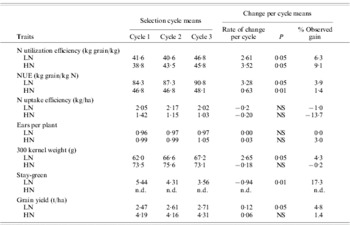
The mean performance of the populations from the three cycles of full-sib recurrent selection in respect of grain yield and other agronomic traits is presented in Table 3. The effects of N rates were significant (P<0·05) for differences in grain yield, 300 kernel weight, N utilization efficiency, and NUE. Cycle 3 of the population showed a significantly lower value (P<0·01) for stay green compared with cycle 1 and cycle 2 at LN (Table 3).
Observed gain per selection cycle for grain yield and other agronomic traits from three cycles of full-sib recurrent selection under LN and HN at Samaru in 2000 and 2001

NS=not significant.
n.d.=no data. Stay-green rating was not taken under HN, since it was not important.
A reduction in grain yield was observed at LN compared with HN [1−(grain yield at LN/grain yield HN)×100], ranging from 41% in cycle 1 to 37% in cycle 3. At LN, significant higher mean yields of the cycle 3 than the cycle 1 were recorded. However, the cycle 3 did not differ significantly from the cycle 1 at HN. Although the grain yield increased with cycles of selection at LN and HN with cycle 3 having the highest yields, the N response of cycle 3 for grain yield at HN was 32% greater than the yield in cycle 3 at LN (1·6 t).
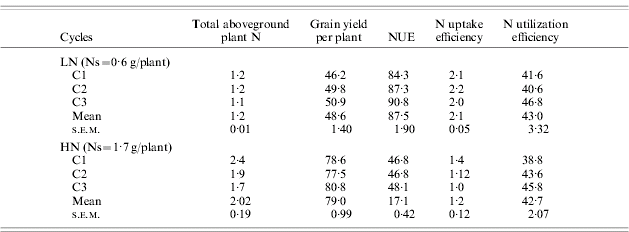
The increase of N uptake at LN was almost twice that of N uptake at HN. A similar trend was observed for N utilization efficiency. Higher N utilization efficiency was observed at LN than at HN (Table 4). In contrast, the average value for total aboveground plant N was higher at HN than at LN, and the largest difference was observed in cycle 1. For N utilization efficiency, no significant differences between the mean values of the cycle's groups could be detected, though the cycle 3 seems to perform better at LN, and the N utilization efficiency of the cycle 2 population was superior at HN (Table 4).
Mean of NUE traits from three cycles of full-sib recurrent selection at two levels of N at Samaru in 2000 and 2001
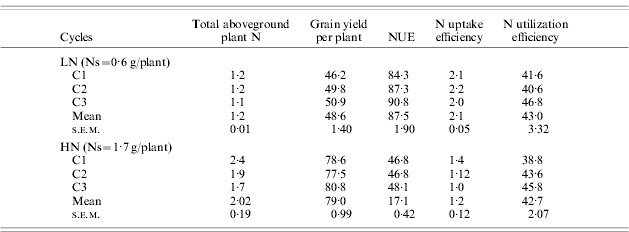
Ns=fertilizer N applied.
The total N uptake by cycle 3 at LN was increased with increasing N rates, whereas the NUE decreased (Table 4). At each N rate, the N uptake by cycle 3 was lower while NUE values were higher. N uptake rate was faster at LN than at HN as indicated by the higher values obtained at LN, though there appeared to be less variation in the two levels of N applied (Table 4).
There was considerable variation in N utilization efficiency among cycles at both LN and HN levels. At LN conditions, considerable variation among cycles was observed for grain yield, 300 kernel weight, N utilization efficiency, N uptake efficiency, and stay-green rating. The observed gain from selection cycles for grain yield was 120 kg/ha/cycle at LN and 60 kg/ha/cycle at HN, corresponding to gains of about 4·8% per cycle at LN and 1·4% per cycle at HN levels (Table 3). The analysis of variance did not find significant cycle×N interaction for all the traits recorded in this experiment (data not shown). Mean grain yield at LN ranged from 2500 kg/ha in cycle 1 to 2700 kg/ha in cycle 3 and from 4200 kg/ha in cycle 1 to 4300 kg/ha in cycle 3 at HN. The mean of cycle 3 was higher than that of cycle 1 and cycle 2 in respect of the traits measured at both N levels, which is an indication of an improvement over cycle 1. The grain yield of cycle 3 was higher than those of cycle 2 and cycle 1 but the differences were not significant at HN. NUE traits were affected by selection cycles (Tables 3 and 4). The cycle 3 had higher values than cycle 2 and cycle 1 with respect to NUE and N utilization efficiency at both N levels. However, the variations in NUE in terms of its components appear to differ between levels of N supplied and among cycles.
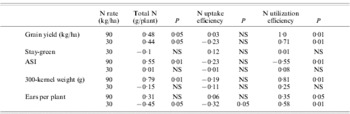
The coefficient of phenotypic correlation between grain yield and N uptake efficiency at HN (r=0·03) and LN (r=−0·23) was not significant (Table 5). Correlation between grain yield and N utilization efficiency was positive and significant at both N levels (Table 5). Similarly, the correlation between N utilization efficiency and ears per plant was positive and significant. The relationship was stronger at LN than at HN. ASI was significantly and negatively correlated with N utilization efficiency at HN.
Correlation of agronomic traits with components of NUE for 3 cycles of maize populations evaluated under LN and HN levels at Samaru, Zaria, Nigeria, in 2000 and 2001

NS=not significant.
DISCUSSION
The average grain yield recorded in the current experiment at LN ranged from 2500 kg/ha in cycle 1 to 2700 kg/ha in cycle 3 at LN and 4200 kg/ha in cycle 1 to 4300 kg/ha in cycle 3 at HN. The appreciable change in the means over successive cycles indicates that there is scope for improvement. The results showed that selection under N-stressed conditions may result in greater gain than selection under non-stressed conditions. The average grain yield recorded in this experiment at LN compared with HN [(1−grain yield LN/grain yield HN)×100] was 63%. Selection for improved performance under LN significantly increased grain yield at LN as compared to HN. The positive gains observed for grain yield and other traits at LN suggest that some favourable yield factors have been accumulated through the full-sib recurrent selection method. This indicates that changes in gene frequencies in the cycles had occurred. The gain under LN compared favourably with the gains of 100–250 kg/ha/cycle reported under LN by other workers (Lafitte & Edmeades Reference Lafitte and Edmeades1994a; Lafitte & Bänziger Reference Lafitte, Bänziger, Edmeades, Bänziger, Mickelson and Pena-Valdivia1997; Bänziger & Cooper Reference Bänziger and Cooper2001).
A significant positive change was also observed for NUE and N utilization efficiency at both N levels, while the means of stay-green rating and grain yield were positively affected at LN. It has been known that stay-green ability is strongly regulated by genetic factors in addition to the environment (Pierce et al. Reference Pierce, Knowles and Phillips1984; Walulu et al. Reference Walulu, Rosenow, Wester and Nguyen1994). Large differences were found for this trait between the three cycles at LN. Stay-green significantly improved by 0·9 per cycle (17% per cycle), and ASI reduced by −0·4 (10% per cycle) although this was not significantly affected at LN. Similar results have been reported by Lafitte & Edmeades (Reference Lafitte and Edmeades1994a), Walulu et al. (Reference Walulu, Rosenow, Wester and Nguyen1994), Bänziger & Lafitte (Reference Bänziger, Lafitte, Edmeades, Bänziger, Mickelson and Pena-Valdivia1997) and Sallah et al. (Reference Sallah, Ehike, Geadelmann, Edmeades, Bänziger, Mickelson and Pena-Valdivia1997). These researchers found significant changes in stay-green rating, ASI, and ears/plant.
Variations in total N accumulation, relative to variation in N uptake efficiency, N utilization efficiency, and NUE, were in sharp contrast to levels of N applied (30 and 90 kg N/ha.). Under LN, higher N utilization efficiency and NUE were observed. The relative contribution of the two component traits, N uptake and N utilization efficiency, to variation in efficiency among the cycles was considerably different for the two levels of N applied. At LN, N uptake efficiency was small, and the variation was also relatively small. Therefore, variation in N uptake efficiency contributed very little to variation in NUE among the populations. This is in sharp contrast to its substantial contribution to variation at HN.
The good adaptation of the cycles to LN conditions was attributed to improved N utilization efficiency. Conversely, Muruli & Paulsen (Reference Muruli and Paulsen1981) found no difference between HN and LN syntheses in N uptake efficiency. Improved adaptation of the population to LN conditions could have resulted from increased N utilization efficiency, whereas adaptation to HN was caused by an increase in both N uptake and N utilization efficiency. Lafitte & Edmeades (Reference Lafitte and Edmeades1994a), Moll et al. (Reference Moll, Kamprath and Jackson1982), and Kamara et al. (Reference Kamara, Kling, Ajala and Menkir2002) also found that N utilization efficiency played a dominant role in determining grain yield at LN. Almost equal contributions of both components were reported by Kamprath et al. (Reference Kamprath, Moll and Rodriguez1982), Moll et al. (Reference Moll, Kamprath and Jackson1987) and Gallais & Hirel (Reference Gallais and Hirel2004); averaged across two N levels.
In the present study, N utilization efficiency and NUE were observed to be good criteria for differentiating between cycles of selection for good adaptation to a LN environment; N uptake efficiency proved to be of little value for differentiating population development for NUE. Similar results have been reported by Moll et al. (Reference Moll, Kamprath and Jackson1982). This result was, however, in contrast to the findings of Lafitte & Edmeades (Reference Lafitte and Edmeades1994a) who found N uptake efficiency and NUE to be most useful in differentiating between genotypes. Also, variations in NUE in terms of its components appear to differ between levels of N supplied and among cycles. Variations in total N accumulation, relative to variation in N uptake efficiency, N utilization efficiency, and NUE, were in sharp contrast between levels of N applied. Under LN, higher N utilization efficiency and NUE were observed compared to HN although each of the cycles accumulated more N under HN than under LN. This was probably due to the high rate of N applied, which led to the abundance of N within the root zone but with no evidence of HN uptake efficiency. Conversely, the HN uptake efficiency under LN implies that at a moderate N level, the maize plant tends to develop a massive root system which enables it to take more N from the different soil layers. Similar findings have been reported in several other maize populations by Moll et al. (Reference Moll, Kamprath and Jackson1982, Reference Moll, Kamprath and Jackson1987), Lafitte & Edmeades (Reference Lafitte and Edmeades1994b) and Kamara et al. (Reference Kamara, Menkir, Ajala and Kureh2005). Higher N utilization efficiency and NUE values were obtained under LN than under HN. The possible explanation for these differences could be that the high amount of N remobilized from storage in vegetative tissues which was efficiently utilized during grain production. Germplasm tolerant to LN is known to have a lower rate of leaf senescence and a longer grain filling period which help in maintaining a balance between carbohydrate assimilation and photosynthesis. This, in part, helps to maintain growth and productivity under conditions where soil N is severely limiting.
In the present investigation, coefficients of correlation of NUE and N utilization efficiency to grain yield were positive. Under LN, grain yield, ears/plant, and 300 kernel weight had significant and positive correlations with N utilization efficiency. This result corroborates the findings of Lafitte & Edmeades (Reference Lafitte and Edmeades1994a, Reference Lafitte and Edmeadesb) and Presterl et al. (Reference Presterl, Groh, Landbeck, Seitz, Schmidt and Geiger2002), which show a strong correlation between N utilization efficiency and grain yield under conditions of limited N supply. Bänziger & Lafitte (Reference Bänziger, Lafitte, Edmeades, Bänziger, Mickelson and Pena-Valdivia1997) and Kling et al. (Reference Kling, Heuberger, Oikeh, Akintoye, Horst, Edmeades, Bänziger, Mickelson and Pena-Valdivia1997) also found a significant positive correlation between grain yield and ears per plant. N utilization efficiency was more important than N uptake efficiency under LN. The significant positive correlation between grain yield and N utilization efficiency also corroborated the earlier findings of Moll et al. (Reference Moll, Kamprath and Jackson1982). From the present study, it appears that a maize population with greater N utilization efficiency has the ability to maintain photosynthesis. This, in part, helps to maintain growth and productivity under conditions where soil N is limiting (Maranville & Madhavan Reference Maranville and Madhavan2002). This result is, however, is in contrast to those of Lafitte & Edmeades (Reference Lafitte and Edmeades1994a, Reference Lafitte and Edmeadesb), who reported that N uptake efficiency was more important than N utilization efficiency. In the present study, N uptake efficiency had a negative but non-significant correlation with grain yield (r=−0·23). This result agrees with the earlier findings of Kling et al. (Reference Kling, Heuberger, Oikeh, Akintoye, Horst, Edmeades, Bänziger, Mickelson and Pena-Valdivia1997) but is in contrast to that reported by Lafitte & Edmeades (Reference Lafitte and Edmeades1994a). Under LN, the correlation between N utilization efficiency and N uptake efficiency was positive and significant. This indicates that variation in N uptake efficiency contributed very strongly to variation in N utilization efficiency in the cycles of selection. Therefore, both components can be improved indirectly when selecting for grain yield at LN. However, N uptake efficiency contributed very little to variation in N utilization efficiency at HN. Thus, it seems that selection at HN would result in the improvement of only one trait of the components of NUE at the expense of the other. Total aboveground N in plants was significant and negatively correlated with N utilization efficiency under LN, indicating that selection for high total N accumulation will lead to a decrease in N utilization efficiency, although this was in sharp contrast to its association with yield under HN.
The results obtained confirmed that a maize population can become specifically adapted to environments with a reduced input of N, as indicated by the good performance of the maize populations, not only at LN but also at HN. Therefore, selection during population development should be carried out in both LN and HN conditions. Because of the linear cycle's response to the two N levels, the greatest gain in adaptation could be expected if selection is carried out at LN, even if the target area is expected to show only moderate N deficiency. The use of NUE and N utilization efficiency in addition to constructing selection indices in discriminating population for adaptation to a LN environment as proposed by Moll et al. (Reference Moll, Kamprath and Jackson1982) seems desirable. Therefore, selection for increased N utilization efficiency in combination with desirable secondary traits would be the avenue to address the adaptation of a maize population to an environment with LN availability.
An acknowledgement is due to Dr J. G. Kling at the International Institute of Tropical Agriculture (IITA) for providing the populations used in the study. Financial support for this study was provided by the IITA/African Maize Stress (AMS) project through the West and Central Africa Maize Network (WECAMAN).