Introduction
Chemical compounds play an important role in life of organisms. They are involved in almost every behaviour and physiological responses related to the location of resources as food, mates and oviposition sites (Dicke & Sabelis, Reference Dicke and Sabelis1988; Vet & Dicke, Reference Vet and Dicke1992; Vet, Reference Vet1999; Dicke & Grostal, Reference Dicke and Grostal2001). The infochemicals are a particular group of chemical compounds that convey information between individuals, which are involved in interactions among individuals of the same (pheromones) or different species (allelochemicals) (Dicke & Sabelis, Reference Dicke and Sabelis1988). Allelochemicals are very important cues used by predators and parasitoids to locate preys in a complex context (Vet & Dicke, Reference Vet and Dicke1992; Godfray, Reference Godfray1994; Stowe et al., Reference Stowe, Turlings, Loughrin, Lewis and Tumlinson1995; Bottrell & Barbosa, Reference Bottrell and Barbosa1998). According to the sources, they are produced directly by prey or indirectly mainly by host plants of herbivorous preys and products derived from prey activities (Lewis & Martin, Reference Lewis and Martin1990; Vet & Dicke, Reference Vet and Dicke1992; Godfray, Reference Godfray1994; Stowe et al., Reference Stowe, Turlings, Loughrin, Lewis and Tumlinson1995; Vet et al., Reference Vet, Lewis, Cardé and Bell1995; Bottrell & Barbosa, Reference Bottrell and Barbosa1998; De Moraes et al., Reference De Moraes, Lewis and Tumlinson2000; Steidle & van Loon, Reference Steidle and van Loon2003). Products of prey activities are weak signals rather than host plants of prey, but they are the most reliable source of allelochemicals that can inform to predators on the presence, identity, density, availability and suitability of the prey (Vet et al., Reference Vet, Wäckers and Dicke1991; Vet & Dicke, Reference Vet and Dicke1992; Stowe et al., Reference Stowe, Turlings, Loughrin, Lewis and Tumlinson1995). For the allelochemicals produced directly from the prey, several sources have been identified: faeces, cuticle, exuviae, honeydew, body scales, hemolymph or body secretions (Vet et al., Reference Vet, Wäckers and Dicke1991; Vet & Dicke, Reference Vet and Dicke1992; Stowe et al., Reference Stowe, Turlings, Loughrin, Lewis and Tumlinson1995).
Pheromones serve as good indicators of the presence of an individual of a species and are involved in behaviours such as aggregation, mate or host location (Dicke & Sabelis, Reference Dicke and Sabelis1988; Stowe et al., Reference Stowe, Turlings, Loughrin, Lewis and Tumlinson1995; Wertheim, Reference Wertheim2005; Wertheim et al., Reference Wertheim, van Baalen, Dicke and Vet2005). Since pheromones mediate the communication between conspecifics, they might be an important source of information for predators and parasitoids that can benefit from exploiting this communication system (Aldrich, Reference Aldrich, Cardé and Bell1995; Stowe et al., Reference Stowe, Turlings, Loughrin, Lewis and Tumlinson1995; Wertheim, Reference Wertheim2005; Wertheim et al., Reference Wertheim, van Baalen, Dicke and Vet2005).
Within dipteran parasitoids, pheromones are mainly used as cues in location of hosts (Aldrich, Reference Aldrich, Cardé and Bell1995; Stowe et al., Reference Stowe, Turlings, Loughrin, Lewis and Tumlinson1995; Feener Jr & Brown, Reference Feener and Brown1997; Stireman III et al., Reference Stireman III, O'Hara and Monty Wood2006). Moreover, several egg, larval and pupal parasitoids in this group actually use pheromones produced by adults to locate the immature host stages. This strategy is a solution to the reliability-detectability problem, called the ‘infochemical detour’ (Vet & Dicke, Reference Vet and Dicke1992; Wiskerke et al., Reference Wiskerke, Dicke and Vet1993). Particularly, this searching strategy is relevant in those dipteran parasitoids that have a split host location strategy with an active larval stage performing the final location and parasitism of the host (Eggleton & Belshaw, Reference Eggleton and Belshaw1992, Reference Eggleton and Belshaw1993; Godfray, Reference Godfray1994; Feener Jr & Brown, Reference Feener and Brown1997; Brodeur & Boivin, Reference Brodeur and Boivin2004). Parasitoids with this host location strategy must use reliable cues, such as pheromones, to find them efficiently given their mobility and the potential time-limitation (Brodeur & Boivin, Reference Brodeur and Boivin2004). The use of host-reliable cues enhances the efficiency in host finding and consequently increases the fitness on time-limited parasitoids (Vet et al., Reference Vet, Wäckers and Dicke1991; Wajnberg et al., Reference Wajnberg, Bernhard, Hamelin and Boivin2006). However, there are few studies dealing specifically with the origin of the pheromones used as cues by the active larval stage in the host-seeking behaviour (Coulibaly & Fanti, Reference Coulibaly and Fanti1992). One of the possible sources of the production is the tissue or the cells that are involved in the production of aggregation or sexual pheromones (Leal, Reference Leal1998; Tillman et al., Reference Tillman, Seybold, Jurenka and Blomquist1999; Ma & Ramaswamy, Reference Ma, Ramaswamy, Blomquist and Vogt2003; Wyatt, Reference Wyatt2003). There is much variability in the anatomic location of this tissue, but the abdomen appears to be the most common location for Blattodea, Coleoptera and Lepidoptera (Leal, Reference Leal1998; Tillman et al., Reference Tillman, Seybold, Jurenka and Blomquist1999; Ma & Ramaswamy, Reference Ma, Ramaswamy, Blomquist and Vogt2003). The other source of pheromone production is the microorganisms that live in virtually every insect (Hoyt et al., Reference Hoyt, Osborne and Mulcock1971; Byers & Wood, Reference Byers and Wood1981; Dicke, Reference Dicke, Barbosa and Letourneau1988). There are microorganisms that are strictly dependent on their hosts and others that can live freely. The location of these microorganisms in the host varies with the species it is associated with (Hoyt et al., Reference Hoyt, Osborne and Mulcock1971; Byers & Wood, Reference Byers and Wood1981; Dicke, Reference Dicke, Barbosa and Letourneau1988).
Mallophora ruficauda Wiedemann (Diptera: Asilidae) is a robber fly endemic to the Pampas region of Argentina that inhabits open grasslands near bee farms (Rabinovich & Corley, Reference Rabinovich and Corley1997). As an adult, M. ruficauda feeds mainly on foraging honeybees and other flying insects; and, as larva, is an ectoparasitoid of the third instar larvae of Cyclocephala signaticollis Burmeister (Coleoptera: Scarabaeidae), which are commonly known as white grubs. Females oviposit on tall grasses or artificial supports, such as wire fences, laying egg-clutches covered by albumin (Copello, Reference Copello1922; Castelo & Corley, Reference Castelo and Corley2004; Castelo et al., Reference Castelo, Ney-Nifle, Corley and Bernstein2006). After hatching, larvae are dispersed by the wind, falling to the ground, where they start to dig searching for their host (Castelo & Capurro, Reference Castelo and Capurro2000; Castelo et al., Reference Castelo, Ney-Nifle, Corley and Bernstein2006). Particularly, it is the second instar larva of M. ruficauda that performs an active searching of the hosts (Crespo & Castelo, Reference Crespo and Castelo2008). According to the biology of the hosts, females of C. signaticollis lay isolated eggs in the soil, walking some distance after each oviposition (López et al., Reference López, Alvarez Castillo, Carmona, Manetti and Vincini1994). After hatching, first instar larvae feed on organic material; and, in the next stadium, they feed on turfgrass and roots of a great variety of plants, consuming a lot of vegetable food (Alvarado, Reference Alvarado1980). To find the plants, beetle larvae have to move into the soil and, when the temperature is stable, tend to remain in the upper root zone (Villani & Wright, Reference Villani and Wright1990). During winter, a seasonal pattern of vertical movement apparently associated with soil temperature has been documented in several species of scarab grubs (Villani & Wright, Reference Villani and Wright1990).
Previous works have demonstrated that the sources of the infochemicals involved in this system are associated with the digestive tube of the third instar larva of C. signaticollis (Castelo & Lazzari, Reference Castelo and Lazzari2004; Crespo & Castelo, Reference Crespo and Castelo2008). Nevertheless, the precise anatomic location where these infochemicals are produced is unknown. It is also unknown whether these infochemicals mediate any behaviour of C. signaticollis larvae. Previous studies indicate that there are two possible anatomical locations where the allelochemicals might be present: glandular tissues or symbiotic microorganisms inside the digestive tube. According to the morphology and histology of the digestive tube, both hypotheses are valid (Hoyt et al., Reference Hoyt, Osborne and Mulcock1971; Bauchop & Clarke, Reference Bauchop and Clarke1975; Byers & Wood, Reference Byers and Wood1981; López-Guerrero & Morón, Reference López-Guerrero and Morón1990; Cazemier et al., Reference Cazemier, Hackstein, Op den Camp, Rosenberg and van der Drift1997; Egert et al., Reference Egert, Stingl, Bruun, Pommerenke, Brune and Friedrich2005).
In the present work, we study some aspects of the chemical ecology of the host-parasitoid system composed by C. signaticollis (the host) and M. ruficauda (the parasitoid). The aims of this work were to determine: (i) which part of the posterior intestine of C. signaticollis is associated to the attractive chemicals for M. ruficauda larvae, and (ii) if the chemicals attractive to M. ruficauda larvae mediate behaviours in C. signaticollis larvae. For this study, we analyze, by means of behavioural experiments, how the display of different stimuli extracted from body parts of the host affects differentially the orientation response of M. ruficauda larvae. We also examine the orientation response of white grub individuals using the same stimuli that were used with M. ruficauda. We expect that M. ruficauda use host infochemicals mediating conspecific interaction between individuals of C. signaticollis as a cue for finding them, when both species show an orientation response towards the same stimulus extract.
Materials and methods
In order to determine both the anatomic production site and whether the infochemicals that mediate the orientation behaviour of M. ruficauda larvae also mediate any behaviour of C. signaticollis larvae, we used second-instar larvae of M. ruficauda and third-instar larvae of C. signaticollis in binary choice tests using different C. signaticollis stimuli.
Experimental conditions
Experiments on M. ruficauda were conducted during January–March 2009 under laboratory conditions (25.7±1.6°C, 60.0±5% RH), in days with atmospheric pressure between 1012 and 1020 mbar. For the C. signaticollis experiments, the tests were made in July–August 2008 under laboratory conditions (22.5±1.3°C, 63.0±15% RH) under atmospheric pressure values between 1005 and 1024 mbar.
Since environmental conditions influence behaviour of insects (Roitberg et al., Reference Roitberg, Sircom, Roitberg, van Alphen and Mangel1993; Amat et al., Reference Amat, Castelo, Desouhant and Bernstein2006), pressure and temperature ranges under which the experiments with M. ruficauda and C. signaticollis larvae were performed were those in which insects had shown an orientation behaviour in previous experiments (Castelo & Lazzari, Reference Castelo and Lazzari2004; Crespo & Castelo, Reference Crespo and Castelo2008; Crespo, Reference Crespo2011). In order to keep the experimental conditions similar to natural conditions, all experiments were carried out in darkness, because both insect species in these instars live underground.
In order to guarantee the occurrence of behavioural responses, we used experimental extracts of the host, equivalent to 2.5 white grubs ml–1 hexane, for experiments with M. ruficauda larvae, which is more than double the concentration used by Castelo & Lazzari (Reference Castelo and Corley2004). For experiments with C. signaticollis larvae, we used experimental extracts of one white grub ml–1 hexane to ensure behavioural responses of individuals (Castelo, Reference Castelo2003).
Insects
Larvae of M. ruficauda were reared in the laboratory from egg-clusters collected in January–March 2009 on grasslands in Pilar (34°28′S, 58°55′W) and Moreno (34°46′S, 58°93′W), two localities with apiculture activity, in Buenos Aires province, Argentina. In the field, egg-clusters were carefully cut off from their support and were kept individually in Falcon-type tubes until larvae were hatched. In the laboratory, after hatching, the neonate larvae were separated individually in Eppendorf-type tubes with a moistened piece of filter paper as substrate, to keep humidity inside the tube at 100%. Tubes were stored in darkness and at room temperature in the laboratory between 18.6–29.8°C. When the larvae reached the second instar and were 22 to 25 days old, they were used to perform the behavioural experiments.
Scarab larvae were collected at soil depth of 0.30 m in grasslands of Pilar, Mercedes (34°40′S, 59°26′W) and Nuñez (34°32′S, 56°26′W) localities, in Buenos Aires province, Argentina, from May to August 2008. Third-instar larvae of C. signaticollis were identified using the taxonomic key of Alvarado (Reference Alvarado1980), which is based on the morphology of the raster. Cyclocephala signaticollis individuals were maintained individually in the laboratory at room temperature (18.6–29.8°C) in black tubes (30 ml) filled with soil and were fed weekly with pieces of fresh carrots.
Extraction of C. signaticollis stimuli
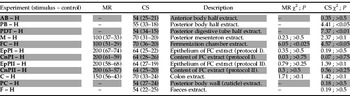
Host stimuli used along the experiments were obtained from different body portions of third instar larvae of C. signaticollis, following the protocols used by Castelo & Lazzari (Reference Castelo and Corley2004) and Crespo & Castelo (Reference Crespo and Castelo2008). Immediately after collection, larvae of C. signaticollis were dissected in several parts, and each body portion was homogenized using hexane as solvent, obtaining an extract with the host infochemicals. A list of stimuli extracts tested in experiments with M. ruficauda and C. signaticollis individuals used as experimental individuals are shown in fig. 1. Each type of extract was made only once, and a fraction of the same vial was offered to both insects in the experiments in due time. To determine whether the infochemicals used by M. ruficauda in the orientation to C. signaticollis individuals mediate any behaviour in the host, we tested the same body portions utilized in Castelo & Lazzari (Reference Castelo and Lazzari2004) but with the host as experimental individual: anterior body half (AB), posterior body half (PB), posterior body wall (cuticle) (PC), posterior half of the digestive tube (PDT), faeces (F).
Regions of the body of C. signaticollis larvae from which extracts were used in behavioural assays throughout the experiments. MR – Castelo & Lazzari (Reference Castelo and Lazzari2004) indicates previous studies where some of these extracts were tested on M. ruficauda larvae.

Castelo & Lazzari (Reference Castelo and Lazzari2004) determined that the origin of the chemical cues linked to the orientation behaviour of M. ruficauda is in the posterior half of the digestive tube of the host. In order to find the specific structure that produces the infochemicals, host extracts were made by dividing the last part of the digestive tube in three portions: posterior mesenteron (M), fermentation chamber (FC) and colon (C). Also, in other experimental series, the content of the posterior digestive tube was separated from the epithelium, to determine if the cue is produced by the gut tissues of the fermentation chamber (López-Guerrero & Morón, Reference López-Guerrero and Morón1990) or by the presence of symbionts in the tract (Chapman, Reference Chapman1998). We used two protocols to carry out the extraction of the stimuli of both parts of the gut. In the first protocol, the content of the digestive tube was separated from the epithelium, and the content was homogenized using hexane as solvent. Then, the tissue was washed with distilled water and then homogenized with hexane. For the second protocol, the epithelium was treated as previously, but the chemical cues present in the content of the fermentation chamber were obtained by a solvent extraction using a separating funnel. This technique allowed us to separate the chemical cues from the whole content of the fermentation chamber, dissolving their content in two immiscible liquids (hexane-water). Due to being nonpolar compounds (Castelo & Lazzari, Reference Castelo and Lazzari2004), these substances were extracted in a nonpolar solvent fraction (hexane).
Responses of individuals to host/conspecific stimuli
Experiments to determine the behavioural responses of the insects were performed using similar experimental arenas as in Castelo & Lazzari (Reference Castelo and Lazzari2004). We divided the arenas into three equally sized zones (one middle and two laterals) along the long axis. On each lateral zone of the arena, a piece of filter paper impregnated with a volume of either the stimulus or the control extract was placed. At the beginning of each trial, an individual was released at the centre of the arena and allowed to move freely. After a time of experimentation, its position in the arena was recorded. In this way, three possible responses could be obtained: choice for the stimulus (S), for the control (C) or no decision (ND) if the individual remained in the middle zone. After every trial, each individual was discarded and the arena was cleaned with soap and water, and then dried with an air current in order to eliminate possible larval odours. Experimental design and number of replicates for each experiment is detailed in table 1.
Olfactometer experiments carried out to evaluate the response of M. ruficauda and C. signaticollis larvae to odours from different parts of the body of third instar C. signaticollis larvae.

Responses of M. ruficauda to host stimuli
Behavioural experiments with M. ruficauda were carried on in an arena of 9×6×1 cm using a piece of filter paper of 1×2 cm impregnated with 10 μl of either the stimulus or the control extract. In each trial, an individual larva was released as experimental individual at the centre of the arena, and after 90 min of experimentation, its position in the arena was recorded (table 1).
Responses of C. signaticollis to conspecific stimuli
For behavioural experiments with C. signaticollis, we carried out trials with an arena of 13×8×2 cm. In each lateral side of the experimental arena, a filter paper of 2×3 cm impregnated with 40 μl of stimulus or control extract was presented. An individual larva was released at the centre of the arena in each trial as experimental individual; and, after 45 min of experimentation, its position in the arena was recorded (table 1).
Statistical analysis
In the experiments, we tested the influence of C. signaticollis stimuli on the orientation behaviour of both M. ruficauda larvae and C. signaticollis larvae. In both orientation experiments, preference of insects for either side of the experimental arena (stimulus or control) was tested against a random distribution by means of χ2 tests of goodness of fit (one-way contingency table analysis: Sokal & Rohlf, Reference Sokal and Rohlf1969; Zar, Reference Zar1984; Rosner, Reference Rosner1995). Individuals that remained in the middle zone of the arena (no decision response) were excluded from the analysis.
Results
Responses of M. ruficauda to host stimuli
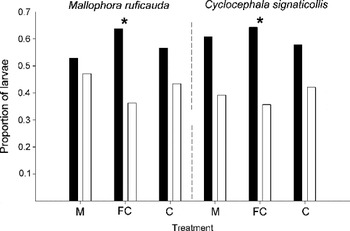
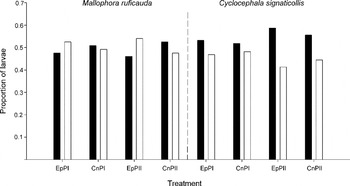
When second instar larvae of M. ruficauda were exposed to C. signaticollis third instar larvae odours, experiments revealed that the infochemicals that evoke the positive orientation behaviour of M. ruficauda toward the host are associated to the fermentation chamber (table 1, fig. 2). However, larvae distributed at random in the experimental arena when they were exposed to extract of both epithelium and content of the fermentation chamber of its host treated with any of both protocols (table 1, fig. 3). These results did not allow us to determine the precise biosynthesis origin of the infochemicals used by the larvae of M. ruficauda during the host-seeking behaviour.
Response of M. ruficauda and C. signaticollis to stimuli from three regions of the posterior digestive tube of third instar larvae of C. signaticollis. Asterisks denote statistically significant differences (χ2, P<0.05). M, posterior mesenteron; FC, fermentation chamber; C, colon (▪, Stimulus; □, Control).

Response of M. ruficauda and C. signaticollis to stimuli extracted from two regions of the fermentation chamber of third instar larvae of C. signaticollis. EpPI, epithelium protocol I; CnPI, content protocol I; EpPII, epithelium protocol II; CnPII, content protocol II (▪, Stimulus; □, Control).

Responses of C. signaticollis to conspecific stimuli
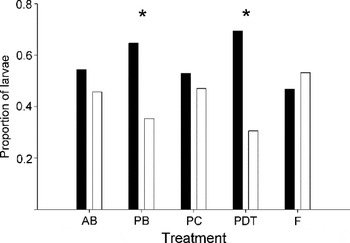
We found that C. signaticollis larvae showed a positive orientation response towards the extract of the posterior body half of conspecifics, particularly towards of the posterior digestive tube half (table 1, fig. 4). These portions of the host body are the same as those that induced the positive orientation behaviour of the larvae of M. ruficauda demonstrated by Castelo & Lazzari (Reference Castelo and Lazzari2004).
Response of C. signaticollis to stimuli extracted from the different body parts of conspecifics. Asterisks denote statistically significant differences (χ2, P<0.05). AB, anterior body half; PB, posterior body half; PC, posterior body wall (cuticle); PDT, posterior digestive tube half; F, faeces (▪, Stimulus; □, Control).

When we analyzed the orientation behaviour of C. signaticollis to extracts of the three morphological portions of the posterior digestive tube half of conspecifics (posterior mesenteron, fermentation chamber and colon), experiments showed that C. signaticollis orientated positively to the extract of fermentation chamber (table 1, fig. 2).
Finally, we found that C. signaticollis larvae distributed at random in the experimental arena when stimulated with extract of both epithelium and content of the fermentation chamber of conspecifics (table 1, fig. 3). These experiment suggest that the extracts lose their biological activity when we divided the fermentation chamber into content and epithelium.
Therefore, these results suggest that the attraction of M. ruficauda and C. signaticollis larvae to the same extracts of the body part of C. signaticollis is due to the utilization of the same cues in two different contexts: the location of host for the parasitoid and conspecific interaction between C. signaticollis individuals.
Discussion
In the present work, we determined which part of the posterior intestine of C. signaticollis has the attractive chemicals used by M. ruficauda to orientate to its host. Our results show that infochemicals eliciting the orientation behaviour of M. ruficauda and C. signaticollis larvae are associated with the fermentation chamber but not with the colon or the mesenteron. This result is in agreement with the result found in the study by Castelo & Lazzari (Reference Castelo and Lazzari2004), where it was concluded that the origin of the chemical cues involved in the host-seeking behaviour are associated with the posterior digestive tube half. It has been shown that Coleopteran and Dipteran immature parasitoids exhibit a searching behaviour modulated by cues released by their hosts (Wright & Müller, Reference Wright and Müller1989; Godfray, Reference Godfray1994; Feener Jr & Brown, Reference Feener and Brown1997; Brodeur & Boivin, Reference Brodeur and Boivin2004). For M. ruficauda, larvae whose entire lifespan is spent underground in a very complex chemical environment, it could be expected that infochemicals triggering the host-seeking behaviour are produced directly by the host.
Regarding the orientation behaviour of C. signaticollis to odours from conspecifics, we found that a positive orientation towards the odour fermentation chamber exists. Moreover, this positive orientation was found only to odours from the fermentation chamber. Interestingly, there was no positive response to odours from the colon extract, indicating that these chemicals are not food related volatiles from degradation of metabolites. However, there is a study showing that white grubs, in general, have an aggregated distribution in the field (Castelo & Capurro, Reference Castelo and Capurro2000). This might indicate that chemicals found in the fermentation chamber could be acting as an aggregation pheromone. The question that arises is how the volatiles in the fermentation chamber get to the outside of the individual. A possibility is that volatiles might be directed somehow towards the cuticle, and reaches the exterior through the tracheal system, as occurs with pheromone gland cells content in others insects (Ma & Ramaswamy, Reference Ma, Ramaswamy, Blomquist and Vogt2003).
This is the first study, to our knowledge, showing active conspecific attraction of scarab beetle larvae by an experimental approach. Nonetheless, there are many reports showing that larvae of insects respond to chemical cues. In those studies, the authors suggested that these chemicals elicited behavioural responses that are indirectly beneficial to the organisms living in groups. Some suggested increases in individual survival, growth or improved development (Ghent, Reference Ghent1960; Stamp & Bowers, Reference Stamp and Bowers1990; Inouye & Johnson, Reference Inouye and Johnson2005; Despland & Le Huu, Reference Despland and Le Huu2006; Jumena et al., Reference Jumean, Fazel, Wood, Cowan, Eveden and Gries2009). Others proposed an increased efficiency in the exploitation of food or in the defensive ability against natural enemies (Capinera, Reference Capinera1980; Tsubaki & Shiotsu, Reference Tsubaki and Shiotsu1982; Deneubourg et al., Reference Deneubourg, Gregoire and Le Fort1990; Hunter, Reference Hunter2000; Ruzicka & Zemek, Reference Ruzicka and Zemek2008).
Other benefits were proposed to the larval aggregation behaviour. For instance, in the codling moth Cydia pomonella L. (Lepidoptera: Tortricidae), a decrease was recorded in the mating searching time of males after emergence by attraction to cocoon-spinning larvae and to female prepupae allowing them to copulate as soon as the female emerges from the cocoon (Duthie et al., Reference Duthie, Gries, Gries, Krupke and Derksen2003). Species of the genus Cyclocephala are univoltine where adults are active only a few weeks per year (Potter, Reference Potter1981). Hence, it is of extreme importance that both males and females find each other efficiently (Potter, Reference Potter1981). Therefore, aggregation behaviour between larvae could be expected since more energy could be invested on mating instead of on mate searching, thus increasing their individual fitness.
We also performed experiments to determine whether the infochemicals that attract larvae of M. ruficauda are produced either by glands or symbionts from the fermentation chamber. In order to achieve this, we performed two series of experiments, but we were unable to elucidate this. None of the treatments performed (extracts of the content and the epithelium of the fermentation chamber) elicited a response on M. ruficauda. The fact that we were unable to obtain a response from this experiment could be indicating a highly volatile chemical cue that was lost during the dissection and manipulation of fermentation chamber and preparation of epithelium and content extracts. Moreover, this fact is indicating that probably both tissues are needed to obtain the attractive cue. There is extensive evidence showing that pheromones are compound blends where a specific proportion of each of them is very important for the blend to have biological activity. Therefore, if the blend composition changes, the biological activity could be lost (Greenfield, Reference Greenfield2002). This is probably the reason of loss of activity when we did the extracts. Other possible explanation to the loss of biological activity is the reaction of the immune system of the host to injuries, i.e. the dissection of the fermentation chamber, triggering the synthesis of different compounds that can interact with the infochemical cue modifying their characteristics (Fehlbaum et al., Reference Fehlbaum, Bulet, Michaut, Largueux, Broekaert, Hetru and Hoffmann1994; Bidla et al., Reference Bidla, Hauling, Dushay and Theopold2009). Nevertheless, if this procedure produces injury-based changes on chemicals, the effects would have also been present in the other extracts. Moreover, the insects were killed before performing the dissections, meaning that the immune system could not have produced any injury induced chemicals. Although we were unable to show where the cue is located, our results indicate that it is possible that a pheromone is involved in conspecific communication of C. signaticollis and that the same cue is used by larvae of M. ruficauda to locate its host. If this were to be true, then M. ruficauda could be exploiting the communication system of its host to locate it.
There are few cases that show that a parasitoid exploits the communication system of its host. This is explained by a reliability-detectability trade-off that exists in a complex multitrophic system where very reliable cues have a low delectability decreasing encounters with the host (Vet et al., Reference Vet, Wäckers and Dicke1991; Vet & Dicke, Reference Vet and Dicke1992; Aldrich, Reference Aldrich, Cardé and Bell1995; Riba & Blas, Reference Riba and Blas1995; Stowe et al., Reference Stowe, Turlings, Loughrin, Lewis and Tumlinson1995). However, parasitoids such as M. ruficauda have a split strategy, where the female would be attracted to less reliable but more detectable cues when laying eggs, whereas the larva seeks and finds the host, orientating to more reliable and specific allelochemicals of the host. This strategy could increase the efficiency of locating a host, augmenting in turn the individual fitness.
Acknowledgements
We thank local beekeepers from Pilar, Mercedes and Moreno, Province of Buenos Aires, Argentina, for allowing us to work on their farms. We also acknowledge Dr J.E. Crespo for the help provided during the work in the field and the experiments. This work has been partially funded through the grants ANPCyT-Foncyt PICT No 01-16724, UBACyT No X416, and PIP-CONICET N° 1597 to M.K. Castelo, and ANPCyT-Foncyt No PICT 01200 and PICS 4144.