Introduction
Archaeology has shown an early interest in studying the variability of artistic modes of representation involved in the development of the art of societies in the past, which may comprise very realistic to extremely simplified images. Figurative artistic motifs are usually classified into at least three modalities, depending on their degree of realism: naturalism, stylization and schematism. Naturalistic art includes those representations that faithfully imitate nature, with abundant details of the real referent, allowing their identification. Naturalism and realism are often used synonymously. In stylized art, the most characteristic attributes of the object tend to be highlighted, while in schematic art only some minimal features are emphasized. Stylization and schematization involve a process by which the details of the real referent are progressively reduced. In other words, there is a tendency to represent reality in a simplified way, which, however, does not imply an impoverishment of artistic technique. Instead of trying to reproduce the depicted animals realistically, it seeks to reduce the unnecessary details and highlight those classified as essential, often altering the original shapes (Criado Boado & Penedo Romero Reference Criado Boado and Penedo Romero1989; Gradin Reference Gradin1978; Ripoll Perelló Reference Ripoll Perelló1983; Summers Reference Summers2003). In order not to copy nature, artists must mentally de-compose the real object and reconstruct it based on their own criteria. Therefore, the process of stylization and schematization entails transformation and interpretation of the real referent. For Lorblanchet (Reference Lorblanchet and Ucko1977), naturalism and schematization are stylistic variations that have been present since the origins of art, and constitute two fundamental tendencies of the human mind. Descola (Reference Descola2006) refers to this process that goes from the most realistic to the most simplified in relation to the degrees of iconicity. For there to be iconicity, in fact, at least one quality of the prototype must be recognizable.
This variation from naturalistic to schematic art has been analysed by several authors, mostly dedicated to the study of European rock art, taking into account the incidence of the chronological factor. Consequently, variability in artistic modes of representation was seen, to a great extent, as the result of a chronological succession of styles (e.g. Beltran Martínez Reference Beltran Martínez1982; Leroi-Gourhan Reference Leroi-Gourhan1965; Ripoll Perelló Reference Ripoll Perelló1983; see Moro Abadía et al. Reference Moro Abadía, González Morales and Palacio Pérez2012 for a critique of the naturalistic prejudice that supported the chronologies proposed by twentieth-century European archaeologists). The incidence of the chronological factor was also applied in relation to portable art, as is the case of Serrano (Reference Serrano1961) in the archaeology of Paraná River. This author proposed a hypothesis of a probable evolution from naturalistic art to schematic, in which some specific anatomical attributes of the animals would have been represented, such as the beak of birds. It is noteworthy that this proposal was formulated in the absence of radiocarbon datings, a necessary condition to establish a precise chronological sequence of the artistic modalities used by human groups.
The terms naturalistic, stylized and schematic have frequently been used to classify the images of rock and portable art in Argentina and America (e.g. Fiore & Hernandez Llosas Reference Fiore and Hernández Llosas2007; Gordillo Reference Gordillo2009; Gradin Reference Gradin1978; Reichel Dolmatoff Reference Reichel-Dolmatoff1988; Sharpe Reference Sharpe2014, among others); however, the causes that may have generated this variability in figurative art have not generally been evaluated. In fact, within South American archaeology there are few works that have tried to explain this variability considering circumstances beyond the chronological. An interesting example of this, from Andean archaeology, shows completely different ways of representing camelids and cervids. While the images of human-reared animals, such as llamas, were elaborated in a naturalistic way, the images of wild deer lack anatomical accuracy (Villanueva Criales Reference Villanueva Criales2021). Another example, coming from Amazonian archaeology, relates the presence of a more naturalistic figurative art with the need to maintain an extra-regional language, probably with the aim of promoting a better integration of the pre-Hispanic groups that inhabited the Amazon basin (Barreto Reference Barreto2009).
This work seeks to evaluate and discuss the agents and circumstances that could generate variability in the ways of representing pre-Hispanic images in the middle and lower basin of the Paraná River. In the first part of the paper we will try to analyse the variability of the modalities of representation of the figurative motifs, considering three factors: chronological, spatial and taxonomic. This last factor contemplates the observable differences in the representation modalities between the different taxon categories identified in the art: an issue that will also be analysed in relation to the distribution of animal motifs in the area. The second part of the article discusses and interprets the results obtained, focusing especially on the iconography of the two most represented groups of animals: birds of prey and parrots. To do this, symbolic references present in ethnohistorical and ethnographic accounts from northeastern Argentina are used, in order to approach art from native ontological understandings and elaborate interpretive hypotheses. Finally, the variations found between the parrot and raptor motifs are considered taking into account current discussions on totemism: an ontology that entails a particular manner of conceiving the human–animal bond, and that is reflected in a certain way of depicting animals (Descola Reference Descola2010; Ingold Reference Ingold and Ingold2000). Thus, this study attempts to contribute to a broader theme: delving into the relationships between humans and their natural environment in pre-Columbian America, an aspect that has recently begun to be addressed in the Paraná Basin through art (e.g. Bastourre Reference Bastourre2021; Bonomo et al. Reference Bonomo, Politis, Bastourre, Moreira, Bonomo and Archila2021; Ottalagano Reference Ottalagano2013; Reference Ottalagano2021a). Therefore, this work seeks to insert itself into the general debate about different supra-nutritional roles played by animals in pre-Hispanic small-scale societies (e.g. Arbuckle & McCarty Reference Arbuckle and McCarty2015; Ingold Reference Ingold1994; Ryan & Crabtree Reference Ryan and Crabtree1995; Willis Reference Willis1990). Although the term art is controversial in archaeology and anthropology, since it is a concept that arises in the context of modern Western society, it is currently considered a term that is also applicable, and in fact necessary, to understand this part of the material culture from non-western societies (Robb Reference Robb2017).
Archaeological context and the use of zoomorphic ceramics
The zoomorphic and anthropomorphic motifs from the Paraná River lowlands, constituted the main identifying feature of the Goya-Malabrigo archaeological unit (González Reference González1977; Serrano Reference Serrano1972). The chronology of this unit is located within the time range of the Late Holocene (≤ 2000 bp). During the last millennium before present the occupation of the area by this unit became particularly more intense; thus the number of Goya-Malabrigo sites increased significantly in the region. This archaeological record was generated by complex hunter-gatherer groups whose diet was based on the intake of fish, semi-aquatic mammals such as Myocastor coypus and deer, supplemented to a lesser extent by the consumption of wild and domestic plants. For the processing of river and terrestrial resources, a large number of vessels were used, which were designed to maximize the extraction of nutrients during cooking of food by boiling. The settlement system was based on central camps with high residential stability, preferably located on river banks (see Acosta & Sartori Reference Acosta and Sartori2011; Ceruti Reference Ceruti and Tarragó2000; Ceruti & González Reference Ceruti and González2007; Mucciolo & Pérez Jimeno Reference Mucciolo and Pérez Jimeno2015; Ottalagano & Loponte Reference Ottalagano and Loponte2017; Politis & Bonomo Reference Politis and Bonomo2018; among others). The Goya-Malabrigo sites are located within the same eco-region, which includes the floodplain of the Paraná River: a sector with azonal features, where the many existing watercourses generate conditions of high humidity as well as reduced levels of daily and seasonal temperature variations, aspects that facilitate the development of flora and fauna typical to the subtropical areas of northeastern Argentina (Burkart et al. Reference Burkart, Bárbaro, Sánchez and Gómez1999).
In the archaeology of the middle and lower Paraná, figurative art is present only in ceramic objects. The geographical context is not conducive to the development of rock art. Figurative art on bone and stone artefacts is also absent. The most represented taxa in regional iconography are birds, though mammals and reptiles are also distinguished, while the human figure features little in art (Serrano Reference Serrano1961; Reference Serrano1972). The animals habitually represented in art tend to have limited or no participation in indigenous subsistence. The data show disparity between the animals routinely hunted for food (fish, small rodents and deer) and those frequently portrayed in pre-Hispanic ceramics (birds, felines, capybaras and reptiles) (see discussion in Ottalagano Reference Ottalagano2021a).
Ceramic figures functioned as appendages of vessels of various shapes, such as plates, bowls and pots. The zoomorphic appendages are also common in tubular artefacts (‘bells’ sensu Gaspary Reference Gaspary1950), which constitute very characteristic pieces of the archaeological record of the Paraná lowlands. The most peculiar attribute of the tubular artefacts is the absence of a base, which prevents their use as containers. Zoomorphic depictions are also common in pottery miniatures, which constitute exact small-scale reproductions of ceramic artefacts that are commonly found in the regional record, such as those specified above. It is noteworthy that in both full-size and miniature bells, parrot and bird-of-prey motifs are particularly frequent. The functionality of the ‘bells’ and the miniatures is currently under discussion; however, recent studies suggest that they were ritual objects, possibly used as mortuary offerings (Loponte et al. Reference Loponte, Ottalagano and Pérez2019; Ottalagano Reference Ottalagano2020). Additionally, a few ceramic zoomorphic pendants were also found. Representation of the figures typically comprises only the head, and on very few occasions it includes the complete design of the body. Unlike other iconographic systems where the motifs are linked in scenes, here a unitary representation pattern is basically observed (Serrano Reference Serrano1961). The studies carried out at the sites where most of the figures considered in this work were recovered indicate that they were associated with both domestic and funerary contexts: 7 per cent of the zoomorphic ceramics would have been burial offerings, and 14 per cent were considered in probable association with burials, while 79 per cent of the pieces were registered in domestic areas (Ottalagano Reference Ottalagano2013). In the latter context, the vessels with zoomorphic motifs would have been used in similar activities to the undecorated vessels, related to the preparation and serving of food.
Zoomorphic ceramics played a particularly prominent role in the expression and communication of group identity symbols, within the framework of processes of social complexity (Ottalagano Reference Ottalagano2013). These small-scale societies would have been immersed in a process of intensification (sensu Price & Brown Reference Price, Brown, Price and Brown1985), in relation to the exploitation of the environment, active defence of the territory, reduction of mobility, emergence of social hierarchies and the presence of social interactions of competition and exchange (e.g. Bonomo et al. Reference Bonomo, Politis and Gianotti2011; Ceruti Reference Ceruti, Politis and Bonomo2018; Loponte & Acosta Reference Loponte and Acosta2016). In this context, the regularities present in the art (related to its morphology, structure and elaboration) were interpreted as part of an emblematic style (sensu Wiessner Reference Wiessner1983). The performance of zoomorphic vessels in different spheres (both mortuary and domestic) made it possible to mark and naturalize an intergroup border, destined to exclude other populations from access to key resources and/or establish alliance relationships in conflict situations (Ottalagano Reference Ottalagano2013).
Materials and methods
The archaeological sites included in this work are located in the middle and lower Paraná (Fig. 1), an eco-region whose character is a wide and complex floodplain (Burkart et al. Reference Burkart, Bárbaro, Sánchez and Gómez1999). In order to evaluate the chronological, spatial and taxonomic variability of the representation modalities, 287 zoomorphic and anthropomorphic motifs in ceramic artefacts were considered. The pieces analysed constitute three-dimensional (n = 246) or two-dimensional (n = 29) appendages, which are generally fractured at the neck of the figure. Additionally, two modelled zoomorphic pendants are included in this study, as well as eight figurative motifs made by incision and two representations made by embossed decoration.
Locations of the archaeological sites considered: (1) PC1; (2) ALM1; (3) BAB; (4) AL1; (5) AL5; (6) AA1; (7) AA4; (8) LP2; (9) VU3; (10) LT; (11) SF; (12) CPA; (13) CGILM; (14) LTSN1.

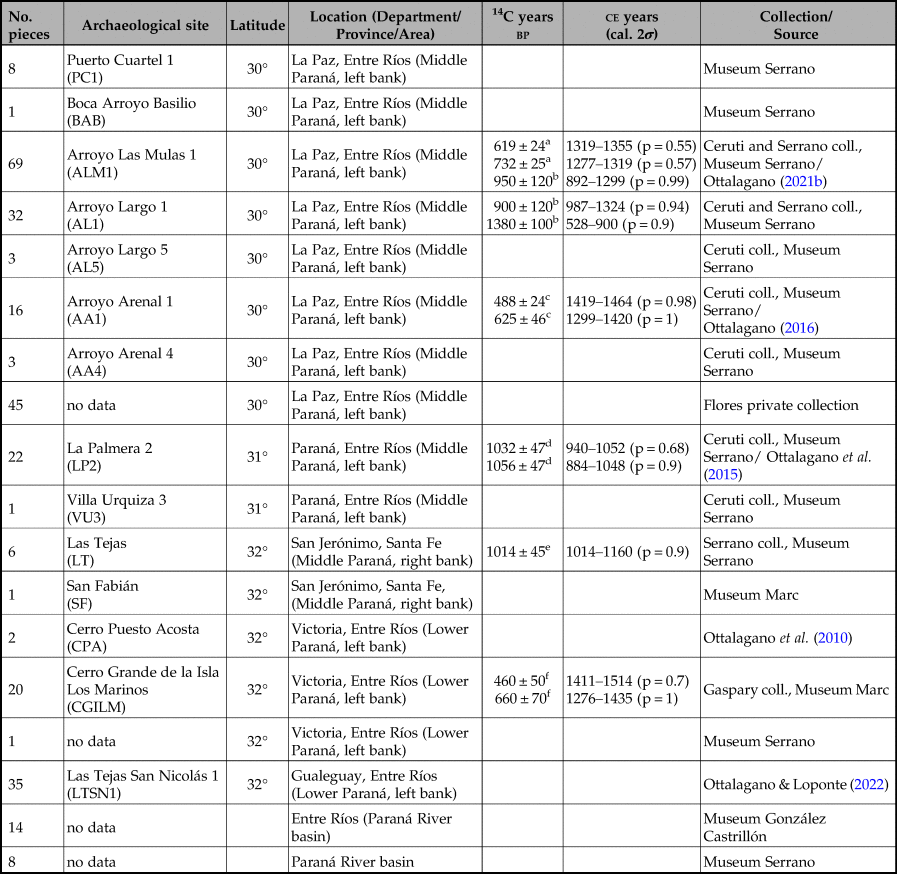
The sample selection criterion was based on the need to obtain first-hand data from each of the pieces considered, in order to carry out a direct and detailed analysis of the representations, taking all their sides into account. For this reason, photographs published by other researchers were not included, studying only those pieces available for the middle and lower Paraná located in museums of the area, private collections and own field works. Most of the pieces analysed here are housed at the following institutions: the Regional Museum ‘Alicia González Castrillón’ (La Paz, Entre Ríos province), the Museum of Natural and Anthropological Sciences ‘Prof. Antonio Serrano’ (Paraná, Entre Ríos province), the Provincial Historical Museum ‘Dr. Julio Marc’ (Rosario, Santa Fe province). The pieces come mostly from 14 archaeological sites that range between 460 ± 50 and 1380 ± 100 14C years bp (Fig. 1; Table 1). Some of these sites, such as Arroyo Las Mulas 1, Cerro Grande de la Isla Los Marinos, Las Tejas and La Palmera 2, due to the quantity and quality of the recovered material, are considered referents of the pre-Hispanic archaeology of northeastern Argentina (e.g. Ceruti Reference Ceruti, Politis and Bonomo2018; Ceruti & González Reference Ceruti and González2007; Gaspary Reference Gaspary1950; Serrano Reference Serrano1972).
Information on the samples considered.

Notes: (a) Ottalagano Reference Ottalagano2021b; (b) Ceruti Reference Ceruti2003; (c) Ottalagano Reference Ottalagano2016; (d) Ottalagano et al. Reference Ottalagano, Darigo, Pereyra, Brancatelli and Iannelli2015; (e) Sartori Reference Sartori2015; (f) Kozameh & Brunás Reference Kozameh and Brunás2013.
The figurative motifs considered in this study were mostly taxonomically identified in Ottalagano (Reference Ottalagano2021a), in which systematic methodological criteria for the recognition of the different taxa in ceramic art are made explicit. The classification of the motifs into naturalistic stylized and schematic was based on the proposal defined in Ottalagano & Loponte (Reference Ottalagano and Loponte2022), which considered the specificities of the regional artistic patterns. According to this proposal, figurative motifs tend to have certain characteristics depending on their level of realism, as will be seen below. Naturalistic motifs have several taxonomic attributes that allow them to be identified within a limited taxonomic range (e.g. family, genus, species). The design of facial attributes is very frequent, such as the eyes and nostrils, whose shapes, proportions and locations are congruent with those of their real referent. They are generally profusely decorated by incised decorative attributes (Figs 2 and 4 & 5, below). Stylized motifs register few taxonomic attributes, which allow them to be identified within a wide taxonomic range, generally at the Class level. In some cases they may manifest certain traits, such as those related for example to the specific shape of the beak or snout, which facilitate their taxonomic identification. However, the morphology of these taxonomic traits tends to undergo modification with respect to the real referent. Facial features are generally omitted or are poorly visible. In stylized motifs, decorative attributes may or may not be present. The schematic motifs, finally, can be differentiated into zoomorphic or anthropomorphic. However, in the case of zoomorphic motifs, they do not usually record unequivocal taxonomic attributes that allow their identification, and they can only be attributed to some particular taxa from certain homologies with their naturalistic or stylized referents. In schematic representations, facial features are omitted, while the incised decorative attributes may or may not be present (Figs 2 and 4 & 5, below).
Representation sequences among psittaciform, falconiform and cathartiform birds: (a) ALM1 site (Ottalagano Reference Ottalagano2021b); (b) site AL1 (Serrano Museum); (c) LT site (Serrano collection, Serrano Museum); (d) CPA site (Ottalagano et al. Reference Ottalagano, Darigo, Sulich, Arelovich, Bárcena and Chiavazza2010); (e) & (h) LTSN1 site (Ottalagano & Loponte Reference Ottalagano and Loponte2022); (f) SF site (Marc Museum); (g) & (i) CGILM site (Gaspary collection, Marc Museum). (a, b, d, e, f, g, h, i: three-dimensional motifs; c: two-dimensional motif.)

Due to the fact that the stylization and schematic processes involve a simplification and an alteration of the object represented, the eventual alterations in shape, proportion and/or location of the facial and taxonomic attributes of the motifs were taken into account. Taxonomic attributes are understood to be those anatomical features that allow the figure to be identified within some taxonomic level. The term facial attributes is used for those elements of the figures, such as eyes and nostrils, which are unnecessary for the identification of the animal depicted. Finally, the term decorative attributes is used to refer to those abstract motifs made by incision, which are not apparently linked to the design of facial or taxonomic features.
Throughout this work, the term birds of prey is used to refer exclusively to those that have diurnal habits, such as Falconiformes (e.g. eagles, hawks, caracaras) and Cathartiformes (e.g. vultures). Therefore, nocturnal birds of prey such as the Strigiformes (e.g. owls), which have significant physical and behavioural differences from the former, will not be included within this term. Due to the morphological and ethological similarities between Falconiformes and Cathartiformes (traditionally included within the same Order) (Wetmore Reference Wetmore1960), the possibility of differentiating between these birds is particularly difficult in stylized or schematic motifs. An attempt at differentiation is shown in Figure 2. The term parrot is used to designate birds of the order Psittaciformes.
Results
Chronological and spatial variability
Radiocarbon dates are available for six of the archaeological sites considered in this study (Table 1), which as a whole concentrate 57.5 per cent (n = 165) of the pieces analysed here, which is a valid sample to make a first approximation to the chronological variability of the representation modalities. As shown in Figure 3a, no impact of the chronological factor was detected on the modalities of representation of animals and humans. For example, sites AA1 and CGILM, whose chronological range is more recent, show very different proportions in terms of the number of schematic and naturalistic motifs surveyed. A similar situation is observed with respect to the two sites with older chronologies, such as EL1 and LP2, where very different proportions are also observed in the representation modalities. Consequently, the scheme proposed by Serrano (Reference Serrano1961) on a possible evolution from naturalistic art to schematic does not seem to be verified by the existing data.
Chronological and spatial variability of the representation modalities: (a) proportion of motifs per site according to available dating; (b) proportion of motifs according to latitude of archaeological sites.

The three modes of representation, naturalistic, stylized and schematic, tend to coexist in the archaeological sites, in different proportions (Fig. 3). Sites such as ALM1 and AL1 have a more significant proportion of naturalistic representations, while at other sites such as CGILM and LSN1, the percentage of stylized and schematic motifs is markedly increased. According to the data shown in Figure 3b, the spatial and particularly latitudinal factor would have a significant impact on artistic variability, in such a way that there would be a process of simplification of the figurative motifs from north to south in the Paraná River corridor. However, as will be analysed later, this spatial variability is conditioned, particularly, by the differential distribution in the area of parrot and raptor motifs.
Variability by taxa
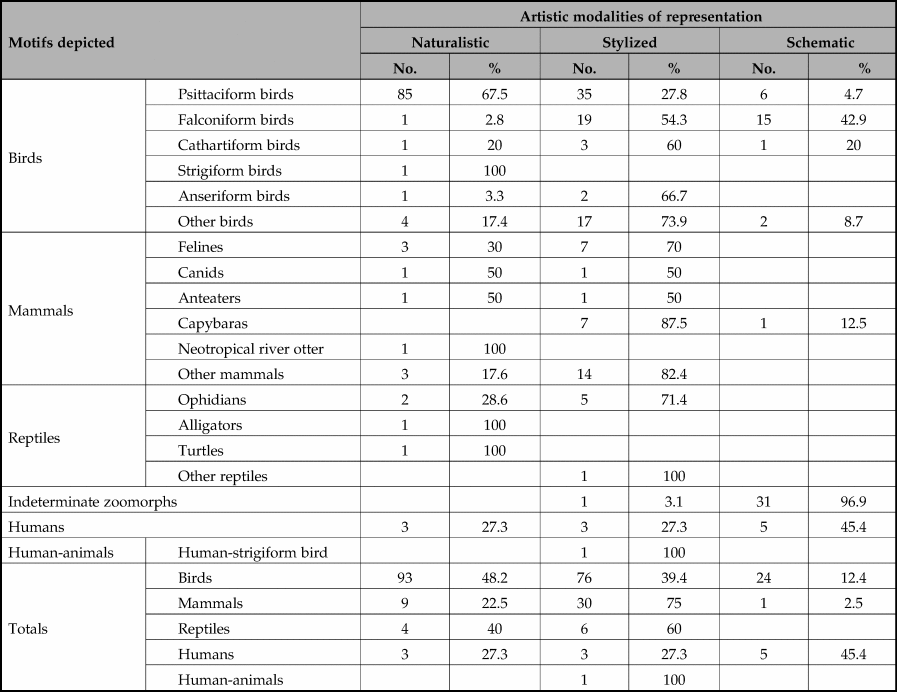
Significant variations are observed in the ways of representing the different taxa. The birds show the highest values of naturalistic modality of all the figurative motifs analysed. However, within this Class there are notable differences between diurnal birds of prey (Falconiform and Cathartiform birds) and Psittaciform birds (Table 2). The latter, which are the most frequent motifs in ceramic iconography and which could include various species of macaws and parrots (see Ottalagano Reference Ottalagano2008), present a significant proportion of naturalistic representations. The diurnal raptors, meanwhile, show a preponderant percentage of stylized and schematic depictions.
Representation modalities by taxa.

The characteristic taxonomic attributes of birds of prey were altered during the stylization process, highlighting the design of an extremely elongated beak, which tends to form a whole with the animal's own head (Fig. 2). In the case of schematic motifs, the design of the distal end of the raptor beak, which has a slight hook shape, is generally omitted. This omission achieves a highly simplified motif, which can only be recognizable by homology with stylized or naturalistic referents. In certain specimens of raptor birds, a protuberance is observed in the upper part of the beak, that could represent the caruncle of the Cathartiform birds (Cornero Reference Cornero2019), as in the case of the king vulture (Sarcoramphus papa), whose distribution is concordant with the study area (Miller et al. Reference Miller, Vandome and McBrewster2010). In Psittaciform birds we also notice a tendency to emphasize the robust and extremely curved beak typical of these birds. In schematic representations of Psittaciform birds, the beak constitutes the only taxonomic attribute designed (Fig. 2).
Regarding the strigiform birds (nocturnal raptor birds), which are scarce in the sample, it has been possible to recognize a naturalistic representation of striped owl (Asio clamator) (Fig. 4b) and a stylized motif that combines human features with those of this nocturnal raptor (Fig. 5g). In this case, the typical facial disc of the bird is highlighted, but its beak is omitted, which is replaced by an open human mouth, rectangular in form. Anseriform birds, such as ducks, were represented in a stylized way, and their wide and flat beak was highlighted (Fig. 5d). Within the Anseriformes we also find a naturalistic specimen of the southern screamer (Chauna torquata) (Ottalagano Reference Ottalagano2021a).
Zoomorphic depictions with different levels of realism: (a) anteater from ALM1 site; (b) strigiform bird from ALM1 site; (c) canid from LTSN1 site; (d) alligator from LT site; (e) neotropical river otter from ALM1 site; (f) & (i) ophidians from ALM1 site; (g) duck from LP2 site; (h) feline (Panthera onca) from AL1 site; (j) capybara from ALM1 site; (k) bird from LP2 site; (l) capybara from LT site; (ll) & (m) indeterminate zoomorphs from LTSN1 site; (n) indeterminate zoomorph from ALM1 site. (a, b, e, g, i, k, n: Ceruti collection, Serrano Museum; c, ll, m: Ottalagano & Loponte (Reference Ottalagano and Loponte2022); d, f, h, l: Serrano collection, Serrano Museum.)

Anthropomorphic depictions with different levels of realism: (a) VU3 site; (b) AL1 site; (c) & (f) LP2 site; (d), (j) & (k) Paraná basin; (e) & (h) middle Paraná basin; (g) human-strigiform bird, LP2 site; (i) ALM1 site. (a, b, c, f, g, i: Ceruti collection, Serrano Museum; d & j: González Catrillón Museum; e & h: Flores private collection; k: Serrano Museum.)

Mammals, which were identified in the sample by the presence of ears and snout, were represented in general terms in a mostly stylized way (Table 2). Among the felines and canids, although facial attributes are present, as well as several taxonomic attributes to identify them in some cases at the species level (Ottalagano Reference Ottalagano2021a), they show some patterns of stylization. The most notorious pattern of stylization is the alteration of the location of the eyes with respect to their real referent, which tend to be located on the sides of the head, instead of the original frontal arrangement (Fig. 4h). Of the two pieces identified as an anteater (Tamandua tetradactyla or Myrmecophaga tridactyla), one was represented in a stylized way and the other in a naturalistic way (Table 2; Fig. 4a). In the case of mammals with semi-aquatic habits identified in the iconography, we note that the neotropical river otter (Lontra longicaudis) was made with great realism, while the capybaras (Hydrochoerus hydrochaeris) were represented in a stylized and schematic way (Table 2; Figs 4e, 4j & 4l). The rectangular and voluminous snout of these large rodents was emphasized. In some pieces a soft protuberance on the snout of the capybaras is observed, which could represent the gland that is present in the males for the marking of their territory. The most noticeable stylization patterns in the capybara depictions are the ears designed in certain pieces as a single unit, the absence or poor visibility of the eyes, or the unilateral presence of a single eye. Reptile iconography, which is scarce in the area, shows a somewhat higher proportion of stylized representations, although some in a naturalistic style are also present (Table 2; Figs 4d, 4f & 4i). Lastly, indeterminate zoomorphic motifs include those pieces that, basically due to their level of schematism, cannot be assigned to a specific Class (Table 2; Figs. 4ll, 4m, 4n).
Anthropomorphic motifs constitute a relatively small minority group in regional iconography, which tends to present great variation (Fig. 5). As Serrano (Reference Serrano1961) pointed out, the representation of humans does not usually respond to standardized canons, as occurs for example with the representations of parrots and birds of prey, where common elaboration rules are noted, as has been seen in this work. Although the sample for this group is small (3.8 per cent of the total motifs analysed here), there is a slight preponderance of the schematic representation modality for the design of the human figure (Table 2). Body adornments on the forehead and head, and probably also on the ears (Fig. 5), are commonly emphasized in human depiction. In stylized human motifs, facial features such as the mouth and/or nose were designed using abstract motifs (e.g. straight lines, rectangles). On the other hand, there is an alteration in the location of the eyes, which tend to move towards the sides of the face in some pieces (Fig. 5d). The schematic human motifs mostly comprise representations made by incision, which are presented full-body (Figs 5i, 5j, 5k). In these cases, the head was designed using a geometric shape: a rectangle (Fig. 5i), a square (Fig. 5j), or a triangle (Fig. 5k). Particularly in these last two pieces, the human body was positioned head down.
Distribution of motifs in the study area
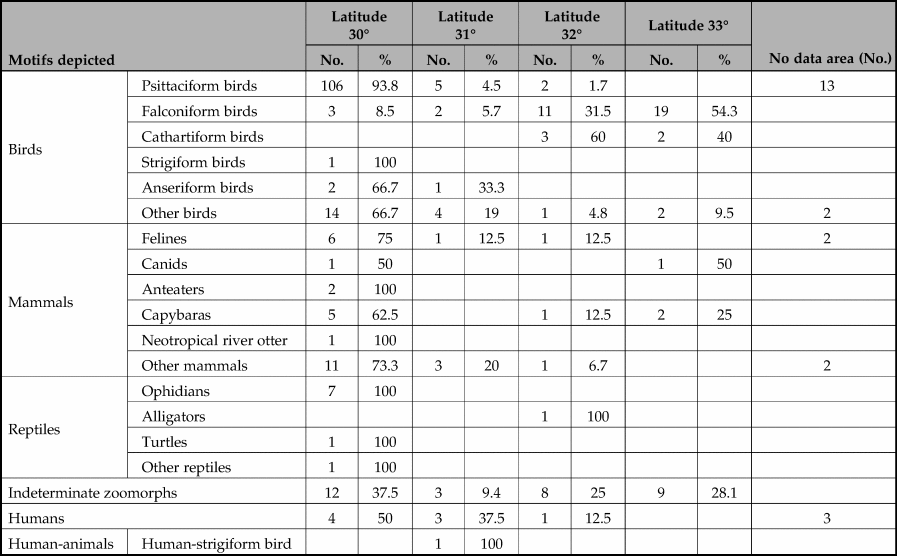
Analysis of the variability of the representation modalities leads to the need to make observations regarding the distribution of the most frequent motifs in the study area, since some correlations between representation modalities, depicted animal and latitude are verified. Although the bird motifs form the majority in all the sites considered, there is a notable difference in the inter-site distribution of the two most represented groups of birds (Table 3; Fig. 6). According to the sample considered in this work, the iconography of parrots is particularly abundant in the sites located on the 30th parallel, corresponding to the left bank of the middle Paraná (Table 1, Fig. 1). As can be seen in Table 2, in this sector the proportion of psittacine motifs reaches 93.8 per cent. In contrast, the iconography of birds of prey tends to increase in those archaeological sites geographically positioned on the 32nd and 33rd parallels, reaching a proportion of 87.5 per cent in this sector. This increase is especially notable in the CGILM and LTSN1 sites, located on the left bank of the lower Paraná (Fig. 1), in which practically all the representations of birds analysed correspond to raptors (see also Gaspary Reference Gaspary1950; Ottalagano & Loponte Reference Ottalagano and Loponte2022). Therefore, although with some variations a general trend towards the elaboration of images of psittaciform birds with mostly naturalistic characteristics in the middle Paraná is observed, an opposite tendency towards the elaboration of images of birds of prey with mostly stylized and schematic features in the lower Paraná is verified (Fig. 6).
Correlations between modes of representation and latitude between parrot and bird-of-prey motifs.

Taxa depicted by latitude.

Symbolic references regarding raptor birds and parrots
This section compiles the most important regional ethnographic and ethnohistoric references in relation to the two most frequent groups of birds in the analysed iconography. The Goya-Malabrigo archaeological unit has been generally linked to the Chaná-Timbú historical groups; however, there are very few documentary sources available for these groups. Due to this lack of data on the Chaná-timbú symbolism, the information used here comes mostly from the Guaycurú and Mataco-Mataguayo linguistic families, taking into account their geographical proximity to the Paraná River basin and its concordance with hunter thought logic (see discussion in Ottalagano Reference Ottalagano2007).
The relevant documentary data of northeastern Argentina shows that these two types of birds portrayed in pre-Hispanic art developed important symbolic roles within mythology. Several myths position the falcons as cultural heroes whom the communities ask for help in solving problems. Such is the case of the caracara. This bird of prey, which is seen as an old man of great wisdom, constitutes the central character of the widespread myth where the origin of women is narrated, who in a primitive time lived only in the sky. The bird is mentioned as the chieftain of primordial humanity, and as the protagonist that makes possible the descent of women from the sky, to inhabit the earth definitively: the event that made sexual encounters between women and men feasible (cf. Lehmann-Nitsche Reference Lehmann-Nitsche1923; Métraux Reference Métraux1973; Terán Reference Terán1994). This leading role of the caracara is alternately played by other raptor birds, such as an eagle, hawk or sparrow hawk, in other variants of the same myth (cf. Cordeu Reference Cordeu1969–70; Cordeu & Siffredi Reference Cordeu and Siffredi1978; Jiménez Núnez Reference Jiménez Nuñez1962). Birds of prey are also perceived as animals that make it possible to eliminate evil beings, as recounted in a chorote myth starring Howa, a caracara (Mashnshnek Reference Mashnshnek1976), and by a sparrow hawk, in a wichí myth (Siffredi Reference Siffredi1976–80).
Birds of prey are admired for their hunting skills among the Wichi (Palmer Reference Palmer1995). Cordeu and Siffredi (Reference Cordeu and Siffredi1978) point out that the Chorote refer to hunting birds as i-yosksi, a term which indicates qualities of courage, strength and power. Among the Toba, condors are seen as animals with even more power than big felines like the jaguar (Terán Reference Terán1994); and various species of falconiform birds are labelled with the name 'miyo, which applies to birds that are described as typical of the woodland (Arenas & Porini Reference Arenas and Porini2009).
The knowledge of fire is linked in several myths with birds, but especially with falcons. Mashnshnek (Reference Mashnshnek1976) comments that the caracara has a fundamentally igneous character, since all its feats are related to fire. A toba myth recounts that the caracara sustained burning wood with its beak, and scattered it from the heights to human communities (cf. Terán Reference Terán1994). Other myths mention that Hówsa, a caracara, taught the people to cook their food, and also managed to protect a community from the flood through magical procedures. The caracara is also linked to the essential tools for the survival of human groups, since it is said to have introduced nets and fishing techniques (cf. Mashnshnek Reference Mashnshnek1976; Métraux Reference Métraux1973).
The figure of the parrot, like the falcons, is also associated with the widespread Chaco myth about the origin of women. According to this myth, the parrot was the first guardian that men had to defend themselves from the repeated attacks that women made during their temporary descents to earth (cf. Cordeu Reference Cordeu1969–70; Cordeu & Siffredi Reference Cordeu and Siffredi1978; Lehmann-Nitsche Reference Lehmann-Nitsche1923; Palavecino Reference Palavecino1969–70; Terán Reference Terán1994). It is said that the parrot lost the attribute of speech and obtained its characteristic curved beak as a result of having failed in its attempt to monitor and avoid the attack of the celestial women (De los Ríos Reference De los Ríos1976). In a chaná variant of this myth, it is explained that the parrot failed in its task of keeping watch due to its great loquacity, which caused it to become distracted. This great loquacity of parrots, in other mythical situations, is a suitable attribute to keep away the spirits of the dead. The parrot's conversation allows the spirits to be distracted, so that they do not disturb those who are alive (Ottalagano & Colobig Reference Ottalagano and Colobig2010).
Birds are often associated in various myths with the emergence of human groups. A chulupí myth tells that humanity originated from a couple consisting of a young man and a parrot transformed into a woman, the only survivors of the great destruction of the world (cf. Mashnshnek Reference Mashnshnek1975). A widespread wichí myth narrates that at the beginning of time there were Talé people: a small falcon. An old woman of this membership group poured the blood of different hunted animals into several vessels. Different wichí tribes, as well as other ethnic groups, originated from the blood spilled in each vessel (cf. Braunstein Reference Braunstein1976; Mashnshnek Reference Mashnshnek1976).
A particularly important reference on the positioning of parrots within the belief system of the indigenous groups of the Paraná basin is made by Techo (Reference Techo1897, 312), a missionary of the seventeenth century:
On the banks, either covered with forests or bare, there are wild beasts and a multitude of birds, especially partridges and parrots that fly in flocks; of these, a remarkable variety is bred, whose individuals, three times larger than those of Asia, show bright colours in their plumage, and were previously venerated by the natives as gods. [Author’s translation]
Another equally important reference is that provided by Sánchez Labrador (Reference Sánchez Labrador1910, 204–5), an eighteenth-century missionary, who mentions that the Guaycurú considered themselves descendants of birds (including parrots), which is why they did not eat them.
The Guaycurús are not as enthusiastic about hunting birds as they are about hunting quadrupedal wild beasts. I think that is the reason why very few birds are appreciated at your table. With the exception of partridges (…), and some other dwellers in the air, they do not like to eat any other bird, no matter how tasty its meat is. What can be founded on the vain belief that they are descendants of birds. They are only struck by the showy feathers, because of the use they make of these, dressing their nakedness with vanity…(…). The multitude of macaws, parrots, parakeet, is especially large. If the Guaycurús, just as they like their feathers, liked to eat them, they would remedy with their game the scarcity of other foods. They all have names; and they like to raise them in their huts … [Author’s translation]
From the comments of both chroniclers it follows not only that parrots were perceived as gods and as ancestral beings, but also that they were usually domesticated animals, and raised as household pets. Parrots were part of the domestic sphere of the Toba, and they were fed with some vegetable products typical of the home diet. Parrot breeding included the task of teaching them to ‘speak’, which would have been related to the refusal to eat them (Arenas & Porini Reference Arenas and Porini2009). According to the comments of both missionaries, the parrots were also valued for their showy feathers, which were used in body adornments. Paucke (Reference Paucke1944), another eighteenth-century missionary, also mentions that the indigenes used the small feathers that are at the base of the parrots’ beaks as personal adornments, and made tassels with feathers of talkative parrots which they placed at the ends of their houses.
Discussion and interpretation
Birds of prey and parrots as opposable conceptual categories
The results obtained show co-occurrences between the animal depicted and artistic modality. Two alternative styles of representation tend to develop, apparently within the same chronological period, on the visual images of two groups of birds with well-differentiated morphological and ethological traits, such as birds of prey and parrots. It is necessary to highlight that, historically, naturalistic figures tended to monopolize the attention of regional archaeology, which led to under-quantifying the raptor motifs, that, due to their stylization and schematization, were classified on several occasions under the generic category of ornithomorphic or even zoomorphic representations (e.g. González Reference González1947; Serrano Reference Serrano1972). As can be seen in Table 2, the proportion of parrots and raptors is vastly higher than that of the rest of the animal motifs, offering a broader database to generate interpretations about the correlations between representational practice and the depicted animal.
As seen in the previous section, mythological accounts show birds of prey as powerful, strong and courageous beings. They are perceived as cultural heroes who ensure the survival and continuity of human communities. They are birds admired fundamentally for their skills as hunters and linked to the woodland. Regarding parrots, the myths emphasize the ability of these animals to ‘speak’. The great loquacity attributed to these birds is seen simultaneously as a quality that can bring positive or negative results. A link between parrots and the domestic sphere could also be considered, given that some communities in northeastern Argentina developed a relationship of physical closeness with parrots through their domestication. It is mentioned that the parrots were treated like people, since they were given a name, and they were allowed to live in their houses. Their feathers were used as clothing or were hung in their homes. Although the archaeological record does not currently show material correlates of domestication of psittacines, such as the finding of individual burials of these animals—as reported in the area in relation to domestic dogs (Acosta et al. Reference Acosta, Loponte and García Esponda2011)—the domestication of parrots could be a possibility not yet verified due to the low level of excavations carried out.
The symbolic attributes assigned to animals in mythological accounts are largely based on their intrinsic zoological characteristics. Birds of prey and parrots have very different morphological and behavioural attributes. The former are carnivorous birds that are characterized by capturing live prey, which they kidnap by taking them through the air, with the exception of vultures, which basically have scavenging habits, although they may also occasionally hunt. They have a strong, long and sharp beak, powerful claws and large wings. There is agreement that the skills displayed by these birds when hunting and their impressive high-altitude flight make them ‘the lords of the air’ (Alvarado Orellana et al. Reference Alvarado Orellana, Figueroa R., Valladares Faúndez, Carrasco-Lagos and Moreno2015; Newton & Olsen Reference Newton and Olsen1993). In the iconography analysed, there is an emphasis on the representation of the beak, which in these carnivorous birds plays an especially important role during predation: this could be taken as a visual metaphor of the hunting attitude, analogous to that developed by the human hunter. Parrots, on the other hand, are diurnal birds with highly gregarious habits. They have a varied diet that includes fruits and grains, and unlike the falcons, their flight is not usually high. They are animals that stand out for their striking colours, their domesticity, as well as for their cognitive skills, comparable even to those of primates, with which they share certain social and biological behaviours (Iwaniuk et al. Reference Iwaniuk, Dean and Nelson2005). The special structure of their tongue enables them to reproduce sounds similar to the human voice (Vigil Reference Vigil1973), as in the case of the turquoise-fronted Amazon and the macaws that would have been represented in the images studied (Ottalagano Reference Ottalagano2008). In the iconography of parrots there is also an emphasis on the representation of the beak, as we have seen. This could be taken as a visual metaphor for an anthropic property par excellence: language. Furthermore, a certain correspondence between the symbolic qualities associated with each animal and its intrinsic zoological characteristics is observed, which is a basis for understanding why these birds were selected to be represented in Goya-Malabrigo ceramic art, as well as in other archaeological contexts of Argentina and America (e.g. Creel & McKusick Reference Creel and McKusick1994; Flores & Velárdez Fresia Reference Flores and Velárdez Fresia2018; Gilman et al. Reference Gilman, Thompson and Wyckoff2014; Gomes Reference Gomes, McEwan, Barreto and Neves2001; Reichel-Dolmatoff Reference Reichel-Dolmatoff1988; Sharpe Reference Sharpe2014; among others). This also constitutes a starting point to understand why these birds are particularly positioned as sources of metaphorical meanings and are used to express human attitudes.
The above arguments lead us to propose some associations that make it possible to shed light on the differences found in the ways of representing birds of prey and parrot motifs. Raptors would be linked to the domain of predation, which is also the domain of attack and fight, that is, of survival. They belong to the group of birds related to the wooded environment, which for humans is the area where hunting takes place, perceived by the indigenous people, as Siffredi (Reference Siffredi1976–1980) points out, as a dangerous and hostile territory. It must be understood that hunting, in indigenous understanding, is primarily a kind of movement on the land (Ingold Reference Ingold and Ingold2000). Parrots, for their part, would be associated with the domain of community life, which is also the domain of domestic space, in terms of home and shelter. It is striking that in the toba communities of the northeast of Argentina, the hour of twilight is marked by the sounds of parrots when they return to their nests, which is taken by the hunters as a sign that the hunting day has ended and it is time to return home (Arenas & Porini Reference Arenas and Porini2009).
Within South American archaeology, some authors have addressed the dichotomy that occurs between groups of animals that are perceived as part of different domains, which has repercussions in the way of representing them. In the Tiwanaku culture, for example, camelids and deer were perceived as metonyms of opposite spheres, such as non-human rearing and human rearing, which would have caused a radical opposition in the norms of plastic expression used. While the images of llamas (human-reared animals) were created in a naturalistic way, the iconography of deer (non-human-reared animals) lacks a formal resemblance to the real referent. Furthermore, the deer would have been associated with a specific physical space, the mountainous environment (Villanueva Criales Reference Villanueva Criales2021). Alaica (Reference Alaica2018) also posits a similar oppositional relationship in the Moche culture, in ancient Peru. The iconographic record suggests that the Moche made a distinction between wild and domestic animals. Wild species tend to be perceived as beings associated with the divinities and supernatural power, while domesticated animals were viewed as integral to human affairs. Although there are marked socio-cultural differences between these societies and the case of the study, these examples help us to think about how differences in the ways of representing animals could be linked to their inclusion in different metaphorical domains and opposable categories.
Totem, land and socially symbolic relationships
The proposal of a possible dichotomy in the perception of birds of prey and parrots, which could generate differences in the ways of representing both groups of animals, still does not explain the variability observed with respect to the spatial distribution of motifs in the area. That is, the greater presence of psittacine motifs in sites located in the middle Paraná, and the increase in raptor motifs in sites located mainly in the lower Paraná. A starting point to discuss this aspect can be found in regional ethno-historic documents where the perception of birds as ancestral beings is mentioned (see previous section), which leads us to address the theme of totemism—initially hinted at by Torres (Reference Torres1911)—and which is currently the subject of much debate within the social sciences.
The term totemism has been used to designate a great variety of relationships between humans and the elements of nature. However, there is a general consensus that it can be broadly defined as ‘the use of animals or plants as emblems or guardians of social groups celebrated in ritual’, such that different social groups are identified with different species (Insoll Reference Insoll and Insoll2012; Layton Reference Layton2000: 169). This is, then, a first pillar of totemism: the connection of the totem with a defined group of the community (Rivers Reference Rivers1914). The significance of each species derives from its place in the cognitive structure. The totems are not mere labels, but are animals that have a context and meaning through their incorporation in myths. They are part of a set of stories or sequence of events (Morphy Reference Morphy1990). The association of a group with the animal totem is actually a corollary of a more fundamental set of links between humans, ancestors and land, since it is in dwelling upon the land that people forge their sense of being (Ingold Reference Ingold and Ingold2000). It is usual, then, that each totemic animal will be preferentially depicted at sites within the territory of the group for whom it is the totemic emblem (Layton Reference Layton2000). This could explain why current research on totemism in archaeology has focused especially on the study of rock art (see a summary in Whitley Reference Whitley, Cummings, Jordan and Zvelebil2014), due to its importance as a territorial marker.
Totemism may be found wherever larger societies are subdivided into equivalent social units (Coulam & Schroedl Reference Coulam and Schroedl2004). The Goya-Malabrigo has generally been considered as an archaeological unit with a certain uniformity, in terms of subsistence and settlement mode, social organization, art, among other aspects (see a synthesis in Ceruti & González Reference Ceruti and González2007). However, the observable variations in the zoomorphic appendages, which could be indicative of the presence of different groups, have not been particularly discussed. The earliest sources from the sixteenth century mention that the coasts of the middle and lower Paraná were inhabited by a set of communities that were part of a larger cultural group, corresponding to the Chaná-Timbú linguistic family, associated with the Goya-Malabrigo archaeological record. The chroniclers point out that this set of communities, fundamentally hunter-gatherer-fisher, maintained friendly relations with each other. Although there are no specifications on the ceramic iconography, it is mentioned that these groups had similar body adornments and communicated in a similar language, among other things (cf. Schmidl Reference Schmidl[1567] 1950). These groups were distributed in the regional space on different sectors of the left or right bank of the Paraná River, although generally following a north–south vertical distribution, along the fluvial axis. Thus, for example, while Mepén and Mocoretá were located in the middle Paraná, Caracará, Timbú, Chaná and Mbeguá inhabited the southernmost portions of the river corridor. The particular habitat where the Chaná-Timbú lived, crossed vertically by the course of the Paraná River, offered a complex scenario in relation to contact with other communities. The river corridor favoured fluid communication and permanent transit of both ‘friends’ and ‘enemies’ groups (Martínez Sarasola Reference Martínez Sarasola2005). In a previous work it was argued that the regularities found in the Goya-Malabrigo artistic record of the middle Paraná could be part of an emblematic style, within the framework of complexity processes (see previous sections) (Ottalagano Reference Ottalagano2013). In that work, the focus was placed especially on the role of art in a context of tension between ethnically different groups. The projection of a group identity through certain distinctive cultural patterns would probably have been related to circumstances of economic and social stress. However, the internal variability of the artistic record throughout the Paraná basin was not discussed, where a change of icon and and its representation seems to be noticed, which could be related to totemic oppositions within a larger cultural group.
This leads us to consider the second fundamental aspect of totemism, as a system of relationships. Totemism refers to a phenomenon that implies socially symbolic relationships (Insoll Reference Insoll and Insoll2012; Morphy Reference Morphy1990). Members of a totemic group share a sentiment of affinity and are perceived as kin. This kinship can also extend to the totem animal (Durkheim & Mauss Reference Durkheim and Mauss1963; Lévi-Strauss Reference Lévi-Strauss1962; Rivers Reference Rivers1914). Some authors have established differences between a social totemism and other special forms of totemism. In social totemism, equivalent groups adopt a totem as their symbolic representation. This allows them to define and differentiate themselves in opposition to other groups (see discussion in Coulam & Schroedl Reference Coulam and Schroedl2004). Totemic symbols are usually present in various elements of material culture, as Durkheim (Reference Durkheim1915) points out. Several ethnographic examples show the considerable place that is given to the totem in the indigenous life, representing its image in both everyday and mortuary objects. This author comments that the totemic images were not only placed in their houses, canoes, utensils and tombs; they were also present on their bodies. As seen in the previous sections, iconography of parrots and raptors is present in a wide variety of ceramic artefacts, which were used for everyday purposes but also for mortuary uses, as is probably the case with the miniatures and the ‘bell’ artefacts, where these birds are particularly frequent. Given that there are no records in the area of figurative art in weapons systems, and rock art is also lacking, ceramics constitute the only enduring material where representations of animals can be found.
Another essential aspect of totemism is related to the prohibition of the consumption of certain species, according to a pre-established order of things (Ingold Reference Ingold and Ingold2000; Insoll Reference Insoll, Barrowclough and Malone2007; Reference Insoll and Insoll2012). Rivers (Reference Rivers1914) considers that the third pillar of totemism is the ritual element, which implies the respect shown to the totem through the prohibition of eating the totem animal, except under certain restrictive conditions. As seen in previous sections, the chroniclers of the seventeenth and eighteenth centuries particularly mention the lack of consumption of birds, and especially parrots, by the ancient populations of northeastern Argentina. The archaeofaunal record associated with the Goya-Malabrigo archaeological unit in particular shows a striking scarcity of bird remains (0.31 per cent of the total NISP), in which evidence of potential human use is not generally observed, such as signs of thermal alteration or anthropic marks; suggesting the existence of restrictions on the consumption of these animals. Therefore, the disparity detected between the high number of birds portrayed in the iconography and the minimal presence of these animals in the faunal remains is especially noteworthy (Ottalagano Reference Ottalagano2021a).
This divorce between depicted and hunted animals makes it possible to move away from the idea that the realism of the analysed figures may be related to an animic ontology, as proposed by Ingold (Reference Ingold and Ingold2000) based on ethnographic cases. This author mentions that the miniature figures of realistic animals are one of the distinctive features in the animic system of northern circumpolar societies. The miniatures are equivalent to the animals killed in the hunt, which justifies their realism. Realistic figures are often carved into hunting and fishing equipment as well. This ornamentation of the weapons constitutes the hunter's way of asking for the gift of the animal to the spirit beings, that are the animal donors. This contrasts with the totemic systems of Australian hunter-gatherers where, they having no such reciprocal ties to donor animals, the ornamentation of weapons is absent (Fitzhugh Reference Fitzhugh, Fitzhugh and Crowell1988; Ingold Reference Ingold and Ingold2000). This last situation is verified particularly in the case of study where the hunting and fishing equipment, made fundamentally on bone and antler, does not present figurative decoration; and only exceptionally minimal abstract decoration is reported.
Totemism, then, especially constitutes an ontology which implies a certain attitude towards nature, different from others such as animism, for example.Footnote 1 As Lévi-Strauss (Reference Lévi-Strauss1962) points out, in totemism there is a continuity of the human being with nature, by bringing the human closer to the animal. When a person proclaims himself by the name of a particular animal species, it means that he, and the other persons who share the same affiliation, partake of the same substance as that animal. In a totemic ontology, the unity of humans and animals lies in their very consubstantiality. Unlike an animic ontology where only the trance state allows the shaman to liberate himself from the limitations of his body and assume an animal form as a vehicle for spiritual encounters, in totemic ontology, on the contrary, such an ‘out-of-body’ experience does not have a place. Here, a person ‘does not have to leave his body to take on that of his totem, for his own body and that of his totem share the same essence whose ultimate source, as we have seen, lies in the land’ (Ingold Reference Ingold and Ingold2000, 115). In the case of the iconography analysed in this work, it is noted that the number of images that combine human and animal characteristics is extremely scarce. Only one figure was recorded that combines a human mouth with characteristic morphological attributes of a strigiform bird. According to Gomes (Reference Gomes2019), these hybrid images can be thought of as a way to materialize the transformation of body states and to express a process of human–animal metamorphosis. In other words, if we assume that hybrid images are related with out-of-body experiences—common within animism and shamanism—the absence of mixed parrot–human and raptor–human figures can reinforce the idea that the images of psittacines and birds of prey were totemic symbols.
Another feature that differentiates the depiction of animals in a totemic ontology in contrast to an animic one is that the former focuses on the morphology and anatomy of the animal. In totemic representations, animal figures are not usually arranged together to form a narrative scene, but instead reveal an immobile and static essence. The totemic figures portray an animal that is not ordinary: rather, it represents an ancestral being. This contrasts with the focus on posture, movement and behaviour that animals generally acquire in an animic ontology, which seem to show living beings in motion (Ingold Reference Ingold and Ingold2000). Following these, the unitary representation of animals, especially of static heads, which occurs in the case study, seems to agree particularly with a totemic ontology. ‘Ways of seeing, ways of depicting’, summarizes Descola (Reference Descola2010, 11) in referring to how ontology—that is, the way of seeing the world and conceiving beings—is reflected in the way of representing, which constitutes a universal operation.
The essential consubstantiality that occurs in the totemic ontology between human and animal could also explain, in part, the relatively scarce presence of the human figure in regional iconography, as well as the lack of standardized canons to elaborate them. Here there would be no need to focus on the human figure and its activities. There is no intention of separation between human and animal, because both share the same interiority and physicality, following Descola (Reference Descola2006). According to this author, totemic ontology especially highlights a continuity between humans and non-humans. And we could also add that, due to this essential continuity, the human morphology is dissolved in the animal one, and it is this latter morphology that is privileged over that of the human. While the animist must go beyond his body to transcend the human–animal distinction, the totemist finds the distinction dissolved within his body, not outside it (Ingold Reference Ingold and Ingold2000).
In the previous section we saw how parrots and birds of prey have ‘anthropic qualities’, which helps us to explain their possible selection as totemic emblems. Some groups conceive the affinity between human and animal life on the basis of shared carnivorous tastes, while in other cases an affinity of habitat is used, for example. Carnivorous animals often have an outstanding place in totemic systems, since they subsist and protect themselves by attacking (Fortes Reference Fortes1945; Lévi-Strauss Reference Lévi-Strauss1962; Radcliffe-Brown Reference Radcliffe-Brown1951). Totemic identification is, then, based on a limited set of physical and moral qualities that the eponymous entity is considered to embody to the highest degree (Descola Reference Descola2006). For this reason, totemic species are not chosen because they are ‘good to eat’, but because they are ‘good to think’ (Lévi-Strauss Reference Lévi-Strauss1962, 89). Animals are a primary source of symbolic meanings for societies, and zoological species constitute an important metaphorical resource for the expression of human attitudes. The social world and the animal world can be thought of in reciprocal terms (Ingold Reference Ingold1994; Willis Reference Willis1990). Totemic symbols can be considered, like all other ritual symbols, the ideological reference points that a person uses to guide himself. It should be noted that totem birds are widespread in various parts of the world; frequently different birds are used to designate equivalent social units within a larger society (Fortes Reference Fortes1945; Radcliffe-Brown Reference Radcliffe-Brown1951). Animal species are usually classified in pairs of oppositions, with the condition of choosing species that have at least one feature in common that makes comparison possible. In this way, totemism expresses through particular codes, correlations and oppositions, whose union gives rise to an organized whole that facilitates integration and cohesion (Lévi-Strauss Reference Lévi-Strauss1962).
Final remarks
According to the current available radiocarbon datings, the variation from a naturalistic art to a schematic art does not seem to be related to a chronological factor in the case study. Instead, it is observed that the spatial factor, and especially the latitudinal gradient, has a noticeable impact. Crossing this information with analysis of the distribution of the motifs, it can be seen that this spatial variability is fundamentally due to the differences found between the ways of representing the two most abundant taxa in iconography: parrots and birds of prey. In other words, correlations between artistic modality, animal depicted and latitudinal gradient are observed. A general trend towards the elaboration of images of psittaciform birds with mostly naturalistic characteristics in the middle Paraná is shown, while an opposite tendency towards the elaboration of images of birds of prey with mostly stylized and schematic features in the lower Paraná is verified. Consequently, a progressive change of icon and plastic norms of representing it towards the south of the Paraná fluvial corridor is noted.
An attempt was made to evaluate and interpret the circumstances that could generate this variability in the images of the past. Using the ethnohistorical and ethnographic information available for hunter-gatherer groups of northeastern Argentina as a basis for interpretation, it is proposed that both groups of birds could have been included within opposing conceptual categories. Raptors and parrots could be linked with different metaphorical status, which would be reflected in opposite ways of representing them. Raptors would be wild animals linked to hunting, and to the space where hunting takes place. They would be associated with the predatory attitude that makes subsistence possible, which would find an analogy with the human hunter as the supreme predator. Parrots, for their part, which are gregarious species and plausible to domesticate, could constitute a metaphor for quintessential anthropic qualities, such as communication through language and community life; and, by extension, they could be associated with domestic space. As has been pointed out by numerous authors, nature constitutes an important source of meanings for societies; and in this sense, the morphological or behavioural qualities of certain zoological groups may be particularly suitable as metaphorical resources to express human attitudes (Foster Reference Foster and Ingold1994; Saunders Reference Saunders and Willis1990; Tilley Reference Tilley1991; Willis Reference Willis1990). These opposite metaphorical statuses could have been related to totemic oppositions. Birds of prey and parrots, made in two different depiction styles, could have been totemic symbols used to identify and distinguish local groups within a larger society. These correlations and oppositions whose union results in an organized whole, following Lévi-Strauss (Reference Lévi-Strauss1962), could have been a way to promote integration and social cohesion. Since totemic ontology primarily implies a set of linkages between people and land (Ingold Reference Ingold and Ingold2000), totemism in archaeology has generally been discussed in relation to rock art. In this work it is assumed that, given the geographical impossibility of developing rock art in the middle and lower Paraná, portable art could have acquired an essential role as a support to visualize totemic emblems.
Totemism has generally been considered in opposition to shamanism. However, this tendency reduces the diversity of empirical reality, since some ethnographic cases indicate that, even when it does not occupy a central place, shamanism can also be a component of a totemic system (Whitley Reference Whitley, Cummings, Jordan and Zvelebil2014). According to Insoll (Reference Insoll and Insoll2012), today the term totemism is infrequently encountered, with the preference currently to use much more popular and accepted alternatives such as ‘emblem’. Even the concept of metaphor has also been employed, in the sense of Tilley (Reference Tilley1991), who conceives it as a binding element that implies an interpretive account of the world, and which constitutes a quality which links together individuals and groups. This unpopularity in the use of the term totemism in current archaeological research may be due, in part, to the fact that it poses a great challenge for the discipline, due to the difficulties in evaluating its materiality. As DeMarrais (Reference DeMarrais, DeMarrais, Gosden and Renfrew2004) mentions, archaeological inquiry inevitably draws us toward problems of the materialization of culture, that is, the transformation, for example, of ideas, values, stories and myths into a physical reality. Due to the complexity posed by the archaeological approach to totemism, this work can be taken, therefore, as a starting point to begin addressing this issue from different lines of evidence in the lowlands of Paraná.
Acknowledgements
I want to thank the editors of the journal for their editorial work, as well as the anonymous reviewers who provided valuable critical insight. Dedicated to Carlos Ceruti, who allowed me to take the first steps on this issue.