Borderline personality disorder (BPD) is a severe mental health problem that is associated with emotional dysregulation, extreme subjective distress, high levels of psychosocial and work impairment, and frequent use of Accident and Emergency (A&E) and inpatient services linked to self-harm and suicide attempts (Ansell et al., Reference Ansell, Sanislow, McGlashan and Grilo2007). Dialectical behaviour therapy (DBT) and mentalisation-based therapy (MBT) were developed specifically for the treatment of BPD and an emerging evidence base for the effectiveness of each of those treatment modalities has been identified by meta-analyses and Cochrane reviews (Stoffers et al., Reference Stoffers, Völlm, Rücker, Timmer, Huband and Lieb2012; Cristea et al., Reference Cristea, Gentili, Cotet, Palomba, Barbui and Cuijpers2017). Both treatment models are increasingly widely available in the USA, Australasia, UK and Europe (University College London, 2014; Behavioral Tech, 2017; Dale et al., Reference Dale, Sethi, Stanton, Evans, Barnicot, Sedgwick, Goldsack, Doran, Shoolbred, Samele, Urquia, Haigh and Moran2017). However, regional health localities commonly offer one or another, rather than both (Dale et al., Reference Dale, Sethi, Stanton, Evans, Barnicot, Sedgwick, Goldsack, Doran, Shoolbred, Samele, Urquia, Haigh and Moran2017), and local treatment commissioners have little information to guide them as to which, if either, will be most effective for their patients. A head-to-head comparison of these two approaches has never been conducted, and indeed, few evaluations of either approach have compared outcomes with another specialised psychological treatment for BPD. DBT and MBT have each arisen from different traditions within psychotherapy and accordingly take differing approaches to the treatment of BPD, which in turn could render each differentially beneficial for different aspects of the BPD phenotype. DBT arose out of cognitive behavioural approaches but has been specifically tailored for BPD by incorporation of validation strategies, mindfulness and a focus on directly improving patients’ emotion regulation skills through group-based behavioural skills training (Linehan, Reference Linehan1993a, Reference Linehan1993b). By contrast, MBT arose out of the psychodynamic tradition, but has been specifically adapted for BPD by incorporation of an emphasis on fostering mentalisation – the ability to reflect coherently on the mental states of oneself and of other people – in interpersonal contexts (Bateman and Fonagy, Reference Bateman and Fonagy2006). A quasi-experimental comparison of the clinical outcomes of each approach may begin to yield insights on differential outcomes in a context that is representative of everyday clinical practice. The current study therefore aimed to address the following question: In patients with BPD, do clinical outcomes at 12 months differ between patients receiving DBT and those receiving receive MBT?
Methods
Design
A quasi-experimental non-randomised comparison of clinical outcomes in 90 patients receiving DBT or MBT in specialist personality disorder services, with treatment type determined by local service availability based on patients’ geographical location.
Inclusion and exclusion criteria
Participants were included if they:
(1) Met criteria for DSM-IV BPD;
(2) Were about to begin either outpatient DBT or MBT.
The exclusion criteria were intellectual disability or difficulty communicating in English of sufficient severity to prevent completion of study questionnaires, and/or insufficient capacity to provide informed consent for study participation.
Setting
Participants were recruited between March 2014 and September 2016 from six personality disorder services across five NHS Trusts in London and Southampton, in the UK. The treatment capacity of the participating services ranged from six to 20 patients at a time. The number of staff delivering treatment at each service ranged from four to seven, usually including some full- and some part-time staff, and professional backgrounds included psychiatry, clinical psychology, social work, mental health nursing and psychotherapy. Three services provided DBT (12-month course) and three provided MBT (18-month course). All participants took part in the study only over a 12-month period in order to render clinical outcomes comparable between the two treatment modalities. The DBT services all provided weekly individual therapy and group skills training, telephone skills coaching and team consultation. The MBT services all provided weekly or fortnightly individual therapy and weekly group therapy. They also provided a short-term group programme which involves weekly groups delivered over a 10-week period, offering psychoeducation and support aimed at helping clients get a better understanding of their problems and suggestions for better ways of dealing with them. These groups serve a dual function of providing a brief intervention to all those who attend and giving clients and staff an opportunity to consider whether longer term group treatment may be of benefit. However, they are not part of the MBT intervention as manualised by Bateman and Fonagy (Reference Bateman and Fonagy2006).
Procedure
At the beginning of their treatment, patients were given verbal information about the study by their DBT or MBT clinicians and asked for verbal consent to be contacted by the research team. A researcher then met with the participant to provide written information about the study and obtain written informed consent. After assessment of participants using the Structured Clinical Interview for DSM-IV, Axis II (SCID-II) to confirm that they met criteria for BPD (First et al., Reference First, Gibbon, Spitzer, Williams and Benjamin1997), baseline measures were administered. Follow-up assessments were then conducted with participants at 3, 6, 9 and 12 months after the baseline assessment. Both patients completing treatment and patients dropping out of treatment were followed up. Participants received a £30 compensation for attending the baseline assessment, and a £15 compensation for each follow-up.
Baseline measures
Personality disorder diagnosis
The SCID-II (First et al., Reference First, Gibbon, Spitzer, Williams and Benjamin1997) was used at baseline to assess participants’ DSM-IV Axis II personality disorder diagnoses. This semi-structured diagnostic interview demonstrates good inter-rater reliability (Maffei et al., Reference Maffei, Fossati, Agostoni, Barraco, Bagnato, Deborah, Namia, Novella and Petrachi1997).
Axis I disorders
The Traumatic Antecedents Questionnaire self-report measure (Herman et al., Reference Herman, Perry and van der Kolk1989) was used at baseline to determine whether participants had experienced a Criterion A traumatic event, as defined by DSM-V (American Psychiatric Association, 2013). In participants for whom a history of Criterion A trauma was indicated, the post-traumatic stress disorder (PTSD) module of the Structured Clinical Interview for DSM-IV-TR, Axis I (SCID-I) was administered (First et al., Reference First, Spitzer, Miriam and Williams2002). This semi-structured diagnostic interview demonstrates a good level of inter-rater reliability for assessment of PTSD (Skre et al., Reference Skre, Onstad, Torgersen and Kringlen1991; Zanarini et al., Reference Zanarini, Skodol, Bender, Dolan, Sanislow, Schaefer, Morey, Grilo, Shea, McGlashan and Gunderson2000). The Mini International Neuropsychiatric Interview (MINI) was administered at baseline to assess major depressive disorder, substance dependence, alcohol dependence and psychotic symptoms (Sheehan et al., Reference Sheehan, Lecrubier, Sheehan, Amorim, Janavs, Weiller, Hergueta, Baker and Dunbar1998). This semi-structured diagnostic interview demonstrates good inter-rater and test–retest reliability and convergent validity (Sheehan et al., Reference Sheehan, Lecrubier, Sheehan, Janavs, Weiller, Keskiner, Schinka, Knapp, Sheehan and Dunbar1997).
Outcome measures
Treatment dropout or completion
Treatment completion was defined as completing at least 12 months of either treatment modality. Individuals completing <12 months of treatment were classed as treatment dropouts. Services offering DBT followed a protocol whereby all participants missing four or more consecutive group sessions or four or more consecutive individual sessions were asked to discontinue treatment, whilst services offering MBT held team discussions of cases of poor attendance and came to a consensus on whether to ask the patient to discontinue treatment.
Crisis service use
Participants were asked to recall any A&E and psychiatric hospital admissions in the 12 months prior to the baseline interview or in the 3 months between each follow-up.
Deliberate self-harm
The Suicide Attempt Self Injury Interview (SASII) was used to enumerate incidents of self-harm in the 3 and in the 12 months before beginning treatment, and in the 3 months between each follow-up (Linehan et al., Reference Linehan, Comtois, Brown, Heard and Wagner2006a). This semi-structured interview demonstrates good inter-rater reliability and adequate concurrent validity (Linehan et al., Reference Linehan, Comtois, Brown, Heard and Wagner2006a). Self-harm was operationalised as ‘Any overt, acute, nonfatal self-injurious act where both act and bodily harm or death are clearly intended (i.e. both the behavioural act and the injurious outcomes are not accidental) that results in actual tissue damage, illness, or, if no intervention from others, risk of death or serious injury’ (Linehan, Reference Linehan1996).
BPD symptom severity
The Borderline Evaluation of Severity over Time (BEST) (Pfohl et al., Reference Pfohl, Blum, St. John, McCormick, Allen and Black2009), a 15-item self-report measure, was administered at baseline and at each 3-month follow-up. Each item is answered using a Likert scale from ‘Not at all’ or ‘Almost never’ (1) through to ‘Extremely’ or ‘Almost always’ (5). Possible scores range from 12 to 72, with higher scores indicating more severe BPD symptoms. It demonstrates moderate test–retest reliability, high internal consistency and high discriminant validity (Pfohl et al., Reference Pfohl, Blum, St. John, McCormick, Allen and Black2009).
Emotional dysregulation
The Difficulties in Emotion Regulation Scale (DERS) (Gratz and Roemer, Reference Gratz and Roemer2004), a 36-item self-report measure, was administered at baseline and at each 3-month follow-up. Each item is answered using a Likert scale from ‘Almost never’ (1) to ‘Almost always’ (5), and possible scores range from 36 to 180, with higher scores indicating a greater degree of emotional dysregulation. The measure demonstrates high internal consistency, good test–retest reliability, and adequate construct and predictive validity (Gratz and Roemer, Reference Gratz and Roemer2004).
Dissociation
The Dissociative Experiences Scale (Bernstein and Putnam, Reference Bernstein and Putnam1986), a 28-item self-report measure, was administered at baseline and at each 3-month follow-up. Each item is answered using a Likert scale indicating the percentage of the time that the participant experiences it, from 0% increasing in 10% increments to 100%. The mean score is used and thus possible scores range from 0 to 100. It demonstrates good test–retest reliability, split half reliability, internal consistency and convergent and predictive validity (Bernstein and Putnam, Reference Bernstein and Putnam1986; van Ijzendoorn and Schuengel, Reference van Ijzendoorn and Schuengel1996).
Difficulties in interpersonal relationships
The Alterations in Relationships subscale of the Structured Interview for Disorders of Extreme Stress – Self-Report (SIDES-SR) was administered at baseline and at the 12-month follow-up (Pelcovitz et al., Reference Pelcovitz, van der Kolk, Roth, Mandel, Kaplan and Resick1997; van der Kolk, Reference Van der Kolk2002). The SIDES-SR is a five-item self-report measure of different aspects of complex reactions to trauma, known as ‘disorders of extreme stress not otherwise specified’. Each item has four possible responses scored from 0 to 3, with response options personalised to each question. The five items of the Alterations in Relationships subscale comprise difficulties in trusting others, avoidance in relationships, difficulties with conflict in relationships, repeatedly being hurt by others and repeatedly hurting others. The internal consistency (Cronbach's α) of these five items was 0.68 at baseline and 0.70 at month 12.
Analysis
All analyses were conducted using STATA/SE version 14.2 (StataCorp, 2015). Analyses were conducted on an intention-to-treat basis whereby data from individuals who dropped out of treatment was retained in the models. Where the dependent variable was self-harm, participants with no history of self-harm in the 12 months prior to treatment were omitted from the analysis. Linear regression was used for continuous dependent variables, logistic regression for binary dependent variables and negative binomial regression for overdispersed count-dependent variables (i.e. number of incidents of self-harm). Where continuous dependent variables did not conform to a normal distribution, robust standard errors were calculated.
It was first established whether there was any difference at the start of the study between participants receiving DBT or to MBT, or between participants who went on to complete or to drop out of treatment, on key sociodemographic and mental health variables. Variables found to differentiate DBT and MBT patients, or treatment completers and dropouts, were considered as potential confounders in subsequent analyses. The effect of treatment type on treatment completion, and on clinical outcomes at month 12, was examined, and multilevel modelling was used to establish whether there was any difference between participants receiving DBT v. MBT in the trajectory of change between baseline and 12 months on any of the outcome variables. The multilevel models included a random effect to adjust for clustering between repeated measures of variables over time within each participant. If significant treatment effects were found in initial ‘basic’ models, an ‘adjusted’ model was run, examining the simultaneous effect of the month 0 measurement of the outcome variable, time, treatment modality, treatment completion, the interaction of time and treatment modality, the interaction of time and treatment completion, and any other month 0 mental health measures that had been shown to differ between participants receiving DBT v. MBT, or between participants completing v. dropping out of treatment.
Results
Description of the sample
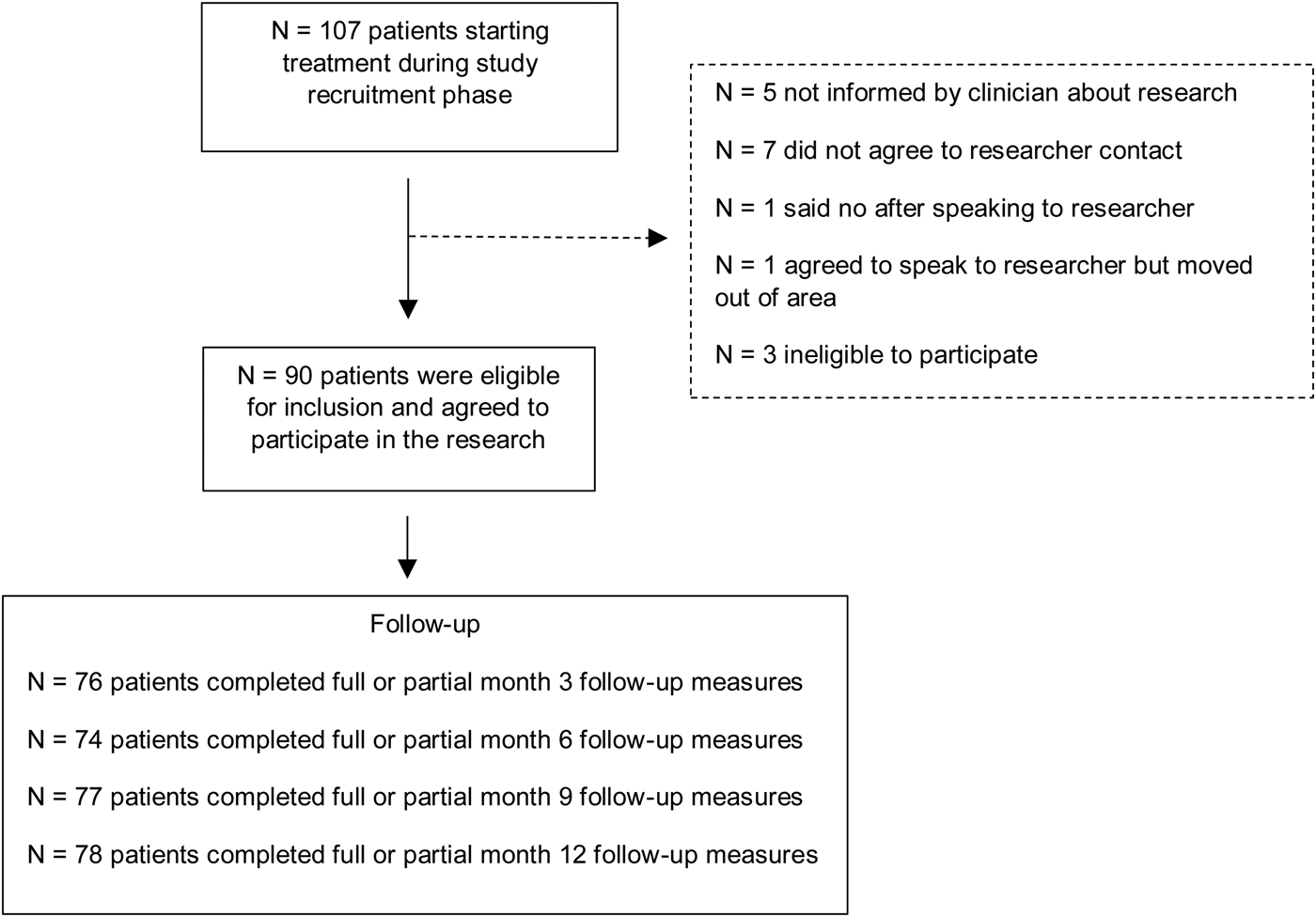
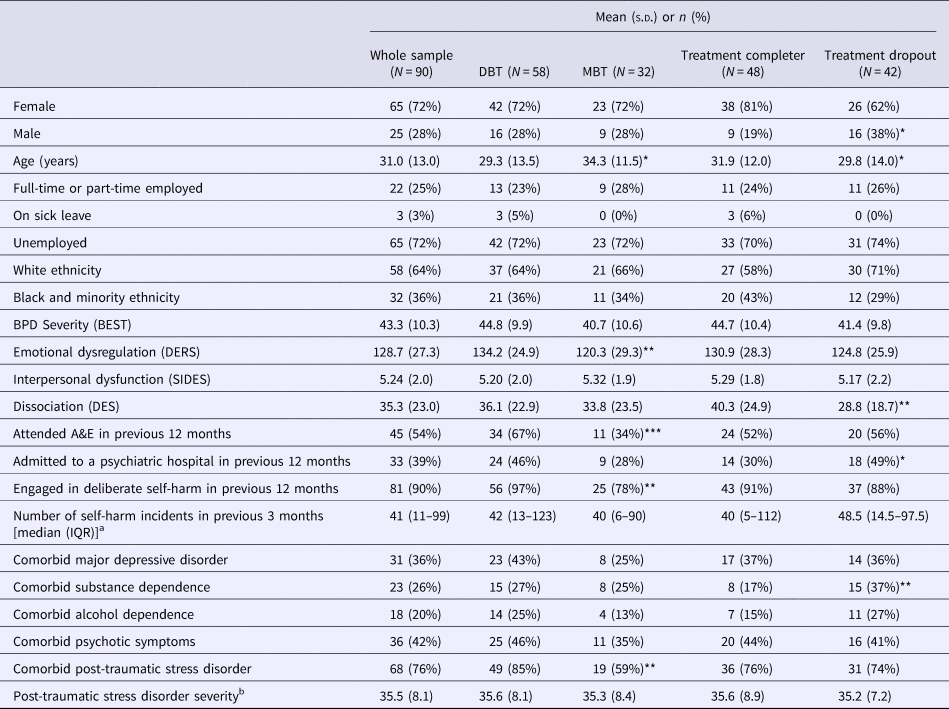
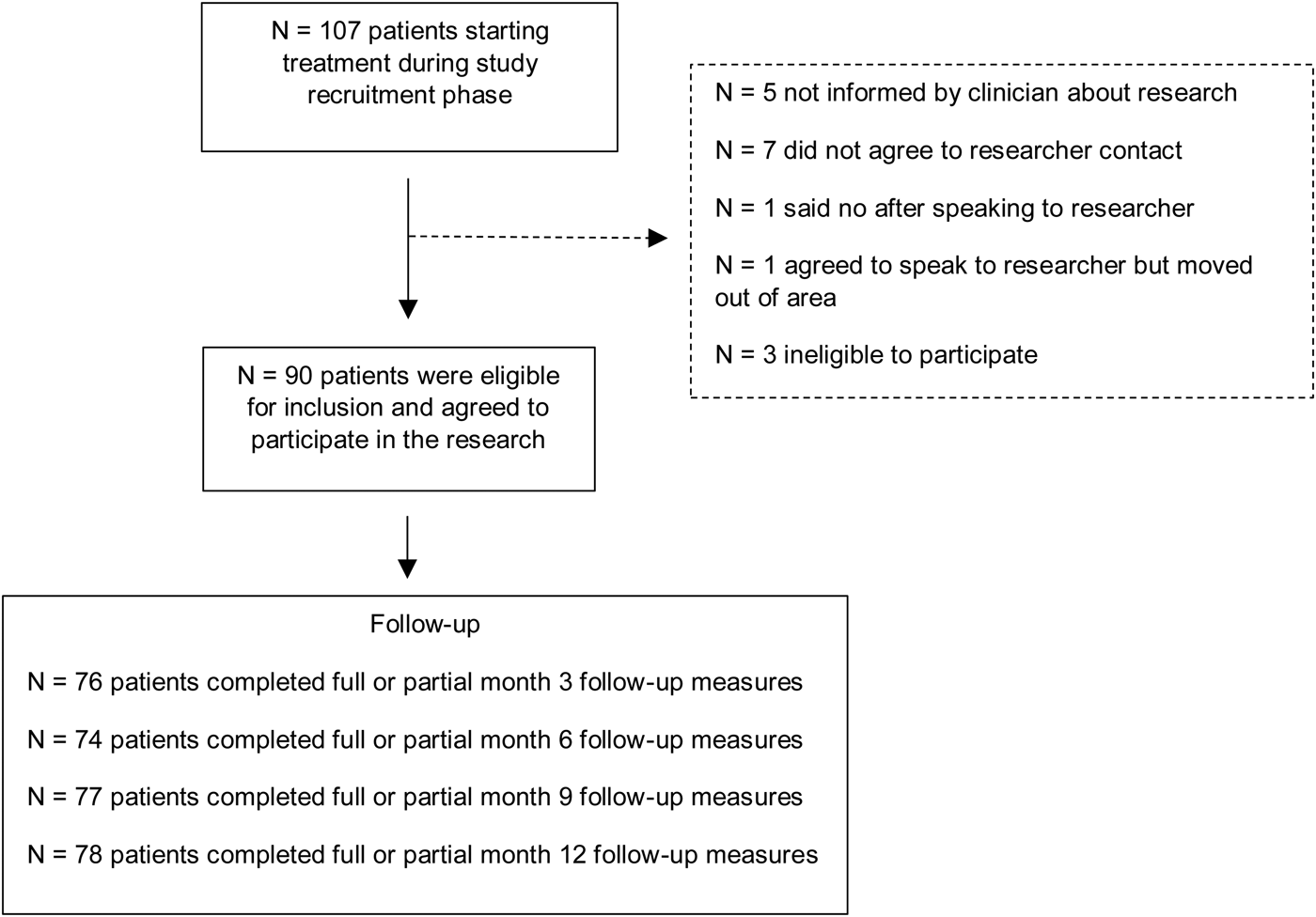
Recruitment into the research and follow-up rates are summarised in Fig. 1. Of 98 eligible individuals approached to take part in the study, 90 consented (consent rate 92%). The sociodemographic and mental health characteristics of the sample at the start of the study are summarised in Table 1, which illustrates the high levels of self-harming behaviour, emotional dysregulation, dissociation and Axis 1 comorbidities, with PTSD being particularly common.
Participant recruitment and follow-up.
Participant sociodemographics and mental health characteristics at the start of treatment

A&E, general hospital accident and emergency department; IQR, interquartile range.
a Including only participants who had a history of self-harm in the 12 months prior to treatment (N = 81) and provided data on the number of incidents of self-harm in the prior 3 months.
b Including only participants who met diagnostic criteria for post-traumatic stress disorder at the start of treatment (N = 68).
*p < 0.10; **p < 0.05; ***p < 0.01.
Differences between participants receiving DBT and those receiving MBT
Fifty-eight participants received DBT and 32 received MBT. Participants receiving DBT were more likely to have engaged in self-harm and/or to have attended A&E in the 12 months before treatment (self-harm OR 7.84, 95% CI 1.5–40.4, p = 0.01; A&E OR 3.82, 95% CI 1.50–9.71, p < 0.01), more frequently had comorbid PTSD (OR 3.73, 95% CI 1.4–10.1, p = 0.01) and began treatment with significantly higher levels of emotional dysregulation (β = 13.9, 95% CI 1.3–26.6, p = 0.03). There was a trend for participants initiating MBT to be older than those initiating DBT (β = −5.02, 95% CI −10.65 to 0.61, p < 0.10). These baseline differences between participants were adjusted for in subsequent analyses of differential outcomes in DBT and MBT patients.
Differences between participants completing treatment and those dropping out
Forty-eight participants completed at least 12 months of treatment, and 42 participants dropped out of treatment before completing 12 months. Participants who went on to complete at least 12 months of treatment were less likely to have met criteria for substance dependence (OR 0.36, 95% CI 0.14–0.98, p = 0.04), and reported higher levels of dissociation at the start of treatment (β = 11.5, 95% CI 2.0–20.9, p = 0.02). There were non-statistically significant trends towards treatment completers being more likely to be female (OR 2.60, 95% CI 0.99–6.77, p = 0.05) and less likely than dropouts to have had a psychiatric hospital admission in the 12 months before treatment (OR 0.46, 95% CI 0.19–1.14, p = 0.09). These differences between participants were adjusted for in subsequent analyses of differential outcomes in DBT and MBT patients.
Treatment dropout from DBT and MBT
Patients receiving DBT were significantly less likely to complete at least 12 months of treatment than those receiving MBT (completion rate 42% v. 72%; OR 0.28, 95% CI 0.11–0.72, p < 0.01). However, this difference was no longer significant after adjusting for baseline differences between DBT and MBT participants, using multiple regression models in which participants’ age, gender, baseline emotional dysregulation, dissociation, substance dependence and PTSD comorbidity, and history of self-harm, A&E admission or psychiatric hospitalisation in the 12 months before treatment were held constant (adjusted OR 0.23, 95% CI 0.05–1.04, p = 0.06). Subsequent analyses of differential outcomes in DBT and MBT patients adjusted for whether or not a participant had completed treatment.
Differences between DBT and MBT on clinical outcome measures at month 12
Clinical outcomes in DBT and MBT patients 12 months after starting treatment are shown in Table 2. At the 12-month follow-up, there were no differences between participants receiving DBT and those receiving MBT in number of incidents of self-harm, BPD severity, emotional dysregulation, relationships with others or dissociation. Participants receiving DBT were more likely to be admitted to A&E (OR 3.65, 95% CI 1.25–10.67, p = 0.02) and were more likely to have a psychiatric hospital admission (OR 13.74, 95% CI 2.59–72.76, p < 0.01) in the 12-month study period than patients receiving MBT. However, after adjusting for the potentially confounding effect of differences in treatment dropout and baseline differences in age, gender, self-harm, A&E and hospital admission history, emotional dysregulation, dissociation, PTSD and substance dependence, the difference between DBT and MBT was no longer significant.
Clinical outcomes at month 12

a Includes only participants who had a history of self-harm in the 12 months prior to treatment (N = 81) and provided sufficient data at month 12 to be included in the analysis.
b These differences between DBT and MBT recipients were no longer significant after adjusting for treatment dropout and baseline differences in age, gender, self-harm, A&E and hospital admission history, emotional dysregulation, dissociation, PTSD and substance dependence: p > 0.05.
*p < 0.05; **p < 0.01.
Association between treatment type and trajectory of change in clinical outcomes over time
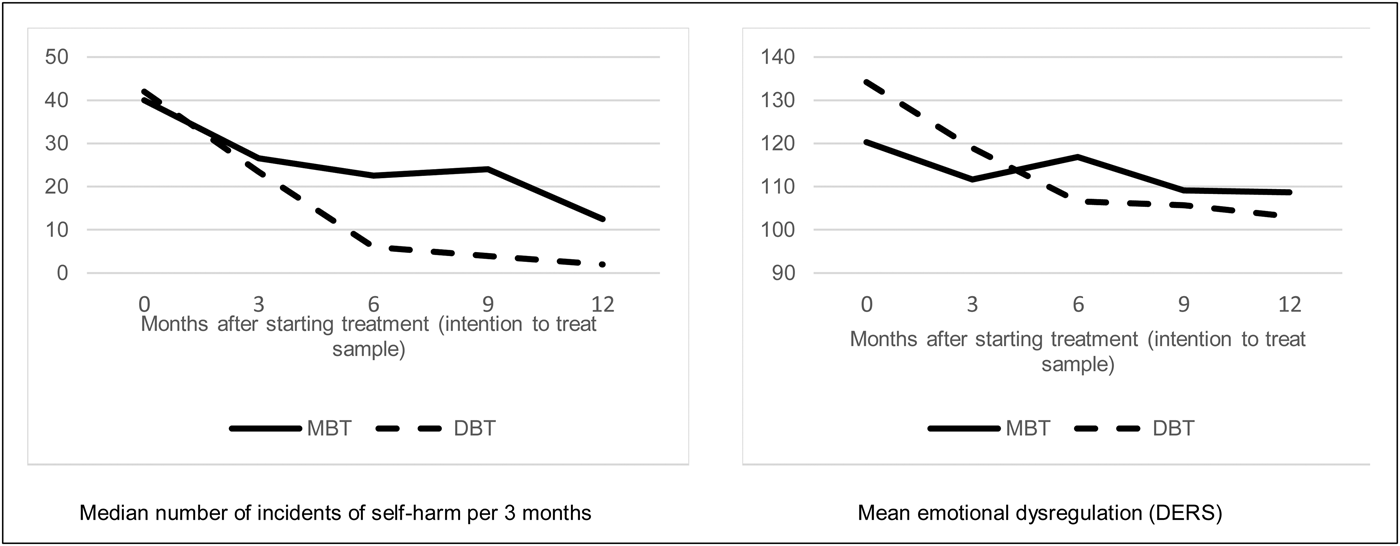
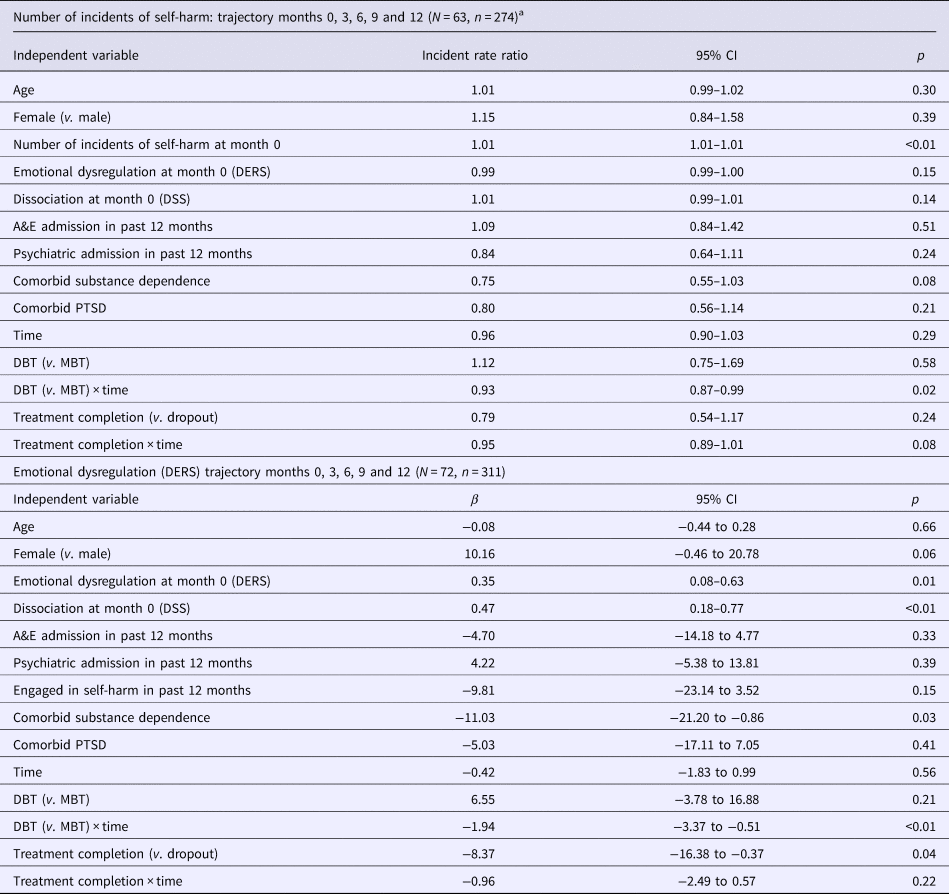
The unadjusted associations between treatment type and the trajectory of change in clinical outcomes over time are shown in online Supplementary Table S1. In unadjusted models, participants receiving DBT reported a significantly steeper decline over time in incidents of self-harm (IRR = 0.94, 95% CI 0.89–0.99, p < 0.01; Fig. 2) and in emotional dysregulation (β = −1.42, 95% CI −2.71 to −0.13, p = 0.03; Fig. 2) than participants receiving MBT. These differences remained significant in the final models which were adjusted for treatment dropout and for other potentially confounding differences between participants (Table 3). There was no difference between participants receiving DBT or MBT in the trajectory of change in BPD severity, interpersonal relationships or dissociation.
Change in incidents of self-harm and emotional dysregulation over time.

Adjusted associations between treatment type and trajectory of change in self-harm and emotional dysregulation

N = number of individuals with sufficient data to be included in analysis; n number of datapoints included in analysis.
a Based on a subsample of individuals who had a history of self-harm in the 12 months prior to treatment (N = 81) and provided sufficient follow-up data to be included in the analysis.
Discussion
Summary of findings
Patients receiving either treatment demonstrated comparable improvements in BPD severity, dissociation and interpersonal relationships. This is compatible with meta-analyses showing that different psychotherapy models tend to achieve equivalent results (Wampold, Reference Wampold2001), and indeed a trial comparing the effects of DBT to another specialised model for BPD, transference-focused psychotherapy, also found outcomes were largely equivalent (Clarkin et al., Reference Clarkin, Levy, Lenzenweger and Kernberg2007). However, despite the improvements achieved, even after completing 12 months of treatment, on average patients were still exhibiting high levels of emotional dysregulation, dissociation and interpersonal dysfunction.
Significantly fewer participants initiating DBT – just 42% – completed 12 months of treatment. However, this difference in treatment completion rates was no longer significant after taking account of differences between participants initiating DBT and those initiating MBT, such as the higher baseline levels of emotional dysregulation and greater likelihood of recent self-harm in the DBT participants. Thus, the more severe mental health difficulties of individuals entering participating DBT programmes compared with those entering MBT programmes are likely to have contributed to the higher treatment dropout rate amongst the DBT participants. Whilst treatment completion rates were substantially higher in US trials of DBT conducted by the treatment developer (e.g. 81%, Linehan et al., Reference Linehan, Armstrong, Suarez, Allmon and Heard1991; 83%, Linehan et al., Reference Linehan, Comtois, Murray, Brown, Gallop, Heard, Korslund, Tutek, Reynolds and Lindenboim2006b), completion rates in US trials in routine community services tend to be lower, ranging from 76% to 48% (Landes et al., Reference Landes, Chalker and Comtois2016), and other UK DBT evaluations have also found low completion rates (e.g. 36%, Zinkler et al., Reference Zinkler, Gaglia, Arokiadass and Farhy2007; 42%, Feigenbaum et al., Reference Feigenbaum, Fonagy, Pilling, Jones, Wildgoose and Bebbington2012; 48%, Priebe et al., Reference Priebe, Bhatti, Barnicot, Bremner, Gaglia, Katsakou, Molosankwe, McCrone and Zinkler2012). The considerably higher treatment completion rate of 72% amongst MBT participants is consistent with the high completion in MBT trials conducted by the treatment developer (88%, Bateman and Fonagy, Reference Bateman and Fonagy1999; 73%, Bateman and Fonagy, Reference Bateman and Fonagy2009).
Despite their higher treatment dropout rate, DBT participants reported a significantly steeper decline over time in incidents of self-harm and in emotional dysregulation. This remained significant after adjusting for treatment dropout, baseline levels of self-harm and emotional dysregulation – suggesting that this difference was not just an artefact of the greater level of baseline mental health difficulties amongst DBT patients. A further difference was that just over half of DBT patients attended A&E and a quarter experienced psychiatric hospitalisation during the study year – a substantially higher rate of crisis service use than the equivalent figures of 22% and 4% in MBT patients. Similarly, 43% of DBT patients attended A&E in the treatment developer's largest trial, and 20% experienced psychiatric hospitalisation (Linehan et al., Reference Linehan, Comtois, Brown, Heard and Wagner2006a, Reference Linehan, Comtois, Murray, Brown, Gallop, Heard, Korslund, Tutek, Reynolds and Lindenboim2006b). However, DBT participants were more likely to have had high baseline levels of emotional dysregulation, a recent history of A&E and to drop out of treatment – and after adjusting for these factors, differences in crisis service use between DBT and MBT were no longer significant. Thus, the findings do not suggest that DBT per se is less effective than MBT at reducing use of crisis services – but do highlight the more chaotic presentation of patients initiating DBT programmes than those initiating MBT programmes in our sample, and the problematic link between dropping out of treatment and poor clinical outcomes.
Implications for research and service provision
Whereas DBT focuses on reducing self-harm as the primary treatment goal, and explicitly teaches emotion regulation skills (Linehan, Reference Linehan1993a, Reference Linehan1993b), MBT aims to achieve these goals more indirectly, through the promotion of mentalising (Bateman and Fonagy, Reference Bateman and Fonagy2006). This may explain the more rapid change in these outcomes in DBT patients. Relatedly, patients’ use of the skills taught in DBT has been shown to mediate reductions in self-harming behaviour (Neacsiu et al., Reference Neacsiu, Rizvi and Linehan2010; Barnicot et al., Reference Barnicot, Gonzalez, McCabe and Priebe2016). Could DBT's explicit focus on targeting self-harm reduction and improving emotion regulation skills render it a more rapidly acting treatment for these difficulties? A large randomised controlled trial of DBT v. MBT is required to address this question. Such a trial should also evaluate potential common and specific treatment mechanisms between the two modalities.
Given the association between treatment dropout and poor outcomes amongst people with personality disorders (McMurran et al., Reference McMurran, Huband and Overton2010; Priebe et al., Reference Priebe, Bhatti, Barnicot, Bremner, Gaglia, Katsakou, Molosankwe, McCrone and Zinkler2012), preventing dropout could potentially improve outcomes. Yet no research to date has evaluated methods for improving completion rates when evidence-based psychological treatments for personality disorder are implemented in routine clinical practice. Previous research has identified that poor therapeutic alliance is one factor consistently predicting treatment dropout in patients with a personality disorder (Barnicot et al., Reference Barnicot, Katsakou, Marougka and Priebe2011), suggesting that patients’ inherent difficulties with trust and conflict resolution in attachment relationships may contribute. Another contributing factor could be that in the participating MBT services, only patients who attend the 10-week group programme, indicate their interest in further group-based treatment, and are judged by staff to have the potential to benefit from this approach are able to begin the full MBT programme. Thus, MBT patients were already selected as individuals with both the practical and emotional capability to sustain the commitment of attending treatment, whereas the DBT participants were a less selected group of individuals who may have varied more widely in their capabilities to commit. A recent audit at one of the participating MBT services found that over a 20-month period, 44 people initiated the 10-week group programme, of which 15 (34%) went on to initiate the full 18-month MBT programme. Whilst this figure does not represent dropout from the 10-week programme per se as some individuals will have completed the 10-week programme but chosen not to continue to the MBT programme, it does nonetheless suggest that incorporation of numbers discontinuing during the 10-week programme would make dropout rates from MBT more similar to those from DBT. However, individuals attending the 10-week programme did not take part in the present research project for both conceptual and practical reasons – namely, that the 10-week programme is a separate intervention in its own right and is not a part of the manualised MBT programme (Bateman and Fonagy, Reference Bateman and Fonagy2006), and also that the lengthy follow-up time required to follow participants up from the point of initiating the 10-week programme was not feasible within the scope of the present project and would make comparison with a 12-month DBT programme more challenging. Future research could investigate whether a similar brief pre-DBT group programme would improve treatment completion rates amongst patients referred to DBT. However, if only patients who successfully complete a brief pre-therapy programme are allowed to begin treatment, would this further limit patients’ access to evidence-based treatments for personality disorder, which are already difficult to access in many localities and non-existent in others (Dale et al., Reference Dale, Sethi, Stanton, Evans, Barnicot, Sedgwick, Goldsack, Doran, Shoolbred, Samele, Urquia, Haigh and Moran2017)? What alternative treatment will be offered to patients who lack the capacity to complete a pre-therapy programme?
Strengths and limitations
Strengths of the present research included the high consent and follow-up rates and recruitment of participants from services implementing evidence-based treatment in a real-world setting, increasing the ecological validity of the findings. Furthermore, the use of multi-level modelling to evaluate changes over time allowed use of a relatively large amount of repeated measures data (up to n = 395 datapoints from 90 individuals), increasing the study's power to detect differences in outcome trajectory, and allowed the inclusion of individuals with data missing at some timepoints, which should reduce bias in the model estimates (Sterne et al., Reference Sterne, White, Carlin, Spratt, Royston, Kenward, Wood and Carpenter2009).
The major limitation was that allocation to treatment was not randomised. Whilst efforts were made to control for confounding, it is possible that other unmeasured differences between study groups exist and these may have been responsible for differences in clinical outcomes. It is unclear how generalisable data from this study are to services beyond those participating, and it is possible that apparent differences in outcomes between MBT and DBT are due to the organisation and delivery of treatments at these services. BPD is a long-term condition and it is possible that clinical outcomes of patients receiving MBT and DBT in this study diverged further or converged after completion of the 12-month follow-up. A further limitation was that it was not possible to evaluate inter-rater reliability for the SCID, MINI or SAS-II interviews. Finally, we did not assess treatment fidelity in this study and it is possible that differences in clinical outcomes seen between these DBT and MBT services reflect differences in the quality of the treatment delivered, rather than to differences in the relative efficacy of these two treatment approaches.
Conclusion
Patients with BPD receiving DBT or MBT in routine community services can achieve improvements in BPD traits, self-harm, emotional dysregulation, dissociation and interpersonal relationships. There may be differences in the extent and speed of reductions in self-harm and emotional dysregulation amongst those offered DBT and MBT, but experimental studies examining treatment fidelity, mechanisms and longer term outcomes are needed to fully examine potential differences in the clinical and cost-effectiveness of these treatments.
Supplementary material
The supplementary material for this article can be found at https://doi.org/10.1017/S0033291718002878.
Acknowledgements
The authors gratefully acknowledge the vital contribution of clinicians and patients from participating clinical services, and in particular thank Laura Couldrey, Jeantique Hommel and Lauren Bryan for their assistance with data processing.
Financial support
The present study was funded by a Postdoctoral Research Fellowship awarded to KB from the United Kingdom National Institute for Health Research: PDF-2013-06-054.
Conflict of interest
None.
Ethical standards
The authors assert that all procedures contributing to this work comply with the ethical standards of the relevant national and institutional committees on human experimentation and with the Helsinki Declaration of 1975, as revised in 2008. Ethical approval for the study was granted by the United Kingdom National Health Service National Research Ethics Service Committee South East Coast – Surrey on 06/02/2014, reference number 14/LO/0158, and by the Research and Development departments of the participating NHS Trusts. All participants gave written informed consent for participation.