




No CrossRef data available.
Article contents
The Evolution of Suffrage Institutions in the New World
Published online by Cambridge University Press: 22 November 2005
Abstract
Extreme variation in the extent of inequality emerged early across the New World colonies established by the Europeans, and we hypothesized in previous work that these contrasts persisted over time through systematic differences in the ability and inclination of elites to shape legal frameworks to advantage themselves. We find support for this view in how the rules governing the extension of suffrage evolved over time within the United States, and across the societies of the Americas. Polities with labor scarcity and greater equality generally led in broadening the franchise and attaining high rates of participation in elections.
Information
- Type
- ARTICLES
- Information
- Copyright
- © 2005 The Economic History Association
It has long been recognized that the conduct of elections, including who holds the right to vote, is one of the most crucial of institutions. Varying the rules or organization of how votes are cast and of who casts them can have a fundamental impact on the policy choices that the elected representatives—who in some sense constitute the collective government of the electors—make. As governments generally have a monopoly of power over certain important activities, there are often major implications for how a society's resources or wealth is distributed across the population, as well as for the pace of economic growth. Given what is at stake, it should not be surprising that throughout history many have fought and died over both the design of the rules and the outcomes of elections.
In recent years there has been a renewed appreciation of how democratic rules for electing government representatives might contribute to different paths of institutional and economic development, and a particular focus on the background to, and consequences of, decisions to extend the franchise. Where an economic elite wields highly disproportionate political power, or a political elite exploits its position for economic advantage, a broadening of political influence through an extension of the franchise could diminish its material standing.1
Alesina and Rodrik, “Distributive Politics”; and Persson and Tabellini, “Is Inequality.”
Acemoglu and Robinson, “Why Did Western Europe”; and Lizzeri and Persico, “Why Did Elites.” See Justman and Gradstein, “Industrial Revolution,” for yet another view.
This view that it might be in the interests of the politically powerful to freely choose to share their authority has a rich tradition in American history. Frederick Jackson Turner is but the best-known proponent of the idea that the special characteristics of frontier society nourished the evolution of democratic institutions. By his argument, not only did the greater equality prevailing on the frontier inspire demands for broad access to opportunities, but also the scarcity of people meant that local and state governments were extremely concerned with attracting migrants. Because population inflows would lower the cost of labor, and boost land values and tax revenues, frontier societies were induced to adopt institutions congenial to newcomers. Among the conditions that appealed most to migrants were cheap land and full participation in the election of government representatives.3
Turner Rise and Frontier.
Many scholars have posited a relation between the breadth of the franchise, or of the distribution of political influence more generally, and the choices governments make about public policies, such as how the tax system is structured, what public services to provide, or how to define and enforce property rights.4
Tocqueville, Democracy, provides a classic discussion. Musgrave, Fiscal Systems, discusses patterns of change in government expenditures after the extension of suffrage in many nations over the twentieth century. For other more recent examples of a vast literature, see Acemoglu and Robinson, “Why Did Western Europe”; Barro, Determinants; and Perotti, “Growth.”
Acemoglu and Robinson, “Why Did Western Europe”; Benabou, “Unequal Societies”; and Saint-Paul and Verdier, “Education.” The construction and maintenance of a rich cross-country data set for the modern period has tended to focus attention on the experience of the late twentieth century, to the neglect of processes that play out over long periods of time. See Summers and Heston, “Penn World Table.”
We may all agree that suffrage institutions have an impact on development, but our understanding of that relationship will vary with why the institutions evolved at the times and places they did. In order to improve our knowledge of the origins of institutions, this article examines how the rules governing the extension of suffrage evolved in the Americas, across countries and over time. The substantial variation in the initial characteristics of these societies, and the shocks associated with European colonization of the New World, make for a wonderful natural laboratory to study the conditions that gave rise to more democratic political institutions.
That there was extreme variation across the New World in the evolution of social and economic institutions cannot be doubted. Over the sixteenth through the eighteenth centuries, Europeans established colonies throughout the Americas as part of a worldwide effort to economically exploit underpopulated or underdefended territories. Nations and private agents set about extracting economic and other advantages from unfamiliar types of environments, and there was great diversity in the characteristics of the societies and institutions that evolved. Common to all of the New World colonies was a high marginal product of labor and, for that era, high per capita income. Among the crucial dimensions in which colonies differed, however, was in the homogeneity of the population and in the extent of inequality in the distributions of income and human capital.6
For excellent surveys of the early development of the colonies in the New World, see Galenson, “Settlement”; and Lockhart and Schwartz, Early Latin America.
In previous work we argued that the substantial variation across these colonies in their initial degrees of inequality was largely attributable to factor endowments broadly conceived.7
Engerman and Sokoloff, “Factor Endowments, Institutions” and “Factor Endowments, Inequality.” Contemporary estimates indicating that Latin America has, as a region, the greatest degree of income inequality in the world today make it clear that the extreme disparities of the colonial era have persisted to the present day. See Deininger and Squire, “New Data Set.”
We hypothesized, moreover, that the exceptional differences in the degree of inequality across the societies of the Americas, rooted in their respective factor endowments and evident during the colonial era, came to be reflected in the institutions that evolved. In our view, the more disproportionate their claims to resources and political influence, the more effective elites in any society were in shaping legal frameworks and state policies to advantage themselves relative to the rest of the population. In what follows, we show that the early patterns of the extension of the franchise, the proportions of the respective populations voting, and other aspects of the conduct of elections across the Americas are indeed generally consistent with our argument. Specifically, where there was greater inequality or heterogeneity, the proportion of the population that had the right to vote was generally lower, and the extensions of this right from elite groups to a broad population generally occurred later, than in areas where a scarcity of labor encouraged measures to attract migrants or where there was relative homogeneity in the population. These relationships, which seem to have held both across the individual states of the United States as well as across the hemisphere, are all the more striking because most of the New World societies were at least nominally democracies by the middle of the nineteenth century, and had embraced the rhetoric of revolution and modernization during their respective movements for independence. Only a few, however, would extend to most of the population the right to vote and to political influence before the twentieth century.
THE UNITED STATES
Despite the sentiments popularly attributed to the Founding Fathers of the United States, the formal or conceptual differences across New World societies in who had the right to participate in community decisions were not large as late as the end of the eighteenth century. The British colonies on the mainland, like those elsewhere in the hemisphere, reserved the privilege of voting to white adult men with significant holdings of real estate, although differences in the extent of inequality in landholding across colonies as well as in the specified thresholds meant that the same sort of limitation on the franchise implied very different proportions of the population eligible to vote.8
Porter, History; and Williamson, American Suffrage.
See Williamson, American Suffrage, for a discussion of precedents, as well as of the range of “freehold” requirements in the colonies. Long-term leases, extending beyond a lifetime, sometimes satisfied such qualifications.
The notion that communities were like corporations was perhaps most appropriate in colonies.
Two general considerations might be said to have framed the political debates that guided the changes in the qualifications for suffrage across the British mainland colonies. One focused on the individual and was concerned with what characteristics gave a person the “right to vote,” for example, ownership of property, the payment of taxes, residency, or simply being an adult white male. The other general issue was what would be good for the community or the society. Would it be in the best interests of the society for nonresidents, non-property holders, women, illiterates, criminals, or non-church members to be allowed to vote? Overall, the dominant trend over the colonial period was the movement away from the idea that the right to vote should be based solely on the ownership of land. There was a growing appreciation, especially in urban settings, of how suffrage qualifications specified along this single dimension might exclude otherwise appropriate individuals. Over time, colonies began to introduce means of substituting other assets to meet property requirements, and this development ultimately led to the acceptance of economic qualifications based on the amount of tax payments. In no colony, however, was there a serious challenge to the notion that suffrage should be restricted to property owners.11
There were often different qualifications for local than for colony-wide elections, and Williamson (American Suffrage) has suggested that one reason was to increase the pool of individuals who could serve as local officials.
All 13 colonies maintained some sort of property qualification for the franchise on the eve of the American Revolution. Georgia, North Carolina, Virginia, New Jersey, New Hampshire, New York, and Rhode Island had minimum real estate requirements, specified in terms of either acreage or value. The remaining six colonies allowed for more flexibility, with the property requirement allowing either landholding, ownership of some other property exceeding a specified minimum, or (in the case of South Carolina) payment of a certain amount of taxes. Given the issues at stake in the conflict between the 13 colonies and Britain, it should not be surprising that the question of suffrage reform was central to many of the vigorous debates after the Revolution about the organization of state governments, which were sparked by the need for the now independent colonies to establish frameworks for governance. Although some states, such as Rhode Island, merely carried over the voting qualifications in place during the colonial era, eight of the 13 made substantial changes through the constitutions they adopted during the Revolutionary era. Most moved in the direction of expanding the franchise somewhat, such as by providing for alternative ways of meeting standards for property holders or adopting differential requirements for elections to different posts (such as New York's having higher property requirements for the election of state senators and the governor than for the election of members of its assembly), but only Pennsylvania eliminated wealth qualifications (replacing them with a taxpaying requirement).12
Economic-based qualifications for suffrage were not the only way wealthier classes were granted privileged status as regards political standing. In 1787 all of the 13 states except Pennsylvania had economic qualifications for holding office. In six of the 12 (Maryland, Massachusetts, New Hampshire, North Carolina, New Jersey, and South Carolina) the property requirements were considerably higher for serving as governor, senator, or as a representative than they were for voting. See McGovney, American Suffrage Medley, chap. 1; and Miller, “Legal Qualifications.”
The paucity of detailed information on the distribution of wealth poses severe challenges for anyone hoping to construct precise estimates of how these changes in the laws governing suffrage impacted the numbers of eligible voters, but many scholars seem to believe the de facto effects were modest.13
Porter, History, chaps. 1–2. Williamson, American Suffrage, appears to be more impressed with the conceptual import of the legal changes during the Revolutionary era than was Porter, but skeptical about their direct impact. McGovney, American Suffrage Medley, suggests that roughly half of the adult white male population was eligible to vote in 1787. Sydnor, Gentleman Freeholders, has a similar estimate for Virginia. Although recognizing the trend toward easing property requirements, Keyssar, Right, suggests that the proportion of the population eligible to vote may have decreased over the late eighteenth century because of the growing numbers of relatively poor urban workers.
In general, the major institutional innovation of doing away with all suffrage qualifications related to property, or economic standing more generally, was led by new states entering the Union (see Table 1). Not a single state that entered the union after the 13 colonies had a property requirement for the franchise, and although a few adopted tax-based qualifications, it was only in Louisiana that the restriction was a serious constraint and endured very long. Most of the original 13 states (all but Rhode Island, Virginia, and North Carolina) eliminated property qualifications by the middle of the 1820s, but tax-based requirements for suffrage (and for the holding of public office) lingered on in many of them into the middle of the nineteenth century and beyond. Of the states formed of the originally settled areas, the leaders in doing away with economic-based qualifications for the franchise were those that were sparsely settled and on the fringe (Vermont, New Hampshire, and Georgia).

The spirit of the Revolution undoubtedly contributed to the movement for the extension of the franchise, but the rather systematic pattern of where the changes were made seems significant and deserves attention.14
Although many observers during that era noted how the new states, and especially those in the West, were more democratic in their suffrage laws and in other respects, Frederick Jackson Turner (Rise and Frontier) was perhaps the first major scholar to examine why they did so, and their effects on the old states: “The frontier States that came into the Union in the first quarter of a century of its existence came in with democratic suffrage provisions, and had reactive effects of the highest importance upon the older States whose peoples were being attracted there.” See Turner, Frontier, p. 30. Williamson, American Suffrage, was skeptical of the notion the West was unique, however, and suggested that the prevalence of universal suffrage in the frontier states may have been due to the difficulty of establishing freehold rights in a newly settled area where land titling was imperfect and recent. It is interesting, however, that this pattern of frontier states providing broader access to suffrage, and to property rights, was repeated later in these states' more liberal treatment of women. See Lott and Kenny, “Did Women's Suffrage”; and Khan, “Married Women's Property Laws.” See McCormick, “New Perspectives” and Second American Party System, for discussion of the variation over state and time in the proportion of adult white males who voted.
See the discussion in Keyssar, Right.
Scarcity of labor is a condition characteristic of frontier areas, as well perhaps of newly settled regions with small native populations, that might have encouraged new states to place fewer restrictions on who had the right to vote. Nearly all of the residents of such territories or states, and certainly property holders and the elite more generally, would have had a strong interest in attracting more people to settle there. If the right to participate in the political process was desirable to potential migrants, the new states thus had an economic incentive to adopt liberal suffrage provisions as a lure.16
The significance of this incentive is dramatically illustrated by the movement of states in the Midwest, such as Wisconsin, Michigan, Indiana, Kansas, and Minnesota, to ease residency requirements for aliens. After Wisconsin (which had the highest proportion of foreign born in its population of any state in 1850) moved first in 1848, Michigan and Indiana soon followed. See the discussion in Keyssar, Right, p. 33.
McCormick, Second American Party System, p. 326, concludes that voting rates in the new states were “on the whole above the national average, except in 1832,” even after most of the older states adopted universal white male suffrage. For an example of how immigrants valued easy access to suffrage and citizenship, see Kamphoefner, Helbich, and Sommer (News, p. 166): “This time we have elected the famous General Grand [sic]. I also voted for him; may God grant him the wisdom & understanding & moderation & strength to govern this troubled country for the best. I can't help saying that I feel proud at the thought of being an American citizen … It is a wonderful feeling to realize that you can replace a hateful government with another one.”
This was less true in the southern states, but the extension of suffrage to all adult white males had the additional benefit in such areas of strengthening solidarity among the white population. See Davis and North, Institutional Change, for discussion of the Northwest Ordinance; and Gates, History, for discussion of land policies. Support for public schools and other publicly provided goods might be considered as other means of offering greater opportunities to potential migrants. Although many factors were involved, and the relationships were undoubtedly complex, the West had a rather good record overall. For evidence on regional patterns in the development of public schools, and in the regulation of entry into the financial sector, see Fishlow, “Common School Revival”; and Rockoff, “Free Banking Era.” Of perhaps particular relevance here is Fishlow's account of how it was in the West that the public sector played an especially important role in promoting primary schooling during the antebellum period.
In the words of Wittke (We Who Built America, pp. 105–06), “In the middle of the last century, the Middle West needed population above everything else. To attract desirable immigrants was the overpowering ambition of practically every new state in this region. State after state began to enact legislation to encourage and stimulate migration to its borders artificially. The attractions offered by favorable legislation and the persuasiveness of the agents of state immigration commissions were important factors in explaining the immigrant tide into the Mississippi Valley. By its constitution of 1850, Michigan gave the franchise to all newcomers who had declared their intention to become naturalized and who had resided in the state for two and a half years. Its immigration agency, established in 1848 and not abolished until 1885, issued attractive pamphlets in German, and its first immigration commissioner was instructed to spend half his time in New York and half in Stuttgart, Germany. Wisconsin had a special commission as early as 1851… The Wisconsin Constitutional Convention of 1846 gave the franchise to immigrants after a declaration of their intention to become naturalized and one year's residence in the state.” Billington saw similar processes at work in the South during the early decades of the century (Westward Expansion, p. 324), “The ‘Great Migration’ into the Gulf Plains made statehood possible for both Mississippi and Alabama. Mississippi acted first, for its concentrated population was able to apply greater pressure, and in 1817 entered the Union; Alabama followed two years later. Both adopted constitutions reflecting the leveling influence of the frontier. Neither required property for voting; both granted the franchise to all male whites residing there one year. Each made the legislative supreme over the governor—whose veto of any act could be overridden by a simple majority vote—and vested in that elective body power to appoint most state officials including judges. Representation in the assemblies was apportioned on the basis of free white population, thus giving the planter no advantage over the small farmer in government matters. The liberalism of the constitutions served as an additional inducement to settlers.” Also see Hibbard, History of the Public Land Policies.
Elites in labor-scarce frontier areas should have been more strongly motivated to attract migrants and stimulate population growth than their counterparts in long-settled areas, but there may have been other mechanisms at work linking labor scarcity to broader suffrage institutions as well. For example, as one would expect in places with a relative abundance of land and scarcity of labor, frontier areas were characterized by greater equality or homogeneity among the population.20
For evidence of the relative equality of populations in frontier states, see Soltow, Men; Newell, “Inheritance”; and Kearl and Pope, “Choices.” Also see Galenson and Pope, “Economic and Geographic Mobility,” for evidence on the returns accruing to early settlers from in-migration to frontier or labor-scarce areas.
The movement toward universal white adult male suffrage, or the elimination of all economic-based qualifications for the vote, began when Vermont and Kentucky joined the United States in 1791 and 1792. Perhaps inspired by her neighbor, in 1792 New Hampshire— which resembled a frontier area in many respects—swept away the taxpaying qualification that it had previously adopted (in 1784) to replace a rather high property requirement. Although making suffrage reform a live issue of political debate, these states did not immediately attract a flood of imitators, especially because both Pennsylvania and South Carolina had in 1790 adopted new state constitutions which maintained, in slightly weakened forms, qualifications that were primarily tax-based.21
During the last decade of the eighteenth century, Tennessee joined the union with a freehold requirement (but one that was waived for those who had been resident for six months) for the suffrage, and Delaware and Georgia revised their laws to set the payment of a state or county tax, or of any assessed taxes, as the test. See Porter, History; Williamson, American Suffrage; McCormick, “New Perspectives”; and Keyssar, Right.
The suffrage issue was of course only one of a number of important issues that divided the population, and the coalitions that formed to fight political battles were somewhat different in each state. In general, however, the struggles over economic-based restrictions on the franchise were more intense, and extended over much longer periods, in the older states, such as Massachusetts, New York, Rhode Island, and Virginia. The new entrants to the union, in contrast, rarely adopted meaningful economic requirements for the suffrage during this era.22
After Tennessee, the next state to join the union was Ohio, in 1803, which required of its voters that they had paid a county tax or else worked on the public highway.
It is notable that Louisiana failed to follow the examples of its southern neighbors such as Georgia, Maryland, and South Carolina, which had formally or effectively done away with economic-based requirements and allowed white adult males to qualify for suffrage by length of residency in 1798, 1802, and 1810 respectively. The changes in these state constitutions to extend the suffrage were highly controversial, with the alignments in favor and in opposition not corresponding all that strongly with political party. Some other reforms dealing with the conduct of elections, such as the introduction of balloting (as opposed to voice votes) and the expansion of the number of polling places were also introduced at about the same time. In South Carolina, the movement for suffrage reform coincided with concern about the possibility of war with Britain and seems to have benefited somewhat from the view that those who bore arms in the militia should be able to vote. See Williamson, American Suffrage, chap. 8.
Louisiana notwithstanding, the innovations in suffrage laws over the first two decades of the United States signify a critical juncture. The use of wealth as a basis for distinguishing who should vote was clearly becoming less viable, and the ultimate fate of such qualifications was becoming clear.24
Mississippi, in 1817, was the last state to enter the union without universal adult white male suffrage, and from then on the maintenance of economic-based restrictions was largely a holding action. Many of the original 13 states replaced wealth qualifications with tax-based requirements, but it is not clear how binding they were. Of course, the use of poll taxes expanded greatly in the late nineteenth and early twentieth centuries as a way of obstructing blacks and immigrants from voting.
See the discussion in Keyssar, Right, chap. 3. We make reference to the significance of “homogeneity” and “heterogeneity” throughout this article, even though they are rather subjective concepts and difficult to measure. The terms are useful for us, and for social scientists generally, because they encompass variation along many dimensions of individual characteristics, including those we think were especially important for social and legal standing across the Americas during the period under study: race or ethnicity, gender, and economic status. We recognize, however, that the salience of any of these characteristics may vary with context. Groups that seem obviously distinctive in one context, may not seem so different in another. See the insightful discussions of this and related issues in Benton, Law, especially chap. 2.
Indeed, it was typical for a package of reforms affecting the composition of the electorate to be adopted altogether, with the requirements for length of residence and mental health strengthened to offset the effects of lower economic-based qualifications. It is notable that despite virtually all of the new states beyond the original 13 entering the union with weak or no economic-based requirements for the franchise, Kentucky (and it only for a brief period) and Vermont were the only ones that allowed blacks to vote. The list of those that never allowed blacks to vote before the Fourteenth Amendment include California, Colorado, Illinois, Indiana, Iowa, Kansas, Michigan, Minnesota, Missouri, Nebraska, Nevada, Ohio, Oregon, Utah, Wisconsin, as well as all of the southern states.
See the discussion in Porter, History, chaps. 2–4; and Stampp, America, p. 134. In some states, Indians who were living in tribes or who had not paid taxes were specifically excluded from voting.
Indiana, Illinois, and Missouri were brought into the nation between 1815 and 1820. None had any suffrage qualification related to wealth or to tax payments. There was little support within the relatively homogenous populations of the western states for drawing a line to distinguish the franchised from the disfranchised among white adult males; indeed, a modest proposal to require a tax payment was voted down resoundingly in the Missouri constitutional convention of 1820. After Ohio in 1803, no northern state admitted to the union came in with a property or taxpaying qualification (and no southern state, after Mississippi in 1817). Residency requirements, strictures on race, gender, and age, as well as disqualifications for infamous crimes were the only constraints on suffrage imposed in the more newly settled areas. Lines continued to be drawn, but the population was increasingly skeptical of basing them on purely pecuniary factors.28
Maine, once part of Massachusetts, joined the United States in 1819, and its constitutional convention issued a public statement describing its stand on the question: “Pecuniary qualifications have been productive of little benefit; sometimes of injustice. They are too often relaxed or strained to suit the purposes of the day. The convention has therefore extended the right of suffrage, so that no person is disqualified for want of property unless he be a pauper.” See Porter, History, pp. 50–51. Of the two new southern states established during these years, Alabama made no reference to property in its suffrage laws, but Mississippi did adopt a requirement of either a tax payment or service in the state militia (one that was abandoned in 1832). Both devoted considerable attention to specifying which classes of the population could vote, and which—including various classes of criminals—could not.
Property- or tax-based qualifications were most strongly entrenched in the original 13 states, and dramatic political battles took place at a series of prominent state constitutional conventions held during the late 1810s and 1820s. For example, although the Committee on Elective Franchise to the New York State convention of 1821 had recommended the abolition of all property distinctions (requiring of voters only virtue and morality), opponents of universal suffrage put up a spirited defense. After lengthy discussion, and a strong vote against an explicit property qualification, a compromise plan that offered a wide set of alternatives was enacted: a voter must have paid a state or county tax, or have performed military service, or have worked on a public highway, or have lived three years in the state (instead of the ordinary one-year requirement); in 1826, these qualifications were dispensed with in favor of universal white adult male suffrage for residents.29
See the discussions in Porter, History; Williamson, American Suffrage; and Chute, First Liberty. Most of the so-called founding fathers were believers in property requirements. Benjamin Franklin and Thomas Jefferson were in the minority.
See Keyssar, pp. 71–76, for a discussion of the Dorr War in Rhode Island. He argues that the emergence of a significant working class population made the question of whether to do away with economic qualifications a much more problematic proposition for elites.
Vigorous political struggles were necessary to do away with property or tax-based qualifications in the majority of the original 13 states, but the restrictions were incrementally but continuously eroded—often to the point of a token tax payment of a dollar or two. Because of our limited knowledge about patterns of wealth holding and of tax payments, and because of shifts in the regional distribution of the population, it is difficult to construct precise estimates of how the eligible pool of voters changed over time. As shown in Table 2, however, comparisons of the number of votes cast with the adult white male population indicate that a very high rate of voter participation was realized rather early in the nineteenth century. These figures suggest that by 1820 more than half of adult white males were casting votes, except in those states that still retained property requirements or substantial tax requirements for the franchise—Virginia, Rhode Island (the two states that maintained property restrictions through 1840), and New York as well as Louisiana.31
Ohio seems also to have had a low rate of voting before 1824, but not afterwards. It is not clear why. It did maintain a requirement that adult white males had to have paid a state or county tax, or been compelled to labor on the “roads” in order to have the right to vote. However, that requirement was not repealed until 1851, long after the rate of voting had risen sharply to levels above the regional average.
This view helps to explain why the right to vote may have been so important to populations in recently settled or rapidly growing areas. Residents would likely have strong interests in public projects, and naturally value the ability to directly influence local and state officials. The evidence of high rates of voting in local and state elections, despite the presumably high cost of going to the polls in that era, is consistent with the observations of Tocqueville (Democracy, p. 243), who was much impressed with how involved Americans were in local political affairs and governance: “The greatest political movement which keeps American legislatures in a state of continual agitation, and which alone is noticed from the outside, is only an episode and a sort of extension of the universal movement, which begins in the lowest ranks of the people and thence spreads successively through all ranks of citizens. No one could work harder to be happy. It is hard to explain the place filled by political concerns in the life of an American. To take a hand in the government of society and to talk about it is his most important business and, so to say, the only pleasure he knows.”
For discussion of the long-term decline in voter participation during the late nineteenth century, see Kornbluh, Why America.

By 1840 only three states retained a property qualification, North Carolina (for some state-wide offices only), Rhode Island, and Virginia. In 1856 North Carolina was the last state to end the practice. Tax-paying qualifications were also gone in all but a few states by the Civil War, but they survived into the twentieth century in Pennsylvania and Rhode Island.34
Porter, History, chap. 4.
The institution of literacy tests was not confined to the South. During the 1850s Connecticut and Massachusetts instituted literacy tests directed primarily at immigrants. However, the major move toward introducing literacy tests occurred later, between 1889 and 1926, when 16 other states, seven southern and nine nonsouthern, did so. Blacks were the principal group target for exclusion in the South, Asians in the West, and immigrants from Europe in the North-east.
See Kousser, Shaping.
It is relevant to note that after emancipation, the British colonies in the West Indies generally increased the levels of wealth required to be eligible to vote. The result, as seen in Table 3, was very low proportions of the population voting in elections.

Of course much of the concern with the factors influencing the evolution of suffrage institutions arises from the belief that as the composition of the electorate changed, so did the types of policies adopted by the elected representatives. In principle, the movement away from economic qualifications for the franchise should have led to laws that were more favorable to the less wealthy, and indeed there is much evidence in support of this view. Historians of education in the United States, for example, typically highlight the fact that the common school movement was one of a number of campaigns for democratization in various social and economic policies that coincided with, or followed shortly, after widespread extension of the suffrage. Although there had previously been scattered successes in achieving the goal of universal access to a primary education, the movement is usually dated as beginning about 1825 and ending about 1850, by which time virtually every northern state had passed and implemented laws to encourage townships or counties to establish tax-supported common schools that were “free” to all who wanted to attend. This 25-year period was marked by intense political struggle in state after state, with especially strong support coming from urban dwellers, members of labor organizations, and residents of western states—groups that are most likely to have benefited from the establishment of the schools, as well as from the extension of the franchise. Opposition is said to have come primarily from the wealthier classes who bore disproportionately more of the increases in the taxes needed to fund the schools.38
See Cubberley, History; as well as the discussion in Soltow and Stevens, Rise.
See Table 4.
LATIN AMERICA
The weakening and ultimate removal of wealth-based restrictions on the franchise were clearly important in raising the fraction of the population voting in U.S. elections. The United States had the highest proportion of the population voting in the world by the middle of the nineteenth century, and together with its spread of more secrecy in balloting and other reforms in the conduct of elections, arguably the most equal distribution of political influence. None of the Latin American countries, which were characterized from the early colonial period by much greater inequality, would attain this rate of suffrage for another 75 years. Indeed, throughout the hemisphere, only Canada, where similar movements for the extension of the franchise with similar outcomes lagged those in the United States, was much of a rival in political participation. As is evident from Table 3, the United States had perhaps one-and-a-half times the rate of population voting as did Canada, and eight or more times the rate as elsewhere in the hemisphere (including other British colonies). Given that most of these societies were at least nominal democracies, it is important to ask where this profound gap in political participation came from.
The chief issue is whether the contrasts in the proportions of the population voting were due to differences in the numbers eligible to vote under law, or to some other disparity in conditions. If attributable to differences in qualifications for the suffrage, what accounted for the differences in the laws? Even a cursory examination is sufficient to demonstrate that the requirements for voting were much more restrictive elsewhere in the Americas than in the United States or Canada. Qualifications based on wealth or income were very common throughout Latin America during the early 1800s, but over time the requirement of literacy came to be virtually universal in Latin America as well. These latter strictures, which were generally set forth as qualifications for being a citizen, effectively barred the great majority of wage-earners, whether urban or rural, and of Native Americans from voting. In such a legal environment, and with extremely low literacy rates (perpetuated by very limited support for public schools) and with unequal distributions of land and wealth, it is not surprising that the proportions of the populations voting were no higher than 1 or 2 percent until late in the nineteenth century.
The independent Latin American nations maintained the same political institutions and policies in place during the colonial period when they excluded non-property owners from the legal standing to vote. Although the Spanish Crown had appointed the chief officials in its colonies, municipal councils (cabildos) were charged with responsibility for providing local public services and granted the authority to levy taxes to pay for them. These councils were primarily composed of appointments from the ranks of prominent citizens (vecinos) of the municipality or pueblo, but some members were selected by election. Participation in such elections (and frequently membership on the council as well as the holding of other offices) was generally restricted to substantial landowners (and sometimes even confined to the council members themselves).40
See, for example, the discussions in Stein and Stein, Colonial Heritage; Lockhart and Schwartz, Early Latin America; and Bayle, Los Cabildos Seculares.
As in the United States, however, the nature of the suffrage qualifications changed over time. Restrictions that had typically been specified in terms of land ownership during the colonial period were made more flexible. Qualifications were revised in early constitutions to encompass those who owned different types of property, satisfied an income threshold, or had a certain social standing or professional occupation. Scholars of Latin America have often attributed these sorts of changes in postindependence political institutions to the interests of the criollo elite—who were much broader in composition, if not distinct from, the major landowning families, and accordingly favored different sorts of requirements.41
Stein and Stein, Colonial Heritage, chap. 6.
Indeed, the introduction and growing emphasis on a literacy requirement was the major change that occurred after independence in the laws governing the franchise. This development is remarkable not only for spreading rapidly throughout Latin America, but also for it being rather novel, at that time, in the New World. Whereas literacy qualifications were not much used in the United States until after amendments to its constitution had forbade restrictions based on race, virtually all Latin American countries included a literacy requirement for citizenship (encompassing the right to vote) in their first constitution or soon afterward. For example: Bolivia advanced a literacy restriction in its 1826 constitution, which was maintained beyond the 1945 constitution; Costa Rica had one in its first constitution as an independent state (1844) but eliminated it in 1913; Chile adopted a literacy requirement in 1833 and maintained one through 1970; Ecuador abandoned its property requirements for voters in its 1861 constitution, but replaced them with a literacy requirement (which endured until 1978); El Salvador had a literacy restriction in its first constitution as an independent state (1864), but seems to have eliminated it in 1945; Guatemala had a literacy restriction in its first full constitution (1879), and maintained it through its 1945 constitution (when illiterates were given the right to a public vote—illiterates with a profession were given the right to vote in 1935); Mexico had a literacy qualification in its 1835 constitution, but did away with it in the 1857 constitution (which also nationalized church property and set off a civil war); Peru had a literacy qualification in its 1826 constitution that was largely maintained through 1979 (there have been more than 20 constitutions, and a few of them prior to 1979 relaxed the qualification albeit briefly); and Uruguay had a literacy requirement from the 1830 constitution until the 1918 constitution. Brazil, despite a different national heritage, also had property-based restrictions after independence, but replaced them with a literacy qualification in 1891. This requirement endured until 1988. The only major Latin American countries that did not have literacy requirements at the national level were Argentina and Colombia. In both of these cases, however, states or provinces were allowed considerable latitude in regulating elections and voting, and it seems that some did impose literacy qualifications.42
See the discussion of the evolution of constitutions in Fitzgibbon, Constitutions. In addition to restrictions on who can vote, there are many other practices that tend to reduce voter participation or increase the relative influence of the well-to-do or more powerful in elections: lack of secrecy in voting; buying of votes (especially where secrecy is compromised); selective placement of voting places; intimidation of selected classes of the population; or fraud in the handling or counting of votes. These phenomena are of course present, at least to some degree, wherever votes are held. For example, see Albright, American Ballot, for a discussion of how some of the problems concerned with the ballot were confronted in the United States over the nineteenth century. Many observers have suggested that such practices were more prevalent in, and may have long endured, in many Latin American countries, and that they help account for why voter participation was sometimes low even when formal restrictions on who held the franchise were not so binding. For example, the substantial increase in the proportion of the people who voted in Argentina after 1912 is normally credited more to the change in the law related to the conduct of elections (replacing a system of public voting in a limited number of voting places with a secret standardized ballot in an expanded set of voting places), than to the institution of a legal requirement that all adult male citizens vote.
To an even greater extent than in the United States, the requirements for suffrage appear to have made a difference in the rates of political participation across Latin America. This is apparent from Table 3. The countries with the most progressive suffrage laws and the highest proportions of the population voting (Argentina, Costa Rica, and Uruguay) are also the countries in the region with histories of relative equality, population homogeneity, and labor scarcity. That the literacy restrictions could have had such a great impact on participation in elections is evident from the exceptionally low literacy rates in Latin America (see Table 4).43
Indeed, there were severe limitations on the franchise and low rates of participation in elections nearly everywhere in the hemisphere, including the British, French, and Dutch colonies around the Caribbean basin and Central America, except for the United States and Canada, until the twentieth century. Given that there was rather extreme inequality in these other areas, the pattern is fully consistent with our perspective.
Valenzuela, “Building Aspects of Democracy,” table 1.
Gallo, “Society,” p. 389.

CONCLUSION
The record of suffrage in the Americas highlights a series of fundamental questions about the evolution of political institutions.46
In 1900 most European countries had markedly higher fractions of the total population voting in elections than did any of their peers in Latin America (with the exceptions including Austria, Finland, Italy, and Sweden), with a few actually exceeding the figures for the United States and Canada (Belgium at 22 percent, France at 19.4 percent, Norway at 19.5 percent, and Switzerland at 22.3 percent). See Engerman, Mariscal, and Sokoloff, “Evolution,” for the estimates of the proportions of the population voting in various countries in Europe and the Americas, as well as for more detail about developments in Canada and Latin America. For a discussion of the extension of the franchise in Australia, see McNaughtan, “Colonial Liberalism.” Australia made a relatively rapid transition to universal adult white male suffrage, but like virtually all of the societies established as colonies by the Europeans, it effectively denied the franchise to most racial minorities—such as Aborigines or Pacific Islanders—until the twentieth century.
These important issues deserve further study. Nevertheless, a few observations seem warranted at this point. First, as regards the existence and sources of systematic variation in the extent of suffrage, several patterns stand out. Most strikingly, states or countries with greater equality or homogeneity (incorporating both socioeconomic and ethnic/racial attributes) among the population tended to extend the franchise earlier and more broadly—contributing to the evolution, or persistence, of a more equal distribution of political influence. This characterization is suggested not only by the contrast between the countries that began as English colonies on the North American mainland and those that began as Spanish colonies in Central and South America, but also by the variation in experience across the states and societies with the same national heritage. It was, for example, the western or frontier states within the United States, where labor was relatively scarce and both human and nonhuman capital relatively equally distributed, that took the lead in doing away with wealth or income-based qualifications for the franchise and establishing universal white manhood suffrage. Here, no threat of civil disorder from below was needed to convince elites that they could benefit by broadening access to the right to suffrage, as well as to other privileges.
Why the states in the United States at first moved from economic-based to race-based qualifications for suffrage, instead of the Latin American pattern of going from economic-based to literacy-based qualifications, is a fascinating and important question. Although eliminating economic-based qualifications (such as land, other forms of wealth, income, or taxes paid) extended the franchise to some groups, the adoption of the new sets of qualifications were clearly intended by those who played a role in designing the new laws to disfranchise other groups. It is not obvious that the elites in the North American states and societies were more ideologically committed to broad suffrage than their counterparts to the South. Both acted to exclude a segment of the male population that was perceived to be very different. In the United States, this distinct class composed a smaller proportion of the population than the distinct classes of most of the Latin American societies did. The situation in the United States was perhaps also different from that of Latin America in that, until the adoption of the Fourteenth and Fifteenth Amendments, race could be legally and effectively specified as a qualification for suffrage. In Latin America, for whatever reason—perhaps cultural, perhaps due to the greater continuity in the racial distribution of the population—explicit use of race or ethnic background as a requirement for suffrage does not seem to have been feasible. The Latin American pattern (excepting Argentina) of employing literacy as a requirement for suffrage (and citizenship) not only served the purpose of excluding large fractions of the respective populations from voting, but may also have had the effect of discouraging elites, and the societies they dominated, from investing in the establishment of an extensive system of public schools.
At least at the national level, the hypothesis that societies with greater equality or homogeneity tended to adopt suffrage institutions that provided broader suffrage or a more equal distribution of political influence seems to be consistent with the historical record in Latin America. Those countries that are thought to have long had more economically and ethnically homogenous populations, such as Argentina, Uruguay, and Costa Rica, were the first to implement suffrage institutions associated with greater access to and use of the franchise. Although this pattern is consistent with the hypothesis, the limited information available means that this is but a weak test. More evidence needs to be retrieved. It would be especially interesting to identify the variation in suffrage institutions across the provinces and states of Argentina, Colombia, and other countries that—like the United States—allowed such jurisdictions to set the qualifications for voting.
Finally, there is the fundamental issue of whether the patterns in how the suffrage institutions evolved were consequential for long-run patterns of economic development. In theory we would expect so, if different classes of voters had systematically different interests in the economic policies that were on the agenda, and if the governments of these nominal democracies were influenced by the opinions of the voters. The salient case of the losses suffered by blacks in the U.S. South when they were effectively disfranchised by the diffusion of literacy tests and poll taxes between 1890 and 1910, to cite a familiar and well-documented example, seems highly relevant to the contexts considered here.47
Powerful examples of how changes in the composition of the electorate can lead to changes in government policy are detailed in Kousser, Shaping; and Lott and Kenny, “Did Women's Suffrage.”
For a general discussion of the pattern, see Engerman and Sokoloff, “Factor Endowments, Inequality.” For a treatment that focuses particularly on the evolution of education institutions, see Engerman, Mariscal, and Sokoloff, “Evolution.”
The authors are grateful to Elisa Mariscal, Leah Brooks, Patricia Juarez, and Luis Zegarra for outstanding research assistance. We greatly benefited from discussions with Daron Acemoglu, Tim Besley, François Bourguignon, Robin Burgess, Anne Case, Angus Deaton, David Dollar, Jeff Frieden, Price Fishback, Barbara Geddes, Claudia Goldin, Stephen Haber, Karla Hoff, Lawrence Katz, Zorina Khan, Sukkoo Kim, Naomi Lamoreaux, Peter Lindert, Deirdre McCloskey, Douglass North, Rose Razaghian, James Robinson, Jean-Laurent Rosenthal, Jon Skinner, Joel Slemrod, John Wallis, Jeffrey Williamson, Eric Zolt, and participants in seminars at the NBER, UC Berkeley, UC Davis, Princeton, Yale, Washington University, and the 2001 Cliometrics Conference. We also appreciate the research support we received from the National Science Foundation (Grant SBR - 9515222) and the UCLA Academic Senate; the hospitality and support All Souls College (Oxford) and the Russell Sage Foundation provided Sokoloff when he was working on the final revision of the manuscript; and advice from Jeremy Atack, Gavin Wright, and two anonymous referees.
References
Acemoglu Daron, and
James A. Robinson.
(November 2000):
“Why Did Western Europe Extend the Franchise?: Democracy, Inequality, and Growth in Historical Perspective”
Quarterly Journal of Economics
115
1167–
200.Google Scholar
Albright Spencer D.
1942.
The American Ballot.
Washington, DC:
American Council on Public Affairs,
Alesina Alberto F., and
Dani Rodrik.
(May 1994):
“Distributive Politics and Economic Growth.”
Quarterly Journal of Economics
109
465–
90.Google Scholar
Barro Robert J.
1997.
Determinants of Economic Growth.
Cambridge, MA:
MIT Press,
Bayle Constantino.
1952.
Los Cabildos Seculares en la América Española.
Madrid:
Sapientia,
Benabou Roland.
(March 2000):
“Unequal Societies: Income Distribution and the Social Contract.”
American Economic Review
90
96–
129.Google Scholar
Benton Lauren.
2002.
Law and Colonial Cultures: Legal Regimes in World History, 1400–1900.
New York:
Cambridge University Press,
Billington Ray Allen.
1960.
Westward Expansion: A History of the American Frontier.
2nd edition.
New York:
Macmillan,
Chute Marchette.
1969.
The First Liberty: A History of the Right to Vote in America, 1619–1850.
New York:
Dutton,
Coatsworth John H.
1998.
“Economic and Institutional Trajectories in Nineteenth-Century Latin America.”
In Latin America and the World Economy Since 1800, edited by
John H. Coatsworth and
Alan M. Taylor,
23–
54.
Cambridge, MA:
Harvard University/David Rockefeller Center for Latin American Studies,
Cubberley Ellwood P.
1920.
The History of Education.
Boston:
Houghton Mifflin,
Davis Lance E., and
Douglass C. North.
1971.
Institutional Change and American Economic Growth.
Cambridge:
Cambridge University Press,
Deininger Klaus, and
Lyn Squire.
(September 1996):
“A New Data Set and Measure of Income Inequality.”
World Bank Economic Review
10
565–
91.Google Scholar
Engerman Stanley L.,
Stephen Haber, and
Kenneth L. Sokoloff.
2000.
“Inequality, Institutions, and Differential Paths of Growth Among New World Economies.”
In Institutions, Contracts, and Organizations,
edited by Claude Menard,
108–
34.
Cheltenham:
Edward Elgar,
Engerman Stanley L.,
Elisa V. Mariscal, and
Kenneth L. Sokoloff.
2002.
“The Evolution of Schooling Institutions in the Americas, 1800–1945.”
Working paper,
University of California,
Los Angeles,
Engerman Stanley L., and
Kenneth L. Sokoloff.
1997.
“Factor Endowments, Institutions, and Differential Paths of Growth Among New World Economies: A View from Economic Historians of the United States.”
In How Latin America Fell Behind, edited by
Stephen Haber,
260–
304.
Stanford, CA:
Stanford University Press,
Engerman Stanley L., and
Kenneth L. Sokoloff.
(Fall 2002)
“Factor Endowments, Inequality, and Paths of Development Among New World Economies.”
Economia
3
41–
102.Google Scholar
Fishlow Albert.
1966.
“The Common School Revival: Fact or Fancy.”
In Industrialization in Two Systems: Essays in Honor of Alexander Gerschenkron, edited by
Henry Rosovsky,
40–
67.
New York:
Wiley,
Fitzgibbon Russell H.
1948.
The Constitutions of the Americas.
Chicago:
University of Chicago Press,
Galenson David W.
1995.
“The Settlement and Growth of the Colonies: Population, Labor, and Economic Development.”
In The Cambridge Economic History of the United States, vol. 1, The Colonial Period, edited by
Stanley L. Engerman and
Robert E. Gallman,
135–
207.
Cambridge:
Cambridge University Press,
Galenson David W., and
Clayne L. Pope.
(1989):
“Economic and Geographical Mobility on the Farming Frontier: Evidence from Appanoose County, Iowa, 1850–1870.”
This JOURNAL
49, no. 3
635–
55.Google Scholar
Gallo Ezequiel.
1986.
“Argentina: Society and Politics, 1880–1916.”
In The Cambridge Economic History of Latin America: 1870 to 1930,
vol. 5,
edited by Leslie Bethell,
359–
91.
Cambridge:
Cambridge University Press,
Gates Paul W.
1968.
History of Public Land Law Development.
Washington, DC:
GPO,
Hibbard Benjamin H.
1924.
A History of the Public Land Policies.
New York:
Macmillan,
Justman Moshe, and
Mark Gradstein.
(April 1999):
“The Industrial Revolution, Political Transition, and the Subsequent Decline in Inequality in 19th Century Britain.”
Explorations in Economic History
36
109–
27.Google Scholar
Kamphoefner Walter B.,
Wolfgang Helbich, and
Ulrike Sommer, eds.
1991.
News From the Land of Freedom: German Immigrants Write Home.
Ithaca, NY:
Cornell University Press,
Kearl J. R., and
Clayne Pope.
1996.
“Choices, Rents, and Luck: Economic Mobility of Nineteenth-Century Utah Households.”
In Long-Term Factors in American Economic Growth, edited by
Stanley L. Engerman and
Robert E. Gallman,
215–
60.
Chicago:
University of Chicago Press,
Keyssar Alexander.
2000.
The Right to Vote: The Contested History of Democracy in the United States.
New York:
Basic Books,
Khan B. Zorina.
(1996):
“Married Women's Property Laws and Female Commercial Activity: Evidence from United States Patent Records, 1790–1895.”
This JOURNAL
56, no. 2
356–
88.Google Scholar
Kornbluh Mark Lawrence.
2000.
Why America Stopped Voting: The Decline of Participatory Democracy and the Emergence of Modern American Politics.
New York:
New York University Press,
Kousser J. Morgan.
1974.
The Shaping of Southern Politics: Suffrage Restrictions and the Establishment of the One-Party South, 1880–1910.
New Haven, CT:
Yale University Press,
Lizzeri Alessandro, and
Nicola Persico.
(2004):
“Why Did Elites Extend the Suffrage?: Democracy and the Scope of Government, With an Application to Britain's Age of Reform.”
Quarterly Journal of Economics
119, no. 2
707–
65.Google Scholar
Lockhart James, and
Stuart B. Schwartz.
1983.
Early Latin America: A History of Colonial Spanish America and Brazil.
Cambridge:
Cambridge University Press,
Lott John R. Jr., and
Lawrence W. Kenny.
(December 1999):
“Did Women's Suffrage Change the Size and Scope of Government?”
Journal of Political Economy
10
1163–
98.Google Scholar
McCormick Richard P.
(January 1960):
“New Perspectives on Jacksonian Politics.”
American Historical Review
65
288–
301.Google Scholar
McCormick Richard P.
1966.
The Second American Party System: Party Formation in the Jacksonian Era.
Chapel Hill:
University of North Carolina Press,
McGovney Dudley O.
1949.
The American Suffrage Medley.
Chicago:
University of Chicago Press,
McNaughtan I. D.
1955.
“Colonial Liberalism, 1851–92.”
In Australia: A Social and Political History, edited by
Gordon Greenwood,
98–
144.
Sydney:
Angus & Robertson,
Miller Frank Hayden.
1900.
“Legal Qualifications for Office in America.”
In Annual Report of the American Historical Association for the Year 1899,
by American Historical Association,
89–
153.
Washington, DC:
GPO,
Musgrave Richard A.
1969.
Fiscal Systems.
New Haven, CT:
Yale University Press,
Newell William H.
1986.
“Inheritance on the Maturing Frontier: Butler County, Ohio, 1803–1865.”
In Long-Term Factors in American Economic Growth, edited by
Stanley L. Engerman and
Robert E. Gallman,
261–
303.
Chicago:
University of Chicago Press,
Perotti Roberto.
(June 1996):
“Growth, Income Distribution, and Democracy.”
Journal of Economic Growth
1
149–
87.Google Scholar
Persson Torsten, and
Guido Tabellini.
(June 1994):
“Is Inequality Harmful for Growth? Theory and Evidence.”
American Economic Review
84
600–
21.Google Scholar
Porter Kirk H.
1918.
A History of Suffrage in the United States.
Chicago:
University of Chicago Press,
Rockoff Hugh.
(February 1974):
“The Free Banking Era: A Reexamination.”
Journal of Money, Credit, and Banking
6
141–
67.Google Scholar
Rusk Jerrold D.
2001.
A Statistical History of the American Electorate.
Washington, DC:
CQ Press,
Saint-Paul Gilles, and
Thierry Verdier.
1993:
“Education, Democracy, and Growth.”
Journal of Development Economics
42, no. 2
399–
407.Google Scholar
Soltow Lee.
1975.
Men and Wealth in the United States, 1850–1870.
New Haven, CT:
Yale University Press,
Soltow Lee, and
Stevens Edward.
1981.
The Rise of Literacy and the Common School in the United States.
Chicago:
University of Chicago Press,
Stampp Kenneth M.
1990.
America in 1857: A Nation on the Brink.
New York:
Oxford University Press,
Stein Stanley J., and
Barbara H. Stein.
1970.
The Colonial Heritage of Latin America.
Oxford:
Oxford University Press,
Summers Robert, and
Alan Heston.
(May 1991):
“The Penn World Table (Mark 5): An Expanded Set of International Comparisons, 1950–1988.”
Quarterly Journal of Economics
106
327–
68.Google Scholar
Sydnor Charles S.
1952.
Gentleman Freeholders; Political Practices in Washington's Virginia.
Chapel Hill:
University of North Carolina Press,
Tocqueville Alexis de.
1835.
Democracy in America.
Translated by George Lawrence and
Edited by J. P. Mayer.
Reprinted in 1969.
Garden City, NY:
Harper & Row,
Turner Frederick Jackson.
1906.
The Rise of the New West.
New York:
Harper and Brothers,
Turner Frederick Jackson.
1920.
The Frontier in American History.
New York. Reprinted in 1962.
New York:
Holt, Rinehart and Winston,
Valenzuela J. Samuel.
1996.
“Building Aspects of Democracy Before Democracy: Electoral Practices in Nineteenth Century Chile.”
In Elections Before Democracy: The History of Elections in Europe and Latin America, edited by
Eduardo Posada-Carbó,
233–
57.
New York:
St. Martin's Press,
Williamson Chilton.
1960.
American Suffrage: From Property to Democracy 1760–1860.
Princeton, NJ:
Princeton University Press,
Wittke Carl.
1939.
We Who Built America: The Saga of the Immigrant.
New York:
Prentice-Hall,
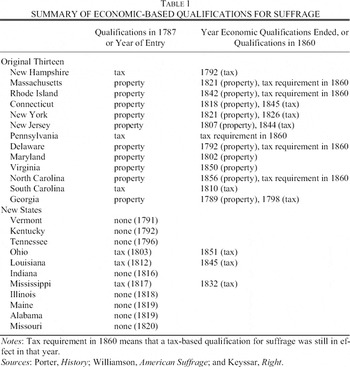
TABLE 1 SUMMARY OF ECONOMIC-BASED QUALIFICATIONS FOR SUFFRAGE

TABLE 2 PERCENTAGES OF ADULT WHITE MALES VOTING IN ELECTIONS
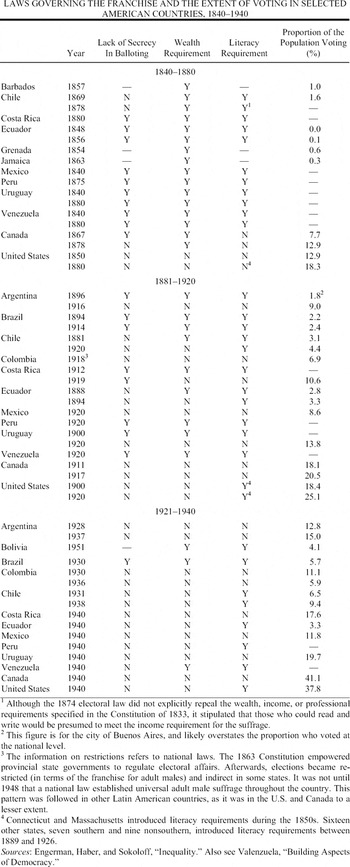
TABLE 3 LAWS GOVERNING THE FRANCHISE AND THE EXTENT OF VOTING IN SELECTED AMERICAN COUNTRIES, 1840–1940
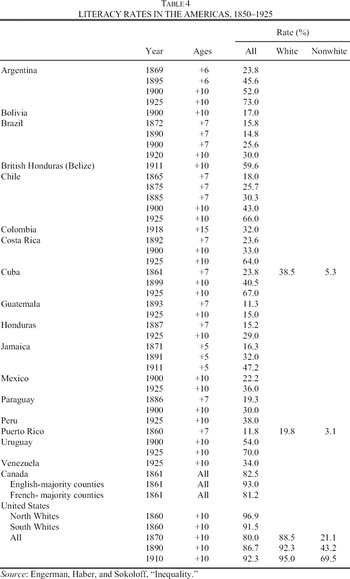
TABLE 4 LITERACY RATES IN THE AMERICAS, 1850–1925
 You have Access
- 162
- Cited by