INTRODUCTION
The family Pinnidae bears large clams of marine waters. Pinnid shells are triangular, and generally fragile and brittle, are buried in mud for protection and stand up with the pointed end down, and they are attached by a tuft of byssal threads which are secreted by glands of the foot (Keen, Reference Keen1958). Pinnid shells are commonly called pen shells. Hayword (Reference Hayword, Hayward and Ryland1990) described the shell of the family Pinnidae as ‘equivalve, inequilateral, triangular; gaping posteriorly and along antero-ventral margin; numerous close-packed ridges, beneath umbones at anterior end of shell, but no hinge teeth; anterior adductor scar small, close to the umbones; posterior larger, close to the middle of shell'.
The genus Pinna Linneaus, 1758, has 96 described species, sub-species and varieties (Bieler et al., Reference Bieler, Carter, Coan, Bouchet and Rocroi2010; Huber, Reference Huber2010). The information available on the family Pinnidae from Pakistan is restricted to a preliminary survey on pelecypod molluscs of Pakistan by Khan & Dastagir (Reference Khan and Dastagir1972) who reported only up to the generic level, and the three species of Pinnidae, viz, Pinna muricata, Pinna bicolor and Atrina vexillum recorded by Zehra (Reference Zehra2001).
MATERIALS AND METHODS
Samples were collected from the Korangi Creek area (24°47′N 67°11′E). The specimens of Pinna were collected manually by hand at low tide during October 2008 to April 2009. A total 47 specimens were collected. Shells were measured using a divider and millimetre scale. The following measurements were made: length was taken from the anterior part to posterior part, whereas, breadth was taken from the broadest middle part. Temperature and salinity were recorded at each collection.
RESULTS
SYSTEMATICS
Phylum MOLLUSCA
Class BIVALVIA, Linnaeus, 1758
Subclass PTERIOMORPHA Beurlan, 1944
Order PTERIOIDA, Newell, 1965
Superfamily PINNOIDEA Leach, 1819
Family PINNIDAE (Barnes, 1987)
Genus Pinna Linnaeus, 1758
Type Pinna fragilis Pennant, 1777
MATERIAL EXAMINED
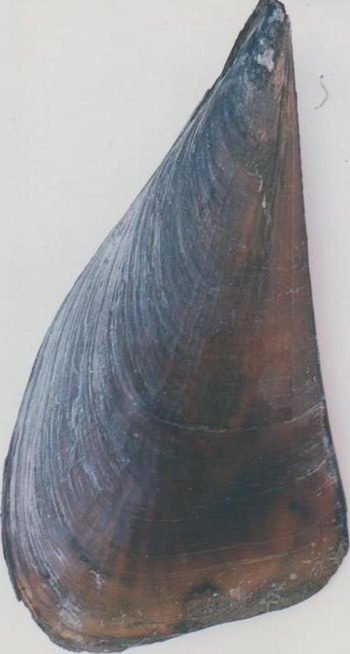
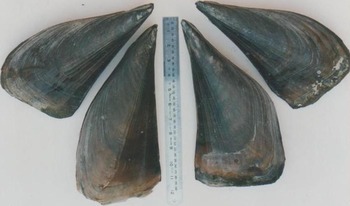
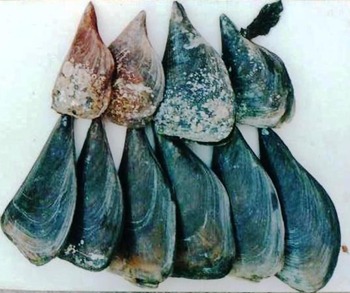
Size: 114–347 mm (N = 38) (Figures 1, 2 & 3).
Pinna fragilis Pennant, 1777, from Korangi Creek, Karachi, Pakistan.

Few Large Cells of Pinna fragilis showing longitudinal lines, transverse ribs and colour variations among different parts of shell.

Pinna fragilis showing different sizes, colours and settlement of barnacles and molluscs spat.

DESCRIPTION
Shell thin, strong and equivalve; strongly inequilateral, beaks at the anterior end; triangular, dorsal margin long and straight, posterior broad, gently curved; ventral margin sinuous; valves gap at broader (posterior) end; small byssus gap at anterior end. The outer surface has concentric lines and ribs. The co-marginal lines and radiating ribs are more than 12–15, found over the dorsal part of the shell, these ribs obscure, hard to distinguish clearly; inner margin smooth with a few septa at the anterior tip. Ligament external; hinge lacking teeth. Anterior adductor scar small at the anterior end behind the septa, posterior adductor scar large and almost central. The shells have a thin inner layer of nacre in the part of the shell which is near the umbos (the pointed end); many shells were found with dark grey pearls. The pearls were dull in lustre.
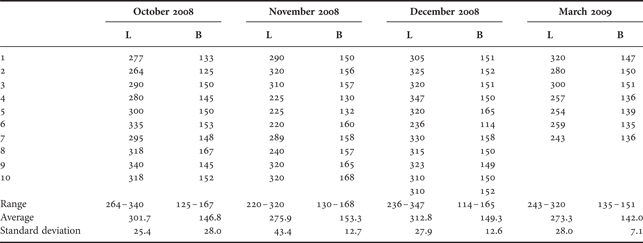
Shell is divisible roughly across the longitudinal axis into two halves by a number of lines besides the dorsal straight margin of shell, though the ribs and transverse lines are present but less conspicuous (Figure 2), whereas, besides sinuous ventral margin transverse ribs are more conspicuous. The specimens were collected during different months; their size variations and mean sizes are given in Table 1.
Measurement of Pinna fragilis: length (L) and breadth (B) in mm from Korangi Creek, Karachi, Pakistan.

COLOUR
The half of shell beside straight dorsal margin is dark brown and half adjacent to sinuous ventral margin is blackish brown; interior light brown and nacreous towards anterior part. The smaller shells were found with a pinkish brown coloration (Figure 3).
HABITAT AND ECOLOGY
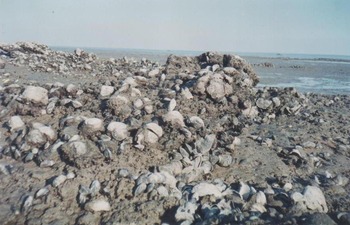
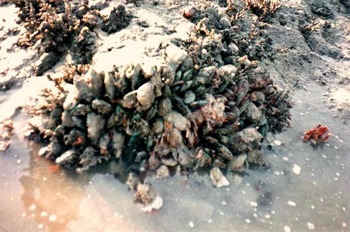
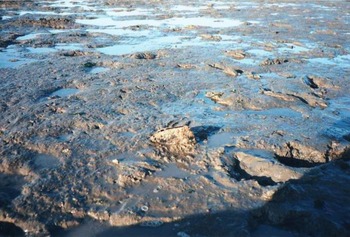
The Korangi Creek area is predominantly muddy with some rocky patches and boulders (Figure 4). The muddy area is devoid of any vegetation but the rocky patches bear some seaweeds. These rocky patches have very rich biodiversity and bear large aggregates of Perna viridis, associated with crabs, sponges, window pane oysters and fan worms (Figure 5). The sponges and fan worms were found abundant in January, whereas with the rise in temperature in April they disappeared from the locality. Shells of P. fragilis were found buried in the muddy substrate, standing upright in the mud with the pointed end down, almost completely embedded, only 1–2 cm part of the upper edge is visible over the substrate (Figure 6). It attaches itself to the sunken hard rocks, stones, pebbles, or even oyster shells very strongly, by byssus threads. Unlike Perna viridis, which were aggregated and form small beds in the area, the occurrence of Pinna fragilis is patchy. Few specimens of Pinna bicolor were also found from the area. Salinity of water ranged from 31–33 ppt and temperature from 28–31°C.
The rocky patch on muddy beach of Korangi Creek exposed at low tide, showing rich biodiversity.

Assemblages of Perna viridis, fan worms, sponges (middle), and (right).

Pinna fragilis in natural habitat, buried in the mud standing upright, the broader margin is visible.

The settlement of barnacles and spat of molluscs were more frequently found in smaller specimens rather than large sizes and more concentrated in the broad posterior region (Figure 3).
DISTRIBUTION
Pinna spp. is widely distributed in tropical, subtropical and Indo-West Pacific coastal waters from south-eastern Africa to Melanesia and New Zealand, north to Japan and to New South Wales and New Zealand. They are also found in Mediterranean and American waters (Rosewater, Reference Rosewater1961; Scheltema, Reference Scheltema1983; Butler, Reference Butler1987; Zavodnik et al., Reference Zavodnik, Hrs-Brenko, Legac, Boudouresque, Avon and Gravez1991; Munguia, Reference Munguia2004). Recently, Idris et al. (Reference Idris, Arshad, Bujang, Mazlan and Daud2008) reported the rich biodiversity and distribution of pen shells from seagrass beds of Sungai Pulai, Peninsular Malaysia.
ECONOMIC IMPORTANCE
Pinnids are considered as an important food item in a number of Asia–Pacific countries (Yu et al., Reference Yu, Moa, Wang, Zhou and Gui2004), notably, in Japan, Mexico, and Polynesia; their posterior and sometimes anterior adductor muscles and even the mantle are consumed (Velasco, Reference Velasco1998). Besides their food value, many species of pinnids produce pearls of moderate value, whereas some species (notably Pinna nobilis Linneaus) are famous for use of their byssus thread to make silk fabric, which is used to make scarves, gloves, shawls, stockings and cloaks. This fabric has an attractive golden hue and these items were greatly valued by the ancients (Rosewater, Reference Rosewater1961). The valves of Atrina vexillum are carved to form decorative articles, and entire valves of larger specimens are sometimes used as plates in Polynesia.
DISCUSSION
With the addition of P. fragilis, the number of species of the genus Pinna reported from the Pakistan coast is raised to four. Variations have been found in colour of P. fragilis from different localities as the shells found from the Bay of Biscay, west France have a lighter and pale buff colour (see online Supplementary Material) whereas specimens from Pakistan are from dark brown to blackish brown (Figure 1); radiating ribs and co-marginal lines are also less conspicuous in specimens from Pakistan as compared to P. fragilis collected from the Bay of Biscay.
Any bivalve shell can produce some sort of pearl on intrusion of some foreign body, either incidentally or by implantation. However, lustrous pearl can be produced by only those molluscs which have a pearl lining. The presence of rose-tinted, reddish, dark colour or almost black pearls from the genus Pinna was reported for the first time by Kunz & Stevenson (Reference Kunz and Stevenson1908) from the Adriatic coast of the Mediterranean, Isle of Pines and New Caledonia, without mentioning species name. Kunz & Stevenson (Reference Kunz and Stevenson1908) further reported that pearls produced by the Pinna squamosa are generally brown in colour. The presence of dark grey pearl of somewhat dull lustre from Pinna fragilis is reported for the first time in this study.
Supplementary materials and methods
The supplementary material referred to in this paper can be found online at journals.cambridge.org/mbd.