From the late nineteenth to the late twentieth centuries, the notion that Robert Schumann failed to recognize or appreciate the irony in Heinrich Heine's poetry haunted the reception of Schumann's Heine settings.Footnote 1 In recent years, however, scholars have put this lingering concern definitively to rest. As Thomas Synofzik and Beate Julia Perrey have shown, there is direct and abundant evidence to prove that Schumann understood and respected the ironic essence of Heine's work perfectly well. At the tender age of eighteen, Schumann wrote in his diary of the ‘bizarre things in Heine's Lieder, that burning sarcasm, that enormous despair [and] all those caricatures of majesty and grandeur’.Footnote 2 That same year, upon meeting Heine in Munich, Schumann remarked in a letter to Carl Krahe that ‘around [the poet's] mouth lay a bitter, ironic smile, but a noble smile about the trivialities of life and a scorn for small-minded people; even that bitter satire which one perceives all too often in his Reisebilder, that profound, inner resentment at life which penetrates all the way to the deepest core, made his conversation very charming’.Footnote 3 In his twenties, Schumann revealed a keen awareness of Heine's irony in the pages of the Neue Zeitschrift für Musik by reflecting upon how other composers had responded to the ironic facets of Heine's poetry in their music.Footnote 4 Schumann could also employ cutting irony and sarcasm as a tool in his critical prose; in a letter to Clara Wieck he even referred to this strategy as ‘my ironic knife’.Footnote 5 As an example of the knife's handiwork, Synofzik mentions Schumann's skewering of his archenemy, the composer Carl Banck. In an article from 1840, Schumann heaped treacly praise on Banck, admiring Banck's great modesty, even shyness, when it came to writing about his own music, let alone that of his contemporaries, and yet in the previous four years Banck had actually written approximately 65 articles for the Neue Zeitschrift, including five pieces about himself.Footnote 6
Most importantly, of course, current criticism has focused on the songs, demonstrating the ways in which Schumann's musical settings of Heine's poetry constitute a sophisticated and knowing response to poetic irony, even if the composer ultimately transformed or reinterpreted the poet's work to suit his own aesthetic and expressive objectives. Most contemporary critics suggest that Schumann's music repurposes the destructive and deflating qualities of Heine's irony toward more productive ends. In light of the diary entry I cited above about Schumann's friendly meeting with Heine as a teenager, John Daverio concluded that Schumann may have ‘smoothed over [the poet's] mordant wit’ in his Heine-Lieder because the composer was able to perceive the ‘humanizing irony’ in Heine's work, an irony which ‘may have sneered, but … also smiled.’Footnote 7 While Beate Julia Perrey finds no such humanism in Heine's poetry whatsoever, she argues that Schumann's musical settings open up the very ambiguities and instabilities of emotion and thought that the irony of Heine's poetry viciously closes off. In the spirit of a genuinely Romantic irony, Perrey suggests, Schumann's music offers multiple and even contradictory perspectives on the poetic text in order to expose the raw emotional truth beneath Heine's barbed and defensive language.Footnote 8 Berthold Hoeckner also perceives Romantic irony's multiplication of meaning at work in Schumann's Heine settings. His reading of the Heine Liederkreis op. 24 focuses in particular on the intertwining and sometimes conflicting agendas of the work's three composite ‘voices’ – the piano, the voice and the text – all of which come together to represent ‘different artistic “selves” inhabiting the same creative consciousness’.Footnote 9 Lest we imagine from all this that Schumann the great Romantic was rarely interested in underscoring Heine's rhetorical irony directly, the bulk of Thomas Synofzik's Heinrich Heine – Robert Schumann: Musik und Ironie aims to serve as a comprehensive demonstration of Schumann's manifold strategies for doing just that.Footnote 10 We need only remind ourselves of the exaggerated joviality and forced, aggressive confidence of songs like ‘Ich grolle nicht’ and ‘Ein Jüngling liebt ein Mädchen’ from Dichterliebe or ‘Warte, warte, wilder Schiffsmann’ from the op. 24 Liederkreis to be convinced that Schumann was fully capable of answering Heine's bitter sarcasm in musical terms. Songs like these are the compositional equivalents of Schumann's journalistic carving-up of Carl Banck with his ‘ironic knife’.
Building on the work of these authors, my own contribution to the re-evaluation of irony in Schumann's Lieder moves in a more biographical or personal direction and begins with this question: what did Clara Wieck think about the irony in Heine's poetry? The question is significant, I think, because Clara was at least sometimes the intended recipient of the Lieder that Robert was writing in 1840. Aside from the fact that Robert actually sent several of his Lieder to Clara for her enjoyment over the course of that year,Footnote 11 we have Robert's testimony in his letters to Clara that, for him, the act of composing songs was often inextricably tied up with thoughts of her.Footnote 12 In coming to grips with the distinctive peculiarities of Schumann's Heine settings, it therefore seems worthwhile to investigate any available evidence that would suggest how Clara might have reacted to her fiancé's choice of Heine as a source of poetic texts, as well as to consider how this ostensible reaction might have factored into Robert's compositional choices in the first place.
Clara repeatedly insisted to Robert that she lacked the requisite insight into great German poetry to be able to compose a Lied,Footnote 13 claiming that she had not read enough of it because she was too busy practicing and dealing with career-related responsibilities.Footnote 14 However, when Clara was living in Paris in April of 1839, she met Heine and wrote approvingly of him, particularly in contrast to his dinner companion for the evening:
The other day I was at Meyerbeer's for dinner and there I met Heine and Jules Janin [the French author]. The former is very witty. The latter, however, is a coarse, ill-bred being, constantly making jokes that aren't unimaginative, but I think it's horrible that he's the one who laughs at his jokes the most. Heine speaks of Germany with bitterness – he wants to visit me tomorrow.Footnote 15
Clara's recorded impression of her encounter with Heine, echoing Robert's own impressions in his letter to Carl Krahe 11 years earlier, suggests that she was familiar with Heine's overall artistic agenda of ‘wit’ mingled with ‘bitterness’ and did not think he was ‘coarse’ like Janin. But what was her view of Heine's poetry? Again, a brief but telling hint is provided in a letter to Robert, this one from 18 September 1838. After receiving a poem from Robert, Clara replied with this comment: ‘I just read the poem again – how beautiful it is, the end is so like Heine, and you know – I think the dream vision comes from – – –’.Footnote 16 It appears that by the time the Liederjahr of 1840 rolled around, Heine was a known quantity, personally as well as poetically, for both Robert and Clara.
In particular, what did Clara mean when she wrote that ‘the end [of the poem] is so like Heine’? Students of Heine's poetry might be tempted to surmise that Clara was referring to one of Heine's most notorious rhetorical strategies: the Stimmungsbruch, a sudden ironic reversal or ‘breaking of the mood’ usually (but not necessarily) found near the end of a poem that punctures the poem's lyric beauty and invalidates its apparent sincerity.Footnote 17 Often the Stimmungsbruch functions as a return to reality by triggering the destruction of some illusory dream or fantasy. In a poem that otherwise depicts the object of the poet's unrequited love in positive terms, the Stimmungsbruch might also serve as a backhanded stab at the beloved that exacts vengeance for her aloofness, insensitivity or treachery.
A potent example of the characteristic features of the Stimmungsbruch is the twenty-fifth poem of Die Heimkehr (see below). The first seven lines of the poem build in passionate intensity; in the first stanza, the poet reflects upon the extremity of the duration of his inextinguishable love, while the second stanza mounts toward a dramatic enactment of his imagined avowal of this love. But when the words finally tumble out, they are surprisingly ceremonial and starchy, even shifting to the formal Sie rather than the familiar Du used in lines five through seven. ‘The absurdity of a dying confession couched in such excessively polite terms’, as S.S. Prawer noted, creates a break in poetic tone meant to show ‘that the beloved has no ear for the language of feeling’ used in the first seven lines.Footnote 18 Moreover, the Stimmungsbruch raises the wounding possibility that the poet's effusive rhetoric was actually nothing more than overblown posturing – perhaps the beloved was not really worth all that fuss after all. In the words of Hanna Spencer, the irony of the Stimmungsbruch in this poem resides in ‘the incongruity between the grandiloquently idealized “eternal” passion and the rather mannered and lean relationship on which it had fed, revealing a world of difference between illusion and reality’.Footnote 19 Whatever deep emotion might have fuelled the opening lines now retreats behind the ironic mask of conventional social discourse. The startling blow of the Stimmungsbruch thereby insults the beloved with the very same gesture that praises her.
Heinrich Heine, Die Heimkehr 25. Text taken from Buch der Lieder, first edition (Hamburg: Hoffmann und Campe, 1827), 202.

As I will soon argue in my discussion of Robert and Clara's correspondence, it is easy to imagine that this poem's shrill and subversive Stimmungsbruch would have repulsed Clara. Along the lines of Clara's comment from 18 September 1838, we might also say that the poem's end, while typical of Heine, nonetheless undermines any ‘beautiful’ qualities it might have possessed hitherto. However, a poem like Lyrisches Intermezzo 43, which Robert set as the penultimate song of Dichterliebe, actually matches Clara's description quite nicely (see below). After six stanzas in which the poet conjures up an enchanting fantasyland, the last two suggest that this was merely a ‘dream vision’ (to use Clara's parlance), a suspicion that is only confirmed in the very last line, the Stimmungsbruch that dispels the vision once and for all. The reversal effected by this final line may be relatively gentle and innocuous in comparison to the vindictive, caustic punch of ‘Madame, ich liebe Sie!’, but in the way it bursts the bubble of a chimerical illusion, it is no less Heinisch.
Heinrich Heine, Lyrisches Intermezzo 43. Text taken from Buch der Lieder, first edition, 148–149.

Extrapolating from these admittedly scant scraps of evidence and conjecture, we might entertain the hypothesis that Clara thought well of Heine and was familiar with his ironic twists but could only appreciate the Stimmungsbruch under certain conditions, such as those fulfilled in Lyrisches Intermezzo 43. It could not be so corrosive as to undermine the beauty of the poem as a whole, it could not be maliciously intended or excessively shocking, and if the poem was heard to come from Robert in some way, then it could certainly not seem to direct its shocking maliciousness at her. For example, in a letter from 14 February 1840, two days before Robert revealed to her the existence of the first fruits of the Liederjahr, Clara wrote favourably to him about the withering critique of Carl Banck that Robert had fashioned with his ‘ironic knife’, but she was careful to add: ‘You do wield a dangerous knife; if only your wife doesn't end up under it one day!’Footnote 20 Although Clara was speaking here about prose rather than poetry or song, the remark resonates with a wealth of other passages in the letters that amply reveal Clara's concerns about ironic expression in general. If we now move to consider Clara's epistolary exchange with Robert in the years leading up to their marriage in 1840, we can observe the lovers’ views about irony and ‘breaking the tone’ in verbal and written communication in much greater depth, lending support to the above hypothesis. Ultimately, the lovers’ private discourse on the workings of ironic language and its role in their relationship provides a suggestive context in which to understand the possible motivations for Schumann's idiosyncratic compositional treatment of the Stimmungsbruch in ‘Dein Angesicht’, one of the Heine settings excised from the final published version of Dichterliebe.Footnote 21 In addition, the letters illuminate a potential personal reading of this poem's imagery on Schumann's behalf that may also help to shed light on his peculiar musical response to Heine's ironic swerves.
How Robert and Clara Negotiated Irony in Their Letters
Clara enjoyed the moments of gentle, teasing humour in Robert's letters, a sort of loving banter she described as heiter and schalkhaft, carefree and roguish.Footnote 22 On one occasion she even wrote specifically of her fondness for Robert's ‘irony’, by which she meant friendly exaggeration and benevolent sarcasm, a kind of good-natured ribbing stemming from kindly intentions.Footnote 23 Malevolent irony, on the other hand – the kind that delivers a curse in the form of a smile – was a brand of irony that Clara also recognized in Robert's expressive repertoire, and whenever she suspected that Robert was levelling it at her, as opposed to Carl Banck or some other enemy, she moved swiftly to reject it. In reference to one of Clara's piano works, Robert once wrote:
Now how you can say that your Idylle didn't please me? How often I play it to myself. You often have such tender motifs; you can get carried away too, huh? But development [Durchführung – literally ‘carrying things out, leading things through’] is a weak point with you girls in love; you have all kinds of thoughts and hopes[.]Footnote 24
What did Robert mean by ‘Durchführung’ here? Was he saying that Clara had produced many beautiful musical themes but lacked the capacity to develop them well? Or was he suggesting that Clara was too flighty to be able to ‘carry things out’ in some other, more personal domain? Clara slapped Robert on the wrist for this ambiguous dig with a touch of her own ironic repartee:
You're quite right about the Idylle; development is often my weak point – or were you really speaking of something else? oh you ironic man – by the way, I do not tolerate such irony, my lord! now come here, Robert, and kiss me how I like it – you know what I mean.Footnote 25
Here Clara characteristically follows her criticism with a gesture of reconciliation. What is not characteristic about this exchange is the relative breeziness with which Clara handled a potentially threatening or critical ironic statement from Robert. Here is Robert in November 1839 venting his frustrations over his legal troubles by casting ironic aspersions on Clara:
Instead of your letter, another one came yesterday from Berlin, which I enclose for you so that you can see how they're after me on all sides – Early this morning Carl brought me the actual letter and I thank you, bride, for your good thoughts about me and the lighter which I often use for fun. Don't take me for cheerful, but rather ironic in the highest degree – for the days don't want to end anymore, the fire goes out in the furnace every minute, and I often fume over the fact that I still don't have a wife. Dear Clara, now don't believe that by wife I mean you. You were meant for Banck or Mendelssohn and I know everything.Footnote 26
Clara began her letter of response by protesting against Robert's unjusttifiable irony:
I discovered your letter yesterday after the concert and subsequently became very sad, as I become every time you write in an ironic tone and [say] such things as in your last letter. It is absolutely not right of you[.]Footnote 27
About two months later, Robert visited the home of Emilie Carl and her family, where a letter from Clara's father gave them all cause for concern – Robert writes:
What ideas these people have of you. Your father thinks he is going to lure you back into his house with such a ludicrous, insipid letter, with ‘Lehmann’ signed at the bottom and spelling mistakes – he names B[anck] as a magnanimous mediator – and Mrs. Carl still gets frightened [that the letter will have its intended effect]. I would certainly not hold you back if you wanted to return to your father. Sure, my sanity could fall to pieces over it; but hold you back – certainly not – then you'll be greater than your father. But forgive what I wrote there. My head is really burning again from all this chatter.Footnote 28
This ironic outburst only drove Clara to despair:
The severity in your letter before last still distresses me. You surely knew that this would sadden me, otherwise why would you have asked me for forgiveness immediately afterwards? oh you are a rascal! [you] think that if you tell me something quickly and turn the thing into something facetious, then it's alright, I'll believe it's just so! but that counts for nothing, you'll get many a reproach yet for that, and only a truce [Friedenskuß] in the meantime – to [give] you one is not to be resisted.Footnote 29
It only took Robert a couple of weeks to break the truce. After affectionately expressing concern about Clara's health, Robert told her to cancel an upcoming soirée and tour so that she could recuperate, adding:
And if you don't obey me, then I will become completely angry or ironic [böse oder ironisch], like that morning on the second day of Christmas. I still think about this morning often, how I confronted you so harshly and you took your album pages off the piano while crying. What was with you then that day, so early? I was so cheerful and was doing everything so that you would feel the same.Footnote 30
Clara was happy to receive Robert's warm wishes for her recovery, but as for the memory of that unpleasant encounter, she would not let it pass without comment. What happened that morning was, in effect, another real-life Stimmungsbruch, in which a harsh confrontation swiftly nullified Robert's general cheerfulness. In her response, Clara was careful to make a distinction between anger and irony, a distinction that Robert did not make in his letter:
So, now how will your next letter be, ironic or angry [ironisch oder bös]? certainly one of the two! oh, rather write me angrily – that way you can be made good again, but irony, that makes me recoil immediately and I flee you, and learn to hate you.Footnote 31
The problem was that Clara wanted Robert to be honest; if he expressed his feelings outright, even if he was angry with her, she would be able to respond from a position of security, but if he disguised his feelings with ambiguous ironic subterfuge, she would not know where she really stood. This constant need for total, unfiltered communication between them was in fact something they both shared. Time and time again in the letters, Robert and Clara implored each other to be completely open, to be absolutely truthful about their feelings, to tell the whole story and not leave anything out, to ignore any comments they might hear from other people that could make them suspicious or doubt one another, and to confirm their faithfulness and love in writing at every opportunity. This strategy was remarkably successful in helping them work through a wide range of difficult personal and professional issues. But with such a severe lack of face-to-face interaction, Robert and Clara needed as much reassurance as they could get that their conception of the other still corresponded to reality. Neither of them liked it when this conception was disturbed by an unexpected shift in tone or attitude in the letters.
One example will have to stand for dozens. Writing from Paris in May of 1839, Clara surprised Robert with some financial concerns that caused her to think they would be better off delaying their wedding for another six months or a year. She knew this would upset Robert, and her letter says as much, along with plenty of compensatory affection to ease the pain.Footnote 32 But even this was not enough – Robert wrote back right away with letters that convinced Clara to change her mind. Perhaps the bitterness of those letters was so intense that the lovers decided to destroy them later on; they no longer survive.Footnote 33 In the next surviving letter of this particular drama, Robert tried to explain his vehement reaction:
Those days were dreadful. Such emotional agitation penetrates straight through my whole body, down to the smallest fibre. When you are involved, all my spirits are doubly active – it takes hold of me right down to the innermost core – Doesn't it seem natural to you that I had to write and behave like that, even though it had to cause you pain? Let this be a warning to you, my dear Clara, that in the future you should always deal with me rather gently – so much depends on the way that one expresses something – You might have been able to tell me the same thing if you had chosen your words more calmly and considerately – but instead you did it in the greatest agitation, very suddenly, without my suspecting anything, in such an abrupt and peremptory way, that I doubted your inner feelings [and] wondered whether they had changed.Footnote 34
Apparently Robert repaid Clara for her Stimmungsbruch with one of his own. Both of them could agree, however, that expressing a change of heart so suddenly and brusquely in their letters was detrimental to their vulnerable sense of connection.
Clara knew of Robert's dark side and repeatedly begged him not to hide it from her by neglecting to write about it or by concealing it behind a mask of equanimity or cheerfulness – that was dangerously close to irony. For example, at the start of 1840, when Robert rationally laid out his plan for how they might still be able to get married by the end of September, several months later than they had originally intended, Clara replied, ‘Nine months look like an eternity to me. You write about it so cold-bloodedly; I know well that you want to seem calm to me in order to make me calm, but I'd rather you always write to me as you truly feel – Your feigned peacefulness frightens me.’Footnote 35 Yet whenever Robert did report his true feelings of sadness, anxiety or despondency, Clara became sad herself out of sympathy and concern. This usually opened up floodgates of self-recrimination in Robert, especially during the second half of 1839 while he was gearing up for the legal showdown with Clara's father. Robert would then hide his feelings again, Clara would get worried, and the cycle continued.Footnote 36
This Catch-22 that Robert found himself in and sincerely struggled with in his written correspondence with Clara might be yet another reason why he turned to Heine so often during the song year of 1840. By that point, Robert was all too familiar with the tortured alternation of concealing and revealing complex negative emotions about the figure of the beloved that lies at the heart of Heine's use of irony in his poetry. Of course, in Heine's poetry the protagonist normally suffers devastating betrayal at the hands of the beloved, and this did not match up with Robert's experience of Clara. However, it must have been easy for Robert to map the nefarious treachery of Heine's beloved onto Clara's father. For Robert, it was the fickle affections and duplicitous behaviour of Friedrich Wieck that stood between him and the Clara of his dreams. ‘[Your father] said to you that I was corrupt’, Robert once complained:
Is that possible, Clara? Really, tell me how I can better myself. This ghastly word obsesses me. Write to your father [and ask] whether I am not that same person whom for a number of years he praised to the skies to everyone for his character, whom he now bad-mouths – now, when I live ten times better, more decently, and more virtuously? Write this to him; I don't know how I should defend myself against this.
No, you love me, I see you vividly right before me and I am happy.Footnote 37
On certain occasions when Clara wrote to Robert with some judicious suggestions about their future in what Robert perceived to be an overly unsympathetic tone, he would imagine that Clara's father had temporarily possessed her, resulting in yet another form of Stimmungsbruch familiar to us from Heine's poetry, in which sour words can suddenly emanate from the beloved's sweet face. Robert replied to these moments with comments such as ‘your father was guiding your pen; the coldness of those lines had something murderous about them and really depressed me’Footnote 38 or ‘what you wrote me is too rationalizing, it isn't from Clara the artist, it's her father's daughter who's speaking there.’Footnote 39 Moreover, and most crucially for our purposes, it was precisely the battle with Clara's father that caused the urge toward caustic, injurious irony to well up most readily in Robert himself:
Shall I tell you – and you will forgive me for it – what sometimes contaminates the sound of my bright pure love, what often aggravates me and what I still can't suppress – a sometimes derisive and mocking pleasure in [your father's] pain because your father's intrigues haven't succeeded. Forgive me, I too am only human.Footnote 40
In Heine's poetry, Robert found a perfect match for the mocking tone that sometimes infected the sound of his ‘bright pure love’. The relationship of Heine's poetic protagonist to his beloved managed to synthesize elements of Robert's relationships with both Clara and her father, including those moments when the two would threaten to blur together in his imagination. Because Heine's poetry contains what Perrey characterizes as the ‘combination of a heightened Romantic sentimentality and modern disillusion’,Footnote 41 it provided Schumann with the opportunity to explore the emotional complexities of these relationships as well as the expressive habits or strategies he had developed to cope with them that we have observed in his correspondence with Clara.
So much is suggested, at least, by Robert's reply to Clara's remark about her preference for angry letters over ironic ones – at least when Robert is angry, she had said, she can know what is really in his heart. Robert shot back in kind:
You too write that you often have such days when one can't make heads or tails of you, like on that second day of Christmas. Dear wife, that's how you can make me desperate, when this goes on for days and weeks. I'm going to be your husband and want to know what's the matter with you and where – and everything down to the last detail – otherwise my love will transform into the most ferocious days- and weeks-long irony – in which, by the way, I am now educating myself a lot – think of your fiancé – he will keep his word.Footnote 42
This letter was written on 29 January 1840, only a week before Robert first reported the torrent of song composition he had embarked upon, including settings of Heine's ‘Du bist wie eine Blume’ (the very first song of the year, written on 23 January) and the op. 24 Heine Liederkreis.Footnote 43 Indeed, he kept his word.
But how so? In some cases, discretion would surely be necessary. As Robert said of his ‘ironic knife’, ‘to always use the same weapon would certainly bring about more harm than good in the world’.Footnote 44 Heine's poetry seemed to be the perfect vehicle for Robert to capture so much of what he and Clara were going through, and yet the potential for stab wounds from the ironic knife was ever-present in the form of the Stimmungsbruch. It would of course be wrong to assume that in Schumann's Heine-Lieder, the protagonist is always Robert and the beloved is always Clara, just as it would be misguided to try to find a hard and fast rule for Schumann's musical approach to irony. Instead, what I would argue is that when poetic, musical, and/or documentary evidence suggests that Clara might indeed have taken the song personally, Schumann's tendency was to transform, redirect, or swallow the Stimmungsbruch in such a way that it would reflect pain honestly without inflicting it at the same time.Footnote 45 As we have seen, there was a tension produced by the conflicting demands that Clara placed on Robert to share his emotions openly on the one hand while not surprising her with inconsistencies of tone or content on the other. On top of these external pressures, Robert felt an inner tension not to distress Clara with his own disturbing thoughts, no matter how much she said she wanted to hear about them. These tensions, as well as Robert's own feelings of fragility and vulnerability, are movingly embedded in Schumann's alchemical compositional transmutation of the unstable element that is the Stimmungsbruch.
How Robert Transformed Irony in His Music: ‘Dein Angesicht’
A song that is particularly rich in this kind of metamorphosis is ‘Dein Angesicht’, op. 127 No. 2, one of the four songs that Schumann removed from Dichterliebe just before it was published in 1844. In the reading of this song that I shall advance here, Heine's brutal dismantling of the beloved's beauty through the use of not just one but two Stimmungsbrüche is reinterpreted by Schumann so that it reflects sincere love and admiration intermingled with fear of loss and pain for both the protagonist and the beloved. Schumann has the protagonist absorb the thrust of Heine's ironic knife into himself, keeping the beloved out of harm's way while still allowing the dark, throbbing energy of the wound to radiate from beneath the surface.
In her insightful analysis of Heine's poetry as a whole, and ‘Dein Angesicht’ (Lyrisches Intermezzo 5) in particular, Beate Perrey explains that the image of the beloved evoked in Heine's verses does not properly correspond to an actual woman. She is not a stand-in for Amalie and Therese, the objects of Heine's youthful unrequited love, nor is she even to be considered a real, existing person in general.Footnote 46 Rather, this image serves as an imago, a metaphorical projection of Heine's feelings of cultural isolation and especially of his tortured relationship with Romanticism. Heine himself referred to the ‘female shadow which now lives on only in my poems’.Footnote 47 As Perrey states, this shadow is ‘a ghost, an outgrowth of Heine's deep-seated suspicion and rejection of the Early Romantic spirit’.Footnote 48 Heine would like to embrace the healing power of this paradigmatic Romantic image as well as the incantatory poetic language that the Romantics used to bring it into being. Ultimately, however, he knows that it is all a lie, and so he wears away at the language with withering clichés until he is ready to destroy the imago altogether through the annihilating power of the Stimmungsbruch.Footnote 49
Hence, in ‘Dein Angesicht’ (see below), the adjectives the poet uses to admire the beloved's face are typically banal and monosyllabic: ‘lieb’, ‘schön’, ‘mild’. This face is also engelreich, which for Perrey calls to mind Heine's characteristic invocation of the Virgin Mary, the Christian figure of compassion.Footnote 50 But the compassion promised by the imago is quickly revoked in line four, when the poet remarks that the face is ‘yet so pale, so pale with pain.’ The sudden reversal marks the first Stimmungsbruch: the beloved's paleness is framed as a disturbing negative attribute in contrast to what has come before, even if the complexion of the chaste Madonna tends to be pale in any case. As a result, it remains unclear whether this disruption of the untroubled mood of the first three lines is a genuine gesture of concern or an unflattering insult ironically cloaked as sympathy. In the second stanza, the redness of the beloved's lips seems to bring the imago back to life, but in line six, colour and life are immediately obliterated by the blanching kiss of death; here we have the second Stimmungsbruch, with similar results. Perrey also observes how the rhyme scheme intensifies the ‘extinguishing’ of the ‘heavenly light’: engelgleich is undermined by schmerzenbleich, rot gives way to Tod, and Licht is cut off by bricht.Footnote 51 I would also suggest that the effect of all these poetic features is to give the last three lines a bitchy, reproachful undertone. The beloved may imagine that she is beautiful, but in these lines the poet reminds her that it will all come to an end, and perhaps sooner than she thinks, if this dream vision is a harbinger of reality. By the time we reach the final line, the piety of the beloved's eyes is coated with a layer of sarcasm – one wonders if this Madonna is actually a whore. Heine's ironic scorn offers a stinging and vengeful rebuke to the false promises of Romanticism as it savages the imago's phantasmal face.
Heinrich Heine, Lyrisches Intermezzo 5. Text taken from Buch der Lieder, first edition, 114.

Such, at least, would be one potential interpretation of ‘Dein Angesicht’, if we were inclined to attune our ear to the most acerbically ironic undertones in the voice of Heine's poetic protagonist. But how might Schumann have read this poem? For one thing, the first Stimmungsbruch line seems to have grabbed his attention; it is underlined in his copy of Heine's Buch der Lieder.Footnote 52 As for the imago of ‘Dein Angesicht’, this remote object of conflicted desire, for Schumann it likely called to mind more than a shadow or a ghost. Like Heine's protagonist, Schumann had been fixating on an image for several years, but even if it did sometimes serve him as a kind of mirror of subjectivity, in his case the image was no loose metaphor. It was a specific, physical image – Clara's. As with the imago, we are not talking about Clara herself, but rather the depicted images that had come to represent her in her absence. From the correspondence it is clear that Robert was positively obsessed with obtaining and enjoying artists’ renderings of Clara during their entire period of separation.Footnote 53 At every opportunity he adamantly insisted that Clara have portraits made of herself – paintings, lithographs, drawings – and that she send them all to him for his own use, no matter how imprudent this may have seemed to her.Footnote 54 At one point he had six images of Clara from different times in her life hanging throughout his apartment in Leipzig;Footnote 55 Clara drolly remarked that the monotony of the decor must have appalled anyone who came to visit, although she admired Robert's perseverance.Footnote 56
Robert's need for Clara's image was intense from the very start of their romantic correspondence; it consoled and fortified him in trying times. In the first paragraph of Robert's first letter to Clara after they had fallen in love in February of 1836, Robert reported from Zwickau about his feelings after the death of his mother:
How you stand before me, my beloved, beloved Clara – ah, you seem so close to me, as though I could grasp you …. My day today was agitated by so many things – my mother's open will, descriptions of how she died. But behind all the darkness stood your blossoming image, and I bore it all more easily.Footnote 57
As we have already seen, when Clara's supportive image faded in Robert's mind, her father's hostile image tended to spring up in its place, driving Robert to angry, ironic detachment. In September of 1837, after a particularly difficult and disheartening conversation with Clara's father, Robert wrote to her:
Today I am so dead, so humiliated, that I can hardly hold on to one good, beautiful thought; even your image has dissolved from me, such that I can hardly remember your eyes. I haven't become so fainthearted that I would give you up; but [I have become] so embittered, so aggrieved in my most sacred feelings, so unjustifiably compared with the most vulgar things!
If only I had a word from you. You must tell me what I should do. Otherwise everything in me will become derision and mockery and off I'll go.Footnote 58
Robert's volatile imagination could indeed go off in a destructive ironic direction when circumstances made him feel insecure about his relationship with Clara. In these moments of emotional vertigo he hungered for Clara's image as a point of focus that could restore his psychological balance. In February of 1839 Robert began to fall into despair about the way that Clara handled the advances of Gustave Schilling, a journalist and editor who seemed at first to be interested in helping the lovers realize their goals but eventually was revealed to be just another competitor for Clara's affections. ‘Perhaps he's promising us so much now so that he can keep even more [promises] later and laugh at me’, Robert wrote. Then he jotted down several more lines, all of which he crossed out completely, followed by this:
Dear Clara, I just fear that I love you more than you love me! Ah, where are my thoughts taking me[?] All of a sudden you stand before me; your hands resting on my shoulders, you look into my eyes so trustingly; ah Clara, Clara, how I love you – But now I have to go rest a bit.Footnote 59
Aside from demonstrating the restorative power of Clara's image, this moment in the correspondence also provides us with another example of the repression and partial concealment of ironic expression that we will observe in Schumann's musical setting of ‘Dein Angesicht’.
Robert's frequent recourse to imagined visions of Clara explains his preoccupation with actual images of Clara; as Robert wrote, ‘don't you think that when people don't see each other for a long time, the image [of the other] in their memory loses its sharpness – perhaps that's why I asked you for your picture – so, will you send it to me then?’Footnote 60 Robert sometimes treated these pictures like ersatz Claras. When he received a new painting from Clara in June of 1839, he literally showered it with kisses and wished he could have it with him all the time.Footnote 61 In the same letter he devotes a lengthy paragraph to a detailed description of the painting that mingles the discriminating observations of an art critic with the effusive praise of a lover.Footnote 62 In other passages in the correspondence, Robert explains how Clara's depicted image on the wall glows with an uncanny sacred presence:
Your picture has left me no peace; I hung it up in front of me; from over there it now lives and actually speaks; whoever painted it is a terrific painter; I feel an inexpressible joy when I look at it; the entire living room seems to me as though it were more sanctified.Footnote 63
By staring with devotional intensity at Clara's picture, Robert could seem to bring it to life. In Robert's appreciation of these images there was even sometimes a kind of ritual involved, bordering on religious worship, which invested them with an aura of spirituality and holiness. In March of 1838 Robert gave an account of his typical day:
I'm up early, usually before six; I solemnly celebrate the most beautiful hours then. My living room really becomes a chapel, the piano becomes an organ, and your image – now that is the altarpiece …. Around nine o'clock in the evening I am back at home, where I'm always happiest – I say good night to your picture – I sink myself deeply in dreams of the future, which are gently and haltingly replaced by real ones – thus I live happily, quietly and well; for everything comes from you and goes back to you again. Would you want me to be any different?Footnote 64
In the porousness of dream and reality, the angelic divinity of the beloved's image,Footnote 65 and the sensation of total immersion while staring deeply into the beloved's face as if into a mirror, we readily recognize elements of the poet's relationship to the imago in Heine's ‘Dein Angesicht’. As in the poem, Clara's image could drive Robert to distraction and haunt his dreams, but at the same time, he would feel himself merging with it in rapt contemplation:
But I can't look at your picture too often; it agitates me too much. Often it wakes me up at night, too, so that I have to strike up a light – and now I immerse myself deeply in it and I stop thinking altogether and I become one with it – Footnote 66
Scenes like this confirm that the main thing Robert wanted to get from these images was the feeling of being together with Clara in flesh-and-blood reality. In their permanence and corporeality, the pictures served to reassure Robert that Clara was still the same sweet faithful girl that he knew from the last time he saw her. Certainly Robert worried about whether the pictures did indeed still correspond to reality, as we have seen, but they were the closest thing he had to a physical confirmation that Clara had not changed or been lost, that everything would work out, that she was healthy and well and of the same mind and heart.
All of these passages from the correspondence suggest that what Schumann saw in ‘Dein Angesicht’ was probably something rather different than the reading of Heine's poem outlined above. There are two further passages, in fact, that have an uncanny similarity to the precise scenario of Heine's poem, lending further biographical support to the interpretation of Schumann's song with which I will conclude.
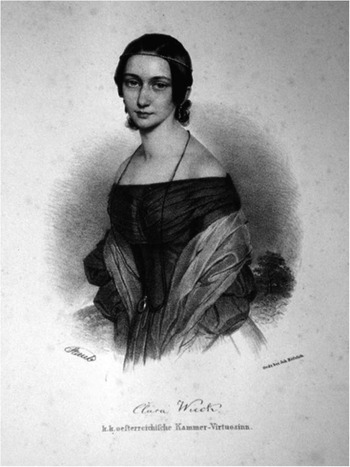
The first passage dates from April of 1838. Robert had heard that an artist by the name of Andreas Schaub had exhibited a painting of Clara based on a lithograph which Robert also possessed (see Figure 1).Footnote 67 He now wrote to Clara asking for permission to obtain this painting:
But I'd like to have the picture which, one can conclude from the lithograph, must also be excellently painted. Whether your likeness is really captured therein, poor me, I hardly know – I haven't been permitted to see you for so long, and each time for only a few minutes! But the picture is just as I imagine you – your entire bearing, your figure at ease – and now your eyes, the painter understood them – say, is he a young man? I could be worried about him; he has gazed deeply into your heart. From the picture one could think you were very pale [blaß], even sickly [kränklich]; but you aren't, are you? But like I said, I still want you to be somewhat heavier – and I will tell you here how you'll do that – you must be really cheerful, sometimes drink a glass of Bavarian beer, and you may play me nothing of Bellini and Chopin, and of your beloved, only pieces that are funny and witty. With everything else, do as you wish – only stay as you are (I already wrote you about this) – you please me, truly you do – I imagine my future wife to be exactly like you – do you hear? But then everyone is even saying, ‘You are even more beautiful than in the picture’ – And, girl, if you write to me one more time that you aren't pretty, then I'll tell you ‘you don't think much of yourself and that is worse than vanity’ – my wife must be pretty, she must be more than that, in a word: she must be like my Clara, indescribably beautiful and dear and angelic [schön und lieb und englisch].Footnote 68
Andreas Staub, lithograph of Clara Wieck, Vienna 1838. Public domain

Like the poet in ‘Dein Angesicht’, here Robert is staring at an image of his beloved. As he scans the image, he notices how Clara's features match up with the ideal Clara he carries in his imagination, or put another way, with the Clara of his dreams – as the poem states, ‘das hab’ ich jüngst im Traum gesehn’. The Stimmungsbruch occurs when Robert discovers something unwelcome in the image that collides with his ideal: as in the poem, the image is disturbingly ‘pale, even sickly’. Robert uses the word blaß here, which could potentially be read as a relatively value-neutral term connoting fairness of skin, as opposed to the morbid overtones of Heine's word, bleich. But Robert qualifies blaß with kränklich, clarifying that he is talking about her health. Immediately Robert becomes concerned; he asks if she really is pale with sickness and offers light-hearted suggestions for how to take better care of herself. Once again, as Clara remarked above, Robert makes light of something that must have sincerely worried him in order to get his message across without causing Clara undue stress.
Above all, Robert asks Clara not to change, to stay as she is. Part of this request has to do with her physical condition. The paleness of Clara's depicted image triggered fears about her well-being which, in the poem, are made explicit in the vision of the beloved's death. As the poem states, this death would ‘extinguish the heavenly light’ that breaks from Clara's eyes, rendered so insightfully by that young painter whom Robert jealously views as a stand-in for himself. At the end of the passage, Robert reassures both himself and Clara that the fiancée of his imagination is in fact the fiancée he is writing to, no matter how much they may genuinely fear that this is not so. And the adjectives that Robert uses to cap off this confirmation of Clara's qualities are almost exactly the same adjectives that Heine uses to characterize the Angesicht at the beginning of his poem – schön, lieb and engelgleich in the poem, lieb, schön and englisch in Robert's letter.
Given all of these potential parallels between the poem and the letters, it is easy to imagine how Robert might have seen his own relationship history mirrored in ‘Dein Angesicht’. Moreover, we can imagine how easy it might have been for Clara to take this poem personally. In setting ‘Dein Angesicht’ to music, Robert would therefore have had some reason to take steps to reconfigure the injurious irony of the poem's two Stimmungsbrüche so that it served his own purposes. A second passage in the letters from a little more than a year later points toward the compositional approach that Robert took. After admiring Clara's remarkable and enduring faithfulness at length, Robert turns a critical eye on himself:
Ah, Clara, I wish I could get rid of many things from my past, from my earlier, often reckless life, in order to stand before you just as purely, I wish everything for myself and especially for what can make you happy – a perpetually happy disposition, beautiful ideas, a cheerful smile when storms are threatening, an idea at the piano that pleases you, dignity and also kindness toward other people. And I also want to better myself more and more and try to become like you, you who are so dear [lieb], so noble and virtuous. I see you now before me with your noble form, a true maiden as it should be – you're also pale [blaß], very pale, aren't you? Just wait, I will soon give you rosy cheeks and strength, and I'll take care of you and love you – and then the world will probably say ‘if only all married couples were like this one, then everyone would be just as happy.’ Isn't that so?Footnote 69
Again Clara is lieb and full of angelic purity; again her paleness disturbs Robert's contemplation of her ideal image and moves him to take action in order to shore up her health. What is also made explicit here is Robert's tendency toward self-recrimination – in contrast to Clara's chaste maidenhood and noble character, Robert portrays himself as an emotional train wreck with a chequered past. But even as Robert expresses his feelings of inadequacy, he vows to make himself better. Though torment might be roiling inside him, he promises to maintain ‘a perpetually happy disposition’, to put on ‘a cheerful smile when storms are threatening’, so that Clara will be happy and her colour and strength will return. In this passage Robert speaks honestly of his inner emotions yet also expresses his desire to transform them into something positive so that Clara will not be upset.
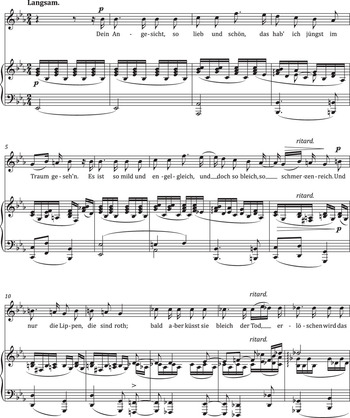
All of the features of the hypothetical personal reading of ‘Dein Angesicht’ suggested by the evidence of Robert and Clara's letters also emerge vividly in Schumann's musical setting of the poem (see Example 1). After a bar of introduction in which the piano lays down a gently rocking accompanimental pattern, the voice presents a four-bar phrase of simple, unaffected lyricism that moves squarely to the dominant at the close. In bar 6 the same phrase begins again, setting up a crystal clear antecedent–consequent pattern. With its technical and structural accessibility and its air of gentle naiveté, this sweetly innocent music is the very image of domestic tranquillity and maidenlike purity that Robert saw in Clara's face. As we may note in the correspondence, for Robert and Clara little words like lieb, schön and mild were authentic terms of endearment that they loved to fuss over, and here the music follows suit. Robert once wrote to Clara, ‘I'd like to give you all kinds of names, and yet I know of no more beautiful word [kein schöneres Wort] than the little German word “lieb” – but it wants to be spoken in a special tone.’Footnote 70 Lest we imagine that this music is in fact excessively simple – that is, that the tone here is ironic and facetious – Schumann adds double suspensions in bars 3 and 7, along with the chromatic passing tone E♮ in bar 7 that creates an exquisite dissonance as temporary leading tone against the third of the chord in the bass. These touches of characteristic sophistication in the voice leading help to assert Schumann's genuine authorial voice as he speaks Heine's text in his own ‘special tone’.
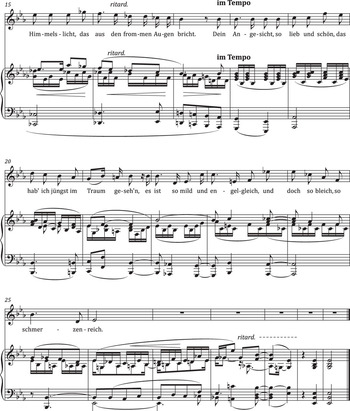
Robert Schumann, ‘Dein Angesicht’, op. 127 no. 2. Score taken from Robert Schumanns Werke, ed. Clara Schumann (Leipzig: Breitkopf & Härtel, 1879–93), series 13, volume 4, 83–4

continued.

The first sign of trouble occurs in bars 7–8, just as the Stimmungsbruch appears in the text and the vocal protagonist observes how pale the beloved's face is. As we move over the barline into bar 8, the voice holds on to its E♭, and this hesitation causes it to lag behind by a semiquaver, falling rhythmically out of sync with the piano. Perrey notes how ‘voice and piano, truly complementary from the beginning, unhinge at this point for the first time’.Footnote 71 In the language of Robert's letters, we might say that the vocal protagonist – the viewer of the beloved's face – is no longer fully immersed in that image, no longer one with it, because he has suddenly noticed how pale it is. Viewer and image detach from one another in a moment of self-consciousness that pulls the vocal protagonist away from the all-consuming object of his gaze.
What is important to note about Schumann's setting is that the disturbing revelation of the beloved's pallor is just as troubling for the protagonist to utter as it might be for the beloved to hear. Schumann changes the last word of the poem's fourth line from schmerzenbleich (‘pale with pain’) to schmerzenreich (‘full of’ or ‘rich with pain’); the focus here is more exclusively on the psychological pain that the beloved's paleness signifies, rather than the physical paleness itself which the poet uses as an insult to contradict her supposed beauty.Footnote 72 Moreover, the vocal protagonist sympathizes with this pain, as the harmony at the end of the second four-bar phrase moves unexpectedly to G minor in bar 9. Rather than give in to the minor-mode affect of the diatonic mediant, however, Schumann substitutes G major at the last moment as the phrase cadences on the second beat of the bar. It is a small thing at first, this swapping of major for minor, yet it neatly captures Robert's desire to both temper his melancholy and maintain a positive demeanour in order not to alarm Clara, even as the hushed dynamics and slowed pacing of this passage testify to the inner emotional distress that attends this effort. The beloved's paleness literally gives the protagonist pause, but he manages to contain his worry and preserve some uneasy semblance of the tonal and rhythmic solidity with which he began the song.
In bars 10–11 G major continues to paper over G minor while the music tepidly reasserts its innocence. As the protagonist shifts focus from the beloved's pale skin to the rosier image of her red lips, he resumes the original tempo, and everything is tonic and dominant in the accompaniment and ‘Three Blind Mice’ in the vocal line. At the very end of bar 11, however, the sudden jolt of an accented, offbeat diminished seventh chord in the piano tonally and rhythmically disorients us even more severely than the relatively subtle and gradual dislocations we had encountered in bars 8–9. Whatever trepidation was repressed there and kept precariously submerged ever since now surfaces again here, only with greater urgency, as the piano's dissonant thud anticipates the second Stimmungsbruch that is about to appear in the text. In this way the protagonist's internal shock of realization that the beloved might be mortally ill (‘bald aber küsst sie bleich der Tod’) precedes its formulation into words. As we know from the correspondence, it is words like these that could wound the beloved if they are not said properly. On the one hand, they must not come across as scornful irony, and on the other hand, they must not betray the protagonist's mounting dread and despondency about the beloved's condition. Earlier we noted that when Robert noticed the paleness of Clara's image, he immediately became concerned about her health but then moved just as swiftly into a mode of smiling reassurance, even if the lightness of his tone may have been covering up internal doubts and fears.
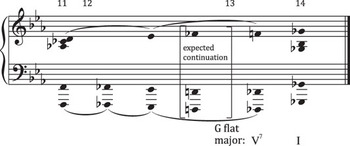
Thus, in the dizzying wake of the essentially atonal diminished seventh chord, the vocal protagonist struggles to keep himself tonally centred in bars 12–13, holding on tenaciously to the B♮ (now a C♭) of the G-major nursery rhyme he was singing two bars earlier, while the piano churns chromatically underneath him.Footnote 73 In particular, the unbearableness of the protagonist's mounting anxiety in bars 11–13 is suggested by the tortured unfolding of a chromatic voice exchange between the outermost voices in the piano (see Example 2). The diminished seventh chord has touched off an inexorable voice-leading process momentarily beyond the protagonist's control; while he clings to his C♭, syncopation and the tightness of the chromatic half steps exacerbate the voice exchange's spiralling slow-motion intensity. Here we have the beginnings of a panic attack that the protagonist does not want the beloved to see. He must take some kind of action from allowing this voice exchange to expand any further, and so in bar 13 the outer voices are both pushed outward by a relatively spacious whole step into a D♭ dominant seventh chord, effortfully bringing to a halt the potentially limitless dilation of the terrifying pattern. From this new point of tonal and emotional stability, after a ritardando allows the seasickness of the syncopation to settle down as part of a righting of the psychological ship, the music moves securely to G♭ major in bar 14 – dominant gives way to tonic, and rhythmic regularity is restored.
Schumann, ‘Dein Angesicht’, reduction of piano accompaniment, bars 11–14

Yet by the time this ship is righted, it is no longer in the same place it began. We came from the G major of bars 9–11. G major is the diatonic mediant of the tonic major (E♭), albeit in its chromaticized major-mode guise (III♮). Now G major has been supplanted by G♭ major, the diatonic mediant of the tonic minor (♭III). Once again, as in bars 8–9 but now at a deeper level of structure, the minor mode has overtaken the major mode, and yet the music still preserves its major affect. This, I believe, is not just a pedantic music-theoretical observation, but rather something we hear and feel in the song. When G♭ major arrives, so does the music from the opening of the song, although the texture of the piano's right hand is a bit thinner, the bass line is a bit more active in bar 14, the piano shores up the vocal line by doubling it in bars 15–17, and two separate crescendi are marked in bars 15 and 16. In this imperfect and fretful making of a reprise on the wrong key, there is a sense of keeping up appearances, of trying to proceed with business as usual despite the worries that may be eating away at the protagonist internally. The singer's tessitura here is also palpably higher than it was at the beginning of the song, even though the melodic line is virtually the same.Footnote 74 Because of the voice's elevated energy, we get the impression of someone who sings while holding back tears, bravely soldiering on as though everything was fine even though he may be crumbling on the inside. He is singing about the future death of his beloved, about how the heavenly light will one day be extinguished from her pious eyes, but he sings this as though marvelling at the fragility of the beauty he is beholding, as though awestruck by the very idea that such chaste, ideal beauty could exist at all in the face of mortality and that he is alive to witness it. The protagonist turns these lines into a kind of rhetorical question whose answer is meant to encourage the beloved as she lies, pale, on her sickbed. ‘Could death really extinguish the light from your heavenly eyes?’ Surely not, the protagonist seems to tell her. And yet, because the protagonist utters these words in this harmonic context and at this pitch level, we still sense his terror, even if it is cloaked in such a way that it would not wound or alarm the incapacitated beloved. In effect, the protagonist has swallowed the Stimmungsbruch, but its unsettling power still burns away at him from within.
In fact, for a brief moment at the end of this passage, the music almost gives way to the destructive forces it has thus far kept inside. On the downbeat of bar 17, a D♮ in the bass signals a change of harmonic direction to the key of E♭. Since we are coming from G♭ major, the implication, however fleeting it may be, is that we are simply moving from relative major to relative minor – E♭ minor, to be precise, the tonic minor of the song as a whole. The passage could easily have given in to this minor-mode inclination, as the protagonist adopted some sort of tragic, melancholic affect (see Example 3). Instead, the protagonist represses those urges yet again, and in bar 18 the actual reprise of the song begins in earnest in E♭ major. As a result, we end up hearing the opening strain of the song twice in a row: once in G♭ major, as an attempted but emotionally compromised reprise, and then again as the true reprise in the original tonic of E♭ major, after the feint toward E♭ minor.
Schumann, ‘Dein Angesicht’, minor-mode recomposition of bars 16–21

As a result of this design, we are left with the lingering sensation of having been in E♭ minor during the B section, even though the minor mode had not once materialized there. With the E♭ major reprise, the protagonist has registrally calmed himself back down to the pitch level at which he began and recovered the peacefulness of the song's home key and tempo – all is well again. But part of the satisfaction of this reprise stems from the sense of relief after a minor-mode B section that never actually was in the minor mode. As the reassuring music of the A′ section flows by, it seems as though the protagonist had just vented his worry and grief directly in the B section, through minor-mode weeping, when in fact this never took place. The protagonist's sadness can only be perceived retrospectively; it is communicated to us without our realizing it, and under the cover of G♭ major. In the correspondence, Robert tried to shield Clara from his considerable worries and expunge melancholic thoughts from his mind for her sake, even though it was not easy and even though Clara insisted nonetheless that he confess his fears openly. In ‘Dein Angesicht’, the protagonist successfully overcomes the urge toward one of those ironic outbursts to which Robert sometimes succumbed when the emotional pressure of this conflict was too great. Yet the pain hidden behind the hurtful Stimmungsbruch in Heine's poem and the protagonist's loving reappropriation of it in Schumann's setting is still there, despite the fact that it is not released onto the surface of the music. The protagonist takes the ironic knife inward, and even if the wound bleeds unseen, its torment is not unfelt.
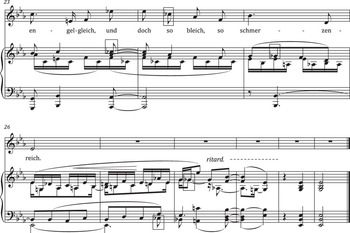
Or perhaps the wound is not completely unseen. As Perrey points out, Schumann creates a ternary form in this song by repeating Heine's opening stanza, such that the song ends with the ambivalent image of the beloved's pale face, rather than the more extreme image of her death. Similarly, we recall how Robert ended the passage of his letter in which he noticed how pale and sickly Clara's portrait seemed to him by reasserting how lovely she truly was, using the very words schön und lieb und englisch. But even as the protagonist restores the central image of ‘Dein Angesicht’ at the end of Schumann's song, the E♭ minor that never appeared during the B section flares up now in the reprise, during the repetition of the first Stimmungsbruch line (‘und doch so bleich, so schmerzenreich’) and at the climax of the postlude in bars 27–28 (see Example 4). The protagonist may have absorbed the blow of the Stimmungsbrüche, but these convulsive minor-mode twinges are symptomatic of their lingering presence within his psyche.
Schumann, ‘Dein Angesicht’, moments of minor-mode inflection in bars 23–31

Epilogue
In the agonizing tension between major and minor in ‘Dein Angesicht’, we hear a correlate to the shifts of mood and tone that Robert and Clara fretted over as they reflected on their communication with each other. Heine's poetic persona relied on these shifts in order to exact revenge on the beloved. Jeffrey Sammons puts it thus:
The wounded feelings [of Heine's protagonist] acquire a cutting edge, the broken heart strikes back. If the poet – whether justly or not is of no consequence – felt himself to be hardly treated, he would mete out hard treatment to the beloved.Footnote 75
From the evidence of the correspondence and Schumann's setting of ‘Dein Angesicht’, it appears that Schumann had the opposite goals in mind, even though he sometimes did resort to the ironic Stimmungsbruch in his letters as a release valve for his anger, frustration and heartache. While Robert and Clara both understood and valued Heine's resentful irony in the context of the poet's particular artistic goals, in their own life together they usually took pains to prevent the corrosion of ironic duplicity from weakening their tenuous bond, itself already under strain from the inevitable insecurities of a long-distance relationship and the menacing figure of Clara's father looming in the back of Robert's mind. After encountering Heine's portrayal of a man caught in an uneasy trance by the image of his beloved, Robert may have been reminded of his own obsessive adoration of Clara's image and of his need to retain and preserve that image as something whole, permanent and trustworthy. His musical response to the poem reflects his stated desire to better himself, to become more noble and virtuous, to rise to Clara's exalted level by purifying the bile and anxiety from his spirit, and yet it also leaves behind poignant traces of his struggle to do so. Ultimately, Robert's musical transformation of the double Stimmungsbruch in ‘Dein Angesicht’ movingly demonstrates the expressive consequences of trying to meet the paradoxical demands that Clara placed on him in the correspondence and that he placed on himself as he approached his reunion with her: share everything honestly, but do not lose hope, and do not cause harm.