Introduction
Waste from intensive dairy operations can be viewed both as a risk to the local environment and an under-utilized resource in a productive enterprise. The inevitable concentration of nutrients in and around a dairy, primarily from feces and urine, can be at risk of run-off into local waterways or of leaching through soil into groundwater (Gourley et al., Reference Gourley, Aarons and Powell2012a). At the same time, productivity of dairies is commonly constrained by nutrient inputs; the cost of which tends to increase (Cordell et al., Reference Cordell, Drangert and White2009) independent of the price received for dairy product. Therefore, the economic return of importing nutrients onto farms, often in the form of high-analysis fertilizer, to maintain or increase forage production appears to be ever-reducing.
There is ample evidence of inefficiencies in nutrient utilization on dairy farms (Gourley et al., Reference Gourley, Dougherty, Weaver, Aarons, Awty, Gibson, Hannah, Smith and Peverill2012b). Redistribution of waste concentrates from the milking facility to surrounding fields is a logical approach to redress some of this inefficiency. However, significant practical constraints exist in effectively redistributing waste from the milking shed over paddocks. For example, sludge products that have high water content require specialized machinery for spreading (Min et al., Reference Min, Vough, Chekol and Kim1999; Ward and Jacobs, Reference Ward, Jacobs and Unkovich2008), the purchase of which might be difficult to justify for individual farmers in small-scale operations. Spreading of raw waste also potentially presents a hazard to herd health through the distribution of pathogenic microorganisms (Jezierska-Tys et al., Reference Jezierska-Tys, Magdalena and Tys2010).
Composting is one possible solution for dealing with dairy waste and better enabling the redistribution of nutrients to fields. The advantages of composting include a more homogenized and diluted product compared with raw waste. This potentially improves the evenness of distribution across a field and makes spreading with conventional machinery more achievable. Nutrients in compost are also likely to be less vulnerable to loss compared with raw waste such as slurry (Laurenson and Houlbrooke, Reference Laurenson and Houlbrooke2014) due to a reduced concentration of labile forms as well as a dilution of nutrients with materials, such as straw, commonly used during composting. On the other hand, the composting process involves significant costs associated with labor and machinery as well as substantial losses of valuable carbon (C) and nitrogen (N) to the atmosphere (Billingham, Reference Billingham2012). However, these negative impacts can only be assessed when the agronomic benefits of compost are known.
There is a paucity of scientific data reporting the impacts of composted waste on soil, particularly in an Australian broadacre context. The lack of scientific scrutiny of the efficacy of organic amendments, such as composts, in broad-scale agriculture and the perceived high application rates required to ensure agronomic benefits are key factors limiting uptake by farmers, particularly in conventional production systems (Quilty and Cattle, Reference Quilty and Cattle2011; Billingham, Reference Billingham2012). Increasing the rate of application would undoubtedly increase the measurable agronomic impact (Edmeades, Reference Edmeades2002; Quilty and Cattle, Reference Quilty and Cattle2011), but high rates required appear impractical in this context for several reasons: (i) an average dairy farm is unlikely to produce sufficient quantities of waste product to enable the spreading of high rates over a large area of the farm; (ii) low rates of application would better achieve the objective of diluting nutrients over a greater area; and (iii) high application rates would seem not to be financially viable, particularly for farms purchasing compost from external sources.
The decision of whether to apply compost to fields is complicated further as farmers often use additives, such as lime or gypsum, in conjunction with the compost. It can be very difficult in a paddock situation to correctly attribute responses in plant growth or soil characteristics to the compost or to the additive, particularly where responses are subtle due to the low rates applied.
We established a field study to evaluate the effect of low rates of composted dairy waste (compost) on forage production and soil health, and make recommendations to improve the potential effectiveness of organic amendments by reducing the spatial variability in application. A greenhouse study was carried out to assess the potential soil-specific effects on forage vetch (Vicia sativa L.) production and soil quality of a range of compost rates applied to three different soils. Forage vetch was chosen as it is a relatively fast-growing annual legume species and commonly used in Australia as part of forage crop mixtures such as with oats (Avena sativa L.) (Kaiser et al., Reference Kaiser, Dear and Morris2007). It is also used as a legume option in cropping rotations grown for seed or terminated prior to seed production to enhance soil N levels for the subsequent crop.
The overarching objective of the study was to evaluate the agronomic impacts of low rates of compost on forage production and soil quality, and separate those responses attributable to additives such as lime commonly used in conjunction with compost. The research was undertaken in close collaboration with a network of dairy farmers in the Riverina region of southeastern Australia (Inland Elite Dairy Network; IEDN) to help inform decisions and validate forage and soil benefits of applying composted dairy waste.
Materials and methods
Field experiment
Experimental design
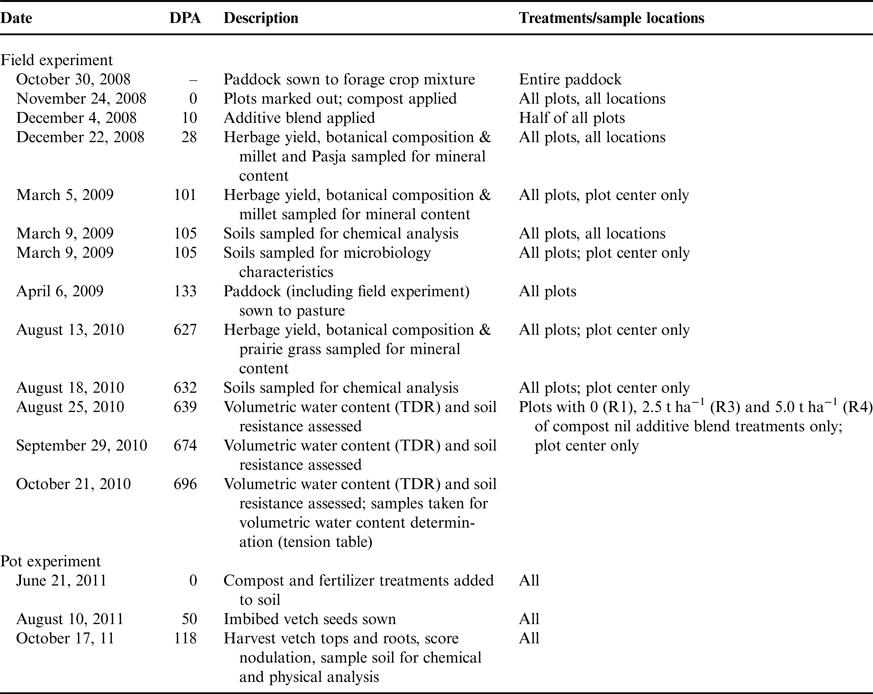
A field experiment was established on a commercial dairy farm on a Grey Dermosol (Isbell, Reference Isbell1996), near Euberta, New South Wales (NSW), Australia. There were four compost application rates and two additive blends (plus and minus the addition of extra nutrients) applied to 10 × 10 m plots arranged in a complete randomized design with three replicates. The additive blends were considered an important inclusion by the dairy farmers to augment the effect of compost. A timeline of events during the experimental period is provided in Table 1. The site was grazed in common with the larger paddock by a herd of approximately 260 milking cows as part of the farmer's rotational grazing regime.
Timeline of key events in the field and pot experiments.

DPA, days post compost application.
Compost and additive application
The compost was spread on November 24, 2008 using a commercial belt-driven centrifugal twin disc spreader. One swathe covered the whole width of a plot (10 m) with the spreader driven on the plot centers. Target rates were nil (R1), 0.5 t ha−1 (R2), 2.5 t ha−1 (R3) and 5.0 t ha−1 (R4).
Three trays (300 × 760 mm) were placed in each plot at the plot center (straddled by the spreader), 2 and 4 m away from the center of the plot, respectively, to collect a subsample of compost actually applied and measure the evenness of spread. These locations were retained as sampling locations within each plot to which the actual rate of applied compost was related. Compost collected in trays was dried at 36°C for 48 h and separated into four fractions based on particle size using sieves of 2, 4 and 9 mm aperture (<2 mm, 2–4 mm, 4–9 mm, >9 mm). The samples for all fractions were analyzed for pH, electrical conductivity, organic C concentration and exchangeable cations using the methods described below in the Laboratory analysis section.
The additive blend, comprising muriate of potash at 180 kg ha−1 and ‘SupaTrace’ nutrient solution (Agrichem) at 7 L ha−1, was applied on December 4, 2008. SupaTrace contains the following nutrients (weight/volume): N 3.3%, Fe 1.6%, Zn 1.8%, Mg 1.4%, Mn 1.3%, Cu 0.6%, S 4.8%, B 0.6% and Mo 0.03%. The potash was applied with a direct-drop fertilizer spreader and the nutrient solution through a boom spray.
Soil sampling
Soil was sampled at the 0–0.1 m depth and at three locations within each plot (plot center, +2 m and +4 m, as described in the previous section). At each sampling location, approximately ten cores of soil (0.02 m in diameter) were taken on March 9, 2008, bulked, dried at 40°C, and sieved to <2 mm. A second set of soils was collected on this date for analysis of microbial abundance and composition and comprised ten cores of 0.02 m diameter taken at the 0–0.1 m depth, giving approximately 500 g of fresh soil per sample.
Soil water was assessed using time-domain reflectrometry (TDR) by inserting 0.15 m waveguides into the soil surface (0–0.15 m) 4–6 times at the plot center only. Soil strength was measured using a Rimik CP40 cone penetrometer inserted 3–5 times in the surface 0.45 m of the soil profile at the center of plots in the R1-, R3- and R4-nil additional nutrient treatments. A soil core 0.45 m deep × 0.042 m diameter was removed immediately adjacent to each set of penetrometer insertions and carefully sectioned into 0.05 m intervals to provide sequential estimates of soil bulk density and gravimetric water content of the soil at each sampling. Six additional intact soil cores were taken per plot at the 0–0.05 m depth using 75 mm diameter bulk density coring rings. Cores were trimmed in the laboratory and slowly wet under tension to saturation and thereafter equilibrated at successive tensions of 0.2, 0.5 and 1.0 m. After equilibrating at each tension, cores were removed from the tension table and weighed and then returned for equilibration at successively higher tensions. After the final equilibration soils were oven dried at 105°C to determine soil bulk density and gravimetric water content.
Wet aggregate stability was measured with a composite soil sample from five soil cores using a 70 mm diameter steel coring tube, sectioned in the field to 0–0.05 and 0.05–0.10 m depths, from each plot at the plot center. Samples were handled carefully to avoid crushing and then dried at 40°C to constant weight before being gently passed through a 6.3 mm sieve and coned and quartered to make representative 20 g subsamples for wet sieving. Water-stable aggregation was determined by a wet-sieving procedure modified from Yoder (Reference Yoder1936) in which soils were wet sieved for 10 min (32 mm stroke length and 30 strokes min−1) using nested sieves of 2 and 0.25 mm apertures within 2 L buckets of distilled water at room temperature. After wet sieving, the material not retained on sieves was brought into uniform suspension and the fraction <0.05 mm was determined using a pipette-sampling technique following Stokes’ law.
Herbage yield and botanical composition
The whole paddock was initially sown on October 30, 2008 to a summer crop with a mix of Shirohie millet [Echinochloa esculenta (A. Braun) H. Scholz; 30 kg ha−1] and Pasja leafy turnip (Brassica hybrid; PGG Wrightson Seeds; 2.5 kg ha−1). The paddock was re-sown on April 6, 2009 to a pasture mixture comprising kikuyu (Pennisetum clandestinum Hochst ex Chiov.), Persian clover (Trifolium resupinatum L.), white clover (T. repens L.), red clover (T. pratense L.), prairie grass (Bromus uniloides Kunth) and Italian ryegrass (Lolium multiflorum Lam.).
Herbage yield and botanical composition were assessed twice for the first summer crop on December 22, 2008 and March 5, 2009 and once for the pasture on August 13, 2010. Herbage yield of the summer forage crops was measured by taking quadrat cuts (0.4 × 0.5 m) at three locations (plot center, +2 m and +4 m) in each plot and separating into component species after drying at 60°C. The millet and Pasja components of the samples were retained for mineral composition analysis. Pasture herbage yield was assessed visually, calibrated with quadrat cuts (r 2 = 0.72) and botanical composition was estimated using the dry-weight rank method (‘t Mannetje and Haydock, Reference ‘t Mannetje and Haydock1963). Grab samples of prairie grass were taken by randomly cutting ~20 individual plants per plot from the plot center only, just above the soil surface, and drying at 60°C for 72 h before analysis for herbage mineral composition.
Laboratory analysis
Chemical characteristics of soil dried at 40°C and sieved to <2 mm were determined as follows: pH in a 1:5 soil:0.01 M CaCl2 solution (pHCa); pH (pHwater) and electrical conductivity in a 1:5 soil:distilled water solution; organic C concentration (Walkley and Black Reference Walkley and Black1934); total C and N by LECO combustion; available phosphorus (Colwell Reference Colwell1963); exchangeable cations, determined by extraction using a 1:10 soil:0.1 M BaCl2/0.1 M NH4Cl solution (Gillman and Sumpter, Reference Gillman and Sumpter1986).
Soil particle size distribution was determined by the hydrometer method following Gee and Bauder (Reference Gee, Bauder and Klute1986). Briefly, soils <2 mm were reacted with hydrogen peroxide to remove organic material before being dispersed with a combination of chemical (sodium hexametaphosphate) and physical (puddling) techniques. After bringing the soils into suspension within mixing cylinders, hydrometer measurements were taken at prescribed times with graphical interpretation used to provide estimates of clay and silt fractions. Sand was collected and weighed after removing the silt and clay fractions.
Soil microbial abundance and composition was examined visually under a microscope by the Soil Foodweb Institute Pty Ltd (Bentley, NSW, Australia) for the relative abundance of active and total bacterial and fungal biomass, as well as hyphal diameter.
Herbage mineral composition was analyzed using acid digestion and radial view inductively coupled plasma-optical emission spectrometry (ICP-OES).
Plant available water (PAW) was calculated based on laboratory estimates of permanent wilting point using pre-wet soils equilibrated on ceramic plates at 15 bar pressure and then oven dried to constant mass at 105°C (Klute, Reference Klute and Klute1986).
Pot experiment
Experimental design
The experiment was conducted in a glasshouse with 25/16°C day/night temperatures. There were three soils and nine soil amendments in a factorial design, replicated four times. The soils (0–0.15 m depth) were collected from Wagga Wagga (hereafter Wagga; Red Kandosol), Euberta (Grey Dermosol) and Binnaway (Red Kandosol) (Isbell, Reference Isbell1996), NSW, Australia. All soils were dried at 40°C for 48 h and sieved to <5 mm. The Binnaway soil was an acidic sandy loam (Marshall, Reference Marshall1947) with a low effective cation exchange capacity (ECEC) and levels of exchangeable Al (18%) likely to be toxic to plant growth. Soil from the Binnaway location has been used often for pot experiments testing plant response to acidic soils (e.g. Guo et al., Reference Guo, Li, Hayes, Dear and Price2012). The Euberta soil was collected from a nil compost/nil additive blend plot in the above field experiment. It was characterized by a loam texture, a high ECEC, high levels of total C and total N and a high Colwell P value relative to the other two soils. The Wagga soil was a clay loam with a high Ca:Mg ratio, high levels of exchangeable K and was comparatively low in total C.
The soil amendments consisted of four compost rates (0, 0.8, 3.8 and 15.4 g compost kg−1 soil, equivalent to 0, 1, 5 and 20 t ha−1 of soil amendments), tested with and without the addition of an ‘additive blend’, deemed by a local supplier (Ylad Living Soils, Young, NSW, Australia) to complement the compost. The compositions of the additive blends differed for each soil on the basis of initial soil tests. The Wagga soil received sulfate of ammonia (80 kg ha−1), lime (250 kg ha−1), gypsum (150 kg ha−1), magnesite (150 kg ha−1), boron humate, zinc and copper (5 kg ha−1 each). The Binnaway soil received the same additives as the Wagga soil, but lime increased to 500 kg ha−1. In addition, the Binnaway soil received 80 kg P ha−1 as rock phosphate. The Euberta soil received lime (500 kg ha−1), gypsum (500 kg ha−1), boron, humate and zinc (5 kg ha−1 each). A conventional fertilizer treatment was included as an additional control. The fertilizer treatment was devised by the present authors based on current ‘best practice’ using only conventional fertilizers and ameliorants and for all three soils included 10 kg P ha−1 as Mo superphosphate. In addition, the Binnaway soil received 1 t ha−1 of lime (CaCO3) and 10 kg N ha−1 as urea. Rates were converted to masses using bulk density values calculated for each soil.
Pot preparation and harvest
Compost and fertilizer treatments were thoroughly mixed with 2.1 kg of air-dried soil from Wagga and Binnaway and 1.75 kg of the Euberta soil before the soil/amendment mixture was added to plastic-lined 1.8 L pots on June 21, 2011. All pots were watered to and maintained at ~80% field capacity with deionized water for 7 weeks prior to sowing under glasshouse conditions.
Six imbibed forage vetch (cv. Morava) seeds were sown on August 10, 2011 into each pot and thinned to three plants per pot after emergence. Pots were maintained at ~80% field capacity after emergence by watering to weight every second day for the duration of the experiment.
Immediately prior to the plant harvest two soil samples were taken from each pot. The first soil sample was a composite of two cores of 20 mm diameter taken to full pot depth, dried at 40°C, sieved to <2 mm and analyzed for soil pHCa, ECEC, total N, total C and available P, as described previously for the field experiment. The second soil sample, an intact soil core of 50 mm diameter and 50 mm length, was taken from each pot using a bulk density coring ring. The core and ring assemblies were trimmed and transferred to a tension table where they were slowly tension wet and then sequentially equilibrated at 0.50, 1.00 and 1.33 m using a suspended water column. Soil weights at these tensions were then used to establish relationships between soil water potential and soil water content. Pots were harvested by washing roots free from soil. Distribution and numbers of nodules were visually assessed using a 0–5 scoring system (Corbin et al., Reference Corbin, Brockwell and Gault1977) before roots were separated from tops and dried at 70°C for 48 h and weighed. Plant tops were ground with a laboratory mill and analyzed for mineral composition, as described previously.
Statistical analysis
Field experiment
A two-way analysis of variance was undertaken to test the effect of compost and additive blend on plant and soil parameters sampled in the field. For the later soil data where sampling was confined only to the plot center of nil additive blend treatments, a one-way analysis of variance was conducted with ‘compost target application rate’ as the treatment. Data collected from different locations within a plot (plot center, + 2 m and + 4 m) were analyzed separately for the latter ANOVA analyses. There was also no statistical comparison of field data collected at different times during the experimental period. Regression analysis was undertaken for available biomass, botanical composition, herbage mineral composition, soil chemistry and soil biology data collected in the field experiment, with actual compost applied used as the independent variable. The regression analysis enabled all sampling locations within a plot to be combined within the one analysis.
Pot experiment
Variables measured in the pot experiment were analyzed with a linear mixed model analysis using Genstat Release 13.2 (VSN International, Ltd) testing ‘soil’, ‘compost rate’, ‘additive blends’ and all two- and three-way interactions as fixed effects, and replicate as a random effect. Additional analyses of variance was also undertaken for each soil type independently using a combination of all compost rates and additive blends as main effects enabling treatment means to be compared side-by-side. Data are reported at the 5% significance level.
Results
Field experiment
Distribution of compost application
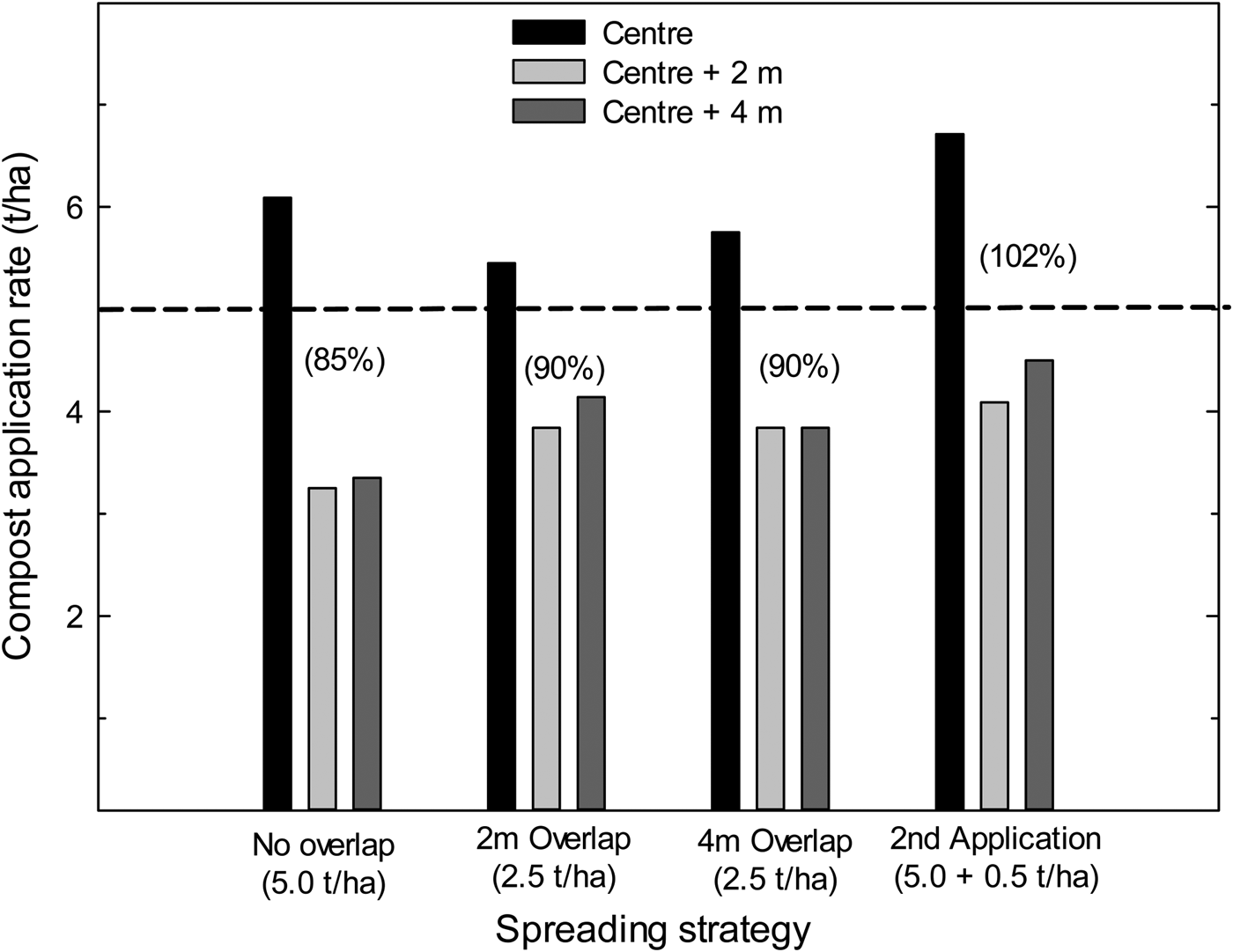
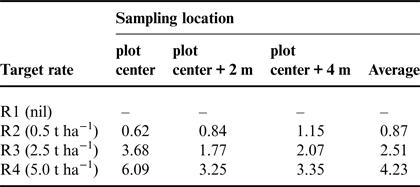
The quantities of compost actually applied to the treatments using the commercial spreader are presented in Table 2. The total quantity of product delivered at the plot center was almost double the quantity applied at the +2 m and +4 m sampling locations, except at the low rate (R2). Using these observed values, a series of calculations were undertaken to determine more effective strategies to deliver the target application rate with reduced spatial variability than was achieved with the current approach. The coefficient of variation (CV) in the quantity of compost applied to the high rate (R4) was 38%, but was almost halved to 19% by overlapping by 2 m between spreading swathes when delivering 2.5 t ha−1 (Fig. 1). Overlapping by 4 m at a 2.5 t ha−1 target rate delivered the same total quantity but with a CV of 25% in the spatial distribution. The strategy that delivered the total quantity closest to the target rate was two separate applications of compost set at 5.0 and 0.5 t ha−1, giving a CV in the spread of 28%.
Potential strategies to achieve a more even application of compost across the spreading width using a target rate of 5.0 t ha−1 compost (dashed line). Values in brackets are the calculated total quantities applied over the spreading width, expressed as a percentage of the target.

Average quantity of compost (t ha−1; air-dried) applied at each of three sampling locations (plot center, +2 and +4 m from plot center) within plots where compost was applied at one of four target application rates (R1–R4).

The distribution of different physical fractions of the compost varied with compost rates. The <2 mm fraction of the compost product increased as a proportion of total mass of compost applied in the higher compost application rates (R3 and R4) compared with the low rate (R2). The R2 treatment tended to comprise a greater proportion of particles >9 mm, although differences were not always significant at P = 0.05, due to large error terms (data not shown). The chemical composition of the compost was consistent among different sized particles with gravimetric moisture content 0.328 g g−1 (oven-dried) and 0.181 g g−1 (air-dried), pHCa 6.9, electrical conductivity 3.5 dS m−1, organic C 8.5 g/100 g, Ca:Mg ratio 1.3, ECEC 30.1 cmol(+) kg−1, comprising Ca 39.1%, Mg 29.5%, K 27.9% and Na 3.6%.
Summer crop production and soil properties
In general, there were no treatment effects on total available biomass and botanical composition throughout the sampling period. The average cumulative above-ground biomass was 10.2 t ha−1 with 50% being weeds for the first summer (Dec 2008–Mar 2009). However, there was some evidence that millet responded positively to compost and the additive blend. For example, in December 2008 at the +4 m sampling location, there was a small but significant increase in the percentage of millet in above-ground biomass from 26.8% in the nil compost treatment up to 39.0% at the highest compost application rate (P < 0.05). This was reflected in an increase in millet biomass from 1.1 to 1.6 t ha−1 with compost rate at that time (P < 0.01). This effect was not observed at the other sampling locations at this time. There was no cumulative biomass response in millet to the additive blend, although occasionally at certain sampling times at particular sampling locations, significant effects of the additive blend were observed. For example, at only the +4 m sampling location in December 2008, a 30% increase in millet yield was observed between the nil (1.05) and plus additive blend treatments (1.36 t ha−1), but no effect was observed at the other sampling locations at this time (P > 0.05). Neither Pasja nor background weeds responded to compost nor additive blend, in terms of total biomass, in the first summer growing season.
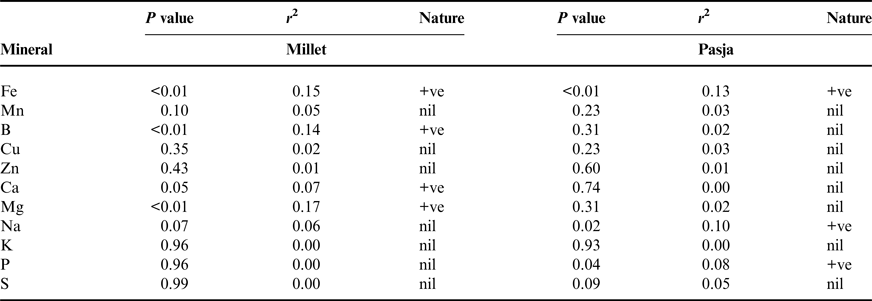
There were few consistent significant effects of compost on herbage nutrient composition. Iron was the only mineral to increase in concentration in both Pasja and millet with increasing compost application rates (Table 3). The additive blend consistently increased Cu concentrations from 4.5 to 5.9 mg kg−1, K from 33.6 to 40.7 g kg−1 and reduced B concentrations from 44.2 to 40.2 mg kg−1 in the millet at all sampling locations. Potassium concentrations also increased from 20.3 to 28.7 g kg−1 in Pasja herbage, while Na concentrations declined from 12.4 to 9.9 g kg−1 due to the additive blends. All other effects of the additive blend on mineral composition of both species were either not significant (P > 0.05) or were not consistent across the sampling locations.
Summary of the significance (P value), coefficient of determination (r 2) and nature (positive [+ve], negative [−ve] or nil) of the relationship between nutrient concentration of millet and pasja herbage and compost addition, sampled in December 2008 (n = 55).

There was no significant effect of compost treatment on soil biological parameters, sampled in March 2009, 105 days after compost was applied. Average values across all treatments were as follows: total bacterial biomass (725 µg g−1), actinobacteria biomass (4.5 µg g−1), active fungal biomass (16.2 µg g−1), total fungal biomass (246 µg g−1) and hyphal diameter (2.74 µm). There were no significant correlations between any soil biological parameter measured and the actual quantity of compost applied to plots. The additive blend reduced active bacterial biomass from 27.3 to 23.3 µg g−1 (P < 0.05). There was no correlation between soil microbiology and herbage mineral composition of millet in March 2009.
The additive blend increased the exchangeable K content of the soil from 0.23 to 0.30 cmol(+) kg−1 and led to a reduction in exchangeable Na from 0.15 to 0.13 cmol(+) kg−1 at the the plot centers (P = 0.05), but this effect was not observed at the other two sampling locations within a plot. There was no other effect of the additive blend on the soil chemical parameters measured.
There were few significant effects of compost on soil chemical parameters. At the plot center levels of exchangeable K increased from 0.24 to 0.33 cmol(+) kg−1 in the R4 treatment compared with the nil control (P < 0.05), but this effect was not observed at the other sampling locations. Exchangeable Ca increased from 5.92 to 6.58 cmol(+) kg−1 (P < 0.05) and the Ca:Mg ratio increased from 2.59 to 2.78 between the R1 and R4 treatments (P < 0.05), but the effect was only observed at the +4 m sampling location. Compost application had no effect on levels of exchangeable Na [mean 0.14 cmol(+) kg−1], electrical conductivity (0.16 dS m−1), total soluble salts (0.05%), organic C (2.67/100 g) or organic matter (4.95/100 g) or pH in water (5.78).
Perennial pasture production and soil properties
No significant effect of compost or additive blend was observed in above-ground biomass (average 3.9 t ha−1) or in pasture botanical composition sampled in August 2010, 627 days post compost application (DPA) (P > 0.05). There were few significant effects of treatment on the herbage nutrient content of the prairie grass sampled at this time. The Na concentration declined from 5266 to 4412 mg kg−1 with the additive blend (P = 0.05). Although the K concentration was numerically higher with the additive blend, differences were not statistically significant (P = 0.078). There were no significant effects of compost on herbage nutrient composition of prairie grass 627 DPA.
There was no effect of compost or additive blend on Colwell P (average 105 mg kg−1), exchangeable Al [0.02 cmol(+) kg−1] or exchangeable Mn [0.08 cmol(+) kg−1] in soil at the 0–0.10 m depth sampled in August 2010 from the center of the plots. Plots that had received compost 2 years prior were shown to have an increased ECEC compared with the nil control, explained by increases in exchangeable Na, Ca, and Mg. These differences were observed in all R2–R4 treatments, compared to the nil control. Total C was greater in the soil surface in the R2 and R3 treatments compared with the control, but differences between the control and R4 treatment were not significant at P = 0.05. The only significant (P < 0.05) effects of the additive blend applied almost 2 years prior was an increase in exchangeable K from 0.25 to 0.33 cmol(+) kg−1, and an increase in electrical conductivity from 77.6 to 84.9 µS cm−1.
There was no effect of compost on the wet aggregate stability of the soil, sampled at the 0–0.05 m depth in August 2010. Averaged across compost treatments, 39% of soil mass remained in aggregates > 2 mm following wet sieving while 26% was in aggregates between 250 µm and 2 mm and 11% of aggregates were <50 µm. Water-holding capacity of intact cores at 0.2, 0.5 and 1.0 m tension increased numerically as compost application rate increased, but differences were not significant (P > 0.05). For example, at 1.0 m tension the gravimetric water content averaged across three replicates was 30.7, 31.3 and 32.7% in the R1–R4 treatments, respectively. There was no significant difference in bulk density of intact cores between treatments.
Gravimetric water content in the field was significantly higher in the surface 0.45 m where compost was applied (Table 4) at all three sampling times. Calculations using gravimetric water content at 0.05 m depth increments, bulk density values from each soil core and laboratory estimates of permanent wilting point indicate that the maximum difference in PAW in the surface 0.45 m was on the final sampling date (696 DPA) where 22.4 mm more water was observed under the R4 compost treatment (Table 4). On the two preceding measurement dates differences in PAW between treatment means were <10 mm with composted treatments more moist in both instances. There was a significant compost × depth interaction (P < 0.05) in gravimetric water content at only one sampling time (639 DPA). The water content was greater in the intermediate R3 compost treatment compared with the nil control in the surface 0.15 m (data not shown). In the surface 0.05 m, there was a significantly greater gravimetric water content (0.42) in the intermediate R3 treatment compared with the highest compost rate, R4 (0.34). Summed over the surface 0.15 m, the maximum difference in soil water between the nil (48.8 mm) and the R3 compost treatment (55.4 mm) was 6.6 mm.
Average gravimetric water content and calculated plant available water (mm) in the surface 0.45 m at different sampling dates in 2010 (sampled at plot center only).

DPA, days post compost application.
Means with same letter in column are not significant at P < 0.05.
The average physical resistance of soil in the 0–0.45 m zone at 696 DPA was higher in the nil compost treatment (2347 kPa) compared with the R3 (2035 kPa) and R4 (1902 kPa) treatments (l.s.d.0.05 = 235.2). The correlation between gravimetric moisture content and physical resistance of soil was negative on that date (r 2 = 0.38; P < 0.001). There was no significant difference in average physical resistance in the surface 0.45 m of the profile at the remaining two sampling dates. Examining the relationship between soil strength and soil moisture in 0.05 m soil depth increments failed to establish significant differences between compost treatments.
Pot experiment
A highly significant effect of soil type was observed for almost all soil and plant parameters measured in the pot experiment. Many significant compost and additive blend main effects were also observed for a range of parameters, but there were very few significant compost × additive blend or three-way interactions (Table 5). The Euberta soil (Grey Dermosol) was generally a more fertile soil with a higher water-holding capacity, particularly compared with the sandy Red Kandosol soil from Binnaway (Table 6).
Significance levels for all soil, compost (CPT) and additive blend (AB) main effects and their two- and three-way interactions on soil and plant parameters measured in the pot experiment.

ns, not significant; TCEC, total cation exchange capacity; θv, volumetric water content.
* P ≤ 0.05; ** P<0.01; *** P < 0.001.
Main effect of soil type on soil chemical and physical properties in the pot experiment, sampled 118 days after application of amendments to soil.

ECEC, effective cation exchange capacity.
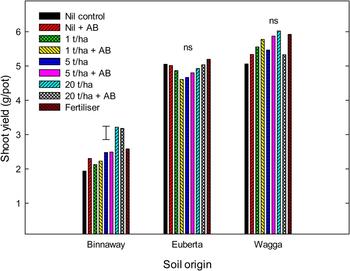
There was a significant (P < 0.05) soil × soil amendment interaction in shoot dry matter (DM) (Fig. 2). The only yield response was obtained where compost was applied to the Binnaway soil. There was no significant yield response to compost in either the Wagga or Euberta soils. Root DM was not significantly different (P > 0.05) between compost treatments and the nil control (mean 1.54 g), but root mass in the Wagga soil (1.37 g) was less (P < 0.05) than in either the Binnaway (1.60 g) or Euberta (1.64 g) soils.
Difference in shoot yield of vetch grown in pots containing one of three different soils with compost applied at the equivalent of nil, 1, 5 and 20 t ha−1, with and without the addition of an additive blend (AB), and a best practice fertilizer treatment. Error bar indicates significant treatment effects (P = 0.05); ns, differences not significant (P > 0.05).

The most common nodulation score was generally higher in the Wagga soil (4.0) than in the other two soils (2.5). In all soils, the nodulation scores were largely unresponsive to any soil amendments. It was observed that a large number (>10) of nodules were at the crown, but few (<10) elsewhere on the root system in the Wagga soil. For the Euberta and Binnaway soils, there were very few (<10) nodules near the crown and elsewhere on the root system.
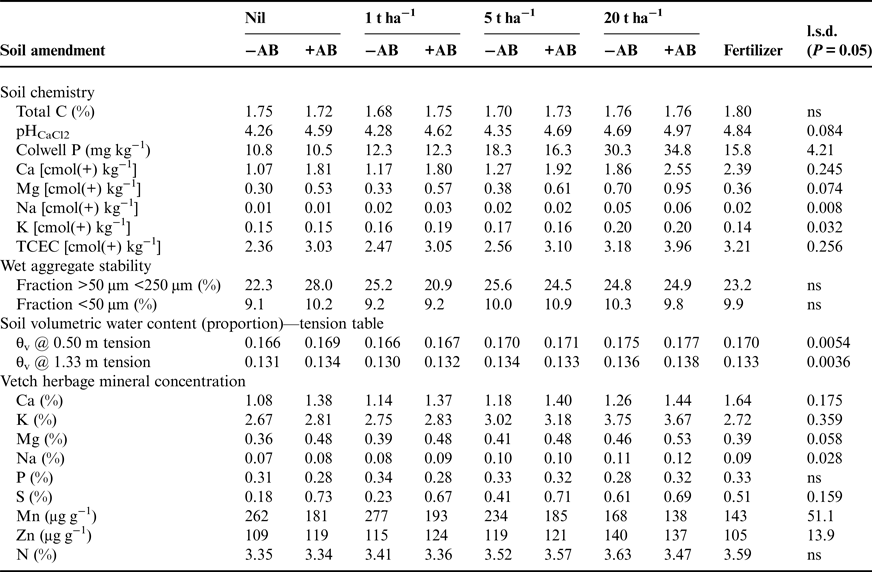
The effects of soil amendment on key soil chemical and physical characteristics as well as on herbage mineral concentration of the vetch are presented in Tables 7–9. There was no significant treatment effect either on soil total N concentration, the percentage of soil aggregates >250 µm, or on the B, Cd, Cu, Fe or Ni concentrations of the vetch herbage, regardless of soil type. For the sandy and acidic Binnaway soil, pH increased with the addition of soil amendments compared with the nil control. Small but significant increases in soil water-holding capacity were also observed in the Binnaway soil relative to the nil control (Table 7). The Euberta soil was the only soil in which small but significant increases in total soil C were observed relative to the nil control (Table 8), whereas the Wagga soil was the only soil on which significant treatment differences were observed in the proportion of fine (<250 µm) soil aggregates, although effects seemed random and not consistent with rates of soil amendments applied (Table 9). The potassium concentration in the Wagga soil was substantially higher than in the other soil types, and this was also reflected in the K concentration of the vetch herbage.
Effects of soil amendment [compost (t ha−1) with and without an additive blend (AB) compared with a fertilizer control] on soil chemical and physical properties and on vetch herbage mineral concentration in the pot experiment on the Binnaway soil, sampled 118 days after application of amendments to soil.

TCEC, total cation exchange capacity; ns, not significant.
Effects of soil amendment [compost (t ha−1) with and without an additive blend (AB) compared to a fertilizer control] on soil chemical and physical properties and on vetch herbage mineral concentration in the pot experiment on the Euberta soil, sampled 118 days after application of amendments to soil.

ns, not significant.
Effects of soil amendment [compost (t ha−1) with and without an additive blend (AB) compared to a fertilizer control] on soil chemical and physical properties and on vetch herbage mineral concentration in the pot experiment on the Wagga Wagga soil, sampled 118 days after application of amendments to soil.

ns, not significant.
Discussion
Crop yield responses to compost
There was little evidence in the current study of increased crop yields due to compost or additive blends. However, there was some evidence of increased millet yields with compost in the field experiment, but this was not consistent across sampling times. Later during the field experiment there was no evidence of increased pasture biomass or changed pasture composition due to treatments. By contrast, significant increases in shoot growth due to compost were observed in the pot experiment, but these were generally associated with the highest application rate (20 t ha−1) and only on the lower fertility soil. The conventional fertilizer treatment gave consistently similar yields to most compost treatments.
Effects of compost on the mineral composition of millet and Pasja were inconsistent in the field experiment (Table 3). Later during the field experiment there was no effect of compost on the mineral composition of Prairie grass. However, compost had significant effects on some minerals in the vetch herbage in the pot experiment and this contrast with the results observed in the field experiment is discussed further below.
There are several factors that likely contributed to the small response observed in plant growth due to compost. First, in the field a large weed burden likely masked yield responses, particularly associated with millet production. Regression analysis showed that compost explained <10% of the increase in millet biomass, indicating a large level of in-field variability associated with other factors. Millet only comprised ~30% of total biomass, with ~50% of total biomass comprised by weed species. Naturalized weed species in this environment are unlikely to be as responsive to improved soil nutrition as forage crop species, and are unlikely to be as sensitive to periodic moisture deficit. Clearly, managing weeds is an important step for dairy farmers in order to realize a financial return from the application of compost.
Secondly, the surface broadcast of compost after the crop was sown limited plant response, which likely explains the contrast between the pot and field experiments in terms of the change in plant mineral composition due to compost. In the field experiment, the compost lay on the soil surface over summer, so any early response to compost was likely reliant upon nutrients leaching from the compost into the root zone. By contrast, a ‘fertilizer’ effect of compost was more likely to have been observed in the pot experiment because the compost was fully mixed with the soil in the pot. More research is required to examine the level of incorporation required to optimize crop responses to compost, but at the very least it would seem appropriate that farmers wishing to apply compost to crops should do so prior to sowing to enhance the capacity for crop roots to interact with the compost.
Thirdly, at low application rates additions of nutrients were perhaps too small to promote plant growth (Edmeades, Reference Edmeades2002). For example, the compost we used with 0.75% total (LECO) N applied at 1 t ha−1 only provided 7.5 kg ha−1 of N in total, much of which is likely to have been in forms initially unavailable to the plant (Billingham, Reference Billingham2012). The additive blend in the field experiment only provided an additional 0.2 kg N ha−1, so there was relatively little N ‘fertilizer’ benefit of the treatments in the field contributing to the low plant response. In the pot experiment, more N was applied with the additive blends with the fertilizer treatment receiving 4.8 kg N ha−1 as urea, and the compost treatments on the two Kandosol soils from Wagga and Binnaway receiving 16.8 kg N ha−1 as sulfate of ammonia.
Finally, in-field variability is a natural occurrence in paddock situations and can mask treatment effects, particularly where rates of application are low. Even across a seemingly homogenous paddock, such as the field experiment where there was no visible spatial differences and where the placement of replicates further reduced spatial differences, spatial variability still existed. Soil is an inherently heterogeneous environment known to vary in a range of characteristics at quite small spatial scales. Previous studies have documented natural spatial variability in characteristics such as pH (Conyers and Davey, Reference Conyers and Davey1990) and soil organic C (Hayes et al., Reference Hayes, Conyers, Poile, Oates, Li, Dove and Culvenor2010a), and variability in soil physical characteristics can also be anticipated, particularly in a landscape that is regularly grazed by a large herd of dairy cattle (Houlbrooke and Laurenson, Reference Houlbrooke and Laurenson2013).
It is therefore perhaps not surprising that the application of low rates of compost onto an inherently heterogeneous soil environment led to few consistent plant response. In the pot experiment, we were able to limit the variability associated with the soil environment by homogenizing the soil prior to experimentation. In a paddock situation, we might expect to increase the crop response to compost by incorporation prior to sowing, or by applying higher rates of compost to reduce the masking effect of soil heterogeneity. Further research is required to explore these issues as neither approach may be practical for farmers. For example, there are considerable cost constraints associated with applying high rates of compost to large areas of land, and cultivation, which is considered to reduce levels of soil organic matter (Lal et al., Reference Lal, Reicosky and Hanson2007), might simply serve to undermine the benefits that a farmer is hoping to achieve by applying compost.
Improvement of soil health
The current study provides evidence that applications of low rates of composted dairy waste can convey benefits, most notably to the physical condition of the soil. An improvement in soil physical condition may be expected with the addition of organic amendments due to increases in soil organic C and biological activity (Haynes and Naidu, Reference Haynes and Naidu1998). These improvements to soil structure and hence porosity may appear as enhanced aeration, increased water-holding capacity, and improved infiltration of water into and drainage through the soil profile. Note that for an improvement in soil structure the direction of these fluxes are both positive and negative. Measurement of soil water may record higher values resulting from higher water-holding capacity and improved water infiltration to the measurement depth or lower values as a consequence of enhanced drainage below the depth measured. Changes in soil water measurements taken through time will therefore inevitably represent the sum of fluxes both positive and negative between sampling times, without necessarily being able to differentiate between the two.
The intact surface cores taken from the field experiment demonstrated small, but significant improvements in water content at field capacity while maintaining air-filled porosity well above the 10% level deemed to be limiting. In addition, we calculated more plant available water to 0.45 m soil depth under composted soils on all three dates measured; with the final sampling date in late October recording 18.1 and 22.4 mm extra PAW on the 2.5 and 5 t ha−1 compost treatments, respectively, compared with the nil control. This is significant given the negative effects on soil structure the grazing dairy herd may have had during the intervening period between samplings (Houlbrooke and Laurenson, Reference Houlbrooke and Laurenson2013). Additional water in the soil profile in spring represents more water available to sustain rapid forage growth and for irrigators, this gives more flexibility (additional time) to schedule the next irrigation, important benefits in either case. The increase in soil water content may be attributed to increased water-holding capacity of the soil due to compost; however, the magnitude of the difference in PAW over 0.45 m is much greater than would be expected if that were the primary cause. We think it much more likely that improved surface soil infiltration under compost has contributed to significantly higher PAW to depth in the soil profile.
The increase in volumetric water content in the pot experiment in the sandy Binnaway Kandosol soil was as much attributable to the additive blend as to the compost, most likely a result of lime being a key ingredient in the additive blend and fertilizer treatments. Lime is known to impact soil water-holding capacity (Roper, Reference Roper2005; Hayes et al., Reference Hayes, Li, Dear, Conyers, Virgona, Dove and Culvenor2010b), most likely due to changes in soil physical properties that result in reduced dispersion and slaking where lime is applied (Chan et al., Reference Chan, Conyers and Scott2007). The effect of compost on soil water-holding capacity may have become evident over a longer period of time.
The impact of improved soil physical condition was scarcely reflected in increased available biomass within the timeframe of this study. This presents farmers a substantial challenge in adopting compost application within a commercial operation as there appears to be little return on investment in the short term, while benefits over a longer timeframe remain poorly defined. The inability to detect improvements in soil aggregate stability in the field experiment raises concerns about whether a farmer will be able to reliably realize benefits of compost applied at low rates in a paddock situation.
The pot experiment demonstrated that the plant response to compost varied greatly depending on soil types. For example, the least responsive soil was the Grey Dermosol, which was taken from the field experimental site at Euberta. This soil was highly fertile with higher total C concentration, higher effective cation exchange capacity and a lower bulk density compared with the other two soils studied. This undoubtedly reflects the fact that it originates from a commercial dairy farm, which are often located on more fertile parts of the landscape and which typically have a history of higher fertilizer inputs (Gourley et al., Reference Gourley, Dougherty, Weaver, Aarons, Awty, Gibson, Hannah, Smith and Peverill2012b). In view of our results, farmers wishing to utilize composted dairy waste may achieve better plant responses by targeting lower fertility areas of the farm, which may be located further from the milking facility (Gourley et al., Reference Gourley, Aarons and Powell2012a).
Variable distribution of compost
In a broadacre context, the ability of a farmer to spread a soil amendment evenly using commercial machinery is central to its feasibility on a large scale (Horrell et al., Reference Horrell, Metherell, Ford and Doscher1999). Although the commercial spreader was able to deliver approximately the right quantity of total compost to the various treatments in the current study, almost double the quantity landed in the region directly behind the spreader compared with toward the edge of the spreading swathe, particularly in the R3 and R4 (2.5 and 5.0 t ha−1) treatments. This is not surprising given that the spreading mechanism which aims to spread at a 10 m width relies on two rotating discs that are located only 1–2 m apart. A concentration in product delivery in the region between the two discs (that is, at the center of the spreading width) might have been anticipated (Lawrence and Yule, Reference Lawrence and Yule2007).
Results from the current study confirmed that the commercial spreader was less successful in accurately delivering the very low target rate (0.5 t ha−1) of compost to plots drawing into question the practicality of applying such low rates with commercial spreading machinery. Reducing the quantity of compost delivered by the spreader, but increasing the overlap between spreader swathes by 2 m was calculated to deliver 90% of the 5.0 t ha−1 target application rate while reducing the variability in the spatial distribution of the compost compared to no overlap between swathes. Farmers would need to weigh up these benefits against a ~20% increase in spreading costs.
Conclusion
Despite demonstrated improvements in soil health, particularly in the physical condition of soil, few significant increases in forage biomass were observed with the application of low rates of compost. This presents a challenge for commercial farmers looking for a return on their investment in applying compost as an amendment to soil. It also presents a challenge for dairy farmers considering composting their own dairy waste on farm. The composting process is reasonably intensive requiring regular turning and monitoring over a 2–3 month period, and may require the purchase of additional machinery. The increased costs in labor, machinery and inputs, such as fuel to drive the machinery, become difficult to justify if consistent increases in forage production cannot be demonstrated. Farmers might increase the response to compost by: (i) increasing compost application rates; (ii) applying it prior to sowing a crop; (iii) incorporating the compost with the soil; (iv) applying to responsive soil types, (v) growing responsive species following the application of compost; and (vi) reducing weed burdens in crops following application. Continued monitoring of plant response following application is necessary to ensure that the benefits of applying compost in a particular situation outweigh the costs. To achieve more immediate increases in available forage, applications of additive treatments such as lime or fertilizers may be required, particularly where a known deficiency exists. The present study observed few significant compost × additive blend interactions indicating that responses to these products are independent and there may be little benefit in using them together. Spatial variability in the delivery of compost using the commercial spreader with a centrifugal twin disc mechanism could be reduced but not eliminated by increased overlapping, but might represent a 20% increase in spreading costs.
Acknowledgements
The authors gratefully acknowledge the support of Mr Ken Sanderson and the Inland Elite Dairy Network for this research. These experiments would not have been possible without the support of Simone and Neil Jolliffe, Wagga Wagga, and we are grateful for the cooperation of Ylad Living Soils, Young, NSW, Australia. Financial support for this research was provided by the NSW Department of Primary Industries, Landcare Australia and the Murrumbidgee Catchment Management Authority. We are grateful for the thoughtful comments of three anonymous referees.